© 2017, IRJET | Impact Factor value: 5.181 | ISO 9001:2008 Certified Journal | Page 1499
Applying DRM to Graph Based Image Classification
Anuradha Karlekar
Department of Computer Science, Siddhivinayak College of Higher Edu. & Research, RTU, India
---***---Abstract:
Representing data in the form ofgraphisanimportantresearchareaduetothecapability graph
structuretomodeltherealworlddataandthecomplexrelations amongthem. Wearepresenting here a powerful graph based
image representing technique for image
classification. Fromthemanyapproachesforimageclassificat ion,graphbasedapproachisgainingpopularityduetoitsabil ityinreflectingglobalimageproperties. Inthisreport,VEAM (VertexandEdgeApproximategraphMiner)algorithmis used forminingfrequentconnectedsubgraphs .Slightvariationsof thedata,keepingthetopologyofthegraphs,areallowed.In this report we have proposed graph-based image representation by using dynamic Region merging (DRM) technique. DRM is used with watershed segmentation.
Key Words
:
Graph Based Image Representation,
Dynamic Region Merging, Frequent Approximate
Subgraph, Graph Clustering, Image Segmentation,
VEAM, Watershed.
1.
INTRODUCTION
In many innovative fields, hierarchical data structures, specifically graphs, are mainly used to store and process realistic data due to their ability to model complex relationships. Also, a vast amount of graph theories has been developed in order to work with graphs and process the information they represent. We intend to explore and combine two research fields where graphs are involved, in order to exploit both their advantages.
The first, image classification field is related to Computer Visualization. Our intension is to categorize images using a graph-based representation. The important factor for image classification is to extract low-level features, but it has been found that low-level information by itself cannot provide the high-level insight clues that exist in human minds to describe objects or images in general (semantic gap problem). Within the scope of low-level features developed so far, graphs are among the representations that can provide some kind of high-level information implicitly, making them advantageous choice of representation for researchers to find new solutions. One major concern related to this representation is that although graphs are dominant representational tools, they are inflexible or complex to handle, and usually includes algorithms with high computational costs. One of the solutions is to simplify the data structure, but it will lose some of the embedded information.
Now we will consider the other research field that we are trying to discover: Data Mining. Several graph-based approaches and procedures are developed to satisfy the necessity of using huge bulks of data and extract useful
information from these heavy chunks of data [4, 22,].One such techniques include Frequent sub graph discovery [15]. An important obstacle in graph mining tasks is organizing information, such as image, text, and molecular datasets. Although using graph mining for classification purposes has been broadly explored, these approaches may not always produce the optimal results in all applications and there is a necessity to use approximate graph matching for frequent sub graph mining. Frequent approximate sub graph (FAS) mining is an important problem in graph mining, where the mined patterns are detected taking into account such semantic misrepresentations. Thus, such approximate solutions achieve classification results which are different from the other graph mining methods.
As mentioned before, we aim at combining and exploiting both research fields (image classification and frequent approximate sub graph mining) by proposing an image representation that can be used in a classification framework. The new contributions and changes with respect to the previous work are as following:
1. Theimagesare segmentedusingWatershedalgorithm. 2. Theover segmented regions are automatically merged
byDRMtechnique.
3. Fromtheseregionsgraphsandpatternsaregenerated. 4. UsingVEAMalgorithm,thesepatternsaremined
5. ByusingKNNclassifierthesepatternsareclassifiedtogen eratefinalclassifiedimages.
2.
LITERATURE
SURVEY
In this section, we overlook previous works related to graph based image representation and approximate graph mining.
2.1 Graph-based image representation
© 2017, IRJET | Impact Factor value: 5.181 | ISO 9001:2008 Certified Journal | Page 1500
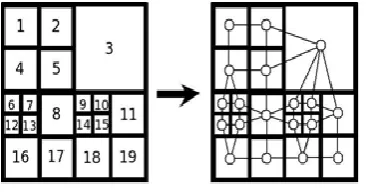
be additional split into four sub-quadrants. The global [image:2.595.308.492.112.208.2]process of the quad-tree consists of dividing the sub-images recursively till the obligatory limit for the amount of divisions is met. An example of quad-tree with four as depth limit of divisions over a picture is showed in figure below. Once the depth limit of divisions is achieved and any sub-quadrant contains many properties to obtain, then the major property during this sub-quadrant is taken as attribute of a tree node. The property taken as an attribute of the nodes in the example of figure below is the color.
Figure 1: Example image with the quadrants of quad-tree identified.
Figure 2: Collection of graph D = fG1; G2; G3g.
After obtaining the quad-tree of an image, we produce a graph to characterize the image with the aim of observing the structural information such as the relations between entities. So, the graph (image) mining can be performed to discover hidden patterns among graph collection. The process of graph generation consists of three steps: 1. The quad-tree leaves (sub-quadrants) with its attributes become the vertices of the graph. The midpoint of the quadrant is the attributes of the leaf nodes of the quad-tree and the major attributes of the image is their labels (i.e. texture, color, etc.).
2. Iteratively for each level from top to bottom of the quad-tree each leaf is visited.
Example 1. Let a quadrant divisions showed in figure 2.1.1 be the quad-tree of an image. We say that the vertex denoted by the number eight and each vertex of the set {5; 7; 9; 13; 14; 17} are connected by an edge.
Figure 3: Example of quadrant divisions of an image
2.2. Background on FAS mining
In this section we provide basic tools for understanding the principles of graph mining techniques and, precisely, how approximation methods work in order to take into account possible data distortions.
2.2.1 Basic concepts:
There are several algorithms for frequent approximate sub graph mining in graph collections which use different similarity functions for graph matching. The approximate sub graph mining can be divided into five kinds according to the matching approach:
1 Based on graph edit distance: The algorithms SUBDUE [14] and RNGV exploring possible edit paths of a graph as required by the candidate. These algorithms do not claim completeness.
2 Based on edge sub-isomorphism: The Monkey algorithm handles only missing edge and edge label mismatch, where the maximum number of edge differences allowed between sub graphs.
3 Based on node/edge disjoint sub-homeomorphism: The CSMiner algorithm discoveries approximate structures that share the similar topology.
4 Based on sub-isomorphism on uncertain graphs: The MUSE algorithm calculates the estimated support of each candidate through a given interval. This algorithm process uncertain graphs as they contain a non-occurrence probability.
5 Based on substitution probabilities: The algorithms gApprox [5] and APGM [17, 18] specifies which vertices, edges or labels can replace others. Thus, the idea that always a vertex label or an edge label can be replaced by any other vertex label or an edge label is defended.
In this paper, we propose a solution based on the approach of the last group, as we are looking for an algorithm which permits some variations in the data through the substitution probability, at the same time retaining the topology of the graphs.
2.2.2 Approximate FAS methods considered:
[image:2.595.57.271.214.310.2]© 2017, IRJET | Impact Factor value: 5.181 | ISO 9001:2008 Certified Journal | Page 1501
label can be replaced by the other, is supported. Therefore,these algorithms specify which vertices, edges or labels can replace others using substitution matrices to perform the frequent sub graph mining task. APGM (Approximate graph miner) solely deals with the variations among vertex labels, whereas VEAM (Vertex and Edge Approximate graph Miner) performs the mining method using the vertex and edge label sets. These approaches use substitution matrices where each cell represents the suitability of approximating one vertex by another vertex (or an edge by another edge) and they provide frameworks for each frequent sub graph mining task.
Here, we propose a replacement algorithm for frequent approximate sub graphs mining referred to as VEAM (Vertex and Edge Approximate graph Miner). This algorithm incorporates in the approximate graph matching all labels that seem in the substitution matrices. Notice that if there are labels that do not seem in any graph of the collection and appear in the matrices, then these labels will be utilized in the mining method, and frequent approximate sub graphs with those labels can be obtained.
VEAM (Vertex and Edge Approximate graph Miner) computes the frequency of the vertices, and starts mining from the frequent ones. At a subsequent step, it adds an edge to an existing pattern, in all possible ways, to make new candidate sub graphs and determine their support value. In this algorithm depth-first search (DFS) is employed to search out candidates by extending each current sub graphs pattern employing a new edge. VEAM (Vertex and Edge Approximate graph Miner) stops when no additional patterns can be extended.
3.
METHODOLOGY
After briefing the basic concepts and details regarding the graph-based image representation and the FAS mining methods used, we can finally describe the overall classification framework as follows:
1. TheimagesareoversegmentedusingWatershedalgorithm 2. Automaticallygrouptheinitiallyover
segmentedmanysmallregionsbyDRMtechnique.
3. Fromtheseregionsgraphsandpatternsaregenerated. 4. UsingVEAMalgorithm,thesepatternsaremined5. Byusin gKNNclassifierthesepatternsareclassified
togeneratefinalclassifiedimages.
In the above framework following tools are combined.
[image:3.595.310.528.125.264.2]3.1. Overall System Design/Architectural
Figure 4. Framework of graph-based image classification The system consists of following modules:
3.2. Combine Approach:
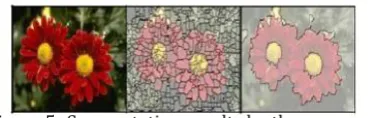
An easy approach to maintain the structural and topological information of an image is to use image representation techniques; for instance, dynamic image merging, etc. By modeling images as graphs, the task of image classification becomes one of classifying graphs. In Fig.5 from left to right, the first column shows the original image. The second column shows the over segmentation produced by watershed algorithm. The third column shows segmentation results exploitation DRM algorithm.
Figure5:Segmentationresultsbytheproposedalgorithm
[image:3.595.315.502.461.520.2]© 2017, IRJET | Impact Factor value: 5.181 | ISO 9001:2008 Certified Journal | Page 1502
defined as pre-processing, second stage as watershedbased image segmentation and last stage as post-processing. Input image is initially processed by the pre-processing stage, and so given to watershed based mostly segmentation stage. The resulting image is post processed by the final stage to get a segmented image. Pre-processing and post-Pre-processing are necessary to beat the problem of over-segmentation in watershed based image segmentation.
Figure 6: Block diagram of watershed based image segmentation
[image:4.595.319.543.64.194.2]3.4. Dynamic Region Merging (DRM):
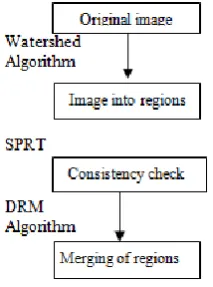
Figure 7: Block diagram of DRM.
In this section, we explain the proposed region merging algorithm as a dynamic region merging (DRM) process, as mentioned above, the proposed DRM algorithm is started from a set of over-segmented regions. This is because a small region can provide more stable statistical information than a single pixel, and using regions for merging can improve a lot the computational efficiency. For simplicity and in order to validate the effectiveness of the proposed DRM algorithm, we use the watershed algorithm, to obtain the initially over-segmented regions.
[image:4.595.50.264.207.284.2]In Fig. 8, an example process of region merging is shown by embedding it into a 3D graph
Figure 8:the dynamic region merging process as a shortest path in a layered graph. The upper row shows the label transitions of a graph node. The lower row shows the corresponding image regions of each label layer. Starting from layer 0, the highlighted region (in red) obtains a new label from its closest neighbor (in red). If the region is merged with its neighbor, they will be assigned to the same label. The shortest path is shown as the group of the directed edges (in blue).
Dynamic Region Merging Algorithm
DRM algorithm begins from a set of segmented regions. This is because a small region can provide more stable statistical information than a single pixel, and using regions for merging can improve a lot the computational efficiency. The algorithm follows as:
1. Input (I/P) = initially over segmented image So. 2. Output (O/P) = region merging result
3. Steps:
4. For given over segmented image assign each region a label as L0 to Ln.
5. Consider n regions.
6. Assign label to regions as L0………. Ln.
7. The label of each region is sequentially transited from initial to final.
8. To find the optimal sequence of merges to produce optimal merging of all regions,
9. The problem is broken down into sub problems using dynamic programming.
11. Obtain the merging result by shortest path algorithm In the DRM algorithm, there is at least one pair of regions to be merged in each iteration before the stopping criteria is satisfied.
3.5. Frequent Approximate Sub graphs:
[image:4.595.84.191.350.494.2]© 2017, IRJET | Impact Factor value: 5.181 | ISO 9001:2008 Certified Journal | Page 1503
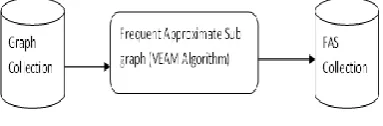
allowed. In VEAM, the approximate matching between edgelabels set in frequent sub graph mining is included in the mining process. The approximate method of VEAM was tested on an artificial image collection using a graph-based image representation. The experimentation on this collection shows that our proposal gets better results than graph-based image classification using some algorithms reported in related work.
Algorithm 1: V EAM
Input: D: A graph collection, MV : Substitution matrix indexed by LV , ME :
Substitution matrix indexed by LE, _ : Isomorphism threshold, _ : Support
threshold.
Output: F : Frequent approximate sub graph set.
F ← C ← 1 { the single vertices labeled in LV , which are frequent approximate
sub graphs in D};
2 for each T ∈ C do
[image:5.595.36.228.407.470.2]3 VEAMSearch(T;D;MV;ME; _; _; F);
Figure 9: VEAM process
3.6. Clustering of graphs (Grouping):
Any no uniform data contains underlying structure due to the heterogeneity of the data. The process of identifying this structure in terms of grouping the data elements is called clustering, also called data classification. The resulting groups are called clusters. The grouping is usually based on some similarity measure defined for the data elements. Clustering is thoroughly associated to unsupervised learning in pattern recognition systems. A basic task in unsupervised learning is to classify data set into two or more classes based on a similarity measure over the data, without resorting to any prior information on how the classification should be done. A graph is a mathematical structure made up of set of vertices or nodes and is connected by a set of edges or lines. Graph clustering is the task of grouping the vertices of the graph into clusters considering the edge structure of the graph such that there should be several edges within each cluster and relatively few between the clusters. Graph clustering means grouping the vertices of a given input graph into clusters.
Here we have used K-means Clustering Algorithm. It is one of the simplest algorithms for clustering of data (graph). The procedure that is followed is a simple and easy way to classify data (graph) through a certain
number of clusters (say k clusters) fixed a priori. The main idea is to define k centers, one for each cluster. Algorithm (k-means clustering):
Consider A = {a1,a2,a3,……..,an} be the set of data points and Z = {z1,z2,…….,zc} be the set of centers.
1) Randomly select ‘c’ cluster centers.
2) Calculate the distance between each data point and cluster centers.
3) Assign the data point to the cluster center whose distance from the cluster center is minimum of all the cluster centers. 4) Recalculate the new cluster center.
5) Recalculate the distance between each data point and new obtained cluster centers.
6) If no data point was reassigned then stop, otherwise repeat from step 3.
3.7. Query Processing:
This block is the important section of the project. In this section, a query image is taken from the User. The image is represented as Graph as discussed above using DRM technique. Then Patterns are generated. Then stored Patterns and Generated Patterns are matched for relevant results and finally Results are displayed along with Accuracy and Precision.
Outcomesofthissystemare:
1. Whenaqueryimageisgiventothesystem,imagesindata baseareclassifiedaspertheirrelevancewithqueryimage. 2. Alsofor agivenquery,accuracyandprecisionis calculate dby consideringentiredatabaseandisdisplayed.
3.8. KNN Classifier:
Classification is the problem of identifying to which
of a set of categories (sub-populations) a
© 2017, IRJET | Impact Factor value: 5.181 | ISO 9001:2008 Certified Journal | Page 1504
training data .k-Nearest neighbor is an example ofinstance-based learning, in which the training data set is stored, so that a classification for a new unclassified record may be found simply by comparing it to the most similar records in the training set.
4.
EXPERIMENTAL
RESULTS
AND
DISCUSSIONS
Actually, in the graph mining community; the standards to perform tests are synthetic datasets or molecular datasets. when we try to use these techniques in real images, they have to deal with larger graphs, with sizes starting from two hundred to three hundred edges per graph, and also the current progressive ways for graph mining are not well ready to address such huge graph sizes, in massive collections, in terms of memory requirements and computational time. If this is considered a computational problem for graph mining methods, the procedure of approximation in graphs increases the complexity.In order to certify our proposal, we have chosen well-known databases containing colourful images of simple objects captured from different viewpoints. The first one is that the COIL-100 [33] dataset, that possess a hundred objects with seventy two poses per object. We tend to took twenty five objects arbitrarily selected from this dataset to check our classification framework. The second dataset is ETH-80 Image Set [30], that contains eighty objects from eight classes and every object is described by forty one totally different views, yielding a complete of 3280 images. Example images from each datasets can be seen in Fig 10.
Figure 10: Sample images
The results shown in this work present that our current proposal is able to provide efficient result for real time image classification, and also underlines the importance of using approximate methods in graph mining when dealing with real time images. The analysis and selection of pivotal parameters in the process also play a significant role, as well as an appropriate choice of the underlying image representation.
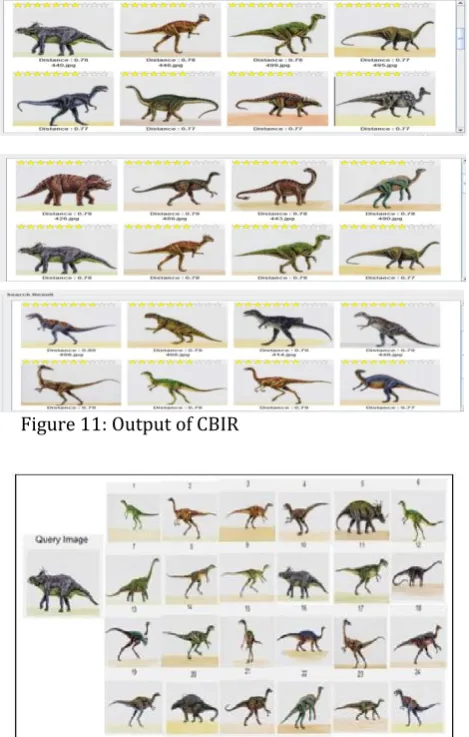
Content based image retrieval (CBIR) using color histogram technique is used for result analysis. CBIR is the process of retrieving images from a database (library of digital images) based upon the visual content of the images. In other words, it is the retrieving of images that have similar content of colors, textures or shapes transparent. In CBIR system, usually the image features are grouped into three main classes: color, texture and shape. Color is the most common visual feature (parameter) used in CBIR, mostly because of the simplicity of extracting color information from images. CBIR system decides which images in the image database is the most similar one with the query image. Obtain the nearest neighbors of the query image, exact images are retrieved. In content-based image retrieval (CBIR) searching process for k most-similar images to a
query image (required image) involves comparing the feature vectors of all the images in the database with that of the query image (required image) using some initially selected (pre-selected) similarity measure, and then sorting the results. However, this requires linear time (time complexity) with respect to the size of the database and becomes impractical for large databases.
CBIR is used to generate idle sequence of images. This sequence is compared with the system generated sequence of images and precision and accuracy is calculated and displayed. Accuracy and Precision are calculated as:
[image:6.595.309.544.337.706.2]The CBIR is applied to an image database and the result is shown below.
Figure 11: Output of CBIR
© 2017, IRJET | Impact Factor value: 5.181 | ISO 9001:2008 Certified Journal | Page 1505
5.
CONCLUSIONS AND FUTURE SCOPE
In this work we proposed and presented an image representation scheme using FASs (Frequent Approximate Sub graph) as efficient and effective features that can be used in a classification framework. Here we have automatically compute substitution matrices and the isomorphism threshold for the mining process, based on image features embedded in the framework, which proves that it can also produce good outcomes for the classification task when expert knowledge is not used. Also, the experimental results show that our proposal is comparable with other state-of-the-art methods for image classification.
Thegoalofthisprojectisgraphbasedimageclassifi cationinwhichDRMtechniqueisusedforgraphgeneration whichwillimproveperformanceofsystem.Graphgeneratedb yDRMtechnique isverysmall insize ascomparedtoquad treein existingsystem.Solotsofspacegetsavedandalsotim egetreducedbecauseoflessnumberofpatternsgeneratedf romgraphs.ByusingapproximationinVEAMalgorithm,mor einterestingpatternscanbefoundformanyapplications,fori nstance,whenprocessinggraphdatabasesthathavedistortion s(intermsofdifferentgeometric,topologicalorsemanticvari ations)ofsimilarstructuresinseveralobjects.Distortionindat aisoneofthechallengesfordevelopingclassifiersbasedonfr equentpatternsinseveraldomainsofscience.
Asfuturework, wewill proposeanewinterestme asurestoreduce thenumberofpatterns identified whichke ep orincrease theclassificationaccuracy. Wewill developn ovelprunestrategiestoobtainalgorithmsmoreefficientforla rger.
REFERENCES
[1] N. Acosta-Mendoza, A. Gago-Alonso, J.E. Medina-Pagola, Clasificación de imágenes utilizando minería de subgrafos frecuentes aproximados, Revista Cubana de Ciencias Informáticas (RCCI), vol. 5, no. 4, 2012. [2] N. Acosta-Mendoza, A. Gago-Alonso, J.E.
Medina-Pagola, Frequent approx- imate subgraphs as features for graph-based image classification, Knowledge- Based Systems 27 (March) (2012) 381–392.
[3] N. Acosta-Mendoza, A. Morales-González, A. Gago-Alonso, E.B. García-Reyes, J.E. Medina-Pagola, Classification using frequent approximate subgraphs, in: Proceedings of the 17th Iberoamerican Congress on Pattern Recognition (CIARP'12), Buenos Aires, Argentina, Springer-Verlag, Berlin, Heidelberg, 2012. [4] C.C. Aggarwal, H. Wang, Graph Data Management
and Mining: A Survey of Algorithms and Applications, Managing and Mining Graph Data, Springer- Verlag, New York, 2010.
[5] L. Brun, W. Kropatsch, Introduction to combinatorial pyramids, Digital and Image Geometry: Advanced Lectures
[6] L. Brun, W. Kropatsch, Contains and inside
relationships within combinatorial pyramids, Pattern Recognition 39 (4)
[7] C. Borgelt, M.R. Berthold, Mining molecular fragments: finding relevant substructures of molecules, in: Proceedings of the 2002 International Con- ference on Data Mining, Maebashi, Japan, 2002, pp. 211–218. [8] H. Bunke, K. Riesen, Graph classification based on
dissimilarity space embed- ding, in: Proceedings of the 2008 Joint IAPR International Workshop on Structural, Syntactic, and Statistical Pattern Recognition, SSPR. [9] C. Chen, X. Yan, F. Zhu, J. Han, gApprox: mining
frequent approximate patterns from a massive network, in: IEEE International Conference on Data Mining, [10] D. Conte, P. Foggia, C. Sansone, M. Vento, Thirty
years of graph matching in pattern recognition, International Journal of Pattern Recognition and Artificial Intelligence 18 (3) (2004) 265–298.
[11] M. Deshpande, M. Kuramochi, N. Wale, G. Karypis, Frequent substructure- based approaches for classifying chemical compounds, IEEE Transactions on Knowledge Data Engineering 17 (2005) 1036–1050.
[12] O. Duchenne, A. Joulin, J. Ponce, A graph-matching kernel for object categor- ization, in: IEEE International Conference on Computer Vision (ICCV), 2011,
[13] A. Elsayed, F. Coenen, C. Jiang, F. García-Fiñana, V. Sluming, Corpus Callosum MR image classification, Knowledge-Based Systems 23 (2010) 330–336. [14] M. Everingham, L. Van Gool, C.K.L. Williams, J. Winn,
A. Zisserman, The PASCAL Visual Object Classes Challenge 2011 (VOC2011) Results, 2011 〈 http://www.
pascal-network.org/challenges/VOC/voc2011/workshop/index .html〉.
[15] A. Gago-Alonso, J.A. Carrasco-Ochoa, J.E. Medina-Pagola, J.F. Martínez-Trinidad, Full duplicate candidate pruning for frequent connected subgraph mining, in: Integrated Computer-Aided Engineering, 17 August, ,.– [16] C. Galleguillos, S. Belongie, Context based object
categorization: a critical survey, Computer Vision and Image Understanding (CVIU) 114 (2010) 712–722. [17] R. Glantz, M. Pelillo, W.G. Kropatsch, Feature
selection for graph-based image classifiers, in: Proceedings of the Second Iberian Conference on Pattern Recogni- tion and Image Analysis – Volume Part II, IbPRIA'05, 2005, pp.–
[18] R. Glantz, M. Pelillo, W.G. Kropatsch, Matching segmentation hierarchies, International Journal of Pattern Recognition and Artificial Intelligence (IJPRAI) 18 (3) (2004) 397–424.
© 2017, IRJET | Impact Factor value: 5.181 | ISO 9001:2008 Certified Journal | Page 1506
[20] X. He, M. Ji, H. Bao, Graph embedding withconstraints, in: Proceedings of the 21st International Joint Conference on Artificial Intelligence, IJCAI 2009, [20] A. Hlaoui, S. Wang, A new algorithm for graph
matching with application to content-based image retrieval, in: Proceedings of the Joint IAPR International Workshop on Structural, Syntactic, and Statistical Pattern Recognition, ,