© 2018, IRJET | Impact Factor value: 6.171 | ISO 9001:2008 Certified Journal | Page 2636
Plan and Examination of Planning Calculations for Optically Prepared
Server Farm Systems
R. Krishna Prakash 1, T. P. Udhaya Sankar 2 and
K. Thangadurai
31, 3 Assistant Professor, Department of Computer Science and Engineering, Annapoorana Engineering College, Salem
2 Associate Professor, Department of Computer Science and Engineering, Annapoorana Engineering College, Salem
---***---Abstract:
Server farm systems produce high volumes oftraffic. With a specific end goal to lessen parcel inactivity, bundle transmissions are frequently halfway planned. Such methodologies have been proposed for both parcel exchanged and half and half optical-bundle exchanged systems. This paper researches calculation plan decisions for transmission planning for a firmly synchronized crossover optical parcel server farm arrange. This issue is examined in two cases: with priority where the solicitations are planned for the request of landing, and without priority, where the solicitations can be reordered in time. It is demonstrated that the issue with no priority imperatives is NP-finished. For planning with priority requirements, a voracious calculation is proposed and appeared to be ideal. Hypothetical estimate for the execution of booking with the covetous calculation is exhibited. Reproduction tests were performed on a two tier system with 1024 servers and 64 wavelengths. Parallel usage parts of the booking calculation are likewise talked about.
Key Words — Hybrid Optical Networks, Optical Traffic
Grooming, Data Center Networks, Centralized
Scheduling, Intra-Data Center.
I. INTRODUCTION
Expanding centralization of registering and capacity by endeavors and suppliers, Server farm Systems (DCN) and cloud systems have become more pervasive amid the previous decade. These systems empower scaling of registering and capacity assets relying upon the overarching load. These components (centralization and the capacity to scale) increment the network load of DCNs beyond the operating range of customary neighborhood (LAN). DCNs are utilized to interconnect a few thousand servers, where every server can have different virtual machines (VMs) [1]. Every server has numerous multi-Gigabit arrange interfaces. In this way, the traffic took care of by a DCN is significantly high. With a specific end goal to deal with such high loads, a few optical systems administration based server farm organize models , Propelled Innovation Focal point of Magnificence in Cutting edge Systems, Frameworks and Administrations
have been proposed as of late [2]– [6], to manage the limit constraints of customary parcel exchanged systems [7].
For efficiency reasons, DCNs are normally worked at heavier burdens, for example, > 60%. At such loads, little load fluctuations can bring about significantly longer deferrals because of lining. In a perfect world, a zero-line arrange (having zero lining delays) is attractive where information exchange delay is at a hypothetical least. At the point when a burst arrives and the switch assets are not accessible to serve this burst, lining ends up noticeably essential. Efficient booking of assets for information exchanges is an essential prerequisite in these systems. Figuring a calendar for zero-and little line systems has been considered in writing covering distinctive planning ranges.
A traverse of planning (or booking range) is the arrangement of system assets considered while registering the timetable. In conventional IP arranges, the booking range is crosswise over segments (indicated as c2c), yet inside a system switch. DCN structures including LION [2] and PETABIT [3] have utilized this conventional approach. As of late, two new methodologies have risen:
(I) A conclusion to-end (e2e) planning approach,
proposed in Versatile Optical Server farm System [4], Optically Prepped Server farm System [5] and FASTPASS [7]
(II) A change to-switch (s2s) booking approach, proposed
© 2018, IRJET | Impact Factor value: 6.171 | ISO 9001:2008 Certified Journal | Page 2637 schedule opening and this expands the conclusion to-end
postpone for unmatched solicitations. Despite the fact that booking in persistent time is utilized as a part of the setting of employment and connection planning, to the best of our insight, this paper is the first endeavor to figure plan over a subjective booking traverse in view of ceaseless time. It is fairly simple to implement timing inside a switch (c2c) utilizing a clock. Yet, steady understanding of time must be tended to when booking crosswise over system elements. The planning calculation in FASTPASS only distributes assets for a booked term. This span is utilized for starting the parcel transmission from the source.
II. BACKGROUND
The system designs treated in this work are differing as far as system operation and the parts utilized inside switches. A more elevated amount of reflection is important to treat booking over these systems. To address this, booking range and conflict chart are defined. They serve as the regular framework for treating the scheduling problem. Before taking a gander at the deliberations, we portray couple of server farm organize structures.
A. Foundation on DCNs
Generally, registering and capacity assets were physically allotted for every service offered. Data centers centralized assets and made a mutual pool of processing and capacity assets. Regularly, administrations are appropriated over the pool of assets and these assets are interconnected by a server farm arrange (DCN). This system assumes a vital part in deciding the execution of an administration. It relies upon the system engineering and the momentary load on the system. A run of the mill DCN design is various leveled in nature and made out of different layers. A 3-layer design is depicted next. At the most reduced level of the chain of importance are the Processing and Capacity Hubs (CSNs) that should be interconnected by the DCN. Each CSN is associated with a Top of-the-Rack (ToR) switch, commonly utilizing 1 Gbps or 10 Gbps Ethernet interfaces. Every ToR switch is then associated with at least one Total switches, normally utilizing 10 Gbps or 100 Gbps fiber optic connections. These are then associated with Center switches, that are regularly interconnected to each other utilizing multi wavelength division multiplexed (WDM) fiber optic connections. Every wavelength will convey multi-gigabit traffic.
Along these lines, a parcel produced from a source CSN will cross an arrangement of ToR, Total and Center switches before achieving the goal CSN. A few server farm organize structures have been proposed in writing. Of
these, parcel exchanged structures utilize electronic switches in their system. This gear stores and advances each bundle. Commonly, a burst of bundles from a flow expands the momentary load along a system way. This builds the deferral of different flows that utilization this system way.
FASTPASS [7] is a parcel exchanged engineering that endeavors to diminish this deferral by unequivocally processing a transmission plan for each datum exchange in view of the prompt system stack. Regularly, a server farm arrange is relied upon to contain a hundred thousand processing and capacity assets. Packet switched designs can't bolster this scale thus interchange structures have been proposed. These models utilize optical segments in their system and are broadly eluded as half and half optical parcel structures. EODCN [4] and OGDCN [5] are mixture optical parcel structures that don't utilize optical bundle or burst exchanging procedures. They likewise don't cradle or line bundles inside their system. They utilize optical circuit switches (OCS, for example, re configurable include/drop multiplexers (ROADM) and optical smaller scale electro-mechanical systems (MEMS).In addition to OCS, they utilize optical splitters and combiners to understand a server farm organize.
A few research endeavors on flow level planning have been accounted for, normally as in [8] and [9]. These methodologies designate data transfer capacity for the lifetime of a flow. This data transfer capacity is terribly under-used since parcel age is regularly bursty and henceforth, the allocated transmission capacity is utilized just for a little portion of time. In the present work, just structures that perform planning at bundle level granularity (or comparative lower level) are considered.
B. A Delegate Optical DCN Engineering
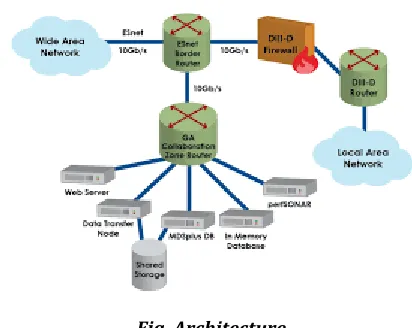
© 2018, IRJET | Impact Factor value: 6.171 | ISO 9001:2008 Certified Journal | Page 2638 Fig. Architecture
Delay Factors of Different Architectures
A impart and select methodology by making multipoint-to multipoint circuits that trade data. From the figure, it can be watched that this framework does not have any package pads to line the groups inside the framework. Banner regenerators (1R and 3R regenerators) are used as a piece of the framework as required to compensate for the banner setbacks. Pre-defined multipoint to-multipoint circuits can be modified by configuring the ROADMs. EODCN configuration in like manner sets up a multipoint-to-multipoint circuit and is in a general sense the same as OGDCN beside two or three changes.
EODCN is a two-level framework however OGDCN is extensible to more levels. The inside switch of EODCN contains a MEMS switch array. Based on its switch configuration, it interconnects a subset of all source-objective sets. Right when diverse sets must pass on, the switch must be re configured. On the other hand, OGDCN ensures reachability over all source destination sets with no re configuration. More unobtrusive components on this designing can be found in [5] and [10]. Specifically, versatility of this designing up to petabit run has been presented in [5].
This outline has likely endorsed for its feasibility [10]. The conclusion to-end concede experienced in a given framework building depends on the parts used, as consolidated in Table I. For instance, because of EODCN intra-rack and OGDCN, there is no packetization or covering. Thusly, the contrasting put off portions are absent. WSS isn't re configured for each package. In the midst of re configuration, traffic isn't moved toward the specific set of channels that are being re configured. In this way, the general end-to-end defer due to WSS is for all intents and purposes zero.
The conclusion to-end put off is proportionate to the entire of association inducing delays in these models. In whatever is left of the paper, most exchanges are given OGDCN as the reference designing and differences, if any are shown as required.
C. Booking Span and Conflict Graphs
A booking range wraps all advantages that are under the space of a scheduler. In light of the arranging range, scheduler resources:
(I) are inside a framework switch, (ii) cover a course of action of framework switches, and (iii) cover a conclusion to-end (e2e) path over the framework. This paper considers the end-toend (e2e) illustrate. FASTPASS, OGDCN and EODCN are instances of this class. At whatever point there is data to be sent from a source to an objective, a central scheduler is come to. This scheduler figures the logbook and this traverse is used for certified data trade. This scheduler has an aggregate point of view of the brisk load on the framework. It uses this data to enlist the transmission get ready for a given data trade. This instrument ensures that the related resources are exclusively distributed to the data trade. Because of optical DCNs, the path between the source CSN and the objective CSN will join widely appealing ToR, Aggregate and Core switches.
© 2018, IRJET | Impact Factor value: 6.171 | ISO 9001:2008 Certified Journal | Page 2639 planned graph that interconnects a course of action of
sources and a game plan of objectives on a wavelength. Once a scheduler circulates mastermind resources for a request, the relating conflict graph is separate as involved. To avoid crashes, each and every other resource part of this graph must stay sit of apparatus for the apportioned length. This outline addresses the framework resources concentrated on a booking requesting and its conflicts with respect to synchronous resource distributions. By OGDCN plot, all source-objective sets have no short of what one conflict diagram interconnecting them. Up until this point, conflict outline was shown with respect to OGDCN. This conflict graph, can be summed up to various models as well. The EODCN building shares various properties of OGDCN anyway it likewise contains MEMS. So any conclusion to-end route in EODCN contains three conflict graphs:
(1) the sub-orchestrate interfacing the source to the contrasting passageway port of a MEMS,
(2) the sub-arrange partner takeoff port of the MEMS that prompts for that.
Network Operation
With the required reflections set up, the system operation is displayed here.
A. Preliminaries:
A control channel is thought to be accessible for trading the control messages. Diverse DCNs understand the control direct in various ways: (I) The control and information messages are time-partaken if there should arise an occurrence of TONAK-LION, FASTPASS, and inheritance DCN, (ii) an out-of-band divert is utilized as a part of instance of PETABIT, LION, EODCN, and OGDCN. The directing data is accessible with the scheduler when figuring the calendar. Thus, directing can either be co-situated with the scheduler or it can be appropriated. Both disseminated and incorporated calculations for course calculation are found in writing. This paper expect that the course is registered and the relating conflict diagram is chosen before the scheduler forms a demand.
B. System Operation:
The accompanying grouping of steps is taken after for every datum parcel exchange, as likewise displayed in Fig. 2(a):
1) Request: Whenever a source (say T1) has information to exchange to a goal (say R3), it sends a control demand to the concentrated scheduler over the control channel.
2) Response: This scheduler registers the transmission begin time and reacts to the control message. Despite the fact that the figure demonstrates that the reaction is sent to source and goal, this reaction must be sent to all assets that must be configured for empowering the information exchange.
3) Data exchange: At the transmission begin time, the source and the goal are prepared to transmit and get information respectively. For the allocated duration, data is transmitted by the source and the goal gets it. As of now specified, there is a finite measure of defer engaged with information transfer across the network. The scheduler considers the comparing postpone gauges while telling the begin time to the assets.
Fig. 1: Demonstrates a synchronous information move in a three conflict chart situation.
Three concurrent transmissions are permitted by assigning the individual source, goal and system asset (appeared in changed hues) for a transmission. This portion is dynamic for their particular administration spans. After administration, the assets are accessible to serve resulting information exchanges that could possibly include similar assets.
For example, T1, R3 and λ3 served the demand in Fig. 2(a). A similar source T1 is caught up with serving another demand alongside λ1 and R2 as found in Fig. 2(b).
III. PROBLEM STATEMENT
© 2018, IRJET | Impact Factor value: 6.171 | ISO 9001:2008 Certified Journal | Page 2640 transmission begin time, transmission end time and
aggregate parcel deferral of the jth ask for in P. Here, Tend j = Tstart j +Tsrv j , andDj = Tend j −Tarr j .
A. Planning Class Notation:
This paper utilizes the documentation for speaking to booking issues displayed in [12]. A non specific planning issue comprises of employments to be executed on a given arrangement of under given certain contraints to fulfill a specified objective. The issue is signified as: α|β|γ, whereα indicates the machines on which occupations are executed, β the key requirements and γ the goal work. For the present booking issue,
1) Three assets (source, conflict chart and sink) in transmission planning phrasing or three machines in work booking wording must all the while benefit the solicitations (or occupations). In this manner, α is meant as M3.
2) In web based planning, each demand has a landing time (Tarr j ) and simply after this time, information exchange can be booked. This ARRIVAL imperative is the same as employment discharge date limitation in planning wording. Moreover, asks for can't be overhauled by any subjective source, sink or conflict chart. Each ask for has a source, and a goal when it is made. Afterward, routing decides the conflict diagram that serves the demand. A vocation's affinity to a machine is utilized to catch this in work booking phrasing. In this way, β = |Tarr j ,aff|,where Tarr j signifies that work can't be begun before its specified landing (or discharge) time, and aff indicates affinity. More imperative decisions are introduced later. 3) Two conceivable target capacities SUMDEL and MAXFIN that are depicted later.
B. Issue Statement:
Given P, the arrangement of solicitations to be planned, two conceivable target capacities (SUMDEL and MAXFIN) are considered, as recorded underneath: (Or on the other hand)
(1) MAXFIN Objective : Min. Cmax = max j∈P Tend j (2) Constraints: ARRIVAL: Tstart j ≥ Tarr j ∀j ∈ P
(3) PRECEDENCE: Tstart k ≥ Tend j ∀k ∈P|j ≺ k (4
(OR) ORDERING: Tstart k ≥ Tend j ∀k ∈P|j ≺ k (5)
T start j −Tend k ≤ M ∀k ∈ P|j ⊀ k (6) Objectives: There are
two conceivable target capacities, as portrayed beneath. The SUMDEL objective (in Eq. 1) limits the aggregate of the finishing times (Tend j ). By definition, j Tend j = j (Tarr j + Dj)=j Tarr j + j Dj. Since the corresponding entry times
are known, j Tarr j is a steady term that can't be limited by booking. Subsequently, limiting j Dj (aggregate of all bundle delays) is comparable to limiting j Tend j . The MAXFIN objective (in Eq. 2) limits the most extreme consummation time. This is otherwise called least makespan objective.
Limitations:
The ARRIVAL, PRECEDENCE and ORDERING imperatives are clarified next. The ARRIVAL constraint, shown in Eq. 3, expresses that a bundle can't be planned before its entry. There are two decisions as far as administration train. They are spoken to utilizing PRECEDENCE and ORDERING requirements. Both these decisions are assessed. Solicitations are sequenced in light of its landing time and are served in a strict first-in-first-out (FIFO) arrange. This is spoken to utilizing the PRECEDENCE requirement appeared for that.
IV. DESIGN CHOICES AND PROPOSED HEURISTIC
This segment examines the decisions for the target work and the imperatives.
A. Correlation of Objective Functions
As specified before, the booking issue with work discharge dates can be displayed either utilizing a makes pan (MAXFIN) or utilizing aggregate of culmination times (SUMDEL) objective. In the accompanying examinations, booking with PRECEDENCE limitation is considered. The nitty gritty examination of imperatives displayed later demonstrates that this detailing is better as far as time multifaceted nature.
There is an unobtrusive distinction between the MAXFIN and SUMDEL targets when considering the ask for arrival times. At the point when the solicitations have landing times, the framework in general or any asset in the framework can be sit out of gear sitting tight for the following solicitation to arrive. This is appeared in Three solicitations are considered with the second demand touching base before the framework finishes overhauling the first ask. For this situation, there are two decisions. This parcel can be planned instantly or after some time. Contingent upon when it is planned, the deferral of the second demand shifts. For whatever length of time that the framework finishes administration of second demand before the third demand arrives, the makes pan of the framework continues as before.
© 2018, IRJET | Impact Factor value: 6.171 | ISO 9001:2008 Certified Journal | Page 2641 Along these lines, the makes pan objective does not
generally diminish the postponement of solicitations at whatever point sit without moving lengths show up in the middle. Considering total of fulfillment times as a goal is more reasonable for this framework. For this situation, the framework not just guarantees that solicitations are served with the end goal that their postpone whole is limited yet additionally meets the makes pan objective. To demonstrate this, we have to demonstrate that the SUMDEL objective has an ideal substructure.
1) Optimal Substructure of SUMDEL: We begin with the
way that j Tend I i=0 is the ideal defer whole for j demands
(let this be Sj) and need to demonstrate that ∀i ∈[0,j]|Tarr
I ,prec |SUMDEL is the ideal postpone entirety.
2) To demonstrate this, let us think about that for some
estimation of i<j, assume Si = I Tend k k=0 isn't the ideal postpone entirety when I employments are finished and
rather S∗ I is the ideal defer aggregate (or (Si > S∗ I )). For
this situation, the ideal defer entirety for all j solicitations can be changed as Tend j = I Tend I 0 + j Tend I i+1 =Si+ j
Tend k k=i+1 . In this condition, supplanting Si with S∗ I
would bring about a postpone whole that is not as much as the ideal defer total Sj. This negates the underlying reality thatSj is ideal. In this way, it is demonstrated by logical
inconsistency that ∀i ∈[0,j]|Tarr I ,prec |SUMDEL has an
ideal substructure.
3) SUMDEL Implies MAXFIN Objective: We demonstrate this by inconsistency. For a similar demand benefit
arrangement, let Q and Q∗ signify the activity finishing
time vectors (<T end 0 ,...,Tend I ,...Tend j > and <T end∗ 0
,...,Tend∗ I ,...Tend∗ j >) that outcome in ideal postpone
aggregate and ideal makespan separately. Let the relating most extreme makespans be Tend max(= Tend j ) and
Tend∗ max (= Tend∗ j ). Assume by ethicalness of
optimality of makespan, let Tend∗ max <Tend max.
Watching the vectors nearly, there ought to be no less than
one demand (say ith ask for) in Q∗ whose finishing time
(Tend∗ I ) is before its fulfillment time (Tend I ) in vector Q
(i.e. Tend∗ I <Tend I ).
In any case, as indicated prior |Tarr j ,prec |Tend j is an ideal defer aggregate and it furthermore has an ideal substructure. In this way, given Tend j is ideal, the fruition time of ith ask for can't be under Tend I . This repudiates the first truth that succession Q brings about the ideal
postpone aggregate. Along these lines Tend max ≮ Tend∗
max . Thus, it can be demonstrated that when Tend max
<Tend∗ max ,Tend∗ max can't be ideal makes pan.
Accordingly Tend max = Tend∗ max must be valid.
Therefore, an ideal defer total too.
V. PERFORMANCE EVALUATION
[image:6.612.331.550.169.283.2]In this section, the performance evaluation of scheduling is presented. First, theoretical estimate for packet delay is presented. As and when required, simulation models are used to validate the theoretical models.
Fig. 2: Same makes pan but different completion times shown with three requests.
VI.CONCLUSIONS
This paper has examined the transmission planning issue in a cross breed optical bundle server farm arrange. The booking issue has been formally examined thinking about various target capacities and requesting limitations. It was demonstrated that the many-sided quality is steady when the priority limitations are considered; and that the issue is NP-finished when reordering of solicitations is permitted.
Numerical and reproduction models of information and control parcel delay have been introduced. Framework level reproduction show comes about are additionally introduced to under the versatility of the framework and the parallelizability of the planning calculation usage. As a major aspect of future work, following angles can be investigated. As a matter of first importance, it was demonstrated that considering finish times as a major aspect of the goal presents re-requesting of solicitations.
© 2018, IRJET | Impact Factor value: 6.171 | ISO 9001:2008 Certified Journal | Page 2642 Addendum OUTPUT PROCESS OF A G/D/1 QUEUE Let us
consider a switch demonstrated as a G/D/1 line with consistent administration time of 1 µ1. Give us a chance to watch the yield of this line amid a subjective time interim N−1 µ1 , N µ1. Since the line has a steady administration time, the between takeoff time between two sequential control parcels must be no less than 1 µ1. At the point when a control parcel is served at time N −1/μ1 + , the following control bundle can be served on or after N −1/μ1 + 1/μ1+, i.e.N/μ1+.
Generalizing this observation, the likelihood that at least two parcels being served amid any 1 µ1 interim is zero. In a given administration interim μ1, one control parcel can either be served or not served. Subsequently, the yield of a G/D/1 line can be demonstrated as a Bernoulli procedure with parameter p. Here, the occasion of serving a control bundle is indicated as progress and not serving a control parcel as disappointment. The unfaltering state likelihood of the yield procedure is the heap on the framework, to be specific, p = ρ, when ρ ≤1.
Fig. 3: G/D/1 line yield process in discrete time.
The enduring state likelihood of a parcel effectively served by a G/D/1 line amid an interim (T0,T0 + 1 µ1) merges under constant load scenario. A constant load scenario assumes that normal landing rate stays steady all through the length of perception. The yield procedure of a G/D/1 line is seen to be an ON/OFF process in [16].
This strengthens the comprehension of the yield procedure of a G/D/1 line. What's more, utilizing reproductions, the mean and change of the yield procedure were processed. They were discovered match with that of a Bernoulli procedure with parameter ρ. In outline, the yield procedure of a G/D/1 line has been appeared to be a Bernoulli process. This outcome is utilized as a part of the investigation of the couple parcel lines in Section VI.
REFERENCES
[1] Y. Liu, J. Muppala, M. Veeraraghavan, D. Lin, and M. Hamdi, Data Center Networks. Cham, Switzerland: Springer, 2013.
[2] Y. Yin et al., “LIONS: An AWGR-based low-latency optical switch for high-performance computing and data centers,” IEEE J. Sel. Topics Quantum Electron., vol. 19, no. 2, Mar. 2013, Art. no. 3600409.
[3] K. Xi, Y.-H. Kao, and H. Chao, “A petabit bufferless optical switch for data center networks,” in Optical Interconnects for Future Data Center Networks (Optical Networks), C. Kachris, K. Bergman, and I. Tomkos, Eds. New York, NY, USA: Springer, 2013, pp. 135–154.
[4] M. Fiorani, S. Aleksic, M. Casoni, L. Wosinska, and J. Chen, “Energyefficient elastic optical interconnect architecture for data centers,” IEEE Commun. Lett., vol. 18, no. 9, pp. 1531–1534, Sep. 2014.
[5] G. C. Sankaran and K. M. Sivalingam, “Optical traffic grooming-based data center networks: Node architecture and comparison,” IEEE J. Sel. Areas Commun., vol. 34, no. 5, pp. 1618–1630, May 2016.
[6] R. Proietti et al., “Scalable optical interconnect architecture using AWGR-based TONAK LION switch with limited number of wavelengths,” J. Lightw. Technol., vol. 31, no. 24, pp. 4087–4097, Dec. 15, 2013.
[7] J. Perry, A. Ousterhout, H. Balakrishnan, D. Shah, and H. Fugal, “Fastpass: A centralized ‘zero-queue’ datacenter network,” in Proc. ACM SIGCOMM, 2014, pp. 307–318.
[8] H. Yang et al., “CSO: Cross stratum optimization for optical as a service,” IEEE Commun. Mag., vol. 53, no. 8, pp. 130–139, Aug. 2015.
[9] H. Yang, J. Zhang, Y. Zhao, J. Han, Y. Lin, and Y. Lee, “SUDOI: Software defined networking for ubiquitous data center optical interconnection,” IEEE Commun. Mag., vol. 54, no. 2, pp. 86–95, Feb. 2016.
[10] G. C. Sankaran and K. M. Sivalingam, “Combinatorial approach for network switch design in data center networks,” in Proc. IEEE Int. Conf. Comput. Commun. (INFOCOM), May 2017.
[image:7.612.61.281.338.463.2]© 2018, IRJET | Impact Factor value: 6.171 | ISO 9001:2008 Certified Journal | Page 2643 [12] D. Karger, C. Stein, and J. Wein, “Scheduling
algorithms,” in Algorithms and Theory of Computation Handbook. London, U.K.: Chapman & Hall, 2010, p. 20.
[13] Using Lpsolve From AMPL, accessed Dec. 20, 2016.
[14] M. J. Karol, M. G. Hluchyj, and S. P. Morgan, “Input versus output queueing on a space-division packet switch,” IEEE Trans. Commun., vol. 35, no. 12, pp. 1347– 1356, Dec. 1987.