http://dx.doi.org/10.4236/ojapps.2015.54014
Numerical Solution of Second-Order Linear
Fredholm Integro-Differetial Equations by
Trigonometric Scaling Functions
Hamid Safdari, Yones Esmaeelzade Aghdam
Department of Mathematics, Shahid Rajaee Teacher Training University, Tehran, Iran Email: [email protected], [email protected]
Received 17 March 2015; accepted 13 April 2015; published 22 April 2015
Copyright © 2015 by authors and Scientific Research Publishing Inc.
This work is licensed under the Creative Commons Attribution International License (CC BY).
http://creativecommons.org/licenses/by/4.0/
Abstract
The main aim of this paper is to apply the Hermite trigonometric scaling function on [0, 2π] which
is constructed for Hermite interpolation for the linear Fredholm integro-differential equation of second order. This equation is usually difficult to solve analytically. Our approach consists of re-ducing the problem to a set of algebraic linear equations by expanding the approximate solution. Some numerical example is included to demonstrate the validity and applicability of the presented technique, the method produces very accurate results, and a comparison is made with exiting re- sults. An estimation of error bound for this method is presented.
Keywords
Numerical Technique, Fredholm Integro-Differential Equations, Hermite Trigonometric Wavelets, Operational Matrix, Error Estimates
1. Introduction
In this paper we solve the Fredholm Linear Integro-Differential Equations as
( )
( ) ( )
( ) ( )
( )
1( ) ( )
( )
( )
0 x 1 x u x 2 x u x g x 0k x t u t, d ,t 0 x 1, u 0 u0, u 1 u1
µ +µ ′ +µ ′′ = +
∫
≤ ≤ = = (1)Systems of integro-differential equations have a major role in the fields of science, physical phenomena, and engineering, such as nano-hydrodynamics, glass-forming process, dropwise condensation, wind ripple in the de- sert, and modeling the competition between tumor cells and the immune system. The concept of a system of integro-differential equations has motivated a huge amount of research work in recent years. Alot of attention has been devoted to the study of differential-difference equations, e.g. equations containing shifts of the un- known function and its derivates, and also integro-differential-difference equations. For instance, see [2] [3]. There are several numerical methods for solving system of linear integro-differential equations, for example, the rationalized Haar functions method [4], Galerkin methods with hybrid functions [5], the spline approximation method [6], the Chebyshev polynomial method [7], the spectral method [8], the CAS wavelet method [9], Ruge- Kutta methods [10], the Adomian decomposition methods [11], and the interested reader can see [12] [13] for more published research works in the subject.
Our approach consists of reducing the problem to a set of linear equations by trigonometric scaling functions which is constructed for Hermite interpolation. A difficulty of using wavelet for the representation of integral operators is that quadrature leads to potentially high cost with sparse matrix. This fact particularly encourages us in efforts to devote to some appropriate wavelet bases to simplify the computation expense of the reoresentation matrix, which is importent to improve the wavelet method. Recently, the trigonometric interpolant wavelet has arisen in the approximation of operators [14]-[16]. Quack [17] has constructed a multiresolution analysis (MRA). Chen [18] [19] presented the feasibility of trigonometric wavelet numerical methods for stokes problem and Hadamard integral equation.
The organization of the rest of this paper is as follows: Section (0) describe the trigonometric scaling function on
[
0, 2π]
, and construct the operational matrix of derivative for these function. Section (0) summarizes the application of trigonometric scaling functions to the solution of Problem (1). Thus, a set of linear equations is formed and a solution of the considered problem is introduced. In Section (0), we report our computational results and demonstrate the accuracy of the proposed numerical schemes by presenting numerical examples. Note that we have computed the numerical results by MATLAB programming.2. Interpolatory Hermite Trigonometric Wavelets
In this section, we will give a brief introduction of Quak’s work on the construction of Hermite interpolatory trigonometric wavelets and their basic properties. More details can be found in (see [17]).
For all j∈ =
{ }
0 , two scaling functions ϕ0j,0( )
x and ϕ1j,0( )
x are defined as( )
2 1 1( )
0
,0 2 1 0
1 2
j
j j l
l
x D x
ϕ
+−
+ =
=
∑
(2)( )
1( )
(
)
1 1
,0 2 1 2
1 1
sin 2 2
2 j
j
j x j D x x
ϕ = + + + +
(3) where the Dirichlet kernel D xl
( )
and its conjugate kernel D xl( )
are defined as( )
( )
1
1
1 sin
2
2π 1
cos 2 sin
2 2
1
2π 2
1 cos cos
2 2
2π sin
2 sin 2
0 2π
l
l
k
l
l k
l x
x x
D x kx
l x
x l
x
D x kx x
x
=
=
+
∉
= + =
+ ∈
− +
∉
= =
∈
∑
∑
Obviously, D xl
( ) ( )
,D xl ∈Tl, where Tl is the linear space of trigonometric polynomials with degree notexceeding l. The equally spaced nodes on the interval
[
0, 2π)
with a dyadic step are denoted by , π 2 j l jany j∈0 and l= 0,1,, 2j+1−1, where 0 is the set of all non-negative integers. Let
( )
(
)
, ,0 ,
s s
j l x j x tj l
ϕ =ϕ − , for s=0,1, and l=0,1,, 2j+1−1. Lemma 1 (See[17].) For j∈0, we have
( )
( )
2 2 2 0 2 ,0 sin 2 1 2π 2 sin 2 1 2π j j j x x x x x ϕ + ∉ = ∈ ( )
(
(
1)
)
1 2 2
,0
1
1 cos 2 cot 2π
2 2
0 2π
j j j x x x x x
ϕ + +
− ∉ = ∈
and their derivations are given by
( )
(
)
(
)
( )
2 1
0 2 2 2
2 ,0
sin 2 cot sin 2
1 1 2
2π
= 2 2
sin sin
2 2
0 2π
j j j j j x x x x x x x x ϕ + + + − ∉ ′ ∈
( )
(
)
(
1)
(
)
1
2 3 1
1 2
,0
cos 2 1
1 1
sin 2 cot 2π
2 2 2 = sin 2 1 2π j j j j j x x x x x x x ϕ + + + + − + ∉ ′ ∈
Theorem 1 (Interpolatory properties of the scaling functions). (See [17]) For j∈0, the following inter- polatory properties hold for each l k, =0,1,, 2j+1−1
( )
(
( )
)
( )
(
( )
)
0 0 , , , , , 1 1 , , , , , , 0, 0, .j l j k k l j l j k
j l j k j l j k k l
x x
x x
ϕ δ ϕ
ϕ ϕ δ
′
= =
′
= =
(4)
From above we can take wavelet functions 0
( )
1( )
1 , , , , 0,1, , 2 1j j l x j l x l
ϕ ϕ = + − as scaling functions. Now, we
can define the scaling function spaces Vj. Then we have
Definition 2 (Scaling functions space). For all j∈0 define the wave space Vj as follows
( )
( )
{
0 1 1}
, , , , 0,1, , 2 1
j
j j n j n
V =span ϕ t ϕ t n= + −
As a first step of studying the spaces Vj, the following result identifies the trigonometric polynomials which from alternative bases of these spaces.
Now a Hermite-type project operator can be introduced by means of the scaling functions. For all j∈0 the Hermite projection operators Lj mapping any real-valued differentiable 2π-periodic function f into the space Vj is defined as
( )
( )
2 1 1( )
( )
0 1 T
, ,
0 j
j k j k k j k
k
f x L f x aϕ x bϕ x C
+−
=
+ = Φ
∑
(5)
where ak = f t
( )
j k, , bk = f′( )
tj k, , C, and Φ are vectors with dimension 22j+ ×1. The following properties
of the operators Lj are therefore obvious:
1 2j
j
L ∈T +
( ) ( ) ( ) ( )
, , and ,( )
, ,j j k j k j j k j k
for all .
j j
L f = f f∈V
Theorem 3 Let f x
( )
∈L22π, and its trigonometric wavelet approximation is L fJ , then we have( )
( )
( ) 2 2π 2 1 2 J J Lf x −L f x ≤C − +
where C is a positive constant value.
Proof. See [17].
Lemma 2 (The operational matrix of scaling function derivative). (See [20]) The differentiation of vector Φ in 5 can be expressed as [20]
Dφ ′
Φ = Φ
where Dφ is 2 2
2J+ ×2J+ operational matrix of derivative for trigonometric scaling function. Suppose
( )
(
)
2 1 1( )
( )
0 1
, , , , ,
0 j
s s s
j m k m j k k m j k
k
x a x b x
φ ϕ ϕ
+− ′
=
=
∑
+ (6)where 1
0,1, , 2j 1
m= + − and s=0,1. So the matrix Dφ can be respresented as a block matrix as 0 0 1 1 A B D A B =
where s
A and s
B are 1 1
2j+ ×2j+ matrices. The entries of matrices s
A and s
B may be find by using
( ) ( )
, ,( )
, ,( ) ( )
, ,( )
,s s s s s s
k m j k j m k m j k j m
A = a = φ ′ x B = b = φ ′′ x
where 0
A is a 1 1
2j+ ×2j+ zero matrix, 1
A is a 1 1
2j+ ×2j+ identity matrix. Using
, π 2
j m j
m
x = we get
( )
(
)
(
)
, , ,0 ,0 ,
π 2
s s s
j k j m j j j j m k
m k
x x
φ φ φ −
−
= =
(7)
Using 7 and
( )
,(
,( )
,)
(
,0(
,)
)
0,1s s s s
k m j k j m j j m k
B = b = φ x ′′= φ x − ′′ s= we get
( ) ( )
(
)
(
)
(
)
(
)(
)
1 20 0 0 1
, ,0 ,
2 1 2 1 0 1 cos 2π 1 2 sin π 2
1 2 1 1
6 2
j
j
k m j j m k
p j p k m k k m m k
B b x
p p p
k m φ + + − − + = = − ≠ − ′′ = = = − + + =
∑ ∑
(8) and( ) ( )
(
)
1 1 1 1
, ,0 ,
cot π
2 0
j
k m j j m k
m k
k m
B b x
k m φ + − − − ≠ ′′ = = = (9)
for k m, =0,1,, 2j+1−1.
3. Procedure Solution Using the Trigonometric Scaling Function
( )
( )( )
( )
( ) ( )
( ) ( )
( )
( )
2 1
0 1
0 1
, 0 0 ,1 1
1
, ,
2 2
0 1, 0 , 1
N i
i
i k
k x u k k k x u
x u x g x k x u
N N N
x u u u u
µ − = = = + + + ≤ ≤ = =
∑
∑
(10)where the subintervals have the form kh k,
(
+1)
h, with h 1 N= and k=0,1,,N−1. By introducing a basis
{ }
φj k, for the subspace VJ, the coefficients vector u x( )
of the discrete solution is defined by( )
2 1 1( )
( )
0 1 T
, ,
0 j
j k j k k j k
k
GL u x aϕ x bϕ x C
+−
=
=
∑
+ = Φ (11)where C is 2J+2×1 unknown vector defined similar to (5). By substituting L u xj
( )
and using Lemma (2) in (1) we have a linear system. Now for determining unknown coefficients vector C or ak and bk, we choose collo- cation method with choosing collocation points as(
)
22 1
π
; 0,1, , 2 1
2 2
J
J J
b a tτ a
τ τ τ +
+ +
−
= + = = − (12)
Thus we have
( )
( )( )
(
)
( )
(
)
( )
( )
2 1
1 1
0 1 0
1
, 1
, 0 ,1 ,
2
N i
i j j
i k
j j
k k
t L u t k t L u
N N N
k t L u k t L u g t t
N
τ τ τ
τ τ τ τ
µ µ − = = − = + + −
∑
∑
(13)By using Lemma 2 and after summarizing Equation (13) can be rewritten as the matrix form ZX =F where 1
0,1, , 2J 1
k= + − , i j, =1,, 2J+1, and τ=0,1,, 2J+2−1
. Now, let us calculate the entries ,
, , , 1, 2
m s m s
z m s= and f t
( )
τ in the system matrix.2 2 1,1 1,2 2 2 2,1 2,2 J J Z Z Z Z Z +× + =
{ }
( )
1 11
0 1,1
1,1 1 , 2 2
1
1
, J J
N
J i j
k
k k
Z B k t L u I z
N τ N N
µ − + +
× = = − =
∑
{ }
( )
1 11
1 2,1
2,1 1 0 , 2 2
1
1
, J J
N
J i j
k
k k
Z B k t L u I z
N τ N N
µ µ − + +
× = = + − =
∑
(
)
{
}
( )
1 11
0 1 1,2
1,2 0 1 , 2 2
1
1
, J J
N
J i j
k
k k
Z B B k t L u I z
N τ N N
µ µ − + +
× = = + − =
∑
{ }
(
)
( )
1 11
1 0 12 2,2
2,2 0 1 ,
2 2 1
1
, J J
N
J i j
k
k k
Z B B B k t L u I z
N τ N N
µ µ − + +
× = = + + − =
∑
( )
1( )
12 1
1 2 1 2 2 1
2 1 2
J J
J k k
X
X X a X b
X + +
+ × × ×
= = =
( )
(
)
2 21( )
(
(
)
0( )
1)
( )
0( )
1
, 0 ,1
2
j J J
F f t f t k t L u k t L u g t t
N
τ + × τ τ τ τ µ τ
= = + + −
where the matrix A0, A1, B0, and B1 defined in Lemma (2), and I is a 2j+1×2j+1 identity matrix. So the unknown function uJ
( )
x can be found. Note that we find these function by MATLAB.4. Numerical Example
main objective here is to solve these two examples using the trigonometric scaling function and compare our results with exact solution.
Example 4 Consider the second-order the Fredholm Linear Integro-Differential Equation
( )
(
)
(
)
( )
4 2
1
3 0 2
2 2
8 1
4 2 d
1 1
x t
y x xy y t t
x x
+
′′ + ′= − −
+
∫
+with the mixed conditions y
( )
0 =1 and( )
1 1 2y = . The exact solution of this problem is
(
2)
( )11
x + − . We
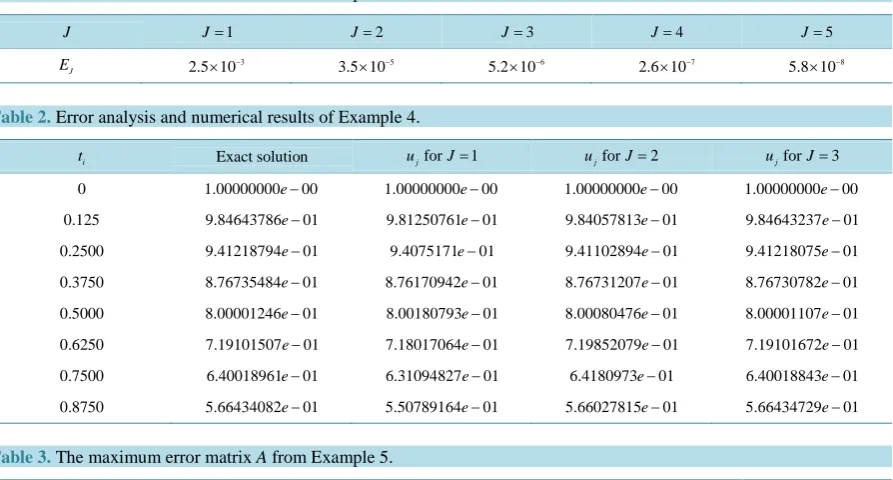
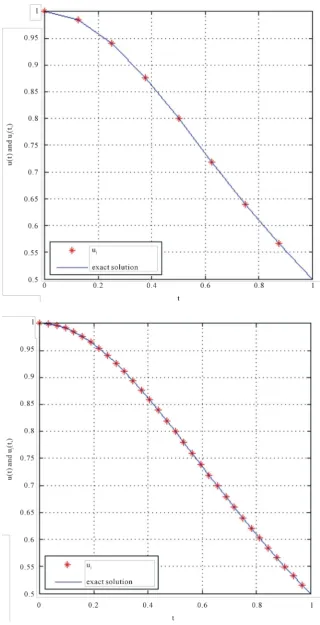
apply the suggested method with J=1 and J =2. The behavior of the approximate solution using the proposed method with J=1, J =2 and the exact solution are presented inFigure 1. InTable 1, we give the errors EJ of matrix A for different values of J. From this figure, it is clear that the proposed method can be considered as an efficient method to solve the linear integral equations. FromTable 1 we see the errors decrease rapidly as J increase.
InTable 2 we compare the new method with J=1, J=2 and J =3 together with the exact solution. For the purpose of comparison we defined the meximum error for uJ
( )
x as( ) ( )
max{
( ) ( )
,}
J J J
E = u x −u x ∞ = u x −u x a≤ ≤x b
Example 5 Consider the following second-order the Fredholm Linear Integro-Differential Equation
( )
( 1)(
)
1( )
2 2
0
1 e
50 50 35 e e d
1
x
x xt
x u x xu x x u t t
x +
−
′′ + ′= + − +
+
∫
with the initial conditions u
( )
0 =1, u( )
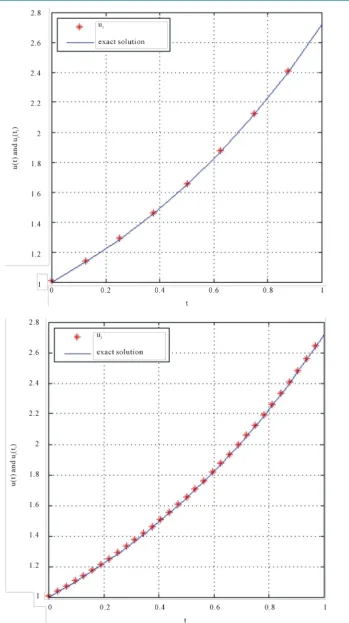
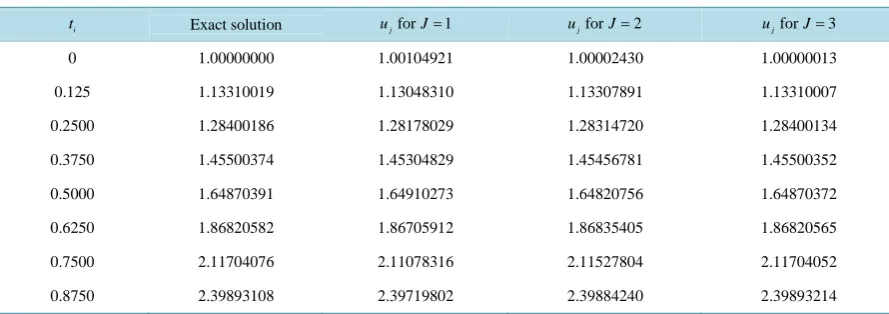
1 =e and exact solution ex. This problem is solved by the same me- [image:6.595.92.539.446.686.2]thods applied in example (4). Results are shown in Figure 2. From this figure, it is clear that the proposed method can be considered as an efficient method to solve the linear integral equations. For the purpose of com- parison inTable 3 we give the errors EJ of matrix A for different values of J. FromTable 4 we see the errors decrease rapidly as J increase. InTable 4 we compare the new method with J = 1, J = 2 and J = 3 together with the exact solution.
Table 1. The maximum error matrix A from Example 4.
J J=1 J=2 J=3 J=4 J=5
J
E 3
2.5 10× − 5
3.5 10× − 6
5.2 10× − 7
2.6 10× − 8
5.8 10× −
Table 2. Error analysis and numerical results of Example 4.
i
t Exact solution ujforJ=1 ujforJ=2 ujforJ=3
0 1.00000000e−00 1.00000000e−00 1.00000000e−00 1.00000000e−00
0.125 9.84643786e−01 9.81250761e−01 9.84057813e−01 9.84643237e−01
0.2500 9.41218794e−01 9.4075171e−01 9.41102894e−01 9.41218075e−01
0.3750 8.76735484e−01 8.76170942e−01 8.76731207e−01 8.76730782e−01
0.5000 8.00001246e−01 8.00180793e−01 8.00080476e−01 8.00001107e−01
0.6250 7.19101507e−01 7.18017064e−01 7.19852079e−01 7.19101672e−01
0.7500 6.40018961e−01 6.31094827e−01 6.4180973e−01 6.40018843e−01
0.8750 5.66434082e−01 5.50789164e−01 5.66027815e−01 5.66434729e−01
Table 3. The maximum error matrix A from Example 5.
J J=1 J=2 J=3 J=4 J=5
J
E 5
2.9 10× − 6
5.2 10× − 7
5.9 10× − 7
2.2 10× − 8
Table 4. Error analysis and numerical results of Example 5.
i
t Exact solution ujforJ=1 ujforJ=2 ujforJ=3
0 1.00000000 1.00104921 1.00002430 1.00000013
0.125 1.13310019 1.13048310 1.13307891 1.13310007
0.2500 1.28400186 1.28178029 1.28314720 1.28400134
0.3750 1.45500374 1.45304829 1.45456781 1.45500352
0.5000 1.64870391 1.64910273 1.64820756 1.64870372
0.6250 1.86820582 1.86705912 1.86835405 1.86820565
0.7500 2.11704076 2.11078316 2.11527804 2.11704052
0.8750 2.39893108 2.39719802 2.39884240 2.39893214
5. Conclusion
Our results indicate that the method with the trigonometric scaling bases can be regarded as a structurally simple algorithm that is conventionally applicable to the numerical solution of IDEs. In addition, although we have re- stricted our attention to linear Fredholm IDEs, we expect the method to be easily extended to more general IDEs. the presented method which is based on the trigonometric scaling function is proposed to find the approximate solution. A comparison of the exact solution reveals that the presented method is very effective and convenient. Nevertheless, asFigure 1 andFigure 2 illustrate, the error of the trigonometric scaling bases shows that the ac-curacy improves with increasing J, hence for better results, using number J is recommended. Also form the ob-tained approximate solution, we can conclude that the proposed method gives the solution in an excellent agree- ment with the exact solution. All computations are done using MATLAB programming.
Acknowledgements
The authors are very grateful to the editor for carefully reading the paper and for their comments and sugges- tions which have improved the paper.
References
[1] Desmond, R.A., Weiss, H.L., Arani, R.B., Soong, S.-J., Wood, M.J., Fiddian, P., Gnann, J. and Whitley, R.J. (2002) Clinical Applications for Change-Point Analysis of Herpes Zoster Pain. Journal of Pain and Symptom Management, 23, 510-516. http://dx.doi.org/10.1016/S0885-3924(02)00393-7
[2] Wazwaz, D.D., Dimitrova, M.B. and Dishliev. A.B. (2000) Oscillation of the Bounded Solutions of Impulsive Diffe-rential-Difference Equations of Second Order. Applied Mathematics and Computation, 114, 61-68.
http://dx.doi.org/10.1016/S0096-3003(99)00102-2
[3] Gulsu, M. and Sezer, M. (2006) A Taylor Polynomial Approach for Solving Differential-Difference Equations. Journal
of Computational and Applied Mathematics, 186, 349-369. http://dx.doi.org/10.1016/j.cam.2005.02.009
[4] Maleknejad, K., Mirzaee, F. and Abbasbandy, S. (2004) Solving Linear Integro-Differential Equations System by Us-ing Rationalized Haar Functions Method. Applied Mathematics and Computation, 155, 317-328.
http://dx.doi.org/10.1016/S0096-3003(03)00778-1
[5] Maleknejad, K., Tavassoli, M. and Kajani, M. (2004) Solving Linear Integro-Differential Equation by Galerkin Me-thods with Hybrid Functions. Journal of Computational and Applied Mathematics, 159, 603-612.
http://dx.doi.org/10.1016/j.amc.2003.10.046
[6] Ganesh, M. and Sloan, I.H. (1999) Optimal Order Spline Methods for Nonlinear Differential and Integro-Differential Equations. Applied Numerical Mathematics, 29, 445-478. http://dx.doi.org/10.1016/S0168-9274(98)00067-1
[7] Dascoglua, A. and Sezer, M. (2005) Chebyshev Polynomial Solutions of Systems of Higher-Order Linear Fredholm- Volterra Integro-Differential Equations. Journal of the Franklin Institute, 342, 688-701.
http://dx.doi.org/10.1016/j.jfranklin.2005.04.001
[9] Danfu, H. and Xufeng, A.S. (2007) Numerical Solution of Integro-Differential Equations by Appling CAS Wavelet Operational Matrix of Integration. Applied Mathematics and Computation, 194, 460-466.
http://dx.doi.org/10.1016/j.amc.2007.04.048
[10] Baker, C. and Tang, A. (1997) Stability of Continuous Implicit Runge-Kutta Methods for Volterra Integro-Differential Systems with Unbounded Delays. Applied Numerical Mathematics, 24, 153-173.
http://dx.doi.org/10.1016/S0168-9274(97)00018-4
[11] El-Sayed, S., Kaya, D. and Zarea, S. (2004) The Decomposition Method Applied to Solve High Order Linear Volterra- Fredholm Integro-Differential Equations. International Journal of Nonlinear Sciences and Numerical Simulation, 52, 105-112.
[12] Sezer, M. and Gulsu, M. (2007) Polynomial Solution of the Most General Linear Fredholm-Volterra Integro Differential- Difference Equations by Means of Taylor Collocation Method. Applied Mathematics and Computation, 185, 646-657.
http://dx.doi.org/10.1016/j.amc.2006.07.051
[13] Sezer, M. and Gulsu, M. (2005) A New Polynomial Approach for Solving Difference and Fredholm Integro-Difference Equations with Mixed Argument. Applied Mathematics and Computation, 171, 332-344.
http://dx.doi.org/10.1016/j.amc.2005.01.051
[14] Chui, C.K. and Mhaskar, H.N. (1993) On Trigonometric Wavelets. Constructive Approximation, 9, 167-190.
http://dx.doi.org/10.1007/BF01198002
[15] Prestin, J. (2001) Trigonometric Wavelets. In: Jain, P.K., et al., Eds., Wavelet and Allied Topics, Narosa Publishing House, New Delhi, 183-217.
[16] Themistoclakis, W. (1999) Trigonometric Wavelet Interpolation in Besov Spaces. Facta Univ. (Nis) Ser. Math. Inform, 14, 49-70.
[17] Quak, E. (1996) Trigonometric Wavelets for Hermite Interpolation. Department of Mathematics, Texas A. M. Univer-sity, 65, 683-722.
[18] Chen, W.S. and Lin, W. (1997) Hadamard Singular Integral Equations and Its Hermite Wavelet Methods. Proceedings
of the 5th International Colloquium on Finite Dimensional Complex Analysis, Beijing, 13-22.
[19] Chen, W.S. and Lin, W. (2002) Trigonometric Hermite Wavelet and Natural Integral Equations for Stockes Problem.
International Conference on Wavelet Analysis and Its Applications, Guangzhou, 73-86.