Scholarly Research Journal for Interdisciplinary Studies, Online ISSN 2278-8808, SJIF 2016 = 6.17, www.srjis.com UGC Approved Sr. No.49366, JULY-AUG 2017, VOL- 4/35
Copyright © 2017, Scholarly Research Journal for Interdisciplinary Studies A STUDY OF QUALITY INDICATORS IN TEACHER EDUCATION
PROGRAMMES AS PERCIEVED BY TEACHER EDUCATORS OF MANUU
Shakera Parveen, Ph. D.
Asst. Prof. Dept. of Education &Training, MANUU
At present a number of initiatives are being taken up from various bodies such as Quality Assurance Division, National Assessment and Accreditation Council for Teacher Education to bring Qualitative Reforms in Teacher Education Programmes. In the context of Teacher Education, this study is an attempt to identify and rate the Quality Indicators related to Teacher Education Programme as perceived by Teacher Educators of MANUU and its respective CTE’s. And also to identify the indicators in top 10 as ranking given by teacher Educators regarding their Perceptions on Quality Indicators .Survey method was adopted to collect the data. Sample consisted of Teacher Educators from MANUU and its respective Colleges of Teacher Education located in various states in India. Simple Random Sampling Technique was adopted. Opinionnaire as a tool with 30 items was administered on the sample. Teacher Educators were requested to identify the relative importance of 30 Quality Indicators in Teacher Education Programme on a five point scale arranged from of no relevance to excellent. Respondents were also given an option to specify any important Quality Indicators other than those included in the scale. Data was analysed using percentages, Ranks given for item-wise scores obtained on Teacher Educators perception on Quality Indicators.
Keywords: Quality indicators; Teacher education; Teacher Educators perceptions; Education quality; Qualitative Reforms;
I. Introduction
Teacher education plays a vital role in reforming and strengthening the education
system in any country. In India, DIET’s, Colleges of Teacher Education and University
Departments of Education/ IASE’s are major institutions that impart teacher training through
various academic programmes. Despite its considerable quantitative expansion, teacher
education has been criticized by the academicians and researchers for low quality. In his
recent article, Dilshad (2010) has reviewed the literature and identified following common
problems related to teacher training “lack of funding and resources, poorly equipped training
institutions, short training period, undue emphasis on quantitative expansion, narrow scope of
curriculum, imbalance between general and professional courses, over-emphasis on theory as
opposed to practice little/no coordination between education departments and training
institutions, deficient quality of instruction, lack of in-service training of teacher educators,
Dr. Shakera Parveen
(Pg. 6688-6692) 6689
Copyright © 2017, Scholarly Research Journal for Interdisciplinary Studies
failure in implementing useful reforms, vague objectives, poor quality of textbooks, defective
examination system, lack of supervision and accountability, and lack of research and
evaluation of teacher training programmes” (Dilshad, 2010, p.88).
In order to bring qualitative reform in teacher education in India, at present a number
of initiatives are being taken from various bodies including, Quality Assurance Division and
National Accreditation Council for Teacher Education. To make these measures more
focused and cost effective, there is a dire need to identify the significant areas/aspects of
quality improvement. In the context of teacher education, this study is an attempt to identify
the important quality indicators as perceived by the teacher educators working in MANUU
campus and its respective CTE’s. And also to rate the quality indicators on the basis of
ranking from 1-10 out of 30 Quality Indicators taken from NAAC Quality indicators scale on
Teacher Education.
II. Literature Review
Quality indicators are “generic statements made in such a way that they ensure
comprehensive coverage of the most relevant domains of the quality of teacher education
institution” (National Assessment and Accreditation Council [NAAC]
Chande (2006) believes that performance indicators may be of three types: quantitative,
narrative (subjective) and combination of quantitative and narrative. Several research studies
have been undertaken either to identify indicators of education quality or to assess quality of
education in the context of indicators. The indicators of education quality suggested by
Thaung (2008) include learners, teachers, content, teaching-learning processes, learning
environments, and outcomes. According to Moosa (2006), quality issues may be grouped into
six basic educational processes including teacher, curricula, assessment, research,
communication and students. With reference to Indian higher education, Chande (2006) has
surveyed teachers’ opinions about 28 performance indicators in six areas including students,
teachers, institution, research, higher education outcomes and syllabus. Some studies have
also been conducted to identify quality indicators for teacher education. Yackulic and
Noonan (2001) have pointed out 34 quality indicators for teacher training in Canada, which
were rated by different groups of respondents. In India, an important work was undertaken by
National Assessment and Accreditation Council (NAAC) to identify 75 quality indicators for
teacher education in six key areas namely curriculum design and planning; curriculum
Dr. Shakera Parveen
(Pg. 6688-6692) 6690
Copyright © 2017, Scholarly Research Journal for Interdisciplinary Studies
resources; student support and progression; and organization and management (NAAC)This
study investigated the perceptions of faculty members of MANUU and its CTE,s about the
quality indicators in teacher education programmes.
III. Objectives of the Study
This study was designed primarily to identify and rate the quality indicators related to
teacher education programmes as perceived by teacher educators of MANUU and its
respective CTE’s.
IV. Research Methodology
Survey method was used to collect data for this study which was descriptive in its
nature. The population of the study consisted of teacher educators of MANUU and its CTE’s.
60 teacher educators were taken as sample. Opinionnaire was used for data collection, teacher
educators were requested to identify the relative importance of 30 quality indicators in
teacher education programmes on five point scale. Teachers were also given option to specify
any important indicator other than those included in the scale that ranged from “of no
relevance” to “excellent” (1 to 5). The relevant literature on quality in teacher education was
surveyed extensively to identify the quality indicators included in the scale. Quality
indicators for teacher education prepared by NAAC covers 75 quality indicators.
Apart from demographic information (gender, age, designation, qualification,
experience), the scale consisted of thirty quality indicators related to teacher education
programmes taken from Quality Indicators- NAAC. The quality indicators identified in this
study were mainly derived from the tool prepared by NAAC. The Opinionnaire was
administered by employing various methods of data collection i.e. mailing the copies of
Opinionnaire, approaching the respondents personally, and reminding them through phone
calls and e-mails. The respondents were given enough time for completing the opinionnaires.
Male and female teacher educators were accessed for data collection and the return rate was
63.82%. In order to arrive at findings and conclusions, data was analyzed by finding
percentages and ranking. The demographic information of the respondents was worked out.
The response value of ranking along with percentages was calculated item-wise.
V. Results and Discussion
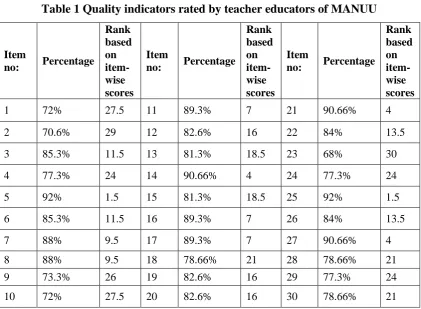
The analysis revealed that 60 Teacher educators were asked to rate 30 indicators related to
quality of teacher education programmes. The table shows Quality indicators rated by teacher
Dr. Shakera Parveen
(Pg. 6688-6692) 6691
[image:4.595.88.510.91.400.2]Copyright © 2017, Scholarly Research Journal for Interdisciplinary Studies
Table 1 Quality indicators rated by teacher educators of MANUU
Item
no: Percentage
Rank based on item-wise scores Item
no: Percentage
Rank based on item-wise scores Item
no: Percentage
Rank based on item-wise scores
1 72% 27.5 11 89.3% 7 21 90.66% 4
2 70.6% 29 12 82.6% 16 22 84% 13.5
3 85.3% 11.5 13 81.3% 18.5 23 68% 30
4 77.3% 24 14 90.66% 4 24 77.3% 24
5 92% 1.5 15 81.3% 18.5 25 92% 1.5
6 85.3% 11.5 16 89.3% 7 26 84% 13.5
7 88% 9.5 17 89.3% 7 27 90.66% 4
8 88% 9.5 18 78.66% 21 28 78.66% 21
9 73.3% 26 19 82.6% 16 29 77.3% 24
10 72% 27.5 20 82.6% 16 30 78.66% 21
Table 1 presents 30quality indicators that Teachers Educators of MANUU rated for
improving quality of teacher education programme. The response values indicate that item
no:5 Access to ICT;Item11 utilization of TLM/ICT lab and other learning resources; item
no:14 proper infrastructure facilities to staff and students ; item no:16 transparency and
objectivity in recruiting staff and faculty ;item no:17 continuous and comprehensive
assessment of learning outcomes; item no:21 faculty research activities; item no:25qualified
staff for vocational guidance and counseling; item no:27 assessment and evaluation for
improving skills and enhancing competence. All these eight items were ranked top ten among
thirty items given in the opinionnaire.
VI. Conclusion
Teacher educators, being key stakeholders, play important role in reforming and
improving quality of teacher education programmes. Hence their judgment and perceptions of
reform agenda are very critical for implementation of different quality improvement
measures. This study was focused on identifying the quality indicators in teacher education
programmes and ranking them in the light of perceptions of teacher educators working in
Dr. Shakera Parveen
(Pg. 6688-6692) 6692
Copyright © 2017, Scholarly Research Journal for Interdisciplinary Studies References
Quality Indicators for Teacher Education-National Accreditation Council for Teacher Education naac.gov.in/docs/quality indicators for teacher education.pdf
Dhar, T.N(1996) Professional Status of Teachers, New Delhi, NCTE. NCTE Document (1998) New Delhi, member secretary NCTE.