MARKER TEXTBOOKS FOR AUGMENTED REALITY ON
MOBILE LEARNING
1TOUFAN D TAMBUNAN, 2HERU NUGROHO
1,2
Telkom Applied Science School, Department of Information Technology,
Telkom University, Bandung, Indonesia.
E-mail: [email protected], [email protected],
2
[email protected], [email protected]
ABSTRACT
Variations learning media in school is to help students understand the material & content being studied. Media like simulation reality can be used as a learning tool to provide learning experiences for students in understanding something that is being studied. In this paper, a design proposed technique will be made learning simulation using mobile augmented reality. The research conducted on learning materials physics and motion at high school. Aims to facilitate students understanding of physics concepts of motion by giving an example of a virtual simulation on mobile applications. Augmented Reality technology used combines a virtual object or 2D and 3D into a real object environment and projecting the virtual objects in real time. We propose the design of an augmented reality system using the student textbook for detecting marker-less augmented. Technique marker-less can simplify the implementation of Augmented Reality applications on textbooks student and implemented in mobile devices. The proposal is expected to learning simulations to help students understand the concept physics and motion through a technology that is easy to use.
Keywords: Augmented Reality, Marker, Mobile Learning, and Simulation.
1. INTRODUCTION
Problems faced today in education world is increasingly diverse. One of them is means of supporting learning, especially for materials that require props and simulation. Constraints faced by, among others, due to the difficulty in supplying props, the price is relatively expensive props and support props appropriate to the material in the textbook school students. Though the existence of these props is very important for students to be able to better understand the material being taught. Besides the existence of props will facilitate students to practice real against content been studied theoretically.
This study took a sample of cases in learning about the physics of matter Straight Regular Motion (linear motion) and uniformly accelerated motion (uniformly accelerated motion). This case would have been very supportive with props and movement simulation is practiced. In the real world these materials can be simulated using props like a pendulum, vehicle, and a bicycle motion, driven on flat or sloping field. Students will be able to see the visualization process of linier motion and uniformly
accelerated motion, and can apply the concept of search velocity, distance and time. Examples for each cases are essential for students' understanding of physics, especially mechanics and motion. Using of props is very important because such material is not enough merely imagined or memorized through textbook theory.
them into animated objects in 3D computer on smartphone or tablet.
This research is expected to produce a model of the application of augmented reality in the case of linear motion and uniformly accelerated motion, which can later be applied also to other learning simulation model. In addition the use of props visually integrated with the textbook, is expected to facilitate students to understand and practice the theory learned from textbooks. Augmented Reality technology, the making of props will be more cost-effective and affordable for their applicability in school because virtually done and can use a smartphone or media tablet computers are relatively affordable price. Outcomes of this research will be a prototype user Augmented Reality technology for learning linear motion and uniformly accelerated motion, with marker adjustable on the student textbook. Additionally, it will be made of design models Augmented Reality application in the case study materials, so that the material can be applied also to similar simulations.
2. METHODS
2.1 Augmented Reality (AR)
[image:2.595.331.491.425.724.2]Augmented Reality technology is merging the real world with virtual objects 3D visual through computer technology. This application will be made the object of a two-dimensional projection into a virtual three-dimensional visualization in real-time on the display monitor. Augmented Reality is another variation of Virtual Environments (VE), or better known as Virtual Reality (VR) [1]. In Augmented Reality application, users can still see the visual real-world environment, because virtual objects are simply inserted in the appropriate environmental detection of specific markers. One of its application on the device is a PC, Mobile even other simulation tools.
Figure 1: Augmented Reality Based On Paper (IQ Mobile)
Augmented Reality system works by capturing a specific marker object using sound sensors, cameras and motion. In a further development, this technology is adapted to developments in mobile device features such as GPS (Global Positioning System), accelerometer, compass, and camera [2]. This rapid development is supported by the application of technology for Augmented Reality on Android-based devices and iPhone. This technology has been widely applied to the needs of education, arts, commerce, health, military, entertainment, and advertising industries.
2.2 Marker AR
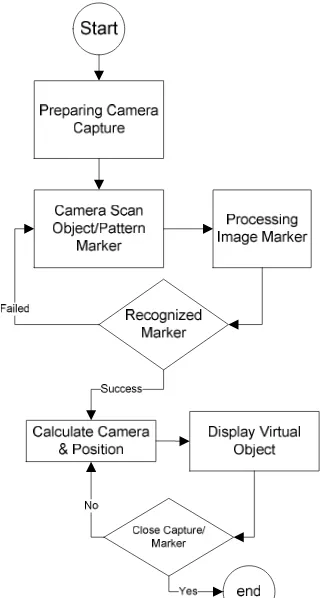
Initialization of augmented system is to identify markers that area will then be translated into an augmented object. Marker is a form that will be recognized by the camera sensor to then display the augmented object [4]. The application can be made with using marker of Vuforia library for Android, which can be used in Unity3D animation. In addition Vuforia can also easily identify markers so much faster in the marker reading initialization process.
[image:2.595.114.276.615.725.2]It is generally made according to a specific pattern of markers in the form of black and white. The shape will further facilitate the reading process. But there are also markers are made based on the text or picture to follow a predetermined format.
2.3 Unity3D Tools
Unity 3D is an application that is often used to create games of three-dimensional or two- dimensional. This application uses the C++ programming language and is supported also for the use of Javascript, Java, & C# [5]. Currently Unity 3D is not only used to build games, but is also used to create 3D animations, process visualization, simulation and other interactive forms , with the help of application 3D modeling Blender to create objects 3D.Engine Unity design can run on Windows , Linux , Mac and even such as Android and iOS mobile for iPhone . In addition this engine also has other facilities to support various library related to animation and games. One of them is a library Qualcomm Augmented Reality (QCAR) of the developer Qualcomm QCAR, or better known as Vuforia SDK, can be used for identification purposes markers in real time with 3D.Library object can also be used in the implementation of the use of augmented reality on Android [5].
2.4 Android SDK
Android is an operating system for mobile devices are currently widely used. This is because the devices that support varied according to the needs of its use, ranging from low specification to the most high. Although Android is derived from the Linux kernel, but for the development of applications can use the Java programming language or C. Especially for the development of interactive multimedia applications or other games, it takes integration with other libraries or engines like Unity, Java APIs , the GNU C Compiler ARM processor, and more [6].
Currently the widely used deviceAndroid have Gingerbread version (version 2.3), Honycomb (specifically version 3.0 computer tablet), or Ice Cream Sandwich (version 4.0), and the new version is Jelly Bean 4.1 [7]. Each version has a variety of
features and increased performance for
applications. But the final version of the three have had a lot of support for multimedia applications and games membangaun. Among the camera sensor, compass, GPS, accelerometers, APIs, OpenGL, and 3D motion processing. Android SDK can be downloaded for free and used to develop applications freely[7]. Another advantage of the use
of Android is the price relative prices vary from cheap to expensive, depending upon the need and more variant specification of hardware.
3. EXPERIMENT & RESULT
The initial step of this study, there are two parts of the discussion that needs to be prepared, namely the concept of motion simulation model of learning and application of engineering technology using Augmented Reality, textbox marker and Android SDK. This stage will be done by searching the references related to the discussion, either in the form of books, journals, articles and documentation applications. For a discussion of the simulation model of learning and teaching aids, reference will be made in accordance textbook students who have been there. Analysis was then performed studies to gain an understanding of the delivery of content in the form of practice through simulation with mobile learning. We will provide suggestions to simplify the design of Augmented Reality in simulation learning content.
3.1. Learning Content of Physics
Physics motion content for middle school students selected as the learning content to be used. Content on the physics of motion much need visual explanations and simulations to help students understand. One of them is the physical content of straight uniform motion and uniformly accelerated motion. In uniform rectilinear motion, objects the
same distance in the same time interval [3]. In other
[image:3.595.309.504.597.727.2]words the ratio of the distance interval is always constant, or constant speed. In linear motion velocity and speed is almost difficult to distinguish due to the straight trajectory causes the displacement distance and reached the same magnitude.
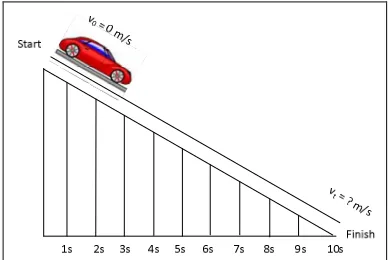
Objects that as uniformly accelerated motion has a velocity that changes with time. Thus within the same time interval change distance is not the same thing be achieved [3]. If the change in distance achieved growing large, mean velocity of the object is increasing as well. Such motion is called uniformly accelerated motion is accelerated. Conversely, if the change in distance achieved on the wane, meaning the slower speed of the object, the so-called motion with uniformly accelerated motion is slowed. Final velocity at a given moment is different from the initial velocity at t = 0, for example when reviewing the motion carried.
3.2.Learning Content with Augmented Reality
Requirement analysis to determine the needs for more detailed specification of the case study learning content. Further we will get the general shape of these needs to be applied to other case studies. In this case the concept of learning material motion, then requirement analysis need for more focus on the problem of learning with props and simulation. Specifically, the need to be formulated to be in accordance with the achievement of teaching content & applications for implementation augmented reality on Android devices. The requirement consists of,
a. form presentation of content physic
b. sample simulation motion
c. device specification
d. student textbooks
3.3.Design System
Augmented Reality systems are adapted to the application of the concept is built on a mobile device Android technology. So the system will design include 3D object modeling, data processing marker in the form of 3D visualization, processing model markers, identification of work designing Augmented Reality, simulation learning process flow design, and designing user interfaces for visualization application of Augmented Reality models.
At the stage implementation of augmented reality systems, will be divided into two phases, namely the development of marker through student textbooks and application simulation content props on Android devices. Each implementation is done in the case of linear motion & uniformly accelerated motion, and takes the form of visualization theory as explained in the textbook. To create a 3D object model will be used application Blender 3D. While the interactive
simulation for liner motion props and uniformly accelerated motion, each created using Unity 3D. The final results will be integrated use the Android SDK, so it can be run through the medium or high specification Android devices
The implementation of this learning model will be performed on two kinds of specifications of
Android devices, namely for specification
smartphones and tablet computers. The application is limited to the specifications of Android devices by looking at the parameters of the processor speed, data capacity, and the quality of the camera sensor, internal memory, graphics capabilities and the ability to screen / screen of the device.
3.4.Testing Result
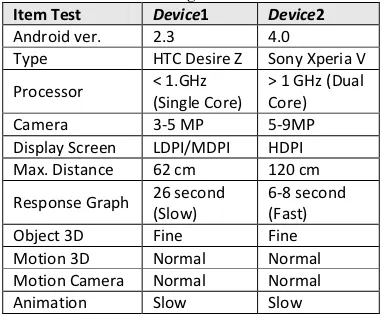
[image:4.595.311.502.416.574.2]After making the implementation phase, the results of the application will try a prototype tested in an environment that has been adapted to the needs. Testing the functionality and performance of the application is done directly on the device Android. The parameters of comparison that will be tested are as follows.
Table 1 Result Testing For Android Device
Item Test Device1 Device2
Android ver. 2.3 4.0
Type HTC Desire Z Sony Xperia V Processor < 1.GHz
(Single Core)
> 1 GHz (Dual Core)
Camera 3-5 MP 5-9MP
Display Screen LDPI/MDPI HDPI Max. Distance 62 cm 120 cm Response Graph 26 second
(Slow)
6-8 second (Fast)
Object 3D Fine Fine
Motion 3D Normal Normal Motion Camera Normal Normal
Animation Slow Slow
Figure 4 : Result Augmented Reality For 3D Object Motion On Android Device
It should also be testing UAT (User Acceptance Test), for the learning content of motion physics. In accordance with the test case concept of linear motion and uniformly accelerated motion, testing was conducted to validate the theoretical concept of motion simulation. The testing process is conducted on students' understanding and testing by a teacher or master the teaching of linear motion and uniformly accelerated motion.
4. CONCLUSIONS
The implementation of AR technology on Android device is relatively easy to do. Result application for animation and 3D object is fairly well. So that the result will be easily applied to development of teaching content. General implementation of AR for Android device is successfully to medium and high device. The challenge is to apply this method for more interactive 3D animation and detail object. Increasing the speed of rendering, 3D animation and response are some of the parameters that need to be developed in next research. In addition it should also develop ways of teaching materials detection marker in a more concise and accurate.
REFRENCES:
[1] Azuma, Ronald T. 1997. A Survey of
Augmented Reality. In Presence: Teleoperators and Virtual Environments 6, 4 (August 1997), 355-385
[2] S. Karpischek, C. Marforio, M. Godenzi, S.
Heuel, and F. Michahelles.2009. Mobile augmented reality to identify mountains. In Adjunct Proc. of AmI. Switzerland: ETH Zurich.
[3] Utomo, Pristiadi. 2009. Fisika Kelas X. Pusat
Perbukuan Departemen Pendidikan Nasional.
[4] Hull, Jonathan. 2007. Paper-Based Augmented
Reality. International Conference on Artificial Reality and Telexistence.IEEE.
[5] The Unity Team. Unity Scripting Reference.
Unity Documentation. Diakses 20 September
2013 dari:
http://docs.unity3d.com/Documentation/Manua l/index.html
[6] Silva, Vladimir. 2009. Pro Android Games.
Apress Publisher
[7] Developer Android. Developer Android:
Documentation. Diakses 20 September 2013 dari: