MAR-APRIL 2017, VOL- 4/30 www.srjis.com Page 5067 CONSEQUENCES OF AN ACID RAIN AND ITS CONTROL MEASURES
Pawanpreet Kaur
Department of Chemistry, DAV College, Sector-10, Chandigarh-160011
Acidic rain is one among the chronic problems for the global climate change and ecological deformation of our surroundings. Acid rain as the name suggests can be given to the precipitation of acid in the form of rain. But this term actually is somewhat misleading because even pure rain water collected in areas remote from civilization is slightly acidic (pH = 5.6) due to dissolved carbon dioxide, which reacts with water to give carbonic acid, a weak acid. It's been reduced by pack up smokestacks and exhaust pipes furthermore as victimization alternatives energy sources for vehicles, fuel station and electricity generation for various purpose so as to measure in an exceedingly safe and appropriate atmosphere without concern of worldwide warming and inexperienced house gases. Herein, the chemical analysis of the acid rain, its consequences and control measures undertaken by the government and should be taken by us are described.
Keywords: Acid rain, environment.
Introduction
The term „Acid Rain‟ was first used by Robert A. Smith in 1872 from his studies of air in
Manchester, England. The widespread occurrence of acid rain was recognized only in 1980.
Acid rain is a rain or any other form of precipitation that is unusually acidic, i.e., elevated
levels of hydrogen ions (low pH). It is downpour containing harmful quantities of nitric and
sulfuric acids which released into the atmosphere. When fossil fuels are burned, harmful
emissions released into the air.
“Clean” or unpolluted rain has an acidic pH, but usually no lower than 5.7, because carbon
dioxide and water in the air react together to form carbonic acid, a weak acid. However,
unpolluted rain can also contain other chemicals which affect its pH. A common example is
nitric acid produced by electric discharge in the atmosphere such as lightning. Carbonic acid
is formed by the reaction.
H2O (1) + CO2 (g) → H2CO3 (aq)
Unlike the normal rain that we all knew; acid rain has a pH below 5.6 [1]. It could be
considered as a result of air pollution. This is due to the presence of acidic oxide emissions in
Scholarly Research Journal's is licensed Based on a work at www.srjis.com
MAR-APRIL 2017, VOL- 4/30 www.srjis.com Page 5068 the atmosphere from industries and vehicles. It has many other names such as acid
precipitation or acid deposition. Emissions of sulfur dioxide and nitrogen oxides are causing
the acid rain, which they can react with the water molecules to produce acids.
Acid rain could affect negatively on plants, aquatic animals, and infrastructure. Acid forming
gases are oxidized over several days by which time they travel several thousand kilometers.
In the atmosphere, these gases are ultimately converted into sulphuric and nitric acids. This
acidic mixture then falls as rain, sleet, mist or snow or as solid flakes. Hydrogen chloride
emission forms hydrochloric acid
Acid rain is the phenomenon of wet and dry acidic deposition. The phase of acid deposition
can either be wet or dry. Acid rain, snow, dew, fog, frost and mist represent the wet form of
deposition, while dust particles containing sulphates and nitrates, settled on earth, is called
dry deposition. However, the wet acid rain is much more common.
Wet deposition of acids occurs when any form of precipitation (rain, snow, and so on)
removes acids from the atmosphere and delivers it to the Earth‟s surface. This can result from
the deposition of acids produced in the raindrops (see aqueous phase chemistry above) or by
the precipitation removing the acids either in clouds or below clouds. Wet removal of both
gases and aerosols are both of importance for wet deposition.
Dry deposition: Acid deposition also occurs via dry deposition in the absence of precipitation.
This can be responsible for as much as 20 to 60% of total acid deposition [2]. This occurs
when acidic particles and gases stick to the ground, plants or other surfaces. The wind blows
these acidic particles and gases towards buildings, cars, homes and trees. Dry deposited gases
and particles can also be washed from trees and other surfaces by rainstorms. When that
happens, the runoff water adds those acids to the acid rain, making the combination more
acidic than the falling rain alone
Methodology:
Acid rain is measured using pH meter from 1 to 14 value scales with a pH of 7.0 being
neutral, 0 to 7 being acidic, and 7 to 14 basic [3]. When the pH value lowers, the acidity
nature of rain increases. Pure water has a pH value of 7. However, normal rain is slightly
acidic because different acidic oxide emissions react with rain that lowers the pH value about
MAR-APRIL 2017, VOL- 4/30 www.srjis.com Page 5069 Discussions:
Chemical Reactions Involved in the Acid Rain:
(i) Oxides of nitrogen like NO reacts with O2 and H2O produces nitrous and nitric
acid as follows:
2NO + O2 → 2NO2 + H2O → HNO3 + HNO2
(ii) Oxides of Sulphur also produce H2SO4 as follows:
2SO2 + O2 →2SO3 + 2H2O → 2H2SO4
Every source of energy that we use-be it coal, fuel wood or petroleum products, has sulphur
and nitrogen. These two elements, when burnt in atmospheric oxygen, are converted into
their respective oxides (SO2 and NOx) which are highly soluble in water. By anthropogenic
and by natural sources, oxides of sulphur and nitrogen enter the atmosphere.
S + O2 → SO2 2SO, + O2 → 2SO3
In case of nitrogen, following reactions are involved.
NO + O3 → NO3 + O2 NO2 + O2 → N O3 + O2
NO3 + NO2 → N2O5
Under the humid conditions of air, N2O5 invariably reacts with water vapors to form droplets
of HNO3.
N2O5 + N2→ 2HNO3
Some HNO2 is also formed.
N2 O3 + H2O→ 2HNO2
HNO3 and HNO2 then return to the earth‟s surface. However, HNO3 can be removed as a
particulate or as particulate nitrates after reaction with bases such as NH3 SO3 in humid
atmosphere forms droplets of H2SO4
SO2 + 1/2 O2 + H2O→H2SO4
HNO3 and H2SO4 thus formed combine with HCl (emitted from natural and man-made
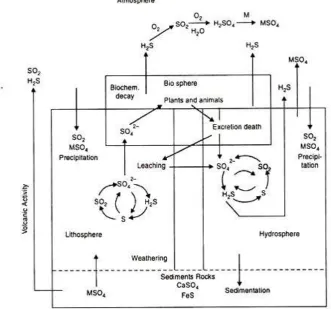
MAR-APRIL 2017, VOL- 4/30 www.srjis.com Page 5070 Fig. 1. Formation of sulphuric acid present in acid rain
A recent study conducted by ocean scientists from Florida State University, USA provides
evidence of the greater role of atmospheric nitrogen, rather than of ground sources, in
controlling the nitrogen levels of rivers.
It was believed that ground sources such as fertilizer runoff from farmland and municipal
waste streams contributed to the variation of nitrogen levels in rivers, But scientists from
Florida analysed the data from two sources the acid rain measurements of National
Atmo-spheric Deposition Programme and the River Chemistry Studies of US Geological Survey to
conclude that the atmospheric deposition of nitrogen plays a major role in quality of water
and acid rain is the most important sources of nitrogen.
The oxides of sulphur and nitrogen are swept up into the atmosphere and can travel thousands
of kilometres. The longer they stay in the air, the more likely they are to be oxidised into
acids.
For example, a given molecule of SO2 may remain in the atmosphere up-to 40 hours, while a
sulphate particle may remain for three weeks. They have enough long-life period and so these
MAR-APRIL 2017, VOL- 4/30 www.srjis.com Page 5071 During the last few decades acid rain occurred within the downwind of areas of major
industrial areas in Europe and America. The chemicals in acid rain can cause paint to peel,
corrosion of steel structures such as bridges, and erosion of stone statues. Both the lower pH
and higher aluminium concentrations in surface water that occur as a result of acid rain can
cause damage to fish and other aquatic animals. At pH lower than 5 most fish eggs will not
hatch and lower pHs can kill adult fish. As lakes and rivers become more acidic biodiversity
is reduced. Acid rain has eliminated insect life and some fish species, including the brook
trout in some lakes, streams, and creeks in geographically sensitive areas, such as the
Adirondack Mountains of the United States.
Soil biology and chemistry can be seriously damaged by acid rain. Some microbes are unable
to tolerate changes to low pH and are killed. The enzymes of these microbes are denatured
(changed in shape so they no longer function) by the acid. The hydronium ions of acid rain
also mobilize toxins such as aluminum, and leach away essential nutrients and minerals such
as magnesium.
2 H+ (aq) + Mg2+ (clay) <==> 2H+ (clay) + Mg2+ (aq)
Soil chemistry can be dramatically changed when base cations, such as calcium and
magnesium, are leached by acid rain thereby affecting sensitive species, such as sugar maple
(Acer saccharum). Parts of India such as North East, Coastal regions of Kerala, Orissa, Bihar,
and West Bengal have reported decline in fertility of soil due to reduced pH of soil (increased
in acidity).
Acid rain not only damages soil but can also affect the trees directly. Pollutants can block or
damage the little pores on the leaves through which the plant takes in the air it needs to
survive. High altitude forests are especially vulnerable as they are often surrounded by clouds
and fog which are more acidic than rain.
Other plants can also be damaged by acid rain, but the effect on food crops is minimized by
the application of lime and fertilizers to replace lost nutrients. In cultivated areas, limestone
may also be added to increase the ability of the soil to keep the pH stable, but this tactic is
largely unusable in the case of wilderness lands. When calcium is leached from the needles of
red spruce, these trees become less cold tolerant and exhibit winter injury and even death.
Acid rain does not directly affect human health. The acid in the rainwater is too dilute to have
direct adverse effects. However, the particulates responsible for acid rain (sulphur dioxide
and nitrogen oxides) do have an adverse effect. Increased amounts of fine particulate matter
MAR-APRIL 2017, VOL- 4/30 www.srjis.com Page 5072 Acid rain can also damage buildings and historic monuments and statues, especially those
made of rocks, such as limestone and marble that contain large amounts of calcium
carbonate.
When sulphur pollutants fall on to buildings made from limestone and sandstone they react
with minerals in the stone to form a powdery substance that can be washed away by rain.
Acids in the rain react with the calcium compounds in the stones to create gypsum, which
then flakes off.
CaCO3 (s) + H2SO4 (aq) <==> CaSO4 (aq) + CO2 (g) + H2O (1)
The effects of this are commonly seen on old gravestones, where acid rain can cause the
inscriptions to become completely illegible. Acid rain also increases the corrosion rate of
metals, in particular iron, steel, copper and bronze. Famous buildings like the Statue of
Liberty in New York, the Taj Mahal in India and St. Paul‟s Cathedral in London have all
been damaged by this sort of air pollution.
Control of Acid Rain: Governments have made efforts since the 1970s to reduce the release
of sulphur dioxide into the atmosphere with positive results.
1. Clean up smokestacks and exhaust pipes: Emission of SO2 and NO2 from industries and
power plants should be reduced by using pollution control equipment‟s such as scrubbers in
the smokestacks of factories. These spray a mixture of water and limestone into the polluting
gases, recapturing the sulphur. Almost all of the electricity that powers modern life comes
from burning fossil fuels like coal, natural gas, and oil. However, exhaust emission of these
fuels are the main causes of acid deposition that released into the atmosphere. Coal fuel
accounts for most US SO2 and a large portion of NOx emissions. Sulphur is present in coal as
an impurity, and it reacts with air when the coal is burned to form SO2. In contrast, NOx is
formed when any fossil fuel is burned. There are several options for reducing SO2 emissions,
including using coal containing less sulphur, washing the coal, and using devices called
scrubbers to chemically remove the SO2 from the gases leaving the smokestack and recycling
to use as a raw material. Power plants can also switch fuels; for example, burning natural gas
creates much less SO2 than burning coal. Certain approaches will also have additional
benefits of reducing other pollutants such as mercury and carbon dioxide. Understanding
these "co-benefits" has become important in seeking cost-effective air pollution reduction
strategies. Finally, power plants can use technologies that don't burn fossil fuels. Each of
these options has its own costs and benefits, however; there is no single universal solution.
Similar to scrubbers on power plants, catalytic converters reduce NOx emissions from cars.
MAR-APRIL 2017, VOL- 4/30 www.srjis.com Page 5073 them working properly and tailpipe restrictions have been tightened recently. EPA has also
made, and continues to make, changes to gasoline that allows it to burn cleaner dioxide of
sulphur (SO2) and NOx
2. Liming of lakes and soils should be done to correct the adverse effects of acid rain.
Powdered limestone added to water and soil to neutralize acid. It is commonly used in
Norway and Sweden. However, it is more expensive and short-term remedy. Acid deposition
penetrates deeply into the fabric of an ecosystem, changing the chemistry of the soil as well
as the chemistry of the streams and narrowing, sometimes to nothing, the space where certain
plants and animals can survive. Because there are so many changes, it takes many years for
ecosystems to recover from acid deposition, even after emissions are reduced and the rain
becomes normal again. For example, while the visibility might improve within days, and
small or episodic chemical changes in streams improve within months, chronically acidified
lakes, streams, forests, and soils can take years to decades or even centuries (in the case of
soils) to heal. However, there are some things that people do to bring back lakes and streams
more quickly. Limestone or lime (a naturally-occurring basic compound) can be added to
acidic lakes to "cancel out" the acidity. This process, called liming. Liming tends to be
expensive, has to be done repeatedly to keep the water from returning to its acidic condition,
and is considered a short-term remedy in only specific areas rather than an effort to reduce or
prevent pollution. Furthermore, it does not solve the broader problems of changes in soil
chemistry and forest health in the watershed, and does nothing to address visibility
reductions, materials damage, and risk to human health. However, liming does often permit
fish to remain in a lake, so it allows the native population to survive in place until emissions
reductions reduce the amount of acid deposition in the area
3. A coating of protective layer of inert polymer should be given in the interior of water pipes
for drinking water.
4. In catalytic converters, the gases are passed over metal coated beads that convert harmful
chemicals into less harmful ones.
5. Use alternative energy sources: There are other sources of electricity besides fossil fuels
such as nuclear power, hydropower, wind energy, geothermal energy, and solar energy. Of
these, nuclear and hydropower are used most widely; wind, solar, and geothermal energy
have not yet been harnessed on a large scale. There are also alternative energies available to
power automobiles, including natural gas-powered vehicles, battery-powered cars, fuel cells,
biofuels and biodiesel and combinations of alternative and gasoline powered vehicles. All
MAR-APRIL 2017, VOL- 4/30 www.srjis.com Page 5074 more expensive to produce than others. Nuclear power, hydropower, and coal are the
cheapest forms today, but changes in technologies and environmental regulations may shift
that in the future. All of these factors must be weighed when deciding which energy source to
use today and which to invest for tomorrow
Conclusions:
Mostly, rainfall that has a pH value less than 5.6 is considered as acid rain. It is formed when
sulphur dioxides and nitrogen oxides reacted with water during rain and as gases or fine. Acid
rain is defined in terms of wet and dry depositions. The wet deposition refers to acidic rain,
fog and snow whereas dry deposition refers to acidic gases and particles. This acid rain
affects a variety of plants and animals in our environment. Hence, its reduction is potentially
important for our future generations. we can reduce it by Clean up smokestacks and exhaust
pipes as well as using alternative energy sources for vehicles and electricity generation for
different purpose with the purpose of live in a safe and suitable environment.
References:
Stephen KL (1999) Introduction to acid-base chemistry. Simon Fraser University, Canada. Safe Drinking Water Foundation (2007) Saskatoon, Canada.
http://en.wikipedia.org/wiki/Acid_rain
http://www.epa.gov/acidrain/education/site_students/phscale.html