5
VIII
August 2017
Denudation Control of Embankment Slope
Configuration Using Jute Geo Textiles
M. Mamatha1, Dr. M. Kameswara Rao2
Civil Engineering Department, MREC(A)/ JNTUH, INDIA
1PG Scholar @ Malla Reddy Engineering College, Hyderabad, Telangana, India 2Professor @ Malla Reddy Engineering College, Hyderabad, Telangana, India
Abstract: Erosion of top soil of sides in case of road embankments and hilly slopes is quite common in the tropical regions. Most of the erosion of top soil takes place when the top layer of the slopes is disturbed due to human or animal interference and other man made activities. The energy which develops due to the impact of the rain drops when falls on the soil ultimately weakens the top soil particle to particle bonding and thereby seepage of water into the top most soil layer occurs which makes the top soil heavy in weight to slide down the slope. Such erosion can be prevented from occurring when the surface of the slope is covered with vegetative belt. But it takes six to nine months duration for the vegetative cover to grow on a soil surface. For the due course, Geojute, an open mesh type of Jute Geotextile which can be naturally degradable, may be utilized so as to control the erosion of the soil surface. By the time where the Jute Geotextile layer degrades and thereby becomes nutrient for fast and enhanced vegetative growth, vegetation cover gets established on the slope. Subsequently, it results in a sustainable and environmental friendly measure for decreasing the erosion of surface soil of the exposed slope surfaces.
Keywords: Jute Geotexile, JGT, Slope, Vegetation, Erosion, Embankment, Geojute
I. INTRODUCTION
It has been proved that Geotextiles can be the most effective, versatile and economic ground improvement materials. Their use in various applications has extended rapidly into nearly areas of all civil, geotechnical, environmental, coastal and also hydraulic engineering. They form the major components in the field of Geosynthetics, whereas other materials being geogrids, geosynthetic clay liners, geomembranes, geocells and geocomposites. One of the effective alternatives in today’s context, with respect to developing concern to the environment and carbon foot print generation, is the emergence of Jute geotextiles made out of naturally occurring fibres which includes geotextile materials for geotechnical applications, agro-textile materials and also other such relative materials. Jute geotextile (JGT) can however be considered as a potential technical product replacing most of today’s famous synthetic products which are anticipating severe threats to our nature and environment thereby adversely affecting the ecological balance and eco-congruity.
II. AIMANDOBJECTIVES
The main aim of this project work is the usage of Jute Geotextile for Denudation control of embankment slope configuration.
The following are the specific objectives and the possible outcome of the study:
A. To analyse the performance of Jute Geotextile, which is an open mesh fabric & a vegetation which are the remedial measures for the rain cut top soil erosion and also the slope failure of hilly regions, road embankments etc through a laboratory-based approach.
B. To promote the engineered application of Jute Geotextile and also vegetation as providing an environmental friendly, most reliable and economical approach against the slope stability failure and erosion concerned problems.
III. SCOPEANDSIGNIFICANCEOFSTUDY
In case of sustainable socio-economic development, applications and usable regions of JGT are in enhancing trend. There is a broad area of scope for prospective and innovative usage of JGT followed by the design as well as engineering of the products, oriented as per the requirements of the end-user for various geotechnical applications. This will open the newer avenues and directions for Jute, not only as a technical product, but also for the entire Jute Sector as it is environmental friendly and its implementation is effective for safeguarding environmental disruption.
Justri
@ CU
filaments woven into a substantial open work. It was essentially utilized for shielding recently slice slopes from disintegration through development of vegetation. Jute Geotextile has good tensile strength and is flexible, easy to install and also biodegradable and is thus environment friendly.
In road development, the side inclines of a street embankment are regularly cladded with thick layer of dirt keeping in mind the end goal to hinder raincut disintegration of the erodible dig fill soils of embankment. In any case, the extra measure of the mud soil required for this reason for existing is ending up noticeably progressively troublesome, costly and impeding to ecological balance. In the uneven regions, actually adjusted slope inclines frequently get aggravated either because of street development exercises or by the trademark local cultivating strategy in which they consume trees and vegetations of the slants keeping in mind the end goal to get an infertile land.
With a specific end goal to address such disintegration of best soil, a reasonable, eco-accommodating and aesthetic arrangement would be guaranteed via finished vegetation cover. In any case, it takes around 6~9 months for the vegetation cover to develop. For the interval time frame, a geojute overlay might be utilized to withstand the rain drop affect vitality, lessen surface overflow and decrease top soil erosion.
IV. MATERIALS
A. Geojute
The geojute (soil saver) utilized for the simulation test was procured from National Jute Board, Ministry of Textiles, Govt of India, Nampally. Geojute utilized for this test was an open work sort of jute geotextile. The gap of geojute was 20mm×20mm. The weight and thickness of the geojute were 590 gsm (grams per meter square) and 4.90 mm, individually. The wide width rigidity of the example was 16kN/m. Ground cover proportion and ingestion limit of the geojute were resolved to be 55% and 3.17 respectively.
B. Soil
The soil is collected from college ground of Jagruthi Institute of Technology and Science, situated at Ibrahimpatnam in the district of Ranga Reddy, South - eastern part in India. The climate of the area is characterized by Normal to high summers, moderate winters, tropical cyclones, tidal inundation, medium rainfall and salinity. The mean rainfall for every year is about 1,750 mm.
Fig 1: Geojute Sample used in the experiment Fig 2: Soil Sample Fig 3: Schematic diagram of soil slope created at Laboratory
C. Properties of Soil
Sandy soil of FM 1.14 was utilized for the simulation test.
TABLE I : PROPERTIES OF TREATED JGT
Weight ( g/m2) 590
Thickness (mm) 4.90
Spiral angle (degree) 9
Water holding capacity % 27.5 Tensile strength (kN/m)
(MDXCD
16×16
Porometry (micron) 200
The specific gravity of soil was 2.72. The angle of friction of the soil obtained from direct shear test was 33°. D10, D15, D50 and D90 of the soil were 0.15mm, 0.22mm, 0.40 mm and 0.48 mm respectively.
D. Slope Characteristics
Tests were done on 1:1.5 incline of compacted soil with 0.15m flat help of same soil on each side of the slant . Length of incline utilized was 0.62mbarring 0.15m on each side. A schematic graph of slant is appeared in Fig 3. Compaction impact was so kept up that the moist density of soil during compaction was approximately 9.9 KN/m3.
E. Rainfall Characteristics
Average rainfall intensity of India is 50-100 mm/hr. The rainfall intensity used in this model test was between 100 mm/hour & 125 mm/hour.
V. EXPERIMENTALSETUP
A. Container for Preparing Soil Slope
The soil slope was created in an 6 mm thick transparent 1.22m×0.81m×0.76m glass container. It is transparent container with thick black border at edges. In the bottom right corner of the container, there is a 20mm dia circular opening. The opening is joined with a pipe which is joined to one more small container for collecting runoff water and eroded soil.
B. Container for Collecting Eroded Soil and Runoff
A 2.44m×0.30m×0.61m compartment was utilized to gather spillover water. Spillover water alongside dissolved soil was depleted through the opening at base of the compartment for get ready soil slant and isolated here utilizing an engineered geotextile channel for measuring weight of disintegrated soil and volume of spillover water. The overflow water volume was found by increasing the tallness of water with length and width of this holder. Dissolved soil was air dried after partition and weighed for vital estimations.
C. Rainfall Distribution System
A steel circular plate precipitation appropriation framework was utilized to mimic uniform precipitation from a consistent stature at a consistent rate. This plate resembles a grinding of 2mm opening with 25.4mm focus to focus dividing. It is made to rest on two thick wooden sheet boards at a constant height on either side of the Glass container for rainfall as shown in the fig.
Fig.4: Experimental Glass container Fig.5: Container with drain pipe for collecting runoff water
Fig.6: Rainfall Distribution system
VI. METHODOLOGY
The outline of methodology comprises of following steps –
A. The test method included a Laboratory based approach where the whole test system (includes slope, rainfall, erosion & failure) was depicted by constructing an experimental model.
C. Water was allowed through a circular steel tray perforated as a form of rainfall.
D. Synthetic Geotextile was used as a filter to separate the eroded soils. Weight of separated eroded soils will be measured by weigh balance.
E. This procedure will be done in three phases:
1) Bare soil slope.
2) Soil slope covered with Geojute.
3) Soil slope with vegetative cover.
VII. PRACTICALWORK
Here, only bare soil slope is used to evaluate the soil loss characteristics.
A. Slope with Bare Soil
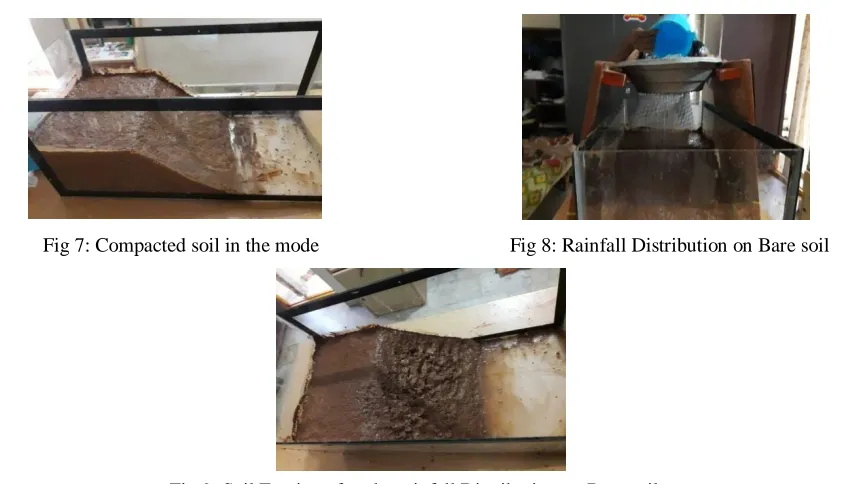
First test was made on bare soil slope. A tamping rod was used to compact soil properly. It was 0.061m feet height and 0.020m dia. 100 strokes of the tamping rod evenly distributed over the surface in every one-third soil fill up. An impermeable layer (rubber cloth) was setup beneath soil so that water didn’t accumulate at the bottom of the tank and liquefaction of soil was also protected. In that case top soil erosion was failure initiates gradually with erosion. The necessary data sheet of the calculation of percentage of erosion and graph showing various percentages of soil erosions with respect to time for bare soil are depicted in further section.
The experiment was done in a controlled atmosphere. Initially, soil slope was created in a container. Features of this slope are explained in above sections. Approximately, 80kg sand was compacted to obtain same volume, shape and slope for all tests to make sure same level of compactness of soil slopes used for both bare soil and geojute covered soil. Soil bed was compacted thoroughly. At that point precipitation of rough power of 120mm/hour was appropriated consistently finished the dirt surface from a consistent tallness to keep up steady precipitation vitality for all tests for the duration of the time. The volume and force of precipitation was checked at each ten moment interim. All the while, the dirt washed away with overflow water was isolated with channel and weighed after air drying. Both overflow water volume and dissolved soil mass were measured at ten moment interim. This procedure was rehashed a few times for uncovered soil to acquire a delegate result.
[image:5.612.99.527.395.637.2]Fig 7: Compacted soil in the mode Fig 8: Rainfall Distribution on Bare soil
Fig 9: Soil Erosion after the rainfall Distribution on Bare soil
After the culmination of these trials on exposed soil this procedure was rehashed for incline secured with geojute under comparative conditions utilizing same degree of soil. As some time recently, for this situation likewise every one of the readings were taken at ten minutes interim and the diagrams were plotted to look at acquired esteems.
B. Soil Covered with Geojute
1) Treatment of JGT: Generally, Geojute fiber gets swelled and degraded within 6 months in water and is less strong in acidic, basic and different arrangements. In this way some substance treatment is important to change over jute into plan biodegradable (5-20 a long time) and hydrophobic in nature without changing its natural cordial properties.
In the design for the treatment purpose, Initially we collected Jute Geotextile from local jute mill, later we prepared a mixer of Copper Sulphate (0.01 kg/m2), Sodium Carbonate (0.1 kg/m2) and then sprayed manually over Jute Geotextile mat and then dried in sun light. As soon as treated Jute Geotextile got fully dried, we laminated the Jute Geotextile tangle by an emulsion made from Bitumen (0.5 kg/m2) and Kerosene (0.4 L/m2). At long last, we included Sodium Silicate (0.005 kg/m2) arrangement on the bitumen treated surface and a layer of Rice process side-effect (0.075 kg/m2) and held it under daylight till it gets fully dried. Now, JGT is spread on the compacted soil slope in the model as shown in the following figure below.
[image:6.612.105.260.211.297.2]Fig 10: Jute Geo Textile on the compacted soil slope Fig 11: Supply of water for Rainfall distribution
Fig 12: Uniform distribution of Rainfall on the Geojute
Now again precipitation of inexact power of 120mm/hour was circulated consistently finished the dirt surface from a consistent tallness to look after steady precipitation vitality for constantly. The volume and force of precipitation was checked at each ten minute interim. All the while, the dirt washed away with overflow water was isolated with channel and weighed after air drying. Both overflow water volume and dissolved soil mass were measured at ten moment interim. This procedure was rehashed a few times to obtain a representative result.
After the completion of these experiments on Geojute covered soil with same degree of soil. As some time recently, in this case likewise every one of the readings were taken at ten minutes interim and the diagrams were plotted to think about acquired values.
3) Develpment of vegetation on the soil slope
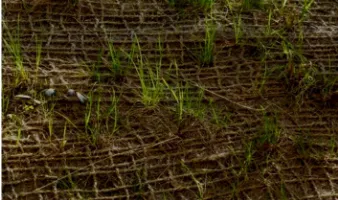
For the break time frame, Geojute, an open work sort of normally biodegradable jute Geotextile, is utilized as a part of request to hinder the best soil disintegration. When the Jute Geotextile overlay decomposes and becomes nutrient for accelerated vegetative growth, vegetation canopy gets established as shown in the figure below. Eventually, it becomes a sustainable as well as eco-friendly solution for reducing erosion of top soil of the exposed surface of the slope.
[image:6.612.221.390.617.717.2]VIII. RESULTS AND DISCUSSION Case I Data sheet:
Type of test: For Bare Soil
Slope of soil: 1:1.5
Water content of soil: 1.70 %
Total wt. of soil used: 78.5 kg
Density of soil =14 kN/m3
Volume of water supplied: 37 Liters
Volume of water on collector container: 8.5 Liter
Volume of water retained in soil container: 28.5 Liter
Time of water supply: 1 Hour
Rate of water supply: 120 mm/hr (2.23 L/mm)
Total Weight of eroded soil: 12.4 kg
Cumulative % of Erosion: 15.8
Case II Data sheet:
Type of test: For Geojute covered Soil
Slope of soil: 1:1.5
Water content of soil: 1.70 %
Total wt. of soil used: 78.5 kg
Density of soil =14 kN/m3
Volume of water supplied: 37 Liters
Volume of water on collector container: 5.5 Liter
Volume of water retained in soil container: 31.5 Liter
Time of water supply: 1 Hour
Rate of water supply: 120 mm/hr (2.23 L/mm)
Total Weight of eroded soil: 1.41 kg
Cumulative % of Erosion: 1.8
Case III Data sheet:
Type of test: For Bare Soil
Slope of soil: 1:2
Water content of soil: 1.70 %
Total wt. of soil used: 78.5 kg
Density of soil =14 kN/m3
Volume of water supplied: 37 Liters
Volume of water on collector container: 10.5 Liter
Volume of water retained in soil container: 25.5 Liter
Time of water supply: 1 Hour
Rate of water supply: 120 mm/hr (2.23 L/mm)
Total Weight of eroded soil: 14.4 kg
Cumulative % of Erosion: 18.3
Case IV Data sheet:
Type of test: For Geojute covered Soil
Slope of soil: 1:2
Water content of soil: 1.70 %
Total wt. of soil used: 78.5 kg
Density of soil =14 kN/m3
Volume of water supplied: 37 Liters
Volume of water on collector container: 6.5 Liter
Volume of water retained in soil container: 30.5 Liter
Time of water supply: 1 Hour
Rate of water supply: 120 mm/hr (2.23 L/mm)
Total Weight of eroded soil: 2.41 kg
Cumulative % of Erosion: 3.07
For 1 hour of precipitation roughly of same magnitude on soil slope, reviewing the thickness of soil at comparable conditions, the total erosion for exposed soil is around 16% of aggregate mass of soil and on the other hand it is around 2% for geojute secured soil . Consequently total decrease of erosion is nearly 95% of total soil erosion.
Chart. I. Cumulative percent soil erosion Vs Time graph.
IX. INTERPRETATION OF RESULTS
No slide or block failure happened inside initial four hours of ceaseless precipitation when geojute cover was utilized. Rather, top soil was gradually washed out with spillover water. Soil turned out to be more steady as effect vitality of precipitation was diminished because of a front of geojute. For geojute secured soil following one hour of 120 mm/hour precipitation soil disintegration was 1.8 % of aggregate mass of soil utilized. Measure of soil disintegrated at various circumstances for geojute canvassed soil is appeared in separate figures. In the two cases, exposed soil and geojute secured soil, soil disintegration began from the toe of incline and the volume of disintegration expanded exponentially with time.
However, amount of slope is a crucial factor for soil degradation, its affect can be alleviated by Jute Geotextile and vegetation cover. A broad observation depicts that the Jute Geotextile plays the essential role of catalyst to bureon native grasses. Whereas in the Soils with Jute Geotextile and grasses contain at least 40% more grasses than those of the soils without Jute Geotextile implemented. Jute Geotextile slows down the runoff and holds runoff so that the sediment gets settled and the moisture gets retained in the root zone. This encourages the growth of vegetation by creating a congenial climate conductive to the development on the surface of the soil. However, the density of the grass roots in that of the soil mass and also the tensile strength of the roots contribute to the ability of the soils to resist shear stress and hence the shear strength of soil is increased.
When Jute Geotextile turn out to be drenched is swells to the soil surface, enhancing the tendency to support micro-topography of the surface and hence runoff and also the control of erosion. Results put forward that Jute Geotextile aided by vegetative cover are very functional in dipping soil erosion and runoff. This is for the reason that Jute Geotextile serve as a defensive barrier that dissipates the impact of kinetic energy of the raindrop. The fine sediment was visible and trapped by the Jute Geotextile resulting in the decreased erosion of the surface. Besides offering defence, Jute Geotextile might have improved the soil organic matter that bind together the soil elements and support the retention of top layer of the soil structure and stability of aggregate, thereby decreasing the erosion of surface by encouraging infiltration. Both of the remedial processes enhance the moisture content. This is due to the intermingle opening of Jute Geotextile, which gives a porous soil structure and water runs into the below existing soil, in contrast the grass canopy will grab dampness in the root system. The result of the application in the soils corroborate the significance of retaining protective vegetative covers on sloping land. In view of the fact that vegetative cover serve as a shielding hurdle that squanders or lowers the impact of kinetic energy of raindrop. Every part of these aspects may indeed have contributed to the enhanced effectiveness of Jute Geotextile in attenuation of erosion of the soil and total runoff.
X. CONCLUSION
Jute Geotextile is an excellent design which is naturally degradable, anionic in nature, price-competitive and also environmental friendly or eco-friendly material; besides its flexibility and distinctive physical characteristics combined with its high spin capacity make it an perfect material for new specialized applications. Despite the fact that we have possessed the capacity to figure a few preparatory correlations and note general patterns, advance versatile determined research with innovation improvement and participatory scattering tended to alongside existing working relations between the legislature, multilateral improvement accomplices and the nearby individuals will be vital preceding get ideal result.
Geojute might be utilized as an interval overlay on the uncovered inclines for decreasing aggregate disintegration of the dirt mass due to precipitation. It expands solidness of an incline for a more drawn out length of precipitation without vegetation cover. Sum of best soil disintegration might be decreased by around 95% as gotten from this investigation in the research center. Field applications in India and Bangladesh propose that geojute (soil saver) might be effectively executed for the reason depicted before. It might be noticed that determination of outlined vegetation is another vital part of this bio-designed way to deal with the arrangement of top soil disintegration control. More thorough field trials and research facility recreations studies ought to be attempted in request to set up a more stable comprehension.
REFERENCES
[1] Thomson, J.C. also, Ingold, T. S. (1986), "Utilization of Jute Fabrics in Erosion Control", Report of the International Trade Center, UNCTAD/GATT. [2] Rickson, R. J. (1988), "The utilization of Jute Geotextiles in Soil Erosion Control" Proc. Fifth Int. soil Consolidation Conf., Bankok, Vol. V, 627-633. [3] Thomson, J.C (1988), "The part of normal filaments in Geotextile Engineering" Proc. FIGC-Bombay.
[4] Fifield, J. S.; Malnor, L.K.; Ritcher, B and Dezman, L.E. (1988), "Field testing disintegration control items to control silt", Proc. nineteenth IECA Conf. [5] Ingold, T.S. furthermore, Thomson, J.C. (1990), "An outline approach for performed disintegration control frameworks," Proc. fourth Int. Conf. on Geotextiles,
Geomembranes and related Products, Den Hang: 375-380.
[6] Rao (Prof.) G V (1995) "Disintegration control with geosynthetics" - CBIP, New Delhi Publication.
[7] Juyal, G. P. furthermore, Dadhwal, K. S. (1996) Geo-jute for disintegration control with unique reference to mine ruin restoration. [8] Rickson, R. J. furthermore, Loveday, A.D. (1998) - "Jute Geotextiles, Techno - Economic Manual".
[9] Howell J H ; Sandhu S. C. ; Vyas N ; Sheik R and Rana S. S. (2006) "Acquainting Bio-Engineering with the Road Network of Himachal Pradesh". Distributed in - Journal of the Indian Road Congress, Vol. 67-3