Compensator for Power Quality Issues Using Active Power
Filter in Renewable Energy Source Grid
Yerrabelliprathapkumar
Assistant Professor Department Of Eee Khammam Institute Of Technology And Sciences Khammam, Telangana 507170, India.
Abstract: Renewable energy sources are a
tried and true extraordinary to the anticipated energy sources. This paper exhibited an equipped for inflatable
grid-associated spreading generation
interconnection of 3 phases 3 wire systems for reactive power pay. In this proposed system, we can control relieve the load unbalance, music, and oversee reactive power and furthermore the active specialist stream. These capacities might be refined either individually or at the same time. So the performing an active power adjust by controlling the RES voltage level for the entire system. With the proposed approach, to shape the grid currents into sinusoidal currents in phase with the grid voltage waveforms and with an adequacy depending on the power accessible from renewable sources. Then again the load music current will decreased by injecting into the alternating current system symphonious currents with a contrary phase.
KEYWORDS: Renewable Energy Sources (RES), Active Power Filter (APF), Power Quality (PQ), Grid Interconnection.
I. INTRODUCTION
The load will be changed in nonlinearly then the reactive power pay will be increased so the power system misfortunes are increased. Because of this nonlinear load the current sounds are increases in the transmission lines, rotating machines, and transformers. Besides, music and unbalance load causes the oscillatory torque in the touchy gear it's leading to breakdowns of the equipment's,
and furthermore interference with
correspondence circuits. So to beat these
music current by using the Active Power Filter(APF) which have been effectively created [1],[2].Resent days the petroleum derivative is the most vital part in the energy
generation, however its prompt a
noteworthy natural issues so to stay away from these issues the mankind to search for elective assets in power generation[3]. Interest in renewable energy is increasing because of worries about contamination, a dangerous atmospheric devation, air quality, and sustainability.Renewable energy source (RES) integrated at the appropriation level is named as distributed generation (DG) the current controlled voltage source inverters are utilized to interface the intermittent RES in distributed system[4]. To play out the active power stream control there is no need of External equipment gadgets of the
proposed strategy. The Renewable
with the utility grid in light of the fact that the produced power is DC or has an AC recurrence that is either non consistent or higher than the grid frequency[7]. In light of neighborhood estimation and operator based correspondence, the power electronic converters were intended to give non-active power notwithstanding active power supply keeping in mind the end goal to repay mutilated current[8]. Using adaptive neural straining for consonant examination, a single-phase DG system with active power filtering capacity was conceived for utility current symphonies remuneration [9]. A Z-source inverter-based adaptable DG system was intended to enhance grid power quality [10]. By effectively integrating power gadgets converters and new generation advancements, the distributed generation has turned out to be increasingly focused against
the customary unified system and pulled in numerous clients from industrial, business, and private sectors [11]. The integration of a positive and negative arrangement SRF-PI controller of inverter output voltage has been proposed in [12]. In view of adaptive linear neuron control, the DG interface is used to control the active power stream, and to deal with the reactive power of the power system [13]. The negative-grouping current pay with a shunt converter has been displayed in [14] and[15], and that with an arrangement converter has been introduced in[16]. The redundant control system has been turned out to be an exceptionally successful and down to earth strategy dealing with intermittent signs. Monotonous control has a few similitude’s with iterative learning control [17].
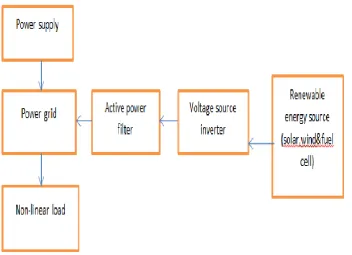
Fig. 1. Block diagram of grid-connected DG interface.
II. GRID CONNECTED DG SYSTEM
In this paper, the Distributed Generation (DG) is interconnected to the Three-Phase
grid with the assistance of the Active Power Filter.
The idea of non-linear loads needs to create sounds in the current waveform so the current waveform will be contorted and this mutilation prompts twisting of the voltage waveform. For these conditions, the voltage waveform is never again depends to the current. This load current contains every ODD consonant. It is Can't be ordered as leading or lagging Loads. In the event that the load is considered as a non-linear load its impedance changes with the supply voltage. At the season of impedance changing that the current drawn by the
non-linear load won't be sinusoidal
notwithstanding when it is associated with a sinusoidal voltage. This non-sinusoidal current contains the symphonious currents that will interact with an impedance of the power appropriation system to make the voltage contortion that can influence both the loads associated with it and the conveyance system hardware. Basically high inrush current (20 time of I Normal) at the season of starting. For cases of the non-linear loads resemble as a Computers, laser printers, SMPS, TV, Rectifiers, Refrigerator, and so on.
B) Distribution Generation(DG)
Presently a days the accessible level of the characteristic assets (coal, regular gases and oil, and so on.) are lessened and furthermore it is the significant reasons for the natural contaminations. So we have to move an elective wellsprings of renewable hotspots for the power generation. Typically the renewable sources are solar, wind, hydro, power modules, and so on. For this paper the solar (PV) and wind energy is utilized as a DG. In this paper, a bound together control technique is proposed for a basic three-phase DG interface with an arrangement diode for preventing power inversion to transmit active power, alleviate load unbalance and music, and repay reactive power. So the DG can play out the two elements of power station and APF as all the while or possibly one.
III. SHUNT ACTIVE POWER FILTER
Lately, the power electronic converters are broadly utilized as a part of industrial and also local applications for the control of power stream. These converters take the upsides of all the current advances and improvements of power hardware; influence from the issue of drawing non-sinusoidal current and reactive power from the supply. Their commitments to the waveform mutilation is of growing interest, and are in charge of various power quality issues, prompted execution of benchmarks and guidelines, for example, IEEE-519. Active power filters(APFs) are inquired about and created as a feasible option over the ordinary techniques to take care of these issues [1], [2]. The APF can repay music and reactive power prerequisite of the nonlinear load viably. By and by, APFs are intended to ingest the greater part of the music produced or potentially reactive power required by the load and make the source current sinusoidal. The size and cost of APF relies upon music and reactive power to be adjusted. For this paper proposed another control algorithm for shunt APF to remunerate the music and reactive power necessity of nonlinear loads, and maintain comparative twisting in the repaid current as present in the voltage. Consequently, the load carries on as a linear load, and the resultant source current will have an indistinguishable waveform from that of the supply voltage. With the goal that reactive power is totally adjusted, and solidarity power factor (UPF) operation can
be accomplished. UPF operation
IV.SIMULATION RESULT
The proposed APF was contemplated using
reproduction devices and progressed
continuous recreation dialect (ACSL). Table I indicates system parameters and load conditions under the unbalance.
TABLE I SYSTEM PARAMETERS
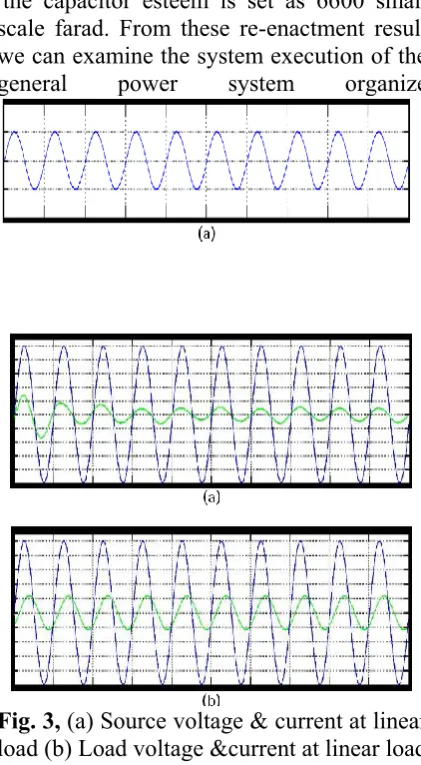
Initially consider the linear load condition at the time the following test result will be
discovered, it's appeared in the fig. 2, and 3, from these chart when the load will be changed as linearly then the source side power stream will be linearly that is source side voltage and current is sinusoidal at the time the reactive power remuneration isn't required. Furthermore, the capacitor will be charged for their maximum esteem. In here the capacitor esteem is set as 6600 small scale farad. From these re-enactment result we can examine the system execution of the
general power system organize
Fig. 2, APF response when the load is linear condition (a). R phase Grid Voltage, (b). R phase Grid current, (c).Y phase Grid current, (d)DC link voltage.
Fig. 4, APF response when the load is non-linear condition (a). R phase Grid Voltage, (b). R phase Grid current, (c).Y phase Grid current, (d).DC link voltage.
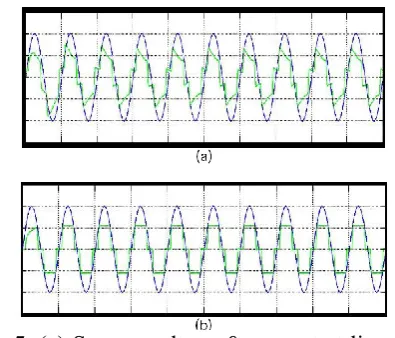
Fig.5, (a) Source voltage & current at linear load (b) Load voltage ¤t at linear load On the off chance that consider the non-linear load condition at the time the following trial result will be obtained, it's appeared in the fig. 4, and 5, from these
diagram when the load will be changed as non-linearly then the source side power stream will be non-linearly that is source side voltage and current is non-sinusoidal at the time the reactive power pay is required. What's more, the capacitor will be released for their minimum esteem. From these recreation result we can investigate the system execution of the general power system organize at non-linear load condition.
V. EXPERIMENTAL RESULT
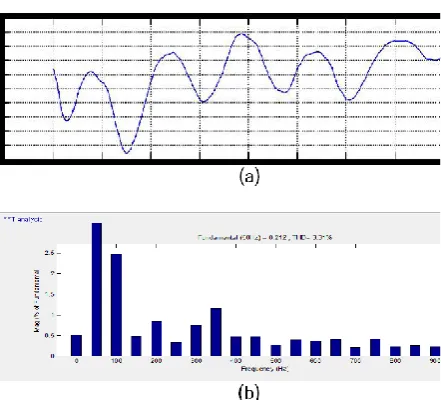
Fig. 6, (a). Power factor in source side at Non-linear load condition. (b). THD analysis = 3.31% From fig. 6 demonstrates The grid current created a nearly solidarity power factor of 0.98, and its aggregate consonant contortion (THD) was around 3.31%. With a specific end goal to show the
load balancing and symphonious
remuneration capacity of the proposed system as an APF.
Fig. 7, (a). Power factor in source side at Linear load condition, (b). THD analysis =28.05%. From fig 7. Demonstrates The grid current delivered a the power factor was 0.83 and THD was 8.05% and the power factor of general system was 0.98. To exhibit the DG interface with double capacities, another trial was directed. To exhibit the dynamic reaction of the proposed
system, the VDG was changed from 320 to 360V and there was no nearby load.
VII. CONCLUSION
A bound together control strategy for the DG interface is proposed in this paper. The proposed technique enables the usage of DG to create active power, eliminates music, repays reactive power, and mitigates load unbalance. Accordingly, its multifunctional conduct replaces the requirement for other power hardware compensators to improve the execution of the circulation systems. With this proposed approach, to shape the grid currents into sinusoidal currents in phase with the grid voltage waveforms and with a plentifulness depending on the power accessible from renewable sources. Then again the load sounds current will diminished by injecting into the alternating current to system symphonious currents with a contrary phase. In this way, controlling the dc voltage level can be proportional to performing an active power adjust for the entire system. Thus, there is an extra equipment and interface are not required. Trial comes about checked the adequacy of the proposed strategy.
REFERENCES
[1]. Sangu Ravindra, Dr.V.C.Veera
Reddy, and Dr.S.Sivanagaraj “Design of Shunt Active Power Filter to eliminate the harmonic currents and to compensate the
reactive power under distorted and or
imbalanced source voltages in steady state” International Journal of Engineering Trends and Technology- Volume2Issue3- 2011. [2]. Maoh-Chin Jiang “Analysis and Design of a Novel Three-Phase Active
Power Filter” IEEE Transactions on
Aerospace and Electronic Systems vol. 37, no. 3 July 2001.
Power Generation Systems” IEEE Transactions on Industrial Electronics, vol. 53, no. 5, October 2006.
[4]. Mukhtiar Singh, Vinod Khadkikar, Ambrish Chandra, and Rajiv K. Varma,
“Grid Interconnection of Renewable
Energy Sources at the Distribution Level
With Power- Quality Improvement
Features” IEEE Transactions on Power
Delivery, vol. 26, no. 1, January 2011.
[5]. Y.-C. Kuo, T.-J. Liang, and J.-F.
Chen, “A high-efficiency single-phase
three-wire photovoltaic energy conversion
system,” IEEE Trans. Ind. Electron., vol. 50, no. 1, pp. 116–122, Feb. 2003.
[6]. S. A. Gonzalez, R. Garcia-Retegui, and M. Benedetti, “Harmonic computation technique suitable for active power filters,” IEEE Trans. Ind. Electron., vol. 54, no. 5, pp. 2791–2796, Oct. 2007.
[7]. J.M. Carrasco, L. G. Franquelo, and J. T. Bialasiewicz, “Power-electronic
systems for the grid integration of
renewable energy sources: A survey,” IEEE
Trans. Ind. Electron., vol. 53, no. 4, pp.
1002–1016, Aug. 2006.
[8]. K. J. P. Macken, K. Vanthournout, and J. Van deneybus, “Distributed control of renewable generation units with integrated active filter,” IEEE Trans. Power Electron., vol. 19, no. 5, pp. 1353– 1360, Sept. 2004.
[9]. M. Cirrincione, M. Pucci, and G. Vitale, “A single-phase DG generation unit with shunt active power filter capability by adaptive neural filtering,” IEEE Trans. Ind. Electron., vol. 55, no. 5, pp. 2093– 2110, May 2008.
[10] .C. J. Gajanayake, D. M.
Vilathgamuwa, P. C. Loh, R. Teodorescu,
and F. Blaabjerg,
“Z-source-inverter-based flexible distributed generation system
solution for grid power quality
improvement,” IEEE Trans. Energy.
Convers., vol. 24, no. 3, pp. 695–
704, Sept. 2009.
[11]. P.-T. Cheng, C.-A. Chen, T.-L. Lee, and S.-Y. Kuo, “A cooperative imbalance
compensation method for
distributed-generation interface
converters,” IEEE Trans. Ind.
Appl., vol. 45, no. 2, pp. 805–815, Mar./Apr. 2009
[12]. P. Hsu and M. Behnke, “A three-phase synchronous frame controller for unbalanced load,” in Proc. 29th Annu. IEEE Power Electron. Spec.
Conf., 1998, pp. 1369–1374.
[13]. M. I. Marei, E. F. El-Saadany, and M. M. A. Salama, “A novel control algorithm for the DG interface to mitigate power quality problems,” IEEE Trans.
Power. Deliver., vol. 19, no. 3, pp.
1384–1392, Jul. 2004.
[14]. Y. Li, D. M. Vilathgamuwa, and L. P. Chiang, “Microgrid power quality enhancement using a three-phase four-wire grid-interfacing compensator,” IEEE Trans. Ind. Appl., vol. 41, no. 6, pp.
1707–1719, Nov./Dec. 2005.
[15]. H. S. Song and K. H. Nam, “Dual current control scheme for PWM converter
under unbalanced input voltage
conditions,” IEEE Trans. Ind. Elec., vol. 46,
no. 5, pp. 953– 959, Oct. 1999.
[16]. W. C. Lee, T. K. Lee, and D. S. Hyun, “A three-phase parallel active power
filter operating with PCC voltage
compensation with consideration for an unbalanced load,” IEEE Trans. Power Electron., vol. 17, no. 5, pp. 807–814, Sept. 2002.
[17]. Mi-Ching Tsai, and Wu-Sung Yao “Design of a Plug-In Type Repetitive
Controller for Periodic Inputs” IEEE
Transactions on Control Systems
Technology, vol. 10, no. 4, july
2002.
[18]. S. A. Gonzalez, R. Garcia-Retegui, and M. Benedetti, “Harmonic computation
technique suitable for active
power filters,” IEEE Trans. Ind.
Electron., vol. 54, no. 5, pp.
Author’s Profile
YERRABELLIPRA THAPKUMAR, he obtained his M.Tech in the stream of
Power Electronics
from JNT University
Hyderabad in