A Study to Recognize Printed Gujarati Characters
Using Tesseract OCR
Milind Kumar Audichya1, Jatinderkumar R. Saini2 1, 2
Computer Science, Gujarat Technological University
Abstract: Optical Character Recognition (OCR) is a widely-known technique to recognize the printed text using computer with the help of various peripheral devices. Research works for OCR of many languages scripts is in process and many languages are still far away. Gujarati script is one of the least focused script in research area of OCR as compared to other scripts. A well-known Open Source OCR Engine called Tesseract which is already used for the recognition of numerous scripts, can be used to recognize printed Gujarati characters from digital images. This paper is trying to enlighten the use of Tesseract to recognize Gujarati characters with the help of already available trained data for Gujarati Script.
Keywords: OCR, Optical Character Recognition, Gujarati OCR, printed Gujarati characters OCR, Tesseract OCR
I. INTRODUCTION
Gujarati is one of the regional languages of India which has a huge number of speakers making it to 26th most spoken language worldwide [1]. Thus, the recognition of Gujarati characters is necessary which is least focused and an attempt is made to recognize Gujarati characters from the digitally printed straight normal images using Tesseract - an Optical Character Recognition (OCR) engine.Printed Gujarati characters OCR is still a challenging task as it depends upon different parameters like: font type, font style, font size and quality of images taken or captured. Still there are several things remains to be managed some of them are disconnected characters, conjuncts and diacritics.Tesseract is Open Source and it supports many languages to recognize characters using its own trained data. It can be used to recognize Gujarati characters from the digitally printed images. Tesseract was initially developed in between the year 1985 and 1994 at Hewlett-Packard (HP) Laboratories Bristol and at HP Co, Greeley Colorado. In 2005, HP has converted Tesseract into Open Source and since 2006, Google is developing it till date [6].
Tesseract is based on 8-bit Unicode Transformation Format (UTF-8) and it can recognize 100+ languages [6]. It also has the potential to recognize different languages if another language’s customized trained data is provided. This paper presents a study of “Recognition of Gujarati characters using Tesseract OCR”
Fig. 1. Gujarati Numerals
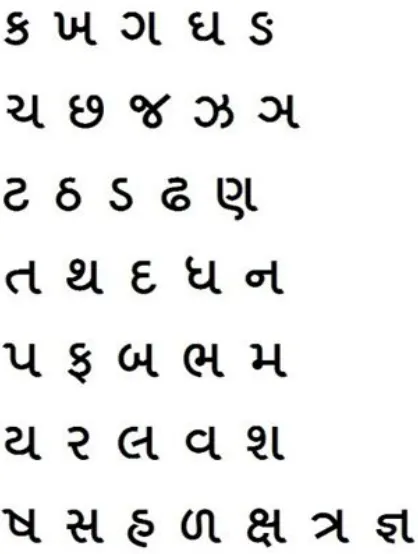
Fig. 3. Gujarati Consonants
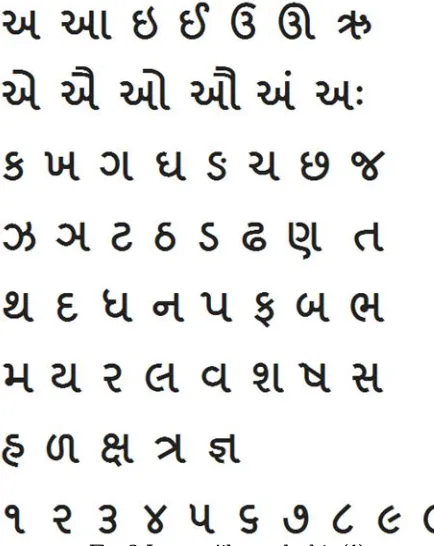
There are 10 numerals, 13 vowels and 37 consonants in Gujarati language which are shown in Fig. 1,2 and 3. Trained data to recognize this all numerals, vowels and consonants is available along with Tesseract and thus, it can recognize the Gujarati language characters from digitally printed images.
II. LITERATUREREVIEW
Gujarati characters OCR had been a challenging and tedious task due to the complexity of script either we are working on digitally typed printed Gujarati characters or handwritten Gujarati characters.
A systematic approach using hybrid method based upon binary tree classifier and k-Nearest Neighbor (kNN) for Gujarati handwritten character had been introduced by Chhaya Patel and Apurva Desai and obtained overall 63.1% set wise average accuracy [8].
Due to complexity of script researchers limits their scope to either certain digits, characters, or characters sets. Shailesh Chaudhari and Ravi Gulati tried for the Separation as well as Identification of Mixed bilingual (English-Gujarati) Digits using kNN Classifier ad gained 99.20%, 99.26% average accuracy for English and Gujarati digits respectively [9].
Jignesh Dholakia, Atul Negi and S. Rama Mohan has presented an effective method for zone detection in digitally printed Gujarati characters [10].
Swital J. Macwan and Archana N. Vyas worked for the classification of offline Gujarati handwritten characters using three different methods combinations and achieved 87.22% accuracy for total 39 Gujarati characters [11].
Tesseract is a very well maintained and it had been used by several researchers for the OCR of multiple language scripts. Chirag Patel had done a comparative analysis between a propriety OCR tool with Tesseract OCR using English script and found Tesseract is faster as it takes approximately 1 second for processing colored images and 0.82 seconds for grey scale images [4].
Nitin Mishra also experimented on the Shirorekha Chopping for enhanced Hindi language recognition in integration with Tesseract OCR [3].
III. PROPOSEDAPPROACH
A. Why Tesseract?
Tesseract is a prominent OCR engine in comparison with other OCR engines as it is open source and registered under Apache license and support 100+ languages. It can be used on all major platforms of computer operating systems.
Apart from this It produces its output in different formats like Text, (Portable Document Format) PDF and other formats using own or already available GUIs or (Application Programming Interface) APIs. It is regularly updated and renovated under the supervision of highly expert team of Google Inc.
[image:4.612.205.406.228.484.2]B. How Tesseract Works
Fig. 4. How Tesseract Works [7]
Tesseract is a very popular and stable open source Optical Character Recognition (OCR) engine today which was initially started as a Doctorate of Philosophy (PhD) research work in Hewlett-Packard (HP) labs, Bristol [5]. Further it was led by Google from 2006 after the Open Source release of Tesseract in 2005. Tesseract can be obtained from the official repositories undertaken by Ray Smith, Google Inc.The repositories are having vast support for various programming languages which can be integrated along with the any programming language. With the use of these Tesseract OCR engine repositories one can test the core features of Tesseract as tesseract has no built-in Graphical User Interface (GUI) support. GUI needed to be developed or can be integrated with any other open source GUI repositories which are compatible and integration can be done with the use of their GUI.
Figure 4. Illustrating the actual working of the Tesseract OCR engine. In very first step an image is inputted on which OCR is needed to be performed after that the image pass through the “Adaptive Thresholding” step in which it gets converted into Binary Image. Later Binary Image further processed into “Connected Component Analysis” in which text/words splitting has been performed with character outlines.
Outlined Characters further sent to 2-way pass to recognize words. In Pass-1 recognized text/words are further processed in to an adaptive classifier which considers the data as trained data. Now text will be again recognized for the second time but now it will use adaptive classifier for recognition.
C. Using Tesseract to recognize Gujarati Script
To demonstrate the uses of Tesseract OCR to recognize Gujarati Script we have used Visual Studio as a tool and C# as a programming language.
Fig. 5. Sample Web GUI to interact with Tesseract OCR
Fig5. Representing the GUI to interact with the Tesseract OCR for Gujarati Character Recognition. As a prerequisite, majorly three things are necessary to carry on this experiment was –
1) A Tesseract dll to support the programming portion to access Tesseract OCR engine.
2) A trained data.
3) A digitally printed image which contains Gujarati characters.
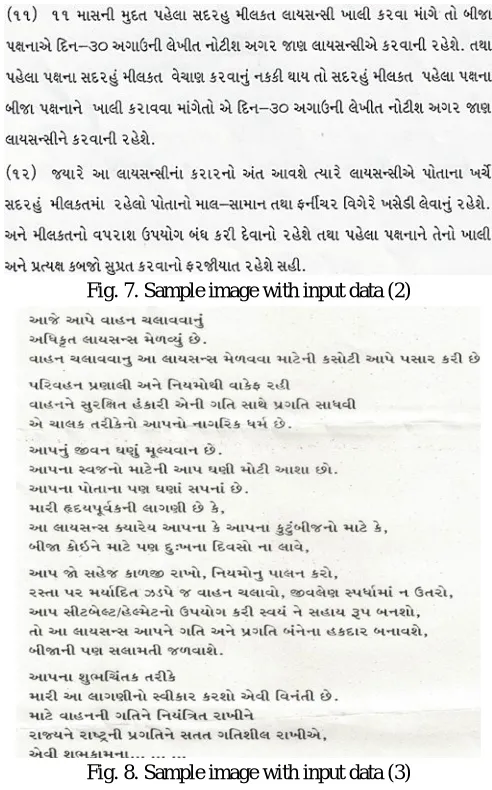
[image:5.612.200.417.319.592.2]In this scenario for the testing purpose, the image contains Gujarati characters printed in different fonts and size with black text on white background as sample data.
Fig. 7. Sample image with input data (2)
Fig. 8. Sample image with input data (3)
IV. EXPERIMENTALRESULT
The output of the experiment conducted is given as below.
Fig9. Output derived from the given input
V. CONCLUSIONS
This research paper tries a representation of a systematic procedure to printed Gujarati Character OCR with use of the open source OCR engine Tesseract OCR. We used the built-in trained test data provided by Tesseract OCR to recognize the characters from the digitally typed printed images.
We tried to observe the results in various situation using the different font, font style and font size etc. We found it performing satisfying apart from some complex characters and similar looking characters ambiguity.
A detailed study is done for Gujarati Character Recognition using Tesseract OCR Engine which can be used as an initial footprint for upcoming future research work.
VI. ACKNOWLEDGMENT
The authors thank SJD International Surat, Gujarat, India and Narmada College of Computer Application (NCCA), Bharuch, Gujarat, India for the contribution of all the resources access to carry out this research study.
REFERENCES
[1] "Gujarati language - wikipedia," 16 February 2017. [Online]. Available: https://en.wikipedia.org/wiki/Gujarati_language. [2] "Tesseract OCR GitHub," 16 02 2017. [Online]. Available: https://github.com/tesseract-ocr.
[3] M. A. Hasnat, M. R. Chowdhury, M. Khan and others, "Integrating Bangla script recognition support in Tesseract OCR," BRAC University, 2009.
[4] N. Mishra, C. Patvardhan, V. C. Lakshimi and S. Singh, "Shirorekha Chopping Integrated Tesseract OCR Engine for Enhanced Hindi Language Recognition,"
International Journal of Computer Applications, vol. 39, no. 6, pp. 19-23, 2012.
[5] C. Patel, A. Patel and D. Patel, "Optical character recognition by open source OCR tool tesseract: A case study," International Journal of Computer Applications, vol. 55, no. 10, 2012.
[6] R. Smith, "An overview of the Tesseract OCR engine," Document Analysis and Recognition, 2007. ICDAR 2007. Ninth International Conference on, vol. 2, pp.
629-633, 2007.
[7] C. Verstraeten, "How to train Tesseract 3.01 - Cédric Verstraeten," 16 02 2017. [Online]. Available: https://blog.cedric.ws/how-to-train-tesseract-301.
[8] Patel, C., & Desai, A. (2013). Gujarati Handwritten Character Recognition Using Hybrid Method Based On Binary Tree-Classifier And K-Nearest Neighbour.
International Journal of Engineering Research & Technology (IJERT), 2(6), 2337-2345.
[9] S. A. Chaudhari and R. M. Gulati, "An OCR for separation and identification of mixed English — Gujarati digits using kNN classifier," International Conference on Intelligent Systems and Signal Processing (ISSP), pp. 190-193, 2013.
[10] J. Dholakia, A. Negi and S. R. Mohan, "Zone Identification in the Printed Gujarati Text," International Conference on Document Analysis and Recognition (ICDAR’05), vol. 1, pp. 272-276, 2005.
[11] S. J. Macwan and A. N. Vyas , "Classification of Offline Gujarati Handwritten Characters," InternationalConference on Advances in Computing,
![Fig. 4. How Tesseract Works [7]](https://thumb-us.123doks.com/thumbv2/123dok_us/8306531.856305/4.612.205.406.228.484/fig-how-tesseract-works.webp)