5
III
March 2017
Technology (IJRASET)
Study on the Properties of Concrete by Using Super
Absorbent Polymer
M. Sivaranjani 1
, K. Ranjitha2 , S. Premkumar 3
1,2,3
Civil-Department, Anna University
Abstract : The use of super absorbent polymer (SAP) in concrete is confirmed to have many constructive effects on the properties of concrete in its both stages; fresh concrete and hardened concrete. This study focus on the use of an most select amount of Sodium Polyacrylate as a super absorbent polymer in ordinary plain concrete. In the past efforts were made only to study the significant reduction of crack width in the concrete. However strength being the important factor for concrete the study focuses on the strength parameter of concrete. The main focus of this study will be on the result of the SAP on the fresh concrete as well as the hardened concrete. Several batches were prepared to determine the result of the SAP on concrete when subjected to compressive, tensile stresses. In the present study, the affect of admixture (superabsorbent polymer) on compressive strength, split tensile strength and water absorption by varying the percentage of superabsorbent polymer by weight of cement from 0% to 1.5% were studied for M20. It was found that a superabsorbent polymer could help in increasing hydration process by giving superabsorbent polymer by weight of cement was optimum for M20 grade concretes for achieving maximum strength without compromising workability. In this review paper effort has been made to understand the working and efficiency of this curing method and compared with the conventional water curing method.
Keywords: super absorbent, polymer Sodium Polyacrylate, workability
I. INTRODUCTION
Cracks in concrete are a common phenomenon due to the moderately low tensile strength. Durability of concrete is impair by these cracks since they offer an easy path for the transportation of liquids and gasses that potentially include harmful substances. If micro-cracks grow and reach the reinforcement, not only the concrete itself may be attack, but also the reinforcement will be
decomposed. Therefore, it is important to control the crack width and to repair the cracks as soon as possible. Since the costs concerned for maintenance and repair of concrete structures are usually high, this research focuses on the development of self-healing concrete. Self-self-healing of cracks in concrete would donate to a longer service life of concrete structures and would make the substance not only more durable but also more sustainable. That is exactly what our new project aims to achieve, the development of self-healing concrete to improve the durability of structures.
The SAP absorb water and convert it into gel, then release it slowly with time, at the same time the gel volume increase proportionally. This assets is very useful when it comes to watering undergrowth over time. The extension in volume has the tendency to clog the water pathways in the concrete mass, and consequently improving its water tightness property. The use of SAP is proven to be very efficient as a sealant in plain concrete if sufficient amount is used. This study focus on the long term effect as well as the short term effect of the use of the SAP in plain concrete. Several samples were ready with different SAP content. The contented of SAP is measured as a proportion of the Portland cement used by weight. The amount of water further to the fresh concrete is one of the most important key factor that affect the concrete properties, as well as water tightness durability and strength. The water is an necessary ingredient needed for the hydration progression in the fresh concrete and for the curing process in the hardened concrete at its early stages. Excessive amount of water added in the fresh concrete improves the concrete workability in general, reduce the concrete strength, and increase the drying shrinkage of the hardened concrete. Different admixtures were used to reduce the quantity of water demand in the fresh concrete without jeopardizing the workability. Water reducer admixtures were used broadly in the ready mix plants. The most common admixture used nowadays is the super plasticizer which is water reducer and at the same time retarder. The water gel created in the fresh concrete by the use of SAP
Technology (IJRASET)
Jensen and Hensen (2001) studied the autogenous shrinkage phenomena in concrete. They done that the autogenously shrinkage may lead to cracking along with affect concrete strength and durability, which is also, can be measured as technological dare of high performance concrete. Addition of superabsorbent polymer in the ultra-high-performance concrete can be used to control the autogenously shrinkage. They also conduct tests that show that the shrinkage reduction due to superabsorbent polymer is related to a corresponding enlarge in the interior relative humidity of the cement paste. In addition, the use of superabsorbent polymer in concrete resulted in a decrease or elimination of stress buildup and related cracking through reserved hardening of these high-performance cementitious systems.
II. SUPER ABSORBENT POLYMNER
The super absorbent polymer used in this learn is Sodium Polyacrylate, also known as water-lock, which is a sodium salt of polyacrylic acid with the chemical formula [-CH2-CH(COONa)-] and broad function in consumer products. It has the capability to suck up as much as 200 to 300 times its mass in water. Sodium polyacrylate is Anionicpolyelectrolytes with harmfully exciting carboxylic groups in the main chain. Sodium polyacrylate is a chemical polymer that is extensively used in a range of consumer products for its facility to absorb several hundred times its mass in water. Sodium polyacrylate is made up of multiple handcuffs of acrylate compounds that have a positive anionic charge, which attract water-based molecules to combine with it, making sodium polyacrylate a super-absorbent compound. Sodium polyacrylate is used widely in the agricultural manufacturing and is infused in the soil of many potted plant life to help them retain moisture, behave as a type of water basin Florists commonly use sodium polyacrylate to help keep flowers clean.
III. MATERIALS
A. Cement
Cement is by far the most important constituent of concrete, in that if forms the binding medium for the discrete ingredients. Made out of naturally occurring raw materials and sometimes blended or underground with industrial wastes, cements come in various types and chemical compositions. In our project we are using Ordinary Portland cement. The Ordinary Portland Cement of 53 grades conforming to IS: 8112-1989 is being used.
B. Aggregates
Aggregate constitutes about 75% of the bulk of concrete. For ordinary concrete, certain data such as fineness modulus, bulk density, surface water in aggregate, bulking of sand are required to be assumed in design. Practical data based on experience has been collected and are reproduced in the ensuing paragraphs.
C. Coarse Aggregate
The fraction from 20 mm to 4.75 mm is used as coarse aggregate. The Coarse Aggregates from compressed Basalt rock, conforming to IS: 383 are being used.
D. 3.4 Fine aggregate
Those fractions from 4.75 mm to 150 micron are termed as fine aggregate. The stream sand and M sand is being used in mix as fine
aggregate meeting the requirements to grading zone ।।। of Table 4 of IS: 383. The river sand is washed and screened, to eliminate
harmful materials and over size particles.
E. 3.5 Water
Water is an important ingredient of concrete as it actually participates in the chemical reaction with cement. Since it helps to from the strength giving cement gel, the quantity and quality of water is required to be looked into very carefully.
Physical Properties
Specific gravity of cement 3.15
Specific gravity of coarse aggregate 2.60
Water absorption for coarse aggregate 0.5
[image:3.612.74.539.632.702.2]Specific gravity for fine aggregate 2.62
Technology (IJRASET)
IV. MIX DESIGN
A. Design Mix
A mix M20 grade was designed as per Indian Standard method (IS 10262-1982) and the same was used to prepare the test samples.
B. Mix Proportions
Cement = 383 kg/m3 (1) Water = 191.6 kg/m3 Fine aggregate = 550.32 kg/m3 (1.436) Coarse aggregate = 1196.72 kg/m3 (3.13) Water-cement ratio = 0.5
V. EXPERIMENTAL PROGRAM
A. Workability of Fresh Concrete by Slump Test
[image:4.612.213.400.277.422.2]Slump test is used to find out the workability of fresh concrete. Slump test as per IS: 1199 – 1959 is followed. The total slump observed = 300 – 241 = 59mm
Fig: 1 Slump Cone Test
B. Compressive Strength and Split Tensile Test
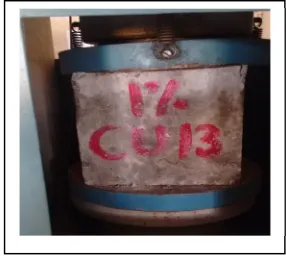
150 mm × 150 mm × 150 mm concrete cubes and cylinders were casted by using M20 grade concrete for compressive strength and split tensile strength. Specimens with ordinary Portland cement (OPC) and OPC replaced with Sodium polyacrylate at 0.5%, 1% and 1.5% levels is cast. During casting the cubes and cylinders were mechanically vibrated vibrator. After 24 h the specimens is remove from the mould and subjected to water curing for 7, 14 and 28 days. After curing, the specimens tested for compressive strength and split tensile strength using a calibrated compression testing machine of 2,000 KN capacity. Figure 3 & 4 show compressive and split strength testing setup on testing machine.
[image:4.612.255.398.549.677.2]Technology (IJRASET)
Fig 3 Split tensile strength test
C. Water Absorption Test for Concrete
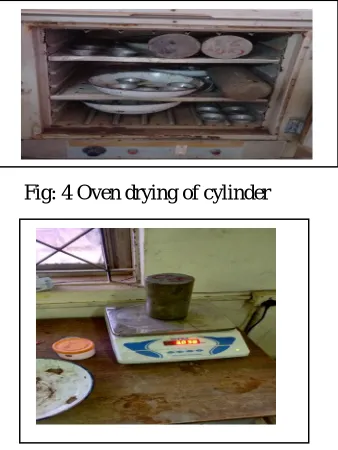
[image:5.612.233.402.284.509.2]Cylinders were casted by using M20 grade concrete for water absorption test. Specimens with ordinary Portland cement (OPC) and OPC replaced with Sodium polyacrylate at 0.5%, 1% and 1.5% levels is cast. During casting the cylinders were mechanically vibrated vibrator. After 24 hours remove the specimen from the mould and immerse it into the water. After curing, the specimen is weighed and then the specimen is placed in oven for 3hrs and then weighed.
Fig: 4 Oven drying of cylinder
Fig: 5 Weighing of Cylinder
VI. RESULTS
A. Compressive Strength and Split Tensile Test
The compressive strength results are compiled in Table-1 and split strength in Table-2. The compressive strength vs. % replacements of cement results are graphically shown in figure 6. The same for split strength is in figure 7.
Addition in %
Average Ultimate Compressive
Strength (N/mm2)
7 days 14 days 28 days
0 11.53 16.52 19.70
0.5 12.37 17.02 20.10
1 12.51 17.27 20.84
1.5 12.67 17.38 21.90
Technology (IJRASET)
Fig: 6 Compressive Strength of Cubes for M20 at 7, 14 & 28 Days
Addition in %
Average Ultimate Tensile strength
N/mm2
7 days 14 days 28 days
0 1.47 1.69 1.97
0.5 1.55 1.72 2.07
1 1.57 1.75 2.14
1.5 1.65 1.81 2.34
Table3: Tensile Strength Of Cylinder For M20 At 7, 14 & 28 Days
Fig: 7 Tensile Strength of Cylinder for M20 at 7, 14 & 28 Days
B. Water Absorption Test
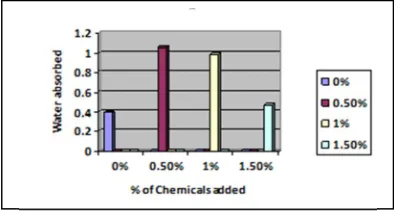
[image:6.612.186.428.264.396.2]The water absorption results are compiled in Table-3. The water absorbed vs % of chemicals added results are graphically shown in figure 8.
[image:6.612.212.409.593.700.2]Technology (IJRASET)
% added Wt befor
oven dry
Wt ofter 3hrs oven dry
W.A
0% 3.786 3.771 0.39%
0.5% 3.839 3.799 1.05%
1% 3.881 3.843 0.98%
1.5% 3.928 3.909 0.48%
Table4: Water Absorption of Cylinder For M20 at 7, 14 & 28 days
VII. CONCLUSION
The use of sodium polyacrylate as super absorbent polymer in concrete has hopeful potential to recover several property of concrete together with the concrete strength. Excessive amount of sodium polyacrylate used in concrete has a considerable negative effect on the concrete strength. Other important properties can be improved using this type of admixture especially concrete stability, where the gel provides cushioning to the bulky aggregates which is in turn reduces the possibilities of concrete separation. Frost resistance is the other significant property that can be improved by using this admixture, by fascinating the hydraulic pressure generate by water extension. Adding SAP to the concrete mix makes the fresh concrete more plastic and uniform. This helps in placing and finishing the concrete. All the result were found to be satisfactory and shows increase in strength for M20 Grade concrete mix. In this project, we recommend the addition of sodium polyacrylate 1.5% to be satisfactory for M20 grade of concrete. When we tried to proceed the experiment by adding more than 1.5% polymer, we found that the water content in concrete was totally absorbed by the polymer and the concrete mix did not set up and also collapsed.
REFERENCES
[1] “Crack Self-healing Behaviour of Cementitious Composites Incorporating various Mineral Admixtures” by Tae-Ho Ahn and Toshiharu Kishi on 6th May 2010
[2] “Recent advances on self healing of concrete“ by E. Schlangen, H. Jonkers, S. Qian & A.Garcia on May 23-28, 2010
[3] “Self healing of polymer modified concrete” by Abd Elmoaty M on March 2011
[4] “Self-Healing Materials Systems: Overview of Major Approaches and Recent Developed Technologies” by B.Aissa, D.Therriault, E.Haddad and W.Jamroz on
25th November 2011
[5] “Investigating the Use of Super Absorbent Polymer in Plain Concrete” by `on August 2013
[6] “Concrete Made For Energy Conservation Mixed With Sodium Polyacrylates” by Moayyad Al-Nasra on September 2013
[7] “The Use of Super Absorbent Polymer as a Sealing Agent in Plain Concrete” by Mohammad Daoud, Moayyad Al-Nasra on February 2014
[8] ”Application of polymer admixtures to modify concrete properties: Effects of polymer type and content” by M. Jamshidi, H.R. Pakravan and A.R.
Pourkhorshidi on 25th March 2014
[9] Miller M. Polymers in Cementitious Materials, Rapra Technology Limited, Shropshire, 2014.