5
III
March 2017
Technology (IJRASET)
Design and Development of Water Distillation &
Desalination Plant
Parth Dave1, Rohitpuri Goswami2, Kailash Patel3, Rushabh Soni4, Prof. Pankaj Deshmukh5
1,2,3,4,5
Department of Electronics Engineering, Mumbai University
Abstract: As per our observations many villages and communities are facing severe water shortage in the country. There is a scarcity of clean water for drinking as well as agricultural purpose. Our project is aimed at finding a concrete solution for this problem. We are creating a system that can be used at household or community level. This system will process dirty or saline water into clean water that can be used for drinking as well as agricultural purpose. There will be several automated stages for the process and each stage will be controlled by control system and embedded system. Various parameters will be monitored in real time. Regardless of the efforts made till now, many advancements are required in fields such as methods and membranes for RO.Government water treatment and disposal policies. are required to be reviewed and updated and greater distinction researches between brackish water and seawater RO desalination processes.
Keywords: R.O. – Reverse Osmosis RES – Renewable Energy SourceWHO- World Health Organizatio MED- Multi effect DistillatioMSF- Multi-stage Flash Distillation VC- Vapour Compression ED- Electro-Dialysis OSW- Office of Saline Water ADS- Autonomous Desalination System
I. INTRODUCTION
In designing a distillation and desalination plant and more over with reverse osmosis (RO) processes, which are the main processes of this system.
The first step is Distillation of water, followed by desalination by means of Reverse Osmosis (RO).
A. Distillation
The process of purifying a liquid by a process of heating and then cooling. This results in elimination of visible impurities and some minerals
B. Desalination
This process removes minerals from saline water. We use process of Reverse Osmosis for this purpose. It removes majority of salts from the water.
C. Reverse Osmosis (Ro)
This is a water purification technology that uses a semipermeable membrane to remove ions, molecules, and larger particles from drinking water.
D. Electro Dialysis
Dialysis in which the movement of ions is aided by an electric field applied across the semipermeable membrane
II. OBJECTIVES
Human life depends upon the existence of fresh water. The World Health Organization (WHO) sets in fifty litres per person and day the minimum quantity of water needed to maintain a certain level of hygiene and avoid the transmission of infectious diseases. From those fifty litres just 0.75% are for drinking and the rest would be for bathing, cooking, washing, cleaning, etc.[1]
The objective of this project is to give reader the idea about the design of distillation and desalination plants by explaining the processes involved in it. Once the main issues are explained it will be possible to understand the actual debate surrounding two main points
A. Environmental aspects of distillation and desalination plants and
Technology (IJRASET)
C. Factors taken into consideration while designing the plant are1) Use of renewable energy sources.
2) Economically affordable especially to people of rural areas throughout country. 3) Solve the scarcity of clean water in rural parts of India.
4) Designing a fully automated and energy efficient system for water distillation and desalination. 5) Useful for domestic usage including drinking.
III. LITERATURESURVEY
With the increase of the world’s population and the water consumption per person, the water demand is arising considerably. According to databases from the World Health Organization, less than 1% of the planet’s hydric resources are fresh water and accessible for the human, varying on the area we study, the climate and the moment of the year. The access to clean water is limited and it is often contaminated. To avoid water crisis some important measures need to be taken to preservewater, reduce contamination, regulate the demand and supply and educate the people the people regarding water conservation.
On one hand the demand of fresh water is rising and on the other one the access to limited and contaminated water supplies makes that many developing countries have to face difficulties . The number of inhabitants on the planet is increasing drastically and we have no more water than less than two thousand years ago, when the world’s population was 3% of today’s. The increasing demand of water for irrigation, domestic purpose and the industrial sector are imposing a very high demand on limited water resources. According to database of the World Health Organization, more than thirty countries, inhabited by less than 8% of the world’s population face chronicfreshwater deficit. But according to our studies more than forty-eight countries will face this deficit by next decade, affecting more than 3 million inhabitants. In the next twenty-five years countries in Asia and Africa will suffer water shortages, whereas parts China already facing water shortages due to which they are planning of transporting water from distant areas.[1]
Table I[1] Sr.
No
Denomination water Salinity ( ppm of TDS)
1 Ultrapure 0.03
2 Pure 0.3
3 Deionized 3
4 Fresh water (poor) <1,000
5 Brackish 1,000-10,000
6 Saline 10,000-30,000
7 Marine 30,000-50,000
8 Brine >50,000
In most parts of the world, contaminated water, the improper disposal of waste and the poor water management brings serious problems of public health. Diseases caused because of water contamination or cholera kills millions of people every year. It should be taken into consideration that an excessive usage of contaminated water and its supply is causing severe damage to the environment.
The health issues due topoor water quality are increasing day by day. According to the survey reportsit is estimated that around 37.7 million Indians are affected by waterborne diseases annually, 1.5 million children are estimated to die of diarrhoea alone and 73 million working days are lost due to waterborne disease each year. As a result, economic burden of more than $600 million a year is estimated by Khurana and Sen, Water Aid, 2007.
[image:3.612.181.431.376.580.2]Technology (IJRASET)
contamination is prevalent in India where 1,95,813 habitations in the country are affected by poor water quality. The major parameters of concern are fluoride and arsenic contamination. Iron is also emerging as a major problem with many habitations showing excess iron in the water samples.[5]
According to the formerly Planning Commission, quality issues are increasing as ground water is depletingdrastically. The amount of natural contaminants like fluoride and arsenic and chemical pollutants such as pesticides and insecticides is increasing . Fluoride contamination has affected 150 districts in 15 States of India. Excess arsenic affects 8 districts of West Bengal. Fluoride levels are enormous in states of Andhra Pradesh, Gujarat, Haryana, Karnataka, Punjab, Rajasthan, Tamil Nadu and U.P. Iron levels are very high in the North-Eastern and Eastern part of the country. Also salinity is high in states of Gujarat, Haryana, Karnataka, Punjab, Rajasthan and Tamil Nadu. High levels of fluoride, which is naturally available, can lead to dental fluorosis and, in worst cases, skeletal fluorosis. Likely, arsenicoccurs naturally, and excess arsenic in drinking-water may cause risk of cancer. Chemicals like uranium and selenium, may cause health concerns when they are present in high quantity. Bacterial contamination of water continues to be a widespread problem across the country and is a major cause of illness and death rate counting around 37.7 million affected by waterborne diseases every year. The main pathogenic organisms which are responsible for water borne diseases in India are bacterias like E. coli, Shigella, V. cholera , viruses like Hepatitis A, Poliovirus, Rotavirus and also parasites such as E. histolytica, Giardia, Hookworm. Water borne diseases are of most important concern when it comes to water quality. Water for personal and domestic hygiene is important in reducing the rates of ascariasis, diarrhoea, schistosomiasis, and trachoma. Sanitation facilities decreased diarrhoea morbidity and mortality and the severity of hookworm infection. Better quality of water reduced the incidence of infection caused due to dracunculiasis, but its part in diarrhoeal disease control was not that important than that of sanitation and hygiene.The link between water for sanitation and drinking water is very important. The greatest microbial risks is due to contamination of water with animal or human faeces. Faeces are sources of viruses, bacterias, protozoa and helminths. Improvement in water supply and disposal facilities have helped in controlling diarrheal diseases among children..[5]
TableI II
Sr.No
Parameter 90/778/CEE 98/83/CEE WHO guidance
1 Chlorides 200 250 250
2 Sulphates 250 250 400
3 Nitrates 50 - -
4 Alkalinity 30 30 200
5 Sodium 175 200 -
6 Magnesium 50 - 200
7 Total hardness 60 - -
8 Total dissolved salts (TDS)
ppm
1,500 1,500 1,000
9 pH 6.5 to 8.5 6.5 to 9.5 6.5 to 8.5
10 Others - Non -
Technology (IJRASET)
IV. PROCESS
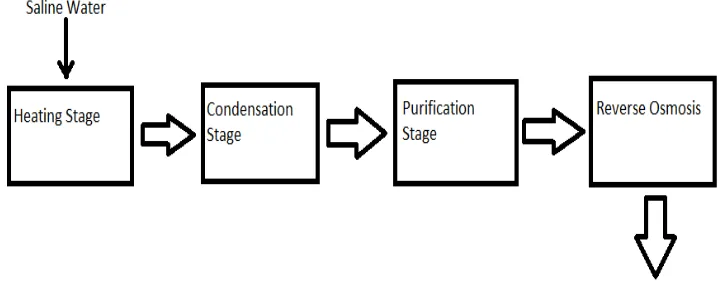
Desalination is achieved through thermal technology processes and membrane technology. Thermal processes cover multi-stage flash distillation (MSF) multi-effect distillation (MED) and vapour compression (VC). Membrane technology include Electrodialysis (ED) and Reverse Osmosis (RO). Both methods get as result two flows: A flow of clean water with low salt concentration and a flow with high salt concentration. Both methods require energy for operation. Energy consumption in membrane processes depends on the feed water salinity whereas in non-thermal processes there is no such dependence.
Energy consumption in RO and ED processes for brackish waters and low salt content waters is much lower than in the processes of distillation. In addition, recent advances in RO technology for seawater desalination have reduced energy consumption. The most widespread current technique and the one that holds most of the future projection is reverse osmosis.
[image:5.612.123.485.271.412.2]Therefore, when choosing either desalination process it is important to know what kind of water will be treated. Here is a brief description of the various desalination processes for marine waters or continental brackish waters
Fig. 1 Process blockdiagram
A. Distillation
Distillation is a process where a mixture of two or more liquids with different boiling points can be separated from each other. The mixture is heated until one of the components boils ( ie. turns to avapor). The vapor is then passed to a condenser, which cools the vapour and condenses it back into a liquid is called ”distillate”. What remains in the original container is called the "residue".
B. Desalination
Desalination is achieved by using Reverse Osmosis or Electrodialysis.
1) Electro-Dialysis: Ion separation through a series of membranes located successively millimetres apart. The application of electric fields generates the migration of ions that pass through these membranes that act as sieves.
C. Electrodialysis
Technology (IJRASET)
electrodialysis cells are arranged to form an electrodialysis stack with alternating anion and cation exchange membranes forming the multiple electro dialysis cells.
V. CONCLUSION
Engineers are facing a difficult challenge regarding the shortage of water in those countries that can’t supply water to their inhabitants. The actual social statuses in the world handicaps many attempts to bring interesting programs to be developed, i.e. many countries with economic difficulties that also experience water shortages are the ones that are positioned in a worst side when talking about future perspectives in the field of desalination. It is stated that new technologies using renewable energy sources are becoming more accessible in an economic perspective, although it is still a big deal. If local government authorities are not willing to finance these projects then it will be extremely difficult to achieve any development in desalination..In accordance with Gibbons and others. (2008), the autonomous desalination systems (ADS) community has to make use of the pertinent authorities financing, as the European Union in this case.[3]
Continuing with authorities, many policies and regulations are getting obsolete when implementing a desalination plant. Every year, new researches and studies brings up debates, doubts and questions about the actual environmental policy. The responsible environmental authorities in each country should focus in the researchers demands by facilitating and easy the acceptance or modification of environmental policies. In accordance with Greenlee et al. (2009) water quality standards will cause further optimization and development in reverse osmosis technology.[3]
Once the input energy source is decided then the plant’s performance can be studied and calculated so the designers can focus in the environmental impact of the concentrate disposal, either it is brackish water or seawater feed system, taking into account the capacity of the plant, water and environmental policies. The third main direction should be the environmental aspects, leaded by the concentrate disposal.
As discussed before, an advantageous way of starting the design of a desalination unit while saving time and cost at the same time is to study already built plants in order to make a detailed analysis of the strengths and weaknesses of each one.
As the society faces acute water shortage in terms of clean water accessible to all mainly rural areas there are steps needed to be taken to address this issue. New technologies are being developed on large scale but most of them are not economic for the purpose of household use. Different types of water is present in different areas of the world and different chemicals are present in them and each needs different treatment which again proves to be unviable. This has been one of the very small attempt to address the issue of domestic water purification. Desalination is again a very complex process and different components are needed.
Finally we have combined the processes of distillation and desalination in an automated process to have an universal solution to the domestic problems of water use.
VI. ACKNOWLEDGMENT
The Completion of this project could not have been possible without participation and assistance of many people whose names may not be enumerated. Their contributions are sincerely appreciated and gracefully acknowledged.
However, the group would like to express the deep appreciation and indebtedness particularly to Prof. Pankaj Deshmukh for his endless support, kind understanding support during our case presentation and also his help and endeavour throughout the execution of the project.
To all relatives, friends and others who in one way or the other shared their support either morally, financially or physically.
REFERENCES
[1] Paper of Design of Desalination plant byHirkoni Martinez June 2012.
[2] Lauren F. Greenlee, Desmond F. Lawler, Benny D. Freeman, Benoit Marrot, Philippe Moulin, 2009.
[3] Reverse Osmosis Desalination: Water sources, technology and today’s challenges. ScienceDirect. Water research 43. 2317-2348.
[4] 4June Gibbons, Michael Papapetrou, Christian Epp, 2008
[5] Assesment of EU policy: Implications for the implementation of autonomous desalination units powered by renewable resources in the Mediterranean region.
ScienceDirect. Desalination 220. 422-430
[6] http://www.desware.net/Sample-Chapters/D01/D01-017.pdf
![Table I[1] Denomination water](https://thumb-us.123doks.com/thumbv2/123dok_us/8575922.859392/3.612.181.431.376.580/table-i-denomination-water.webp)