Synthesis, Characterization and Gas sensing
properties of Cr surface modified BaTiO
3
thick
films
S. B. Nahire1, G. E. Patil 2, G. H. Jain 3, V. B. Gaikwad 4, Sushant B. Deshmukh5
1
Dept of Physics, Arts, Science and Commerce College, Ozar (Mig) Nashik 422103, SPPU, Pune, India 422 206 2, 3
Dept of Physics, SNJB’s KKHA Arts, SMGL Commerce & SPHJ Science College, Chandwad 423101, SPPU Pune, India.
4
Dept. of Chem. KTHM College, Nashik 422 005SPPU, Pune India 5
Dept of Physics, JES College, Jalna 431203,BAMU, Aurangabad, India
Abstract: Barium titrate oxide BaTiO3 thick films with surface modification by Cr were prepared to improve the response,
recovery time and tailoring the operating temperature, when the surface modified thick films are exposed to H2S. The thick film
sensor is prepared by screen printing technique. The gas sensing performances of BT films were tested to various gases by using static gas sensing system at various operating temperatures. The pure BT film showed maximum response to H2S gas at 350oC .
Cr-BT films were determined at various operating temperatures ranging from 100 to 450oC to H2S gas. The very short response
and recovery time are the important features of this CrBT film to NH3 gas
Keywords: BaTiO3, Thick films, NH3 gas sensor, Sensitivity, Selectivity
I. INTRODUCTION
Barium titanate (BaTiO3) is one of the most intensively investigated ferroelectrics and has been widely used in electronic industry in applications for capacitors, thermocouples, transducers, sensors and actuators, etc. A number of studies have focused on the chemistry and physics of the response of these materials to gases. Depending on the conditions, these compounds can behave as n- or p-type semiconductors. Because of their structural similarity, similar mechanisms of interaction with gases are expected to occur for these compounds, although the relative importance of the mechanisms for any specific operating condition would depend, in each instance, on the specific compound. It is well known that a number of pervoskite oxides (ABO3) have been used as gas sensor materials because of their stability in thermal and chemical atmospheres. It is capable of detecting a particular gas in the high temperature region, 175-450oC, near and above the temperature giving the maximum resistivity[1]. Modifications in the microstructure, the processing parameters and also the concentration of acceptor/donor dopants can vary the negative temperature coefficient of the resistance (NTCR) and conductivity of BaTiO3. It is also known in literature[2]-[6] that PTCR (positive temperature coefficient region) disappears completely when donar-doped BaTiO3 was annealed at high temperatures in atmosphere of low oxygen partial pressure.[7] BaTiO3 is well known for the detection of CO[8]-[11], CO2 [10-[12], humidity [13], etc. Various attempts have been made to improve the selectivity and sensitivity of BaTiO3 by using dopants and additives [14,15]. There are a few reports dealing with BaTiO3-based gas sensors. Efforts are, therefore, made to develop BaTiO3 - based gas sensors and for the improvement in its sensing performance by doping and modifying the surface of the thick films. Pure and modified BaTiO3 are observed to be most sensitive to H2S gas. Some well-known materials for H2S gas sensing are SnO2-ZnO-CuO [16], SnO2-Pd [17], SnO2-Al2O3 [18], SnO2-CuO [19]-[24], SnO2-CuO-SnO2 [25], and ZnSb2O6 [26] Researchers have developed various types of sensors by adding different additives 1,27-29 into semiconducting BaTiO3. The sensing materials modified by incorporating different additives, either by doping or dipping technique. The sensing performance of pure and modified BaTiO3 films was studied in terms of the change in conductance in the presence and absence of gases.
II. EXPERIMENTAL
A. Preparation of BaTiO3 Powder
B. Preparation of BaTiO3 Thick Films
The thixotropic paste was formulated by mixing the fine powder of BaTiO3 with a solution of ethyl cellulose (a temporary binder) in a mixture of organic solvents such as butyl cellulose, butyl carbitol acetate and terpineol, etc. The ratio of the inorganic to organic part was kept at 75:25 in formulating the paste. This paste was screen printed [32][33] on a glass substrate in a desired pattern. The films were fired at 550oC for 30min. Silver contacts were made for electrical measurements.
C. Preparation of Cr2O3-doped BaTiO3Thick Films
Different wt% of CrO3 was added in BaTiO3, base material, followed by sintering at 550oC for 30min. CrO3 is not thermally stable above its melting temperature (197oC). At higher temperature, it loses oxygen to give stable Cr2O3. In this way, the Cr2O3- doped BaTiO3 powder was obtained. The thick films of such powder were prepared by screen-printing technique.
D. Measurements
By using the Taylor-Hobson (Talystep, UK) system, the thickness of the thick films was measured .The thicknesses of the films were observed in the range from 65 to 70 nm. By maintaining the proper rheology and thixotropy of the paste, the reproducibility in thickness of the films was possible.
E. Characterization Results
1) Microstructural Analysis: Figure 1(a) depicts a SEM image of an unmodified BaTiO3 thick film fired at 550oC. The film consists of voids and a wide range of particles with particle sizes ranging from 200 to 1330 nm distributed non-uniformly. Figures 4.2(b-d) depict SEM images of Cr2O3-doped BaTiO3 thick films fired at 550oC with 0.56, 5.27 and 6.07wt% of Cr, respectively. The agglomeration of particles increases as Cr2O3 wt% increases. The change in doping concentration changes the particle sizes. The particle sizes ranging from 0.3 to 1.0μm (Fig.1(b)), 0.5 to 1.0μm (Fig. 1 (c)), and 0.66 to 2μm (Fig. 1(d)) were observed.
Fig. 2 (a-f): EDX spectra of pure BT and Cr surface modified BT thick films
F. Elemental Analysis
[image:4.612.127.465.88.277.2]Using an energy dispersive spectrometer and atomic percentage (mass %) of Ba, O and Cr are represented in Table 3.3 the quantitative elemental composition of the pure and Cr modified BT films was analyzed,. All samples were oxygen deficient. The films dipped in Cr were observed to be most oxygen deficient than the pure BT film. It is clear from Table 1 that the mass % of Cr increases and mass % of oxygen goes on decreases with the dipping time.
Table 1: Quantitative elemental composition of pure BT and surface modified CrBT thick films
G. Electrical Conductivity of Cr2O3-doped BaTiO3 Films
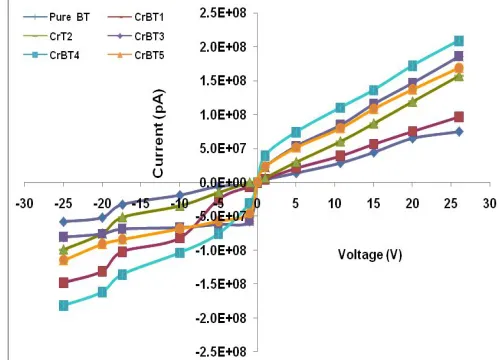
[image:4.612.178.429.530.710.2]Fig. 3 shows the I-V characteristics of samples pure BT, CrBT1, CrBT2, CrBT3, CrBT4 and CrBT5. It is observed that they are nearly symmetrical in nature indicating ohmic nature of contacts. Due to semiconducting nature of the films, the non-linear I-V characteristics are observed.
[image:5.612.149.465.145.337.2]H. Electrical conductivity
Figure 4 : Variation of electrical conductivity with temperature.
Figure 4 represents the variation of conductivity with temperature for the pure BaTiO3 and Cr-BaTiO3 (BT) films. The legends suffixed with ‘a’ are the graphs for the conductivities of the films in the air ambient, while legends suffixed ‘g’ are the graphs for conductivities of the films in the NH3 gas ambient. It is clear from the graphs that the conductivity is varying approximately linearly with temperature for all films. The conductivity of Cr-BaTiO3 films was observed to be increased.
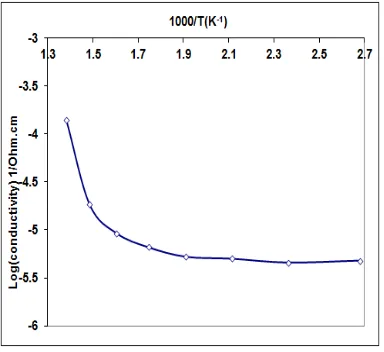
Fig. 5 represents the variation of conductivity with temperature BT thick film. From the graphs it is clear that the conductivity is varying with temperature. The resistance decreases dramatically in the 450–350 oC region due to semiconducting nature of sample., The change in resistance is very small in the 325- 200 oC region. As the conductance of the Cr-BT hardly changes from 3250C to 200 oC has good thermal stability when its operating temperature is in this range.
Fig. 5: Variation of conductivity with temperature
I. Temperature dependence of sensitivity of pure and modified BT thick films to H2S
[image:5.612.211.403.474.650.2]Fig. 6: Variation of sensitivity of pure and Cr modified BT thick films with operating temperature.
J. Selectivity
Figure 7 shows the bar diagram of the selectivity of pure and Cr2O3-doped BaTiO3 films to various gases at optimum operating temperature. The table attached to bar diagram indicates the gas response values to various gases. The pure BaTiO3 film showed highest H2S gas response while Cr2O3-doped BaTiO3 films showed highest response to NH3 gas.
Fig.7 Selectivity of Cr2O3-doped BaTiO3 films to various gases.
Table 2 shows the selectivity coefficients of pure and Cr2O3-doped films to NH3 gas against the other gases. The film with 5.27 wt% of Cr was more selective to NH3 gas against the other gases as compared to other films.
Table 2: Selectivity coefficient.
K. Response and recovery time of Cr2O3-doped BaTiO3 sensor
[image:6.612.156.459.296.460.2]Fig. 8. The gas response of Cr2O3-doped (5.27wt%) BaTiO3
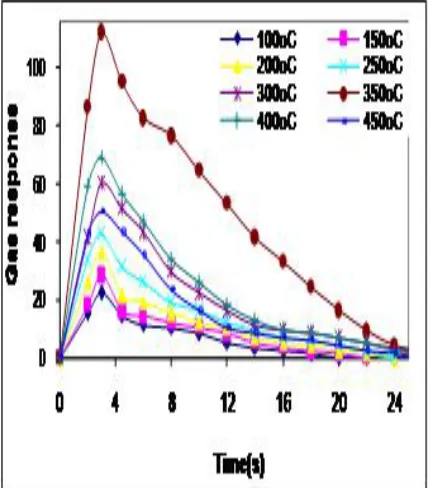
Fig.9 shows the variations in H2S gas response with speed of response time in seconds for the CrBT (20min) film operated during 100oC through 450oC and fired at 550oC. The very short response and recovery time are the important features of the CrBT. The 90% response and recovery levels were attained within 3 and 9s, respectively.
Fig. 9 Transient response of Cr2O3-doped (5.27wt%) BaTiO3 to NH3 gas
L. Gas response with operating temperature
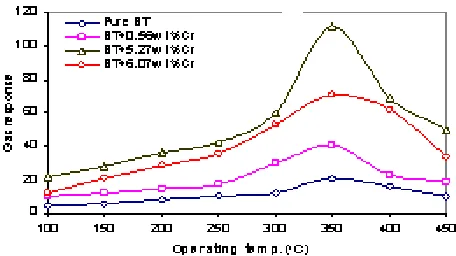
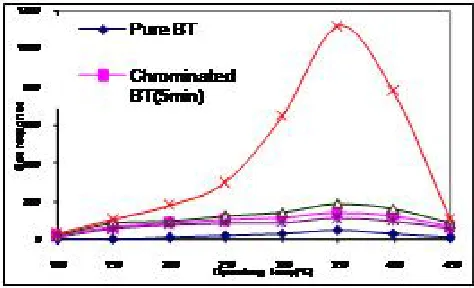
Fig. 10 shows variations in response to H2S gas (100ppm) with operating temperature of the unmodified (pure) and modified (chrominated) BaTiO3 films, fired at 550oC. The response values of unmodified and surface Cr-BT films were determined at various operating temperatures ranging from 100 to 450oC to H2S gas. The response goes on increasing with the operating temperature, attains its maximum (at 350oC) and then decreases with a further increase in operating temperature. It is observed from that the optimum operating temperature is 350oC.
Fig. 10 Variations in H2S gas (100ppm) response with operating temperature.
III. DISCUSSION
A. Cr2O3-doped BaTiO3 as a NH3 gas sensor
Atmospheric oxygen molecules are adsorbed on the surface of Cr2O3-doped BaTiO3 semiconductor oxide in the forms of O- and O2
-thereby decreasing the electronic conduction. Atmospheric oxygen molecules take electrons from the conduction band of Cr2O3-doped BaTiO3 to be adsorbed as O-BATIO3. The reaction is as follows:
O2{g} + 2e-→ 2O-BaTiO3………....(1)
The Cr2O3-doped BaTiO3 is more oxygen deficient as compared to pure BaTiO3. The excess Ba ions (due to oxygen vacancies) act as donors [42]. When reducing gas molecules like NH3 react with negatively charged oxygen adsorbates, the trapped electrons are given back to conduction band of Cr2O3-doped BaTiO3. The energy released during decomposition of adsorbed ammonia molecules would be sufficient for electrons to jump up into conduction band of Cr2O3-doped BaTiO3, causing an increase in the conductivity of sensor. The possible reaction is:
2NH3 + 3O-BaTiO3 → 3H2O + N2 + 3e-……….……..(2)
To proceed this reaction to the right hand side, some amount of activation energy has to be provided thermally. An increase in operating temperature surely increases the thermal energy so as to stimulate the oxidation of NH3 (Eq. (2)). The reducing gas (NH3) donates electrons to Cr2O3-doped BaTiO3. Therefore, the resistance decreases, or the conductance increases. That is why the gas response increases with operating temperature. The point at which the gas response reaches maximum is the actual thermal energy needed for the reaction to proceed. However, the response decreases at higher operating temperatures, as the oxygen adsorbates are desorbed from the surface of sensor [43]. Also, at high temperatures the carrier concentration increases due to intrinsic thermal excitation and the Debye length decreases. This is the reasons for the decreased gas response at high temperatures [44].
When the optimum amount of Cr (5.27wt%) is incorporated into the BaTiO3 material, the Cr2O3 species would be uniformly distributed .Because of this, not only the initial resistance of the film is high but this amount would also be sufficient to promote the catalytic reaction effectively and the overall change in the resistance on exposure of ammonia gas leading to high sensitivity. When the amount of Cr2O3 on the surface of base material, BaTiO3, is less than the optimum, the dispersion may be poor and the sensitivity of the film is decreased since this amount may not be sufficient to promote the reaction effectively. On the other hand, as the amount of Cr2O3 on BaTiO3 surface is more than the optimum, an additive Cr2O3 would be distributed more densely. As a result, base material BaTiO3 would be masked and the overall change in the resistance on the exposure of gas would be smaller leading to lower response to ammonia gas.
B. Cr-BT as a H2S gas sensor
Above its melting temperature (197oC) the chromium oxide (CrO3) on the surface of BaTiO3 film is not thermally stable,losing oxygen to give Cr2O3 after series of intermediate stages [45]. In this investigation, it is usual procedure, to test the sensors by heating them at operating temperatures ranging from 50oC to 450oC. The first time heating of a sensor above 200oC would convert CrO3 into Cr2O3.Hence the surface chrominated films can be looked upon as the small particles of chromium oxide (Cr2O3) distributed along the grain boundaries of BaTiO3 leading to very high resistance.
At elevated temperatures, when oxygen is adsorbed on the chromium zones of strong localization the potential between the BaTiO3 grains may be raised further and as a result the total resistance increases in comparison with the sample without chromium. It is known that abstraction of electrons from bulk BaTiO3 by the adsorbed oxygen results in the formation of surface states. The amount of oxygen adsorbed on the surface of Cr-BT films would be larger since chromium oxide would form misfit regions between the grains of BaTiO3 and would act as an efficient catalyst for oxygenation.
On exposure of reducing gas such as H2S on BaTiO3 based films, it would be oxidized and the potential barrier would be decreased as a result of oxidative conversion of the H2S gas and desorption of oxygen. The reaction of H2S with the adsorbed oxygen ions can be represented as:
H2S + 3O - H2O + SO2 + 3e-……….…(4)
In addition to this the conversion of chromium oxide into well conducting sulphides decreases the resistance on exposure of H2S gas. The amount and its distribution on the surface are also the important factors influencing the gas response. Due to desorption of adsorbed oxygen ions and release of electrons back to the film, and the resistance of the film would change abruptly leading to high response to H2S.
The H2S gas is reducing in nature. It reduces Cr2O3 into Cr2S3 or CrS, which are metallic in nature and are more conducting than Cr2O3 [46]. Upon exposure to H2S gas of the Cr-BT, it would reduce the chromium oxide (Cr2O3 or CrO). This can be represented as:
Cr2O3 + 3H2S Cr2S3 + 3H2O ………(5)
or 2Cr2O3 + 2H2S 4CrO + SO2.……….(6)
CrO + H2S CrS + H2O.………...……..………(7)
The film resistance would decrease suddenly and largely due to the reduction of chromium oxide into sulphides,. This can be attributed to the high sensitivity of the chrominated films.
Upon subsequent exposure of sensor to ambient air at elevated temperatures, sulphides got oxidized and could be recovered back to oxides as:
2Cr2S3 + 9O2 2Cr2O3 + 6SO2……….(8)
2CrS + 3O2 2CrO + 2SO2………...………(9)
On the surface of the BaTiO3 film, when the optimum amount of chromium oxide is dispersed, chromium species would distribute uniformly throughout the surface. Due to this, not only the initial resistance of the film was high, but this amount would also be sufficient to promote the catalytic reaction effectively and the overall change in resistance upon exposure to the test gas gets larger leading to high response to the gas. When the amount of chromium oxide on the surface of the film was less than the optimum, the surface dispersion would be poor and the amount might not be sufficient to promote the reaction more effectively, leading to lower gas response. Observations from thermal analysis indicate that the surface Cr-BT was more stable than pure BaTiO3. Hence, reproducibility of chrominated samples is expected to be better than pure BaTiO3. The adsorption of oxygen on the Cr-BT would be more effective as compared to pure BaTiO3 leading to higher gas response.
The semiconducting nature may be attributed to oxygen deficiencies in BaTiO3. The nonlinearity of the electrical conductivity-temperature profiles of the samples reveals the semiconducting nature of pure and Cr-BT. Cr of BaTiO3 has enhanced the electrical conductivity. This may be due to the bridging of intergranular gaps between BaTiO3 particles by small particles of Cr2O3 segregated around the grain boundaries of BaTiO3.
A large number of oxygen ions would be adsorbed on the misfit regions of chromium in ambient air. Fast recovery and response to H2S gas may be due to faster adsorption-desorption reactions on the surface of the Cr films The larger the misfits on the surface, the larger would be the number of oxygen ions adsorbed on the surface leading to high resistance. . The larger the oxygen deficiency, the faster would be the adsorptions of oxygen ions and in turn the faster the recovery of the sensor. The larger the number of oxygen ions adsorbed on the surface, the faster would be the oxidation of the exposed gas and the response time. BaTiO3 was observed to be highly oxygen deficient
IV. SUMMARY AND CONCLUSIONS From the experimental results following statements can be made.
A. The thick films of pure BT were sensitive to H2S gas.
C. The CrBT was observed to be semiconducting in nature and showed a negative temperature coefficient of resistance.
D. The resistance of the CrBT films in ambient air was observed to be very high.
E. The resistance of the CrBT films was observed to decrease suddenly upon exposure to H2S gas at optimum operating
temperature.
F. Chromium oxide formed misfits on the surface region. The larger the misfits on the surface, the larger would be the number of oxygen ions adsorbed on the surface, leading to high resistance.
G. The surface chromination facilitated adsorption of a large number of oxygen ions on the surface, which could immediately oxidize the exposed H2S gas, leading to faster response time of the sensor.
H. The fast recovery of the sensor could be attributed to the larger oxygen deficiency in BT. The larger oxygen deficiency would enable BT to adsorb more oxygen ions, helping the sensor to recover fastly.
I. Surface CrBT was observed to be more sensitive to H2S gas than unmodified BT..
J. The CrBT was observed to be highly selective to H2S gas.
REFERENCES [1] J. Mair, Solid State Ionics 62 (1993) 105.
[2] T. Hirschfeld, J. B. Callis, B. R. Kowalski, Science 226 (1986) 312. [3] H. Meisuer, U. Lampe, Sens. Actuators B33 (1995) 198.
[4] J. M. Herbert, Ferroelectric Transducers and sensors, Gorden and Breach, New York 1980. [5] N. Setter, E. L. Collar, Ferroelectric ceramics Basel: Birkhäuser 1993.
[6] Z. G. Zhou, Z. L. Tang, Z. T. Zhang, W. Wlodarski, Sens. and Actuators B 77 (2001) 22. [7] P.W. Haayman, R.W. Van Dam and H. A Klaasens, German Patent No. 929350 (1995).
[8] P. Jaffe. W. R. Cook, Jr. and H. Jaffe, Piezoelectric ceramics, Academic Press, New York, 1971, pp. 94. [9] O. Sahuri, K. Wakino, IEEE Trans. Component Paris, 10 (1963) 53.
[10]V. Ravi, T. R. N. Kutty, J. Appl. Phys. 68 (1990) 4891. [11]T. R. N. Kutty, V. Ravi, Appl. Phys. Lett. 59 (1991) 2691.
[12]Z. -G. Zhou, Z. -L. Tang, Z. -T. Zhang, Sens. Actuators B 93 (2003) 356. [13]Z. -T. Tang, Z. -G. Zhou, Z. -T. Zhang, Sens. Actuators B 93 (2003) 391. [14]T. Ishihara, K. Kometani, Y. Nishi, Y. Takita, Sens. Actuators B 28 (1995) 49. [15]B. Liao, Q. Wei, K. Y. Wang, Y. X. Liu, Sens. Actuators B 80 (2001) 208. [16]A. Haeusler, J. -U. Meyer, Sens. Actuators B 34 (1996) 388.
[17]J. Wang, B. K. Xu, G. F. Liu, J. C. Zhang, T. Zhang, Sens. Actuators B 66 (2000) 159. [18]M. S. Wagh, L. A. Patil, T. Seth, D. P. Amalnerkar, Mater. Chem. Phys. 84 (2004) 228. [19]S. Kanefusa, M. Nitta, M. Haradome, J. Electrochem. Soc. 132 (1985) 1770.
[20]V. Lantto, P. Romppainen, J. Electrochem. Soc. 135 (1988) 2550.
[21]J. Tamaki, T. Maekawa, N. Miura, N. Yamazoe, Sens. Actuators B9 (1992) 197. [22]S. Manorama, G. Sarala Devi, V. J. Rao, Appl. Phys. Lett. 64 (1994) 3163. [23]G. Sarala Devi, S. Manorama, V. J. Rao, J. Electrochem. Soc. 142 (1995) 2754.
[24]J. Tamaki, K. Shimanoe, Y. Yamada, Y. Yamamoto, N. Miura, N. Yamazoe, Sens. Actuators B 49 (1998) 186. [25]R. B. Vasiliev, M. N. Rumyantseva, N. V. Yakovlev, A. M. Gaskov, Sens. Actuators B 50 (1998) 186. [26]G. Mangamma, V. Jayaraman, T. Gnanasekaran, G. Periaswami, Sens. Actuators B 53 (1998) 133. [27]W. Yuanda, T. Maosong, H. Xiuli, Z. Yushu, D. Guorui, Sens. Actuators B 79 (2001) 187. [28]J. Tamaki, Y. Yamada,Y. Yamamoto, M. Matsuoka, I. Ota, Sens. Actuators B66 (2000) 70. [29]N. Yamazoe, Y. Kurokawa, T. Seiyama, Sens. Actuators B 4 (1983) 283.
[30]M. -S. Lee, J. -U. Meyer, Sens. Actuators B 68 (2000) 293.
[31]T. Ishihara, K. Kometani, Y. Nishi, Y. Takita, Sens. Actuators B 28 (1995) 49. [32]J. D. Lee, Concise In-organic Chemistry, 5th Edition, pp. 698.
[33]G. S. Manku, In-organic Chemistry, pp. 465.
[34]L. A. Patil, P. A.Wani, S. R. Sainkar, A. Mitra, G. J. Pathk, D. P. Amalnerkar, Mater. Chem. Phys. 55 (1998) 79. [35]L. A. Patil, P. A. Wani, D. P. Amalnerkar, Mater. Chem. Phys. 61 (1999) 260.