Original Research Article
A community based study to determine the prevalence of infertility
and associated socio demographic factors in rural area
of Mandya district of Karnataka
Shashank Kumbarahalli Javaregowda
1, Praveen Govindagowda
2*,
Chethan Thotahalli Krishna
1, Supriya Varadaraju
3INTRODUCTION
World Health Organization (WHO) defines infertility as “the inability of a sexually active couple to achieve a clinical pregnancy after 12 months or more of regular unprotected sexual intercourse. The epidemiological definition (for monitoring and surveillance) put forth by WHO is women of reproductive age group (15-49 years) at risk of becoming pregnant (non-pregnant, sexually
active, not using any contraception and not lactating) who report trying unsuccessfully for a pregnancy for two years or more. It may be primary infertility which refers to couples who have never conceived whereas secondary infertility refers to couples who are unable to conceive after two years of unprotected intercourse following previous pregnancy and not using any contraceptives.1,2
The importance of infertility as a public health problem affecting the individual and the family's mental and social
ABSTRACT
Background: Infertility is defined as failure to achieve pregnancy after at least 1 year of regular unprotected sexual intercourse. Infertility is classified into two types, primary and secondary infertility. World Health Organization explains primary infertility as inefficiency to conceive after a year of unprotected sex and secondary if not conceived following previous pregnancy. The objective of the study was to find out the prevalence and socio demographic factors of infertility (primary and secondary) among eligible couples in rural area of Mandya district.
Methods: A cross sectional study was conducted at Adichunchanagiri Institute of Medical sciences from the month of June 2016 to September 2016. One of the primary health center in the study area was randomly selected by lottery method. All the eligible couples who are permanent residents and in the reproductive age group were included in the study.
Results: Majority (59.64%) of the study group were in the age group of 20-25 years. Nearly 59.3% and 40.7% of the respondents belonged to joint and nuclear family respectively. The overall prevalence of infertility in our study was 7.7%. The overall prevalence of primary infertility was 6.3% and secondary infertility was 1.4%.
Conclusions: As healthcare professionals, we should remember that infertility is a stressful life event for both women and men. Hence by knowing the prevalence and knowledge of the couple regarding the infertility, suitable health education programmes can be done to create awareness among the people regarding the treatment modalities available for infertility.
Keywords: Infertility, Eligible couples, Prevalence, Socio cultural factors
Department of Community Medicine, 1Chamarajanagara Institute of Medical Sciences, Chamarajanagara, 2Hassan Institute of Medical Sciences, Hassan, Karnataka, India
3
Adichunchanagiri Institute of Medical Sciences, Bellur Cross, Mandya, Karnataka, India
Received: 21 February 2019
Accepted: 17 May 2019
*Correspondence:
Dr. Praveen Govindagowda, E-mail: [email protected]
Copyright: © the author(s), publisher and licensee Medip Academy. This is an open-access article distributed under the terms of the Creative Commons Attribution Non-Commercial License, which permits unrestricted non-commercial use, distribution, and reproduction in any medium, provided the original work is properly cited.
wellbeing has resulted in its inclusion in the national program for reproductive and child health.3 Infertility is not merely a health problem it is also a matter of social injustice and inequality. Infertility is a life crisis with invisible losses, and its consequences are manifold. Childless women experience stigma and isolation. Infertility can threaten a woman’s identity, status and economic security and consequently, be a major source of anxiety leading to lowered self-esteem and a sense of powerlessness.
The etiology of infertility is suggested to be related to a female factor in 25-40% of the cases and to a male factor in 40-55%. Unexplained infertility accounts up to 10% of the cases.1,4
The WHO estimates 60-80 million couples worldwide currently suffer from infertility. It affects a 10-15 percent of the world's young population.5 It was ranked the 5th highest serious global disability among the population under the age of 60.
In India, even with conservative estimate of 12 percentage infertility rate, the number of infertile couples in India is about 18-20 million. Some 15 – 20 percent of these infertile couples can be treated successfully with life style modification and non-specialized intervention. About 80 percent would need specialized medical intervention as assisted reproductive techniques.6 Hence, this study was done to find out the prevalence of infertility (primary and secondary) and the association between socio-demographic factors and infertility.
METHODS
A cross sectional study was conducted from the
Department of Community Medicine at
Adichunchanagiri Institute of Medical sciences, Bellur Cross, Mandya from June 2016 to September 2016.
There are total of three Primary health center (Bidinganavile, Bellur and Adichunchanagiri) attached to Adichunchanagiri Institute of Medical sciences. One of the Primary health center (Bellur) was randomly selected by lottery method, which was our study area.
Study population
All the eligible couples who are permanent residents in the study area.
Sample size
All the eligible couples in the reproductive age group (15-49 yrs) in the study area.
Inclusion criteria
Inclusion criteria were all the eligible couples who give consent for the study; participants who are permanent resident of the village.
Exclusion criteria
Exclusion criteria were eligible couples who are using any type of family planning methods (temporary and permanent) for the past one year; couple with married life less than one year.
Data collection procedures
The list of all the eligible couples in the village was obtained from the eligible couple register from the concerned Primary health center. After explaining the purpose of the study and obtaining their consent for participation in the study, all the eligible couple was interviewed. Information regarding socio-demographic profile of the family, duration of married life, history of contraception usage, infertility- duration, investigation and treatment, previous pregnancy’s and its outcome, H/o reproductive tract infections, chronic illness, history of past illness was obtained by pretested, predesigned and semi-structured questionnaire, followed by Health education to all the study participants was given.
Ethical considerations
Ethical clearance certificate was obtained from
Institutional Ethical Clearance Committee of
Adichunchanagiri Institute of Medical Sciences.
RESULTS
A total of 285 eligible couples were interviewed and analyzed.
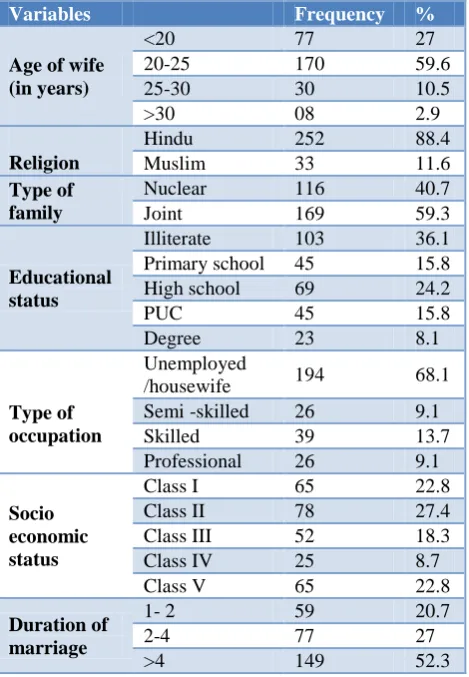
Majority (59.64%) of the study group were in the age group of 20-25 years, followed by less than 20 years of age (27.01%) and 10.52% belonged to 25-30 years and 2.8% were aged more than 30 years. In our study 88.42% of the respondents were Hindu by religion and 11.58% were Muslims. Nearly 59.3% and 40.7% of the respondents belonged to joint and nuclear family respectively. Nearly 36.1% of the participants were illiterate and 63.9% were literate. 68.1% of the women were unemployed and 31.0% were employed at various locations. In our study, class I (22.8%), Class II (27.4%), Class III (18.2%), class IV (8.7%), Class V (22.8%) were present. Majority (52.2%) had more than 4 years of married life, 27.1% between 2-4 years and 20.7% between 1-2 years (Table 1).
Out of the total 285 couples interview in our study, 22 (7.7%) of the couples reported infertility (both primary and secondary). The overall prevalence of infertility in our study was 7.7%. The overall prevalence of primary infertility was 6.3% and secondary infertility was 1.4% (Table 2).
Table 1: Socio-demographic profile of subjects (n=285).
Variables Frequency %
Age of wife (in years)
<20 77 27
20-25 170 59.6
25-30 30 10.5
>30 08 2.9
Religion
Hindu 252 88.4
Muslim 33 11.6
Type of family
Nuclear 116 40.7
Joint 169 59.3
Educational status
Illiterate 103 36.1
Primary school 45 15.8
High school 69 24.2
PUC 45 15.8
Degree 23 8.1
Type of occupation
Unemployed
/housewife 194 68.1
Semi -skilled 26 9.1
Skilled 39 13.7
Professional 26 9.1
Socio economic status
Class I 65 22.8
Class II 78 27.4
Class III 52 18.3
Class IV 25 8.7
Class V 65 22.8
Duration of marriage
1- 2 59 20.7
2-4 77 27
>4 149 52.3
Table 2: Prevalence of infertility.
Frequency Percentage (%) Number of infertile
couples 22 7.7
Number of fertile
couples 263 92.3
Total 285 100
Table 3: Classification of infertility (n=22).
Frequency Percentage (%) Primary infertility 18 81.8
Secondary
infertility 4 18.2
Total 22 100
Among the infertile couples, 40.9% of them were in the age group of 20-25 years, 27.3% less than 20 years, 22.7% between 25-30 years and 9.1% aged above 30 years. Among the fertile couples 61.2% of them were in the age group of 20-25 years, 26.9% less than 20 years, 9.5% between 25-30 years and 2.4% aged above 30 years. The association between the fertile and infertile couples among the age groups was found to be statistically significant. Nearly 81.8% of infertile couples belonged to Hindu religion and 18.2% were Muslims. Among the fertile couples 88.9% were Hindu and 11.1% were Muslims. The association was found to be statistically not significant between the two groups. Among the infertile couples, 40.9% belonged to nuclear family and 59.1% were from joint family. In fertile couples 40.7% and 59.3% belonged to nuclear and joint family. The association was found to be statistically insignificant.86.4% of the infertile couples were illiterate and 13.6% were literate. Among the fertile couples 31.9% were illiterate and 68.1% belonged to literate. The association between the groups and education was found to be statistically significant. In infertile groups, 77.3% were unemployed/housewife and 22.7% were employed. In fertile couples 67.3% were unemployed and 32.7% were employed and association was found to be statistically insignificant. The association between socio-economic class and fertility was found to be statistically not significant. Among the infertile groups 68.2% had positive family history of infertility whereas only 31.5% among infertile couples had positive family history. The association was found to be statistically significant (Table 4).
Table 4: Association between socio demographic factors and infertility.
Socio demographic factors Infertile couples (n=22) Fertile couples (n=263) P value
N (%) N (%)
Age of wife
<20 6 (27.3) 71 (26.9)
Chi square =8.13 Df= 3
p=0.04
20-25 9 (40.9) 161 (61.2)
25-30 5 (22.7) 25 (9.5)
>30 2 (9.1) 6 (2.4)
Religion Hindu 18 (81.8) 234 (88.9) Chi square =1.02
Df= 1; p=0.31
Muslim 4 (18.2) 29 (11.1)
Type of family Nuclear 9 (40.9) 107 (40.7) Chi square =0.42
Df= 1; p=0.984
Joint 13 (59.1) 156 (59.3)
Education status Illiterate 19 (86.4) 84 (31.9) Chi square =26.1
Df= 1; p=0.0001
Literate 3 (13.6) 179 (68.1)
Occupation Unemployed 17 (77.3) 177 (67.) Chi square = 0.92
Df= 1; p=0.335
Employed 5 (22.7) 86 (32.7)
Socio demographic factors Infertile couples (n=22) Fertile couples (n=263) P value
N (%) N (%)
SES
Class I 1 (4.5) 64 (24.3)
Chi square =8.28 Df= 4
p=0.08
Class II 10 (45.5) 68 (25.8)
Class III 2 (9.1) 50 (19.1)
Class IV 3 (13.7) 22 (8.4)
Class V 6 (27.2) 59 (22.4)
Family history of infertility
Yes 15 (68.2) 83 (31.5) Chi square =12.1
Df= 1; p=0.001
No 7 (31.8) 180 (68.5)
Table 5: Social cultural practices followed by infertile couples.
Variables Frequency Percentage (%)
Visited temples Yes 20 90.9
No 2 9.1
Astrologer Yes 10 45.4
No 12 54.6
Rituals Yes 4 18.2
No 18 81.8
Wearing threads Yes 12 54.55
No 10 45.45
In our study the infertile couples were found to following various cultural and social beliefs along with the treatment for infertility. 90.9% were visiting temples, 45.4% regularly visited astrologer, 18.2% performed few rituals and 54.6% were wearing threads in order to get pregnant. Out of 22 infertile couples, 18 (81.8%) were availing treatment for infertility in the hospital (Table 5).
DISCUSSION
In our study the overall prevalence of infertility was 7.7%. The primary infertility was 6.3% and secondary infertility was 1.4%.
According to NFHS 3 survey prevalence of infertility was in rural area which was 1.8%. DLHS 2008 Karnataka reported the prevalence of infertility in rural area was 7.7% where primary infertility was 6.1% and secondary infertility was very less 1.6% which is almost similar to the findings of our study.7
In the study done by Chethana and Shilpa in rural Bangalore, prevalence of infertility was 8% among which 4.5% of them had primary infertility and 3.6% had secondary infertility which is also similar to the findings of our study.8
Study conducted by Paul et al on prevalence and correlates of primary infertility among young women in Mysore, India showed the prevalence of primary infertility to be 12.6% which is much higher than the prevalence in the present study.9
Study conducted by Zargar et al to assess the magnitude of primary infertility and to study its etiologic aspects in
Kashmir India showed the magnitude of primary infertility to be 4.66%.10
In a study conducted at Ambala, Haryana, prevalence of primary and secondary infertility was 6.1% and 5.7% respectively in field practice area of a tertiary care hospital where primary infertility is same as in our study and higher secondary infertility rate when compared to our study.11
In our study majority of infertile couples were seen in the age group of less than 25 years. In the study done by of Paul et al in Mysore 56% were in the 20-29 years of age and Shilpa et al also had majority of the respondents in the 20-24 years of age group.8,9
In the study done by Sudha in Andra Pradesh the findings were similar to our study where majority of infertile couples were less than 25 years of age.12
In our study among the infertile couples nearly 81.8% were Hindus, which is similar to the findings of the Paul et al.9
In our study 86.4% were illiterate, where as in the study done by Nicole also 97% of the infertile couples were illiterate.13
where 49.9% belonged to middle socioeconomic status.14,15
In our study 77.3% of the respondents were unemployed or housewife which is contradicting to the study findings of Patel A. This also contradicts the fact that working women are 20% more likely to be infertile compared to non-working women stated in NFHS data.16,7
In the study done by Samila et al the cases of infertility among positive family history was 13.87% which is much lesser than the findings of our study.17
CONCLUSION
As Healthcare professionals, we should remember that infertility is a stressful life event for both women and men. Hence by knowing the prevalence and knowledge of the couple regarding the infertility, suitable health education programmers can be done to create awareness among the people regarding the treatment modalities available for infertility and to overcome the social, mental agony of infertility and helping them to achieve a new dimension in their reproductive life.
ACKNOWLEDGEMENTS
We would like acknowledge the Principal of
Adichunchanagiri Institute of Medical Sciences for the moral support in conducting this study.
Funding: No funding sources Conflict of interest: None declared
Ethical approval: The study was approved by the Institutional Ethics Committee
REFERENCES
1. World Health Organization. Infertility. Available at: http://www.who.int/topics/infertility/en/. Assessed on 20 September 2016.
2. Zegers Hochschild F, Adamson GD, deMouzon J, Ishiharao, Mansour R, Nygrenk, et al. The international committee for monitoring assisted reproductive technology (ICMART) and the world health organization (WHO) revised glossary ART terminology. Hum Reprod. 2009;24(11):2683-7. 3. Gupta N. Infertility: planning a prototype action
plan in the existing health care system. J Indian Med Assoc. 2002;100:391-4.
4. Sundby J. Methodological consideration in the study of frequency, risk factors and outcome of reduced fertility. Scand J Soc Med. 1939;17(2):135-40. 5. Boivin J, Bunting L, Collins JA, Nygren KG.
International estimates of infertility prevalence and
treatment seeking: Potential need and demand for
infertility medical care. Hum Reprod.
2007;22(6):1506-12.
6. The fertility resource, female infertility. Available at: http://www.conceivingconcepts.com. Assessed 20 September 2016.
7. International Institute for Population Sciences (IIPS) and Macro International.2007. Government of India: Volume I. Mumbai: IIPS. National Family Health Survey (NFHS-3), 2005–06.
8. Chethana R, Shilpa. Treatment seeking pattern among infertile couples in a rural area. Int J Community Med Public Health. 2016;3(10):2884-90.
9. Adamson PC, Krupp K, Freeman AH, Klausner JD,
Reingold AL, Madhivanan P. Prevalence & correlates of primary infertility among young women in Mysore, India. Indian J Med Res. 2011;134:440-6.
10. Zargar AH, Wani AI, Masoodi SR, Laway BA, Salahuddin M. Epidemiologic and etiologic aspects of primary infertility in the Kashmir region of India. Fertil Steril. 1997;68(4):637-43.
11. Mittal A, Yadav S, Yadav S, Bhardwaj A, Kaur R. An epidemiological study of infertility among urban population of Ambala, Haryana. Int J Interdiscipl Multidiscipl Studies. 2015;2(4):124-30.
12. Sudha G, Reddy KSN. causes of female infertility: a cross- sectional study. Int J Latest Res Sci Technol. 2013;2(6):119-23.
13. Wiersema NJ, Drukker AJ, Mai BT, Giang HN, Nguyen TN, Lambalk CB. Consequences of infertility in developing countries: results of a questionnaire and interview survey in the South of Vietnam. J Transl Med. 2006;4:54.
14. Maha A. Social Consequences of Infertility upon Women in Mosul City. Iraqi J Comm Med. 2008;21(4):291-8.
15. Aflatoonian A, Seyedhassani SM, Tabibnejad N. The epidemiological and etiological aspect of infertility inYazd province of Iran. Iranian J Reprod Med. 2009;7:117-22
16. Patel A, Sharma P, Narayan P, Binu VS, Dinesh N, Pai PJ. Prevalence and predictors of infertility-specific stress in women diagnosed with primary infertility: A clinic-based study. J Hum Reprod Sci 2016;9:28-34.
17. Shamila S, Sasikala SL. Primary report on the risk factors affecting female infertility in South Indian districts of Tamil Nadu and Kerala. Indian J Comm Med. 2011;36(1):59-61.