Biometric Vehicle Access System Using Fingerprint
Recognition
G. Srikanth1, U. Ramakrishna2
1Communication & Signal Processing M. Tech, 2Assistant professor ECE Department R.V.R& J.C College OF Engineering, Ganrur, Andhra Pradesh (522019), India
Abstract: In this project a biometric access system for vehicle is implemented. Using this project the access to a car can be controlled using finger prints. For this an embedded finger print module is used in which the finger prints of the owner and his other authorized users will be fed into the embedded module. This finger print module is further connected to a microcontroller that controls the connection to the ignition of the car.
Hence the car can only be started using a proper finger print match. Else the vehicle will not be started and sends an SMS to owner. The project will also include GSM module connected to the controller. In case of some unauthorized person trying to access the car using a unauthorized finger print then the controller, using the GSM module can automatically send SMS to the actual owner of the vehicle. Furthermore, since the controller already has a GSM modem it can also be used for additional applications like alcohol detection, over speed driving. In all these cases, automatic SMS updates can be sent to the owner of the vehicle if someone else is driving the vehicle. If required the vehicle can also be stopped if any of these conditions are detected. Key words - Biometrics, fingerprint module, microcontroller (LPC2148), GSM modem, alcohol sensor.
I. INTRODUCTION
Because of increasing number of theft cases of the vehicles there is a need to enhance the security level of the bikes and cars. Traditional and commonly used key locks available in the bikes are well known to the thieves and thus it can easily be unlocked by the professional thieves. With the help of master key it becomes very easy to unlock the lock of the bikes by the thieves. This creates the demand of such type of lock which is new and provides an additional security level. The new and modern lock must be unique in itself i.e. it must be only unlocked by special and specific key. This type of feature is available in the biometrics locks i.e. the lock which can only be locked and unlocked by the human body features. Biometrics can include: face recognition, voice recognition, fingerprint recognition, eye (iris) recognition. Of all these type of special biometric recognition techniques the fingerprint recognition is the most widely used because fingerprint of every person on the earth is unique and can provide good reliability.
Also the implementation of the fingerprint recognition system is easy and cheap than the other ones. Thus fingerprint recognition locking system can provide better reliability than the traditional locks and also is cheaper and easy than the other biometric locking system. Thus here we are proposing a model which utilizes the concept of fingerprint recognition in the motorcycles and cars to enhance the security level of the vehicle.
II. PROPOSEDMETHODOLOGY
The proposed system overcomes all the security problems in existing system and provides high security and efficiency. This is a perfect/optimal solution for saving/protecting one from the hassle of stolen/lost key or an unauthorized accessing. Fingerprint is a boon solution for these problems which provides high level of recognition accuracy. The skin on our palms and soles exhibits a flow like pattern of ridges called friction ridges.
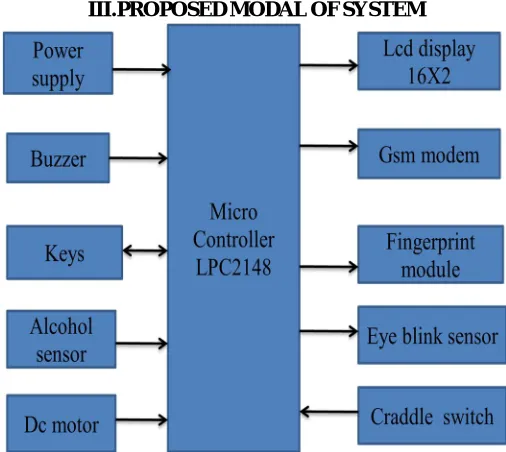
Figure 1: Block Diagramatic Representation
A. Microcontroller (Lpc2148)
The system uses LPC2148 from ARM7 family. It is the core controller in the system. It has ARM7TDMI core which is a member of the Advanced RISC Machines (ARM) a family of general purpose 32-bit microprocessors. It offers high performance for very low power consumption and price. The ARM architecture is based on RISC (Reduced Instruction Set Computer) principles, and the instruction set and related decode mechanism are much simpler than those of micro-programmed Complex Instruction Set Computers (CISC). This simplicity results in a high order output and remarkable real-time interrupt response from a small and cost-effective chip. All parts of the processing and memory systems can operate continuously since, pipelining is employed. Typically, while one instruction is being performed, its successor is being decoded, and a third instruction is being got from memory.
The ARM memory interface designed to allow the performance potential to be realized without suffering high costs in the memory system. Speed-critical control signals are pipelined to allow system regulates functions to be implemented in standard low-power logic, and these regulates signals facilitate the exploitation of the fast local access modes offered by industry standard dynamic RAMs. The LPC2148 is interfaced to different modules via GPIO (General Purpose I/O) pins. It receives the fingerprint template produced by the fingerprint module. It will match the same with the reference template stored at installation of the system.
If the acknowledged template gets matched with the reference one, the person is allowed to access the further system. In case of successive mismatch of templates, the system will initialize the GSM module to send message to the enrolled user and simultaneously will raise the alarm through buzzer.
We have used LPC2148 from NXP semiconductors (founded by Philips). It shows features as
follows-1) 16/32-bit ARM7TDMI-S microcontroller in a tiny LQFP64 package.
2) 240 kB of on-chip static RAM and 512 kB of on-chip flash program memory.
3) In-System Programming(ISP/IAP) via on-chip boot-loader software.
4) Two 10-bit A/D converters provide a total of 14 analog inputs, with conversion times as low as 2.44 μs per channel.
5) Single 10-bit D/A converter provide variable analog output.
6) Multiple serial interfaces including two UARTs (16C550), two Fast I2C-bus (400 Kbit/s), SPI and SSP with buffering and
variable data length capabilities.
7) Vectored interrupt controller with configurable priorities and vector addresses.
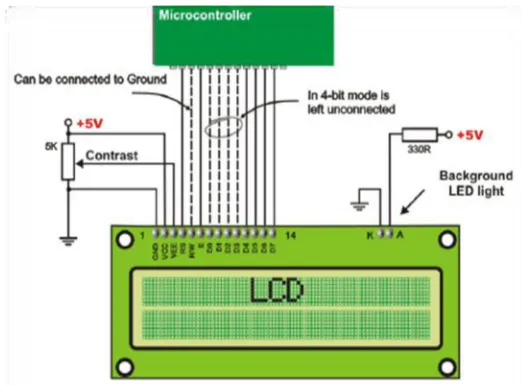
B. User Interface
Figure 2: LCD Pin Connections
C. Power supply
This section is meant for supplying power to all the sections mentioned above. It basically is consisted of a transformer to step down the 230V ac to 18V ac followed by diodes. The diodes are used to rectify the ac to dc. After rectification process, the obtained rippled dc is filtered using a capacitor Filter. A positive voltage of 12V and 5V are made available through LM7812 and LM7805. Further, LM317 is used to provide variable power e.g. 3.3V to LPC2148.
D. Alcohol sensor
The sensor MQ-3 is Gas/Smoke sensor. It is sensitive to LPG, Hydrogen, Smoke, Methane, Propane, Alcohol, Butane and other industrial combustible gases.MQ303A is a semiconductor sensor for Alcohol detection. It has very good sensitivity and fast response to alcohol, suitable for portable alcohol detector. It is a High sensitivity, Fast response, long life, low cost and small size.
E. Fingerprint module
The important module of the system is fingerprint scanner. We used FIM3030 by NITGEN. It has ADSP-BF531 as central
processing unit with 8 MB of SDRAM and 1 MB of flash ROM. It uses overall supply voltage of 3.3V.The communication with the fingerprint module is made through RS-232 via UART0 of LPC2148. A fingerprint sensor is an electronic device used to capture a digital image of the fingerprint pattern. The captured image is called a live scan. This live scan is digitally processed to create a biometric template (a collection of extracted features) which is stored and used for matching. FIM3030 is an evolutionary standalone fingerprint recognition module consisted of optic sensor Opp03 and processing board. As CPU and highly upgraded algorithm are embedded into a module, it provides high recognition ratio even to small size, wet, dry, calloused fingerprint. High speed 1: N identification and 1: N verification.
FIM3030 has functions of fingerprint enrolment, identification, partial and entire deletion and reset in a single board, thereby offering convenient development environment. Off-line functionality stores logs on the equipment memory (up to 100 fingerprints) and it’s identified using search engine from the internal algorithm. Evolutionary standalone fingerprint recognition module FIM3030 is ideal for on-line applications, because allows ASCII commands to manage the device from the host. On-line functionality, fingerprints to verify (1:1) or identify (1: N) can be stored on non volatile memory, or be sent by RS-232 port.
F. Gsm modem
The GSM modem used in this is GSM MODULE SIM 800L. The Modem is coming with RS232 interface, which allows you conect PC as well as microcontroller with RS232 Chip (MAX232).Its operates in the frequency (800MHz) of our mobile communication range (800-1200MHz). The baud rate is configurable from 9600-1 1 5200 (default baud rate is 9600) through AT command. The GSM/GPRS Modem is having internal TCP/IP stack to enable you to connect with internet via GPRS. It is suitable for SMS, Voice as well as DATA transfer application in M2M interface with the help of SIM (subscriber identity module) card. The features of GSM module SIM 800L
3) GSM mobile station class B.
4) Controlled by AT Command (3GPP TS 27.007, 27.005 and SIMCOM enhanced AT Commands)
5) Supports Real Time Clock.
6) Its supports Bluetooth feature.
7) Supply voltage range 3.4V ~ 4.4V.
8) Supports A-GPS (A means Assisted GPS).
9) Supports 3.0V to 5.0V logic level.
G. Dc motor
A DC motor relies on the fact that like magnet poles repels and unlike magnetic poles attracts each other. A coil of wire with a current running through it generates an electromagnetic field aligned with the center of the coil. By switching the current on or off in a coil its magnetic field can be switched on or off or by switching the direction of the current in the coil the direction of the generated magnetic field can be switched 180°.
IV.EXPERIMENTRESULTS
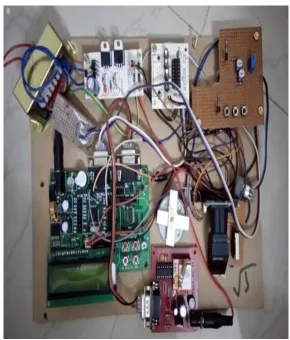
Step 1: When power is supplied to the board, the initial displays on the LCD are as shown below. Step 2: Now it displays that insert the finger on the fingerprint scanner
Step 3: After inserting finger if the finger is matched then the ignition i.e. vehicle engine will be started without any problem. Then it checks all the sensors.
Step 4: This is having the sensors like alcohol sensor, eye blink sensor and over speed so it checks when finger print was matched. If any problem occurs then stops vehicle and sends SMS to owner.
[image:5.612.160.450.383.723.2]Step 5: If the fingerprint was mismatched then the engine will not start and then already the GSM module is connected so sends a SMS to the owner’s mobile.
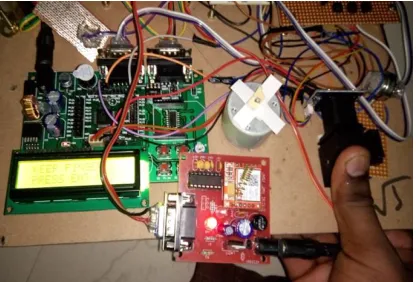
Figure 4: Indication To Scan The Finger
Figure 5: Scanning The Finger
V. CONCLUSION
Fingerprint identification enhances the security of a vehicle and makes it possible only for some selected people to start the vehicle. The expected result by implementing this model on the motorcycle is that only the authorized person will be able to ignite the vehicle. Not every person with the key will be able to start the vehicle. There will be matching of the person’s data with the stored one and only in the case of match the bike will start otherwise not. Thus by implementing this relatively cheap and easily available system on a vehicle one can ensure much greater security and exclusivity than that offered by a conventional lock and key. The thief would have to do a great deal of homework to steal the bike, and it is unlikely that they have the fingerprint technology needed to fake your fingerprint.
REFERENCES
[1] Sukeerti Singh and Ayushi Mhalan, Vehicle Theft Alert System using GSM, Int. Journal of Engineering Science and Technology (IJEST), May 2013 [2] Upendran Rajendran and Albert Joe Francis, Anti Theft Control System Design Using Embedded System, Proc. IEEE, vol. 85, page no. 239- 242, 2011 [3] Jayanta Kumar Pany and R.N. Das Choudhury, Embedded Automobile Engine Locking System Using GSM Technology, Int.Journal of Instrumentation,
Control and Automation (IJICA) ISSN : 2231-1890 Volume -1, Issue -2, 2011
[4] E.Walia and S.Kumar, Analysis of various biometric techniques, Int. Journal of Computer and Information Technologies, Vol.2,no.3,2011
[5] Mudit Singhal and Sudeep Singh, An Embedded Interface for GSM Based Car Security System, Int. Conference on Computational Intelligence, Communication Systems and Networks, IEEE Computer society, 2012
[6] Jiao She and KAisheng Zhang, Study on the Embedded Fingerprint Image Recognition System, Int. Conference of Information Science and Management Engineering, IEEE Computer Society,2010.
[7] T.Ignatenko and F. M. J Williams, Biometric Systems:Privacy and Secrecy aspects, IEEE Transactions on Information Forensics and security, IEEE,vol.4,no.4, December 2009
[8] L. F. Lai, S. W. Ho and H. V. Poor, “Privacy–security trade-offs in biometric security systems, part II: multiple use case”IEEE Transactions on Information Forensics and Security, vol. 6, no. 1, March 2011.
[image:6.612.204.412.251.392.2]