Analysis of Compressive Strength of Concrete
Partially Using Stone Dust
Ashish Kumar Patel.1, Dr. S. K. Jaiswal.2
1 M. Tech student, 2ProfessorDepartment of Civil EngineeringBhilai Institute of Technology, Durg
Abstract: : In the presented Research, a fraction of fine aggregate used in concrete is replaced by stone dust, a by-product of stone crushing and the sample cube is tested to determine the compressive strength of concrete. Tests to determine the physical properties of sample cube such as specific gravity, fineness modulus, and moisture content are also performed. Stone dust is best alternative for the fine aggregate because fine aggregate (natural sand) and stone dust has similar physical and mechanical properties. This paper shows some relevant studies regarding the effect of stone dust on mechanical property like compressive strength. Hence in this paper strength and properties of conventional concrete and stone dust concrete are compared so that it will be helpful to other researchers.
Key words: compressive strength, concrete, natural sand, mechanical properties, stone dust
I. INTRODUCTION
Concrete plays a vital role in construction industries. Concrete is composite material, which is comprised of coarse aggregate, fine aggregate, water and binding material. Fine aggregate is one of the most important material for preparation of concrete. It is obtained from the river. However due to increased use of concrete in construction work t he demand for fine aggregate is increased, to attain the demand of natural sand in concrete, partial or fully replacement of natural sand with stone dust is one of the effective method. Stone dust is the best alternative for the natural sand, because properties of natural sand and stone dust are similar.
In the backdrop of Rapid growth, Construction industries are facing acute shortage of the conventional building material. Naturally occurring sand is being used as fine aggregate in concrete. For the past some year, Due to the environmental concerns and administrative restriction in India cost of sand rose higher and higher. Comparatively, cost of sand is three to four times higher than the stone dust, even in river banks and places where the natural sand is locally and easily available. It is proposed to ascertain the possibility of replacing the sand with locally available alternatives such as stone dust, without compromising quality, strength and workability of concrete.
Coarse aggregate is a prime constituent of RCC work of all types. With help of stone crusher large boulders of 100 to 150 mm size is reduced in smaller sizes. Crushed stone is separated by sieve and stone measuring less than 4.75 mm in building construction is termed as stone dust. This stone dust is heaped near the crushing site. The amount of accumulating stone dust increases day by day. Disposal of stone dust becomes major concern of owner of crusher.
A. Materials which are used
1) Cement and aggregate: Ordinary Portland cement of 43 grade confining to IS 8112 [8] was used throughout the work. Fine
aggregates used throughout the work comprised of clean river sand with maximum size of 4.75mm conforming to zone II as per IS383-1970 [9] with specific gravity of 2.6. Coarse aggregates used consisted of machine
2) crushed stone angular in shape passing through 20mm IS sieve and retained on 4.75mm IS sieve with specific gravity of 2.
Stone dust: It is an industrial by product. It is a by-product of stone crushing which broken downs into fine aggregates. It is grey in colour and is like fine aggregate. The stone dust was obtained from nearby crushers from Spore. It causes environmental problems like damping problems. Converting stones into useful by-product stone dust has many benefits like maintenance of ecological balance. Also it is used for different activities in construction industry such as road construction and manufacture of building materials such as light weight aggregates bricks and tiles. It is sieved through 1.18mm IS sieve.
3) Water: Water is an important ingredient of concrete as it initiates the chemical reaction with cement. Potable water with pH
value 7 is used for mixing and curing through the experiment.
B. Uses of stone dust in construction
passageway surface.
2) Stone dust is also a great choice for the sub-base in laying paving blocks and slabs, and for jointing natural stone, such as slate.
3) Face work of structures for appearance and ornamental value. Stone dust as substitute for sand.
Fig.1 Stone dust used for yard construction
II. METHODLOGY
In our proposed approach cubes are casted using Stone dust additives and simple conventional concrete cubes using appropriate proportion of materials after that the cubes are kept for curing period for 7 days, 14 days and 28 days. The cube are taken out from curing after its period gets over and is subjected to the compressive strength test and the values are taken for all cubes and by comparing their strength we get the desired result.
A. Procedure Adopted for Casting Cubes
Firstly calculate the various proportion weight for M-20 (1: 1.5: 3) grade of concrete and M-30 (1:1.462:2.312) grade of concrete. Then after calculating the weight of materials
1) Spread measured quantity of sand and proportion of stone dust on the platform.
2) Dump sand and stone dust mix over the cement.
3) Dry mix the cement and sand and stone dust thoroughly, .
4) Spread the measured quantity of course aggregate in another place of platform.
5) Spread the sand cement and stone dust mixer.
6) Thoroughly mix the whole mass mass at least 3 times by shovelling and turning over by twist from centre to side then back to
the centre and again to the sides.
7) Make a hollow in the middle of the mixed materials.
8) Add measure quantity of water & slowly turn the whole mixture over & over again until each aggregate is coated with
sand-cement mortar & the mixture should be uniform & plastic.
9) Apply grease on the inner surface of moulds.
10) Fill 1/3 of the mould until the prepared mixture & tamp it for 25 times tamping.
11) Again fill the mould with 2/3 of the prepared mix & tamp it for 25 times.
12) Completely the mould & level it and (also tamp the third layer).
III. RESULT AND DISCUSSION
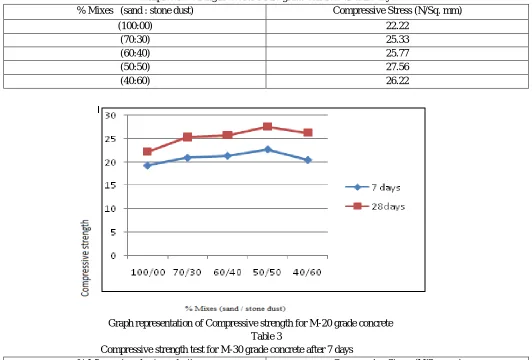
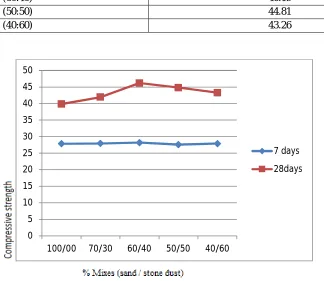
For stone dust cube-Add stone dust respectively 30%,40%,50%, and 60% . It was observed that the replacement of natural sand by stone dust increases the compressive strength of concrete by 5-22%, and found that amongst all the mixes the highest compressive strength was obtained for 40% replacement of sand by stone dust.
Table 1
Compressive strength test for M-20 grade concrete after 7 days
% Mixes (sand : stone dust) Compressive Stress (N/Sq. mm)
(100:00) 19.25
(70:30) 20.89
(60:40) 21.33
(50:50) 22.67
[image:4.612.40.572.279.639.2](40:60) 20.44
Table 2
Compressive strength test for M-20 grade concrete after 28 days
% Mixes (sand : stone dust) Compressive Stress (N/Sq. mm)
(100:00) 22.22
(70:30) 25.33
(60:40) 25.77
(50:50) 27.56
(40:60) 26.22
Graph representation of Compressive strength for M-20 grade concrete Table 3
Compressive strength test for M-30 grade concrete after 7 days
% Mixes (sand : stone dust) Compressive Stress (N/Sq. mm)
(100:00) 27.86
(70:30) 27.92
(60:40) 28.19
(50:50) 27.6
Table 4
Compressive strength test for M-30 grade concrete after 28 days
% Mixes (sand : stone dust) Compressive Stress (N/Sq. mm)
(100:00) 39.84
(70:30) 41.93
(60:40) 46.19
(50:50) 44.81
(40:60) 43.26
Graph representation of Compressive strength for M-30 grade concrete
IV. CONCLUSION
A. Following significant points can be concluded form my study
1) Concrete shows higher compressive strength after replacing fine aggregate by stone dust. So stone dust can be used as an
additive in concrete preparation.
2) Workability of concrete increases with the use of stone dust.
3) Stone dust can be used as an alternate material of fine aggregate both in lean concrete as well as in high strength concrete.
It is reported in this paper that stone dust increases the strengthen properties of concrete. However other parameters like temperature, humidity, climate conditions, air-entrapped etc. also effects the same.
REFERENCES
[1] Abbas S.Y., Srivastava V. & Agarwal V.C. “Effect of stone dust on compressive strength of concrete an experimental investigation”. International Journal of Engineering Science & Research Technology, vol. 4(2), pp. 538-543. 2015.
[2] [2] Bhiksham V., Kishore R. & Raju N.H.M. Flexural behavior of high strength stone dust concrete. Challenges, Opportunities and Solutions in Structural Engineering and Construction-Ghafoori (ed.). Taylor & Francis Group-London, pp. 491-500. 2010.
[3] [3] Fate S.S. Concrete with smart material (manufactured crushed sand)- a review. International Conference on Advances in Engineering and Technology. pp. 27-29. 2014.
[4] Manchiryal R.K., Dewangan A. & Gupta D.P. Implementation and analysis of strength characteristics of concrete using crusted stone dust as fine aggregate. International Journal of Research in Engineering & Applied Sciences, vol. 4(10), pp. 21-28. 2014.
[5] Patel A.N. & Pitroda J.K. Stone waste: Effective replacement of cement for establishing green concrete. International Journal of Innovative Technology and Exploring Engineering, vol. 2(5), pp. 24-27. April 2013.
[6] Reddy M.V. investigation on stone dust and ceramic scrap as aggregate replacement in concrete. International Journal of Civil and Structural Engineering, vol.
0 5 10 15 20 25 30 35 40 45 50
100/00 70/30 60/40 50/50 40/60
7 days
[image:5.612.149.473.153.434.2]1(3), pp. 661-666. 2010.
[7] Sai Kumar A.V.S. & Krishna Rao B. A study on strength of concrete with partial replacement of cement with quarry dust and metakaolin. International Journal of Innovative Research in Science and Engineering and Technology, vol. 3(3), pp. 10467-10473. 2014.
[8] Syam Prakash V., Dhanya Krishnan & Jeenu G. Influence of fine stone dust on high strength concrete. Our World in Concrete & Structure. Singapore. 28-29 August, 2007.[32nd conference of Singapore Concrete Institute]