ISSN Online: 2157-9431 ISSN Print: 2157-9423
Evaluation of the Knowledge and Perceptions of
Patients towards Generic Medicines in UAE
Suleiman I. Sharif*, Raneem J. Chaar, Zahraa Z. Albadrani, Jameel S. Shahwan,
Mohamed N. Badreddin, Mohamed A. K. Charbaji
Department of Pharmacy Practice and Pharmacotherapeutics, College of Pharmacy, University of Sharjah, Sharjah, United Arab Emirates
Abstract
Objectives: The objective of this study was to evaluate the knowledge and percep-tions of patients towards generic medicines in some Emirates of the United Arab Emirates. Methods: A cross-sectional survey involving patients in three Emirates was undertaken. A 23-item questionnaire was designed, pre-validated and administered. Results: The questionnaire was fully answered by 96 patients out of 120 producing a response rate of 80%. The majority of patients were young Arab females with a uni-versity degree. Slightly less than 50% of patients were having a monthly income of less than ED 10,000. Results of the patient’s survey indicate that they have poor knowledge and perception of generic medicines. They did not know the meaning of generic or brand medicines and this negatively influenced their responses to conse-quent questions. Conclusion: Patients’ knowledge and perception of generic drugs were poor. Efforts are needed to increase public awareness of generic drugs and possible brand substitution. Both the prescribing physician and the dispensing pharmacists have an essential role to play in educating their patients of generic drugs.
Keywords
Evaluation, Patients, Generic Medicines, Brand Medicines, Knowledge, Perception
1. Introduction
Generic medicine use is increasing both in developing and developed countries. Pre-scribing trends among physicians can be investigated using the drug use indicators suggested by the World Health Organization (WHO) [1]. In a previous study of this kind, we demonstrated that generic prescribing by both consultants and general
practi-How to cite this paper: Sharif, S.I., Chaar, R.J., Albadrani, Z.Z., Shahwan, J.S., Badred-din, M.N. and Charbaji, M.A.K. (2016) Eva- luation of the Knowledge and Perceptions of Patients towards Generic Medicines in UAE. Pharmacology & Pharmacy, 7, 369- 378.
http://dx.doi.org/10.4236/pp.2016.79045
Received: August 11, 2016 Accepted: August 29, 2016 Published: September 1, 2016
Copyright © 2016 by authors and Scientific Research Publishing Inc. This work is licensed under the Creative Commons Attribution International License (CC BY 4.0).
tioners in the United Arab Emirates was far from ideal [2]. However, there is evidence that not only doctors but also pharmacists hold negative views of generics and resist prescribing generic medicines [3] [4]. Patients have been shown to have poor know-ledge and misconceptions about generic medicines [5]. Many studies have reported pa-tients to have negative views about generics as they believe generics to be less effective, of lower quality and unsuitable for treatment of major illnesses, as compared to their branded equivalents [5]-[7]. It is worth noting that some patients might ask the pre-scriber for a particular drug by name which is usually brand and expensive drug either because of previous experience with the medicine or due to the impact of promotional activity. It has also been suggested that such an insistence on an expensive medicine may be because the patient does not pay the full cost or because they believe that those drugs are better than cheaper ones [8]. Keeping this in mind, it seems rather important to evaluate the level of knowledge, perception and attitudes of patients and if the levels are poor or misconception were of significant negative impact on generics use, inter-ventions must be implemented to increase awareness of the public towards generic drugs as substitutes for expensive counterpart brands. It must be noted that low income patients and those without medical insurance coverage may not adhere to their pre-scribed drugs if they cannot afford its cost and as such drug compliance may not be achieved and this would negatively impact therapeutic outcomes. On the other hand, prescribing generic medicine by the physician or replacement of brand by generic by the pharmacist would have the opposite effect. Taken cost of medicine into considera-tion, it must be remembered that generics, according to estimates of Food and Drug Administration (FDA) are usually 20% - 70% less expensive than their counterpart brands [9]. In the United Arab Emirates (UAE) there is a lack of studies on generic prescribing and knowledge, perception and attitude of patients towards generic drugs. Therefore, this study was undertaken to evaluate the level of knowledge, perception and attitude of patients towards generic versus brand medicines.
2. Methods
2.1. Questionnaire and Study Design
In addition to that, anonymity of respondents in the study was preserved in which the names of participants were not included. One of the investigators was available during filling the questionnaire to clarify any queries. The questionnaire consisted of three sec-tions. The first dealt with patient’s demographic data including gender, age, ethnic group, educational level, monthly income, medical insurance and % cost paid per pre-scription. The second section comprised the average number of prescriptions per year, practice of self-medication without prescription, asking for specific medicine by name, explaining the condition and consulting the pharmacist for medication and whether the patient prefers local or imported medicines. We also examined patient’s believes of imported medicines as compared to locally produced drugs. Patients have to select ei-ther agree, not sure or disagree to statements on wheei-ther imported medicines are of higher quality, more effective, more expensive, with less side effects, more prescribed by physicians, more recommended by dispensing pharmacists and are more advertised than locally produced drugs.
In the third part of the questionnaire, we examined the patient's knowledge and per-ception of generic medicines. In this section, patients were asked if they know the meaning of generic and brand medicines, and to briefly describe each in case they know, and if they think there are differences between generic and brand medicines. In addition, patients were asked whether they agree, are not sure or disagree to statements such as; brand medicines are of higher quality than generics, safer, with fewer side ef-fects and whether they are more expensive. Patients were also asked whether they ac-cept substitution by pharmacists of their prescribed brand with generic and what ge-nerics they prefer locally produced or imported, cheap or expensive, and how often their brand medication was replaced by a generic one and whether the cost of the pre-scribed medicines is an issue or not as long as his/her condition is treated.
2.2. Statistical Analysis
Responses of the participants were encoded and the data were analyzed using Statistical Package for the Social Sciences (SPSS, version 17, Chicago, IL, US). Three categories of the relevant responses were used so that 95% confidence intervals (95% CI) could be calculated. Descriptive analysis was used to calculate the proportion of each group of respondents who agreed/disagreed with each statement in the questionnaire. Chi square test was used to identify any significant difference among the participants’ res-ponses regarding certain statements in the questionnaire with a significant level of p value of <0.05.
3. Results
Participants include more female (71, 74%) than male (25, 26%) patients. More than two thirds of participants were young (20 - 30 years) Arabs and holders of a university degree. Slightly less than 50% of the participants were with a monthly income of less than ED 10,000 (Table 1).
Table 1. Demographic characteristics of patients.
Frequency (%) n = 96 Criteria
Gender
25 (26%) Male
71 (74%) Female
Age
65 (67.7%) 20 - 30
14 (14.6%) 31 - 40
12 (12.5%) 41 - 50
4 (4.2%) 51 - 60
1 (1.1%) >60
Nationality
77 (80.2%) Arabic
18 (18.8%) Non-Arabic
Educational level
8 (8.3%) Illiterate
6 (6.3%) High school
73 (76%) University degree
4 (4.2%) Master
5 (5.2%) Ph.D.
Patient’s monthly income ED
47 (49%) <1000
20 (20.8%) 10,000 - 14,000
14 (14.6%) 15,000 - 19,000
12 (12.5%) 20,000 - 24,000
3 (3.1%) 25,000 - 30,000
shown in Table 2. The majority of patients agreed to the statements that imported me-dicines are of higher quality (44.8%), more effective (50%), more expensive 66.7%), more advertised (65.6%) and more prescribed (42%) than locally produced drugs. Knowledge of participants of brand medicines as compared to generics is shown in Table 3. It is clear that knowledge of patients in the present study is poor as 47% - 50% of the data that is based on awareness of brand and generic medicines was not recorded by participants.
Table 2. Views of patients on various aspects of imported versus locally produced drugs.
Statement Agree Frequency (%), n = 96 Not sure Disagree 95% CI for Agree responses
Imported medicines are of higher quality 43 (44.8%) 41 (42.7%) 41 (42.7%) (34.89 - 54.69) Imported medicines are more effective 48 (50%) 36 (37.5%) 12 (12.5%) (40.05 - 59.95) Imported medicines are more expensive 64 (66.7%) 22 (22.9%) 10(310.4%) (57.28 - 76.05) Imported medicines produce fewer side effects 18 (18.8%) 43 (44.8%) 35 (36.5%) (10.98 - 26.52)
Imported medicines are more
prescribed by physicians 42 (43.8%) 42(43.8%) 11 (11.5%) (33.88- 53.62) Imported medicines are recommended
more by pharmacists 33 (34.4%) 45 (46.9%) 17 (17.7%) (24.92 - 43.83)
[image:5.595.199.552.291.418.2]Imported medicines are more advertised 63 (65.6%) 23 (24%) 10 (10.4%) (56.17 - 75.08)
Table 3. Patient’s knowledge of properties of brand as compared to generic medicines.
Statement
Frequency (%), n = 96 95% CI for agree responses Agree Not sure Disagree Data not recorded
Quality of brand medicine is higher. 26 (27.1%) 12 (12%) 13 (13.5%) 45 (46.9%) (18.24 - 35.93) Brand medicine is more effective. 21(21.9%) 13 (13.5%) 15 (15.6%) 47 (49%) (13.65 - 30.10) Brand medicine is safer. 18 (18.8%) 16 (16.7%) 15 (15.6%) 47 (49%) (10.98 - 26.52) Brand medicine is more expensive. 37 (38.5%) 9 (9.4%) 3 (3.1%) 47 (49%) (28.86 - 48.23)
Brand medicine produces
fewer side effects. 11 (11.5%) 21(21.9%) 16 (16.7%) 48 (50%) (5.12- 17.80)
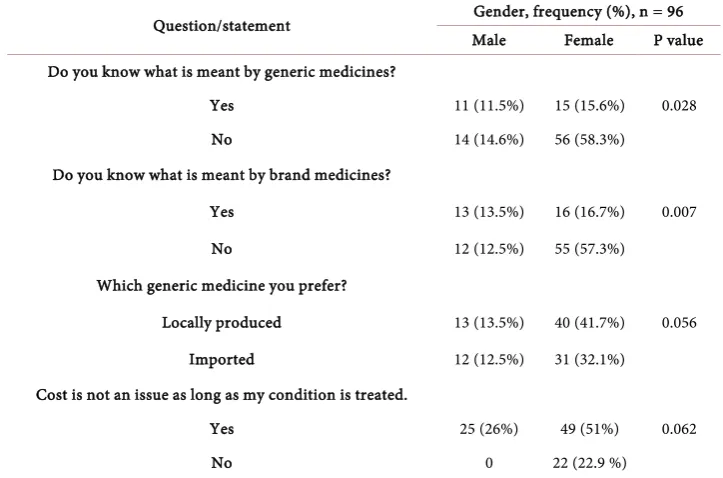
Table 4. Influence of patient’s gender on various aspects of generic drugs.
Question/statement Gender, frequency (%), n = 96 Male Female P value Do you know what is meant by generic medicines?
Yes 11 (11.5%) 15 (15.6%) 0.028
No 14 (14.6%) 56 (58.3%)
Do you know what is meant by brand medicines?
Yes 13 (13.5%) 16 (16.7%) 0.007
No 12 (12.5%) 55 (57.3%)
Which generic medicine you prefer?
Locally produced 13 (13.5%) 40 (41.7%) 0.056
Imported 12 (12.5%) 31 (32.1%) Cost is not an issue as long as my condition is treated.
Yes 25 (26%) 49 (51%) 0.062
No 0 22 (22.9 %)
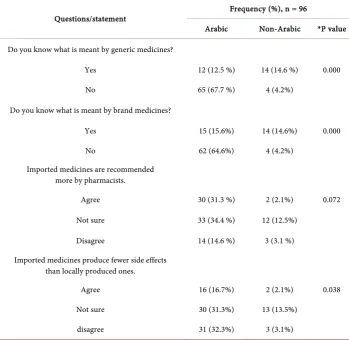
[image:5.595.192.554.453.692.2]produced or imported generics. When considering the cost, statistically significant number of females selected yes to cost being not an issue as long as their condition is treated. Although low (21, 21.9%) but statistically significant number of the youngest (20 - 30 years) age group agreed that brand medicines are more expensive than generics (Table 5). More Arab (65, 67.7%) than non-Arab patients (4, 4.2%) did not know what is meant by brand or generic. However, only less than 5% of non-Arab pharmacists did not know the meaning of both brand and generic medicines (Table 6). When asked whether more imported medicines are recommended by pharmacists, about one third of Arab patients agreed or was not sure. With regard to the statement that imported medicines produce fewer side effects than locally produced ones, statistically higher percentages of Arab patients disagreed or were not sure of such statement (Table 3). In studying the influence of the level of education on the statements that brands are more recommended by pharmacists and being more expensive than generics, statistically sig-nificant higher percentages of patients with a master degree approved both statements (Table 7). The monthly income of patients did not statistically influence their prefe-rence to locally produced or imported drugs but patients with the least monthly income (<10,000 ED) agreed or were not sure of imported medicines being of higher quality, more effective and are more prescribed by physicians than locally produced counter-parts (Table 8).
4. Discussion
[image:6.595.195.552.588.688.2]In the present study, most of the participants were young Arab females with a universi-ty degree who believed that imported drugs are superior to locally manufactured coun-terparts. In addition, knowledge of patients of generic and brand medicines was rather poor and this was negatively reflected on their consequent responses to the questions in the survey. In general, patients have less confidence in generic drugs, because, among other reasons, the packaging of generics does not have acceptable appearance as brand drugs do. It has been reported that a significant disadvantage to the use of generics— and a factor identified as conducive to continued use of proprietary medicines—was variability in appearance of generics [10]. Also some patients insist on certain drugs, because of their previous experience or due to the impact of promotional activity in fa-vor of these drugs. Knowledge of patients in the present study was poor as compared to
Table 5. Influence of patient’s age on whether brand medicine is more expensive than generic ones.
Statement patient age (years), frequency (%), n = 96
20 - 30 31 - 40 41 - 50 51 - 60 >60 P value Brand medicines are more
expensive than generics.
Agree 21(21.9 %) 8 (8.3 %) 6 (6.3%) 2 (2.1%) 0
0.005 Not sure 8 (8.3%) 0 1 (1%) 0 0
Table 6. Influence of ethnicity of patient on some aspects of generic medicines.
Questions/statement Frequency (%), n = 96
Arabic Non-Arabic *P value
Do you know what is meant by generic medicines?
Yes 12 (12.5 %) 14 (14.6 %) 0.000
No 65 (67.7 %) 4 (4.2%)
Do you know what is meant by brand medicines?
Yes 15 (15.6%) 14 (14.6%) 0.000
No 62 (64.6%) 4 (4.2%)
Imported medicines are recommended more by pharmacists.
Agree 30 (31.3 %) 2 (2.1%) 0.072
Not sure 33 (34.4 %) 12 (12.5%)
Disagree 14 (14.6 %) 3 (3.1 %)
Imported medicines produce fewer side effects than locally produced ones.
Agree 16 (16.7%) 2 (2.1%) 0.038
Not sure 30 (31.3%) 13 (13.5%)
disagree 31 (32.3%) 3 (3.1%)
Chi square test, significance at p value < 0.05.
Table 7. Views on imported and brand medicines.
Questions/statement Frequency (%), n = 96
Illiterate High school University Master Ph.D. *P value
Imported medicines are recommended more by pharmacists
Agree 2 (2.1%) 1 (1%) 27 (28.1%) 3 (3.1%) 0 0.009
Not sure 4 (4.2%) 1 (1%) 35 (36.5%) 0 5 (5.2%)
Disagree 2 (2.1%) 4 (4.2%) 10 (10.4%) 1 (1%) 0
Brand medicines are more expensive than generics
Agree 2 (2.1%) 0 30 (31.3%) 2 (2.1%) 3 (3.1%) 0.002
Not sure 0 2 (2.1%) 7 (7.3%) 0 0
Disagree 2 (2.1%) 0 1 (1%) 0 0
[image:7.595.195.553.475.695.2]Table 8. Influence of patient’s monthly income on their views on some aspects of imported drugs.
Question/ statement
Frequency (%), n = 96
10 10 - 14 15 - 20 20 - 24 25 - 30 *P value What medicines
do you prefer?
-Locally produced 7 (7.3%) 8 (8.3%) 2 (2.1%) 1 (1%) 0 0.064 -Imported 18 (18.8%) 6 (6.3%) 3 (3.1%) 5 (5.2%) 3 (3.1%) No preference 22 (22.9%) 6 (6.3%) 9 (9.4%) 6 (6.3%) 0 Imported medicines are of
higher quality than local ones.
Agree 16 (16.7%) 14 (14.6%) 6 (6.3%) 4 (4.2%) 3 (3.1%) 0.005 Not sure 27 (28.1%) 4 (4.2%) 3 (3.1%) 7 (7.3%) 0
Disagree 4 (4.2%) 2 (2.1%) 5 (5.2%) 1 (1%) 0 Imported medicines
are more effective.
Agree 18 (18.8%) 14 (14.6%) 8 (8.3%) 5 (5.2%) 3 (3.1%) 0.009 Not sure 24 (25%) 5 (5.2%) 1 (1%) 6 (6.3%) 0
Disagree 5 (5.2%) 1 (1%) 5 (5.2%) 1 (1%) 0 Physicians prescribe
mainly imported medicines
Agree 21 (21.9%) 11 (11.5%) 2 (2.1%) 7 (7.3%) 2 (2.1%) 0.019 Not sure 23 (24%) 4 (4.2%) 8 (8.3%) 5 (5.2%) 0
Disagree 2 (2.1%) 5 (5.2%) 4 (4.2%) 0 0
Chi square test, significance at p value < 0.05.
more expensive the medication, the better its quality and its effectiveness [13].
5. Conclusion
Results of this survey conclude lack of knowledge of generic medicines and patients are inclined to prefer imported drugs. Efforts must be directed towards increasing public awareness of generic medicines and should also focus on educating physicians and pharmacists about generic medicines through inclusion of related topics in undergra-duate curricula and continuing educational programs.
Acknowledgements
The authors are greatly indebted to all patients who participated in the study.
Limitation of the Study
In the present study although we covered patients from three Emirates in UAE, cover-age of patients from other Emirates would produce more informative results particu-larly in the light of the relatively small sample size of our study.
Conflict of Interest
The authors declare that there is no conflict of interest.
References
[1] Sharif, S.I., Fazli, H., Tajrobehkar, Y., Namvar, Z. and Bugaighis, L.M.T. (2015) Drug Pre-scribing Trends among Consultants and General Practitioners in Sharjah-UAE.
Pharma-cology & Pharmacy, 6, 374-379. http://dx.doi.org/10.4236/pp.2015.68038
[2] WHO (1995) How to Investigate Drug Use in Health Facilities: Selected Drug Use Indica-tors. World Health Organization, Geneva, WHO/DAP/93.1.1995.
[3] Chong, C.P., Hassali, M.A., Bahari, M.B. and Shafie, A.A. (2011) Exploring Community Pharmacists’ Views on Generic Medicines: A Nationwide Study from Malaysia.
Interna-tional Journal of Clinical Pharmacy, 33, 124-131.
http://dx.doi.org/10.1007/s11096-010-9470-1
[4] Shrank, W.H., Liberman, J.N., Fischer, M.A., Girdish, C., Brennan, T.A. and Choudhary, N.K. (2011) Physician Perceptions about Generic Drugs. Annals of Pharmacotherapy, 45, 31-38. http://www.ncbi.nlm.nih.gov/pubmed/21205953
http://dx.doi.org/10.1345/aph.1p389
[5] Al Ameri, M.N., Whittaker,C., Tucker, A. and Johnston, A. (2011) A Survey to Determine the Views of Renal Transplant Patients on Generic Substitution in the UK. Transplant
In-ternational, 24, 770-779. www.ncbi.nlm.nih.gov/pubmed/21575080
http://dx.doi.org/10.1111/j.1432-2277.2011.01268.x
[6] Himmel, W., Simmenroth-Nayda, A., Niebling, W., Ledig T., Jansen, R.D., Kochen, M.M., Gleiter, C.H. and Hummers-Pradier, E. (2005) What Do Primary Care Patients Think about Generic Drugs? International Journal of Clinical Pharmacology and Therapeutics, 43, 472- 479. www.academia.edu/17656190/What_do_primary_c
Medicine, 75, 90-96. www.ncbi.nlm.nih.gov/pubmed/23115341 http://dx.doi.org/10.1097/psy.0b013e3182738826
[8] Quintala, C. and Mendesb, P. (2012) Underuse of Generic Medicines in Portugal: An Em-pirical Study on the Perceptions and Attitudes of Patients and Pharmacists. Health Policy, 104, 61-68. http://www.healthpolicyjrnl.com/article/S0168-8510(11)00199-0/abstract?cc=y= http://dx.doi.org/10.1016/j.healthpol.2011.10.001
[9] Food & Drug Administration. Facts about Generic Drugs.
http://www.fda.gov/Drugs/ResourcesForYou/Consumers/BuyingUsingMedicineSafely/Und erstandingGenericDrugs/ucm167991.htm
[10] World Health Organization (2003) Introduction to Drug Utilization Research. WHO, Oslo. http://apps.who.int/medicinedocs/en/d/Js4876e/
[11] Al Ameri, M.N., Mohamed, W., Makramalla, E., Shalhoub, B., Tucker, A. and Johnston, A. (2013) Renal Patients’ Views on Generic Prescribing and Substitution: Example from the United Arab Emirates. Eastern Mediterranean Health Journal, 19, 373-381.
www.ncbi.nlm.nih.gov/pubmed/23882964
[12] Abduelkarem, A.R. and Sharif, S.I. (2008) Current Levels of Interaction between the Physi-cian and Pharmacist: A Comparative Study in Libya and UAE. Jordan Journal of
Pharma-ceutical Sciences, 1, 142-150. http://journals.ju.edu.jo/JJPS/issue/archive
[13] Meredith, P. (2003) Bioequivalence and Other Unresolved Issues in Generic Drug Substitu-tion. Clinical Therapeutics, 25, 2875-2890. www.ncbi.nlm.nih.gov/pubmed/14693311
Submit or recommend next manuscript to SCIRP and we will provide best service for you:
Accepting pre-submission inquiries through Email, Facebook, LinkedIn, Twitter, etc. A wide selection of journals (inclusive of 9 subjects, more than 200 journals)
Providing 24-hour high-quality service User-friendly online submission system Fair and swift peer-review system
Efficient typesetting and proofreading procedure
Display of the result of downloads and visits, as well as the number of cited articles Maximum dissemination of your research work