www.ijraset.com Volume 5 Issue IV, April 2017 IC Value: 45.98 ISSN: 2321-9653
International Journal for Research in Applied Science & Engineering
Technology (IJRASET)
©IJRASET: All Rights are Reserved
1638
Software Reliability Growth Models and its
Applications
Prof. Deepa N1, Vurimi Krishna Harika2, S. Uma Meghana3, Lakshmi Priya V4, K. Vindhya5
School of Information Technology And EngineeringVIT University , Vellore, Tamil Nadu
Abstract: A software reliability growth model is one of the major strategies used to evaluate the system's reliability quantitatively. The software reliability growth model is required to have a decent execution as far as integrity of-fit, consistency, predictability. Various explanatory models have already been proposed during the previous three decades for surveying . In this paper we will outline some current Software Reliability Growth Models (SRGMs), their importance, along with some discussion about the applicability of these models during the software development cycle.
Keywords: SRGM, TE, FDR, fault detection rate.
Abbreviations
SRGM: Software growth reliability model TE: Testing effort
FDR: Fault detection rate
I. INTRODUCTION
Due to technology development, we rely on software intensive systems for our day to day life , there arises the need for software reliability. The term “Software Reliability” defines the error free software for specified period of time in a specified environment. Measurement of software reliability plays a important role in optimization of software development and maintenance cost.
There were so many models which have been proposed and analyzed which is completely based on results conducted during software testing. Software reliability is similar to hardware reliability but finding software errors are difficult than finding hardware errors .Software reliability depends on the reliability of design involved to build a system , mapping that design to implementation and reliability of software components involved. This paper illustrates an overview of models of software reliability growth for fault detection ,its limitations and applicability of the models proposed in development of software.
II. DISCUSSION
A. Software Reliability
The term software reliability used find the ability of the system functionality. Mean time between failure used to measure the software reliability. Reliability rate increases when there is no error in the system. Reliability value is given between 0 and 1.
1) Reliability testing is important for the testers and practitioners.
2) There are many types of reliability testing like load, feature, regression.
3) Reliability is important to enhance process management.
B. Software Reliability Growth Models
Technology (IJRASET)
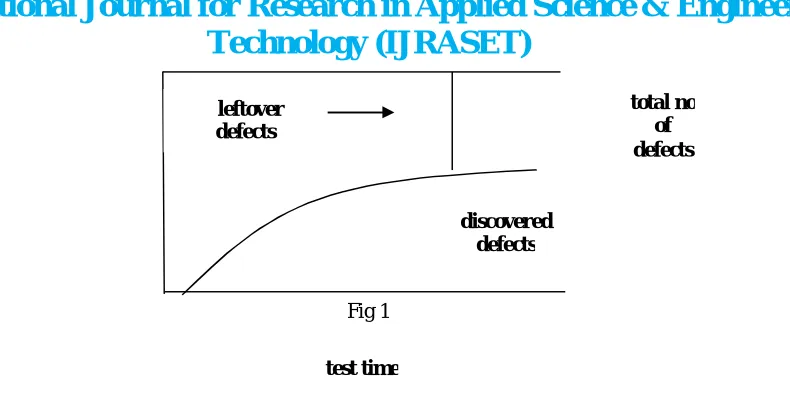
Fig 1
Below are some of the reliability growth models with brief description.
C. Non Homogenous Poison Process
NHPP was designed to detect errors in the software system based on mean-function value which gives result in terms of S-shaped growth curve which helps the testers to become familiar the testing process and enhance their skills.
D. User Oriented Reliability Model
This model has been designed to measure service reliability given to the customers. We know that the reliability highly dependent on the modules, their interconnectivity and their functions. In User oriented system the reliability of program can be achieved by detecting errors in the program. But the systems requires user input to provide output so it can be clearly understood that expected output and even failure depends on the user input. As a result set of modules in a system will be executed in a sequence which gives correct output. The reliability of program is tested by assuming independence in modules reliability as first case and in second case execution of second module depends on first module .Therefore modules should be executed in sequence is important to get correct output.
1) C.SRGM for FDR: Software reliability growth models are designed to detect errors in the software systems. FDR can be obtained from previous project experiences and combination of TE and time-variable FDR which gives accurate prediction of faults which is very similar to exact fault value and this can be applied to real time software systems.
E. Architecture based Software Reliability System
Architecture based software reliability system uses two methods-path based and state based. Path based method begins with the execution one component and ends with execution of last component which gives approximate software application reliability. In hierarchical methods , application reliability can be obtained in two steps by calculating the architectural statistics and combining them with failure parameters of the components.
III. APPLICATIONSOFSRGM
A. The S-shaped software reliability model is applied to real time systems to detect errors accurately.
B. The user oriented software reliability teaches the user how to effectively analyze the system reliability based on statistical analysis which detects fault.
C. The reliability models are used to find very good strategic testing techniques to make testing process more effective.
D. The testing strategies makes our system more reliable.
E. The reliability models identifies the critical modules so we can identify and correct the modules before failure occurs.
total no of defects
discovered defects leftover
defects defects
[image:3.612.122.517.46.244.2]www.ijraset.com Volume 5 Issue IV, April 2017 IC Value: 45.98 ISSN: 2321-9653
International Journal for Research in Applied Science & Engineering
Technology (IJRASET)
©IJRASET: All Rights are Reserved
1640
J. General Assumptions Of SGRM
1) An failure is detected at the early stage
2) Failure is caused by the error is found
3) Removal of error causing failure is done using SRGM.
IV. APPLICABILITY OF SRGM IN SOFTWARE DEVELOPMENT LIFECYCLE
In this section we will discuss about how the software reliability models are used at each stage of software development lifecycle.
A. Design Phase
During the design phase, faults might be identified outwardly or by other formal or casual systems. Existing software reliability models are not pertinent during this stage in light of the fact that the test cases expected to uncover defects as required by fault seeding and information area based models do not exist, and the defects history required by time subordinate models is not accessible.
B. Testing Phase
Many software Reliability models are applicable during testing phase.
1) During Unit Testing, the fault seeding model is applicable. The probability of detecting indigenous faults and seeding faults is equal. But some difficulties may arise in between. The input domain based models can also be applicable but not useful to full extent.
2) During Integration testing, most applicable models are fault count models and Time between Failure models. These models are useful for performing random testing
3) During Acceptance Testing, the inputs in view of operational utilization are produced to check whether the software is acceptable or not. In this stage, seeding of faults is not handy furthermore, the uncovered faults are not generally quickly amended. Therefore mainly Input domain based models and fault count models are applicable.
C. Operational Phase
At the point when the software as viewed by the designer or the "amicable clients" is as of now adequate, the product is discharged for operational utilize. During operational phase, the client information sources may not be arbitrary. This is because that the client may utilize a similar software function or way on a normal premise. User inputs may likewise be correlated, hence losing their randomness. Moreover, issues are not generally promptly adjusted. In this condition, fault count models are mostly applicable and could be utilized for observing software failure rate.
V. CONCLUSIONS
This paper illustrates the applications of software reliability growth models along with their working. Reliability of software system is highly essential to software project management and enhance of software systems. Software reliability growth models detects the error to detect errors at the early stage and remove them immediately.
VI. ACKNOWLEDGEMENTS
The authors are highly thankful to journals and support provided by the University.
REFERENCES
[1] Yamada, Shigeru, and Shunji Osaki. "Software reliability growth modeling: Models and applications." IEEE Transactions on Software Engineering 11.12 (1985): 1431.
[2] Yamada, Shigeru, Hiroshi Ohtera, and Hiroyuki Narihisa. "Software reliability growth models with testing-effort." Reliability, IEEE Transactions on 35.1 (1986): 19-23.
[3] Yamada, Shigeru, and Shunji Osaki. "Software reliability growth modeling: Models and applications." IEEE Transactions on Software Engineering 11.12 (1985): 1431.