Technology (IJRASET)
Designing Parameters and Study of 8 KW Solar
PV Grid Connected System (A Case Study
)
Nikhil Kumar Yadav1, Dr. Dharmendra Kumar Singh2, Amit Agrawal3
1
M.Tech (Power System Engineering Scholar), Department of Electrical and Electronics Engineering
2
Head & Associate Professor, Department of Electrical and Electronics Engineering
3
Assistant Professor, Department of Electrical and Electronics Engineering DR. C.V. Raman University Bilaspur Kargi Road Kota, Chhattisgarh India
Abstract: - The purpose of this paper is to provide the real information about 8KW Solar Photo Voltaic System. The conventional energy sources like coal, petroleum and fossil fuels are limited in nature. About 55% of energy is produced by fossil fuels in India. And fossil fuels are limited in nature and are not long lasting. With the increase in demand of electrical energy, the alternative non- conventional energy generation technique is required. The generation of electrical energy through Sun is the best option. The day and night is periodic in nature. So, one can extract unlimited amount of energy from sun. The energy generated from the sun is called solar energy. The solar energy is generated with the help of photovoltaic cell which is also called PV Cells. The photovoltaic cell converts the light into electrical energy directly without any intermediate conversion step. Now days the solar energy is preferred over conventional fossil fuels generators. The solar energy is considered as green energy as it doesn’t create pollution and no mechanical parts are used in solar photovoltaic system. The solar photovoltaic system is 90% efficient for the first ten years and 80% efficient for the coming five years. The solar systems are equipped with battery sources to supply the load in night. In this way, if there is sunshine for seven to eight hours, the load can be supplied for complete 24 hours. To promote power system security or to avoid outage the solar systems are used. The Grid Tied solar system can also be designed, where in absence of sun; the power can be taken from grid.
Keywords: - Grid, PV (Photo Voltaic), Power System Security, Outage and Green Energy.
I. INTRODUCTION
The solar energy is the energy produced by sun. The earth surface receives this energy in the form of electromagnetic radiation; this radiation can be easily converted to some other form of energy, such as heat and electricity which can be easily utilized by human beings. It is expected that sun is radiating as solar energy is renewable in nature, and abundantly available in nature. It is eco-friendly in nature and doesn’t create pollution, so it can be the good alternative for fossil fuels. Solar radiation includes visible, infrared and ultraviolet rays, which are radiated throughout the space in all directions and these all rays are filtered through atmosphere. Ozone layers present in stratosphere blocks the ultraviolet radiation and allow only visible and infrared rays to enter in earth surface. Earth receives 8 percent of ultraviolet radiation, 46 percent visible light and 46percent infrared radiation [1].
The major limitations of solar energy are that is considered as a dilute form of energy, uncertain availability of solar energy is a major problem and solar rays are not fixed and continuously varies. The fair sunshine is experienced when these rays are not blocked by clouds or some objects in between. These objects causes reflection and diffused light is obtained. As per World Meteorological Organization sunshine duration is about 120Watts per square meter [2].
The energy is created in sun through a thermonuclear process and there 650,000,000[ ] tons of hydrogen is converted into helium
every second. This creates enormous amount of heat and electromagnetic waves and the heats produced plays a vital role in maintaining the thermonuclear reaction. Earth surface receives very small quantity of this radiation and heat. In short all the energy sources are interlinked directly or indirectly with sun, the fossil fuels like coal, petroleum, gas etc. are dead remains of animal or plant which were sun dependent millions of year ago. In 2009-2010 Jawaharlal Nehru National Solar Mission launched in India with the target of 20,000 MW of solar energy installation by end of the year 2022 through solar photovoltaic systems. This scheme launched by Central government; provides incentives as well as subsidies that promote installation of the solar autonomous as well as solar grid connected systems. This increases the demand of solar panel and price of solar panel is also decreasing day by day. [4]
II. SOLAR PHOTOVOLTAIC SYSTEM
Technology (IJRASET)
steps. PV modules are formed by the connection of solar cell in series, & parallel. In the same way, no. of modules are combined together to form “PV Arrays” and these solar arrays are used for small as well as for large power applications.
The electricity is generated by the application of Fossil fuels, Hydel Energy, Wind Energy or Nuclear Energy. About 55% of country’s total electrification is fulfilled by the coal. The process starts with the coal pulverization; then fed to boilers where these powdered coals of fixed sized are brunt at high temperature and pressure, to produce steam which is rich in potential energy able to rotate the blades of turbines. The efficiency of steam power plant is not 100%. So, it creates huge amount of pollution (in the form of particulate matters, ejection of carbon dioxide from chimneys and produces several green house gases.).The stocks of coals are limited in nature, So, One have to go for some other renewable alternative source of energy generation. In recent times, the solar or photovoltaic technology has been popular and cost per watt associated with solar power generation has also reduced [5].
The conversion of light directly into electricity is only possible through photovoltaic effect; hence the solar cell is also referred as photovoltaic cell. When sunlight is incident on the solar panel, the current and voltage is generated in the terminals of solar cell. Sunlight intensity decides the amount of electricity to be generated from solar cell and other factors on which electricity generation depends are “Area of solar Cell, angle of incidence of light on the panel & intensity of light. [5]
By increase in solar cell area, the current generated from it can be increased [5]. The best result is obtained when the sun is exactly 90ᵒ to the solar cell or when sunlight is perpendicular to the cell. [5]
Finally, the output of solar cell in a panel has only two terminals (i.e. positive terminal and negative terminal). Usually the upper layers of solar cell have front contact in top portion which receives radiation; p-n junction is present in the intermediate layer and there is end contact at the lowest layer. The negative and positive charges are separated at the Emitter-Base junction, and load is
connected to the positive and negative output terminals if load is dc and if the load is ac it is fed through inverters [4] .
Fig.1:- A.C. Load Feeding Through Solar Panel
III. WORKING PRINCIPLE
The sunlight encompasses accumulation of small energy packets; these packets of energy are called photons. Each packet has fixed amount of energy. For electricity generation, the absorption of this photon is required by the solar cell. Photons energy and band energy gap in “eV (electron Volts)” of semiconducting material decides the amount of photons to be absorbed by the solar cell [8].For electricity generation through solar panel following steps are required:-
A. The semiconducting material of solar panel absorbs the photon present in the sunlight.
B. This generates electron-hole pairs. Electrons are regarded as negatively charged while holes are regarded as positively charged. The separation of electron and holes takes place near the junction, when we connect the load to solar cell. The electrons are accumulated at cathode while the hole gets collected at anode.
Technology (IJRASET)
position can be taken up by high energy electron and produces enormous amount of energy. This effect is called photovoltaic effect and the best result of photovoltaic effect is obtained from semiconducting materials. Once the photons gets absorbed by this material. The electron gains higher level of energy than electron in base. Then the electric field becomes necessary for induction of this higher energy electron to out from semiconductor to perform some useful work. And material junction having different electrical characteristics provides these electric field [1] .There are two types of semiconducting materials. In an intrinsic semiconductor all the four valence electrons are strongly attached in chemical bonding and there is no availability of free electrons at absolute zero temperature. If the doping of these semiconductors are done by penta-valent element then it provides an excess electron, thus n-type semiconductor is formed. This free electron is mobile throughout the semiconductor lattice. Whenever the intrinsic semiconductor is doped by trivalent impurity; it creates excess amount of holes able to move throughout lattice structure, in turn causes the shortage of electrons and this creates p-type semiconductor. The semiconductor formed by one side with p-type and other side with n-type is called p-n junction. Once, the photons are absorbed in this junction. The mobile electrons of n-type semiconductor will move towards p-side and in order to balance the shortage of charge carriers the holes of p-type semiconductor will move towards the n-region. This creates the diffusion effect which further causes electric field from n to p region. Until equilibrium is reached this field keeps on increasing. If the external load is connected through contacts of p- type and n type semiconductors, there is movement of electrons from n-region to p-region. And, then there is formation of bounded electron when electron get into the hole and ultimately the removal of both holes and electron takes place. Electrical current in the external circuit is caused by the movement of free electrons and continues to flow till electrons and holes are produced by absorption of solar radiation in the solar panel. The current produced is direct in nature and can be converted into alternating form by the means of inverter [1][6].
Fig.:-3 A Typical Schematic Diagram of Solar Cell
IV. GRID CONNECTED PHOTOVOLTAIC SYSTEM WITH BATTERY BACK-UP
Technology (IJRASET)
[image:5.612.92.503.98.249.2]
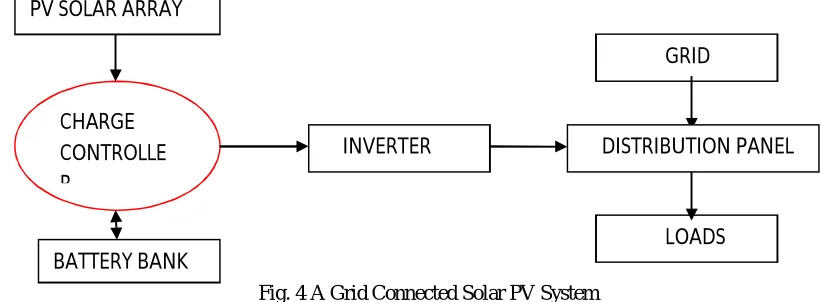
Fig. 4 A Grid Connected Solar PV System
A grid connected solar Photo Voltaic system consists of the following components:
Solar Photo Voltaic array (Formed With PV Modules P1,P2,P3……Pn) Array combining box
DC Cabling DCDB Inverter AC Cabling ACDB
ARRAY COMBINING BOX
PV ARRAY
CHARGE CONTROLLE R
PV SOLAR ARRAY
BATTERY BANK
GRID
LOADS
INVERTER DISTRIBUTION PANEL
P 1 P 2 P 3 P 4 P n P 1 P 2 P 3 P 4 P n INVERTER
DC BREAKER BOX
AC CABLING DC CABLING
AC BREAKER BOX AC DISTRIBUTION BOX
TO GRID
Technology (IJRASET)
A. Solar Photo Voltaic Array
The solar photo voltaic array is the combination of solar modules in series and parallel. It converts the photons ejected by sun into electricity. The voltage level can be increased by series connection and the current level can be increased by parallel connection of modules. The modules are connected in series or parallel to form string. The series string offer voltage range of 120V-1000V DC and current output varies between 5-10 A [4].
B. Array Combining Box
To make electrical interconnections of solar Photo Voltaic strings in an array combiner box is used. It has the DC protecting equipments used in a solar PV array. MC4 connectors are used to connect the string to the box and by the use of short terminal switches + ve and –ve string connection can be broken and combined inside the box [5].
From Strings + -
+ +
[image:6.612.70.498.214.530.2]- -
Fig. 6 Arrangement of AC Combining Box
Inside the box, the dc surge arrester is placed. The combiner box is doubly insulated at belongs to class II protection ranking against electric shock. The ground fault detector interrupter is used for grounded PV arrays and arrays are also protected and under IP65 protection scheme the solar PV module is protected against dust and low pressure rain [5].
C. DC Cabling
The modules are series combined with the help of DC cables and strings are also interconnected through these cables to form array. The cables used for the connection of string are rated for 1.25-1.5 times the value of short circuit current. For less than 4 strings by pass diode is not necessary.
D. DCDB (DC Distribution Box)
DC distribution box performs the distribution of dc cables to inverter. Photo Voltaic arrays are isolated from the inverter with the
Surge Protection
FROM STRINGS GROUND
ARRAY OUTPUT DC DISCONNECT SWITCH
MC4
MC4
Technology (IJRASET)
help of 2-pole DC disconnect switch. The output of this equipment is connected to the inverter.
V. SITE LOCATION
A. Location site of installed Photovoltaic system
The Korba is known as the industrial hub of Chhattisgarh. It is surrounded by thermal power plants from all the direction. Its elevation is 316 meter from sea level and located at 22.3595° N latitude, 82.7501° E longitude. The 8Kilo Watt grid connected solar photovoltaic system is installed on the roof of Korba district collectorate office and magnified satellite location of installed site is as follows:-
Fig.7 PV system installed site on Google Map (Source Google Map)
Fig.8 Magnified view of site on Google Map (Source Google Map)
VI. RESULTS AND DISCUSSIONS
A. Wind Speed of the location
Technology (IJRASET)
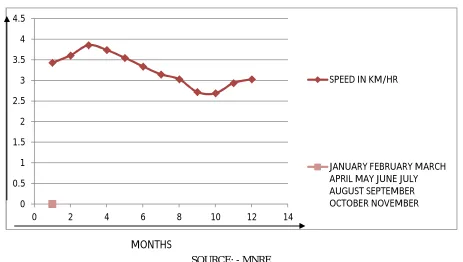
Graph no. 1. Monthly Wind Speed in kmph
[image:8.612.75.538.92.354.2]SOURCE: - MNRE
Table no. 1. Monthly Wind Speed in kmph
B. Monthly average solar radiation of the location
Intensity of sunlight plays a vital role in electricity production. The voltage and current output is directly dependent on the solar radiation incident on the panel. There is increase in sunlight radiation from morning to afternoon then from afternoon to evening there is decrease in radiation. The average monthly radiation falling on korba is as follows:-
0 0.5 1 1.5 2 2.5 3 3.5 4 4.5
0 2 4 6 8 10 12 14
SPEED IN KM/HR
JANUARY FEBRUARY MARCH APRIL MAY JUNE JULY AUGUST SEPTEMBER OCTOBER NOVEMBER
MONTHS SPEED IN Km/hr
JANUARY 3.43
FEBRUARY 3.61
MARCH 3.86
APRIL 3.74
MAY 3.55
JUNE 3.34
JULY 3.15
AUGUST 3.03
SEPTEMBER 2.72
OCTOBER 2.69
NOVEMBER 2.94
DECEMBER 3.03
Average Monthly Wind Speed is 3.2575Km/hr.
SPEED (KM/HR)
Technology (IJRASET)
[image:9.612.53.556.97.305.2]Graph no. 2 Monthly Solar Radiation in KWh/m2/Month
Table no.2 Monthly Solar Radiation in KWh/m2/Month [Source: - CREDA KORBA CHHATTISGARH]
C. Module Connection
The solar photovoltaic module is a packed interconnected combination of solar photo voltaic cells. This module has capability to convert sunlight into electricity without any other intermediate steps. Here, monocrystalline solar panel is used which offers highest efficiency among all types of panels and It has wattage of 275 Wp. Each module has 72 solar cells. All module offers positive wattage. No modules rating are below 275Watt. 90% performance efficiency is provided for first 10 year and 85% efficiency is provided for the remaining 15 years [CREDA KORBA].
0 1 2 3 4 5 6 7
0 2 4 6 8 10 12 14
RADIATION IN KWh/m2/day
JANUARY FEBRUARY MARCH APRIL MAY JUNE JULY AUGUST SEPTEMBER OCTOBER
NOVEMBER
MONTHS RADIATION IN KWh/m2/Month
JANUARY 4.39
FEBRUARY 5.27
MARCH 5.98
APRIL 6.46
MAY 6.43
JUNE 4.86
JULY 3.89
AUGUST 3.75
SEPTEMBER 4.22
OCTOBER 4.96
NOVEMBER 4.64
DECEMBER 4.3
Average Monthly Solar Radiation is 4.9291KWh/Month
RADIATION (KWh/M2 /DAY)
Technology (IJRASET)
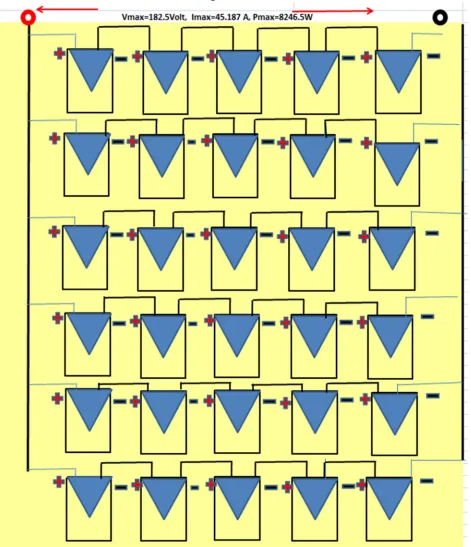
[image:10.612.73.544.87.634.2]The connection diagram of module is as follows:-
Fig. no. 9 Connection of solar module in a String (Source:-CREDA)
Technology (IJRASET)
Table no. 3 Solar Module Calculation
Fig. no. 10 8 KW Solar Practical Values Calculation Chart
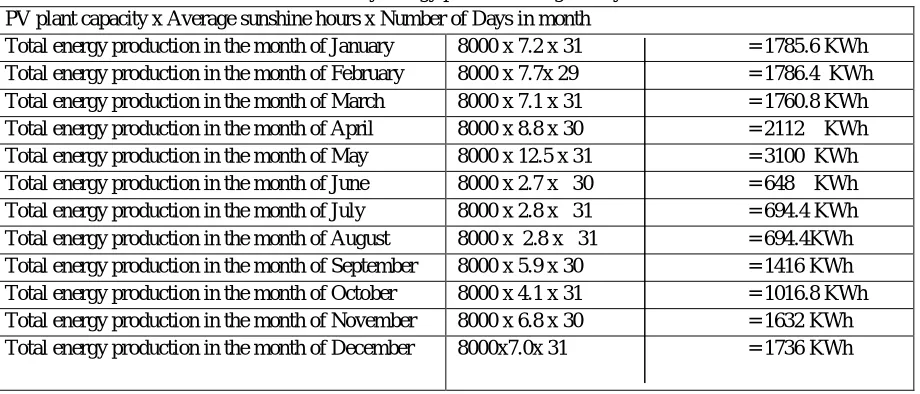
D. Monthly Energy Production
The Monthly energy production is given by:- PV plant capacity x Average sunshine hours x Number of Days in month
Technology (IJRASET)
Table no.4 Monthly power generation parameters
MONTHS RADIATION IN
KWh/m2/Month
SYSTEM CAPACITY
Average Sunshine(In
Hours/day)
Monthly Power Generated (KWh)
JANUARY 4.39 8000W 7.2 1785.6
FEBRUARY 5.27 8000W 7.7 1786.4
MARCH 5.98 8000W 7.1 1760.8
APRIL 6.46 8000W 8.8 2112
MAY 6.43 8000W 12.5 3100
JUNE 4.86 8000W 2.7 648
JULY 3.89 8000W 2.8 694.4
AUGUST 3.75 8000W 2.8 694.4
SEPTEMBER 4.22 8000W 5.9 1416
OCTOBER 4.96 8000W 4.1 1016.8
NOVEMBER 4.64 8000W 6.8 1632
DECEMBER 4.3 8000W 7 1736
Average 4.93 8000W 6.28 1531.86
Graph no. 3 for monthly energy produced in months
Technology (IJRASET)
E. Final Module Testing Result Panel Wise
The testing is performed at Standard Test Condition as per recommendation of MNRE and CREDA. Table no. 5 30 Panel STANDARD TEST CONDITION Testing Results
SOURCE:-CREDA
VII. CONCLUSION
In this way designing aspects of solar photo voltaic system is studied with the help of all important parameters. Solar PV system promotes power system security and hence, outage can be avoided. Although, solar system are costly, but no extra cost is required after installation and one can get complete amount back within 5 years. As conservation of fossil fuels are required. So, solar power generation is the best choice. If the concept of wireless power transfer comes in practical usage. Then, we can get energy 24 hour by installing solar panels in space.
REFERENCES
[1] Non Conventional Energy Sources by G.D. Rai.
[2] Data from World weather Information Service Website and Solar Radiation Data from Non Conventional Energy Sources by G.D. Rai. [3] www.ccs.neu.edu/home/feneric/solar.html, Eric W Brown, “An Introduction to Solar Energy”(accessed in April, 2016).
[4] www.mnre.gov.in/file-manger/annual-report/20142015/EN/Chapter%204/Chapter_4.html(accessed in April, 2016). [5] “Solar PV Manual” by Chetan Singh Solanki.
[6] www.thegreenage.co.uk/tech/types-of-solar-panel/ (accessed on April, 2016) .
[7] Ioannis-Thomas K. Theologitis, “Comparison of existing PV models and Possible integration under EU grid specifications”.

![Table no.2 Monthly Solar Radiation in KWh/m2/Month [Source: - CREDA KORBA CHHATTISGARH]](https://thumb-us.123doks.com/thumbv2/123dok_us/8581007.860899/9.612.53.556.97.305/table-monthly-solar-radiation-month-source-creda-chhattisgarh.webp)