Abstract
The ability to accurately quantify all the microRNAs (miRNAs) in a sample is important for understanding miRNA biology and for development of new biomarkers and therapeutic targets. We develop a new method for preparing miRNA sequencing libraries, RealSeq®-AC, that involves ligating the miRNAs with a single adapter and circularizing the ligation products. When compared to other methods, RealSeq®-AC provides greatly reduced miRNA sequencing bias and allows the identification of the largest variety of miRNAs in biological samples. This reduced bias also allows robust quantification of miRNAs present in samples across a wide range of RNA input levels.
Keywords:miRNA-seq, Sequencing bias, Small RNA sequencing, Small RNA library preparation
Background
MicroRNAs (miRNAs) are small non-coding RNAs of approximately 21–23 nucleotides that control the expres-sion of most genes and are involved in many biological processes. Dysregulation of miRNA expression or biogen-esis has been implicated in cancer and other diseases [1]. The ability to accurately measure absolute amounts of all miRNAs is important for understanding their biological functions as well as for discovering miRNA biomarkers, developing miRNA-mimic drugs, and identifying miRNA therapeutic targets.
Next-generation sequencing (NGS) is the only approach that allows both discovery of novel miRNA sequences—in-cluding sequence variants such as isomiRs—and expression profiling of miRNAs. It is widely believed that NGS will increasingly displace other expression profiling methods in both research and clinical diagnostic applications [2]. Be-sides its high cost, the major problem preventing the adop-tion of NGS for routine expression profiling of miRNAs is its poor accuracy (bias) in quantifying many miRNA se-quences: most individual miRNAs are underrepresented as a proportion of total sequence reads, in some cases by as much as 104-fold relative to their true abundance within a sample [3–7]. In cases where sequencing bias leads to some miRNAs being under-detected or undetectable in particular samples, NGS can provide misleading or useless results [5, 7, 8]. Indeed, it is likely that many important
miRNAs remain to be discovered because they are not incorporated by current library preparation methods [9].
There is compelling evidence that most of this sequen-cing bias results from inefficient and sequence-dependent ligation of miRNAs with the two sequencing adapters, a key step in the most widely used methods of sequencing library preparation (Fig. 1a). Several approaches to ad-dressing this adapter ligation bias have been developed [4–6,8,10–13], including partially randomizing sequences at either the ends [14] or internal regions of adapters [8]. The latter approach allows co-folding of the adapters with the miRNA and ligation products, increasing ligation efficiency by bringing the ends of the adapters and miRNA closer together [8]. As demonstrated below, however, methods incorporating these approaches remain signifi-cantly biased.
Results
Here we describe a new, more effective approach to reducing ligation bias. In our approach (Fig. 1b), we incorporate the sequences of both standard sequencing adapters into a single adapter. This single adapter is ligated to the 3′ end of the miRNA and the miRNA– adapter ligation product is then circularized via intramo-lecular ligation. Before circularization of the miRNA– adapter ligation product, a blocking oligonucleotide is li-gated to the 5′-preadenylated end of the remaining unligated adapter to inhibit adapter circularization,
which would be a template for adapter-dimer
* Correspondence:[email protected];[email protected]
SomaGenics, Inc., Santa Cruz, California, USA
amplification. RT-PCR amplification of the resulting cir-cles generates a library suitable for use in standard next-generation platforms. With this approach, the inef-ficient, intermolecular 5′-adapter ligation step is re-placed by a highly efficient intramolecular ligation.
To assess the value of this approach, we first identi-fied eight miRNAs for which detection with a two-adapter ligation approach is accompanied by a wide range (~ 216-fold) of bias levels (Additional file1: Figure S1). Using this set of eight miRNAs we devel-oped a highly efficient ligation and circularization protocol that minimized differences in ligation and circularization efficiency among these eight miRNAs, with < 20% variation in single-adapter ligation effi-ciency and < 25% variation in circularization effieffi-ciency (Additional file 1: Figure S2).
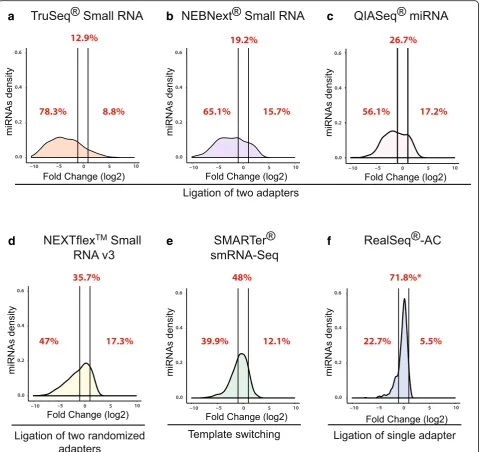
Based on this novel single-adapter approach, we have developed a new protocol for preparing small-RNA sequencing libraries called RealSeq®-AC (Fig. 1b). To test this protocol and compare its bias in detection of miRNAs to other commercially available library preparation kits, we prepared sequencing libraries in triplicate using RealSeq-AC along with five commercially available library preparation kits: NEBNext® (NEB), TruSeq® (Illumina), NEXTFlex™ (Bioo Scientific/PerkinElmer), QIAseq (Qia-gen), and SMARTer (Takara Bio). Libraries were prepared for a pool of 963 synthetic miRNAs, including the eight miRNAs described above, present in equimolar concentra-tions (miRXplore™Universal Reference, Miltenyi Biotech). This pool has become established as a standard validation tool for microarray, RT-qPCR, and NGS assays [8]. To determine bias in miRNA quantification, we calculated the fold-deviation from the equimolar input by using the ratio of observed to expected numbers of sequencing reads for each miRNA, and the expected reads are equal for all miRNAs in the pool, as previously described [8]. By this standard measure of bias in miRNA detection, we found that RealSeq®-AC showed significantly less bias (pvalue < 0.005) than the other kits (Fig. 2, Additional file 1:
Figure S3, Additional file 2: Table S1). Kits employing variants of the two-adapter scheme showed the greatest bias, with most miRNAs being underrepresented (negative log2(fold-change)), a much smaller number overrepre-sented (positive log2(fold change)), and between 12.9% and 35.7% accurately quantified (defined as log2(fold change) between −1 and 1, or observed reads within ± 2-fold of expected) (Fig.2a–d). SMARTer, a ligation-free technique that uses poly(A)-tailing and reverse transcriptase (RT) template switching to detect small RNAs, accurately quan-tified 48% of miRNAs (Fig.2e), while RealSeq®-AC accur-ately quantified 71.8% (Fig.2f).
The use of a reference pool of synthetic miRNAs provides a straightforward way to measure ligation bias. However, for biological RNA samples, other RNA mole-cules interfering with the enzymatic reactions can poten-tially influence the accuracy and sensitivity of miRNA detection. To test for differences in detection of en-dogenous miRNAs among different library preparation kits, we prepared sequencing libraries in triplicate from a Human Brain Total RNA sample (ThermoFisher) using each of the six kits indicated in Fig.3. Each library was sequenced and the reads aligned against all miRNAs in miRBase 21 [15] (see also “Methods” and Additional file 2: Table S2). After sub-sampling sequencing reads to analyze the same number of reads for each kit for each member of the triplicate, we found that RealSeq®-AC allowed the detection of the largest number of high-confidence miRNAs, with an average of 324 miR-NAs detected with coverage of at least five reads (Fig.3). To compare miRNA profiles of biological samples with “profiles” obtained from the synthetic pool, we selected, from a set of 542 human miRNAs that have been desig-nated as high-confidence miRNAs based on experimen-tal evidence [15], all miRNAs that are also represented in the miRXplore pool (276 miRNAs). In profiling the expression of these 276 miRNAs within the brain sam-ple, we found significant differences in quantification among the various kits (Fig. 4). For example, comparing
a
b
[image:2.595.58.539.88.217.2]RealSeq®-AC and SMARTer, 186 (67.4%) of the 276 high-confidence miRNAs present in the synthetic pool showed more than a twofold difference in quantification between the two kits (Fig.4e). Of these 186 differentially quantified miRNAs, 100 (53.8%) showed a strong detec-tion bias (more than twofold) when the synthetic pool was profiled with the SMARTer kit, while only 10.7% had such bias with RealSeq®-AC (Fig. 4e, f). Comparing the differences in miRNA quantification between RealSeq®-AC
and the other small RNA library preparation kits and assessing these differences according to each kit’s accuracy of detection of the synthetic pool, we calculated the per-centage of miRNAs that each kit either fails to detect (false negatives) or for which it overestimates the abundance (false positives) due to incorporation bias. RealSeq®-AC showed the lowest rate of false positive and false negative measurements (Fig. 4). This suggests that most of the differences seen among library preparation
d
e
f
Fig. 2Bias in miRNA detection using various small-RNA library preparation kits. For each kit, sequencing libraries were prepared from the miRXplore™pool and sequenced; the sequence data were then used to calculate fold-deviations from the equimolar input and plotted as log2
values. Densities of miRNAs within a two-fold deviation from the expected values (betweenvertical lines) are considered unbiased according to [8]. Under-represented, over-represented, and accurately quantified percentages of miRNAs are shown inred font. Results for two-adapter schemes areaTruSeq® Small RNA,bNEBNext®, andcQIAseq.dNEXTFlex™, a scheme using two adapters with randomized sequences.e
[image:3.595.59.541.88.540.2]Fig. 3Brain miRNAs detected by different library preparation kits. Sequencing libraries were prepared in triplicate and subsampled to the same number of trimmed reads (200,000 per library), and the average number of high-confidence miRNAs [15] identified is shown.Error barsrepresent the standard deviation of triplicate experiments
a
f
b
g
c
h
d
i
e
j
Fig. 4Differential quantification of brain samples between different small RNA library preparation kits. Data obtained with eitheraTruSeq®,b
NEBNext®,cNEXTFlex™,dQIAseq, oreSMARTer kits were compared with data obtained with RealSeq®-AC to obtain differential quantification (log2) values for 276 high-confidence miRNAs. These values were plotted against the accuracy of detection of that miRNA when profiling the
[image:4.595.62.537.86.344.2] [image:4.595.59.540.386.663.2]detect other classes of small RNAs, we profiled an RNA reference sample (Universal miRNA Reference kit, Agi-lent) comprised of RNAs from nine human tissues and cell lines, including adult testis and a testis cell line. It has been demonstrated that piRNAs play important roles during spermatogenesis, where their levels of expression are increased [17]. This sample thus contains a high percentage of piRNAs with 2′-OMe modifications at their 3′ends. We found that, of the reads that map to small RNAs, the percentage of piRNA reads is higher for RealSeq-AC (17.9%) than for the three other kits tested (QIAseq 7.1%, NEXTFlex™ 5.5%, and TruSeq® 6.2%) (Additional file 1: Figure S4). The apparently larger bias of other kits against non-miRNA small RNAs compared to RealSeq®-AC may contribute to the fact that a larger percentage of their small-RNA reads map to miRNAs.
Several recent studies comparing NGS and RT-qPCR for miRNA quantification have found poor agreement between these platforms [18–22]. To perform a similar comparison with RealSeq®-AC and RT-qPCR, we identified the 15 most-abundant brain miRNAs according to RealSeq®-AC (Additional file2: Table S3). From these, we selected four miRNAs that show very disparate abundances when quan-tified by the various sequencing kits and quanquan-tified them by RT-qPCR (Additional file 1: Figure S5 and Additional file2: Table S4). The rank order of relative abundance of these four miRNAs as determined by RealSeq®-AC was the same as that determined by RT-qPCR, whereas all other kits tested ranked the selected miRNAs differently to RT-qPCR. The kit with the best correlation between quan-tification by sequencing and by RT-qPCR was RealSeq®-AC (r= 0.89). While RT-qPCR procedures can themselves be biased, these results suggest that the previously reported poor correlation between NGS and RT-qPCR data may have been largely due to bias introduced by the procedures used for sequencing library preparation.
Based on the above results showing its better accuracy in quantification of miRNAs by using a single-adapter and circularization, we tested whether RealSeq®-AC could de-tect and profile a larger number of different miRNAs in an RNA sample than other small RNA sequencing library preparation kits. Using RealSeq®-AC and TruSeq®, we pre-pared sequencing libraries from a reference sample of total RNA (Agilent) obtained from nine different human tissues
larger number of miRNAs for differential expression stud-ies and highlights the importance of accuracy in detection even when performing relative profiling measurements.
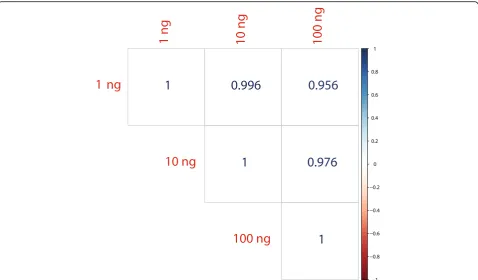
The recent surge of interest in detecting extracellular RNAs has increased the need for accurate measurement of miRNA representations from samples with extremely low concentrations of miRNAs. Due to the inefficient and biased to particular miRNA sequences ligation steps, current library preparation methods that use two-adapter ligation techniques require a high number of PCR amplifi-cation cycles to reliably detect miRNAs from low-input samples. While PCR bias is much less of a factor than adapter ligation bias in contributing to inaccuracy of detecting miRNAs, the known bias of PCR toward favor-ing GC-rich, more abundant, and highly similar miRNA sequences can further hinder the accurate quantification of miRNAs [23]. Also, for low input samples the high number of PCR cycles required can drastically increase the risk of cross-contamination of sequencing samples. For example, several reports have questioned the identifi-cation of circulating miRNAs of dietary origin, with some publications suggesting that cross-contamination with other samples is to blame for their identification [24]. Considering the high efficiency of the ligation steps by de-tecting miRNAs with our approach using a single-adapter and circularization, we aimed to measure the robustness of detection of miRNAs across different input levels and cycles of PCR. For this experiment we profiled a human reference RNA with inputs from 100 to 1 ng in tenfold dilution steps. Figure 5 shows the strong correlation in measuring miRNA levels between different sample dilu-tions while limiting the number of PCR cycles to less than 20. All sequencing libraries from 100 to 1 ng were pre-pared with a gel-free protocol that includes only a single bead-based purification step.
Discussion
available library preparation kits use the same ap-proach of ligating two adapters to the miRNAs, with similar protocols and reagents.
Here we introduce an alternative approach that pro-vides the best accuracy in detection of miRNAs among all tested technologies (Fig. 2). Accurate detection of miRNAs not only provides more accurate relative and absolute quantification, it also enables the discovery of novel miRNAs and other small RNAs. The improved ac-curacy of RealSeq®-AC is due to two features: i) the use of a single adapter containing the sequences of both 5′ and 3′ standard sequencing adapters in the 3′ ligation step; and ii) replacement of the intermolecular ligation of the 5′ adapter in the two-adapter ligation methods, with a highly efficient and unbiased circularization step.
Due to a high rate of adapter dimer formation, several small RNA library preparation protocols require gel-purification steps to remove adapter dimers. The use of gel purification diminishes the reproducibility of small RNA sequencing experiments: any variability in the efficiency of separation will result in differential recovery of specific small RNA between samples. RealSeq®-AC provides very little formation of empty adapter/adapter dimer, allowing gel-free purification of libraries with as low as 1 ng of input total RNA (Fig. 4). This gel-free purification allows for higher reproducibility of sequen-cing results between libraries.
RealSeq®-AC differs from previously described single-adapter and circularization methods [25–31] in several respects. (1) The previous single adapter methods use ligation of a standard 3′sequencing adapter followed by reverse-transcription of the miRNA–adapter ligation prod-ucts with an RT primer that contains sequences of both adapters used in the two-adapter ligation methods. The resulting cDNA is then circularized and the circular cDNA is PCR-amplified using a pair of PCR primers specific for the standard adapter sequences. In contrast to these methods, RealSeq®-AC incorporates both standard primers into the single adapter rather than the RT primer. (2) In RealSeq®-AC, the combo adapter has RNA nucleotides at its 3′end that provide circularization by ligating the RNA ends of miRNA–adapter, whereas in the other methods it is the cDNA that is circularized. The efficiency of intramolecular ligation (circularization) is significantly higher between RNA ends than between DNA ends [31, 32]. (3) RealSeq®-AC directly incorporates the miRNA sequences into the sequencing libraries whereas other single-adapter methods incorporate the RT products of these sequences. Thus, any premature stopping of reverse transcription will contamin-ate the sequencing libraries with trunccontamin-ated copies of RNA sequences. Furthermore, reverse transcriptase can add non-templated nucleotides at the 3′terminus of the cDNA [25,30] that may be mistakenly identified as isomiR variants of the miRNAs.
[image:6.595.59.538.87.367.2]small RNAs in biological samples with more accurate quantification than other available sequencing methods. Its high accuracy in detection also allows a robust quantifica-tion with high correlaquantifica-tion across several logs of diluquantifica-tion.
Methods Oligonucleotides
Single-adapter AppTGGAATTCTCGGGTGCCAAGG/idSp/idSp/ rGrUrUrCrArGrArGrUrUrCrUrArCrArGrUrC
Blocking oligo /5BiotinTEG/TTCGACGATC
Blocking splint /5AmMC6/GAGAATTCCATTTTTTTTTT/3AmMO/
RT primer CCTTGGCACCCGAGAATTCCA
Forward PCR primer
AATGATACGGCGACCACCGAGATCTACACGTTCA GAGTTCTACAGTCCGACGATC
Reverse index PCR primer*
CAAGCAGAAGACGGCATACGAGATCGTGATGTGA CTGGAGTTCCTTGGCACCCGAGAATTCCA
*The sequence shown in bold corresponds to one of the 48 standard Illumina-compatible barcodes. idSp is 1′, 2′-dideoxyribose (dSpacer). 5AmMC6 is a 5′ amino modifier with six carbons. 3AmMO is a 3′amino modifier. 5BiotinTEG is a 5′biotin with an extender spacer arm. All DNA oligonucleotides were obtained from IDT
Library preparation protocol (RealSeq®-AC) Single-adapter adenylation
The 5′-phosphorylated single-adapter was pre-adenylated using a 5′ DNA adenylation kit (NEB) according to the manufacturer’s recommendations.
Single-adapter ligation to 3′end of miRNAs
Ligation of the pre-adenylated single-adapter to the 3′end of the miRNAs was performed with either truncated RNA ligase 2 [Rnl2(tr)], Rnl2(tr)K227Q, or Rnl2(tr)KQ (NEB), with similar results obtained with all three enzymes. The reaction included 1 pmol of the miRXplore pool or 1 μg of human brain total RNA (ThermoFisher, AM7962) or 1 μg Universal miRNA Reference Kit (Agilent, 750,700), 1× T4 RNA ligase buffer, 200 units of Rnl2(tr), 40 units of RNase OUT (Life Technologies/ThermoFisher), 15% PEG 8000, and 75 ng of single-adapter, in a 10μl reaction vol-ume. The reaction mix was incubated for 1 h at 25°C in a thermocycler followed by 10 min at 65°C.
1 h at 37°C and 20 min at 65°C.
Circularization
To circularize the miRNA–adapter products, 10 units of T4 RNA ligase 1 and 450 μM ATP (sodium salt at pH 7.0 from NEB) were added to the 20 μl reaction mixture from the adapter blocking step for a final reaction volume of 22 μl. This reaction mix was incubated at 37°C for 1 h.
RT-PCR
Reverse transcription of the circular miRNA–adapter templates was performed with SuperScript IV (Invitrogen). The reaction mix included 22 μl from the circularization reaction, 1× SSIV Buffer (Invitrogen), 40 units of RNase OUT (Life Technologies), 1.25 μM RT primer, 5 mM dNTPs, and 200 units of SuperScript IV in a 40 μl total reaction volume. The reaction mix was incubated for 30 min at 50 °C followed by 10 min at 80 °C. PCR was performed with LongAmp® Hot Start Taq DNA polymerase (NEB). The reaction included 40μl from the RT reaction, 1× LongAmp® Taq Reaction Buffer (NEB), 3 mM dNTPs, 0.7μM forward PCR primer, 0.7μM reverse index primer, and 10 units of LongAmp® Hot Start Taq DNA polymerase in a 100 μl reaction volume. The PCR reaction was performed for either 5 cycles for the miRXplore pool, or 7, 10, 13, or 16 cycles for 1μg, 100 ng, 10 ng or 1 ng 3RNA samples respectively. PCR included a first step at 94°C for 30 s, and 5, 7, 10, 13, or 16 cycles of 94°C for 15 s, 62°C for 30 s, and 70°C for 15 s, with a final step at 70°C for 5 min.
Library preparation for other kits
libraries were analyzed with an Agilent D1000 ScreenTape on a 2200 TapeStation instrument (Agilent) and then quantified with a Qubit dsDNA BR Assay kit on a Qubit 3.0 instrument.
RNA samples
Experiments to test accuracy of detection (bias) were performed with 1 pmol of the miRXplore™ Universal Reference (Miltenyi Biotec), which contains equimolar amounts of 963 RNAs that match mature miRNAs. Experiments profiling total RNA were performed with 1 μg of reference Human Brain Total RNA (Life Technologies/ThermoFisher) or with 1 μg Universal miRNA Reference Kit (Agilent).
Sequencing
Triplicate libraries for each input and kit, with the exception of brain total RNA with the NEXTFlex™ kit that was performed in duplicates, were pooled at equimolar concentrations and sequenced in Illumina MiSeq or Illumina NextSeq instruments with single-end reads of 36 nucleotides (MiSeq) or 50 nucleotides (Next-Seq) following the manufacturer’s recommendations. Libraries were mixed with 5% PhiX.
Data analysis
FastQ files were trimmed of adapter sequences by using Cutadapt (https://doi.org/10.14806/ej.17.1.200) with the following parameters: cutadapt -a TGGAATTCTCGG GTGCCAAGG -m 15. Trimmed reads were aligned to the corresponding reference by using Bowtie2 [33]; data for Fig.2were obtained by alignment to a reference file containing the sequences of all miRNAs included in the miRXplore pool; data for Figs.3 and4 were obtained by aligning trimmed reads to a reference containing the sequences of all the high-confidence miRNAs [15]. Data for Additional file1: Figure S5 were obtained by aligning reads from the Universal miRNA Reference Kit libraries to a reference database of small RNAs (YM500v3 [34]). Analysis for Fig.4included differential quantification be-tween RealSeq®-AC and each of the other kits calculated as the log2-fold difference; these values are represented on the y-axis (differential quantification) and plotted against the accuracy of detection for each of the 276 high-confidence human miRNAs for each of the kits tested, as determined by quantification of each miRNA within the miRXplore™ pool (Fig. 2 data). Data are available at the NCBI GEO with accession number GSE107304 [35].
RT-qPCR
Data for Additional file1: Figure S4 and Additional file2: Table S4 were generated with miR-ID® assays [36] for miR-NAs hsa-miR-26a-5p, hsa-miR-125b-5p, hsa-miR-16-5p,
and hsa-miR-29a-3p with 10 ng reference Human Brain Total RNA following the manufacturer’s recommenda-tions. Absolute quantification to determine the amounts of each miRNA present in the total RNA sample was performed by comparison of the Cq values obtained from brain total RNA with standard dilution curves of the corresponding synthetic miRNA prepared over an 8-log concentration range (200 pM–20 aM).
Additional files
Additional file 1:Figure S1.Sequencing results of a library prepared using the TruSeq® Small RNA kit (Illumina) with 1 pmol of synthetic miRNAs (miRXplore™Universal Pool) as input.Figure S2.Ligation and circularization efficiency of a single-adapter to the group of miRNAs selected in Figure S1.
Figure S3.Testing accuracy of quantification by sequencing of eight test miRNAs using TruSeq® and RealSeq®-AC kits.Figure S4.Percentage of reads corresponding to different classes of small RNAs when sequencing a human reference sample (Agilent).Figure S5.Quantification by RT-qPCR and the various sequencing methods of four of the most abundant brain miRNAs according to RealSeq®-AC.Figure S6.Number of miRNAs identified by TruSeq® and RealSeq®-AC in a human total RNA reference sample (Universal miRNA Reference kit, Agilent) that was sequenced to high coverage (ten million reads). (PDF 472 kb)
Additional file 2:Table S1.Pvalues obtained from a two-samplet-test between the percentage of unbiased miRNAs measured with RealSeq-AC (in triplicate experiments) against five other library preparation kits.Table S2.
Analysis of miRNA sequencing data for a reference human brain sample (Life Technologies/ThermoFisher) using different sequencing library preparation kits.Table S3.The most abundant brain miRNAs according to RealSeq®-AC.Table S4.RT-qPCR validation of abundant brain miRNAs levels (in pM). (PDF 31 kb)
Acknowledgements
We thank Colleen McLaughlin for assistance with the RT-qPCR validations of the sequencing data.
Funding
This work was supported by the National Human Genome Research Institute Small Business Innovation Research grants R43HG007788 and R44HG007788 to S.A.K.
Availability of data and materials
Data are available at the NCBI GEO with accession number GSE107304 [35].
Authors’contributions
SAK created the concept. SBS, BHJ, and SAK conceived and developed experimental plans. SBS, JV, and REH performed experiments. AD supervised the RT-qPCR validations. SBS analyzed the sequencing data. SBS, BHJ, and SAK wrote and/or edited the manuscript. All authors read and approved the final version of the manuscript.
Ethics approval and consent to participate
Not applicable.
Consent for publication
Not applicable.
Competing interests
All authors are employees and shareholders of Somagenics. S.A.K., S.B.S, A.D., and B.H.J. have filed a patent application on the protocol for single-adapter and circularization.
Publisher’s Note
bias: comparison of different protocols of microRNA library construction. BMC Biotechnol. 2010;10:64.
5. Hafner M, Renwick N, Brown M, Mihailovic A, Holoch D, Lin C, Pena JT, Nusbaum JD, Morozov P, Ludwig J, et al. RNA-ligase-dependent biases in miRNA representation in deep-sequenced small RNA cDNA libraries. RNA. 2011;17:1697–712.
6. McCormick KP, Willmann MR, Meyers BC. Experimental design, preprocessing, normalization and differential expression analysis of small RNA sequencing experiments. Silence. 2011;2:2.
7. Sorefan K, Pais H, Hall AE, Kozomara A, Griffiths-Jones S, Moulton V, Dalmay T. Reducing ligation bias of small RNAs in libraries for next generation sequencing. Silence. 2012;3:4.
8. Fuchs RT, Sun Z, Zhuang F, Robb GB. Bias in ligation-based small RNA sequencing library construction is determined by adaptor and RNA structure. PLoS One. 2015;10:e0126049.
9. Bicalho Saturnino G, Godinho CPS, Fagundes-Lima D, Silva AC, Weber G. Detection of construction biases in biological databases: the case of miRBase. In: ArXiv e-prints; 2014.https://arxiv.org/abs/1407.6570. 10. Jayaprakash AD, Jabado O, Brown BD, Sachidanandam R. Identification and
remediation of biases in the activity of RNA ligases in small-RNA deep sequencing. Nucleic Acids Res. 2011;39:e141.
11. Zhuang F, Fuchs RT, Sun Z, Zheng Y, Robb GB. Structural bias in T4 RNA ligase-mediated 3′-adapter ligation. Nucleic Acids Res. 2012;40:e54. 12. Zhuang F, Fuchs RT, Robb GB. Small RNA expression profiling by
high-throughput sequencing: implications of enzymatic manipulation. J Nucleic Acids. 2012;2012:360358.
13. Raabe CA, Tang TH, Brosius J, Rozhdestvensky TS. Biases in small RNA deep sequencing data. Nucleic Acids Res. 2014;42:1414–26.
14. Baran-Gale J, Kurtz CL, Erdos MR, Sison C, Young A, Fannin EE, Chines PS, Sethupathy P. Addressing Bias in small RNA library preparation for sequencing: a new protocol recovers MicroRNAs that evade capture by current methods. Front Genet. 2015;6:352.
15. Kozomara A, Griffiths-Jones S. miRBase: annotating high confidence microRNAs using deep sequencing data. Nucleic Acids Res. 2014;42:D68–73. 16. Dard-Dascot C, Naquin D, d'Aubenton-Carafa Y, Alix K, Thermes C, van Dijk
E. Systematic comparison of small RNA library preparation protocols for next-generation sequencing. BMC Genomics. 2018;19:118.
17. Yang Q, Hua J, Wang L, Xu B, Zhang H, Ye N, Zhang Z, Yu D, Cooke HJ, Zhang Y, Shi Q. MicroRNA and piRNA profiles in normal human testis detected by next generation sequencing. PLoS One. 2013;8:e66809. 18. Chugh P, Dittmer DP. Potential pitfalls in microRNA profiling. Wiley
Interdiscip Rev RNA. 2012;3:601–16.
19. Mestdagh P, Hartmann N, Baeriswyl L, Andreasen D, Bernard N, Chen C, Cheo D, D'Andrade P, DeMayo M, Dennis L, et al. Evaluation of quantitative miRNA expression platforms in the microRNA quality control (miRQC) study. Nat Methods. 2014;11:809–15.
20. Moldovan L, Batte KE, Trgovcich J, Wisler J, Marsh CB, Piper M.
Methodological challenges in utilizing miRNAs as circulating biomarkers. J Cell Mol Med. 2014;18:371–90.
21. Tam S, de Borja R, Tsao MS, McPherson JD. Robust global microRNA expression profiling using next-generation sequencing technologies. Lab Investig. 2014;94:350–8.
22. Backes C, Sedaghat-Hamedani F, Frese K, Hart M, Ludwig N, Meder B, Meese E, Keller A. Bias in high-throughput analysis of miRNAs and implications for biomarker studies. Anal Chem. 2016;88:2088–95.
23. Leshkowitz D, Horn-Saban S, Parmet Y, Feldmesser E. Differences in microRNA detection levels are technology and sequence dependent. RNA. 2013;19:527–38.
2011;21:265–75.
28. Ingolia NT, Brar GA, Rouskin S, McGeachy AM, Weissman JS. The ribosome profiling strategy for monitoring translation in vivo by deep sequencing of ribosome-protected mRNA fragments. Nat Protoc. 2012;7:1534–50. 29. Jackson TJ, Spriggs RV, Burgoyne NJ, Jones C, Willis AE. Evaluating
bias-reducing protocols for RNA sequencing library preparation. BMC Genomics. 2014;15:569.
30. Heyer EE, Ozadam H, Ricci EP, Cenik C, Moore MJ. An optimized kit-free method for making strand-specific deep sequencing libraries from RNA fragments. Nucleic Acids Res. 2015;43:e2.
31. Sterling CH, Veksler-Lublinsky I, Ambros V. An efficient and sensitive method for preparing cDNA libraries from scarce biological samples. Nucleic Acids Res. 2015;43:e1.
32. Brennan CA, Manthey AE, Gumport RI. Using T4 RNA ligase with DNA substrates. Methods Enzymol. 1983;100:38–52.
33. Langmead B, Salzberg SL. Fast gapped-read alignment with bowtie 2. Nat Methods. 2012;9:357–9.
34. Chung IF, Chang SJ, Chen CY, Liu SH, Li CY, Chan CH, Shih CC, Cheng WC. YM500v3: a database for small RNA sequencing in human cancer research. Nucleic Acids Res. 2017;45:D925–31.
35. Barberan-Soler S, Kazakov SA: Increasing miRNA sequencing accuracy using an RNA circularization approach. NCBI GEO. Datasets. 2018.https://www. ncbi.nlm.nih.gov/geo/query/acc.cgi?acc=GSE107304.

![Fig. 3 Brain miRNAs detected by different library preparation kits. Sequencing libraries were prepared in triplicate and subsampled to the samenumber of trimmed reads (200,000 per library), and the average number of high-confidence miRNAs [15] identified i](https://thumb-us.123doks.com/thumbv2/123dok_us/8592542.863860/4.595.59.540.386.663/preparation-sequencing-libraries-triplicate-subsampled-samenumber-confidence-identified.webp)