Proceedings of Anooal Fundamental Science Saminilf 2006 (AFSS 2006/. 6-7 .!Jne 2006
IbnuSina Inslillite for Fundamental ScienCli Studies, Universili reknologi Malaysia
,---,,' Interstreet Crossing Issues In Single-Row Routing
Shaharuddin Salleh
Dept of Mathematics, Faculty of Science, Universiti Teknologi Malaysia,
81310 Johor Bahru, Malaysia
Corresponding author email address:[email protected]
Abstract
In single-row routing,doglegsor the inter-street crossings, is an issue that greatly determines the congestion level in the printed-eircuit board (PCB) layout. A single-row network consists of a set of nets fonned from pairs of pins. The nets make up the wires in the PCB which are drawn from left to right in a non-erossing manner. In this scenario, the nets can bemodeled as nodes in a planar graph. However, inter-street crossings in the node axis are allowed, and they are necessary to prevent the nets from crossing each other. Each inter-street crossing in the node axis creates a dogleg. A good PCB design requires evenly distributed doglegs that utilize the compact space to the maximum. Uneven distribution of doglegs may trigger technical glitches on the PCB such as the creation of electric and magnetic fields. In this paper, we discuss this issue and a technique for distributing the doglegs evenly in the pin intervals.
Keywords:Single-row routing, PCB design and dogleg.
Introduction
Single-row routing is a NP-complete problem[1Jthat contributes in the compact design of the printed-circuit boards (PCBs). The problem has been widely studied. In[1J,single-row routing was proposed along with other routing techniques to help in minimizing the congestion level in the multilayer PCBs. In [2). Kuhet al.supported the NP-completeness of this problem, and presented some necessary and sufficient conditions to determine the optimality of the solutions to the problem. In addition, the authors suggested heuristics as a suitable approach to besides the classical graph theoretical and integer programming methods.
Various methods based on graph theory, mathematical programming and heuristics have been proposed to solve the single-row routing problem. In [3J. Du and Liu proposed a heuristic for finding an optimal routing based on a method that sorts the nets according to their classes, internal cut numbers and residual cut numbers. In [4}, a graph decomposition technique was proposed to obtain the least congested routing based on the overlapping intervals of a graph.
A metaheuristical method based on the stochastic simulated technique was proposed in [5] for minimizing the congestion based on an objective function as a function of the street congestions and the doglegs. The technique was further enhanced through a model called Enhanced Simulated
annealing for Single-row Routing (ESSR) in [6]. The approach produces optimal solutions to the
Proceedings of Annual Fundamental Science Seminar 2006 (AFSS 2006).6-7June 2006 Ibnu Sina Institute for Fundamental Science Studies. Universffi Teknologi Malaysia
earlier solutions using the simulated annealing approach are described in details in Section 4. Our model for distributing the doglegs evenly is described in Section 5, which is a refinement to the overall problem involving doglegs. Section 6 concludes the paper with the summary and some suggestions for further extension to the work.
Problem Formulation
Given N intervals, 1k for k=1,2,...,N ,joining pairs of pins in S , the problem is to find a realization in the form of list ordering L that distributes the doglegs evenly on the pin intervals. Even distribution of doglegs is an important factor in keeping the circuitry free from electromagnetic interferences as wires that are close to each other generate intolerable amount of heat, and electric and magnetic fields.
The main objective in single-row routing is to minimize the street congestion so as to maximize the placement of electronic components in the PCB. Distributing the doglegs evenly on pin intervals is also an important objective which contributes to a practical. well-organized and scalable circuitry in the PCB. However, it is not possible to achieve both objectives at the same time as both parameters are independent of each other.
Symbols and Terminologies
Several common symbols and terminologies related to the single-row problem are explained briefly as follows:
bk Beginning pin in nk' D Number of doglegs in the realization.
E Energy in the realization.
ek Ending pin in nk' Ik Interval
k.
hk,j Height of segment j in net
k .
L Ordering list of nodes in the single-row axisNumber of nets in S . S.
m
Overall street congestion in the realization.
Net
k
in S. Qnk
Pin i in S. Ri,i+1 Pin interval between Si and Si+l.
Si
S Single-row network.
Single-Row Routing Problem
Single-row routing is a combinatorial optimization problem that has been proven to be NP-complete [1]. Traditionally, single-row routing is one of the techniques employed for designing the routes between the electronic components of a printed-circuit board. Each path joining the pins is called a net. In single-row routing problem, we are given a set of 2m evenly-spaced pins (terminals or vias).
Si. for i =1,2,:..,2m, arranged horizontally from left to right in a single horizontal row called single-row
Ibnu Sina Institute lor Fundamental Science studies,Univer.;~iTeknologi Malaysia
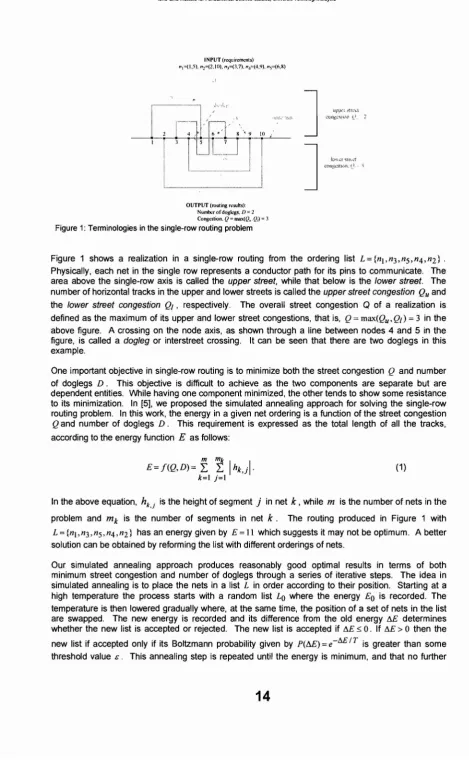
INPUT(requirements)
nl~(I,5). n2~(2.IO), n,~(3.7). n4~(4,9).ns={6,8)
OUTPUT(routing n:suks): Number ofdoglegs.D ::2 Congestion.Q=ma."(Q",Q/)=3 Figure 1: Terminologies in the single-row routing problem
]
]
upp·,', Arcd
-:OJlg":-"ll<.'!~t)
iOI..:.:r<;;[(,,-,t
Figure 1 shows a realization in a single-row routing from the ordering list L={nl' n3, ns, n4, n2} ,
Physically, each net in the single row represents a conductor path for its pins to communicate. The area above the single-row axis is called the upper street, while that below is thelower street. The number of horizontal tracks in the upper and lower streets is called theupper street congestion Quand the lower street congestion QI, respectively. The overall street congestion Q of a realization is defined as the maximum of its upper and lower street congestions, that is, Q=max(Qu' QI)=3 in the above figure. A crossing on the node axis, as shown through a line between nodes 4 and 5 in the figure, is called adogleg or interstreet crossing. It can be seen that there are two doglegs in this example.
One important objective in single-row routing is to minimize both the street congestion Q and number of doglegs D. This objective is difficult to achieve as the two components are separate but are dependent entities. While having one component minimized, the other tends to show some resistance to its minimization. In [5], we proposed the simulated annealing approach for solving the single-row routing problem. In this work, the energy in a given net ordering is a function of the street congestion
Qand number of doglegs D. This requirement is expressed as the total length of all the tracks, according to the energy function E as follows:
m mk
E=f(Q,D)=
L L
Ihk,jl·
k=l j=l
(1)
In the above equation, hk,J is the height of segment j in net k.while
m
is the number of nets in theproblem and mk is the number of segments in net
k.
The routing produced in Figure 1 withL={nJ,n3,nS,n4,n2} has an energy given by E=11 which suggests it may not be optimum. A better solution can be obtained by reforming the list with different orderings of nets.
Proceedings of Annual Fundamental Science Seminar2006(AFSS 2006),6-7June 2006 IbnuSinaInstitute fur Fundamental Science studies, UnivefSffi Teknologi Malaysia
improvement is noted after several iterations. The list corresponding to this minimum energy is then the solution to the problem, and this list produces the desired least-congested routing.
The method is further improved in [6] in a model called ESSR where a set of nets, rather than just one pair, are swapped to produce a faster convergence to its solution. ESSR produces reasonably good optimal results in terms of both the street congestion and number of doglegs.
Refinement by Distributing Doglegs Evenly in the Pin Intervals
A few issues arise in the final realization produced from the objective function in Equation (1). While the overall congestion in the network is greatly reduced, the final realization may produce uneven distribution of doglegs in the pin intervals which may cause technical glitches such as the creation of electric fieldS within the circuitry. This is because wires that are too close to each other produce intolerable amount of heat and electric field which may cause some interference to the circuit. A good network design requires the doglegs to be evenly distributed between the pins so that the wires are positioned some distance apart.
We discuss the case of uneven distribution of doglegs in the pin intervals. Figure 2 (left) shows a case of multiple doglegs in the pin interval (Si, si+\)' As shown in this figure, the occurrence of many doglegs in a pin interval is caused by a separation in the ordering of two successive pins from different nets. The doglegs in the interval are created as the endpoints of the nets nk and nk+\ are covered by three other nets. In this case, nk and nk+\ are separated by three steps in the ordering, and this creates three doglegs.
Sj Sj
n
HI- - - - " - - ' - - - Sj+1
nk+1
- - - . S i + 1
Figure 2: Uneven dogleg distribution (left) and its rectification (right).
A quick solution to the above problem is to move nk+\ immediately above or belownk, as shown in Figure 2 (right). This move eliminates the three doglegs in the interval(Si,si+d but it may affect the distribution of doglegs originating from the left pin of nk+\' The move can backfire as a reduction of doglegs in one interval may result in an increase in other intervals. Therefore, a comprehensive solution requires the participation of all pins in the network.
Our solution to the problem requires the participation of both the left and right pins of all nets. At every step, the occurrence of doglegs at each endpoint of the nets is calculated. A net whose sum of doglegs from its endpoints is the highest is selected for swapping into a new position. The new location of the net is determined from the proximity of the net endpoints to the endpoints of the nets in the new position.
We illustrate this technique using an example as shown in Figure 3. The figure shows an initial single-row network consisting of ten nets on 20 pins. The nets are numbered from 1 to 10 into the list
Lo={1,2,3,4,5,6,7,8,9,1O} according to their order from top to bottom. Table 1 shows the left and right pins of each net nk=(bk>
ed
defined in columns 2 and 3 of Table 1, respectively. There areIbnu Sina InstitutelorFundamental Science Studies, Universiti TeknologiMalaysia
Table 1: The initial list La= (l,2,3,4,5,6,7,8,9,1O)
+3
111
+£
+5 112
+2
-1 +4 n:~ +5 +2
11.
+1 +3 -1 +4 -1 +1
-1 -2 +2 -2 +3 -2 -1 n5
+1 -3 +2 -3 nf;
-4 +1 -4 117
-5 118
-5 ng
-6 n1()
Figure3:The list La= {l,2,3,4,5,6,7,8,9,10}
having E= 86, Q= 6 and D= 21,
Doglegs
nk bk ek Left Right Total
nl 2 5 0 3 3
nZ 11 15 5 6 11
n3 3 10 1 4 5
n4 6 19 1 1 2
nS 1 20 0 0 0
n6 7 16 1 2 3
n7 8 17 0 0 0
nS 9 13 4 0 4
n9 14 18 4 1 5
nlO 4 12 3 5 8
Figure3also displays the energy values of the net segments from the list. From Equation (1), the total energy produced from the ordering in the Iist is E= 86, and this results in Q= 6 and D= 21, Doglegs are distributed unevenly in the pin intervals as follows: R3,4=I, R4,5 = 2, Rs,6= 1, R6,7= 1,
R9,10=4, Rll,IZ=5, RI4,1S=4, R1S,l6=2 and RlS,19=1. Note that other pin intervals in the network have no doglegs, This initial list produces a realization which is not optimal.
Our objective here is to redistribute the doglegs so that each pin interval will not have more than the threshold value, defined as follows:
Threshold, H=fD/(m-1)l
In Figure 3, D is 21 while the number of pins, m, is 20, Therefore, H= 2, and each pin interval should not have more than two doglegs,
We discuss a technique to achieve the evenly distributed doglegs. Columns 4 and 5of Table 1 plot the number of doglegs produced from the left and right pins of each net as the output from
Proceedings ofAnnual Fundamental Sdence Seminar 2006 (AFSS 20061, IH June 2006 Ibnu Sina Institute for Fundamental Sdence Studies, Uni....rsiti reknologi Malaysia
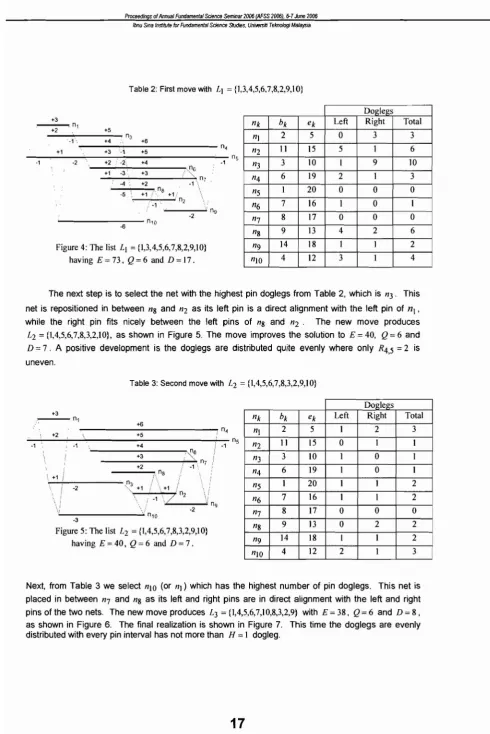
Table 2: First move with LI ={1,3,4,5,6,7,8,2,9,1O}
Figure 4: The list LI
=
{1,3,4,5,6,7,8,2,9,1O}having E
=
73, Q=
6 and D=
17."'---::-6-~n10 +3
+2 ' n1 -1\ +1
-1 -2
+5
·1
"'---"", ng -2
Doglegs
nk bk ek Left Right Total
nl 2 5 0 3 3
nz II 15 5 I 6
n3 3 10 I 9 10
n4 6 19 2 I 3
ns I 20 0 0 0
n6 7 16 I 0 I
n7 8 17 0 0 0
ng 9 13 4 2 6
n9 14 18 I I 2
nlO 4 12 3 I 4
The next step is to select the net with the highest pin doglegs from Table 2, which is n3. This
net is repositioned in between ng and nz as its left pin is a direct alignment with the left pin ofnj ,
while the right pin fits nicely between the left pins of ng and nz. The new move produces
Lz
=
{l,4,5,6,7,8,3,2,1O}, as shown in Figure 5. The move improves the solution to E=
40, Q=
6 andD=7. A positive development is the doglegs are distributed quite evenly where only R4,S =2 is uneven.
Table 3: Second move with Lz={l,4,5,6,7,8,3,2,9,1O}
Figure 5: The list Lz ={1,4,5,6,7,8,3,2,9,10}
havingE
=
40, Q=
6 and D=
7 .+3
n1
+2
-1 -1
+1 J -2
-3
+6
- - - + 5 - - - : , n4
+4 ' -1 ns
---+3----~6 ;
- - - - + - 2 - - - - ! - '..._1',n; "
Doglegs
nk bk ek Left Right Total
nl 2 5 I 2 3
nz II 15 0 1 I
n3 3 10 1 0 I
n4 6 19 I 0 I
nS I 20 I I 2
n6 7 16 I I 2
n7 8 17 0 0 0
ng 9 13 0 2 2
n9 14 18 I I 2
nlO 4 12 2 1 3
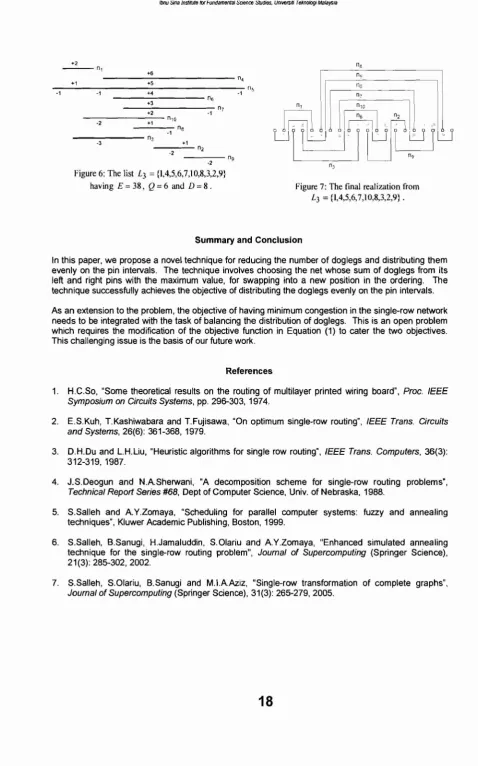
Next, from Table 3 we select nlO (ornl) which has the highest number of pin doglegs. This net is placed in between n7 and ng as its left and right pins are in direct alignment with the left and right pins of the two nets. The new move produces L3
=
(l,4,5,6,7,10,8,3,2,9) with E=
38, Q=
6 and D=
8 ,Ibnu ISina Institutetor~undamentalSCIence STud,es, umversIfJreknolOg, MafaYSla
1-;:
II
01
I [~;G
I----°9
-2+2
0,
+6
+5 0,
+1
n~
-1 -1 +4 -1
n6 +3
+2 ·1 O?
-2 +1
°'0
-1 ne n3
+1 -3
-2
°2
Figure 6: The list L3={1,4,5,6,7,10,8,3,2,9}
having E
=
38, Q=
6 and D=
8 . Figure 7: The final realization from L3={l,4,5,6,7,1O,8,3,2,9}.Summary and Conclusion
In this paper, we propose a novel technique for reducing the number of doglegs and distributing them evenly on the pin intervals. The technique involves choosing the net whose sum of doglegs from its left and right pins with the maximum value, for swapping into a new position in the ordering. The technique successfully achieves the objective of distributing the doglegs evenly on the pin intervals.
As an extension to the problem, the objective of having minimum congestion in the single-row network needs to be integrated with the task of balancing the distribution of doglegs. This is an open problem which requires the modification of the objective function in Equation (1) to cater the two objectives. This challenging issue is the basis of our future work.
References
1. H.C.So, "Some theoretical results on the routing of multilayer printed wiring board", Proc. IEEE Symposium on Circuits Systems, pp. 296-303,1974.
2. E.S.Kuh, T.Kashiwabara and T.Fujisawa, "On optimum single-row routing", IEEE Trans. Circuits and Systems, 26(6): 361-368, 1979.
3. D.H.Du and L.H.Liu, "Heuristic algorithms for single row routing", IEEE Trans. Computers, 36(3): 312-319, 1987.
4. J.S.Deogun and NASherwani, "A decomposition scheme for single-row routing problems", Technical Report Series #68, Dept of Computer Science, Univ. of Nebraska, 1988.
5. S.Salleh and A.Y.zomaya, "Scheduling for parallel computer systems: fuzzy and annealing techniques", Kluwer Academic Publishing, Boston, 1999.
6. S.Salleh, B.Sanugi, H.Jamaluddin, S.Olariu and A.Y.Zomaya, "Enhanced simulated annealing technique for the single-row routing problem", Journal of Supercomputing (Springer Science), 21(3): 285-302, 2002.