en
t
re
v
ie
w
s
re
ports
de
p
o
si
te
d r
e
se
a
rch
refer
e
e
d
re
sear
ch
interacti
o
ns
inf
o
rmation
Damian Fermin
*
, Baxter B Allen
*
, Thomas W Blackwell
*
, Rajasree Menon
*
,
Marcin Adamski
*
, Yin Xu
*
, Peter Ulintz
*
, Gilbert S Omenn
†
and
David J States
*‡
Addresses: *Bioinformatics Program, University of Michigan, Ann Arbor, MI 48109, USA. †Department of Internal Medicine, University of Michigan, Ann Arbor, MI 48109, USA. ‡Department of Human Genetics, University of Michigan, Ann Arbor, MI 48109, USA.
Correspondence: David J States. Email: [email protected]
© 2006 Fermin et al.; licensee BioMed Central Ltd.
This is an open access article distributed under the terms of the Creative Commons Attribution License (http://creativecommons.org/licenses/by/2.0), which permits unrestricted use, distribution, and reproduction in any medium, provided the original work is properly cited.
Human gene detection
<p>High-throughput mass spectroscopy data combined with a six-frame translation of the human genome can be used to identify novel protein encoding genes, as demonstrated with a search for plasma proteins.</p>
Abstract
Background: Defining the location of genes and the precise nature of gene products remains a fundamental challenge in genome annotation. Interrogating tandem mass spectrometry data using genomic sequence provides an unbiased method to identify novel translation products. A six-frame translation of the entire human genome was used as the query database to search for novel blood proteins in the data from the Human Proteome Organization Plasma Proteome Project. Because this target database is orders of magnitude larger than the databases traditionally employed in tandem mass spectra analysis, careful attention to significance testing is required. Confidence of identification is assessed using our previously described Poisson statistic, which estimates the significance of multi-peptide identifications incorporating the length of the matching sequence, number of spectra searched and size of the target sequence database.
Results: Applying a false discovery rate threshold of 0.05, we identified 282 significant open reading frames, each containing two or more peptide matches. There were 627 novel peptides associated with these open reading frames that mapped to a unique genomic coordinate placed within the start/stop points of previously annotated genes. These peptides matched 1,110 distinct tandem MS spectra. Peptides fell into four categories based upon where their genomic coordinates placed them relative to annotated exons within the parent gene.
Conclusion: This work provides evidence for novel alternative splice variants in many previously annotated genes. These findings suggest that annotation of the genome is not yet complete and that proteomics has the potential to further add to our understanding of gene structures.
Background
Defining the location of genes and the precise nature of gene products remains a fundamental challenge in genomics. High
throughput tandem mass spectrometry based proteomics provides an important new source of information to help define both the location of transcription units and the reading
Published: 28 April 2006
Genome Biology 2006, 7:R35 (doi:10.1186/gb-2006-7-4-r35)
Received: 5 January 2006 Revised: 22 February 2006 Accepted: 27 March 2006 The electronic version of this article is the complete one and can be
frame of protein translation. In theory, high throughput pro-teomics will complement genome and transcript sequence analysis by independently confirming translation products. In practice, a number of technical challenges have limited the widespread use of this approach. In this paper, we present a novel statistical approach to assessing the significance of pep-tide and open reading frame (ORF) matches when searching very large target sequence collections. We further demon-strate that these measures allow us to identify a substantial number of new gene models by comparing the tandem mass spectra data of the Human Proteome Organization (HUPO) Plasma Proteome Project (PPP) against the amino acid sequences coded by all of the ORFs in the human genome. The use of an exhaustive translation of the human genome also allows us to identify many peptides not contained in the standard protein sequence collections.
In the five years since the first draft of the human genome was released, it has undergone numerous revisions primarily in the form of additional gene annotations. However, despite the fact that we live in a post-genomic era, there is still much to be learned from the sequence that is the basic blueprint for humans. As the number of genome entries in public data-bases has expanded in recent years, de novo gene prediction has been greatly improved. New approaches have been devel-oped that employ multiple genome alignments to make better gene predictions [1-3]. Along with these new gene predictors, empirical data from expressed sequence tags (ESTs) are also being exploited in the search for novel coding regions [4,5]. Despite these advances, there still remains a great deal of uncertainty regarding the current gene model [6].
High throughput, bottom up chromatography/tandem mass spectrometry protein identification strategies, makes possi-ble a new approach to human genome annotation: identifying all known proteins. Using mass spectrometry (MS) data, it is now possible to work backwards from a protein to its parent genomic sequence. Previous work has been done using mass spectra for de novo gene finding [7]. Recently, Desiere et al . [8] performed such an analysis using their MS data. In their work they were able to map 25,754 of their 26,840 peptides to 9,747 of the human Ensembl proteins. Kuster et al . [9] and
Choudhary et al . [10] both used the draft sequence of the human genome as a template to search for novel peptides.
One of the major limitations of protein identification by MS is that all current software packages rely on a protein database against which to search. As a result, even the most exhaustive protein database search is limited to the data available in the current public databases. This poses a serious constraint if one is searching for novel protein coding regions since all results will be limited to data for a small set of highly curated proteins. In this paper, we describe an exhaustive protein database generated from the 6-frame translation of the entire human genome to identify peptides isolated from human blood. Peptides found from the MS data of the Human PPP were mapped back to their parent sequences using this data-base [11]. Our method revealed a number of splice variants to previously annotated genes as well as several new coding regions that potentially encode novel exons. These candidate regions were validated using EST mapping.
Results
Identifying novel splice variants
Since our goal was to identify novel coding regions including splice variants, we needed to obtain all the possible ORFs encoded by the genome. To this end we generated a putative open reading frame FASTA file for each chromosome. These ORF sequences were obtained by translating each chromo-some in all six reading frames. This method of generating a putative ORF library did not take into account global genomic features such as exon/intron splice boundaries or repeat regions. Therefore, the method produced a significant number of protein sequences that were unlikely to be real. The average length of a sequence in our library of ORFs is 25.5 residues (± 22.6 standard deviations). In contrast, the aver-age protein length of an entry in the International Protein Index (IPI) database (release 3.14) is 438.5 amino acids (± 523.8 standard deviations) [12]. This suggests an overabun-dance of relatively short peptide sequences in our protein data set. Our method, however, ensured that we obtained a representative for every possible exon encoded in the human genome. We were willing, therefore, to accept this initial high degree of signal to noise in our putative ORF library.
Selection of candidate high confidence ORFs
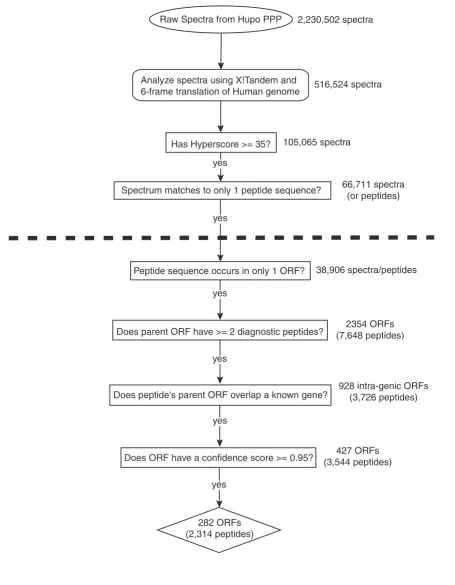
Figure 1 (see following page)
comm
en
t
re
v
ie
w
s
re
ports
refer
e
e
d
re
sear
ch
de
p
o
si
te
d r
e
se
a
rch
interacti
o
ns
inf
o
[image:3.612.79.535.107.693.2]rmation
Figure 1 (see legend on previous page)
Raw Spectra from Hupo PPP
Analyze spectra using X!Tandem and 6-frame translation of Human genome
Has Hyperscore >= 35?
Spectrum matches to only 1 peptide sequence?
Peptide sequence occurs in only 1 ORF?
Does parent ORF have >= 2 diagnostic peptides?
Does peptide's parent ORF overlap a known gene?
928 intra-genic ORFs (3,726 peptides)
Does ORF have a confidence score >= 0.95?
282 ORFs (2,314 peptides)
yes
yes
yes
yes
yes
yes
2,230,502 spectra
516,524 spectra
105,065 spectra
66,711 spectra (or peptides)
38,906 spectra/peptides
2354 ORFs (7,648 peptides)
Selection of diagnostic peptides
The ORF library was used as the search database for X!Tan-dem, an open source program that matches tandem mass spectra to a peptide sequence from a given database of pro-tein sequences [13,14]. As mentioned earlier, the putative ORF library used by X!Tandem contained a very high degree of noise. As a result, the peptide identifications resulting from this analysis needed to be filtered to remove false hits. As an initial filtering step, spectra whose X!Tandem peptide matches had hyperscores below 35 were removed from con-sideration. Large hyperscore values indicate that the match made by X!Tandem was a high confidence one. This threshold was chosen based upon analysis of a hyperscore receiver-operator curve(ROC) generated from a collection of known high confidence matches and a set of known false negatives (see Materials and methods). In choosing a threshold of 35, we reduced the number of potential false positive matches made by X!Tandem. This reduced our search space to one-fifth its original size (516,524 spectra reduced to 105,065 spectra). Many spectra were matched to multiple peptide sequences. In these instances, it would be difficult to deter-mine which peptide is the true match to the spectra. To avoid this ambiguity, we selected for spectra that were only matched to a single unique peptide sequence. From these peptides, we selected out only those that were unique to a sin-gle ORF in the database. This left us with 38,906 peptide matches that we are considering our set of high-confidence diagnostic peptides. In the flowchart presented in Figure 1, this corresponds to the first box below the dashed line.
Selection of candidate open reading frames
To identify potential novel coding regions, the diagnostic pep-tides were mapped back to their parent ORFs. A total of 33,502 putative ORFs contained at least 1 diagnostic peptide. High confidence ORFs as identified using our Poisson proba-bility (see Materials and methods), which had at least 2 diag-nostic peptide matches, were selected. Based on these criteria, we isolated a total of 427 ORFs that were represented by 3,544 diagnostic peptides. Candidate ORFs were then sep-arated into two major categories based upon whether or not their coordinates overlapped with those of an annotated gene. A total of 282 ORFs (represented by 2,314 peptides) were
classified as intragenic ORFs. The information presented up to this point is contained within the flowchart of Figure 1. We then analyzed these ORFs and their associated peptides in greater detail.
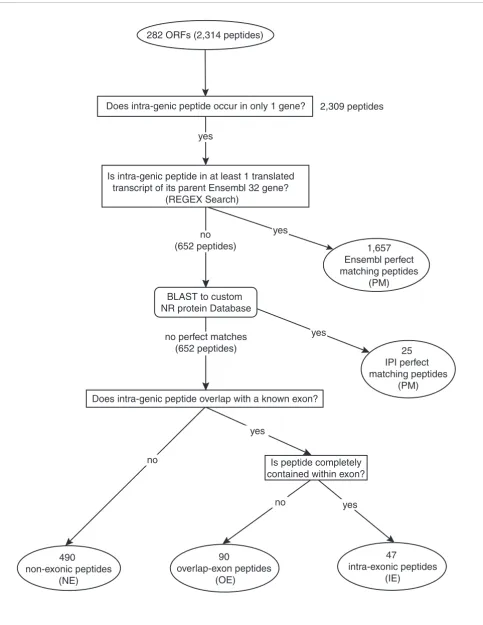
Analysis of intragenic open reading frame peptides To validate our method, we examined the peptides derived from intragenic ORFs in terms of how well they matched to known protein coding regions. Work from this section is illus-trated in the flowchart in Figure 2. Of the 2,314 intragenic peptides, 5 were derived from an ORF that straddled 2 differ-ent gene coding regions. Since we were unable to determine which gene produced which peptide, all five were discarded. The remaining 2,309 were unique to a single gene and their peptide sequences were searched against a non-redundant human protein database for exact matches. A total of 1,682 (72.8%) of the intragenic peptides had exact matches to the protein products of the genes they occur within. These pep-tides were classified as perfect matching (PM) peppep-tides. A total of 89 distinct proteins encompassed all of these PM peptides.
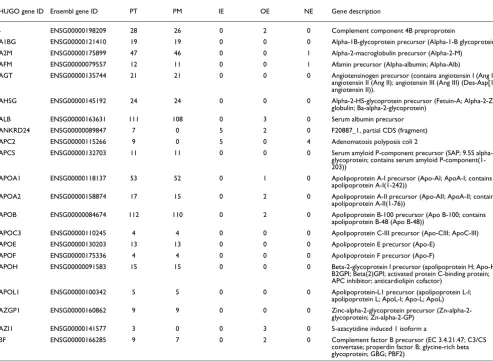
The remaining 627 intragenic peptides do not have a perfect match to a known protein product. This suggests that these peptides represent novel protein products for the genes within which they occur. These peptides were classified into three distinct categories depending upon their position rela-tive to the genomic coordinates of an annotated gene. There were 47 peptides that occurred inside of an annotated exon of their parent gene, but in a different reading frame. These we called (IE) intra-exonic peptides. Another 90 peptides over-lapped with a portion of an annotated exon (overlapping exons (OEs)) and the remaining 490 peptides fell in between the coordinates of annotated exons in their parent gene (non-exonic (NE)). Taken together, a total of 128 genes were repre-sented by these intragenic peptides. Table 1 lists the break-down of all the intragenic peptides. A total of 128 genes encompassed all of our intragenic peptides. Table 2 lists a sampling of the 128 genes along with the peptide breakdown for each gene. A complete list is provided in Additional data file 1.
Selection and classification of diagnostic peptides
Figure 2 (see following page)
comm
en
t
re
v
ie
w
s
re
ports
refer
e
e
d
re
sear
ch
de
p
o
si
te
d r
e
se
a
rch
interacti
o
ns
inf
o
[image:5.612.67.550.85.710.2]rmation
Figure 2 (see legend on previous page)
282 ORFs (2,314 peptides)
Does intra-genic peptide occur in only 1 gene?
Is intra-genic peptide in at least 1 translated transcript of its parent Ensembl 32 gene?
(REGEX Search)
BLAST to custom NR protein Database
Does intra-genic peptide overlap with a known exon?
490 non-exonic peptides
(NE)
90
overlap-exon peptides (OE)
47
intra-exonic peptides (IE)
25 IPI perfect matching peptides
(PM) 1,657 Ensembl perfect matching peptides
(PM) yes
no (652 peptides)
no perfect matches (652 peptides)
no
yes
no
Is peptide completely contained within exon?
yes yes
yes
Of the 128 genes listed, 20 had peptide matches that only occur in non-coding regions. Upon closer inspection of these peptides, most of them contained long repeats of glycine, sug-gesting that they may be erroneous matches. Rather than dis-carding these hits immediately, we first tried to determine if there was expression data supporting the observed novel peptide.
Verification of novel peptides through ESTs
We searched the EST library using our set of diagnostic pep-tides. If these peptides were in fact being translated, we would expect to identify transcripts encoding them. For this analy-sis, the DNA sequence encoding the peptide plus 100 base-pair flanking sequence was used in an alignment search. In instances where peptides were substrings of one another, only the longest representative peptide was used as a BLAST query. By doing so, we reduced the number of diagnostic pep-tides from 2,314 to 1,202. Only hits involving some part of the peptide's coding region were considered true matches. Table 3 gives the breakdown of peptides in the four categories: OE, NE, IE, and PM. The peptide category with the most EST hits was the PM category. Of the peptides that occurred within known exons but in different reading frames, 24 (62%) of them had EST matches, while 36 (65%) of the peptides that overlapped partially with known exons also had EST hits.
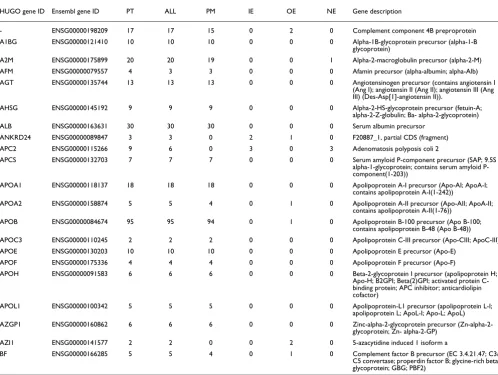
Table 4 gives a representative list of the peptide-to-EST matches by gene. The complete list is available in Additional data file 2. A total of 114 genes had diagnostic peptides asso-ciated with them that also had EST matches to those peptides. This accounted for 89% of the total genes we reported as hav-ing a diagnostic peptide match. The genes havhav-ing the most EST matches were proteins commonly found in plasma. Only 9 of the 20 genes mentioned earlier for their sole representa-tion by NE peptides had EST supporting evidence for their assigned peptides. Upon inspection of the amino acid
sequences for their peptides, it was found that 40 of them (representing 3 genes) were predominately glycine repeats. Overall, a total of 14 identified genes were discarded from the list given in Additional data file 1 since it was more likely that their reported peptide matches were erroneous.
A total of 47 of the 114 genes had EST hits to peptides that were classified as either NE (49 peptides) or OE (52 peptides). These matches potentially represented novel coding regions. The longest conserved block of ESTs that overlapped with a peptide's encoding coordinates were used to better define the boundaries of the novel coding region. Eighty of the 101 novel coding regions (represented by 43 genes) had well defined boundaries that were supported by ESTs. Additional data file 3 summarizes the coordinates for each of the novel OE and NE coding regions found within the 43 genes.
Protein features of encompassing genes
We examined the annotated protein products of the genes having the novel coding regions defined by OE peptides. NE and IE peptides also represented novel protein products but, with MS data alone, we were unable to accurately define the boundaries for the novel coding region. A new protein prod-uct containing the OE peptide sequence was generated and searched against PROSITE and UNIPROT to determine what impact, if any, the addition of the diagnostic peptide fragment would have on the protein's domains. A total of 11 diagnostic peptides overlapped in some way with a known protein domain. Table 5 summarizes the domains identified for the protein products of the genes.
In all cases, the impact caused by the presence of the extra amino acids introduced by the OE peptide was limited to a single domain. PROSITE was able to identify the domain regardless of the presence or absence of the extra amino acid characters, suggesting that the functional components of the
Table 1
Diagnostic peptides
Number
ORF identification statistics
All peptide matches above hyperscore 35 105,065
+ spectra match only a single peptide 66,711
+ peptide maps to a unique location in the genome 38,906
ORFs with confidence > 95%* 427
Peptide classification
Intra-exonic perfect match (PM) 1,682
Intra-exonic different reading frame (IE) 47
Overlapping exon (OE) 90
Non-exonic (NE) 490
comm
en
t
re
v
ie
w
s
re
ports
refer
e
e
d
re
sear
ch
de
p
o
si
te
d r
e
se
a
rch
interacti
o
ns
inf
o
rmation
domains remained intact and were thus not disrupted by the additional amino acid residues. A review of the literature revealed that all but one of the domains overlapped by the peptides were associated with plasma proteins. The remain-ing domain is called sirtuin and is reported to function in pep-tide deacetylation in an NAD-dependent manner. The proteins having this domain are members of the sirtuin fam-ily. These proteins are associated with cellular functions involving transcriptional silencing, cell cycle progression, and chromosome stability [15].
Discussion
We identified a number of novel splice variants to previously annotated genes. These splice variants were identified work-ing backwards from MS data to their parent-codwork-ing region in
the genome. A six-frame translation of the entire human genome was used as the query database for the protein iden-tification analysis. This enabled us to detect protein products that are currently not in the public databases. We first inves-tigated peptides that could potentially represent novel splice variants of known genes. A total of 2,309 peptides were iso-lated whose genomic coordinates placed them singularly within the start/stop points of annotated genes. These pep-tides were grouped into four categories based upon where their genomic coordinates place them within their parent gene. Of these categories, three represent peptides that in some way overlap with a known exon.
The first two categories represented peptides that were com-pletely contained within annotated exons. The first of these were the intra-exon PM peptides. These represented a control
A representative set of peptide containing genes
HUGO gene ID Ensembl gene ID PT PM IE OE NE Gene description
- ENSG00000198209 28 26 0 2 0 Complement component 4B preproprotein
A1BG ENSG00000121410 19 19 0 0 0 Alpha-1B-glycoprotein precursor (Alpha-1-B glycoprotein) A2M ENSG00000175899 47 46 0 0 1 Alpha-2-macroglobulin precursor (Alpha-2-M)
AFM ENSG00000079557 12 11 0 0 1 Afamin precursor (Alpha-albumin; Alpha-Alb)
AGT ENSG00000135744 21 21 0 0 0 Angiotensinogen precursor (contains angiotensin I (Ang I); angiotensin II (Ang II); angiotensin III (Ang III) (Des-Asp[1]-angiotensin II)).
AHSG ENSG00000145192 24 24 0 0 0 Alpha-2-HS-glycoprotein precursor (Fetuin-A; Alpha-2-Z-globulin; Ba-alpha-2-glycoprotein)
ALB ENSG00000163631 111 108 0 3 0 Serum albumin precursor ANKRD24 ENSG00000089847 7 0 5 2 0 F20887_1, partial CDS (fragment) APC2 ENSG00000115266 9 0 5 0 4 Adenomatosis polyposis coli 2
APCS ENSG00000132703 11 11 0 0 0 Serum amyloid P-component precursor (SAP; 9.5S alpha-1-glycoprotein; contains serum amyloid P-component(1-203))
APOA1 ENSG00000118137 53 52 0 1 0 Apolipoprotein A-I precursor (Apo-AI; ApoA-I; contains apolipoprotein A-I(1-242))
APOA2 ENSG00000158874 17 15 0 2 0 Apolipoprotein A-II precursor (Apo-AII; ApoA-II; contains apolipoprotein A-II(1-76))
APOB ENSG00000084674 112 110 0 2 0 Apolipoprotein B-100 precursor (Apo B-100; contains apolipoprotein B-48 (Apo B-48))
APOC3 ENSG00000110245 4 4 0 0 0 Apolipoprotein C-III precursor (Apo-CIII; ApoC-III) APOE ENSG00000130203 13 13 0 0 0 Apolipoprotein E precursor (Apo-E)
APOF ENSG00000175336 4 4 0 0 0 Apolipoprotein F precursor (Apo-F)
APOH ENSG00000091583 15 15 0 0 0 Beta-2-glycoprotein I precursor (apolipoprotein H; Apo-H; B2GPI; Beta(2)GPI; activated protein C-binding protein; APC inhibitor; anticardiolipin cofactor)
APOL1 ENSG00000100342 5 5 0 0 0 Apolipoprotein-L1 precursor (apolipoprotein L-I; apolipoprotein L; ApoL-I; Apo-L; ApoL) AZGP1 ENSG00000160862 9 9 0 0 0 Zinc-alpha-2-glycoprotein precursor
(Zn-alpha-2-glycoprotein; Zn-alpha-2-GP) AZI1 ENSG00000141577 3 0 0 3 0 5-azacytidine induced 1 isoform a
BF ENSG00000166285 9 7 0 2 0 Complement factor B precursor (EC 3.4.21.47; C3/C5 convertase; properdin factor B; glycine-rich beta glycoprotein; GBG; PBF2)
[image:7.612.56.549.120.482.2]group in our study since they should have mapped to previously annotated proteins. Of our 2,309 high quality pep-tides, 1,682 (72.3%) fall into this category. The high percent-age of peptides in this category that were successfully matched suggested that our methods were sound. The second intra-exonic peptide category consisted of 47 peptides whose coding region was contained within a known exon but whose amino acid sequence corresponded to a different reading frame. The final exonic peptide category was for peptides whose coding regions overlapped partially with those of a known exon. A total of 90 peptides were identified that extended the start or end boundaries for known exons. Apart from the intragenic peptides in the preceding 3 categories, an additional 490 peptides aligned to non-coding regions within genes. These peptides potentially represented novel exons for parent genes that have not been previously identified. This suggests that many genes have splice variants that have not previously been identified. Several reasons for this can be put forward, including sequencing errors and polymorphisms. Both of these may result in frame shift mutations that could prematurely end a coding exon or extend an intron. It is also possible that these ORFs were overlooked because they did not conform to accepted gene models. Many gene prediction algorithms use training data from known coding sequences to identify putative gene regions. Hence, prediction programs may overlook ORFs not fitting their training model. Another possibility is that these ORFs overlap with repeat-rich or low-complexity DNA regions; many sequence analysis tools mask regions that are high in repeats, resulting in these ORFs escaping detection. An additional explanation is that human errors were introduced into the database annotations. These errors, like the frame shift mutations or polymorphisms, would alter the exon/intron splice boundaries.
None of the final 114 genes having peptide matches were annotated as pseudogenes in the ENSEMBL, UCSC or NCBI genome web sites. It is possible that a spectrum could match to an ORF derived from a pseudogene. For relatively recent pseudogenes and processed pseudogenes, the peptide would also match to the true gene from which the unused copy arose. Our filtering methods would eliminate early on such a peptide match. In cases of older and more highly diverged
pseudogenes, there might be little to distinguish them from random intergenic sequence. False matches in the database search phase of our algorithm could occur in these regions, but there is no reason to anticipate that they would occur more frequently than false matches in other regions of the genome. The 2,309 intragenic peptides all mapped to 128 dis-tinct genes. Table 2 lists the names of the various proteins encoded by these genes. In looking at the table, it is clear that the vast majority of these proteins are plasma proteins. This is to be expected given that the source of our peak list extrac-tions was human blood plasma. In this study, we used MS data provided by the HUPO PPP consortium. Since these raw data were derived from human plasma, our data were most descriptive for that tissue type as supported by the genes identified. Our approach could easily be applied to other tis-sue samples. Such an experiment could reveal novel splice variants of other proteins whose expression was unique to the chosen tissue type.
Conclusion
In this paper, we present a novel approach to assessing the significance of peptide and ORF matches when searching very large target sequence collections. We further demonstrate that these measures allow us to identify a substantial number of new gene models through comparison using tandem mass spectra against the amino acid sequences coded by all of the ORFs in the human genome. We found a large number of genes (114) have either incomplete descriptions of their anno-tated exons, or potentially novel coding regions. Working backwards from MS data we were able to show supporting evidence for the existence of novel coding regions in previ-ously annotated genes. Most (89%) of the genes we identified as having peptide matches are supported by expression data.
[image:8.612.56.558.120.184.2]Our use of an exhaustive translation of the human genome has clearly suggested that many genes contain variable splice sites that have not been previously characterized. While this work focused on novel splice variants, the approach could also be used to identify candidate novel ORFs that do not overlap with previously annotated genes. Such ORFs could represent novel genes whose cellular functions have not yet
Table 3
EST library matches to diagnostic peptides
PM IE NE OE Total
EST + 615 (72%) 24 (62%) 36 (17%) 36 (65%) 711
EST - 241 (28%) 15 (38%) 216 (83%) 19 (35%) 491
Total 856 39 252 55 1,202
comm
en
t
re
v
ie
w
s
re
ports
refer
e
e
d
re
sear
ch
de
p
o
si
te
d r
e
se
a
rch
interacti
o
ns
inf
o
rmation
been characterized. Future work will focus on identifying such candidate ORFs and investigating their viability as pos-sible novel genes. Given the extensive literature describing plasma proteins and the stringent statistical requirements applied here, which limit the sensitivity for detecting less abundant species, it is not surprising that we did not find con-vincing examples of novel genes in this study. Furthermore, this work demonstrates that we can use proteomics to further improve our annotation of the human genome, and it shows that the annotation of the genome is still a work in progress.
Materials and methods
Generating the open reading frame database
The complete human genome (NCBI 35 hg17) was down-loaded from the UCSC Genome site in FASTA format [16]. Putative ORFs were generated by translating each
chromo-some starting from its first nucleotide. ORFs were terminated whenever a stop codon was encountered. The next ORF was started at the next nucleotide following the previous stop codon. Instances of ambiguous nucleotides (represented by 'N' in the genome sequence) were replaced with random nucleotides; other ambiguous characters were also replaced with random nucleotides depending upon their symbol. Puta-tive ORFs were generated on both DNA strands of the chro-mosome in all three reading frames.
The genomic coordinates and orientation were recorded for every novel ORF. Only the first instance of every putative ORF encountered on a chromosome was recorded. Resulting amino acid sequences for each chromosome were recorded in a FASTA formatted sequence file. A total of 217,305,234 puta-tive ORFs were generated using this method. The sequences for these ORFs, along with the source code for the program
Representative distribution of the ESTs across diagnostic peptides
HUGO gene ID Ensembl gene ID PT ALL PM IE OE NE Gene description
- ENSG00000198209 17 17 15 0 2 0 Complement component 4B preproprotein A1BG ENSG00000121410 10 10 10 0 0 0 Alpha-1B-glycoprotein precursor (alpha-1-B
glycoprotein)
A2M ENSG00000175899 20 20 19 0 0 1 Alpha-2-macroglobulin precursor (alpha-2-M) AFM ENSG00000079557 4 3 3 0 0 0 Afamin precursor (alpha-albumin; alpha-Alb) AGT ENSG00000135744 13 13 13 0 0 0 Angiotensinogen precursor (contains angiotensin I
(Ang I); angiotensin II (Ang II); angiotensin III (Ang III) (Des-Asp[1]-angiotensin II)).
AHSG ENSG00000145192 9 9 9 0 0 0 Alpha-2-HS-glycoprotein precursor (fetuin-A; alpha-2-Z-globulin; Ba- alpha-2-glycoprotein) ALB ENSG00000163631 30 30 30 0 0 0 Serum albumin precursor
ANKRD24 ENSG00000089847 3 3 0 2 1 0 F20887_1, partial CDS (fragment) APC2 ENSG00000115266 9 6 0 3 0 3 Adenomatosis polyposis coli 2
APCS ENSG00000132703 7 7 7 0 0 0 Serum amyloid P-component precursor (SAP; 9.5S alpha-1-glycoprotein; contains serum amyloid P-component(1-203))
APOA1 ENSG00000118137 18 18 18 0 0 0 Apolipoprotein A-I precursor (Apo-AI; ApoA-I; contains apolipoprotein A-I(1-242))
APOA2 ENSG00000158874 5 5 4 0 1 0 Apolipoprotein A-II precursor (Apo-AII; ApoA-II; contains apolipoprotein A-II(1-76))
APOB ENSG00000084674 95 95 94 0 1 0 Apolipoprotein B-100 precursor (Apo B-100; contains apolipoprotein B-48 (Apo B-48)) APOC3 ENSG00000110245 2 2 2 0 0 0 Apolipoprotein C-III precursor (Apo-CIII; ApoC-III) APOE ENSG00000130203 10 10 10 0 0 0 Apolipoprotein E precursor (Apo-E)
APOF ENSG00000175336 4 4 4 0 0 0 Apolipoprotein F precursor (Apo-F)
APOH ENSG00000091583 6 6 6 0 0 0 Beta-2-glycoprotein I precursor (apolipoprotein H; Apo-H; B2GPI; Beta(2)GPI; activated protein C-binding protein; APC inhibitor; anticardiolipin cofactor)
APOL1 ENSG00000100342 5 5 5 0 0 0 Apolipoprotein-L1 precursor (apolipoprotein L-I; apolipoprotein L; ApoL-I; Apo-L; ApoL) AZGP1 ENSG00000160862 6 6 6 0 0 0 Zinc-alpha-2-glycoprotein precursor
(Zn-alpha-2-glycoprotein; Zn- alpha-2-GP) AZI1 ENSG00000141577 2 2 0 0 2 0 5-azacytidine induced 1 isoform a
BF ENSG00000166285 5 5 4 0 1 0 Complement factor B precursor (EC 3.4.21.47; C3/ C5 convertase; properdin factor B; glycine-rich beta glycoprotein; GBG; PBF2)
[image:9.612.55.553.120.495.2]that generated them, are available for public download at [17].
Protein identification using X!Tandem
MS data collected as part of the HUPO PPP was used in this study. Briefly, the samples collected were pooled plasma and serum from Caucasian, African and Asian American donors. These data consist of 2,230,502 tandem mass spectrometry (MS/MS) spectra generated by a number of contributing lab-oratories. Peaklists were either obtained as collections of individual *.dta peaklist files from the contributing authors to the HUPO PPP, or extracted directly from contributed *.RAW files using the Spectrum Mill tool. All peaklists corresponding to individual electrospray runs were converted to Mascot Generic Format (MGF) and concatenated together for faster searching. The raw mass spectra used in our study are pub-licly available at [16,18].
MS data were analyzed using the X!Tandem open source pro-tein identification package [13,14]. Raw data from each mass spectrum run were submitted to X!Tandem along with a FASTA formatted file representing the six-frame translation of one of the Human chromosomes generated as described above. Searches were performed using a mass error tolerance of +/- 2.0 Daltons, allowing for one post-translational modi-fication (57.022 Daltons added to the amino acid cystine). Proteolytic cleavage specificity was turned off for the searches. All X!Tandem runs were performed on a cluster composed of 106 nodes.
X!Tandem analysis XML output was parsed using Perl scripts and stored in an MS SQL server relational database for fur-ther analysis. The X!Tandem output data that were recorded included the genomic loci of each peptide, the putative ORF each peptide was found in and the X!Tandem hyperscore
associated with the peptide match. Only spectra matches that were associated with a distinct peptide sequence were consid-ered for further analysis; significantly scoring spectra match-ing multiple ORFs were removed. ORFs containmatch-ing these diagnostic peptides were selected out as candidate novel ORFs.
Localization and selection of diagnostic peptides associated with putative ORFs
Coordinates for all known human genes were obtained from Ensembl (Release 32) using BioPerl and the Ensembl API. Genomic coordinates for peptide matches reported by X!Tan-dem were compared to known human gene coordinates. Pep-tides localizing within known genes were termed intragenic, and all non-intragenic peptides were disregarded.
We define a diagnostic peptide as one having an X!Tandem hyperscore = 35, mapping to only one genomic locus, and being associated with only one ORF. All peptides meeting these criteria were chosen as diagnostic peptides. The hyper-score threshold of 35 was chosen based upon analysis of a ROC (Figure 3) [19]. Peptides matching to ORFs that were generated from ambiguous nucleotide substitutions were chosen as our set of true negative examples. Spectra matching the 86 most highly represented proteins from the HUPO PPP were used to define our distribution of true positive examples. On the resulting ROC, the first instance of the hyperscore thresholds 25, 30, 35, 40, and 45 were marked.
Selection of high-confidence putative open reading frames
[image:10.612.57.556.118.298.2]An important issue in searching very large sequence collec-tions for matches to MS data is assessment of the likelihood of false identification. Several approaches have been utilized [20,21], including probability-based evaluations of mass
Table 5
Features of proteins from genes with novel coding regions
HUGO gene ID Ensembl gene ID AAs in domain Domain ID Domain name Gene name
PLG ENSG00000122194 23 P00747 Kringle Plasminogen precursor
BF ENSG00000166285 28 P00751 Peptidase S1, trypsin Complement factor B precursor APOB ENSG00000084674 21 Q13787 Vitellogenin Apolipoprotein B-100 precursor C4BPA ENSG00000123838 29 P04003 Sushi C4b-binding protein alpha chain
precursor
HPX ENSG00000110169 15 P02790 Hemopexin-like Hemopexin precursor
GC ENSG00000145321 17 P02774 Albumin Vitamin D-binding protein precursor PLEKHA4 ENSG00000105559 7 PS50003 PH_DOMAIN Pleckstrin homology domain-containing
protein family A member-4 IGLC1, IGLC2, IGLC3,
IGLV1-40, IGLV3-25, IGLV4-3 ENSG00000100208 12 PS50835 IG-LIKE Ig lambda chain C region IGHA1, IGHG3, IGHM ENSG00000130076 11 PS50835 IG-LIKE Ig alpha-1 chain C region
- ENSG00000142082 51 PS50305 SIRTUIN NAD-dependent deacetylase sirtuin-3 mitochondrial precursor
TF ENSG00000091513 11 PS00207 TRANSFERRIN Serotransferrin precursor
comm
en
t
re
v
ie
w
s
re
ports
refer
e
e
d
re
sear
ch
de
p
o
si
te
d r
e
se
a
rch
interacti
o
ns
inf
o
rmation
spectra [8,22,23], reversed sequence database searches [24,25], and Poisson analysis of the identifications by number of peptides matching [26]. However, when applied to the cur-rent analysis, these measures exhibited anomalous behavior.
The expected number of peptide matches to a protein depends importantly on the length of the matched protein. We have devised a Poisson model to estimate the expected number of false matches that incorporates the number of spectra searched, score threshold applied for accepting a match, size of the target sequence database and the length of the matched protein sequence. We postulate that a mass spec-trum is derived from a given protein in the database but that, in addition, there may be a number of false matches with sim-ilar or higher scores occurring at random across the sequence database. Based on the number of proteins for which no pep-tide matches are reported by any laboratory, we set the rate of matches in our Poisson model, µ, to 1.27197e-5. The mean number of matches, λ, expected at random for a protein of length L is µL . The probability, Prand , that M or more matches will be observed is:
And the expected number of matches, E, is:
E = Ndb Prand
confidence, C, that we have identified the sequence from which the spectral data were derived and not one of the E false positives is:
High-confidence ORFs are defined as those having two or more diagnostic peptide matches and a confidence score of at least 0.95 based upon this Poisson model.
Identification of diagnostic peptides of known proteins Intragenic diagnostic peptides mapping to known coding regions were identified using a combination of perfect-match text searching and local sequence alignments. Initial identifi-cations were done by Perl regular expression matching. Pep-tide sequences were searched against a list of the Ensembl proteins from the genes whose coordinates they overlapped with. Peptides not identified by this method were aligned against the protein products of their parent gene using BLAST, using the PAM30 matrix [27]. In the BLAST searches, only matches of 100% identity were considered. Proteins used in these searches were from a non-redundant set of sequences obtained from the Ensembl genome database (Release 32) [28] and the human IPI database (releases 2.21 and 3.09) [12].
Classification of novel diagnostic peptides inside of known genes
Intragenic peptides not aligning to a known protein were clas-sified into one of three categories based upon their genomic coordinates in relation to the exons of their parent gene. Novel peptides completely contained within annotated exons were classified as IE. Peptides overlapping annotated exons were classified as overlapping exon OE. Peptides not placed within an annotated exon were classified as NE.
Alignment of diagnostic peptides against human ESTs Diagnostic peptides were aligned against the 2005-10-31 release of the human ESTs library obtained from the UCSC genome website [7]. Alignments were performed using MEGABLAST using a word size of 12. For each peptide align-ment, the encoding DNA sequence was obtained from the genome flanked by 100 base-pairs. A match was only consid-ered if the EST aligned at least partially to the peptide-encod-ing region. ESTs alignpeptide-encod-ing to only the flankpeptide-encod-ing regions were discarded.
Defining novel coding regions
The coding regions, flanked by 1,000 base-pairs, for NE and OE diagnostic peptides were aligned to ESTs. Alignments were performed using BLASTN and only the matches over-lapping the peptide coding region and having an E-value less than 1e-6 were accepted. Coordinates for the novel coding
[image:11.612.54.297.86.327.2]Receiver operator curve for X!Tandem hyperscores
Figure 3
Receiver operator curve for X!Tandem hyperscores. The ROC was used to select the hyperscore cut-off value for candidate peptides. Numbers represent the first instance of the hyperscore values 24, 30, 35, 40, and 45 as they occur among the data points.
0.0 0.2 0.4 0.6 0.8 1.0
0.0 0.2 0.4 0.6 0.8
1.0 25 20
30
35
40
45
50
P
i rand
i
i M
=
( )
−= ∞
∑
λ λ!exp
C E =
+
region were derived based upon the longest contiguous align-ment window generated from overlapping ESTs.
Identification of disrupted protein domains
Diagnostic peptides classified as OE were aligned to their par-ent protein using BLASTP. Protein coordinates that would encompass the novel peptide were then computed. Each pro-tein sequence was searched for propro-tein domains using UNI-PROT and PROSITE [29,30]. Protein domains overlapped by the novel peptide region were extracted from the database.
Theoretical proteins containing the novel OE peptide sequences were also generated based upon the BLASTP coor-dinates mentioned above. These theoretical proteins were also analyzed with PROSITE and compared to the original proteins to determine what changes were introduced into the protein domains by the presence of the additional amino acid residues.
Ensembl DAS viewing of peptides and ORFs
DAS tracks can be viewed by selecting a genomic region using the Ensembl genome browser [31].
Additional data files
The following additional data are available with the online version of this paper. Additional data file 1 is a Microsoft Excel spreadsheet containing the complete list of 128 genes that have diagnostic peptides associated with them. The table gives the distribution of each type of diagnostic peptide among the 128 parent genes they occur in. The columns in the table are as follows. HUGO Gene ID, HUGO Gene Identifier; Ensembl Gene ID, the Ensembl gene identifier for the gene containing the diagnostic peptides; PT, the total number of diagnostic peptides found within the coding boundaries of this gene; PM, number of perfect-matching peptides to a pro-tein product of this gene; IE, number of intra-exonic peptides associated with this gene; OE, number of exon overlapping peptides associated with this gene; NE, number of non-exonic peptides associated with this gene; Gene Description, a short descriptor characterizing the gene. The gene description is taken from the Ensembl genome browser's record for this gene.
Additional data file 2 is a Microsoft Excel spreadsheet con-taining the complete list of 114 genes that have diagnostic peptides that are supported by ESTs. The columns of the table are as follows: PT, the total number of non-redundant (NR) peptides associated with this gene; All, the number of pep-tides with EST hits; PM, number of PM peppep-tides with EST hits; IE, the number of IE peptides with EST hits; OE, the number of OE peptides with EST hits; NE, number of NE pep-tides with EST hits.
Additional data file 3 is a Microsoft Excel spreadsheet con-taining the genomic coordinates for the coding region of the
novel OE and NE peptides. The table columns are as follows: Peptide Type, indicates whether the anchoring peptide is an NE or OE peptide; Ensembl Gene ID, reports the gene identi-fier for the gene the peptide occurs in; Chr, Start, and End, report the genomic nucleotide coordinates that encode for the peptide; ESTs, reports how many ESTs overlap with these genomic coordinates.
Additional data file 4 is a Microsoft Excel spreadsheet provid-ing the sequences for the diagnostic peptides and the ORFs they align to. The columns in this spreadsheet are as follows: Ensembl Gene ID, the Ensembl gene identifier for the gene that the ORF overlaps; orflocid, a unique identifier for the ORF sequence; peplocid, a unique identifier for the peptide sequence identified as mapping to this ORF; groupId, an X!Tandem identifier for the spectrum assigned to the given peptide sequence; hyperscore, the maximum X!Tandem hyperscore assigned to this peptide; srcFile, the name of the X!Tandem file from which the peptide assignment informa-tion was extracted; peptide, the peptide sequence; orf, the complete open-reading frame sequence that the peptide matches.
Additional data file 1
The complete list of 128 genes that have diagnostic peptides associ-ated with them
The table gives the distribution of each type of diagnostic peptide among the 128 parent genes they occur in. The columns in the table are as follows. HUGO Gene ID, HUGO Gene Identifier; Ensembl Gene ID, the Ensembl gene identifier for the gene containing the diagnostic peptides; PT, the total number of diagnostic peptides found within the coding boundaries of this gene; PM, number of perfect-matching peptides to a protein product of this gene; IE, number of intra-exonic peptides associated with this gene; OE, number of exon overlapping peptides associated with this gene; NE, number of non-exonic peptides associated with this gene; Gene Description, a short descriptor characterizing the gene. The gene description is taken from the Ensembl genome browser's record for this gene
Click here for file Additional data file 2
The complete list of 114 genes that have diagnostic peptides that are supported by ESTs
The columns of the table are as follows: PT, the total number of NR peptides associated with this gene; All, the number of peptides with EST hits; PM, number of PM peptides with EST hits; IE, the number of IE peptides with EST hits; OE, the number of OE pep-tides with EST hits; NE, number of NE peppep-tides with EST hits Click here for file
Additional data file 3
The genomic coordinates for the coding region of the novel OE and NE peptides
The table columns are as follows: Peptide Type, indicates whether the anchoring peptide is an NE or OE peptide; Ensembl Gene ID, reports the gene identifier for the gene the peptide occurs in; Chr, Start, and End, report the genomic nucleotide coordinates that encode for the peptide; ESTs, reports how many ESTs overlap with these genomic coordinates
Click here for file Additional data file 4
The sequences for the diagnostic peptides and the ORFs they align The columns in this spreadsheet are as follows: Ensembl Gene ID, the Ensembl gene identifier for the gene that the ORF overlaps; orflocid, a unique identifier for the ORF sequence; peplocid, a unique identifier for the peptide sequence identified as mapping to this ORF; groupId, an X!Tandem identifier for the spectrum assigned to the given peptide sequence; hyperscore, the maximum X!Tandem hyperscore assigned to this peptide; srcFile, the name of the X!Tandem file from which the peptide assignment information was extracted; peptide, the peptide sequence; orf, the complete open-reading frame sequence that the peptide matches Click here for file
Acknowledgements
We thank Rork Kuick and George Michailidis for discussions on statistical data analysis, and all of the HUPO PPP participating laboratories for making their data available for this analysis. The collaborative HUPO Plasma Pro-tein study and the data analysis presented here have been supported by a trans-NIH grant supplement 84982 administered by the National Cancer Institute, by pharmaceutical and technology company sponsors, and by vol-untary efforts of collaborating laboratories. This work was also supported in part by grants R01 LM008106, U54 DA021519 and P41 RR018627.
References
1. Flicek P, Keibler E, Hu P, Korf I, Brent MR: Leveraging the mouse genome for gene prediction in human: from whole-genome shotgun reads to a global synteny map. Genome Res 2003, 13:46-54.
2. Dewey C, Wu JQ, Cawley S, Alexandersson M, Gibbs R, Pachter L: Accurate identification of novel human genes through simul-taneous gene prediction in human, mouse, and rat. Genome Res 2004, 14:661-664.
3. Siepel A, Haussler D: Combining phylogenetic and hidden Markov models in biosequence analysis. J Comput Biol 2004, 11:413-428.
4. Guigo R, Dermitzakis ET, Agarwal P, Ponting CP, Parra G, Reymond A, Abril JF, Keibler E, Lyle R, Ucla C, et al.: Comparison of mouse and human genomes followed by experimental verification yields an estimated 1,019 additional genes. Proc Natl Acad Sci USA 2003, 100:1140-1145.
5. de Souza SJ, Camargo AA, Briones MR, Costa FF, Nagai MA, Verjo-vski-Almeida S, Zago MA, Andrade LE, Carrer H, El-Dorry HF, et al.: Identification of human chromosome 22 transcribed sequences with ORF expressed sequence tags. Proc Natl Acad Sci USA 2000, 97:12690-12693.
6. Brent MR, Guigo R: Recent advances in gene structure prediction. Curr Opin Struct Biol 2004, 14:264-272.
7. Yates JR 3rd, Eng JK, McCormack AL: Mining genomes: correlat-ing tandem mass spectra of modified and unmodified pep-tides to sequences in nucleotide databases. Anal Chem 1995, 67:3202-3210.
comm
en
t
re
v
ie
w
s
re
ports
refer
e
e
d
re
sear
ch
de
p
o
si
te
d r
e
se
a
rch
interacti
o
ns
inf
o
rmation
teomics 2001, 1:641-650.
10. Choudhary JS, Blackstock WP, Creasy DM, Cottrell JS: Interrogat-ing the human genome usInterrogat-ing uninterpreted mass spectrom-etry data. Proteomics 2001, 1:651-667.
11. HUPO (Human Proteome Organization) 3rd Annual World Congress. Beijing, China, October 25-27, 2004. Mol Cell Proteomics 2004, 3(Suppl 10):S1-S352.
12. Kersey PJ, Duarte J, Williams A, Karavidopoulou Y, Birney E, Apweiler R: The International Protein Index: an integrated database for proteomics experiments. Proteomics 2004, 4:1985-1988.
13. The Global Proteome Machine Organization: TANDEM project [http://thegpm.org/TANDEM/index.html]
14. Craig R, Beavis RC: TANDEM: matching proteins with tandem mass spectra. Bioinformatics 2004, 20:1466-1467.
15. Brachmann CB, Sherman JM, Devine SE, Cameron EE, Pillus L, Boeke JD: The SIR2 gene family, conserved from bacteria to humans, functions in silencing, cell cycle progression, and chromosome stability. Genes Dev 1995, 9:2888-2902.
16. Hupo PPP Raw Data [http://www.bioinformatics.med.umich.edu/ app/hupo/raw/]
17. Six-frame Translation of Human Genome (hg17) [http:// www.stateslab.org/data/6frameorfs/index.htm]
18. Adamski M, Blackwell T, Menon R, Martens L, Hermjakob H, Taylor C, Omenn GS, States DJ: Data management and preliminary data analysis in the pilot phase of the HUPO Plasma Pro-teome Project. Proteomics 2005, 5:3246-3261.
19. Zweig MH, Campbell G: Receiver-operating characteristic (ROC) plots: a fundamental evaluation tool in clinical medicine. Clin Chem 1993, 39:561-577.
20. Carr S, Aebersold R, Baldwin M, Burlingame A, Clauser K, Nesvizhskii A: The need for guidelines in publication of peptide and pro-tein identification data: Working Group on Publication Guidelines for Peptide and Protein Identification Data. Mol Cell Proteomics 2004, 3:531-533.
21. Cargile BJ, Bundy JL, Stephenson JL Jr: Potential for false positive identifications from large databases through tandem mass spectrometry. J Proteome Res 2004, 3:1082-1085.
22. Keller A, Nesvizhskii AI, Kolker E, Aebersold R: Empirical statisti-cal model to estimate the accuracy of peptide identifications made by MS/MS and database search. Anal Chem 2002, 74:5383-5392.
23. Sadygov RG, Yates JR 3rd: A hypergeometric probability model for protein identification and validation using tandem mass spectral data and protein sequence databases. Anal Chem
2003, 75:3792-3798.
24. Shen Y, Kim J, Strittmatter EF, Jacobs JM, Camp DG 2nd, Fang R, Tolie N, Moore RJ, Smith RD: Characterization of the human blood plasma proteome. Proteomics 2005, 5:4034-4045.
25. Perkins DN, Pappin DJ, Creasy DM, Cottrell JS: Probability-based protein identification by searching sequence databases using mass spectrometry data. Electrophoresis 1999, 20:3551-3567. 26. States DJ, Omenn GS, Blackwell TW, Fermin D, Eng J, Speicher DW,
Hanash SM: Challenges in deriving high-confidence protein identifications from data gathered by a HUPO plasma pro-teome collaborative study. Nat Biotechnol 2006, 24:333-338. 27. Altschul SF, Gish W, Miller W, Myers EW, Lipman DJ: Basic local
alignment search tool. J Mol Biol 1990, 215:403-410.
28. Hubbard T, Andrews D, Caccamo M, Cameron G, Chen Y, Clamp M, Clarke L, Coates G, Cox T, Cunningham F, et al.: Ensembl 2005. Nucleic Acids Res 2005:D447-453.
29. Bairoch A, Apweiler R, Wu CH, Barker WC, Boeckmann B, Ferro S, Gasteiger E, Huang H, Lopez R, Magrane M, et al.: The Universal Protein Resource (UniProt). Nucleic Acids Res 2005:D154-159. 30. Sigrist CJ, Cerutti L, Hulo N, Gattiker A, Falquet L, Pagni M, Bairoch
A, Bucher P: PROSITE: a documented database using patterns and profiles as motif descriptors. Brief Bioinform 2002, 3:265-274.