T h e s t r u g g l e fo r c o-e xi s t e n c e :
c o m m u n i c a ti o n p olicy b y p riv a t e
t e c h ni c al s t a n d a r d s m a ki n g a n d
it s li mi t s i n u n li c e n s e d s p e c t r u m
R a s h i d , I a n d Si m p s o n , S
h t t p :// dx. d oi.o r g / 1 0 . 1 0 8 0 / 1 3 6 9 1 1 8X. 2 0 1 9 . 1 6 6 2 0 7 2
T i t l e
T h e s t r u g g l e fo r c o-e xi s t e n c e : c o m m u n i c a ti o n p oli cy b y
p r iv a t e t e c h n i c al s t a n d a r d s m a k i n g a n d it s li mi t s i n
u n lic e n s e d s p e c t r u m
A u t h o r s
R a s h i d , I a n d Si m p s o n , S
Typ e
Ar ticl e
U RL
T hi s v e r si o n is a v ail a bl e a t :
h t t p :// u sir. s alfo r d . a c . u k /i d/ e p ri n t/ 5 2 3 2 1 /
P u b l i s h e d D a t e
2 0 1 9
U S IR is a d i gi t al c oll e c ti o n of t h e r e s e a r c h o u t p u t of t h e U n iv e r si ty of S alfo r d .
W h e r e c o p y ri g h t p e r m i t s , f ull t e x t m a t e r i al h el d i n t h e r e p o si t o r y is m a d e
f r e ely a v ail a bl e o nli n e a n d c a n b e r e a d , d o w nl o a d e d a n d c o pi e d fo r n o
n-c o m m e r n-ci al p r iv a t e s t u d y o r r e s e a r n-c h p u r p o s e s . Pl e a s e n-c h e n-c k t h e m a n u s n-c ri p t
fo r a n y f u r t h e r c o p y ri g h t r e s t r i c ti o n s .
Full Terms & Conditions of access and use can be found at
https://www.tandfonline.com/action/journalInformation?journalCode=rics20
ISSN: 1369-118X (Print) 1468-4462 (Online) Journal homepage: https://www.tandfonline.com/loi/rics20
The struggle for co-existence: communication
policy by private technical standards making and
its limits in unlicensed spectrum
Imir Rashid & Seamus Simpson
To cite this article: Imir Rashid & Seamus Simpson (2019): The struggle for co-existence:
communication policy by private technical standards making and its limits in unlicensed spectrum, Information, Communication & Society, DOI: 10.1080/1369118X.2019.1662072
To link to this article: https://doi.org/10.1080/1369118X.2019.1662072
© 2019 The Author(s). Published by Informa UK Limited, trading as Taylor & Francis Group
Published online: 07 Sep 2019.
Submit your article to this journal
Article views: 73
View related articles
The struggle for co-existence: communication policy by
private technical standards making and its limits in unlicensed
spectrum
Imir Rashidaand Seamus Simpsonb
a
Department of Politics, University of Exeter, Exeter, UK;bSchool of Arts and Media, University of Salford, MediacityUK, Salford, UK
ABSTRACT
Huge increase in the demand by the wireless sector to use the airwaves has trained focus on the classic policy problem of resource scarcity in the field. This article illuminates a part of wireless communication – unlicensed spectrum – where a particularly fractious debate over the future usage of such space has developed between incumbent Wi-Fi interests and new entrants from the field of licensed mobile communication. The case is novel in that private technical standards making has become a site aimed at resolving what is a contest for co-existence in unlicensed spectrum. In its conceptualisation of private technical standards making processes as communication policy activity, the article illuminates both their affordances and limitations. It also shows the enduring utility of public regulatory steer in what are, in effect, private self-regulatory processes aimed at creating solutions to problems with a complex socio-technical character.
ARTICLE HISTORY
Received 24 October 2018 Accepted 26 August 2019
KEYWORDS
Spectrum; policy; standards; co-existence; multiple streams
Introduction
Rapid growth in wireless communication has been one of the most outstanding features of the development of the communications sector in recent decades. Mobile communication, which this facilitates, for example, now comprises both standard voice telephonic and, for many users, Internet-based communication in all its forms. Added to this, customer access to the Internet in the home, organisations and outdoor public spaces often takes place through local area network (LAN) wireless communication (Wi-Fi), in the first instance. Such a huge increase in the demand by the wireless sector to use the airwaves has placed renewed focus on a classic communication policy problem: spectrum scarcity. Spectrum historically has been viewed as a highly limited resource whose allocation and use required careful man-agement in the public interest through direct regulation. Yet one particularly interesting– though under-explored in public policy analysis–aspect of the burgeoning demand for wire-less communication relates to a part of the spectrum reserved for use without a regulatory
© 2019 The Author(s). Published by Informa UK Limited, trading as Taylor & Francis Group
This is an Open Access article distributed under the terms of the Creative Commons Attribution License (http://creativecommons.org/ licenses/by/4.0/), which permits unrestricted use, distribution, and reproduction in any medium, provided the original work is properly cited.
body-issued licence. Here, strong differences between Wi-Fi and mobile cellular telecommu-nications players over the future of this space have developed. The ensuing contestation and the nature of efforts to resolve it constitute the focus of this article.
Wi-Fi interests are historic incumbents of the part of the unlicensed spectrum environ-ment under consideration here (namely 2.4 and 5 GHz), taking advantage of the open entry operational approach to the use of available capacity. Mobile cellular players, by contrast, hail from a comparatively closed, proprietorial, control-centric licensed operational environ-ment, whose cultural characteristics they have wished to introduce into unlicensed spaces as their interest in exploiting them (because they are free to enter), alongside their licensed allo-cation, has intensified. In such contentious circumstances, direct public regulatory policy interventions might be expected to occur to resolve the future of the unlicensed spectrum space. Yet the article shows how this has not been the case. Instead, ongoing, competing technical work undertaken in several private standards development organisational contexts has dominated efforts to determine the future of the currently uneasy relationship between Wi-Fi and mobile broadband players. The article thus contends that private technical stan-dards development has assumed a public policy making role. Activity of this kind, though poorly understood, is important in policy terms since technical standards establish the con-text for the development and use of new products and services. The article shows evidence of competing technical (which we conceive as policy) solutions to the co-existence problem, which have aimed to shape the co-existence agenda, in an incompletely resolved policy pro-cess, in our terms. It illustrates, ultimately, how private technical standards making alone is unable to address complex socio-technical problems like co-existence.
We illustrate and explain how organisational venues dominated by interests from the mobile broadband business have led work to develop technical specifications which articulate and present particular versions of co-existence. Historically, the Institute for Electrical and Electronics Engineers (IEEE) played the lead role in standards-making in the 2.4 and 5 GHz unlicensed bands. However, in the co-existence debate, it has merely been able to add its own updated technical standard–and thus techno-cultural version of co-existence–to a group of competing techno-policy co-existence solutions. The article shows how standards development processes failed to resolve the key technical issue of energy detection levels (EDL) and mechanisms for accessing transmission channels in unlicensed spectrum to ensure the avoidance of collisions between transmitted packets in the jointly used space. Whilst an arcane technical issue in one sense, in another, it demarcates essential differences in oper-ational and cultural approaches of licensed mobile communications and Wi-Fi players.
To illustrate and explain its case, the article adapts and applies features of work on Mul-tiple Streams (Kingdon,1984) to thefield of private technical standards making to illumi-nate why and how the co-existence problem has materialised and developed into a shared agenda for policy action through technical standards making. The framework explains the existing controversies in the wireless local area network co-existence debate (defined as the problem stream); examines potential solutions to the problem which have emerged (defined as the policy stream); and analyses pressures encountered and responded to by the involved actors in the chosen standards development processes (defined as the political stream).
The article is structured as follows. The next section sets out the main features of Mul-tiple Streams analysis. This is followed by an exploration of the main organisational con-texts for unlicensed spectrum standards making. Drawing on and applying the core elements of the previous two sections, the remainder of the article proceeds to illustrate the case of technical standards for co-existence in unlicensed spectrum through the pro-blem, policy and political streams of the Multiple Streams approach.
Analysing standards development as a policy process in communications
The arcane process of writing and securing agreement on technically robust, efficacious standards underpins future development of a plethora of new information and communi-cation products and services with economic and societal ramifications. Such processes are multi-faceted in character and often subject to time constraints. They can be highly con-tested by a range of different actors and may evolve across a variety of national and inter-national fora.
In political science, the Multiple Streams approach has been developed to understand policy in similarly complex environments, though it has not been deployed to date in the
contexts), and ideologically motivated institutional settings (displaying techno-cultural differences between Wi-Fi and licensed operators, in our case). In respect of the latter, there are times when policy problems are not solvable in designated policy settings leading to the search for alternatives. This can intensify as the time-based need for a solution to be achieved becomes more apparent. Zahariadis (2016, pp. 6–7) notes that institutions, which we view broadly to incorporate organisational contexts for policy development constitute‘an imperfect guide for action’thus providing opportunity forflexibility and experimentation. In our case, the Broadband Random-Access Networks (BRAN) committee of ETSI emerged as a key venue to consider the co-existence problem and displayed enough organisationalfl exi-bility to allow development of the co-existence agenda in the direction of a solution.
The Streams approach is particularly apposite for illuminating the co-existence case in that it envisions policy activity as developing in three initiallyindependentstreams. The problem stream focuses on the key issues of concern–and often dispute–in policy pro-cesses. Here, focus is trained on the origins of policy problems, as well as their core fea-tures. Here policy problems become apparent as a consequence of evidence that a problem exists. This can also occur through so-called focusing events, landmark occur-rences which highlight the problem at hand. In our case, evidence of the intensifying deployment of licensed mobile broadband traffic in the unlicensed space, thus increasing the likelihood of conflict with Wi-Fi operators, as well as technical work of standards set-ting bodies with implications for co-existence, were central to awareness of the co-exist-ence problematic in the 2.4 and 5Ghz bands.
Separate–though ultimately closely related–to the problem stream, the policy stream explores the range of proposed solutions–or alternatives in Kingdon’s terms–that may exist to address policy problems. An important feature of the policy stream is that these solutions are not necessarily generated in a directly responsive modeto the problem at hand. This points to a history of often detailed work leading to products or outcomes whose value, in respect of a problem at hand, only becomes realised at an opposite moment in time. This implies that the alternatives presented in the policy stream may have been developed with a different initial purpose than to address directly the evident problem. They may, in fact, assume that the latter does not exist. This feature of Multiple Streams makes it a particularly insightful tool to understand the case of co-existence. Technical standards to exploit unlicensed Wi-Fi and licensed mobile broadband spectrum environments, respectively, were developed in separate–though also overlapping– tech-nical (or policy, in Streams terminology) communities across an incremental historical trajectory. The primary aim was to exploit the available resource for communication pur-poses. It was implicitly assumed that the technical standards in question could ensure co-existence with other users.
Policy entrepreneurs, which for us can be individual or organisational expend sig-nificant resources to advocate for policy development in a direction they favour (King-don,2011). In complex and ambiguous situations, they can‘craft contestable meaning’, which for us can include technological meaning. They also ‘pursue strategies to join together problems and policies into attractive packages’ (Ackrill et al., 2013, p. 873), through the coupling process. We extend the idea of ‘attractive packages’ to mean acceptable technical standards. The policy entrepreneur plays a key active role in coup-ling problems to potential solutions when the time for doing so is appropriate or, in Multiple Streams terms, when a policy window exists. Policy windows are moments or contexts when change is ripe to take place and can form in the problem stream. These
‘constitute triggers that delimit and/or help frame the way issues are debated’ (Ackrill et al.,2013, p. 873; Kingdon,1995). Here problems and policies become clear and their potential linkage to create a change in future policy action becomes an issue con-sidered vital to resolve. Policy windows serving the same purpose also form in what the Multiple Streams literature refers to as the political stream.
In Kingdon’s (1984) original work, two core elements of the political stream are the actions of national governments or parliaments and what was termed as the national mood. We argue that these features are particularly useful in understanding the evol-ution of the case of co-existence. First, it is important to acknowledge that the world of international standards making is different from the issues of national policy making envisioned in the political stream originally. However, in the case of co-existence in unlicensed spectrum, we show that political-legislative change in wireless communi-cations at the European Union level in the shape of the 2014 Radio Equipment Direc-tive (European Parliament and Council,2014) was a key political condition leading to the development of the work on co-existence analysed in this article, since it necessi-tated technical standards making activity to ensure compliance with it.
Standards development for co-existence: organisational contexts and salience
Spectrum capacity in the so-called ISM (industrial, scientific and medical) bands (e.g., 902–928 MHz, 2.4 GHz, 5.7–5.8 GHz frequency bands) was highly exclusive initially in its uses (e.g., cordless phones, microwave ovens, military radars) (Guvenc, Gezici, Sahino-glu, & Kozat,2011, pp. 6–7). In 1985, however, the US Federal Communications Commis-sion (FCC) undertook the key regulatory measure to open the ISM bands for wireless communications on a licence-exempt basis, provided that they did not create interference with primary and secondary occupancy rights holding users of spectrum, such as the mili-tary and, by contrast, terrestrial broadcasters. In 1997, the FCC made a second important intervention through releasing an additional 300 MHz of frequencies for unlicensed use by short range, high-speed wireless communication devices in the 5GHz band (Cooklev,
2004, p. 10).1Whilst monitoring the development of unlicensed communication, it there-after adopted a hands-offrole in the sector’s evolution which has persisted to the time of writing (confirmed by authors’interviews, July 2017 and July 2018). Instead, the IEEE’s Committee 802, Subcommittee 11 (hereafter IEEE 802.11) developed as a key private venue for standards development work that would shape wireless short-range communi-cations. Created in 1990, IEEE 802.11 introduced itsfirst standard in 1997 and, by 2000, the organisation had two standards for the use of unlicensed spectrum–IEEE 802.11a and IEEE 802.11b (Greenstein,2007, pp. 13–14). These and the subsequently developed ver-sions of the 802.11 standard (most importantly for the ongoing co-existence contestation, the 802.11ax standard) became commonly known as Wi-Fi. From this account, it is clear that standards have a tendency to evolve in an incremental fashion, developing strong path developmental characteristics.
In Europe, the European Telecommunications Standards Institute (ETSI), created in 1988 by the European Conference of Postal and Telecommunications Administrations (CEPT), developed a key role in the introduction of Wi-Fi. ETSI includes state adminis-trations as well as major telecoms companies, manufacturers, network operators, service and content providers, universities and research bodies, user organisations, and consultan-cies (ETSI,2016a). It is a‘pay to play’ organisation with a stratified membership where members buy voting rights and weight through subscription (authors’ interview, 2017; ETSI,2018). ETSI is one of the organisations officially recognised by the EU as a provider of European Standards (ENs). Within ETSI, the Broadband Radio Access Networks (BRAN) committee has played a role in the promotion of the 802.11 standard family his-torically (ETSI,2016b). In fact, the EN 301 893 standard was written in part with the IEEE 802.11 standard in mind (authors’ interview, 12 October 2016). The ETSI EN 301 893 standard‘instructs’devices operating in unlicensed bands how precisely to access a chan-nel. Thus, in contrast to the US, the EU, through legislation and standards development activity, has played a significantly more hands-on role in the development of Wi-Fi. It also is important to note that ETSI’s resonance for co-existence goes beyond the EU since it comprises as many as 865 members from 66 countries across five continents (ETSI,2018) and its technical specifications are thus copied by states beyond Europe.
offloading, based on the Long Term Evolution (LTE) technical standard which under-pinned licensed operators’ services historically. This involved technical work aimed at creating new LTE-based specifications to secure a more controlled use of the unlicensed space in the less crowded 5 GHz bands. To utilise the available capacity in these bands, key initiatives have occurred in the LTE-U (Long Term Evolution–Unlicensed) Forum and a formal institutional standard setting process undertaken within the much larger 3rd Generation Partnership Project (3GPP) (see below). Established in 1998, 3GPP has defined technical specifications for advanced cellular communications, originating from
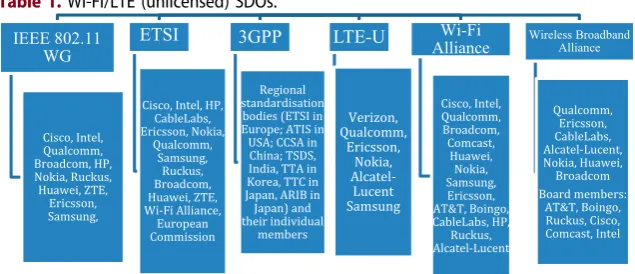
‘a 3rd generation mobile system based on evolved Global System for Mobile Communi-cations (GSMTM)’(ETSI,2016c). 3GPP work, building on LTE, focused on Internet Pro-tocol (IP) based technical solutions to transport voice, messaging and data services over cellular networks (3GPP,2016a). 3GPP unites under its structure seven telecommunica-tions standardisation bodies from across the world that serve as its Organisational Part-ners and‘determine [its] general policy and strategy’ (3GPP, 2016b). Very importantly for the current co-existence debate, one of these partners is ETSI (seeTable 1).
Thus, the standards development organisation (SDO) world overall is organisationally nexus-like and overlapping. The membership of 3GPP is diverse and includes almost all major cellular, but also many Wi-Fi, related companies and alliances (see 3GPP,2016c). The members of the LTE-U Forum are part of 3GPP. The Wi-Fi Alliance2industry group is also an individual member of 3GPP, while the diverse Wireless Broadband Alliance (WBA)3is one of 3GPP’s partners. The landscape, in policy terms, is thus interconnected and multi-forum (seeTable 1). This interconnectedness, in theory at least, provides the opportunity for the resolution of conflict that might arise from different technical stan-dards development processes.
[image:9.493.61.379.499.636.2]There is a notable difference in the participation cultures of these organisations, most particularly between 3GPP and IEEE 802 (authors’interviews, 12 October 2016 and 12–13 July 2017). While participation in both organisations is undoubtedly motivated by corpor-ate business goals, in IEEE 802 attendees at standards development meetings hailing from a range of high tech corporate telecommunications players, when voting in any standards development process, are required to act in a personal capacity using their expertise to make decisions in the general or common interest of technological progress (see IETF RFC, 7241, 2014; authors’ interviews 12–13 July 2017). Attempted expansion of this
Table 1.Wi-Fi/LTE (unlicensed) SDOs.
cultural norm beyond IEEE–in the form of individual policy entrepreneurship–would create a crucial window of opportunity to resolve the co-existence problem (see p. 25).
The problem stream: defining the terms of co-existence between LTE and Wi-Fi in unlicensed spectrum space
Spectrum usage undertaken on the basis of cellular and Wi-Fi standards (LTE and IEEE 802.11 respectively) differs markedly. These technical differences have created different operational cultures and distinct tension in terms of co-existence. This can be understood in respect of the idea of fairness, in particular in relation to access to network capacity. Some brief technical explanation is needed to illustrate this.
Wi-Fi devices gain access to spectral channels in a so-called‘contention-based’process, using the carrier sense multiple access with collision avoidance (CSMA/CA) technical pro-tocol (Jeon et al.,2015, p. 2321). Here, an automatic‘clear channel assessment’process is performed before signal transmission occurs (Kwon et al., 2016, p. 4). The contention mechanism operates by a process of trying to avoid collision using the so-called listen before talk (LBT) algorithm, whereby a station attempting to transmit selects a random listening time duration. After it has detected no user transmitting during this random dur-ation, it proceeds to transmit (authors’interview, 12 October 2016). This is known as Wi-Fi’s ‘random back off’ mechanism (Google, 2015). The Wi-Fi 802.11 standard family includes an additional back offmechanism, called‘exponential back off’. Here, if a signal collision occurs, the length of the random back offinterval referred to above is automati-cally increased before transmission recommences, thus minimising (though not removing entirely) the risk of further signal interference in densely populated (known as densified) network environments in Google (2015); see also DSA, (2015a, p. 3); Public Interest Organizations (2015, p. 14).
By contrast, cellular communication through LTE operates on a so-called‘ contention-free’or schedule-based system,‘designed to transmit persistently as long as there are [data] packets awaiting to be served’(Jeon et al.,2015, p. 2321). This provides better throughput for LTE based signals (Public Interest Organizations,2015, p. 14) and thus better quality of service to the user but is problematic for co-existence since the reserved space it monop-olises can leave Wi-Fi devices operating in the unlicensed environment starved of access to transmission channels, because LTE does not allowflexibility for the free or‘idle’periods of opportunity (Cano et al., 2016, p. 2) on which Wi-Fi capitalises for communication. Therefore, the inherent techno-cultural‘politeness’in the design of Wi-Fi devices creates a distinct disadvantage when operating in proximity to LTE transmitters as is increasingly the case in the unlicensed space, something exacerbated by the control-centric modus operandi of LTE. This is important, since historically:
It is the combination of all three of these politeness protocols, (LBT, initial wait, exponential back off) and [its] ability to sense extremely weak signals…that make [Wi-Fi] such a good neighbor to other technologies. (DSA,2015a, p. 3)
perception of ‘fair’ coexistence between Wi-Fi and licensed providers differs markedly. The results of technical simulation exercises conducted by proponents of LTE are often disputed by the Wi-Fi community (Alderfer,2015; Andreoli-Fang,2015).
A key focusing event in highlighting the co-existence problem occurred in 2014, when a closed group of mobile carrier, chipset, and equipment manufacturers (led by Verizon and also comprising Qualcomm, Ericsson, Nokia/Alcatel, and Samsung) formed in the United States and put forward a technical specification (LTE-U) for the deployment of LTE in unlicensed spectrum bands. LTE-U was intended for use by licenced mobile carriers only (Feld, 2015a) and excluded other players with major stakes in the Wi-Fi sector, including Cisco, Broadcom, Microsoft, Cablelabs, and Google, all part of the Wi-Fi Alli-ance. It operated according to a so-called‘duty-cycle approach’, which performed a par-ticularly narrow, self-first techno-cultural articulation of sharing, by‘owning’spectrum for a chosen period of time and then allowing other devices (such as Wi-Fi) to use it in the remaining time (authors’interview, 12 October 2016; Paolini,2015, p. 12). This amounted to the cultural antithesis of Wi-Fi based communication. Whilst LTE-U incorporated the Wi-Fi originated back offmechanism, it was absent the‘listen before talk’(LBT) technique (WBA,2015). Its activated duty cycle mechanism would share the selected channel based on ‘on and off’ periods, which would be determined, crucially, by the LTE-U operators themselves on a self-regulatory principle (DSA,2015a, p. 4).
The Dynamic Spectrum Alliance (DSA), an industry association sympathetic to the position of Wi-Fi in the co-existence debate, argued that the mechanism would give con-trol to LTE-U players to determine allocated time to Wi-Fi based counterparts, and would impact negatively on the real time voice and video communications opportunity of the latter (DSA, 2015, p. 4). By contrast, Qualcomm refuted accusations of unfair coexistence (Qualcomm,2015) by arguing that LTE-U did not impact on the perform-ance of a Wi-Fi device any more than would another Wi-Fi neighbour (Cablevision et al.,
2015, August 29).
the test produced proved an unsuccessful policy window since it was not endorsed by key stakeholders and there was no obligation on service providers and vendors to run it. The process delayed the emergence of LTE-U based products on the market by a year which might have been considered as a victory in policy terms for the Wi-Fi community but merely served to highlight the persistence of the coexistence problem.
In February 2017, the US FCC finally authorised the operation of LTE-U devices. Whilst potentially a key focusing event, the core issue of contestation in the Wi-Fi proble-matic remained: disagreement on the inherent mechanism for spectrum use by LTE-U technology (LBT) and the energy detection levels necessary to prevent interference and enable‘fair’access to spectrum. Energy detection levels are crucial since they determine the decision taken on whether or not a channel or medium is busy and thus whether or not the device concerned is able to transmit a signal. Nevertheless, by this stage co-exist-ence as a key techno-political problematic had become widely recognised among licensed and unlicensed spectrum players.
The policy stream: LTE-LAA, 802.11ax and the development of unlicensed spectrum use
The development of the LTE-U standard served to epitomise the co-existence problem rather than resolve it. However, a separate LTE-based standard development process – known as LTE-LAA (Licence Assisted Access) was undertaken in an alternative organis-ational venue. This standard evolved simultaneously to–and became closely connected with– work within the Wi-Fi community of the IEEE to create the next generation of the Wi-Fi standard, known as 802.11ax. Both standards developed into potential policy options to address co-existence.
The LTE-LAA development process was undertaken in 3GPP (whose membership included the founders of the LTE-U Forum) with the aim of creating a‘single global sol-ution’ that responded to the challenge of overcoming the international regulatory diff er-ences noted above on use of unlicensed spectrum (Flore,2015; Paolini,2015, p. 11) as well as technical differences over communication protocol and energy detection. Unlike LTE-U, a formal standard creation process commenced within 3GPP. Yet, the LTE-LAA stan-dard had a particularly closed techno-cultural underpinning in that it catered only for licensed providers through aiming to allow aggregation, by a primary licensed carrier, of one or more supplemental unlicensed channels (WBA,2015, p. 1). It did crucially, how-ever, include the LBT mechanism for functioning in the 5 GHz band (Qualcomm,2015, p. 2; see IEEE,2015, also Paolini,2015, p. 11). In March 2016, 3GPP announced the near completion of work on LTE-LAA (3GPP,2016b) and devices using it were approved by the FCC in September 2016 (Brenner, 2018). Despite the incorporation of LBT, a key difference between LTE-LAA and 802.11ax remained in respect of the detailed specifics of energy emission.
In essence, the system used in Wi-Fi devices is more noise sensitive than that of LAA. This increases the risks of‘unfair’access and use of spectrum when both operate in the same bands. Whilst LAA underpinned devices are designed to operate by detecting and avoiding interference with transmissions using the Energy Detection (ED)-only mechan-ism with a threshold of−72 dBm (decibel-milliwatts), Wi-Fi incorporates a more sensitive two stage ED (at a threshold of−62 dBm) and Preamble Detection (PD) (at a threshold of −82 dBm) process. This PD accounts for Wi-Fi’s exceptional‘politeness’characteristics.
The politics of the interaction proved fractious and the policy window proved unsuc-cessful. IEEE 802 argued that 3GPP should incorporate a lower (more sensitive) ED threshold or include in LAA’s design a PD system for increasing the detection sensitivity of devices operating according to it. The 3GPP rejected this argument and returned a counter proposal to IEEE 802 that the latter should consider the application of a less sen-sitive ED-only mechanism with a detection threshold chosen as optimal by the 3GPP (i.e., −72 dBm) in the IEEE’s ongoing work on the 802.11ax standard. Negotiations ended in deadlock when IEEE 802 rejected this counter proposal citing the long established and widely deployed Wi-Fi technological legacy of which dual detection was an integral part. The new IEEE 802.11ax standard,first vaunted in 2013, and commenced formally in 2014, was scheduled for formal ratification by the end of 2019. The standard addresses the key technological challenge of managing in a more controlled and more effective fashion signals in the increasingly crowded,‘densified’, spaces of unlicensed spectrum.4 In this respect, 802.11ax can be regarded as a direct technical response to the concerns of licensed communications providers about the variable service quality of user experience in the unlicensed space, though it differed distinctly from LTE-LAA in respect of energy detection levels as a policy option to deliver co-existence.
The ETSI policy window, policy entrepreneurship and efforts to couple the co-existence problem and policy streams
Despite the seemingly implacable impasse in potential coupling of the problem and policy streams of the co-existence debate, a policy window of opportunity emerged in Europe, drawing on its more public regulatory interventionist character in technical standards making (see next section). This led to a process to revise ETSI’s EN 301 893 harmonised standard, which establishes the essential requirements for radio equipment to use spec-trum efficiently and to avoid harmful interference. In an attempt to seek an alternative organisational venue to address the ongoing co-existence problematic, Wi-Fi stakeholders focused on the work undertaken in ETSI’s technical committee on Broadband Radio Access Networks (BRAN). Importantly–in a situation of policy deadlock where existing standards making venues yielded merely articulations of difference–ETSI BRAN created a policy window by acting as a more‘neutral’forum for altering the unlicensed space tech-nical standards making agenda towards the meaningful pursuit of fair coexistence terms between LAA and Wi-Fi through the EN 301 893 revision process.
threshold of ED and PD, and covered versions of the Wi-Fi standard up to – but not including–the IEEE 802.11ax standard. The coupling process commenced with the initial acceptance of the package as a pragmatic outcome, as‘it was not possible to allow a“carve out”for 802.11ax given it did not exist at the time’(authors’interview, July 2017). Given the importance of 802.11ax, it was, however, agreed that the rules would be revisited. In the latter process, there was initially no sign of movement to a new technical understand-ing on energy detection levels, merely a trenchant tactical re-statement of preferred pos-itions: the licensed cellular industry in 3GPP was still motivated to remove the dual threshold option used by Wi-Fi, while the Wi-Fi industry hoped that it could convince ETSI BRAN to remove the single (ED-only) threshold. However, central for the Wi-Fi industry remained its desire to ensure that the 802.11ax standard was covered by the revised ETSI standard to allow the use of dual thresholds in its future products and ser-vices, as had been the case for existing similar Wi-Fi standard variants in ETSI’s Harmo-nised Standard.
Evidence of collective policy entrepreneurship emerged with efforts to address the log-gerheads at which the protagonists found themselves, through pressure exerted by Cisco, Intel, Broadcom, and HPE, from the Wi-Fi stakeholders’ side. These firms proposed to keep rules to continue with the status quo (i.e., allow both options) as already defined in the previous revision of the ETSI standard, but to extend these rules to cover IEEE 802.11ax. Some licensed mobile network operators among 3GPP’s LTE stakeholders initially opposed the proposed compromise and the discussions at the March 2018 ETSI meeting showed no signs of consensus (authors’interview, 2018). However, the pos-ition changed unexpectedly with a key piece of individual policy entrepreneurship from a participant associated with Ericsson (a company strongly interested in LTE initiatives in unlicensed spectrum), who suggested, in his personal capacity, a way to exit from the deadlock. This action was not in line with the established company membership-based decision taking cultural norm of ETSI BRAN. Instead, it was reminiscent of the cultural norm and modus operandi of the IEEE 802.11 committee. In essence, the policy entrepre-neur proposed that all parties take the bold step of accepting the still unfinalised 802.11ax standard as a so-called‘market reality’(authors’interview, 09 May 2018).5This proposal was accepted and completed the coupling process between the problem and policy streams. Furthermore, in a signal of clear agenda shift in the direction of the practical pur-suit of co-existence, participants in ETSI BRAN reached a common position agreeing on the need to test real world coexistence performances of 802.11ax and LTE-LAA. Both ETSI and Wi-Fi Alliance members were requested to make coexistence test reports available, which, according to multiple participants, would ‘provide the industry the best hints’ on enabling acceptable coexistence (IEEE, 2017).
The political stream in the debate on co-existence: policy windows of opportunity and coupling with the problem and policy streams
The directive was scheduled to come into effect in June 2016, with a mandatory compli-ance among EU Member States of June 2017. The EN 301 893, however, needed to be revised earlier, in 2016, to allow approval and transition processes to be executed in time, thus precipitating the activity in ETSI BRAN analysed in the previous section. Thus, EU level political-legislative change created an important window of opportunity in the political stream which contributed to its coupling with the co-existence problem and policy streams.
The second vital aspect of the political stream for standards making parties was aware-ness of the consumer public’s preferences for mobile communication in licensed and Wi-Fi spaces. This article has earlier outlined the interconnected nature of the licensed mobile broadband and Wi-Fi sectors in terms of standards making. As usage of laptops, tablets and mobile phones has grown, wireless communications users have become a vital inter-national consumer public. Regularly upgraded wireless devices are now often both Wi-Fi and LTE enabled. This is particularly important for mobile phones, which are used increasingly to access the Internet, often through utilising the process of switching or
‘offloading’ between licensed and Wi-Fi services. Design and manufacture of new dual mode enabled equipment is thus both costly and something subject to significant commer-cial time pressures, yet at the same time potentially highly lucrative. Industry analysts pre-dicted that whilst latest fifth generation (5G) licensed mobile services will provide customers with increased data allowances and connection speeds, ‘new application demands on 5G are also going to move upwards…encouraging similar behaviours of offload as 4G’ (Cisco, 2019) in the future. As pointed out at IEEE 802.11, the dual threshold was included in an earlier version of the EN 301 893 Harmonised Standard and acknowledgment made that any drastic change of rules would jeopardise existing economic and social benefits of Wi-Fi to European citizens (IEEE, 2017). EU policy makers have advocated a technological neutrality approach in regulating electronic com-munications. The IEEE 802.11 community argued that extension of the dual threshold in the revision of EN 301 893 would achieve such neutrality without putting at risk the socio-economic value associated with the additional benefits of IEEE 802.11ax for the European community (IEEE,2017).
The previous section has shown how, as the coupling process between the problem and policy streams unfolded, the crucial latest version of the 802.11 standard, according to which a raft of new equipment would be built and sold, could not be covered initially as the standards making process had not yet been completed. The incomplete 802.11ax standard development process raised the prospect of devices underpinned by it not being operable in Europe. This, in theory, would have knock on consequences for devices, such as laptops, incorporating the 802.11ax standard, but also LTE-based use in the case of dual mode mobile phones. The latter devices might not be ascribed as enabled with the latest Wi-Fi technology, making them considerably less attractive to customers as a whole. Awareness among standards making interests of the two crucial public preferences for regular device upgrades, on the one hand, and smooth transition and interoperability on mobile devices between licensed and unlicensed Wi-Fi environments (authors’ inter-view, 2017; Pwc,2015) created another important window of opportunity in the political stream.
compliance requirements of the EU Radio Equipment Directive, in coupling the co-exist-ence political stream to the problem and policy streams. As Qualcomm, a key advocate of LAA, asserted‘Wi-Fi connectivity is in hundreds of millions of Qualcomm chips sold each year and embedded into the smartphones and tablets that [licensed] service providers and manufacturers sell to consumers’, therefore LTE stakeholders ‘have every incentive to achieve fair coexistence’(Qualcomm,2015).
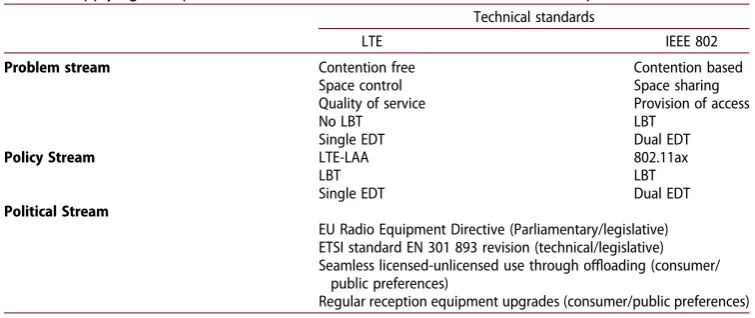
A contested policy environment in which the material interests of the protagonists are understood to be linked and common and in need of time pressured attention is more likely to lead to compromise shared policy agendas. The overall features of the three streams in respect of the co-existence debate analysed in this article are summarised inTable 2.
Conclusion
The technical standards for co-existence process amounts to a European legislation man-dated, consumer public driven, compromise based on acceptance of two incrementally devel-oped standards families, likely to sit uneasily aside each other in the unlicensed environment. In other words, the co-existence agenda set by this compromise is unlikely to assuage immediately concerns about fair access to communication space. It appears that IEEE 802.11 has achieved its goals of ensuring that LBT remains a predominant communication protocol in unlicensed spectrum and of convincing ETSI BRAN members to allow the use of traditional ED and PD mechanisms through the newly designed IEEE 802.11ax standard. Yet, at the same time, Wi-Fi interests had to accept the single energy detection threshold (of−72 dBm) for LAA devices as adopted by 3GPP as a feature of the landscape of co-exist-ence in an increasingly utilised unlicensed spectrum space. The opportunity ETSI has opened as a seemingly more neutral venue for coexistence decision-making, provided a policy win-dow to set in train thefirst steps of consensus-building and, most importantly, a common agenda on the need for generation and consideration of in-practice coexistence test data.
[image:16.493.58.436.61.220.2]The co-existence case shows that private technical standards making, like complex pol-icy processes, can create compromise technical outcomes. Fractious polpol-icy development processes can lead in the end to a clearer understanding of common interests, the ultimate one in this case amounting to commercial risk in a highly lucrative sector. The technically Table 2.Applying multiple streams to the case of co-existence in unlicensed spectrum.
Technical standards
LTE IEEE 802
Problem stream Contention free Contention based
Space control Space sharing
Quality of service Provision of access
No LBT LBT
Single EDT Dual EDT
Policy Stream LTE-LAA 802.11ax
LBT LBT
Single EDT Dual EDT
Political Stream
EU Radio Equipment Directive (Parliamentary/legislative) ETSI standard EN 301 893 revision (technical/legislative) Seamless licensed-unlicensed use through offloading (consumer/
public preferences)
arcane co-existence debate has provided a vital way of setting the ground for an under-standing of the direction in which the wireless communications environment is proceed-ing in user terms. Put simply, consumers are unlikely to know or care about the technical standard that underpins their core preference for affordance of ready and efficient access to data rich, interactive mobile communications through regularly upgraded reception equipment.
The historic mandating of LBT in Europe, through the EU and ETSI, inserted it as the established and predominant cultural and operational norm of unlicensed communication in Europe and beyond. This created a window of opportunity for negotiation on the see-mingly insolvable issue of energy detection. Policyflexibility and compromise were necess-ary to achieve regulatory compliance, where the Wi-Fi community accepted inclusion of the LTE community’s less sensitive EDL; the LTE community accepted the 802.11ax stan-dard, though not complete, as a market reality. Applying the Multiple Streams approach to the co-existence case allows us to see clearly how private technical standards-setting on its own when viewed through a policy process lens, struggles to solve, unaided, complex socio-technical problems like co-existence with issues of control and quality of user experience versus openness and equality of opportunity in communication at their core.
Notes
1. The regulation of the bands falls within FCC’s Part-15 Rules, stipulated in Title 47 of the Code of Federal Regulations (CFR).
2. Created in 1999, the Wi-Fi Alliance has provided interoperability certification and approved backward compatibility of Wi-Fi CERTIFIEDTM products (Wi-Fi Alliance,2016). As seen further in this paper, the Wi-Fi Alliance has been particularly active in the planning of tech-nical tests for measuring fair coexistence between LTE and Wi-Fi devices.
3. Founded in 2003, the Wireless Broadband Alliance (WBA) focuses on next generation Wi-Fi, connected cities, wireless innovation and testing, as well as on trials of LTE devices in unli-censed spectrum (WBA,2016).
4. Specifically, the 802.11ax project aimed to increase traffic throughput per user by a factor of four in dense user contexts through‘implementing mechanisms to serve more users a con-sistent and reliable stream of data (average throughput) in the presence of many other users’ (National Instruments,2017, p. 1).
5. Interestingly, Ericsson (as a company) has since proposed the ED/PD option to be defined as an‘exception’, but the proposal seems to have been refused by ETSI BRAN (IEEE 802.11 Coexistence SC,2017).
Disclosure statement
No potential conflict of interest was reported by the authors.
Funding
This work was supported by Economic and Social Research Council [grant number ES/M00953X/1].
Notes on contributors
she worked as Associate Research Fellow on the ESRC-funded project‘International Professional Fora: A Study of Civil Society Organisation Participation in Internet Goverance’. Her current research interests include debates in licence-exempt spectrum for wireless broadband communications.
Seamus Simpsonresearch interests lie in European and global communications policy. He is author of‘Regulation, Governance and Convergence in the Media’(2018, Edward Elgar), with Peter Hum-phreys, formerly of the University of Manchester. His work has been funded by the ESRC and the European Commission. He is a Senior Editor of the Oxford Research Encyclopedia of Communcia-tion (Oxford University Press).
References
3GPP. (2016a). The evolved packet core. Retrieved from http://www.3gpp.org/technologies/ keywords-acronyms/100-the-evolved-packet-core
3GPP. (2016b, March 15).Release 13 frozen in Gothenburg. Retrieved fromhttp://www.3gpp.org/ news-events/3gpp-news/1769-rel-13_tsg71
3GPP. (2016c, October 24).New partners at London 3GPP meeting. Retrieved fromhttp://www. 3gpp.org/news-events/3gpp-news/1800-pcg_37
Ackrill, R., & Kay, A. (2011). Multiple streams in EU policy-making: The case of the 2005 sugar reform.Journal of European Public Policy,18(1), 72–89.
Ackrill, R., Kay, A., & Zahariadis, N. (2013). Ambiguity, multiple streams, and EU policy.Journal of European Public Policy,20(6), 871–887.
Alderfer, R. (2015, November 11). Fair LTE-U coexistence far from proven in CableLabs/ Qualcomm testing. INFORMED blog. Retrieved from https://www.cablelabs.com/fair-lte-u-coexistence-far-from-proven-in-cablelabs-qualcomm-testing
Andreoli-Fang, J. (2015, November). Wi-Fi vs. duty cycled LTE-U: In-home testing reveals co-existence challenges. INFORMED blog. Retrieved from https://www.cablelabs.com/wi-fi -vs-duty-cycled-lte-u-in-home-testing-reveals-coexistence-challenges
Brenner, D. (2018). From LTE-U/LAA to 5G spectrum sharing. Retrieved from https://www. lightreading.com/mobile/spectrum/from-lte-u-laa-to-5g-spectrum-sharing/a/d-id/743015 Cablevision, Suddenlink Communications, Tele Columbus, Charter Communications, Cox
Communications, Comcast, & Liberty Global et al.. (2015, August 29).Contribution to 3GPP LAA workshop. Retrieved from ftp://ftp.3gpp.org/workshop/2015-08-29_RAN_LAA/Docs/, LAA-150006.zip.
Cano, C., Lopez-Perez, D, Claussen, H, & Leith, D J. (2016). Using LTE in unlicensed bands: Potential benefits and co-existence issues. Retrieved from https://www.scss.tcd.ie/Doug.Leith/ pubs/lteWi-Fi_2015.pdf.
Cisco. (2019, February 18).Cisco visual networking index: global mobile data traffic forecast 2017-22 white paper (Document id: Document ID:1486680503328360). Retrieved from https://www. cisco.com/c/en/us/solutions/collateral/service-provider/visual-networking-index-vni/white-paper-c11-738429.html
Cohen, M. D., March, J. G., & Olsen, J. P. (1972). A garbage can model of organizational choice. Administrative Science Quarterly,17(1), 1–25.
Cooklev, T. (2004). Wireless communication standards: A study of IEEE 802.11, 802.15, 802.16. New York: IEEE Press.
DSA. (2015a, June 11). Letter: Re: ET Docket No. 15-105: Office of Engineering and Technology and Wireless Telecommunications Bureau Seek Information on Current Trends in LTE-U and LAA technology. Retrieved from https://ecfsapi.fcc.gov/file/60001077791.pdf#viewer. action=download
ETSI. (2016a).The third generation partnership project (3GPP). Retrieved fromhttp://www.etsi.org/ about/what-we-do/global-collaboration/3gpp
ETSI. (2016c).What we are. Retrieved fromhttp://www.etsi.org/about/what-we-are
ETSI. (2018).What does membership cost?Retrieved fromhttps://www.etsi.org/membership/fees European Parliament and Council. (2014, May 22). Directive 2014/53/EU of the European
Parliament and of the Council of 16 April 2014 on the harmonisation of the laws of the Member States relating to the making available on the market of radio equipment and repealing Directive 1999/5/EC.OJL153/62.
Feld, H. (2015a).Part I: Spectrum game of thrones. Retrieved fromhttp://www.wetmachine.com/ tales-of-the-sausage-factory/my-insanely-long-fi
eld-guide-to-the-lte-u-dust-up-part-i-spectrum-game-of-thrones/
Feld, H. (2015b).Part II: A storm of spectrum swards. Retrieved fromhttp://www.wetmachine.com/ tales-of-the-sausage-factory/my-insanely-long-fi eld-guide-to-the-lteu-dust-up-part-ii-a-storm-of-spectrum-swords/
Flore, D. (2015, June 25). On LAA capabilities and scope. Liaison from 3GPP TSG RAN, LS on LAA capabilities and scope. Retrieved fromhttp://www.ieee802.org/Communications.shtml
Google. (2015, June 11).Comments of Google. ET DKT 15-105. Retrieved fromhttps://ecfsapi.fcc. gov/file/60001078145.pdf#viewer.action=download
Greenstein, S. (2007, June).Economic experiments and neutrality in Internet access(Working Paper 13158, NBER Programs). Retrieved fromhttp://www.nber.org/papers/w13158
Guipponi, L., Henderson, T, Bojovic, B, & Miozzo, M. (2016). Simulating LTE and Wi-Fi coexis-tence in unlicensed spectrum with ns-3. Retrieved fromhttps://arxiv.org/pdf/1604.06826.pdf. Guvenc, I., Gezici, S., Sahinoglu, Z., & Kozat, U. C. (2011).Reliable communications for short-range
wireless systems. Cambridge, UK: Cambridge University Press.
IEEE 802.11 Coexistence SC. (2017). Agenda for IEEE 802.11 Coexistence SC meeting in Berlin in July 2017. Retrieved fromhttps://mentor.ieee.org/802.11/documents?n=2&is_dcn=DCN%2C% 20Title%2C%20Author%20or%20Affiliation&is_group=coex
IEEE. (2015, May 18).Follow-up Liaison statement regarding LAA. Retrieved fromhttp://ieee802. org/secmail/pdfuYWRYdEDz5.pdf
IETF RFC 7241. (2014). IEEE 802/IETF relationship. Retrieved fromhttps://datatracker.ietf.org/ doc/rfc7241/
Jeon, J., Niu, H, Li, Q, Papathanassiou, A, & Wu, G. (2015). LTE with listen-before-talk in unli-censed spectrum. Retrieved from http://ieeexplore.ieee.org/stamp/stamp.jsp?arnumber= 7247527.
Kingdon, J. W. (1984).Agendas, alternatives and public policies. Harlow: Longman.
Kingdon, J. W. (1995). Agendas, alternatives and public policies (2nd ed.). New York: Harper Collins.
Kingdon, J. W. (2011). Agendas, alternatives and public policies (Updated 2nd ed.). Boston: Longman.
Kwon, H.-J. (E.), Jeon, J, Bhorkar, A, Ye, Q, Harada, H, Jiang, Y, & Liu , L et al. (2016). Licensed-assisted access to unlicensed spectrum in LTE release 13. Retrieved fromhttps://arxiv.org/pdf/ 1604.08632.pdf.
Lindblom, C. (1968).The policy making process. Englewood Cliffs, NJ: Prentice-Hall.
Mintrom, M., & Norman, P. (2009). Policy entrepreneurship and policy change. Policy Studies Journal,37(4), 649–667.
National Instruments. (2017). Introduction to 802.11ax high-efficiency wireless. Retrieved from http://www.ni.com/white-paper/53150/en/
Nwana, H. (2016, February 4). Letter Re: Office of Engineering and Technology and Wireless Telecommunications Bureau Seek Information on Current Trends in LTE-U and LAA Technology (ET Docket No. 15-105). Retrieved from https://ecfsapi.fcc.gov/file/60001422974. pdf#viewer.action=download
Paolini, M. (2015).LTE unlicensed and Wi-Fi: Moving beyond coexistence. Retrieved fromhttps:// ecfsapi.fcc.gov/file/60001076664.pdf
Pwc. (2015, April). Are Wi-Fi and 4G LTE on a collision course? Communications Review. Retrieved from https://www.pwc.com/id/en/publications/assets/ticepublications/pwc-communications-review-wi-fi-4g-lte_final.pdf
Qualcomm Incorporated. (2015, July 23). Letter Re: Office of Engineering & Technology and Wireless Telecommunications Bureau Seek Information on Current Trends in LTE-U and LAA Technology. (ET Docket No. 15-105). Retrieved from https://ecfsapi.fcc.gov/file/ 60001117759.pdf#viewer.action=download
Quotient Associates. (2017, February). Wi-Fi spectrum needs - final report to Wi-Fi alliance. Retrieved fromhttps: www.QuotientAssociates.com
WBA. (2015, June 29). Wireless Broadband Alliance (WBA) Response to Federal Communications Commission (FCC) Office of Engineering of and Technology and Wireless Telecommunications Bureau Public Seek of Information on Current Trends in LTE-U and LAA Technology (ET Docket No. 15-105). Retrieved from https://www.fcc.gov/ecfs/filing/60001086066/document/ 60001105679
Wi-Fi Alliance. (2016).Who we are. Retrieved fromhttp://www.wi-fi.org/who-we-are