International Journal of Emerging Technology and Advanced Engineering
Website: www.ijetae.com (ISSN 2250-2459, ISO 9001:2008 Certified Journal, Volume 5, Issue 12, December 2015)
71
Fuzzy Logic: An Appropriate Technique for Effective Risk
Analysis and Decision Making for Construction Projects
Savita Sharma
1, Pradeep K. Goyal
2 1ResearchScholar, Gyan Vihar University, Jaipur, India
2Associate Professor, Dept. of Civil Engineering, Govt. Engineering College, Ajmer, Rajasthan, India Abstract --- Risk management is an important and crucial
matter for project manager as the success of any project very much depends on the associated risks and uncertainties in the project. A systematic risk management process can be divided into risk classification, risk identification, risk analysis and risk response. Risk analysis is the second stage in the Project risk management (PRM) where risks which have the highest impact on the project, are short listed out of all the identified risks. There are number of techniques available for risk assessment in the literature, which have their own advantages, disadvantages and limitations. The purpose of this paper is to review and discuss risk analysis techniques which can be used for risk analysis for construction industry. The strengths and weaknesses of the techniques are highlighted and discussed. In this paper, we are illustrating the use of fuzzy logic theory for risk analysis and decision support system in construction industry, as according to author this theory has the potential to handle the complex and dynamic nature of construction industry.
Keywords---Construction management, Simulation, Risk, Fuzzy logic, Probability
I. INTRODUCTION
Risk management is considered to be an important and crucial matter for project manager as the success of any project very much depends on the associated risks and uncertainties in the project. It is observed that construction projects are plagued by risks and uncertainties due to the various factors such as contribution of numerous participants, long construction durations, interaction between internal and external environments and the complex & dynamic behaviour of the construction activities. These risks are sure to be increased with the rapid advancement of the construction especially in developing countries like India. Therefore it has become the need of time for project managers to develop a systematically and integrated approach to reduce the risk in construction projects. Thus, project risk
management (PRM) is one of the important areas of interest for both researchers and construction managers [1].
Risk management is a systematic way of finding areas of risk and how each should be treated. It is a tool for identifying sources of risk and uncertainty, determining their impact, and developing appropriate management responses [2].
A systematic risk management process can be divided into risk classification, risk identification, risk analysis and risk response. Risk responses are further categorized into four actions, i.e. retention, reduction, transfer and avoidance [3, 4].
Risk analysis is the second stage in the PRM where risks which have the highest impact on the project, are short listed out of all the identified risks [5]. The objective of risk analysis is a precise and objective calculation of risk and making decisions.
The purpose of this paper is to review and discuss risk analysis techniques which can be used for risk analysis for construction industry. The strengths and weaknesses of the techniques are highlighted and discussed. In this paper, we are illustrating the use of fuzzy logic theory for risk analysis and decision support system in construction industry, as according to author this theory has the potential to handle the complex and dynamic nature of construction industry.
II. RISK ANALYSIS TECHNIQUES AND THEIR CLASSIFICATION
The appropriate and efficient techniques are required for the risk analysis of any project. There are number of techniques available in the literature, which have their
own advantages, disadvantages and limitations.
International Journal of Emerging Technology and Advanced Engineering
Website: www.ijetae.com (ISSN 2250-2459, ISO 9001:2008 Certified Journal, Volume 5, Issue 12, December 2015)
72
Fig.1: Classification of risk analysis techniques
A. Qualitative analysis
In qualitative analysis, risks are assessed on the basis of descriptive scales. Each risk and its impacts are described in terms of qualitative scale such as high/medium/low. For identifying requirements for further analysis or action Risk events are ranked and assessed after combining their probability of occurrence and impact [7]. These methods are used where quick assessment are required [5]. Risk probability and impact assessment, Probability/impact risk rating matrix, Risk categorization and risk urgency assessment are the techniques which fall under this type of analysis. As indicated by Lyons and Skitmore [8], the qualitative approach is the most common type of technique to analyze risks. Barnes [9] modelled risk as probability and impact (P-I) with risk impact defined as a variance in cost estimate. P-I model has been widely used. In spite of that this model has limitations as expressed by many researchers [10]. The strengths and weaknesses of the qualitative analysis are given below:
Strengths
The method is easy to use.
Not much mathematical skills are required for assessing the risk.
Methods can be understood easily and appeared to
be more accessible.
These methods are very helpful when sufficient data are not available for quantitative assessment
Weaknesses
Do not quantify the risk exactly.
Methods are depended on the personal judgment and past experiences therefore results are varied from person to person.
B. Quantitative analysis
In this approach, the effect of identified risk on the project are analysed numerically. Quantitative risk analysis quantifies the combined effect of risk on project objectives. These methods are based on probability distribution of risks. For quantitative risk analysis usually Probability Theory (PT) based tools are used [11]. This method of analysis is useful and gives more accurate results, if sufficient and adequate data are available. Birnie and Yates [12] explored the use stochastic modelling into construction cost estimating and forecasting. It has been suggested that use of utility theory, decision tree and the Monte Carlo simulation techniques can be used in the prediction of cost. The study was conducted on a housing refurbishment contract. In this study, the actual project final cost was compared with the predicted range. The result showed that figure was within the predicted range. The strengths and weaknesses of quantitative analysis are given below:
Strengths
These methods may provide more objective results,
if ample data are available.
Risk Asseessment
Techniques
Qualitative
Risk probability and impact assessment,
Probability/impact risk rating matrix,
Risk Categorization
Risk Urgency Assessment
Quantitative
Monte Carlo simulation,
Scenario analysis
Sensitive analysis
Event tree analysis
Fault tree
Failure mode and effect analysis
Analytical
International Journal of Emerging Technology and Advanced Engineering
Website: www.ijetae.com (ISSN 2250-2459, ISO 9001:2008 Certified Journal, Volume 5, Issue 12, December 2015)
73
These methods utilize more sophisticated
techniques and tools to analyze construction project risks.
Weaknesses
Due to the uniqueness and non repetitive
character of construction projects sufficient and adequate data are not available for obtaining objective probabilities to quantify the risk. It is found very difficult to exactly quantify the
effects and consequences of risk because of association of many factors with a high level of uncertainty.
There are involvement of large number of
assumptions, judgments and opinions
Uniqueness of construction projects decrease the
significance and reliability of statistical
aggregates which are derived from probability-based analysis.
C. Analytic hierarchy process
Analytic Hierarchy process (AHP) is a common method of multicriteria decision making. This method is used for organizing and analyzing complex decisions and is based on mathematical and psychological sciences. It incorporates the experience, the knowledge and the intuition of the decision makers [13]. In this method, decision elements and their corresponding alternatives are classified after making comparisons between possible pairs of each group. This method used by Mustafa and Al-Bahar [14], Azuma and Miyagi [15] for construction projects. Bhushan and Raj [16] found that this method is very useful for decision making with high risks and uncertainties with human perceptions and judgments. The strengths and weaknesses of the Analytic Hierarchy process (AHP) are given below:
Strength
Method is easy to understand.
Method is based on systematic judgement.
Useful for decision making with high risks and uncertainties
Weakness
Due to the involvement of a large number of judgments, inconsistency problem may occur.
AHP is not found suitable in rank reversal problem
in certain situations. Rank reversal may take place if a new alternative is introduced (which does not change the range of outcomes of any criterion) due to this the previous assessment is to be rejected. The conversion from semantic to numeric scale
which is used to measure the strength of preference, is sometimes not seemed to be suitable.
D. Dempster-Shafer theory
It is also called theory of belief functions as it is a generalization of the Bayesian theory of subjective probability [17-18]. The Dempster-Shafer theory is used for expressing and interpreting with uncertain, imprecise and incomplete information [19]. Obtaining degrees of belief for one question from subjective probabilities for a related question, and Dempster's rule evidence for combining such degrees of belief of independent items of evidence are the basic ideas on which this theory works [17-18]. The strengths and weaknesses of the Dempster-Shafer theory are given below:
Strength
It presents the relationships of variables and is easy to understand.
It estimates the conditional probability and
distribution. Specific conditions are taken into account, and a range of values is provided for better informed decision-making.
Weakness
It is not suitable for complex issues involving many variables. It may be too expensive to determine the relationships and conditional probability functions.
It may be difficult to determine conditional
probability without experience data.
Its main shortcoming is, however, the elicitation and interpretation of belief functions. Furthermore, the computational methods employed in the theory are very complex and thus, of little practical use. This is the reason why it has had very little application
Theory is richer in terms of semantics since it allows an expression of partial knowledge.
E. Fuzzy theory
Fuzzy set theory is a branch of modern mathematics was introduced by Lotfi A. Zadeh [20] to model vagueness intrinsic to human cognitive process. It is suitable to handle the ill defined and complex problems due to the partial and imprecise information for decision making. Fuzzy sets are able to incorporate information described in linguistic terms. Many researchers [21-24] used the process in construction industry for risk analysis.
Strength
It is an appropriate mathematical modelling
framework for risk analysis.
It is a useful way to tackle the uncertain or approximate reasoning that characterize the real-world systems.
Fuzzy set theory has fewer limitations as compared
International Journal of Emerging Technology and Advanced Engineering
Website: www.ijetae.com (ISSN 2250-2459, ISO 9001:2008 Certified Journal, Volume 5, Issue 12, December 2015)
74
Fuzzy set theory is helpful in making rationaldecisions in uncertain and conflicting situations.
Membership functions are useful for vague input in
the modelling
The process of modelling can be
easily understood and verified intuitively
By using membership functions, the results of the scaling membership functions can be scaled.
Weakness
The process suffers from the problem of execution of arithmetic procedure.
Limitation of aggregating risk assessments.
Average assessment solution can be obtained by existing methods.
III. APPROPRIATENESS OF FUZZY LOGIC IN CONSTRUCTION PROJECTS
Based on the extensive literature review, it is observed that qualitative analysis is commonly adopted for the ease of the method. Traditional risk models in construction industry are based on probability and classical set theory. But as the construction projects have the nature of non repetitiveness, the data for quantitative analysis are not seemed to be adequate. AHP and Demster Shafer theories also have some limitations. Each theory has its own advantages, disadvantages and no theory is found perfect for handling the uncertainty.
After discussions of strengths and weaknesses of the risk analysis process, in the opinion of the author fuzzy theories are found more suitable for tackle the complex problems in construction industry as the process is based upon experience, assumptions and human judgment. The theory can be applied in various phases of risk analysis in construction. The risks can be ranked according to the level of severity so that required action can be taken to manage the risks without any delay. The theory is used to quantify the probability of the project delay and cost overrun risk and therefore plays an important role for decision making and strategic planning in construction projects.
IV. APPLICATION OF FUZZY LOGIC THEORY FOR RISK ANALYSIS IN CONSTRUCTION
In this section the applicability of fuzzy theory in construction projects is being demonstrated with the help of a numerical example. A model is developed for determining the probability of risk and decision making. The following procedure is adopted to calculate the rank and assess the importance index of risk factors. The risk factors prevailing in the construction industry are identified through a questionnaire survey. For judging the level of importance of identified factors. The relative importance index (RII) is calculated by using the relation given [25] below:
*
W
RII
A N
Where W is the weighting given to each factor by the respondent (ranging from1 to 5), A is the highest weight and N is the total number of respondent.
A.Modelling in fuzzy inference system
In this step, the fuzzy logic model is designed for predicting the probability of risk. The fuzzy logic process can be defined as rule-based systems, in which the input is first fuzzified (i.e., converted from a crisp number to a fuzzy set) and subsequently processed by an inference engine. This engine retrieves the knowledge in the form of fuzzy rules contained in a rule-base. The fuzzy sets computed by the fuzzy inference as the output of each rule are then composed and defuzzified (i.e., converted from a fuzzy set to a crisp number). Fuzzy Logic allows the mapping of the linguistic values in a way that mimics precise numerical analysis by using membership structure that organizes the data. the main steps for the process are as follows:
Step 1. Independent variables are selected as the key determinants or indicators of the dependent variable. Step 2. Fuzzy sets are created for both independent and dependent variables. Instead of using the numerical value, fuzzy sets in terms of human language are used to describe a variable. The degree of truth that each variable belongs to a certain fuzzy set is specified by the membership function.
Step 3. Inference rules are built in the system. A fuzzy hedge may be used to tweak the membership function according to the description of the inference rules.
Step 4. The output fuzzy set of the dependent variable is generated based on the independent variables and the inference rules. After defuzzification, a numerical value may be used to represent the output fuzzy set.
Step 5. The result is then used for informed decision-making. Fig. 2 shows the basic steps of fuzzy logic process
B. Numerical Example
The following risks are considered for the study economic and financial,
contractual and legal,
physical and construction related,
managerial and performance related,
Political and societal.
(i)Ranking of risk factors
International Journal of Emerging Technology and Advanced Engineering
Website: www.ijetae.com (ISSN 2250-2459, ISO 9001:2008 Certified Journal, Volume 5, Issue 12, December 2015)
75
C. Analysis steps for the model development To develop the model, following steps are
performed on fuzzy logic tool box of MATLAB.
Construct a five input, one output system in the FIS editor. The identified risk factors and “risk probability” are entered as input members and output member respectively. These are shown in Fig. 3. [image:5.595.326.537.128.432.2]Fig. 2: Basic steps of fuzzy logic process
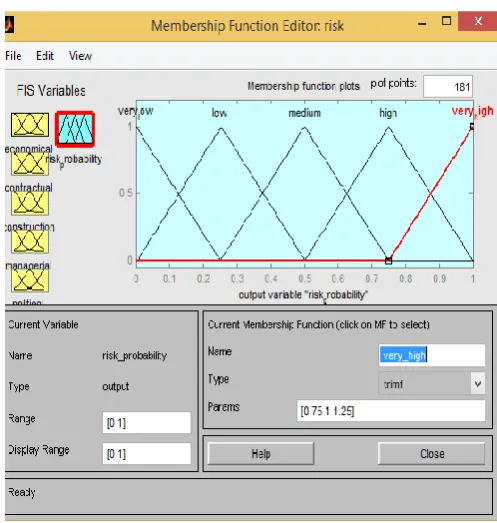
(ii) Membership functions associated with all of the input and output variables are defined in membership function editor as shown in Fig.4. All the parameter related to their membership function of each variable is given in the Table1.
(iii) In order to perform fuzzy inference, rules which connect input variables to output variables are defined. For the present model 25 rules are constructed in the form of IF-THEN. Five of them are given below.
Rule1: if the probability of economic and financial risk is very low the risk probability is very low
Rule2: if the probability of economic and financial risk is low the risk probability is low
Rule3: if the probability of economic and financial risk is medium the risk probability is medium.
Rule4: if the probability of economic and financial risk is high the risk probability is high.
Rule5: if the probability of economic and financial risk is very high the risk probability is very high.
(iv) The relative importance indices (RII’s) of risk factors are assigned as weightage to the fuzzy rules to develop the assessment model to estimate the probability of risk. Since the RII’s of the risk factors have different values, the fuzzy rules weights will differ accordingly. So that each if-then rule will have different weights, showing relative importance of fuzzy rules. These are presented in Table 2.
Fig. 3: Input and output members for risk analysis model
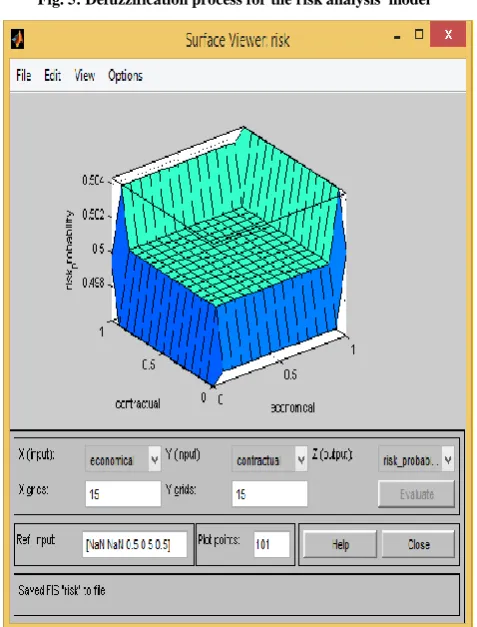
[image:5.595.310.551.138.714.2](v) The rule viewer displays a roadmap of the whole fuzzy inference process. The rule viewer shows how the shape of the certain membership function influences the overall result. Fig. 5 shows the rule view of the system.
Fig. 4: Membership function for the risk assessment model independent variable (input)
fuzzification
rule evaluation
defuzzification
[image:5.595.313.562.498.760.2]International Journal of Emerging Technology and Advanced Engineering
Website: www.ijetae.com (ISSN 2250-2459, ISO 9001:2008 Certified Journal, Volume 5, Issue 12, December 2015)
[image:6.595.323.539.125.445.2]76
Table 1:
linguistic variables used in model and their membership function
variables Range MFs No of
MFs
Name of the parameters Input parameter
[image:6.595.42.288.155.456.2]economic and financial,
[0 -1] trapmf 5 1.very low 2.low 3.medium 4.high 5.very high contractual
[image:6.595.314.553.443.757.2]and legal
[0 -1] trapmf 5 1.very low 2.low 3.medium 4.high 5.very high physical and
construction related,
[0 -1] trapmf 5 1.very low 2.low 3.medium 4.high 5.very high managerial
and performance related,
[0 -1] trapmf 5 1.very low 2.low 3.medium 4.high 5.very high Political and
societal.
[0 -1] trapmf 5
1.very low 2.low 3.medium 4.high 5.very high (vi) Finally, the input-output mappings are obtained by
choosing view menu and under it view surface.
Table 2:
Sample fuzzy rules for the of risk assessment model and rules weight
S N
Rules
Rule weight
1 if the probability of economic and financial risk is very low the risk probability is very low
.82
2 if the probability of contractual and legal risk is very low the risk probability is very low low
.8
3 if the probability of physical and construction risk is very low the risk probability is very low
.78
4 If the probability of managerial and performance related, is very low the risk probability is very low
.72
5 if the probability of Political and societal. is very low the risk probability is very low
.9
[image:6.595.43.285.483.714.2]Fig. 5: Defuzzification process for the risk analysis model
International Journal of Emerging Technology and Advanced Engineering
Website: www.ijetae.com (ISSN 2250-2459, ISO 9001:2008 Certified Journal, Volume 5, Issue 12, December 2015)
77
V. CONCLUSIONThe paper has reviewed the existing literature on the risk assessment theories. The theories have their own advantages and disadvantages. No theory seems to be perfect. Practical experience, personal judgment and intuition play an important role in decision making. We propose FST as an appropriate theory for tackling the ill-defined and complex problem of construction industry as the theory has the potential to model vagueness intrinsic to human cognitive process. The theory can be applied in various phases of risk analysis in construction. The risks can be ranked according to the level of severity so that required action can be taken to manage the risks without any delay. The theory is used to quantify the probability of the project delay and cost overrun risk and therefore plays an important role for decision making and strategic planning in construction projects.
REFERENCES
[1] Raz Z, Shenhar AJ, Dvir D., 2002. Risk management, project success and technological uncertainty. R&D Manage;32(2,pp.101–109.
[2] Uher, T., 2003. Programming and Scheduling Techniques, UNSW Press, Sydney
[3] Berkeley, D., Humphreys, P.C. and Thomas, R.D., 1991. Project Risk Action Management, Construction Management and Economics, 9(1),pp. 3-17.
[4] Flanagan, R. and Norman, G., 1993. Risk Management and Construction, Victoria: Blackwell Science Pty Ltd, Australia. [5] Cooper, D., Grey, S., Raymond, G., and Walker, P., 2005. Project
Risk Management Guidelines: Managing Risk in Large Projects and Complex Procurements. Chichester: John Wiley & Sons, Ltd
[6] Lichtenstein,Sh.,1996.Factors in the selection of a risk assessment method. Information Management and Computer Security,4,pp.20–25.
[7] PMI (Project Management Institute), 2004. A guide to the project management body of knowledge: PMBOK. 3rd edition. Pennsylvania: Project Management Institute, Inc
[8] Lyons T. and Skitmore M., 2004. Project risk management in the Queensland engineering construction industry: a survey. International Journal of Project Management. Vol. 22, pp. 51- 61
[9] Barnes, M. 1983. How to allocate risks in construction contracts. International Journal of Project Management, 1(1),pp. 24-28.
[10] Taroun, A., Yang, J.B. and Lowe, D. Abdulmaten,2011 , Construction Risk Modelling and Assessment: Insights from a Literature Review. The Built & Human Environment Review, Volume 4, Special Issue 1,PP.87-97
[11] Tah, J.H., Carr, v.,2001. Knowledge-Base approach to construction project risk management. Journal of Computing in Civil Engineering, 15(3), pp.170-177.
[12] Birnie, J and Yates, A, 1991. Cost prediction using decision/risk analysis methodology. Construction Management and Economics, 9, pp.171-86.
[13] Forman, E. and Gass, S., 2001. The analytical hierarchy process– an exposition. Operations Research, Vol. 49, No. 4, pp. 469–487. [14] Mustafa, M.A. and Al-Bahar, J.F. ,1991. Project Risk Analytic
Assessment Using the Hierarchy Process. IEEE Transaction on Engineering Management 38(1), pp.46-52.
[15] Azuma R and Miyagi H ,2009. AHP for risk management based on expected utility theory. IEEJ Transact. Electronics, Info. Systems. 129, pp.1123–1128.
[16] Bhushan, N. and Raj, K., 2004. Strategic Decision Making: Applying the Analytic Hierarchy Process. London: Springer-Verlag.
[17] Shafer, G ,1990. Perspectives on the theory and practice of belief functions.International Journal of Approximate Reasoning, 4(5-6),pp. 323-362.
[18] Shafer, G. ,1992. The Dempster-Shafer theory. Encyclopedia of artificial intelligence,pp 330-331.
[19] Smets P., 1988, Belief functions, In Smets, Mamdani, Dubois, Prade (ed.), Non-standard logics for automated reasoning, Academic Press, New York.
[20] Zadeh, L. A.,1965. Fuzzy Sets. Information and Control, 8, pp.338-353
[21] Kangari, R. and Riggs, L.S, 1989. Construction Risk Assessment by Linguistics. IEEE Transaction on Engineering Management 36(2), pp.126-131.
[22] Tah, J.H.M and Carr, V. ,2000. A proposal for construction project risk assessment using fuzzy logic. Construction Management and Economics 18,pp. 491–500.
[23] Choi, H.H, Cho, H.N. and Seo, J.W. ,2004. Risk Assessment Methodology for Underground Construction Projects. Journal of Construction Engineering and Management, 130(2) ,pp.258-272. [24] Zeng, J., An, M. and Smith, N.J. 2007.Application of a fuzzy
based decision making methodology to construction project risk assessment. International Journal of Project Management, 25, pp.589–600.