International Journal of Emerging Technology and Advanced Engineering
Website: www.ijetae.com (ISSN 2250-2459,ISO 9001:2008 Certified Journal, Volume 4, Issue 6, June 2014)
373
A Survey on Time Efficient and Secure Data Hiding Algorithm
Shriya Pandey
1, Manish Shrivastava
21,2Department of Information Technology, LNCT, Bhopal, M.P.,India
Abstract— Cryptography is the process of securing
information; it ensures that the information is only understood by authenticated persons. Steganography is the process of exchanging secret information in such a way that nobody else can detect the presence of that secret message. To achieve high security, steganography process is combined with cryptographic encryption decryption algorithm such that if any one detect the presence of secret information still it is not understandable. In this paper, authors have studied and implemented many such algorithms and presenting experimental results of overall observation of these algorithms.
Keywords— Computer Security, Steganography, MSA
Algorithm, Encryption Decryption Algorithm.
I. INTRODUCTION
Information security keeps most importance in today’s fast developing era. Various networks are used to exchange the information, which may be secure or not. With the rapid growth of computer networks and advancement in technology, a large amount of information is being exchanged. Much of this information is confidential or private which increases the demand for stronger encryption techniques. Security has become a critical feature for endowed networks. Communication is not safe due to the presence of hackers who wait for a chance to gain access to confidential data. Cryptography is derived from the Greek words “kryptos” (meaning “hidden”) and “graphein” (meaning “to write”). Cryptography is the study of shuffling information from in such a way that no one can understand the original meaning of message without knowing the secret key which make it again original text. The process of converting information (plain text) by transforming it into unreadable format (cipher text) is known as encryption. Encryption techniques can be sometimes broken by cryptanalysis, also called as code breaking, although modern cryptographic techniques are virtually unbreakable. Cryptography encrypts the original message that is being sent. This mechanism employs mathematical schemes and algorithms to scramble data into unreadable text. It can only be decoded or decrypted by the party that possesses the associated key [5].
Steganography is derived from the Greek word “stegnos” (meaning “covered/secret”) and “graphein” (meaning “to write/draw”) [2].
Steganography is the study of means of hiding the information in order to prevent hackers from detecting the presence of the secret information. The process of hiding the message in a cover without leaving a remarkable trace is known as Steganography. Steganography is the form of convert communication in which a secret message is hided with a carrier data. Steganography facade the presence of communication, making the true message not observable to the observer. Cryptography and Steganography achieve the same goal using different means. Encryption encodes the data so that an unintended recipient cannot determine its intended meaning. Steganography in contrast attempts to prevent an unintended recipient from suspecting that the data is there [3]. The authors studied both the algorithms and studied the techniques that use both the algorithm to provide high degree of security and also compare the result on the basis of timing and avalanche effect.
II. LITRATURE SURVEY
Nearly everyone these days in steganographic systems uses image as cover object, Authors have investigated many such algorithms, many techniques have been proposed to conceal the secret data behind the cover image without leaving any mark. As described by Neil Johnson and sushil Jagodia [4], least significant bit (LSB) incorporation is an ordinary, straightforward and uncomplicated approach to implant secret data in a cover object. To hide the secret data with image as a covering file, LSB bit of a pixel is substituted with the message bit. In a 24-bit image cover file, each pixel is made of three colours (R, G, and B) and each colour is of 8 bit. Each pixel is modified by 3 bits of message by modifying LSB of each colour with the message bit. To the human eye, the resulting stego image will look indistinguishable to the cover image.
International Journal of Emerging Technology and Advanced Engineering
Website: www.ijetae.com (ISSN 2250-2459,ISO 9001:2008 Certified Journal, Volume 4, Issue 6, June 2014)
374
Authors named the proposed algorithm “RJDA” which is architecture of joining these proposed two algorithms. To hide secret message inside the text file authors proposed a new method in which the bits of each character of secret message file is inserted in place of eight randomly selected blank space characters of the cover files. In this method author first converted the secret file in binary format where every character is represented by 8 bits. To hide each bit, authors use blank spaces, to hide bit–0 authors left the blank space as it is, and for bit-1 authors replace the blank space to a character having ASCII value 160 and this character also appear like a blank space on the screen or while printing.
III. ANALYSIS OF RJDAALGORITHM
This section is providing analysis of RJDA algorithm on the basis of different parameters like timing and security. Dot Net implementation has used to test this algorithm. For experiment, Intel Pentium Dual Core E2200 2.20 GHz, 1 GB of RAM and Window-XP SP2, have used in which performance data is collected.
A. Analysis of RJDA encryption and Decryption algorithm:
There are many encryption/decryption algorithms, but still there is always a competition to develop an algorithm which will provide high security in minimum time. Time and security both are the important parameters for any cryptographic algorithm. If an algorithm has high security but not a time efficient then there is no significance to use it. Such algorithms cannot be used in real time transmission or in ad-hoc networks because of time taken by algorithm and also if algorithm is time efficient but not secure than again it is useless.
B. Time Efficiency and Throughput:
Time efficiency is one of the parameter used to measure the performance of cryptographic algorithm. It can be defined as a time taken by algorithm to convert the plaintext into cipher text
.
There is also one another parameterdepended on time i.e. throughput. Throughput is the amount of text encrypted per unit time. The algorithm having higher throughput is considered better than the other.Table1
Execution Time and Throughput of RJDA Encryption algorithm
File Size ( in KB)
RJDA Encryption Algorithm
Execution Time (in Seconds)
Throughput (Bytes/ Second)
1 KB 8.658 118
5 KB 16.582 308
10 KB 24.663 415
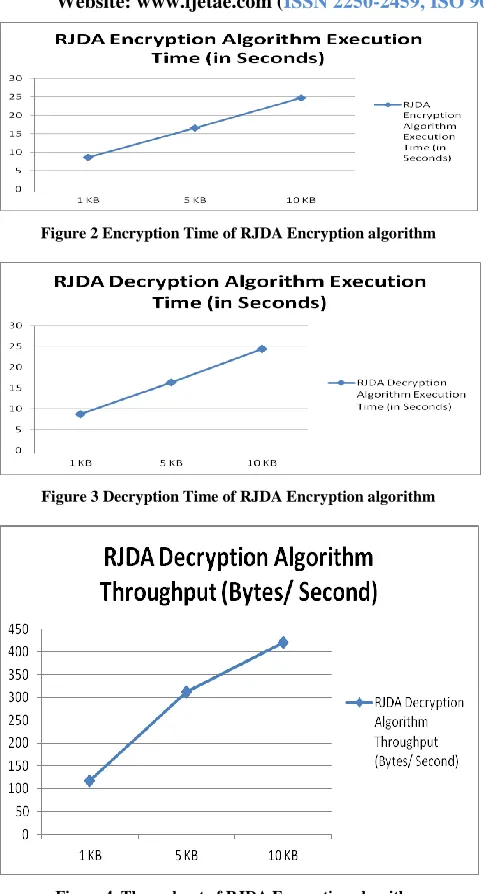
Table 1 shows the execution time of encryption algorithm and throughput (Bytes/ Second) RJDA algorithm and Table 2 shows the execution time of decryption algorithm.
Table2
Execution Time and Throughput of RJDA Decryption algorithm
File Size ( in KB)
RJDA Decryption Algorithm
Execution Time (in Seconds)
Throughput (Bytes/ Second)
1 KB 8.672 118
5 KB 16.358 312
10 KB 24.363 420
From Table 1, it is clearly seen that execution time of RJDA algorithm is very high hence it is not time efficient algorithm. Timing for encryption and decryption algorithm is almost same. It is also observe that throughput of RJDA
International Journal of Emerging Technology and Advanced Engineering
Website: www.ijetae.com (ISSN 2250-2459,ISO 9001:2008 Certified Journal, Volume 4, Issue 6, June 2014)
375 Figure 2 Encryption Time of RJDA Encryption algorithm
[image:3.612.320.565.122.270.2]Figure 3 Decryption Time of RJDA Encryption algorithm
Figure 4 Throughput of RJDA Encryption algorithm
Figure 5 Throughput of RJDA Encryption algorithm C. Analysis of RJDA Avalanche Effect:
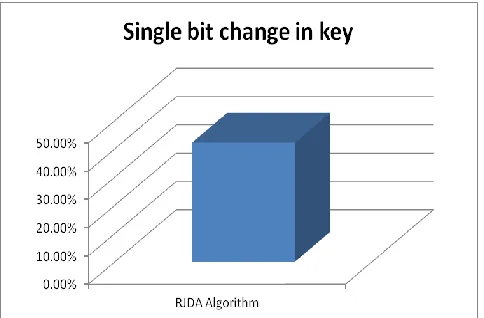
Avalanche effect is used to measure the internal strength of encryption/ decryption algorithm. This is second parameter to check the robustness of any cryptographic algorithm. According to avalanche effect change in a single bit of plaintext will change 50percent of bits of cipher text. The algorithm closed to avalanche effect condition is considered more secure than others. To check the internal strength of RJDA algorithm authors have computed the value of avalanche effect and show the result at Table 3 and its graphical representation at figure 6.
It is clearly seen from the Table 3 that the avalanche effect of RJDA encryption algorithm is far from 50%. Hence, internal structure of RJDA algorithm is not that much strong which is demanded in todys scenario with the rapid increase in technologies.
Table 3
Avalanche Effect of RJDA algorithm
File Size in KB RJDA Algorithm
Avalanche Effect
Single bit
[image:3.612.49.291.124.571.2]International Journal of Emerging Technology and Advanced Engineering
Website: www.ijetae.com (ISSN 2250-2459,ISO 9001:2008 Certified Journal, Volume 4, Issue 6, June 2014)
[image:4.612.321.566.130.290.2]376 Figure 6 Avalanche Effect of RJDA algorithm
D. Analysis of RJDA Data Hiding and Unhiding Algorithm:
RJDA introduces an algorithm to hide text data behind the text file. Authors analyzed the performance of this algorithm on the basis of timing. Authors have implemented this algorithm and calculated the time taken by this algorithm. Experiment results is shown in Table 4 and in Figure 7. Also during study of this algorithm, authors have marked some issues that is the size of cover file is very large. To hide a single character, this algorithm needed a cover file having 8 spaces. therefor to hide normal size file it requires very large cover file in size.
Table1
Execution Time and Throughput of RJDA Encryption algorithm RJDA Hiding Algorithm
File Size
( in KB) Execution Time
(in Seconds)
1 KB 0.11
2 KB 1.323
[image:4.612.49.291.134.293.2]3 KB 8.319
Figure 7 Execution Time of RJDA Hiding Algorithm
IV. PROPOSED METHOD
In this thesis, we proposed an architecture, which will combine the two proposed algorithms: shown in figure 1 and reverse architecture used in receiver end is shown in figure 2. The key feature of this thesis is to reduce the cover file size which will do by using color code of characters. Each Character is coded with 3 colors: Red, Green and Blue. It this work we hide the data behind the blue color. To hide 0, value of blue color of a character is determined and make it even number by subtracting the value by 0 or 1. To hide 1, value of blue color of a character is determined and makes it odd number by adding the value by 0 or 1. Therefore, it makes us able to hide the bit stream behind every character.
Secret Message
Cipher Text
Cover File
MS-Word File (Containing Secret Message)
Figure 1: Proposed Architecture at sender end
Proposed Encryption Algorithm
International Journal of Emerging Technology and Advanced Engineering
Website: www.ijetae.com (ISSN 2250-2459,ISO 9001:2008 Certified Journal, Volume 4, Issue 6, June 2014)
377
Steps of Proposed Architecture:
1.First the secret message is passed to the encryption algorithm which will generate Cipher Text.
2.Then the message is converted to the bit stream and then passed to the data hiding algorithm.
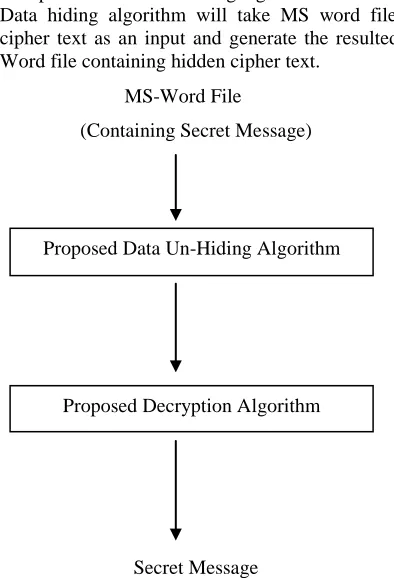
3.Data hiding algorithm will take MS word file and cipher text as an input and generate the resulted MS Word file containing hidden cipher text.
MS-Word File
(Containing Secret Message)
Secret Message
[image:5.612.70.267.194.483.2]Secret Message
Figure 2: Proposed Architecture at Receiver end.
V. CONCLUSION
With the rapid increase of technologies in computer and internet, data security is main concern in today’s life. In this paper, authors have analyzed cryptographic algorithm RJDA. Authors first reviewed the basic algorithm and analyzed the algorithm with different parameter. Algorithm RJDA is combination of two algorithm Encryption/Decryption algorithm and data hiding algorithm. In RJDA encryption/decryption experimental results shows that it is not time efficient algorithm. Hence it cannot be used for fast communication or real time communication. Also the internal structure of encryption/decryption algorithm is not very robust. In RJDA data hiding algorithm authors have found the issue that to hide any text data, one should need very large cover file, and if the size of cover file is large than the transmission time to transmit that file will also be more.
RJDA algorithm introduces a new concept of hiding text behind the text but there are some drawbacks which need to be improved.
REFERENCES
[1] Rishav Ray, Jeeyan Sanyal, Debanjan Das, Asoke Nath. “A new Challenge of hiding any encrypted secret message inside any Text/ASCII file or in MS word file: RJDA Algorithm”. 2012 IEEE International Conference on Communication Systems and Network Technologies
[2] Clair, Bryan. “Steganography: How to Send a Secret Message.” 8 Nov. 2001.
[3] Westfeld, A., and G. Wolf, Steganography in a Video conferencing system, in proceedings of the second international workshop on information hiding, vol. 1525 of lecture notes in computer science, Springer, 1998.pp. 32-47.
[4] Johnson, N. F. and Jajodia, S, “Exploring steganography: Seeing the unseen”, IEEE Computer Magazine, pp. 26-34, February 1998. [5] William Stallings, Cryptography and Network Security, Principles
and Practice, Third edition, Pearson Education, Singapore, 2003. [6] Symmetric Key Cryptography using Random Key generator: Asoke
Nath, Saima Ghosh, Meheboob Alam Mallik: “Proceedings of International conference on security and management(SAM’10” held at Las Vegas, USA Jul 12-15, 2010), P-Vol-2, 239-244(2010). [7] An Integrated Symmetric key Cryptography Algorithm using
Generalised modified Vernam Cipher method and DJSA method: DJMNA symmetric key algorithm : Debanjan Das, Joyshree Nath,
Megholova Mukherjee, Neha Choudhary, Asoke Nath:
Communicated for publication in IEEE International conference WICT 2011 to be held at Mumbai Dec 11-14, 2011.
[8] Data Hiding and Retrieval: Asoke Nath, Sankar Das, Amlan Chakraborty, published in IEEE “Proceedings of International Conference on Computational Intelligence and Communication Networks (CICN 2010)” held from 26-28 NOV’ 2010 at Bhopal. [9] Advanced Steganographic approach for hiding encrypted secret
message in LSB, LSB+1, LSB+2, LSB+3 bits in non standard cover files : Joyshree Nath, Sankar Das, Shalabh Agarwal and Asoke Nath, International Journal of Computer Applications, Vol- 14, No. 7, Page-31-35, Feb (2011).
[10] Advanced Steganography Algorithm using encrypted secret message: Joyshree Nath and Asoke Nath, International Journal of Computer Science and Applications, Vol-2, No. 3, Page- 19-24, Mar (2010).
[11] A Challenge in hiding encrypted message in LSB and LSB+1 bit positions in any cover files: executable files, Microsoft Office files and database files, image files, audio and video files : Joyshree Nath, Sankar Das, Shalabh Agarwal and Asoke Nath : JGRCS, Vol-2, No. 4, Page- 180-185, Apr (2011).
[12] New Data Hiding Algorithm in MATLAB using Encrypted secret message: Agniswar Dutta, Abhirup Kumar Sen, Sankar Das, Shalabh Agarwal and Asoke Nath : Proceedings of IEEE CSNT- 2011 held at SMVDU (Jammu), 03-06 Jun, 2011, Page 262-267.
[13] New Steganography algorithm using encrypted secret message: Joyshree Nath, Meheboob Alam Mallik, Saima Ghosh and Asoke Nath : Proceedings of Worldcomp 2011 held at Las Vegas (USA), 18-21 Jul, 2011.
[14] Steganography In Digital Media: Principles, Algorithms and Applications by Jessica Fridrich : Cambridge University Press.
Proposed Data Un-Hiding Algorithm
International Journal of Emerging Technology and Advanced Engineering
Website: www.ijetae.com (ISSN 2250-2459,ISO 9001:2008 Certified Journal, Volume 4, Issue 6, June 2014)
378 [15] Cryptography and Network Security, William Stallings, Prentice
Hall of India.
[16] Cryptography & Network Security, Behrouz A. Forouzan, Tata McGraw Hill Book Company.
[17] Cryptography and Information Security, V. K. Pachghare, Prentice Hall of India.
[18] SANS Security Essentials, (volume 1.4, chapter 4) Encryption and Exploits, 2001.
[19] Petitcolas, Fabien A.P., “Information Hiding: Techniques for Steganography and Digital Watermarking.”, 2000.
[20] StegoArchive, “Steganography Information, Software and News to enhance your Privacy”, 2001
[21] Petitcolas, Fabien A.P., “The Information Hiding Homepage: Digital Watermarking and Steganography”
[22] Johnson, Neil F., “Steganography”, 2000.
[23] The WEPIN Store, “Steganography (Hidden Writing)”, 1995
[24] Sellars, D., “An Introduction to Steganography”
[25] Bender, W., “Techniques for Data Hiding”, IBM Systems Journal, Vol. 35, Nos 3+4, Pgs 313-336, 1996.
[26] Krinn, J., “Introduction to Steganography”, 2000 [27] Noto, M., “MP3Stego: Hiding Text in MP3 files”, 2001 [28] “Chameleon”, Image Steganography by Mark David Gan
[29] Translation-Based Steganography: Christian Grothoff, Krista Grothoff, Ludmila Alkhutova, Ryan Stutsman, Mikhail Atallah
[30] Hide and Seek: An introduction to Steganography: Niels Provos, Peter Honeyman.