
N A N O E X P R E S S
Open Access
Controlled atom transfer radical polymerization
of MMA onto the surface of high-density
functionalized graphene oxide
Mukesh Kumar, Jin Suk Chung and Seung Hyun Hur
*Abstract
We report on the grafting of poly(methyl methacrylate) (PMMA) onto the surface of high-density functionalized graphene oxides (GO) through controlled radical polymerization (CRP). To increase the density of surface grafting, GO was first diazotized (DGO), followed by esterification with 2-bromoisobutyryl bromide, which resulted in an atom transfer radical polymerization (ATRP) initiator-functionalized DGO-Br. The functionalized DGO-Br was characterized by X-ray photoelectron spectroscopy (XPS), Raman, and XRD patterns. PMMA chains were then grafted onto the DGO-Br surface through a‘grafting from’technique using ATRP. Gel permeation chromatography (GPC) results revealed that polymerization of methyl methacrylate (MMA) follows CRP. Thermal studies show that the resulting graphene-PMMA nanocomposites have higher thermal stability and glass transition temperatures (Tg) than those of pristine PMMA.
Keywords:Graphene oxide; PMMA nanocomposites; Controlled radical polymerization; ATRP
Background
The discovery of two-dimensional (2D) sp2hybridized gra-phene sheets by Novoselov [1] in 2004 has received much attention due to their extraordinary electrical, thermal, and mechanical properties [1-5]. Due to its high surface-area-to-volume ratio, graphene has been effectively used in the synthesis of polymer nanocomposites which exhibit enhanced physical and chemical properties over individual components [6]. The functionalization of graphene has re-ceived much attention in recent years as a way to improve interfacial interactions with other components, including organic and inorganic polymers, as the key to maximizing the end properties of the resulting graphene-polymer nanocomposites is controlling the dispersion of gra-phene within the matrix of the main components [7-9]. Moreover, the functional groups may not only improve the miscibility of graphene in organic solvents but also may provide nucleation sites for efficientin situgrafting of polymeric chains onto the graphene surface, which results in further improvements in mechanical and ther-mal properties [10].
Efforts to enhance the end properties of graphene-polymer nanocomposites using surface polymerization through in situ‘grafting to’and‘grafting from’techniques have been reported [11,12]. In situ polymerization offers the ability to control the polymer architecture and final morphology of the resulting composites. Ramanathan et al. reported an extraordinary shift in glass transition temperature (Tg),
modulus, ultimate strength, and thermal stability for poly (acrylonitrile) and poly(methyl methacrylate) using very low levels of functionalized graphene sheets [13]. In situ
emulsion polymerization of methyl methacrylate (MMA) was carried out by Kuila et al. using graphene as a reinfor-cing filer, which also enhanced the storage moduli,Tg, and
thermal stability of the resulting nanocomposites [14]. Living ionic polymerization has been widely used to produce homo- and block copolymers with well-defined architectures, controlled molecular weights, and narrow polydispersity index (PDI). However, the industrial appli-cations of ionic polymerization are limited due to the need for rigorous polymerization conditions, such as highly purified monomers and solvents. In addition, living ionic polymerization can only be used to polymerize hydrocar-bon monomers and the polar monomer due to unwanted side reactions. Atom transfer radical polymerization (ATRP) is an alternative polymerization technique to * Correspondence:[email protected]
School of Chemical Engineering, University of Ulsan, Daehakro 93, Ulsan, Namgu 680-749, Korea
improve polymer architectures under simple polymerization conditions in the presence of hydrophilic organic/inorganic fillers such as layered silicates and graphene oxide (GO) [15,16]. The direct growth of thermoresponsive poly-2-(dimethylamino)ethyl methacrylate polymer brushes with narrow PDI through surface-initiated highly con-trolled ATRP from initiator functionalized graphene sheets has been reported, where the polymers were grown directly from a graphene surface with covalent functionalization to tune the physical, thermal, and elec-trical properties [17]. Pyrene-based functionalized gra-phene has been used for reversible addition fragmentation chain transfer (RAFT) polymerization of dimethyl ami-noethyl acrylate, acrylic acid, and styrene in order to avoid graphene aggregation [18]. The efficient functionalization through diazotization of graphene for ATRP of styrene re-sults in high-performance polymer-graphene nanocom-posites with increased tensile strength,Tg and Young's
modulus [19]. Covalently bounded polystyrene polymer chains have been systematically tuned using ATRP on single-layer graphene nanosheets by Fang et al. [20]. High-density grafted polymer-graphene nanocomposites exhibit an appreciable increase inTgcompared with
low-density grafted samples.
In this study, we focused on the functionalization of GO and highs-density grafting of poly(methyl methacryl-ate) (PMMA) chains onto its surface through an in situ
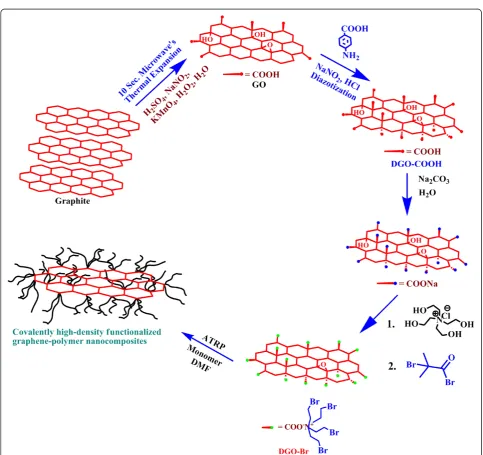
‘grafting from’ technique using ATRP. Quaternization and esterification after diazotization were carried out to increase the number of anchoring sites for ATRP initia-tors for increased grafting of polymer chains on the GO surface. ATRP of MMA was carried out using GO with ATRP initiators on the surface, cupric bromide (CuBr, catalyst), and N,N,N′,N″,N″-pentamethyldiethylenetriamine (PMDETA, ligand) at ambient temperature. The resulting graphene-PMMA nanocomposites showed higher thermal stability and higher glass transition temperatures (Tg) than
pristine PMMA polymers.
Methods
Acid-treated natural expandable graphite (grade 1721) was purchased from Asbury Carbons, Asbury, NJ, USA. Concentrated sulfuric acid (H2SO4), potassium
perman-ganate (KMnO4), sodium nitrate (NaNO3), sodium nitrite
(NaNO2), sodium carbonate (Na2CO3), hydrochloric acid
(HCl, 35%), hydrogen peroxide (H2O2, 30 wt.%), N,
N′-dimethylformamide (DMF), MMA, 2-chloroethanol,
p-aminobenzoic acid, and 2,2',2"-trihydroxy-triethylamine (triethanolamine) were purchased from Daejung Reagents & Chemicals, Ulsan, Korea. Cuprous bromide (CuBr), N, N,N′,N″,N″-PMDETA and polystyrene standards for gel permeation chromatography (GPC) were purchased from Sigma-Aldrich, St. Louis, MO, USA and were used as
received without further purification. The stabilizing agent was removed from commercial MMA by washing three times with sodium hydroxide (NaOH), followed by vac-uum distillation; the middle portion was stored at 0°C to 4°C until use. DMF was stirred with anhydrous calcium hydride (CaH2) and then distilled before use.
Preparation of DGO-Br
The preparation steps of GO, diazotized GO (DGO-COOH), tetrakis(2-hydroxyethyl) ammonium chloride (THAC), DGO-COO−Na+, and DGO-OH have been reported in our previous paper [21]. DGO-Br was prepared by the es-terification ofα-bromoisobutyryl bromide with DGO-OH. In brief, 2 g of DGO-OH powder was dispersed in distilled dry DMF using sonication, and 1 mL of triethyl amine was added to the suspension under a nitrogen atmos-phere. The α-bromoisobutyryl bromide was added slowly to the above suspension at 0°C using a gas-tight syringe. The reaction mixture was stirred at the same temperature for 6 h and then increased to 25°C and stirred for 12 h. The resulting suspension (DGO-Br) was centrifuged and washed repeatedly with acetone and methanol and dried at 65°C in a vacuum oven.
Polymerization of MMA on the surface of DGO-Br
The ATRP of MMA was carried out using the prepared DGO-Br. In a typical procedure, 30 mg of DGO-Br was dissolved in 5 mL of distilled dry DMF and was homoge-nously dispersed by ultrasonication for 30 min before starting polymerization. Next, 15 mg of CuBr, 15 μL of PMDETA catalyst, and 5 mL of MMA were added suc-cessively. The reaction mixture was then degassed three times and vacuum-sealed with a septum, followed by ni-trogen purging for 30 min to evacuate the residual oxygen. The mixture was then placed in a thermo-stated oil bath at 80°C for the designated period of time. Polymerization was stopped by quenching the polymerization tube in ice cold water. The resulting solution was poured into a petri dish to evaporate the excess solvent. The polymerization yields were calculated gravimetrically.
Detachment of the polymer chains from the GO surface
Characterization
Raman spectra were recorded using a confocal Raman spectrometer (Alpha300S, WITec, Ulm, Germany) with a 633-nm wavelength incident laser light. The crystallo-graphic structures of the materials were determined by a wide-angle X-ray diffraction (WAXRD) system (Rigaku RU-200 diffractometer, Shibuya-ku, Japan) equipped with a Ni-filtered Cu Kαsource (40 kV, 100 mA,λ= 0.15418 nm). Bragg's equation (nλ= 2dsinθ) was used to calculate thed
spacing between the layers. X-ray photoelectron spectros-copy (XPS) was performed to determine the oxidation sta-tus of carbon using a Thermo Fisher X-ray photoelectron spectrophotometer (Waltham, MA, USA) employing an
[image:3.595.56.540.260.715.2]Al Kα X-ray source (1,486.6 eV). Thermogravimetric analysis (TGA) was performed to analyze the thermal behavior of the samples using a TGA analyzer (Q50, TA Instruments, New Castle, DE, USA) with a 10°C min−1 heating rate in a nitrogen atmosphere. Number of average molecular weight (Mn), weight average molecular weight (Mw), and molecular weight distribution (MWD) were determined using a Waters GPC instrument (Milford, MA, USA) equipped with a 2414 differential refractive index detector and two (HR 2 and HR 4) Watersμ-Styragel columns. Spectral grade THF was used as an eluent at a flow rate of 1.0 ml min−1, and the molecular weight calibra-tions were carried out using polystyrene standards.
Results and discussion
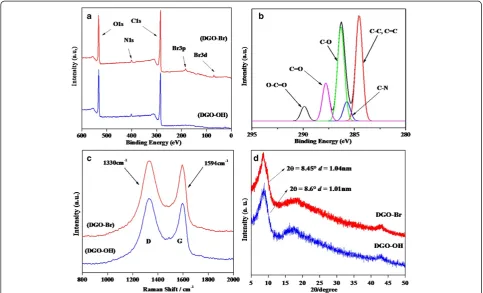
In general, good interaction between fillers and polymers leads to significant improvements in the properties of the resulting final products. To increase the interfacial inter-actions between GO and the polymers, the GO was first diazotized with p-aminobenzoic acid to obtain DGO-COOH, followed by a quaternization reaction with THAC and an esterification reaction with α-bromoisobutyryl bromide, which resulted in a tertiary bromine-terminated DGO-Br for efficient ATRP, as shown in Figure 1. Detailed characterizations of GO, DGO-COOH, and DGO-OH through FT-IR, Raman, XPS, XRD, and TGA have been reported in our previous paper [21]. In addition, XPS was used to investigate the changes in the functional groups of DGO-OH and DGO-Br, as shown in Figure 2a. Two in-tense peaks at 285 and 532 eV can be attributed to C1s and O1s, respectively [22]. The new peak of N1s at 399 to 400 eV was observed by diazotization. The C/O ratios of the functionalized DGO-OH and DGO-Br were 2.5 and 2.65, respectively, which can be correlated with dehydra-tion during the esterificadehydra-tion of DGO-OH to DGO-Br. The deconvoluted C1s XPS spectra of DGO-Br (Figure 2b) show several peaks at 284.5, 286.3, 287.9, and 289.7 eV originating from C-C, C-O, C = O, and O-C = O groups, respectively. In comparison to DGO-OH [21], the relative intensity of the C-C peak remains the same after esterification,
but the intensity of the C = O and O-C = O peaks increased, which may be due to increased functionality.
Raman spectra of DGO-OH and DGO-Br are shown in Figure 2c. The G and D bands in the Raman spectra originate from the first-order scattering of E2g phonons
of sp2-bonded carbon atoms and with a breathing mode of j-point photons of A1gsymmetry of sp3-bonded carbon
atoms of disordered graphene. The Raman spectrum of DGO-OH shows sp2-bonded carbon stretching related to the G band at 1,594 cm−1 and disordered, D band, sp3 -bonded carbon atoms at 1,330 cm−1. The intensity ratio of the D and G bands (ID/IG) for DGO-OH and DGO-Br
were 1.3 and 1.35, respectively. The slightly increasedID/IG
ratio may be due to increased functionalization after esteri-fication. WAXRD patterns of DGO-OH and DGO-Br are shown in Figure 2d. The DGO-OH and DGO-Br exhibit peaks at 8.6° and 8.45°, indicatingd spacings of 1.01 nm and 1.04 nm, respectively (based on Bragg's equation). The slightly increased dspacing of Br over OH can be also attributed to the esterification of DGO-OH withα-bromoisobutyryl bromide.
[image:4.595.56.540.411.704.2]Thermal properties of the graphene-PMMA nanocom-posites were compared with pristine PMMA by differential scanning calorimetry (DSC) and TGA. Figure 3 shows the DSC and TGA results for pristine PMMA and graphene-PMMA nanocomposite (GP-5) samples. For DSC (Figure 3a),
the midpoints between the onset and offset points of the transition temperature were chosen as theTgvalues.
The graphene-PMMA nanocomposite showed a higher
Tgthan that of the pristine PMMA, which can be
attrib-uted to the interactions between GO and PMMA. The decomposition patterns for PMMA and GP-5 are shown in Figure 3b. About 15% of GP-5 nanocomposites decom-posed between 130°C and 340°C, whereas pure PMMA decomposition started at 250°C. The initial decomposition of GP-5 may be due to the presence of additional labile functional groups after surface modification using quater-nization followed by esterification onto the surface of GO [23]. On the other hand, the main decomposition of PMMA ends at 400°C, whereas that of the graphene-PMMA nanocomposite ends at 430°C. The difference in the thermal stability between pristine PMMA and GP-5 indicates that the presence of graphene layers improves the thermal properties of graphene-PMMA nanocompos-ites after in situ polymerization on the functionalized GO surface. The increased thermal stability of graphene-PMMA nanocomposites can be attributed to the attractive nature of graphene toward free radicals generated during decomposition as well as the tortuous path formation dur-ing the decomposition process [21,23].
Controlled study of radical polymerization
Polymerization of MMA was carried out through ATRP using multifunctional DGO-Br, and controlled radical polymerization (CRP) was studied using GPC. The detailed GPC results (Mn, Mw, and MWD) are summarized in Table 1. As shown in Figure 4, as time increased, the GPC curves shifted from the lower molecular weight region to the higher molecular weight region due to the CRP mech-anism. It is also interesting to note that the PDI values for PMMA become narrower with time, which also supports the CRP mechanism. Figure 5 shows the time vs. conversion and time vs. ln[M]0/[M] plots for MMA polymerization,
where [M]0and [M] represent the initial monomer
concen-tration and the monomer concenconcen-tration at timet, respect-ively. The linear relation between time vs. ln([M]0/[M])
[image:5.595.59.540.89.240.2]shows that the concentration of propagating radicals is
[image:5.595.305.540.512.705.2]Figure 4GPC curves of PMMA recovered from graphene-PMMA nanocomposites by reverse cation exchange.
[image:5.595.56.292.629.725.2]Figure 3DSC results (a) of (i) PMMA and (ii) DGO-PMMA and TGA curves (b) of (i) PMMA and (ii) DGO-PMMA.
Table 1 Polymerization of MMA using TPEBMP at 80°C in DMF using DGO-Br
Code Time (h)
aConversion (%)
GPC results
Mw10‐4 M
n10‐4 M w=Mn
GP-1 2 23 3.8173 1.8621 2.05
GP-2 3 30 4.4302 2.3565 1.88
GP-3 4 44 5.3074 3.2561 1.63
GP-4 5 55 5.7492 4.2274 1.36
GP-5 6 64 6.2888 4.9132 1.28
a
almost constant throughout the polymerization process. The small deviation in CRP results may be correlated with the induction period before starting the MMA polymerization, with similar results reported in previous literature [24,25]. As reported earlier, this induction period may account for the initial delay in reaching equilibrium between propagating radicals and dormant species. This delay may be responsible for the irreversible termination of some of the primary radicals in MMA polymerization, resulting in the deviations that are observed in the time vs. ln([M]0/[M]) plot. Further CRP was confirmed by
plot-ting conversion against the number of average molecular weight (Mn), as shown in Figure 6. A linear increase in molecular weight was observed with increasing mono-mer conversion, which confirms that the polymono-merization of MMA on the DGO-Br proceeds through the CRP
mechanism. The deviation of the conversion vs.Mnplot is also correlated with slow initiation. These plots show that MMA polymerization undergoes an induction period with slow initiation, as reported previously [25].
Conclusions
ATRP initiator-attached high-density functionalized gra-phene oxide (DGO-Br) was prepared and used for MMA polymerization, resulting in graphene-PMMA nanocom-posites through controlled radical polymerization. DSC and TGA studies show that the graphene-PMMA nano-composites exhibited higher Tgand higher thermal stability
compared to pristine PMMA polymers. GPC results con-firmed the presence of a controlled radical polymerization mechanism using functionalized DGO-Br. We believe that high-density functionalized GO can be used to develop graphene-polymer nanocomposites with enhanced properties.
Competing interests
The authors declare that they have no competing interests.
Authors' contributions
MK has designed all the conducted experiments and characterization for final publication. JSC and SHH have approved the final manuscript. All authors read and approved the final manuscript.
Acknowledgements
This research was supported by the Basic Science Research Pro-gram through the National Research Foundation of Korea (NRF) funded by the Ministry of Education (2013R1A1A2A10004468).
Received: 13 February 2014 Accepted: 3 March 2014 Published: 10 July 2014
References
1. Novoselov KS, Geim AK, Morozov SV, Jiang D, Zhang Y, Dubonos SV, Grigorieva IV, Firsov A:Electric field effect in atomically thin carbon films. Science2004,306:666–669.
2. Morozov SV, Novoselov KS, Katsnelson MI, Schedin F, Elias DC, Jaszczak JA, Geim AK:Giant intrinsic carrier mobilities in graphene and its bilayer. Phys Rev Lett2008,100:016602.
3. Balandin AA, Ghosh S, Bao W, Calizo I, Teweldebrhan D, Miao F, Lau CN:
Superior thermal conductivity of single-layer graphene.Nano Lett2008,
8:902–907.
4. Jang W, Chen Z, Bao W, Lau CN, Dames C:Thickness-dependent thermal conductivity of encased graphene and ultrathin graphite.Nano Lett2010,
10:3909–3913.
5. Bunch JS, Zande AMVD, Verbridge SS, Frank IW, Tanenbaum DM, Parpia JM, Craighead HG, McEuen PL:Electromechanical resonators from graphene sheets.Science2007,315:490–493.
6. Huang X, Qi X, Boey F, Zhang H:Graphene-based composites.Chem Soc Rev2012,41:666–686.
7. Paulus GLC, Wang QH, Strano MS:Covalent electron transfer chemistry of graphene with diazonium salts.Acc Chem Res2013,46:160–170. 8. Kuila T, Bose S, Mishra AK, Khanra P, Kim NH, Lee JH:Chemical
functionalization of graphene and its applications.Prog Mater Sci2012,
57:1061–1105.
9. Georgakilas V, Otyepka M, Bourlinos AB, Chandra V, Kim N, Kemp KC, Hobza P, Zboril R, Kim KS:Functionalization of graphene: covalent and non-covalent approaches: derivatives and applications.Chem Rev2012,112:6156–6214. 10. Salavagione HJ, Martínez G, Ellis G:Recent advances in the covalent
modification of graphene with polymers.Macromol Rapid Comm2011,
32:1771–1789.
11. Badri A, Whittaker MR, Zetterlund PB:Modification of graphene/graphene oxide with polymer brushes using controlled/living radical
[image:6.595.57.290.89.257.2]polymerization.J Polym Sci Part A: Polym Chem2012,50:2981–2992.
[image:6.595.57.292.516.693.2]Figure 6Conversion vs.Mnand conversion vs. polydispersity index (PDI;Mw=Mn) plots for the polymerization of MMA using DGO-Br.
Figure 5Time vs. conversion and time vs. ln[M]0/[M] plots for
12. Ye YS, Chen YN, Wang J-S, Rick J, Huang YJ, Chang FC, Hwang ABJ:Versatile grafting approaches to functionalizing individually dispersed graphene nanosheets using RAFT polymerization and click chemistry.Chem Mater
2012,24:2987–2997.
13. Ramanathan T, Abdala AA, Stankovich S, Dikin DA, Herrera-Alonso M, Piner RD, Adamson DH, Schniepp HC, Chen X, Ruoff RS, Nguyen ST, Aksay IA, Prud’homme RK, Brinson AC:Functionalized graphene sheets for polymer nanocomposites.Nat Nanotechnol2008,3:327–331. 14. Kuila T, Bose S, Khanra P, Kim NH, Rhee KY, Lee JH:Characterization and
properties of in-situ emulsion polymerized poly(methyl ethacrylate)/graphene nanocomposites.Compos Part A2011,42:1856–1861.
15. Wang JS, Matyjaszewski K:‘Living’/controlled radical polymerization: transition-metal-catalyzed atom transfer radical polymerization in the presence of a conventional radical initiator.Macromolecules1995,
28:7572–7573.
16. Yang Y, Wang J, Zhang J, Liu J, Yang X, Zhao H:Exfoliated graphite oxide decorated by PDMAEMA chains and polymer particles.Langmuir2009,
25:11808–11814.
17. Lee SH, Dreyer DR, An J, Velamakanni A, Piner RD, Park S, Zhu Y, Kim SO, Bielawski CW, Ruoff RS:Polymer brushes via controlled, surface-initiated atom transfer radical polymerization (ATRP) from graphene oxide. Macromol Rapid Comm2010,31:281–288.
18. Cui L, Liu J, Wang R, Liu Z, Yang W:A facile“graft from”method to prepare molecular-level dispersed graphene-polymer composites.J Polym Sci Part A: Polym Chem2012,50:4423–4432.
19. Fang M, Wang K, Lu H, Yang Y, Nutt S:Covalent polymer functionalization of graphene nanosheets and mechanical properties of composites. J Mater Chem2009,19:7098–7105.
20. Fang M, Wang K, Lu H, Yang Y, Nutt S:Single-layer graphene nanosheets with controlled grafting of polymer chains.J Mater Chem
2010,20:1982–1992.
21. Kumar M, Chung JS, Kong BS, Kim EJ, Hur SH:Synthesis of graphene-polyurethane nanocomposite using highly functionalized graphene oxide as pseudo-crosslinker.Mat Lett2013,106:319–321. 22. Liu J, Chen G, Jiang M:Supramolecular hybrid hydrogels from
noncovalently functionalized graphene with block copolymers. Macromolecules2011,44:7682–7691.
23. Goncalves G, Marques PAAP, Barros-Timmons A, Bdkin I, Singh MK, Emami N, Gracio J:Graphene oxide modified with PMMA via ATRP as a reinforcement filler.J Mater Chem2010,20:9927–9934.
24. Kumar M, Kannan T:A novel tertiary bromine-functionalized thermal iniferter for controlled radical polymerization.Polym J2010,42:916–922.
25. Qin DQ, Qin SH, Chen XP, Qiu KY:Living controlled radical polymerization of methyl methacrylate by reverse ATRP with DCDPS/FeCl3/PPh3 initiating system.Polymer2000,41:7347–7352.
doi:10.1186/1556-276X-9-345
Cite this article as:Kumaret al.:Controlled atom transfer radical polymerization of MMA onto the surface of high-density
functionalized graphene oxide.Nanoscale Research Letters20149:345.
Submit your manuscript to a
journal and benefi t from:
7Convenient online submission
7Rigorous peer review
7Immediate publication on acceptance
7Open access: articles freely available online
7High visibility within the fi eld
7Retaining the copyright to your article

![Figure 5 Time vs. conversion and time vs. ln[M]0/[M] plots forthe polymerization of MMA using DGO-Br.](https://thumb-us.123doks.com/thumbv2/123dok_us/8867917.940781/6.595.57.292.516.693/figure-time-conversion-time-plots-forthe-polymerization-using.webp)
