Harris, A.J.L. and Sildmäe, O. and Speekenbrink, M. and Hahn, Ulrike (2018)
The potential power of experience in communications of expert consensus
levels. Journal of Risk Research 22 (5), pp. 593-609. ISSN 1366-9877.
Downloaded from:
Usage Guidelines:
Please refer to usage guidelines at or alternatively
The potential power of experience in communications of expert
consensus levels
Adam J. L. Harris
a*, Oliver Sildmäe
a, Maarten Speekenbrink
a, and Ulrike
Hahn
baDept. of Experimental Psychology, University College London, London, UK; bDept. of
Psychological Sciences, Birkbeck College, University of London, UK.
*Adam J. L. Harris, Dept. of Experimental Psychology, University College London, 26
Bedford Way, London, UK, WC1H 0AP. Email: [email protected]
Oliver Sildmäe, Dept. of Experimental Psychology, University College London, 26
Bedford Way, London, UK, WC1H 0AP. Email: [email protected]
Ulrike Hahn, Dept. of Psychological Sciences, Birkbeck College, University of London,
UK. Email: [email protected]
The potential power of experience in communications of expert
consensus levels
Understanding the scientific consensus on anthropogenic climate change has been dubbed a ‘gateway belief’ to engaging people in sustainable behaviour. We consider the question of how the impact of a consensus communication can be maximised. Firstly, the credibility of the communicator should be maximised. One way of achieving this is to present the opinions of a sample of scientists directly to individuals. The decision making literature suggests that such a technique will confer an additional advantage over standard descriptions of consensus (e.g., “97% of scientists agree”). In decision making research, low probabilities tend to be overweighted when probabilities are described, but underweighted when probability information is experienced. Consequently, statements of high consensus may lead to an overweighting of the dissensus, a phenomenon that may be reversed were the consensus to be ‘experienced.’ We obtain some positive support for our proposal that consensus is best
‘experienced’ in one of two experiments. We suggest that the lack of stronger positive support could relate to ceiling effects for the topics studied and propose that investigation of effective methods for ‘experiencing’ the consensus is a fruitful area for future research.
‘97% of climate scientists agree that humans are causing global warming’
‘Nine out of ten economists say Brexit will damage economy’
‘84% of medical scientists agree that regular aerobic exercise lowers diastolic
blood pressure’ (Cook et al., 2013; Green, 2016; Whelton, Chin, Xin, & He,
2002).
The statements above represent a fundamental element of the scientific method, that of
consensus building. As an incremental, cumulative practice, an emergent consensus
becomes our best possible estimate of the true state of the world. Subsequently,
decisions, policies, engineering breakthroughs,…, can all be made relative to this
scientific knowledge. How, though, should this consensus best be communicated to the
public and policy makers to ensure maximum effectiveness?
Expert consensus is relevant across almost any domain which requires specialist
knowledge. Some recent research has, however, specifically highlighted the role of
scientific consensus in relation to the topic of anthropogenic climate change (ACC). As
a universal global concern, such a focus is understandable. Ding, Maibach, Zhao,
Roser-Renouf and Leiserowitz (2011; see also, McCright, Dunlap, & Xiao, 2013; van der
Linden, Leiserowitz, Feinberg, & Maibach, 2015) demonstrated, statistically, that
correct perceptions of high levels of expert consensus about the reality of ACC
predicted greater support for climate change mitigation policies through increasing
beliefs that ACC is occurring. Subsequently, Lewandowsky, Gignac and Vaughan
(2013; see also van der Linden, Leiserowitz, Feinberg, & Maibach, 2014) demonstrated
this latter result experimentally. Specifically, participants informed that “97 out of 100
climate experts agree that global warming is a consequence of the burning of fossil
estimates of the scientific consensus and a higher belief in the link between human CO2
emissions and climate change. Thus, highlighting the level of scientific consensus has
been suggested as an approach to increase support for climate mitigation policies, being
tagged a ‘gateway belief’ for the subsequent support of such actions (e.g., van der
Linden et al., 2015).
The efficacy of consensus communications in affecting greater support for
sustainable policies has not, however, gone unquestioned (see e.g., Cook, 2016; Cook &
Jacobs, 2014, for reviews). As an example, Kahan (2015) argued that from 2003 to
2013, public option had not updated in favour of believing in ACC, despite the release
of six studies quantifying high levels of scientific consensus in that time period, plus the
release of ‘An Inconvenient Truth.’ Consequently, Kahan argues, lab-based
demonstrations of the efficacy of consensus messaging must not be ecologically valid.
This debate is not of central concern to the current manuscript, though we note that
since 2010 there is evidence that public belief in ACC hasincreased (e.g., Gallup, 2017;
Hamilton, 2016; the start of this pattern is also noticeable in Kahan’s, 2015, Figure 8).
What is of central concern to the current manuscript is that, in addition to demonstrating
the effectiveness of messages about the scientific consensus, laboratory studies have
also demonstrated that there is still room for improvement. Specifically, whilst
estimated levels of scientific consensus increased an impressive 21%, from 67% to
88%, following receipt of the consensus message in Lewandowsky, Gignac, and
Vaughan (2013), this ‘posterior’ degree of belief still remained some way short of the
communicated figure of 97% (see Bolsen, Leeper, & Shapiro, 2014, for even more
mixed results).
The current paper draws insights from formal work on source credibility, and
effectiveness of the communication of expert consensus. Finally, we present two
experiments as an initial test of the potential efficacy of these methods.
Source credibility
The statements presented at the top of this article represent pieces of testimony.
That is, someone is stating that this proportion of experts agree on this fact. Arguably,
most of what we believe we know stems from the testimony of others. As an example,
most people’s belief that North America is west of Europe is based on a map that
another individual has drawn. Even our experience of travelling by plane provides little
direct evidence as to the directional relationship between the continents. The current
authors’ (firm) belief that America does lie west of Europe is based primarily on a level
of trust in map makers (and geography teachers).
As the example above suggests, source credibility is a key factor underlying how
persuasive a piece of testimony should be (e.g., Bovens & Hartmann, 2003; Friedman,
1987; Schum, 1981). Moreover, Hahn, Harris and Corner (2009; see also Harris &
Hahn, 2009; Harris, Hahn, Madsen, & Hsu, 2016) have demonstrated that people can
incorporate considerations of source credibility into their evaluation of a
communication in a normatively appropriate manner. It is thus important to give source
credibility due attention in consensus communications.
One way in which a source might be unreliable is if they are deliberately
deceitful. Perceptions of deceitfulness are at the heart of conspiracy claims such as ‘the
moon landings were faked to demonstrate the United States’ superiority over the
USSR’. The potential for deceit is an issue of genuine concern in an evaluation of
testimony. However, considerations of source credibility are not only integral in
instances of wilful deceit. A lack of competence should also influence the
there is no misdirection involved) friend flips a coin under a cup and says “I think it’s
heads”, you should not update your belief that the coin under the cup has landed on
heads. Your friend in this instance has no privileged information – they are as likely to
say “heads” if the coin has come up heads as if it has come up tails. Subsequently, their
‘testimony’ is non-diagnostic of the true state of the world. Less extreme examples are
ubiquitous. As one example, multiple factors are known to impact the accuracy of
eyewitness testimony, even where the eyewitness has no motivation to provide a biased
testimony (for a review see Wells & Olson, 2003). The two components to source
credibility (the more malevolent deceit and the less malevolent paucity of knowledge)
have been termed, variously: veracity and sensitivity (Schum, 1981, 19941);
trustworthiness and expertise (Hahn, Oaksford, & Harris, 2012; Harris et al., 2016;
Walton, 2008); helpfulness and knowledgeability (Shafto, Eaves, Navarro, & Perfors,
2012).
Concepts of source credibility are central to the evaluation of a communication
of scientific consensus at two levels. The first level is the individual scientists
themselves. There is a great difference in the convincingness of the agreement of 84%
of medical scientists if they are known to be the ‘crackpots’ (low in trustworthiness and
expertise), whereas the 16% who disagree with the statement are the respectable
scientists high in both trustworthiness and expertise. Source credibility also becomes a
relevant concept wherever an individual is not experiencing the level of consensus for
themselves (e.g., by reading original journal articles or interviewing individual
1 Schum additionally recognises the distinction between untruthful bias (‘veracity’) and
scientists). As an illustration, throughout this manuscript we quote figures of scientific
consensus. For you, the reader, therefore, not only is the credibility of the individual
scientists within the consensus important, but also our credibility as accurate purveyors
of information. In fact, as can be seen from citations accompanying the three examples
at the outset of this article, we have not experienced the consensus levels ourselves, and
consequently the credibility of Cook et al. (2013), Green (2016) and Whelton et al.
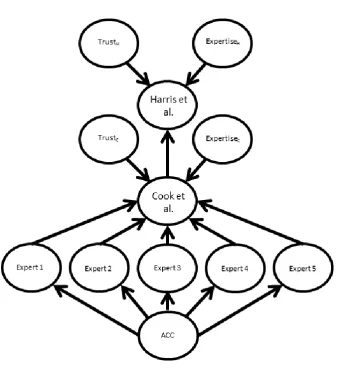
(2002) become relevant. Figure 1 shows a Bayesian Network demonstrating the
complexity of the inferences that must be made. In this network, the expertise and
trustworthiness of the individual scientists are not represented explicitly due to space
constraints, but they can be captured in the probabilistic relationships (the arrows)
linking the true fact about ACC with what is reported by each expert (for an
introduction to Bayesian Networks, see e.g., Korb & Nicholson, 2003; Pearl, 1988; on
their application in this particular context see Cook & Lewandowsky, 2016; Hahn et al.,
2016; for other examples see e.g., Fenton, Neil, & Lagnado, 2013; Harris et al., 2016;
Jern et al., 2014; Kadane & Schum, 1996; Lagnado, 2011; Lagnado, Fenton, & Neil,
2013). Figure 1 demonstrates that the report of expert consensus on the topic of ACC
presented at the outset of this article is ‘third hand.’ In addition to the potential for error
(or bias) in the reports of each of the individual scientists (Experts 1-5), a reader might
perceive Cook et al. as having a particular ideological bias2, or Harris et al. (present
paper) as too incompetent to accurately report on the report of Cook et al. All these
factors are relevant to the question of how persuaded a reader should be by the scientific
consensus presented at the outset of this article.
2 Indeed, some potential readers (e.g., Legates, Soon, Briggs, Monckton of Brenchley, 2015)
Following Hahn et al. (2016), in the present empirical work, we consider source
credibility as it pertains to the reporter of the consensus (e.g., Cook et al. in Figure 1).
Furthermore, although the two different components of source credibility
(trustworthiness and expertise) appear conceptually important and have been
demonstrated to be necessary to fully capture use of testimony (e.g., in children, Shafto
et al., 2012), in the current paper we simplify the concept of source credibility and
consider it as a single factor. Practically, it is however important to recognise that
complete trust in the honesty (veracity) of a communicator, does not mean that they
have not made honest mistakes (sensitivity).
Lessons from decision making
Having considered the formal question of what factors should influence the
convincingness of a communication of expert consensus, we now turn to consider a
potential lesson from descriptive research into decision making. Scholars of decision
making have spent a considerable amount of research time and resources attempting to
understand how people evaluate prospects such as ‘A 90% chance of winning £10,
otherwise nothing.’ Indeed, gambles such as these have been deemed the ‘fruit fly’ of
decision research (Lopes, 1983; see also Bateman, Dent, Peters, Slovic, & Starmer,
2007; Wulff, Mergenthaler-Canseco, & Hertwig, in press).
Research investigating evaluations of gambles like the one above has
demonstrated that people’s valuations (measured directly and through choice
paradigms) are well described by two functions which are non-linear transformations of
the probability described in the gamble (i.e., 90%) and the value described in the
gamble (i.e., £10) (e.g., Kahneman & Tversky, 1979; Tversky & Kahneman, 1992; see
e.g., Speekenbrink & Shanks, 2013, for a review). Specifically, and of central interest
high (though less than certain) probabilities, and overweight low probabilities (see also,
e.g., Gonzalez & Wu, 1999). In the light of these findings, it is perhaps unsurprising that
communication of high levels of scientific consensus has not had as much of an
influence as might be hoped on people’s overall perceptions of the consensus or
decisions to engage in more sustainable behaviour. The 97% communicated in a
statement such as the one at the start of this article is likely to be underweighted by
recipients of the communication. Correspondingly, the 3% who (implicitly) are
suggested not to agree with the consensus will be overweighted. More recent research
into decisions from experience suggests a way in which the influence of the high
consensus might be enhanced.
Barron and Erev (2003) shook up decision making research with their
demonstration that a number of well-established and robust decision making
phenomena did not hold (indeed, mostly were reversed) when the presentation of the
gambles was altered. Specifically, rather than having the parameters of a given gamble
described to them (e.g., “90% chance of winning £10, otherwise nothing”), participants
learn the structure of the gamble through experience. For example, the gamble
described above might be recreated by asking the participant to press a button multiple
times (e.g., 100, 200, 400 times in the different experiments reported in Barron & Erev).
On 90% of occasions, the button would yield £10, whilst on 10% of occasions it would
yield nothing. Typically, in decisions from experience, participants would be required to
choose between different buttons, with different payoffs.
The critical finding for the present paper is that when outcomes are experienced
rather than described, the best fitting function capturing the influence of probability on
decisions has the opposite properties to that observed for described outcomes. Namely,
low probabilities are now underweighted and high probabilities are overweighted (e.g.,
Hertwig, 2010; Hau, Pleskac, Keifer, & Hertwig, 2008; Hertwig, Barron, Weber, &
Erev, 2004; Rakow, Demes, & Newell, 2008; Ungemach, Chater, & Stewart, 2009; for
an reviews see Hertwig & Erev, 2009; Wulff et al., in press). Although there are
arguments that this so-called decision-experience ‘gap’ arises primarily from an
underexperience of the rare outcome, either in the whole, or in recently experienced
samples (Camilleri & Newell, 2011b; Fox & Hadar, 2006; Rakow et al., 2008; see also
Jarvstad, Hahn, Rushton, & Warren, 2013), the descriptive phenomenon remains.
Typically, when gambles are experienced rather than described, people make choices as
though they overweight high probabilities and underweight low probabilities. Thus, if
we wish to maximise the influence of high scientific consensuses on people’s
subsequent decisions (e.g., regarding sustainable behaviour), the decision making
literature suggests that presenting people with the consensus in an experiential format
will be more effective than merely describing it to them.
How might we improve the communication of scientific consensus?
In our experiments we focus on the importance of source credibility and the format of
consensus communication. The literature reviewed above provides two clear
suggestions for improving consensus communications: 1) Present the information from
a reputable (trustworthy and expert) source; 2) Have people experience the consensus,
rather than merely describing it to them. It is worth noting that the latter suggestion
stems both from the lessons learnt from decision making research and from formal work
on source credibility. In the case of the latter, pure experience of the scientists’
consensus (i.e., personal interviews with all the scientists), removes two ‘layers’ from
Figure 1 (‘Cook et al.’ and ‘Harris et al.’). Consequently, there are fewer, potentially
fallible, steps between the level of consensus of the scientists (zero – this is experienced
communication of expert consensus will be greater the more trustworthy and expert the
source describing the consensus is, but it will be greatest where participants experience
the consensus.
In the following, we present two experiments to test these predictions, noting
that the manipulation of experience is somewhat impoverished. Nevertheless, we hope
that these experiments will encourage future researchers to further test the effectiveness
of experiencing expert consensus, given the strong theoretical support for its
effectiveness.
Experiment 1
Method
Participants
After excluding four incomplete entries, 161 British nationals (75 female, 1 preferred
not to say; aged 18-61 [median = 33]) were recruited through the online crowdsourcing
platform Prolific Academic (www.prolific.ac). The participants were each paid £0.60.
Ethical approval for both experiments in this paper was granted from the Departmental
Ethics Chair for Speech, Hearing and Phonetic Sciences (University College London).
Design
Participants were presented with three out of nine possible communications, each one
presenting consensus information about one of three topics. The first independent
variable was Topic – participants were presented with consensus information on each of
following three topics: climate change, politics (Brexit) and medicine. The second
independent variable was Format – consensus information pertinent to the relevant
Each participant saw one (different) format for each topic, and each topic was presented
only once.
The dependent variables were estimates of consensus levels (perceived
consensus [out of 100]) and beliefs about the claims towards a topic, measured on a
5-point scale from “strongly disagree” [1] to “strongly agree” [5]. These were collected
both before (prior) and after (posterior) participants received consensus information
about each of the three topics.
Materials
Across all three communication formats (Experience, Reliable source and Unreliable
source), the statements that experts agreed with were identical. For climate change, the
relevant statement was ‘Humans are causing global warming’; for the political topic, it
was ‘Leaving the European Union and the single market (Brexit) would be bad for the
UK economy’; for the medical topic it was ‘Regular aerobic exercise lowers blood
pressure.’
The level of consensus presented within each topic was taken from an existing
reputable source, with external validity prioritised over the internal validity associated
with keeping the level of consensus communicated constant. For climate change, Cook
et al.’s (2013) figure of 97% of climate scientists agreeing that humans are causing
global warming was used; for the political topic (Brexit), the Ipsos MORI (2016) survey
figure of 88% of economists agreeing that leaving the EU would be bad for the UK
economy was used; and for the medical topic, Whelton et al.’s (2002) figure of 84% of
medical scientists agreeing that regular aerobic exercise lowers diastolic blood pressure
was used (the technical term ‘diastolic’ was not included in the experiment).
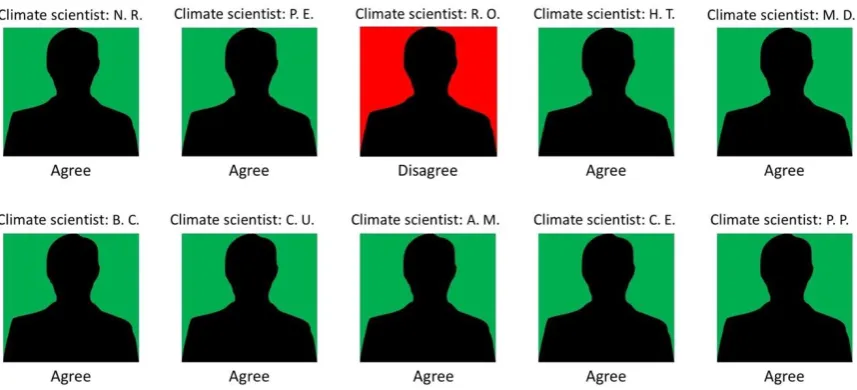
In the Experience condition, participants were presented with ten sets of ten
three aforementioned statements. The level of agreement/disagreement was identical to
the consensus reported by the reliable and unreliable sources. Although the order of the
silhouettes within each set was fixed, their initial order had been randomised, and the
order in which the ten sets were displayed was also randomised. To personify the
fictional experts, they were each identified with pseudo-random initials (such that there
were not a high number of uncommon initials; see Figure 2 for an example set from the
climate change condition).
As the reliable sources, fictional anonymous professors of renowned UK
universities (Oxford, Cambridge, LSE) were presented. For example, a participant
presented with a reliable medical source would have read the following:
Carefully consider the following report:
‘84% of medical scientists agree that aerobic exercise lowers blood pressure.’
Source: Review by a professor of Medical Sciences, University of Cambridge
To determine the unreliable sources, a pilot study was run via Prolific
Academic. For each of the three topics, 40 participants were presented with the
appropriate aforementioned consensus information, and presented with a list of nine
sources expected to vary in perceived trustworthiness and expertise. Participants were
asked to rate the sources’ trustworthiness and expertise on a scale of 0-100. The
following unreliable sources were subsequently chosen for the main experiment: a
political columnist in a politically left-leaning publication for climate change; a political
columnist in a politically right-leaning publication for Brexit; and a medical columnist
in a politically right-leaning publication for the medical topic. For each of these three
sources, the balance of bias (i.e. lack of trustworthiness) and expertise was the same,
Although for the climate change topic, a political columnist in a politically right-leaning
publication was, similarly to the Brexit topic, rated as being the least trustworthy, we
chose the left-leaning columnist instead. Because it is generally politically right-leaning
individuals who deny climate change (e.g., Hornsey, Harris, Bain, & Fielding, 2016;
McCright & Dunlap, 2011), a left-leaning columnist might be perceived as more likely
to advance ‘left-wing propaganda’ advocating the reality of ACC.
Before being presented with any consensus information, participants completed
a prior beliefs and attitudes questionnaire assessing: a) their beliefs about the claims
relevant to the consensus information (such as “Humans are causing global warming”
for the climate change topic, requiring an answer ranging from strongly disagree to
strongly agree); b) how many experts out of every 100 they believed agreed with these
same statements; c) to what degree they agreed with the statement “I am in favour of
Britain leaving the European Union”; d) five questions about support for the
free-market system (Heath & Gifford, 2006). These latter questions required the participant
to indicate their belief in the free market system on a 5-point scale from ‘strongly
disagree’ to ‘strongly agree’. Following Lewandowsky, Oberauer, & Gignac (2013),
one question (‘I support the free-market system but not at the expense of environmental
quality’) was left out, the authors finding that this question loaded on a second factor by
itself. Lewandowsky, Gignac, and Vaughan (2013), and Cook and Lewandowsky
(2016; see also van der Linden, Leiserowitz, & Maibach, in press) found that the effect
of free market ideology on climate change scepticism was almost eliminated when
providing Australian participants with ‘socially-normative’ information about the
scientific consensus on climate change. For U.S.-based participants, however, the
difference between free-market supporters and free-market opponents in climate change
skepticism was enhanced by a consensus communication (Cook & Lewandowsky,
affiliation, rather than free market beliefs). Free market beliefs (FMBs) were thus
assessed to check for the robustness of the effects of displaying consensus information
to participants. We additionally assessed attitudes towards Britain leaving the European
Union to determine the scope of influence of the consensus communication.
Procedure
The experiment was run through the online data collection platform Qualtrics.com.
After receiving instructions and giving consent to participate, participants completed the
prior beliefs and attitudes questionnaire. Next, they were presented with consensus
information on all three topics. After each presentation of consensus information,
participants were asked to provide some demographic data before being asked to again
indicate their beliefs about statements relevant to the consensus information just
presented (the questions were identical to the first two questions in the prior beliefs and
attitudes questionnaire outlined above). Finally, after proceeding through these
questions for all three topics, the participants were again asked to indicate their
agreement with the statement “I am in favour of Britain leaving the European Union”.
Results
In both Experiments 1 and 2, we analyse perceived consensus levels separately from
beliefs about the claims. For each dependent variable, we use a linear mixed effects
analysis as an alternative to a repeated-measures ANOVA, which would have been
inappropriate as every participant did not complete every combination of Format and
Topic. The models includes fixed effects for Format, Topic, and Prior/Posterior, as well
as all two-way and three-way interactions. To account for the repeated-measures, the
models included participant-specific random intercepts. All models were estimated with
environment (R Core Team, 2017), and test results are based on the Satterthwaite
approximation to the degrees of freedom, obtained with the R package lmerTest
(Kuznetsova, Brockhoff, & Christensen, 2017).
Perceived consensus levels
The linear mixed-effects model yielded no effects of, nor interactions involving,
Format. Of most relevance, the Format x Prior/Posterior interaction was not significant,
F(2, 784.20) = 1.10, p = .34. Figure 3 shows mean estimates of the consensus across the
three topics. The first thing to note is that, whilst participants initially underestimated
the level of consensus for Climate Change and Brexit, this was less apparent for the
Medical topic. Subsequently, there was less of an increase in estimated levels of
consensus for the Medical topic, as confirmed by a Topic x Prior/Posterior interaction,
F(2, 784.20) = 19.19, p < .001. Despite this, there was still an overall main effect of the
consensus communication (Prior/Posterior), F(1, 784.72) = 65.25, p < .001. Other than
the unsurprising main effect of Topic, F(2, 784.27) = 37.73, p < .001, no other
significant effects were observed (all Fs < 1).
Beliefs about the claims
Given the lack of effects on perceived consensus levels, it would be surprising to
observe an effect on people’s beliefs about the claims. Inspection of Figure 4 indeed
suggests, once again, that there is no effect of communication format in these data. A
linear mixed-effects model confirmed this, yielding no effects of, nor interactions
involving, Format. Again, critically, the Format x Prior/Posterior interaction was not
significant (F < 1). Aside from main effects of Prior/Posterior, F(1, 786.85) = 11.70, p <
.001, and Topic, F(2, 786.52) = 35.92, p < .001, there were no other significant effects
There was a significant interaction between FMBs (mean support was 2.5 [1-5
scale]) and Prior/Posterior in predicting beliefs about ACC, Beta = 0.12, p = .04. There
was a significant relationship between beliefs about ACC and FMB before receiving the
consensus communication, r(159) = -.32, p < .001, but not afterwards, r(159) = -.12, p =
.13. These results are in line with those observed in Lewandowsky, Gignac and
Vaughan (2013), van der Linden et al. (in press), and Cook and Lewandowsky’s (2016)
Australian participants, and counter to those in the latter’s U.S. participants.
Nineteen of the 157 respondents who reported their attitude to Brexit both
before and after the consensus communications provided different ratings at the two
time points. Fourteen of these became less favourable towards Brexit, whilst 5 became
more favourable.
Discussion
The results of Experiment 1 were somewhat disappointing. Despite the clear theoretical
justification for the predictions that the Format manipulation would affect the
persuasiveness of the consensus communication, there was no evidence to support this.
The effect of the consensus communication (main effect of Prior/Posterior) on
participants’ reported beliefs about the claims presented replicates other findings in the
literature (Lewandowsky, Gignac, & Vaughan, 2013; van der Linden et al., 2014).
Communicating information about actual levels of scientific consensus influences both
perceptions of that consensus, as well as beliefs about the claims about which there is a
consensus.
Despite the lack of support obtained in Experiment 1 for the main prediction that
communication format would influence perceptions of scientific consensus levels, and
associated beliefs, the basic design of the experiment was repeated in Experiment 2.
recruited U.S. participants via Amazon Mechanical Turk. Whilst about 90% of people
in the UK believe that climate change is happening (Capstick, Demski, Sposato,
Pidgeon, Spence, & Corner, 2015), the number in the US is only about 70%
(Leiserowitz, Maibach, Roser-Renouf, Feinberg, & Rosenthal, 2014). We thus
anticipated greater variance in prior beliefs about ACC in this sample, potentially
increasing the power of our manipulation. In addition, we (nearly) doubled the sample
size.
Experiment 2
Method
Participants
Excluding two participants who reported problems viewing the silhouettes in the
Experience condition, 300 U.S. nationals completed the experiment (103 females, 197
males; aged 18-65 [median = 31]). They were recruited through Amazon Mechanical
Turk and each paid $0.50.
Design, Materials, and Procedure
The materials and procedure were, for the most part, identical to Experiment 1. Due to
the Brexit vote being in the past by the time Experiment 2 was conducted, and the U.S.
population perhaps not being overly involved or interested in the issue in the first place,
the politics topic was changed to the issue of whether ‘undocumented immigrants
currently living in the US should have a way to legally stay in the US, if certain legal
requirements, for example the application for citizenship or permanent residence, are
met’. The relevant consensus statistic (72% of Americans agree with the statement) was
the opinions of regular Americans, the 72% here represents social consensus rather than
expert consensus. The political topic was therefore of less primary research interest, and
mainly served to provide a third level of Topic to facilitate the presentation of three
levels of Format. The questions about the participants’ Brexit voting intentions were
also removed.
Secondly, because in Experiment 1 the participants’ prior consensus belief
ratings for the medical topic were on average higher than the reported ‘correct’
consensus statistic, this number was raised from the previous 84% to 96% in
Experiment 2, in order that prior consensus beliefs were mostly lower than the reported
statistics, facilitating more meaningful comparisons between the climate change and
medical topics. Participants were notified of this change in the debrief.
Finally, the university for all the reliable sources was changed to Harvard
University to ensure relevance for U.S. participants.
Results
Perceived consensus levels
In the linear mixed-effects analysis, the critical Format x Prior/Posterior interaction was
significant, F(2, 1483.71) = 6.58, p < .001. Figure 5 shows mean estimates of the
consensus across the three topics. In each of the three topics, the greatest difference
between prior and posterior estimates was in the Experience condition, as predicted.
This is confirmed by the individual contrasts comprising the interaction, which show
that the Prior/Posterior effect was greater in the Experience condition versus the
Reliable and Unreliable conditions, t(1483.70) = 3.63, p < .001, whilst there was no
significant difference in the Prior/Posterior effect between the Reliable and Unreliable
interaction was not moderated by Topic, F(4, 1483.71) = 1.30, p = .27. Once again,
overall, there was a significant main effect of the consensus communication
(Prior/Posterior), F(1, 1483.84) = 865.22, p < .001, as well as uninteresting effects of
Topic, F(2, 1483.84) = 865.22, p < .001, and a Topic x Prior/Posterior interaction, F(2,
1483.72) = 12.51, p < .001.
Beliefs about the claims
Having observed an effect of communication format on perceived consensus levels, a
downstream effect might also be observed on people’s beliefs about the claims. Figure 6
shows that, numerically, the pattern of results is in the predicted direction, with the
greatest change in belief observed in the Experience condition across all three topics.
There was no evidence, however, that this was a reliable result, with the Format x
Prior/Posterior interaction non-significant, F(2, 1484.07) = 1.54, p = .21. The only
significant effects were the main effects of Prior/Posterior, F(1, 1484.07) = 19.99, p <
.001, and Topic, F(2, 1484.17) = 161.31, p < .001. No other significant effects were
observed (all ps > .13).
In Experiment 2, beliefs about ACC were not predicted by an interaction
between FMB (mean support 2.6/5) and Prior/Posterior, Beta = 0.03, p = .37, but FMB
did predict beliefs both before, r(298) = -.58, p < .001, and after, r(298) = -.54, p < .001,
consensus communications.
Discussion
Once again, an overall effect of consensus communication on reported beliefs was
observed. Of more relevance to the current paper, and more encouragingly than
Experiment 1, Experiment 2 showed the greatest change in perceived consensus levels
that such a presentation might be beneficial in expert consensus communications. That
the effect did not filter through to influence reported beliefs about the claims presented,
despite an effect of consensus communication on said beliefs, might be a result of the
small effect size on perceived consensus levels, which was not able to influence
responses on a 5-point response scale.
General Discussion
We have set out conditions that we expect to facilitate the communication of expert
consensus information, specifically highlighting the role of ‘experiential’
communications from reliable experts. Two experiments provide mixed support for the
prediction that such communications will lead to greater change in perceived consensus
levels and related beliefs. Experiment 1 provided no support for the prediction in a UK
sample, whilst Experiment 2 (U.S. sample) observed a small, but reliable, effect on
perceived consensus levels, but no effect on beliefs about the statements being made.
There are a number of possible reasons for the mixed support for our
hypotheses, and space constraints prevent us from considering them all here. Of course,
the first is that the hypotheses were wrong. Given the justification for the hypotheses
from different areas of psychology, however, we are reluctant to arrive at that
conclusion too swiftly. We believe that a search for appropriate means for conveying
consensus information ‘experientially’ is a fruitful one. We therefore primarily focus on
two alternative, non-exclusive, reasons for the mixed nature of our data. One is that our
operationalisation of ‘experience’ was insufficient. The other relates to the potential for
ceiling effects.
Support for the potential for ceiling effects operating in these data is evident
from a comparison of the two experiments, focussing on the climate change scenario,
experiments, participants were informed that the scientific consensus was 97%.
Averaging across all experimental conditions, participants’ prior estimates of consensus
were 80% in Experiment 1 and 79% in Experiment 23. Thus, the potential for updating
beliefs is the same across experiments. The U.S. participants in Experiment 2 typically
updated their estimates less on receipt of the consensus communication. If one uses the
Unreliable condition as a benchmark (since this was the condition in which we expected
participants to update least), U.S. participants in Experiment 2, on average, only revised
their consensus estimates to 83%, whilst U.K. participants in Experiment 1 revised their
estimates to 92%. The difference between 92% and 97% leaves little room for the other
Format conditions to exert additional influence, which provides a parsimonious
explanation for why an effect was observed in Experiment 2, but not in Experiment 14.
Similarly, even in the U.S., mean ratings of belief in human caused climate change were
4.1 (out of 5) at the start of the experiment, and 4.3 after receiving an Unreliable
consensus communication. Thus, once more, the skew of responses towards the top of
the scale likely contributed to the lack of an effect on belief ratings.
Ceiling effects might therefore have compromised the power of the experiments
presented. This is, however, something of a conjecture, and future research should seek
to test the influence of experience in consensus communications using messages where:
3 These estimates are higher than usually observed; we did not recruit nationally representative
samples.
4 Cook and Lewandowsky (2016) noted different responses of Australian and U.S. participants
a) participants greatly underestimate the expert consensus; and b) a standard consensus
communication results in new estimates that are still considerably below the actual
expert consensus. We suggest that a critical aim of such studies should be to identify
most effective methods for an ‘experiential’ communication of expert consensus. The
‘experience’ in the current experiments was minimal, and yet we observed some support
for our hypothesis that this will lead to greater belief updating in terms of consensus
estimates. Future studies should seek to identify an optimum compromise between a
practical communication and the amount of information provided about the individual
experts providing the consensus. The ’97 hours’ project
(https://skepticalscience.com/nsh/#) presents 100 characters on the screen. The user can
click on any character to reveal the individual the cartoon is representing, their expert
credentials, and a quote. Subsequent research could measure the influence of
presentations such as this.
We hypothesised a benefit of an ‘experiential’ communication based on
considerations of source credibility, and from observations in the decision making
literature. It is also true, however, that the Experience condition required participants to
spend more time thinking about the expert consensus. Whilst this could be seen as a
confound, we see it as an integral part of experience. Experience will typically require
more time and effort than simple testimony (running the experiments and analysing the
data oneself – ultimate experience – would take longer still!). We are non-committal on
the precise psychological mechanisms that could underlie the benefits of the Experience
condition. As specified in the Introduction, the decisions from experience literature
suggests a few contributing mechanisms (for reviews see Hertwig & Erev, 2009; Wulff
et al., in press; see also Hills & Hertwig, 2010; Jarvstad et al., 2013), in addition to the
potential for fundamentally different decision processes being involved (Hau et al.,
considerations of source expertise) are potentially additional contributing factors.
Indeed, the fact that there are many factors that could generate such an advantage, to us
makes it all the more important that the potential for such a benefit is fully explored.
Conclusion
Expert consensus is fundamental to the continual development of society and
technological advancement. In some domains, especially those with political
considerations, public support is required for necessary policy changes in light of expert
consensus. Consequently, how information about expert consensus is best
communicated is an important applied question. From the literatures on source
credibility and decision making, we suggested that the potential to experience high
levels of expert consensus would be more effective than a simple numerical description
of that consensus. We observed some support for such a prediction in one of two
experiments testing this prediction. We argue that the mixed nature of these results
potentially stems from ceiling effects. Given the strong theoretical justification for the
predictions, we encourage future researchers to seek to identify optimum methods for
presenting consensus information ‘experientially.’
References
Barron, G., & Erev, I. (2003). Small feedback-based decisions and their limited
correspondence to description-based decisions. Journal of Behavioral Decision
Making, 16, 215-233.
Bateman, I., Dent, S., Peters, E., Slovic, P., & Starmer, C. (2007). The affect heuristic
and the attractiveness of simple gambles. Journal of Behavioral Decision
Making, 20, 365-380.
Bates, D., Maechler, M., Bolker, B., & Walker, S. (2015). Fitting linear mixed-effects
Bolsen, T., Leeper, T. J., & Shapiro, M. A. (2014). Doing what others do: norms,
science, and collective action on global warming. American Politics Research,
42, 65-89.
Bovens, L., & Hartmann, S. (2003). Bayesian Epistemology. Oxford, UK: Oxford
University Press.
Camilleri, A. R., & Newell, B. R. (2011a). When and why rare events are
underweighted: A direct comparison of the sampling, partial feedback, full
feedback and description choice paradigms. Psychonomic Bulletin & Review,
18, 377-384.
Camilleri, A. R., & Newell, B. R. (2011b). Description- and experience-based choice:
Does equivalent information equal equivalent choice? Acta Psychologica, 136,
276-284.
Capstick, S. B., Demski, C. C., Sposato, R. G., Pidgeon, N. F., Spence, A., & Corner, A.
(2015). Public perceptions of climate change in Britain following the winter
2013/2014 flooding. Understanding Risk Research Group Working Paper, 15-01.
Chaiken, S. (1980). Heuristic versus systematic information processing and the use of
source versus message cues in persuasion. Journal of Personality and Social
Psychology, 39, 752-766.
Chaiken, S. & Maheswaran, D. (1994). Heuristic processing can bias systematic
processing: effects of source credibility, argument ambiguity, and task
importance on attitude judgement. Journal of Personality and Social
Psychology, 66, 460-473.
Coady, C.A.J., (1992). Testimony: A Philosophical Study. Oxford: Oxford University
Press.
Condorcet, Nicolas Caritat de (1785). Essai sur l'Application de l'Analyse a la
Probabilite des Decisions Rendues a la Pluralite des Voix. Paris.
Cook, J. (2016). Countering Climate Science Denial and Communicating Scientific
Consensus. Oxford Encyclopedia of Climate Change Communication. Oxford:
Oxford University Press.
Cook, J., & Jacobs, P. (2014). Scientists are from Mars, laypeople are from Venus: An
evidence-based rationale for communicating the consensus on climate. Reports
Cook, J., & Lewandowsky, S. (2016). Rational irrationality: Modeling climate change
belief polarization using Bayesian networks. Topics in Cognitive Science, 8,
160-179.
Cook, J., et al. (2013). Quantifying the consensus on anthropogenic global warming in
the scientific literature. Environmental Research Letters, 8, 024024.
Deer, B. (2004). Exposed: Andrew Wakefield and the MMR-autism fraud. Retrieved
from http://briandeer.com/mmr/lancet-summary.htm
Ding D, Maibach E W, Zhao X, Roser-Renouf C and Leiserowitz A (2011) Support for
climate policy and societal action are linked to perceptions about scientific
agreement. Nature Climate Change, 1, 462–465.
Fenton, N., Neil, M., & Lagnado, D. A. (2013). A general structure for legal arguments
about evidence using Bayesian Networks. Cognitive Science, 37, 61-102.
Fox, C. R., & Hadar, L. (2006). "Decisions from experience" = sampling error +
prospect theory: Reconsidering Hertwig, Barron, Weber & Erev (2004).
Judgment and Decision Making, 1, 159–161.
Friedman, R. (1987). Route analysis of credibility and hearsay. The Yale Law Journal,
96, 668–742.
Gonzalez, R., & Wu, G. (1999). On the shape of the probability weighting function.
Cognitive Psychology, 38, 129–166.
Green, C. (2016, February 26). EU referendum: Nine out of ten economists say Brexit
will damage the economy. The Independent. Retrieved from
http://www.independent.co.uk/news/uk/politics/eu-referendum-nine-out-of-ten-economists-say-brexit-will-damage-economy-a6898886.html
Hahn, U., Harris, A. J. L., & Corner, A. (2009). Argument content and argument source:
An exploration. Informal Logic, 29, 337-367.
Hahn, U., Harris, A. J. L., & Corner, A. (2016). Public reception of climate science:
Coherence, reliability and independence. Topics in cognitive science, 8,
180-195.
Hahn, U., Oaksford, M., & Harris, A. J. L. (2012). Testimony and argument: A
Bayesian perspective. In F. Zenker (Ed.), Bayesian argumentation (pp. 15–38).
Dordrecht NL: Springer.
Harris, A. J. L., & Hahn, U. (2009). Bayesian rationality in evaluating multiple
testimonies: Incorporating the role of coherence. Journal of Experimental
Harris, A. J. L., Hahn, U., Madsen, J. K., & Hsu, A. S. (2016). The Appeal to Expert
Opinion: Quantitative support for a Bayesian Network approach. Cognitive
Science, 40, 1496-1533.
Hau, R., Pleskac, T. J., & Hertwig, R. (2010). Decisions from experience and statistical
probabilities: Why they trigger different choices than a priori probabilities.
Journal of Behavioral Decision Making, 23, 48–68.
Hau, R., Pleskac, T. J., Kiefer, J., & Hertwig, R. (2008). The description-experience gap
in risky choice: The role of sample size and experienced probabilities. Journal of
Behavioral Decision Making, 21, 1–26.
Heath, Y., & Gifford, R. (2006). Free-market ideology and environmental degradation
the case of belief in global climate change. Environment and Behavior, 38,
48-71.
Hertwig, R., Barron, G., Weber, E. U., & Erev, I. (2004). Decisions from experience
and the effect of rare events in risky choice. Psychological Science, 15, 534–
539.
Hertwig, R., & Erev, I. (2009). The description–experience gap in risky choice. Trends
in Cognitive Sciences, 13, 517–523.
Hills, T., & Hertwig, R. (2010). Information search and decisions from experience: Do
our patterns of sampling foreshadow our decisions? Psychological Science, 21,
1787-1792.
Hornsey, M. J., Harris, E. A., Bain, P. G., & Fielding, K. S. (2016). Meta-analyses of
the determinants and outcomes of belief in climate change. Nature Climate
Change, 6, 622-626.
Ipsos MORI (2016, May 28). Economists’ Views on Brexit. Retrieved from
https://www.ipsos-
mori.com/researchpublications/researcharchive/3739/Economists-Views-on-Brexit.aspx.
Jarvstad, A., Hahn, U., Rushton, S. K., & Warren, P. A. (2013). Perceptuo-motor,
cognitive, and descriptive decision-making seem equally good. Proceedings of
the National Academy of Sciences, 110, 16271-16276.
Jern, A., Chang, K. K., & Kemp C. (2014). Belief polarization is not always irrational.
Psychological Review. 121, 206-224.
Kadane, J. B., & Schum, D. A. (1996). A probabilistic analysis of the Sacco and
Kahan, D. M. (2015). Climate-science communication and the measurement problem.
Political Psychology, 36 (Supplement 1), 1-43.
Kahneman, D., & Tversky, A. (1979). Prospect theory: An analysis of decision under
risk. Econometrica, 47, 263-291.
Kirk, R. E. (1995). Experimental design: Procedures for the behavioural sciences.
London: Brooks/Cole.
Korb, K. B., & Nicholson, A. E. (2003). Bayesian Artificial Intelligence. Boca Raton,
FL: CRC Press.
Kuznetsova, A., Brockhoff, P. B., & Christensen, R. H. B. (2017). lmerTestPackage:
Tests in linear mixed effects models. Journal of Statistical Software, 82, 1-26.
Ladha, K. K. (1992). The Condorcet jury theorem, free speech, and correlated votes.
American Journal of Political Science, 617–634.
Lagnado, D. A. (2011). Thinking about evidence. In P. Dawid, W. Twining, & M.
Vasaliki (Eds.), Evidence, inference and enquiry (pp. 183-223). Oxford, UK:
Oxford University Press/British Academy.
Lagnado, D. A., Fenton, N., & Neil, M. (2013). Legal idioms: A framework for
evidential reasoning. Argument and Computation, 4, 46–63.
Legates, D. R., Soon, W., Briggs, W. M., & Monckton of Brenchley, C. (2015). Climate
consensus and ‘misinformation’: A rejoinder to ‘Agnotology, scientific
consensus, and the teaching and learning of climate change. Science &
Education, 24, 299-318.
Leiserowitz, A., Maibach, E., Roser-Renouf, C., Feinberg, G., Rosenthal, S. (2014).
Climate change in the American Mind. Yale University and George Mason
University. New Haven, CT: Yale Project on Climate Change Communication.
Retrieved from:
http://environment.yale.edu/climate-communication/files/Climate-Change-American-Mind-April-2014.pdf.
Lewandowsky, S., Gignac, G., & Vaughan, S. (2013). The pivotal role of perceived
scientific consensus in acceptance of science. Nature Climate Change, 3,
399-404.
Lewandowsky, S., Oberauer, K., & Gignac, G. E. (2013). NASA faked the moon
landing—therefore, (climate) science is a hoax an anatomy of the motivated
rejection of science. Psychological science, 24, 622-633.
List, C. (2004). On the significance of the absolute margin. British Journal for the
Lopes, L. L. (1983). Some thoughts on the psychological concept of risk. Journal of
Experimental Psychology: Human Perception and Performance, 9, 137-144.
McCright, A. M., Dunlap, R. E. (2011). Cool dudes: The denial of climate change
among conservative white males in the United States. Global Environmental
Change, 21, 1163-1172.
McCright, A. M., Dunlap, R. E., & Xiao, C. (2013) Perceived scientific agreement and
support for action on climate change in the USA. Climatic Change 119,
511-518.
Pearl, J. (1988). Probabilistic reasoning in intelligent systems. Palo Alto, CA: Morgan
Kaufmann.
Petty, R.E., & Cacioppo, J.T. (1984). Source factors and the elaboration likelihood
model of persuasion. Advances in Consumer Research, 11, 668-672.
Petty, R. E., Cacioppo, J. T., & Goldman, R. (1981). Personal involvement as a
determinant of argument-based persuasion. Journal of Personality and Social
Psychology, 41, 847-855.
Pew Research Centre (2015). Broad Public Support for Legal Status for Undocumented
Immigrants. Retrieved from:
http://www.people-press.org/2015/06/04/broad-public-support-for-legal-status-for-undocumented-immigrants/.
R Core Team (2017). R: A language and environment for statistical computing. R
foundation for statistical computing, Vienna, Austria. URL
https://www.R-project.org/.
Rakow, T., Demes, K. A., & Newell, B. R. (2008). Biased samples not mode of
presentation: Re-examining the apparent underweighting of rare events in
experience-based choice. Organizational Behavior and Human Decision
Processes, 106, 168–179.
Schum, D. A. (1981). Sorting out the effects of witness sensitivity and
response-criterion placement upon the inferential value of testimonial evidence.
Organizational Behavior and Human Performance, 27, 153-196.
Schum, D. A. (1994). The evidential foundations of probabilistic reasoning. New York:
Wiley.
Shafto, P., Eaves, B., Navarro, D. J., & Perfors, A. (2012). Epistemic trust: Modeling
children’s reasoning about others’ knowledge and intent. Developmental
Speekenbrink, M., & Shanks, D.R. (2013). Decision making. In: D. Reisberg (Ed.),
Oxford handbook of cognitive psychology (pp. 682-703). New York: Oxford
University Press.
Tversky, A., & Kahneman, D. (1992). Advances in prospect theory: Cumulative
representation of uncertainty. Journal of Risk and Uncertainty, 5, 297-323.
Ungemach, C., Chater, N., & Stewart, N. (2009). Are probabilities overweighted or
underweighted, when rare outcomes are experienced (rarely)? Psychological
Science, 20, 473–479.
van der Linden, S. L., Leiserowitz A. A., Feinberg, G. D., Maibach, E. W. (2014). How
to communicate the scientific consensus on climate change: plain facts, pie
charts or metaphors? Climatic Change, 126, 255–262.
van der Linden, S. L., Leiserowitz, A. A., Feinberg, G. D., & Maibach, E. W. (2015).
The scientific consensus on climate change as a gateway belief: Experimental
evidence. PloS one, 10(2), e0118489.
van der Linden, S. L., Leiserowitz, A. A., & Maibach, E. W. (in press). Scientific
agreement can neutralize politicization of facts. Nature Human Behaviour.
Walton, D. (2008). Informal logic: A pragmatic approach (2nd ed.). New York:
Cambridge University Press.
Wells, G. L., & Olson, E. A. (2003). Eyewitness testimony. Annual Review of
Psychology, 54, 277–295.
Whelton, S. P., Chin, A., Xin, X., & He, J. (2002). Effect of aerobic exercise on blood
pressure: A meta-analysis of randomized, controlled trials. Annals of Internal
Medicine, 136, 493-503.
Wulff, D. U., Mergenthaler-Canseco, M., & Hertwig, R. (in press). A meta-analytic
review of two modes of learning and the decision-experience gap. Psychological
Figure 1. The testimonial ‘steps’ in the report at the outset of this article that
“97% of climate scientists agree that humans are causing global warming.” (The 5
Figure 2. Climate scientists’ silhouettes in the Experience condition (see the
Figure 3. Prior and posterior estimates of the expert consensus across the 3
communication formats for the Climate (top), Political (middle) and Medical (bottom)
Figure 4. Prior and posterior beliefs about the claims made in the consensus statements
for the Climate (top), Political (middle) and Medical (bottom) topics in Experiment 1.
Figure 5. Prior and posterior estimates of the expert consensus across the 3
communication formats for the Climate (top), Political (middle) and Medical (bottom)
Figure 6. Prior and posterior beliefs about the claims made in the consensus statements
for the Climate (top), Political (middle) and Medical (bottom) topics in Experiment 2.
Figure captions
Figure 1. The testimonial ‘steps’ in the report at the outset of this article that “97% of
climate scientists agree that humans are causing global warming.” (The 5 scientists are
illustrative and kept to 5 solely due to space constraints).
Figure 2. Climate scientists’ silhouettes in the Experience condition (see the online
version for a color version).
Figure 3. Prior and posterior estimates of the expert consensus across the 3
communication formats for the Climate (top), Political (middle) and Medical (bottom)
topics in Experiment 1. Error bars represent 95% confidence intervals.
Figure 4. Prior and posterior beliefs about the claims made in the consensus statements
for the Climate (top), Political (middle) and Medical (bottom) topics in Experiment 1.
Error bars represent 95% confidence intervals.
Figure 5. Prior and posterior estimates of the expert consensus across the 3
communication formats for the Climate (top), Political (middle) and Medical (bottom)
topics in Experiment 2. Error bars represent 95% confidence intervals.
Figure 6. Prior and posterior beliefs about the claims made in the consensus statements
for the Climate (top), Political (middle) and Medical (bottom) topics in Experiment 2.