Incentives for Strengthening the Adoption of Modern Costing Techniques
Manmeet Kaur
Assistant Professor in Commerce
Govt. College, Sector -14
Gurgaon [India]
Abstract
________________________________________________________________
The paper studied the incentives use by the sample companies for the satisfaction of their
employees. Employees are very important for the well implementation of both modern costing
techniques namely target and kaizen costing. For full involvement of their members
automobile manufacturing companies use different incentives for their employees. For
commitment of members it is necessary that automobile companies should focus their
inventive plans and systems. The study concludes that the full commitment from the side of
members requires some stimulus and automobile companies should use different incentives to
encourage their members.
Introduction
In current competitive business environment target and kaizen costing, are accepted as
modern cost management tools for reducing the manufacturing cost of a product. These
methods have been used by many leading firms. Target costing was invented by Toyota in
1965 (Tanaka, 1993). It was pioneered by Japanese company Toyota to achieve high quality
and desirable features at a competitive price. The target costing (genka kikaku in Japanese)
seeks to bridge the gap between the cost determined through market research and the cost at
which the firm can supply its product. Target costing was initially a market oriented cost
calculation approach consisting on determining the target cost of a product at the product
design stage before the beginning of manufacturing stage by subtracting from the target
selling price (taken from the market) the target profit fixed by the company in order to assure
desired profit margin is subtracted from the estimated selling price to determine the target
cost for the new product and its formula is:
Target Cost = Estimated Selling Price —Desired Profit Margin
Target costing is a process for ensuring that a product launched with specified functionality,
quality and sales price can be produced at a life cycle cost that generates the desired level of
profitability (Cooper & Slagmulder, 1997).
Kaizen costing was originated as cost management practice in Japanese companies after
World War II. Kaizen costing is known “Genkakaizen” in Japanese companies. Kaizen
costing method is used in manufacturing stage of the existing products as cost reduction
process. Kaizen costing focuses on continuous improvement in all processes, customers‟
satisfaction and on involvement of all employees of company. Kaizen costing is derived by
Japanese automobile companies. In 1960 Toyota established the cost management technique
namely kaizen costing (Toyota Motor Corporation, 1987). Yasuhiro & John (1993)
commented that kaizen costing works on the establishment of a cost reduction target amount
through continuous improvement or kaizen activities in operations. Guilding et al. (2000)
stated that kaizen costing is a strategic management accounting practice which is
forward-looking and closely aligned to a quest for competitive advantage. According to Yasuhiro &
John (1993) kaizen costing activities maintain the current level of the existing production
costs and further reduce costs to an expected level based on the plans of firm. A major feature
of kaizen casting is that shop floor workers are given the responsibility to decrease cost and
to improve processes. The basis of many of the cost improvement ideas is that the shop floor
workers closest to the product and production process.
The cross-functional team structure is the critic component for the implementation of target
costing and kaizen costing. Target costing and kaizen costing successful implementation
depend on the employees of different departments of the company. Literature said that
motivational consideration is very important for well execution of these techniques in
company. Target cost and kaizen cost targets can be met by the company through the
assignment and decomposition of total target costs and kaizen costs among different
departments. The amount of kaizen cost targets must not be affected by the organizational
power instead of this self control autonomous involvement should be prevailed. Targets
should be determined through consultation between managers and other members. For target
reduction optimistically thus, company needs to motivate employees by different incentives
such as information provide to employees, cooperation etc. Target costing and kaizen costing
require people involvement at all levels members of the company for successful
implementation of Japanese total cost management system.
Review of literature
Target costing is adopted as a philosophy that has gained recognition due to the need to
produce a product at a pre decided cost level. This method is used with the help of team not
to control employees and teams. In target costing process top management and all remaining
employees are important (Ansari & Bell, 1997). Typically there are four main teams in a
manufacturing process of product: the business planning team, the product team, the design
team and the product manufacturing team (Ansari & Bell, 1997). The effectiveness of this
method usually increases with the involvement of personnel. The members of team should be
trained to apply the target costing process. This system motivates employees think and act
strategically. Multidisciplinary teams are crucial (Cooper & Slagmulder, 1997). These teams
play very important role in achieving cost/price, quality and functionality objectives. Without
these teams shop floor workers commit no cost reduction. Target costing process focuses on
designing the new products and cross functional teams to assess the possible design
alternatives. Commitment of workers towards task requires trust and respect among team
members. Support of all employees is vital for target costing. Kato et al. (1995) supported
cross functional teams and they use the term “people involvement”. An integrated and skilled
product development team having members from different departments can satisfy the
requirements of market (Butscher & Laker, 2000).
Kato et al. (1995) presented some common importance of cross functional teams for target
costing. Cross functional team members are from different departments and all worked
together for smooth functioning of target costing. Active support of upper level management,
empowered cross functional teams and internal reward structure are important elements for
the success of target costing. Cross functional cooperation is also important for strategy
formulation process. Team members often negotiate to set the level of target costs but there
negotiation is not seen as bargaining. There negotiation is the rationality of the team members
and it motivates employees in positive way with their commitment to achieve assigned
The target costing method decides cost objectives and goals for teams and it is the base of
their performance measurement. Target costing can achieve its goal with the participation of
all departments and departments help in different ways. Target costing process requires the
involvement of different departments‟ employees of the organization. Different departments
perform in different ways in target costing process for the attainment of target costs.
According to Kaplan & Cooper (1998) kaizen costing is an approach to develop a costing
system to carry continuous improvement activities in a company. Kaizen costing
implementation needs the culture in which work groups can always try to meet their cost
targets and be able to identify the progress during the period. Kaizen targets or cost reduction
targets must be both attainable and satisfactory to meet generally company objectives because
if the cost target is too high workers cannot attain these and it will frustrate them and if cost
target is too low they will not take interest in these targets. It is assumed that work groups are
able to identify the place of waste existed in a process. Literature stated that the
implementation of the kaizen costing method involves the improvement of the production
process with staff or shop floor workers formation, motivation and encouragement, with the
identification of cost reduction possibilities. The main criticism of this method is stress on the
staff. Literature said that this continuous cost reduction method is stressful by its nature. This
philosophy is so deep-rooted that the team leaders and foremen in manufacturing companies
are required to meet regularly to discuss their progress for reducing costs.
Kaplan & Cooper (1998) mentioned that kaizen philosophy favours to delegate more
authority and responsibility to the specific teams in order to provide them freedom in
improving their parts in the process. In this system every activity is supported by a work team
that shares the result. Kaizen costing is carried out by the team members and it is mainly
related to operational measures. The team members are asked to produce weekly product
costs which could be decreased over time against cost target. Cheser & Tanner (1993)
indicated the use of kaizen costing within a given framework and with the involvement of
groups. They stated that after the estimation of investment working groups which are working
with that issue are informed about these estimates to make them understand about the earlier
stage of the challenges and this also provides a clarification about the problem issues and cost
rationalization to the working groups.
Monden & Hamada (1991) described the system of total cost management used by Japanese
main pillars and the first pillar target costing is used to reduce the cost of new products in the
design and development stage while kaizen costing is used by the Japanese companies for the
cost reduction of existing products in the manufacturing stage and through these two methods
Japanese companies control the overall cost of product during the whole life cycle of product.
Objective of the study
The objective of the study is to evaluate the stimuli posses by the members in implementation
of two modern costing techniques namely target costing and kaizen costing in the sample
companies. To know what are incentives behind the silent acceptance of these techniques,
from the side of employees working in sample companies.
H0- There is no stimuli posed by the members in the implementation of target and
kaizen costing techniques.
Methodology
In the present study data collected from sample companies from automobile industry is
analysed to accomplish the objective of the study.
Research Population
The research objective of the study is concern with the use of kaizen and target costing
techniques in Indian automobile companies. The target population of this study identified in
this concern is Indian automobile companies. This study concentrates only on this sector in
order to avoid confusion arising from variations between different sectors. Automobile sector
is suitable for this study because according to literature this sector have a higher proportion of
firms who are most likely to use kaizen and target costing techniques.
Sample Selection
The study has been conducted on automobile manufacturers in India. The modern costing
techniques were originated in Japanese automobile companies which provide an ideal base
for the present study on target and kaizen costing in Indian automobile companies. Cost
management is a vital area in automobile manufacturing companies and these companies
automobile companies is that they are the large-sized firms, having good image in their field
and have larger resources available for investment in new techniques such as kaizen and
target costing. The three rational criteria for sample selection were: Research objective,
existing literature and data availability and accessibility
The sample of study should be representative of the population. In this view, purposive as
well as convenience sampling have been applied to select the sample of the study, because it
is believed that selected sample companies providing the typical information for the
accomplishment of the study. Therefore, three large companies were selected which were
considered relevant to the purpose of the study.
Sample of the Study
A sample of three automobile companies was taken for the study. For the study following
companies have been taken as sample companies-
1. Maruti Suzuki India Limited
2. Hero Motocorp Limited
3. Honda Motorcycle and Scooter India Private Limited
Sample Size
The sample size from each of the sample company in this study after response of respondents
has been used as under:
Maruti Hero Motocrp Honda
I] Non Managers 87 75 48
II] Managers 39 34 20
In the above stated way total sample size of 303 has been used (and data is collected) for the
attainment of the objectives of the study.
Data collection
For the completion of the study both primary as well as secondary data have been used.Data
visits in companies, structured questionnaires which were distributed among respondents,
also e-mail of questionnaires, discussions with the officials of sample companies, feedback
from managers at different level, people at operational level, through telephone calls, face to
face conversations and interaction with employees of companies. Data from secondary
sources have been obtained from financial statements of companies, annual reports of
companies, research and development statistics of the sample companies, other documents
underlying cost management, websites of companies (Maruti Suzuki, Hero Motocorp and
Honda Motorcycle & Scooter), textbooks, web pages (internet search), trade and scholarly
Journals (literature or previous studies) related to cost management and control in
manufacturing companies.
Research Instrument
In this research, the most applicable method of primary data collection is deemed to be
questionnaires. The Two questionnaires had been developed containing various questions in
this study, one for managers and other for non-managers. The survey instrument sought
objective information about the incentives use by the sample companies, incentives change
by companies and satisfaction of employees with the incentives provide by the companies.
Statistical techniques
Analysed data is presented in form of frequency tables and in percentages. The descriptive
analysis of the data is used to provide a summary of responses of the respondents, which are:
frequency distributions and percentage. Descriptive statistics have been used to draw
percentages of frequencies. Chi-square test has been used mainly for data analyses. It is used
to find out any significant difference between observed and expected responses.
Data Analysis
The analyses regarding this objective have been done on the basis of questions in the
Table1: Incentives Provided by the Companies
MARUTI HERO HMSI
Freq-uency Per
cent
Total Freq-
uency
Per
cent
Total
Freq-uency Per cent Total Financial incentives
118 93.7 126 109 100 109 68 100 68
Good working
conditions
108 85.7 126 109 100 109 61 89.7 68
Good cooperation 94 74.6 126 108 99 109 49 72 68
Seniority base
wage system
79 62.7 126 107 98 109 59 86.8 68
Recognition 106 84.1 126 106 97.2 109 54 79.4 68
Nonfinancial
incentives
86 68.3 126 106 97.2 109 18 26.5 68
Suggestion
scheme
114 90.5 126 107 98 109 58 85.3 68
Gain / Profit
sharing
72 57.1 126 3 2.8 109 28 41.2 68
Life time
employment
facility
75 59.5 126 4 3.7 109 38 55.9 68
Welfare systems 111 88.1 126 109 100 109 66 97 68
Training 104 82.5 126 104 95.4 109 58 85.3 68
Awards 87 69 126 103 94.5 109 37 54.4 68
Bonus 86 68.2 126 102 93.6 109 53 77.9 68
Prizes 107 84.9 126 106 97.2 109 65 95.6 68
The above table 1 has elucidated the incentives provide by the sample companies to their
employees. The table depicts the frequency of responses and their percentages on the
different types of incentives provide by the sample companies. The table shows 14 incentives
companies. The table shows that Hero Company uses all incentives except gain/profit sharing
and life time employment facility incentives because in this company the percentage of
responses on these two incentives is very low. The table shows that Maruti Company and
HMSI use all incentives but there is a variation in the percentages of the responses on the
incentives of these companies. From the table it is observed that two incentives gain/profit
sharing and life time employment facility have low percentages in all companies but in HMSI
with these two incentives awards and non financial incentives have also low percentages. The
researcher notes that the difference in percentages may be due to the awareness of employees.
It is clear from the table that all companies provide different incentives to stimulate their
[image:9.595.69.529.361.656.2]employees but may be different incentives for different levels of employees.
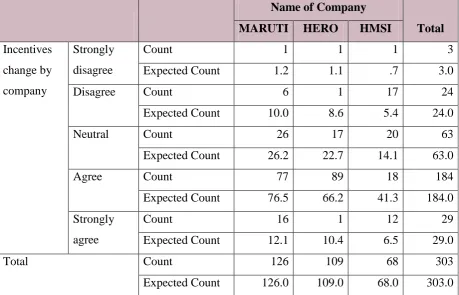
Table 2: Incentives Change by Company
Crosstab
Name of Company
Total
MARUTI HERO HMSI
Incentives
change by
company
Strongly
disagree
Count 1 1 1 3
Expected Count 1.2 1.1 .7 3.0
Disagree Count 6 1 17 24
Expected Count 10.0 8.6 5.4 24.0
Neutral Count 26 17 20 63
Expected Count 26.2 22.7 14.1 63.0
Agree Count 77 89 18 184
Expected Count 76.5 66.2 41.3 184.0
Strongly
agree
Count 16 1 12 29
Expected Count 12.1 10.4 6.5 29.0
Total Count 126 109 68 303
Chi-Square Tests
Value df
Asymp.
Sig.
(2-sided)
Pearson
Chi-Square
72.892(a
) 8 .000
Likelihood Ratio 75.387 8 .000
Linear-by-Linear
Association 12.319 1 .000
N of Valid Cases 303
a 3 cells (20.0%) have expected count less than 5. The minimum expected count is .67.
In order to analysis the strategy of sample companies to change incentives; an empirical study
has been carried out in this context. The above table 2 shows that expected and count figures
indicate a considerable difference in company strategy to change incentives. It is observed
that the calculated value of chi square at 8 df. @ 5% level of significant, indicate 72.892.
Meaning thereby, that calculated value of chi square is higher than that of given value that is
15.51. Hence, the null hypothesis is rejected. Hence, it is quite obvious that the all three
companies time to time change their strategies for incentives. It is clear from the observation
that in total (213) employees has marked on „strongly agree and agree‟. It indicates a
clear-cut picture that companies time to time change their strategy regarding incentives to
employees. The table also presents that Maruti and Hero are more concern about the change
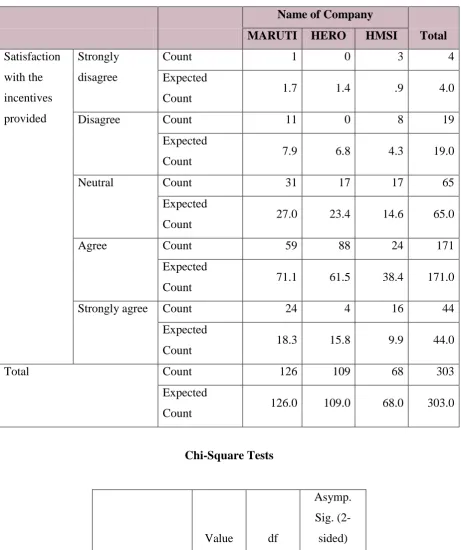
Table 3: Satisfaction with the Incentives Provided
Crosstab
Name of Company
Total
MARUTI HERO HMSI
Satisfaction
with the
incentives
provided
Strongly
disagree
Count 1 0 3 4
Expected
Count 1.7 1.4 .9 4.0
Disagree Count 11 0 8 19
Expected
Count 7.9 6.8 4.3 19.0
Neutral Count 31 17 17 65
Expected
Count 27.0 23.4 14.6 65.0
Agree Count 59 88 24 171
Expected
Count 71.1 61.5 38.4 171.0
Strongly agree Count 24 4 16 44
Expected
Count 18.3 15.8 9.9 44.0
Total Count 126 109 68 303
Expected
Count 126.0 109.0 68.0 303.0
Chi-Square Tests
Value df
Asymp.
Sig.
(2-sided)
Pearson
Chi-Square
53.942(a
Likelihood Ratio 62.354 8 .000
Linear-by-Linear
Association .466 1 .495
N of Valid Cases 303
a 4 cells (26.7%) have expected count less than 5. The minimum expected count is .90.
The above table 3 has revealed the satisfaction level of employees regarding incentives
provided by the sample companies, an empirical study has been carried out in this context.
The expected and count figures indicate a considerable difference in the satisfaction level of
employees toward incentives provided by companies. In this context, it is observed that the
calculated value of chi square at 8 df. @ 5% level of significant, indicate 53.942. Meaning
thereby, that calculated value of chi square is higher than that of given value that is 15.51.
Hence, the null hypothesis is rejected. It is quite obvious that the employees are satisfied with
the incentives provided by the companies. It is clear from the observation that in total (215)
employees has marked on „strongly agree and agree‟. It indicates a clear-cut picture that
employees of the all companies are satisfied with the incentives provided by the companies to
motivate their employees. The table also shows that employees of Hero are more satisfied
with the incentives provided by the company than Maruti and HMSI.
Conclusion
In current market environment modern costing techniques are required in every
manufacturing company and the requirement of proper cost management is more in
automobile companies due to fast changing market and customers desires. For proper
application and benefits of the use of modern costing techniques both target and kaizen
costing, commitment and involvement of employees is necessary. Without the support and
involvement of employees these techniques cannot give best results. If employees work well
then they expect something from companies. After the analyses of statements in respect of
the objective which is concerned with the stimuli posses by the members in implementation
of kaizen and target costing techniques in sample companies it is clear that for the long period
commitment of employees‟ automobile companies use different incentives and they time to
time change their incentives. Companies try to satisfy their employees and for this they
different companies use different incentives and their policies to change incentives are also
different. Finally, it is found that employees accept change and work with new techniques
when they are satisfied and for their satisfaction companies use different incentives to
encourage them.
References
Ansari, S. L. & Bell, J. E. (1997). Target costing: the next frontier in strategic cost
management. New York: McGraw-Hill.
Butscher, S. A. & Laker, M. (2000). Market-driven product development using target
costing to optimize products and prices. MM, Vol. Summer, pp. 48-53.
Cheser, R. & Tanner, C. (1993). Critikon declares war on waste, launches kaizen drive.
Target, Vol. 9, pp. 12-22.
Cooper, R. & Slagmulder, R. (1997). Target costing and value engineering. Portland:
Productivity Press, IMA Foundation for Applied Research.
Guilding, C., Cravens, C. K. & Tayles, M. (2000). An international comparison of
strategic management accounting practices. Management Accounting Research, Vol. 11,
pp. 113-135.
Kaplan, R. S. & Cooper, R. (1998). Cost and effect-using integrated cost systems to drive
profitability and performance. Boston: Harvard Business Press.
Kato, Y., Boer, G. & Chow C. W. (1995). Target costing: an integrative management
process. Journal of Cost Management, Spring, pp. 39-51.
Monden, Y. & Hamada, K. (1991). Target costing and kaizen costing in Japanese
automobile companies. Journal of Management Accounting Research, Vol. 3, pp. 16-34.
Tanaka, T. (1993). Target costing at Toyota. Journal of Cost Management, Spring, pp.
4-11.
Toyota Motor Corporation. (1987). History of Toyota Motor Corporation for 50 years.
Toyota Motor Corporation.
Yasuhiro, M. & John, L. (1993). How a Japanese automaker reduces costs?. Health Care