Citation:
Barnes, CJ and Nath, P and Bevan, N and Lui, Z and Wei, W and Hassenzahl„ M (2016) Comparison
of Kansei Engineering and AttrakDiff to Evaluate Kitchen Products. In: Proceedings of the 2016 CHI
Conference Extended Abstracts on Human Factors in Computing Systems. ACM, pp. 2999-3005.
ISBN 978-1-4503-4082-3
Link to Leeds Beckett Repository record:
http://eprints.leedsbeckett.ac.uk/2354/
Document Version:
Book Section
The aim of the Leeds Beckett Repository is to provide open access to our research, as required by
funder policies and permitted by publishers and copyright law.
The Leeds Beckett repository holds a wide range of publications, each of which has been
checked for copyright and the relevant embargo period has been applied by the Research Services
team.
We operate on a standard take-down policy.
If you are the author or publisher of an output
and you would like it removed from the repository, please
contact us
and we will investigate on a
case-by-case basis.
Comparison of Kansei Engineering
and AttrakDiff to Evaluate Kitchen
Products
Abstract
Kansei Engineering can be used to create scales to measure perceptions and evaluations of products in a particular context. To what extent do specifically constructed Kansei scales reveal more information about a product than a more generic, prestructured instrument, such as AttrakDiff? This case study identified relevant affective and pragmatic Kansei attributes that influence the purchase of a range hood (cooker hood). 102 customers rated the extent to which each of 10 range hoods possessed these
attributes. In addition, AttrakDiff was used to measure hedonic and pragmatic quality perceptions. There was a general high correspondence between AttrakDiff and Kansei. While Kansei provided richer and more specific feedback, it was more resource intensive to carry out.
Author Keywords
User experience; affective engineering; Kansei Engineering; Attrakdiff; evaluation.
ACM Classification Keywords
D.2.2 Design Tools and Techniques; D.2.1Requirements/Specifications; H.5.2 User Interfaces
Permission to make digital or hard copies of part or all of this work for personal or classroom use is granted without fee provided that copies are not made or distributed for profit or commercial advantage and that copies bear this notice and the full citation on the first page. Copyrights for third-party components of this work must be honored. For all other uses, contact the Owner/Author.
Copyright is held by the owner/author(s).
CHI'16 Extended Abstracts, May 07-12, 2016, San Jose, CA, USA ACM 978-1-4503-4082-3/16/05.
http://dx.doi.org/10.1145/2851581.2892407
Nigel Bevan
Professional UX Services 12 King Edwards Gardens London W3 9RG, UK [email protected]
Zhengjie Liu
Zhejiang Key Lab on Healthy & Smart Kitchen,
Sino-European Usability Center Dalian Maritime University Dalian, 116026 China [email protected]
Cathy Barnes
The Retail Institute, Leeds Beckett University, OBH, City Campus, Leeds LS2 9EN, UK [email protected]
Marc Hassenzahl
Experience and Interaction, Faculty of Design,
Folkwang University of Arts, Essen, Germany
Weijie Wei
Zhejiang Key Lab on Healthy & Smart Kitchen,
Fotile Kitchen Ware Co., Ltd 218 Binhai 2nd Road, Ningbo 315336 China
Introduction
Kansei Engineering provides a means of analyzing affective as well as more pragmatic product perceptions and evaluations and incorporating them into design [8]. Kansei words (e.g., attributes, adjectives) can be then used as a semantic differential scale for evaluating a particular type of product. Since attributes are selected specifically (from a large pool of possibilities) for a particular group of products, the resulting scales can provide a rich and product-specific picture of relevant users’ perceptions and evaluations. However, this advantage relies on a resource-intensive Kansei Engineering procedure. Consequently, other semantic differentials have been developed. For example, the now well-established AttrakDiff [2,4] is a generic scale, applicable to a wide range of different products. While much less resource-intensive, this generic method, however, might lead to different conclusions compared to the more finely attuned Kansai approach. The purpose of the present paper is to explore commonalities and differences between both approaches in the context of kitchen appliances.
Kansei and AttrakDiff
The essential steps of using Kansei Engineering to create a semantic differential scale are:
§ Define the product and context-of-use to be evaluated.
§ Collect as many relevant Kansei words and phrases as possible from various sources.
§ Create a semantic differential scale from a representative subset of the words.
§ Identify which features differentiate products and select products to be evaluated that have
representative examples of the features.
§ Recruit a large number of participants to evaluate the products using the semantic differential scale. § Use factor analysis to identify Kansei factors. § Compare the scores of each product on each factor.
AttrakDiff is a 28-item semantic differential to measure two broad types of quality perceptions: Hedonic quality and pragmatic quality [3,5]. Hedonic quality refers to a product’s potential to support pleasure in use and ownership, that is, the fulfillment of psychological needs. This aspect is represented by two
subdimensions: Stimulation and Identification. Pragmatic quality refers to a product's perceived potential to support relevant task achievement. In addition to pragmatic and hedonic scale, AttrakDiff provides a scale to measure general appeal. Appeal is conceptualized as a consequences of pragmatic and hedonic quality perceptions.
Study
This paper compares the results of evaluating 10 range hoods with a Kansei-based semantic differential scale and AttrakDiff. The study took place in Shanghai, China, in conjunction with a Chinese manufacturer of range hoods in October 2015. This paper uses English translations of the scale items that were presented in Chinese [6].
The research questions were: a) Does using the AttrakDiff attributes as general Kansei attributes [8] add value to Kansei Engineering? and b) How would the conclusions derived from use of the more
product-Combined hedonic
factor
Loading
Kansei
Unique Design 0.78 Looks High End 0.77 Looks Fashionable 0.77
High Tech 0.73
Good Looking 0.72 Looks Brand New 0.69
AttrakDiff Appeal
Attractive/Pretty 0.77
Inviting 0.75
AttrakDiff Hedonic quality: Identification
Novel 0.82
Inventive/Original 0.81
Creative 0.79
Innovative 0.79
Challenging 0.77
Captivating/Absorbing 0.75
AttrakDiff Hedonic quality: Stimulation
Stylish 0.84
[image:3.792.32.176.116.511.2]Presentable 0.74
specific scale created by Kansei Engineering compare with use of the prestructured, generic AttrakDiff scale?
Method
Kansei Engineering is most often used to understand how to design products with attributes that will create positive emotions. In this case study the manufacturer wanted to understand the factors that influenced purchase decisions, so product function and interaction was also important. For this reason, we collected Kansei words relating to both hedonic and pragmatic aspects. The pragmatic words and phrases were not specific product features, but perceptions, such as: “high smoke-gathering efficiency” and “easy to clean”.
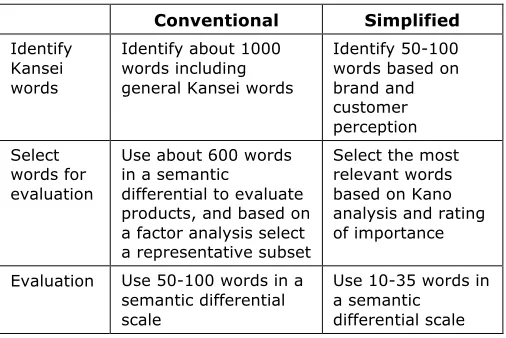
Since Kansei is labor intensive, we employed a simplified version of the Kansei Engineering method, based on the Kansei Engineering toolkit for the packaging industry [1]. Table 6 summarizes the main differences between conventional [8] and Simplified Kansei Engineering. The steps in the Simplified Kansei Engineering method were:
§ The context of use to be evaluated was making a purchase decision in a showroom.
§ 10 customers were interviewed to find out where they obtained information about range hoods, what information they would have before making a purchase decision, and which physical features were most important.
§ Data for potential Kansei scale items was obtained from marketing material and from two customer focus groups, and the most relevant 32 "hedonic" attributes and 34 "pragmatic" attributes were selected.
Conventional Simplified
Identify Kansei words
Identify about 1000 words including general Kansei words
Identify 50-100 words based on brand and customer perception Select words for evaluation
Use about 600 words in a semantic
differential to evaluate products, and based on a factor analysis select a representative subset
Select the most relevant words based on Kano analysis and rating of importance
Evaluation Use 50-100 words in a semantic differential scale
Use 10-35 words in a semantic
[image:4.792.33.175.109.529.2]differential scale
Table 6: Main differences between conventional and Simplified Kansei Engineering
§ 94 customers rated 10 range hoods using the 66 Kansei words on the 5-point Kano scale and gave each one an importance rating. Kano analysis [7] was used to select the 17 hedonic and 10 pragmatic words that had high scores for ”more is better” or ”surprise and delight” and that were judged as important.
§ A semantic differential scale was created using the identified hedonic and pragmatic attributes and an additional five more specific pragmatic attributes of concern to the manufacturer.
§ The features that had been identified by customers as most important were used to create a product-feature matrix so that products with a representative distribution of features could be used for the
evaluation.
§ Each of the 10 products to be evaluated was accompanied by a poster containing the information
Combined pragmatic
factors
Loading User interface quality Kansei
The button light is a
refreshing color 0.72 The information
displayed is clear 0.70 The button light is not
dazzling 0.69
The button sound is
pleasant 0.67
Not troublesome 0.64 The noise of the hood is
quiet and relaxing
0.53 2 AttrakDiff Pragmatic quality
Manageable 0.67
Clearly Structured/Clear 0.64
Simple 0.61
Straightforward/Facile 0.54 Smoke extraction quality Will extract all the
smoke 0.78
High smoke gathering
efficiency 0.76
High suction 0.74 Health benefit 0.62 Design quality
Well coordinated 0.57 Does everything it is
supposed to do
0.57
Well integrated 0.54 Simple and clean design 0.54 Easy to dismantle 0.53 Very stylish 0.52
[image:4.792.470.723.115.284.2]about the product that customers would typically have.
§ Customers were recruited to evaluate the products in a showroom-like environment, and rated them in a counterbalanced order using the 32 scale items and a Chinese translation of AttrakDiff, as well as additional items, including their willingness to buy. § The scale item and AttrakDiff data were factor
analyzed to identify the Kansei factors, and the ratings for each product on each factor were calculated.
Factor analysis
From factor analysis (principal components with varimax rotation) of the combined Kansei and AttrakDiff ratings of 10 hoods by 102 people, the four factors shown in Table 7 were identified. They explained 72% of the variance: 32% for the hedonic factor, and a total of 40% for the pragmatic factors.
The Kansei and AttrakDiff data were also factor analyzed separately. The Kansei data produced the same 4 factors with very similar loadings (Tables 3 & 4) as in the combined analysis (Tables 1 & 2).
The AttrakDiff data also produced the same two factors that had AttrakDiff items in the combined analysis with a similar order of loadings (Table 5). The hedonic factor was a combination of items from the three AttrakDiff subscales: Appeal, Hedonic quality
(Identification) and Hedonic quality (Stimulation). The pragmatic factor was User interface quality.
The Kansei (Table 4) and combined (Table 2) factor analyses identified pragmatic factors related to user
Factor analysis: Factors
Comb -ined
Kansei Attrak Diff Variance Explained &
α
1. Hedonic 32% 28% .96 43% .97 2. User interface 16% 16% .90 33% .92 3. Smoke extraction 12% 14% .91
4. Design quality 11% 12% .87 Combined pragmatic 39% 43%
Total 71% 70% 76%
Correlation with WTB
1. Hedonic 0.49 0.48 0.48
2. User interface 0.42 0.38 0.44 3. Smoke extraction 0.43 0.43
[image:5.792.472.717.114.316.2]4. Design quality 0.49 0.49 Combined pragmatic 0.48 0.48
Table 7: Variance explained by each factor, Chronbach’s alpha for the scales, and correlation of the scales with willingness to buy (WTB)
interface quality, smoke extraction quality and design quality.
We calculated a hedonic scale value and a pragmatic scale value for each method (Kansei, AttrakDiff) and each hood. All the scales had high levels of
Chronbach’s alpha (Table 7), indicating good internal consistency, although for the hedonic scales with
α
>0.95, some items are probably redundant [9]. There was a significant correlation between AttrakDiff and Kansei hedonic scales using the 10 highest loading items on each: r(1068) = .92 (Tables 3 & 5), and an 0.85 correlation between the AttrakDiff and Kansei pragmatic user interface scales using the high loaded items shown in Tables 4 & 5. The Kansei scales provide individual items that are easier to interpret toKansei hedonic factor
Loading High-loaded items in the Combined Kansei scale
Unique design 0.77 Looks High End 0.80 Looks Fashionable 0.86
High Tech 0.71
Good Looking 0.84 Looks Brand New 0.74
Additional items
Smart and Delicate 0.78 Very Fine Finish 0.77 Three Dimensional
Appearance 0.70
Very Stylish 0.68
understand the strengths and weaknesses of a range hood. The AttrakDiff items are less specific, but because they do not refer to any specific capabilities, the scales are also likely to be appropriate for other types of kitchen equipment.
Ratings for each product
Customers were asked which product they would most like to buy, and Figure 1 shows the products arranged in order of preference. The same order is used in Figures 2 and 3.
Figure 2 shows the ratings for each product on the Kansei and AttrakDiff hedonic scales. The ratings of the two scales are similar, and generally consistent with purchase preference (although the reasons for the willingness to buy P5 despite low ratings could be investigated).
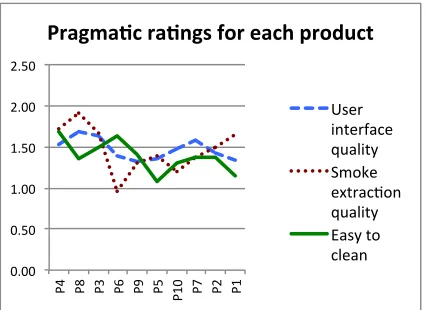
Figure 3 shows the ratings for each product on Kansei items for the pragmatic factors shown in Table 4. Although the differences between products are smaller, the differences for all the factors are significant (at p= <.001). The Design quality factor shows the same pattern as Hedonic quality, while User interface quality and Smoke extraction quality are more varied. A scale using the 4 AttrakDiff items in Table 2 produced results very similar to those for Kansei User interface quality.
[image:6.792.477.718.323.491.2]Although the hedonic and pragmatic factors have similar correlations with willingness to buy (Table 7), it is apparent that there is more agreement between customers on which products have desirable hedonic properties than which products have desirable pragmatic properties. Thus despite a correlation between pragmatic factors and willingness to buy on an
Figure 1: Frequency of products that customers said that they would most like to buy.
Figure 2: Hedonic ratings for each product (scale +3 to -3) individual level, there is a lack of agreement between customers about which pragmatic properties are more desirable. For this reason there were also no clear
0 5 10 15 20 25
P4 P8 P3 P6 P9 P5 P10 P7 P2 P1
Purchase preference
0.00 0.20 0.40 0.60 0.80 1.00 1.20 1.40 1.60 1.80 2.00
P4 P8 P3 P6 P9 P5 P10 P7 P2 P1
Hedonic ra+ngs for each product
Hedonic Kansei Hedonic A9rakDiff
Kansei pragmatic
factors
Loading User interface quality
Combined Kansei scale items The button light is a
refreshing color 0.76 The button light is not
dazzling 0.75
The information
displayed is clear 0.66 The button sound is
pleasant 0.71
Not troublesome 0.51 The noise of the hood is
quiet and relaxing 0.58
Smoke extraction quality
Combined Kansei scale items Will extract all the
smoke
0.80
High smoke gathering efficiency
0.79
High suction 0.79 Health benefit 0.63 Additional item
Firm and Reliable 0.58 Easy to clean
Easy to Clean 0.80 Easy to Dismantle 0.78 Outside Surface Easy to
Clean 0.65
Figure 3: Pragmatic ratings for each product (scale +3 to -3) correlations between Kansei factors and the identified product features. Further analysis of the data may reveal distinct groups of customers, differentiated by their preferences, which could show clearer
relationships between Kansei scale ratings and product features.
Conclusions
The research questions were:
a) Would using the AttrakDiff attributes as general Kansei attributes add value to the Kansei Engineering analysis? Including AttrakDiff attributes in the combined analysis did not change the factor structure and did not make the factors any easier to interpret. From this perspective, the addition of AttrakDiff to Kansei does not have any additional benefit.
b) How would the conclusions derived from use of the Kansei Engineering scale compare with use of the AttrakDiff scale? A scale composed of a subset of AttrakDiff items provides at least as good an evaluation
of hedonic quality as a scale based on the identified Kansei items, although the AttrakDiff scale provides less detailed, product-specific feedback. As would be expected, Kansei Engineering identifies more product-specific pragmatic factors and individual scale items are also easier to interpret. So using Kansei factors and AttrakDiff to evaluate products provide different benefits. Future analysis will include the results obtained by using the complete AttrakDiff scale and subscales, and investigation of which scales have the highest correlation with buying preference.
Although the resources required for Kansei Engineering are unlikely to justify a one-off evaluation, they can provide rich and useful data for tracking and comparing hedonic and pragmatic quality for a particular type of product and usage context. And it is generally possible to relate the Kansei factors to specific product features. So designers could use Kansei Engineering early in product development to get actionable insights that could help improve design. AttrakDiff could be used as a quick evaluation tool to compare products and check that the designs meet the customer needs. Products with long timescales and relatively large budgets (such as automotive design) are more likely to find Kansei Engineering cost-effective, while consumer products with tight budgets and short timescales may find it more beneficial to use AttrakDiff.
Acknowledgements
We thank the students from Dalian Maritime University: Hui Li, Huitian Miao, Li Wang, Qing Xu, Xinru Liu, Bingbin Wang, Ziwei Wang and Xiaotong Wang for their contributions to the case study, and Fotile Kitchen Ware Co., Ltd, for their sponsorship of the work.
0.00 0.50 1.00 1.50 2.00 2.50
P4 P8 P3 P6 P9 P5 P10 P7 P2 P1
Pragma&c ra&ngs for each product
User interface quality Smoke extracAon quality Easy to clean
AttrakDiff factors
Loading
Hedonic
Attractive quality
Attractive/Pretty 0.76
Inviting 0.76
Identification
Novel 0.86
Inventive/Original 0.85
Creative 0.82
Innovative 0.83
Challenging 0.78
Captivating/Absorbing 0.77
Stimulation
Stylish 0.85
Premium/High Quality 0.75
Pragmatic
Simple 0.80
Practical and useful 0.80
Manageable 0.79
Straightforward/Facile 0.79 Clearly structured 0.76
References
1. Cathy Barnes, Tom Childs, Brian Henson and Stephen Lillford . 2008. Kansei engineering toolkit for the packaging industry, The TQM Journal, 20(4) pp. 372-388/
https://www.researchgate.net/publication/2005527 95_Kansei_engineering_toolkit_for_the_packaging_ industry
2. Marc Hassenzahl. 2001. The effect of perceived hedonic quality on product appealingness. International Journal of Human–Computer Interaction, 13, 481–499.
3. Marc Hassenzahl. 2003. The thing and I:
Understanding the relationship between user and product. In M. Blythe, C. Overbeeke, A. F. Monk, & P. C. Wright (Eds.), Funology: From usability to enjoyment (pp. 31–42). Dordrecht, the
Netherlands: Kluwer Academic.
4. Marc Hassenzahl. 2004. The interplay of beauty, goodness, and usability in interactive products. Human–Computer Interaction, 19, 319–349. 5. Marc Hassenzahl. 2010. Experience design:
Technology for all the right reasons. San Rafael, CA: Morgan & Claypool.
6. Zhengjie Liu and Nigel Bevan. 2016. Kansei and AttrakDiff scale items in Chinese.
http://nigelbevan.com/kansei.htm
7. Jan Moorman. 2012. Leveraging the Kano Model for Optimal Results. UX Magazine.
http://uxmag.com/articles/leveraging-the-kano-model-for-optimal-results
8. Mitsuo Nagamachi and Anitawati Mohd Lokman. 2003. Innovations of Kansei Engineering. Published in English in 2011 by CRC Press.