Recursive Composition and Bootstrapping
for SNARKs and Proof-Carrying Data
Nir Bitansky∗ [email protected]
Tel Aviv University
Ran Canetti∗ [email protected]
Boston University and Tel Aviv University Alessandro Chiesa
Eran Tromer† [email protected]
Tel Aviv University
December 28, 2012
Abstract
Succinct non-interactive arguments (SNARGs) enable verifying NP statements with much lower complexity than required for classical NP verification (in fact, with complexity that isindependent of the NP language at hand). In particular, SNARGs provide strong solutions to the problem of verifiably delegating computation.
Despite recent progress in the understanding and construction of SNARGs, there remain unattained goals. First, publicly-verifiable SNARGsare only known either in the random oracle model, or in a model that allows expensive offline preprocessing. Second, known SNARGs require from the prover significantly more time or space than required for classical NP verification.
We show that, assuming collision-resistant hashing,anySNARG having a naturalproof of knowledge
property (i.e., a SNARK) can be “bootstrapped” to obtain a complexity-preservingSNARK, i.e., one without expensive preprocessing and where the prover’s time and space complexity is essentially the same as that required for classical NP verification. By applying our transformation to known publicly-verifiable SNARKs with expensive preprocessing, we obtain the first publicly-publicly-verifiable complexity-preserving SNARK in the plain model (and in particular, eliminate the expensive preprocessing), thereby attaining the aforementioned goals. We also show an analogous transformation for privately-verifiable SNARKs, assuming fully-homomorphic encryption. Curiously, our transformations do not rely on PCPs. At the heart of our transformations isrecursive compositionof SNARKs and, more generally, new techniques for constructing and usingproof-carrying data(PCD) systems, which extend the notion of a SNARK to the distributed setting. Concretely, to bootstrap a given SNARK, we recursively compose the SNARK to obtain a “weak” PCD system for shallow distributed computations, and then use the PCD framework to attain stronger, complexity-preserving SNARKs and PCD systems.
∗
Supported by the Check Point Institute for Information Security, Marie Curie grant PIRG03-GA-2008-230640, and ISF grant 0603805843. The first author was also supported by the Fulbright program.
†
Contents
Contents 2
1 Introduction 3
1.1 Motivating Questions . . . 4
1.2 Our Results . . . 5
1.3 More on Proof-Carrying Data and Compliance Engineering . . . 7
1.4 The Ideas In A Nutshell . . . 9
1.5 Roadmap . . . 11
2 Overview of Results 11 2.1 SNARKs and Proof-Carrying Data . . . 11
2.2 The SNARK Recursive Composition Theorem . . . 13
2.3 The PCD Depth-Reduction Theorem . . . 15
2.4 The Locally-Efficient RAM Compliance Theorem . . . 16
2.5 Putting Things Together: A General Technique for Preserving Complexity . . . 16
3 The Universal Language on Random-Access Machines 20 4 SNARKs 20 5 Proof-Carrying Data 24 5.1 Distributed Computations And Their Compliance With Local Properties . . . 24
5.2 Proof-Carrying Data Systems . . . 25
6 Proof Of The SNARK Recursive Composition Theorem 28 6.1 Recursive Composition For Publicly-Verifiable SNARKs . . . 30
6.2 Recursive Composition For Designated-Verifier SNARKs . . . 35
7 Proof Of The Locally-Efficient RAM Compliance Theorem 41 7.1 Machines With Untrusted Memory . . . 42
7.2 A Compliance Predicate for Checking RAM Computations . . . 43
8 Proof of The PCD Depth-Reduction Theorem 45 8.1 Warm-Up Special Case: Reducing The Depth Of RAM Checkers . . . 47
8.2 General Case . . . 51
9 Putting Things Together 56
Acknowledgments 58
1
Introduction
Succinct arguments. We study proof systems [GMR89] for the purpose of verifying NP statements faster than by deterministically checking an NP witness in the traditional way. When requiring statis-tical soundness, significant savings in communication (let alone verification time) are unlikely [BHZ87, GH98, GVW02, Wee05]. If we settle for proof systems withcomputational soundness, known as argu-ment systems [BCC88], then significant savings can be made. Using collision-resistant hashing (CRHs) and probabilistically-checkable proofs (PCPs) [BFLS91], Kilian [Kil92] showed a four-message interactive argument forNPwhere, to prove membership of an instancexin a givenNPlanguageLwithNPmachine
M, communication and the verifier’s time are bounded bypoly(k+|M|+|x|+ logt), while the prover’s running time bypoly(k+|M|+|x|+t). Here,tis the classical NP verification time ofMfor the instance
x,kis a security parameter, andpolyis auniversalpolynomial (i.e., independent ofk,M,x, andt). We call such argument systemssuccinct.
Proof of knowledge. A strengthening of computational soundness is (computational)proof of knowledge: it guarantees that, whenever the verifier is convinced by an efficient prover, not only a valid witness for the theoremexists, but also such a witness can be extracted efficientlyfrom the prover. This captures the intuition that convincing the verifier of a given statement can only be achieved by (essentially) going through specific intermediate stages and thereby explicitly obtaining a valid witness along the way, which can be efficiently recovered by aknowledge extractor. Proof of knowledge is a natural property (satisfied by most proof system constructions, including the aforementioned one of Kilian [BG08]) that is useful in many applications of succinct arguments. It is alsoessentialto the results of this paper.
Non-interactive succinct arguments. Kilian’s protocol requires four messages. A challenge, which is of both theoretical and practical interest, is removing interaction from succinct arguments. As a first step in this direction, Micali [Mic00] constructedone-messagesuccinct non-interactive arguments for NP, in the random oracle model, by applying the Fiat-Shamir paradigm [FS87] to Kilian’s protocol.
In the plain model, it is known that one-message solutions are impossible for hard-enough languages (against non-uniform provers), so one usually considers the weaker goal of two-message succinct arguments where the verifier message is generated independentlyof the statement later chosen by the prover. Such arguments are called SNARGs. More precisely, a SNARG for a languageLis a triple of algorithms(G,P,V)
where: (i) the generatorG, given the security parameterk, samples areference stringσand a corresponding verification stateτ (G can be thought to be run during an offline phase, by the verifier, or by someone the verifier trusts); (ii) the proverP(σ, x, w)produces a proofπ for the statement “x ∈ L” given a witnessw; (iii)V(τ, x, π)deterministically verifies the validity ofπfor that statement.
Extending earlier work [ABOR00, DLN+04, Mie08, DCL08], several recent works showed how to remove interaction in Kilian’s PCP-based protocol and obtain SNARGs of knowledge (SNARKs) using ex-tractable collision-resistant hashes[BCCT12, DFH12, GLR11], or construct MIP-based SNARKs using fully-homomorphic encryptionwith an extractable homomorphism property[BC12].
The use of non-standard assumptions in the aforementioned works may be partially justified in light of the work of Gentry and Wichs [GW11], which shows that no SNARG can be proven sound via a black-box reduction to a falsifiable assumption [Nao03]. (We remark that [GW11] rule out SNARGs only for hard-enoughNPlanguages. For the weaker goal of verifying deterministic polynomial-time computations, there are constructions relying on standard assumptions in various models.)
additional input a time boundB, may run in timepoly(k+B)(rather thanpoly(k+ logB)), and generates a reference stringσ and a verification stateτ that can be used, respectively, to prove and verify correctness of computations of length at most B. A set of works [Gro10, Lip12, GGPR12, BCI+13] achieves this weaker goal using techniques that can be cast as a combination oflinearPCPs and linearly homomoprhic encryption/encoding with suitable knowledge properties [BCI+13].
1.1 Motivating Questions
In this work, we study three open questions regarding SNARGs and SNARKs:
Public verifiability. A basic question regarding SNARKs is whether the verification state τ needs to be kept secret. In adesignated-verifierSNARK,τ must be kept secret; in particular,τ must be protected from leakage, including the verifier’s responses when checking proofs. (Of course, a new pair(σ, τ)can always be generated afresh to regain security.) In contrast, in apublicly-verifiableSNARK, the verification stateτ
associated with the reference stringσcan be published. Thus leakage is not a concern,τ andσcan be used repeatedly, anyone who trusts the generation ofτ can verify proofs, and proofs can be publicly archived for future use.
The SNARKs in [DCL08, Mie08, BCCT12, DFH12, GLR11, BC12] are of the designated-verifier kind (and there, indeed, an adversary learning the verifier’s responses on, say,kproofs can break soundness). In contrast, Micali’s protocol is publicly verifiable, but is in the random-oracle model. The protocols based on linear PCPs [Gro10, Lip12, GGPR12, BCI+13] are also publicly verifiable, but only yield the weaker notion of preprocessing SNARKs. We thus ask:
Q-1:Can we construct publicly-verifiable SNARKs without preprocessing in the plain model?
Of course, we could always assume that Micali’s protocol, when the random oracle is instantiated with a sufficiently-complicated hash function, is sound. However, this assumption does not seem to be satisfying, because it strongly depends on the specific construction, and does not shed light on the required properties from such a hash function. Instead, we would like to have a solution whose soundness is based on aconcise andgeneralassumption that is “construction-independent” and can be studied separately.
Complexity-preserving SNARKs. While typically the focus in SNARKs is on minimizing the resources required by the verifier, minimizing those required by the prover is another critical goal: e.g., the verifier may bepayingto use the prover’s resources by renting servers from the cloud, and the more resources are used the greater the cost to the verifier. These resources include, not only time complexity, but also space complexity, which tends to be a severe problem in practice (often more so than time complexity).
When instantiating the PCP-based SNARK constructions of [Mic00, DCL08, Mie08, BCCT12, DFH12, GLR11] with known time-efficient PCPs [BSCGT12], the SNARK prover runs in timet·poly(k)and the SNARK verifier in time|x| ·poly(k). However, the quasilinear running time of the prover is achieved via the use of FFT-like methods, which unfortunately demandΩ(t)space even when the computation of theNP verification machineMrequires spaceswithst.
The situation is even worse in the preprocessing SNARKs of [Gro10, Lip12, GGPR12, BCI+13], where the generator runs in timeΩ(t)·poly(k)to produce a reference stringσof lengthΩ(t)·poly(k). This string must then be stored somewhere and accessed by the prover every time it proves a new statement; thus, once again,Ω(t)space is needed (in contrast to a SNARK without preprocessing where the generator runs in time
poly(k)and the reference string is short).
thus define acomplexity-preservingSNARK to be a SNARK where the prover runs in timet·poly(k)and spaces·poly(k), and the verifier runs in time|x|·poly(k), when proving and verifying that at-times-space random-access machineMnon-deterministically accepts an inputx. We ask:
Q-2:Can we construct complexity-preserving SNARKs?
The SNARKs constructed by [BC12] are, in fact, complexity-preserving. However, that construction is for designated verifiers and also relies on a rather specific knowledge assumption. The case of public verifiability remains open, as well as whether there are more generic approaches to construct complexity-preserving SNARKs.
SNARK composition and proof-carrying data. It is tempting to use a SNARK to produce proofs that, in addition to attesting to the correctness of a given computation, also attest that a previous SNARK proof for another (related) computation has been verified (and so on recursively). An intriguing question is thus whether one can achieve stronger cryptographic primitives via suchrecursive compositionof SNARKs, and under what conditions.
Several works have in fact studied this question. Valiant [Val08] studied the problem of incrementally-verifiable computation(IVC), where a deterministic computation is compiled into a new computation (with polynomially-related time and space) that after each step outputs, in addition to the current state, a short proof attesting to the correctness of the entire computation so far. Valiant showed (when phrased in our terminology) that IVC can be obtained by recursively composing publicly-verifiable SNARKs that have very efficient knowledge extractors, and conjectured that such SNARKs exist. In another work along these lines, Boneh, Segev, and Waters [BSW12] studiedtargeted malleability(TM), and showed how to obtain certain forms of TM by recursively composing publicly-verifiable preprocessing SNARKs that may have an expensive online verification.
Chiesa and Tromer [CT10] formulated and studied the security goal of enforcing local properties in dynamic distributed computations; this goal, in particular, captures many scenarios which seem to require SNARK recursive composition, such as the goals in [Val08] and [BSW12] (by choosing appropriate local properties to enforce). To achieve this security goal, [CT10] introduced a cryptographic primitive called proof-carrying data(PCD), which allows to dynamically compile a distributed computation into one where messages are augmented by short proofs attesting to the fact that the local property holds; this, without incurring significant overhead in communication or computation. They showed how to use recursive proof composition to obtain PCD, but only in a model where parties can access a signature oracle. We ask:
Q-3:Under what conditions can SNARKs be recursively composed? More generally, what forms of PCD can be achieved in the plain model?
We further discuss and motivate the notions of verifying local properties of distributed computations and the framework of proof-carrying data in Section 1.3.
1.2 Our Results
In this work, we positively answer all three questions. To do so, we develop techniques demonstrating that the three questions are, in fact, tightly related to one another.
The second transformation takes anyPCD system (such as the one output by the firsttransformation) and outputs a complexity-preserving SNARK or PCD system. These transformations work in both publicly-verifiable or designated-verifier cases (where SNARKs can be proved secure based on potentially weaker knowledge assumptions).
Theorem(informal). Assume existence of collision-resistant hash functions. Then:
(i) Any publicly-verifiable SNARK can be efficiently transformed into a publicly-verifiable PCD system for distributed computations of constant depth or over paths of polynomial depth.
(ii) Any publicly-verifiable PCD system (for distributed computations of constant depth or over paths of polynomial depth) can be efficiently transformed into a complexity-preserving publicly-verifiable SNARK or PCD system.
(Where thedepthof a distributed computation is, roughly, the length of the longest path in the graph repre-senting the distributed computation over time.)
Assuming existence of fully-homomorphic encryption, an analogous statement holds for the designated-verifier case.
While this theorem implies a significant efficiency improvement for preprocessing SNARKs (as it re-moves the expensive preprocessing), it is also useful for improving the efficiency of SNARKs that do not have expensive preprocessing, yet are still not complexity preserving, such as PCP-based constructions in the plain model.
Applying our theorem to any of the preprocessing SNARKs of [Gro10, Lip12, GGPR12, BCI+13], we obtain positive answers to the three aforementioned open questions:
Corollary(informal). There exist publicly-verifiable SNARKs and PCD systems (for a large class of dis-tributed computations), in the plain model, under “knowledge-of-exponent” assumptions. Moreover, there exist such SNARKs and PCD systems that are complexity-preserving.
To prove our main theorem, we develop three generic tools:
1. SNARK Recursive Composition: “A (publicly- or privately-verifiable) SNARK can be composed a constant number of times to obtain a PCD system for constant-depth distributed computations (without making special restrictions on the efficiency of the knowledge extractor).”
2. PCD Depth Reduction: “Distributed computations of constant depth can express distributed computa-tions over paths of polynomial depth.”
3. Locally-Efficient RAM Compliance: “The problem of checking whether a random-access machine non-deterministically accepts an input within t steps can be reduced to checking that a certain local property holds throughout a distributed computation along a path oft·poly(k)nodes and every node’s local computation is onlypoly(k), independently oft, wherekis the security parameter.”
technique main generator prover prover verifier verification complexity
assumption time time space time preserving?
PCP extractable CRH poly(k) t·poly(k) t·poly(k) poly(k) designated no linear PCP linear-only hom. t·poly(k) t·poly(k) t·poly(k) poly(k) public no MIP hom. extraction poly(k) t·poly(k) s·poly(k) poly(k) designated yes
this work any SNARK poly(k) t·poly(k) s·poly(k) poly(k) public yes
Table 1: Features of known SNARK constructions vs. those obtained using our transformations.
1.3 More on Proof-Carrying Data and Compliance Engineering
Succinct arguments focus on the case of a single prover and a single verifier. This suffices for capturing, say, a client interacting with a single worker performing some self-contained computation for the client. However, reality is often more complex: computations may be performed by multiple parties, each party with its own role, capabilities, and trust relations with others.
In general, there are multiple (even apriori unboundedly many) parties, where each partyi, given inputs from some other parties, and having its own local input linpi, executes a program, and sends his output
message zi to other parties, each of which will in turn act likewise (i.e., perform a local computation and
send the output message to other parties), and so on in a dynamical fashion. In other words, reality often involves possibly complexdistributed computations.
There are manysecurity goals, both about integrity and privacy, that one may wish to achieve in dis-tributed computations. The study ofmulti-party computation(MPC) in the past three decades has focused on formulating definitions and providing solutions that are as comprehensive as possible for secure distributed computations. This ambitious goal was met by powerful generic constructions, working for any polynomial-time functionality and in the presence of arbitrary malicious behavior, e.g., [GMW87, BOGW88]. A major caveat of generic MPC protocols, however, is that they often require the parties participating in the compu-tation to interact heavily with all other parties and perform much more expensive compucompu-tations than their “fair share”. In fact, such overheads are inherent for some security goals, e.g.,broadcast[FLP85, KY86].
Chiesa and Tromer [CT10, CT12] introduced and studied a specific security goal,enforcing compliance with a given local property; as we shall see, for this goal, it is possible to avoid the aforementioned caveats. More concretely, the goal is to ensure that any given messagezoutput by any party during the distributed computation is the result ofsomeprevious distributed computation in which every party’s local computation (including the party’s input messages, local inputs, and output message) satisfies a prescribed local property
C; i.e., the goal is to ensure that there is some “explanation” for the generation of the message z as the aggregate of many local computations, each satisfyingC. For example, the local propertyCmight be “the local inputlinpi is a programprogi bearing a valid signature of the system administrator and, moreover,
the output messageziis the correct output of runningprogion the input messages”. Such a local property
would ensure that a messagezresulting from a distributed computation satisfyingCis in fact the result of correctly executing only programs vetted by the system administrator.
Proof-carrying data. To fulfill the above goal, Chiesa and Tromer [CT10] proposed theProof-Carrying Data (PCD) solution approach: each party i behaves exactly as in the original distributed computation (where there is no integrity guarantee), except thatialso appends to his messagezi asuccinct proof πi
as-serting thatziis consistent with some distributed computation in which every local computation satisfiesC.
Partyigenerates the proofπi based onzi,linpi, previous messages, and their proofs. Crucially, generating πidoes not require partyito perform much more work than generatingziin the first place. Furthermore, the
“natural” evolution of the distributed computation, including its communication pattern, is unaffected. This solution approach extends Valiant’s notion of incrementally-verifiable computation [Val08], which can be cast as verifying a “path” distributed computation where the local property to be enforced is the transition function of a fixed deterministic machine, and the set of parties is fixed according to the number of steps made by the machine. See Figure 1 on page 8 for a diagram of this idea.
An abstraction for SNARK recursive composition, and compliance engineering.As already mentioned, in this work we use recursive composition of SNARKs to obtain PCD systems for a large class of distributed computations. While describing the proof to parts of our main theorem could be done without using PCD systems, PCD systems enable us to state, once and for all, exactly what we can “squeeze” out of recursive composition of (even the most basic and inefficient) SNARKs. From thereon, we can forget about the many technical details required to make recursive composition work, and only focus on the corresponding guarantees, rather than implementation details. Specifically, armed with PCD systems, we can concentrate on the simpler and cleaner task ofcompliance engineering: how to express a given security goal as a local property. We can then achieve the security goal by enforcing the local property by using a PCD system.
For example, already in this work, after constructing a “weak” PCD system, we solve all other technical challenges (including obtaining stronger PCD systems) via compliance engineering. As another example, targeted malleability[BSW12] can be obtained via a suitable choice of local property and then enforcing the local property by using a PCD system over any homomorphic encryption scheme.1 The class of distributed computations supported by the resulting construction is the same as that of the PCD system used.
More generally, we believe that investigating the power (and limits) of compliance engineering is a very interesting question: what security goals can be efficiently achieved by enforcing local properties?
⇡8 ⇡3 ⇡2 z1 z2 z3 z4 z5 z6 z7 z8 prog1 prog2 prog3 prog4 prog5 prog6 prog7 prog8 z2 z2 z3 C ? ? ⇡2 ⇡2 ⇡4 ⇡5 ⇡6 ⇡3 ⇡7 ⇡1 PCD z1 z2 z3 z4 z5 z6 z7 z8 prog1 prog2 prog3 prog4 prog5 prog6 prog7 prog8 z2 z2 z3 C ? ?
Figure 1: Proof-carrying data enables each party in a distributed computation to augment his messagezi with a short easy-to-verify proofπithat is computed “on-the-fly”, based on previous
messages and proofs. At any point during the computation, anyone may inspect a message to decide if it iscompliantwith the given local propertyC. Distributed computations are represented as directed acyclic graphs “unfolding over time”.
1
1.4 The Ideas In A Nutshell
We now give the basic intuition, stripping away all abstraction layers, behind one part of our main the-orem. Specifically, we explain how to transform any (possibly very inefficient) SNARK(G,P,V) into a complexity-preserving SNARK(G?,P?,V?)(that, in particular, has no expensive preprocessing), assuming
collision-resistant hashing. Consider first the case where(G,P,V)is publicly verifiable.
Suppose that(G,P,V) is a preprocessing SNARK (this only makes the transformation harder because we must get rid of preprocessing). Recall that, in such a SNARK, the online verification phase is succinct, but the offline phase is allowed to be expensive, in the following sense. The generatorGtakes as an additional input a time boundB, may run in timepoly(k+B), and generates a (potentially long) reference stringσand a (short) verification stateτ that can be used, respectively, to prove and verify correctness of computations of length at mostB. The (online) verifierV still runs in timepoly(k), independently ofB. (Additionally, no guarantees are made about the time and space complexity of the honest prover, except that they both are
poly(k+B).) We would like to construct(G?,P?,V?)so thatG?runs in timepoly(k)(which in particular
bounds the size of the reference stringσ) andP?runs in timet·poly(k)and spaces·poly(k).
At high-level, the idea is to first represent the longt-step computation of the random-access machineM
to be verified as a collection ofO(t)smallpoly(k)-step computations, and then use recursive composition to aggregate many SNARK proofs for the correctness of each of these small computations into a single SNARK proof. Indeed, by repeatedly invoking the proverP of the “inefficient” preprocessing SNARK(G,
P,V)only to prove the correctness ofsmall computations, we would “localize” the effect of the SNARK’s inefficiency. Specifically, when running the generatorG in the offline phase in order to produce(σ, τ), we would only have to budget for a time boundB = poly(k), thereby making runningGcheap. Furthermore, if the collection of small computations can be computed in timetand spaces(up topoly(k)factors), then runningP on each of these small computations in order to produce the final proof would only take time
t·poly(k) and spaces·poly(k). Overall, we would achieve complexity preservation. Let us make this intuition somewhat more concrete.
Starting point: incrementally-verifiable computation. A natural starting point towards fulfilling the above plan is trying to use of the idea of incrementally-verifiable computation (IVC) [Val08]. Recall that the goal in IVC is to transform a given computation into a new computation that after every step outputs its entire state and a proof of its correctness so far, while preserving the time and space efficiency of the original computation (up topoly(k)factors).
Specifically, to be convinced that there exists a witness w for which the random-access machineM
acceptswwithintsteps, it suffices to be convinced that there is a sequence oft0statesS0, S1, . . . , St0 ofM (witht0 ≤t) that (a) starts from an initial state, (b) ends in an accepting state, and (c) every state correctly follows the previous one according to the transition function ofM. Equivalently, from the perspective of proof-carrying data, we can think of a distributed computation of at mosttparties, where thei-th partyPi
receives the stateSi−1 ofMat stepi−1, evaluates one step ofM, and sends the stateSiofMat stepito
the next party; the last party checks that the received state is an accepting one.
This suggests the following solution, which we can think of as happening “in the mind” of the new SNARK proverP?. Using the SNARK proverP, the first partyP1 proves to the second partyP2 that the
stateS1 was generated by running the first step ofMcorrectly. Then, again usingP,P2 proves to the third
partyP3 that, not only did he evaluate the second step ofM correctly and obtained the state S2, but he alsoreceived stateS1carrying a valid proof (i.e., accepted by the SNARK verifierV) claiming thatS1 was generated correctly. Then,P3 usesP to prove to the fourth partyP4that, not only did he evaluate the third
thatS2was generated correctly, and so on until the last party who, upon receiving a state carrying a proof of
validity, proves that the last state is accepting. A verifier at the end of the chain gets a single, easy-to-verify, proof aggregating the correctness of all the steps inM’s computation. Hopefully, by relying on the proof of knowledge property of the SNARK, it is possible to recursively extract from any convincing prover a full transcript of the computation attesting to its correctness.
From the above IVC-based approach to our eventual goal of complexity-preserving SNARKs without pre-processing there is still a significant gap; we now describe the difficulties and how we overcome them.
Challenge 1: IVC with preprocessing SNARKs, and the size of local computations.In his construction of IVC, Valiant relies on the existence of publicly-verifiable SNARKs thatdo not have expensive prepro-cessing. In our setting, we have only a preprocessing SNARK at hand, so we have to ensure that each of the computations whose correctness we are proving is shorter than the time bound B associated with the preprocessing. Specifically,B must be larger than the running time of the SNARK verifierV plus a single computation step ofM. This is reminiscent of thebootstrapping paradigmin fully-homomorphic encryption [Gen09], where, in order to bootstrap a somewhat homomorphic scheme, homomorphic evaluation should support the decryption operation plus a single computation step. Whereas in bootstrapping of homomorphic encryption the challenge is to get the decryption circuit to be small enough, in our setting the running time of V (even for a preprocessing SNARK) is alreadypoly(k)-small, and the challenge is to get the computation required to perform one step ofMto be small enough. Indeed, running stepiin the “middle” of the com-putation requires comcom-putation proportional to the corresponding stateSi. Such a computations may thus be
as large as the spacesused byM, which in turn could be as large asΩ(t). If, instead, we could ensure that each local computation being proven is of sizepoly(k), then we could setB = poly(k)and thereby avoid expensive preprocessing.
To achieve this goal, we invoke a “computational” reduction [BEG+91, BSCGT13] that transformsM
into machineM0 that requires onlypoly(k)space and preserves the proof of knowledge property (i.e., any computationally-bounded adversary producing a witness thatM0 accepts can be efficiently used to find a
witness thatMaccepts). The idea is thatM0emulatesMbut does not bother to explicitly store its random-acess memory; instead, reads from memory are satisfied by “guessing” the resulting value, and verifying its correctness via dynamic Merkle hashing. These guesses, and corresponding Merkle verification paths, are appended to the witness, whose length, crucially, does not affect the time to run a step of the machine. (To ensure that the new computation steps are small enough, we ensure that each step only looks at a small chunk of the witness, which is now at least as large as the original spacesofM.)
This strategy also ensures that the resulting SNARK is complexity-preserving. Indeed, reducingMto the “small-space”M0and its representation as aO(t)˜ -step distributed computation can be done “on the fly”, using the same timetand spacesas the original computation, up topoly(k)factors.
Challenge 2: extractor efficiency and the depth of the computation. As mentioned, to prove that the above approach is secure, we need to rely on proof of knowledge, in order to perform recursive extraction. This means that a proof of security based on recursive knowledge extraction will work for only aconstant number of recursive compositions (due to the polynomial blowup in extractor size for each such compo-sition). However, the distributed computation we described haspolynomialdepth. Valiant showed that, if the knowledge extractor is extremely efficient (linear in the prover’s size), then the problem can be avoided by aggregating proofs along a tree rather than along a path. We avoid Valiant’s assumption by extending his idea into aggregating proofs along “wide proof trees” of constant depth (similarly to the construction of SNARKs from extractable collision-resistant hash functions [BCCT12, GLR11].)
(G,P,V)is publicly verifiable. What happens in the designated-verifier case? In this case, it is not clear how a party can prove that he verified a received proof without actually knowing the corresponding private verifi-cation state (which we cannot allow because doing so would void the security guarantee of the SNARK). We solve this problem by showing how to carefully use fully-homomorphic encryption to recursively compose proofswithoutrelying on intermediate parties knowing the verification state.
From intuition to proof through PCD.We have now presented all the high-level ideas that go into proving one part of our main theorem: how to transform anySNARK into a complexity-preserving one. Let us briefly outline how these ideas are formalized via results about the constructibility of PCD systems. Our first step is to transform any SNARK into a PCD system for constant-depth distributed computations; this step generalizes the notion of IVC to a richer class of distributed computations (not only paths) and to arbitrary local security properties (not only the transition function of a fixed machine). We then forget about the details of recursively composing SNARKs, and express the security goals we are interested in via the compliance of distributed computations with carefully-chosen local properties. In this spirit, we show how PCD systems for constant-depth distributed computations give rise to PCD systems for a class of polynomial-depth distributed computations (including polynomial-length paths). Finally, we show how these can in turn be used to obtain complexity-preserving SNARKs (that, in particular, have no preprocessing), by suitably representing a computation to be verified as a sequence of “small” computations in a distributed path computation.
Proving the above claims about PCD systems will enable us to construct complexity-preserving PCD systems as well. Next, we provide a more detailed discussion of these claims.
1.5 Roadmap
In Section 2, we discuss our results in somewhat more detail, describing each of the three tools we develop, and then how these come together for our main result. We then proceed to the technical sections of the paper, beginning with definitions of the universal relation and RAMs in Section 3, of SNARKs in Section 4, and of PCD in Section 5. After that, we give technical details for our three tools, in Section 6, Section 7, and Section 8 respectively. In Section 9, we finally give the technical details for how our tools come together to yield the transformations claimed by our main theorem.
2
Overview of Results
We discuss our results in more detail.
2.1 SNARKs and Proof-Carrying Data
To describe our results, we first recall in more detail what are SNARKs and Proof-Carrying Data. The formal definitions can be found in Section 4 and Section 5 respectively.
When discussing verification-of-computation problems, it is convenient to consider a canonical repre-sentation given by theuniversal languageLU [BG08]. This language consists of ally = (M, x, t), where Mis a random-access machine,xis an input forM, andtis a time bound, such that there is a witnesswfor whichM(x, w)accepts withinttime steps (see Section 3). When considering anNPlanguageL⊆ LU, the
machineMis theNPverification machine andt=t(|x|)is the polynomial bound on its running time.
The verifierV(τ, y, π)deterministically decides whether to acceptπas a proof fory, in timepoly(k+|y|). The polynomialpolyisuniversal(and thus independent of theNPlanguageL, and its associated running timet). In terms of security, the SNARK proof of knowledge property states that: when a malicious efficient proverP∗(σ)produces a statement y (possibly depending onσ) and proofπ that is accepted byV, then, with all but negligible probability, a corresponding efficient extractorEP∗(σ)outputs a witnesswfory.
PCD. We define PCD systems as in [CT10], except for minor modifications to suit our setting and the plain model. A PCD system is associated with a compliance predicate C representing a local security property to be enforced throughout a distributed computation. It is a triple (G,PC,VC), where Gis the generator, PC the prover, and VC the verifier; it induces a dynamic compiler to be used in a distributed computation as follows. The generatorG, on input the security parameterk, samples a reference stringσ
and a corresponding verification stateτ. Then, any party in the distributed computation, having received proof-carrying input messages~ziand produced an output messagezo to be sent to a next party, invokes the
PCD proverPC(σ,zo,linp,~zi, ~πi), where~ziare the input messages,~πitheir proofs, andlinpis any additional
local input used (e.g., code or randomness), to produce a proofπo for the claim thatzo is consistent with
someC-compliant distributed computation leading up to zo. The verifierVC(τ,zo, πo)can be invoked by
any party knowing the verification stateτ in order to verify the compliance of a messagezo. (If the PCD
system is publicly verifiable, anyone can be assumed to knowτ; in the designated-verifier case, typically, only some parties, or even just one, will knowτ.)
From a technical perspective, we can think of a PCD system as adistributed SNARK: the proving algo-rithm is “distributed” among the parties taking part in the computation, each using a local prover algoalgo-rithm (with local inputs) to prove compliance of the distributed computation carried out so far, based on previous proofs of compliance.
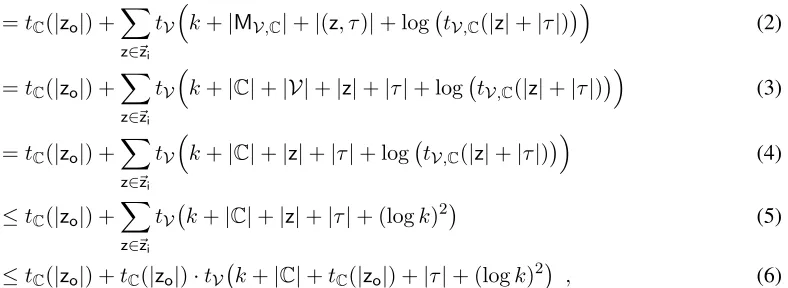
Succinctness. Analogously to a SNARK, the generatorG(1k)is required to run in timepoly(k), the
(honest) proverPC(σ,zo,linp,~zi, ~πi)in timepoly(k+|C|+|zo|+tC(|zo|)), and the verifierVC(τ,zo, πo)
in timepoly(k+|C|+|zo|), where tC(|zo|)is the time to evaluateC(zo;~zi,linp)andpolyis a universal
polynomial. In other words, proof-generation by the proverPCis (relatively) efficient in thelocal computa-tion (and independent of the computacomputa-tion performed by past or future nodes), and proof verificacomputa-tion by the verifierVCis independent of the computation that produced the message (no matter how long and expensive is the history that led to the message being verified).
Security. Again analogously to a SNARK, a PCD system also has a proof of knowledge property: when
a malicious proverP∗(σ) produces a messagezo and proofπo such thatVC(τ,zo, πo) = 1then, with all
but negligible probability, the extractor EP∗(σ) outputsa full transcript of a distributed computationthat isC-compliant and leads to the messagezo. In other words,VC can only be convinced to accept a given
message whenever the proverP∗actually “knows” aC-compliant computation leading up to that message.
A useful notion: the distributed computation graph. It will be convenient to think of a distributed
computation “unfolding over time” as a (labeled) directed acyclic graph (generated dynamically as the com-putation evolves) where comcom-putations occur at nodes, and directed edges denote messages exchanged be-tween parties. (When the same party computes twice, it will be a separate node “further down” the graph; hence the graph is acyclic.) See Figure 1 for a graphical depiction.
Preprocessing SNARKs and PCD systems. We also consider the weaker notion of an (expensive) pre-processing SNARK, in which the generator takes as additional input a time bound B, may run in time
We now move to describe in more detail, each of the three main tools developed to obtain our transformation.
2.2 The SNARK Recursive Composition Theorem
Our first step is to show that the existence of a SNARK implies the existence of a PCD system, with anal-ogous verifiability and efficiency properties, for the class ofconstant-depth compliance predicates. Here, thedepthd(C)of a compliance predicateCis the length of the longest path in (the graph corresponding to) any distributed computation compliant withC. (Note that a distributed computation of depthd(C), even a constant, may have many more “nodes” thand(C); e.g., it could be a wide tree of depthd(C).)
Theorem 1(SNARK Recursive Composition— informal).
(i) Any publicly-verifiable SNARK can be efficiently transformed into a corresponding publicly-verifiable PCD system for constant-depth compliance predicates.
(ii) Assuming the existence of FHE, any designated-verifier SNARK can be efficiently transformed into a corresponding designated-verifier PCD system for constant-depth compliance predicates.
Moreover, if the SNARK is of the preprocessing kind, then so is the corresponding PCD system; in such a case, our transformation further relies on collision-resistant hashing.
The purpose of the theorem is to cleanly encapsulate the idea of “recursive proof composition” of SNARKs within a PCD construction. After proving this theorem, every time we need to leverage the bene-fits of recursive proof composition, we can conveniently work “in the abstract” by engineering a (constant-depth) compliance predicate encoding the desired local property, and then invoke a PCD system to enforce this property across a distributed computation. We now outline the ideas behind the proof of the theorem; see Section 6 for details.
Part (i): the case of public verifiability. At high level, the PCD system(G,PC,VC) is constructed by using the SNARK (G,P,V) as follows. The PCD generator G invokes the SNARK generator G. The PCD prover PC uses the SNARK proverP to perform recursive proof composition relative to the given compliance predicate C. Roughly, when a party A wishes to begin a computation with message zA, A
usesP to generate a SNARK proofπAfor the claim “C(zA;⊥,⊥) = 1”; πAattests to the fact thatzAis
a compliant “input” to the distributed computation. When a partyB receiveszA, after performing some
computation by using some local inputlinpB(which may include a program) and then producing a message
zB,BusesPto generate a SNARK proofπBfor the claim “∃(linp0B,z0A, πA0 )s.t. C(zB;linp0B,z0A) = 1and πA0 is a valid SNARK proof for theC-compliance ofz0A”. And so on: in general, a party receiving input messages~ziwith corresponding proofs~πi, having local inputlinp, and producing messagezo, runs the PCD
proverPC(σ,zo,linp,~zi, ~πi), which usesP to generate a SNARK proofπo for the claim
“∃(linp0,~z0i, ~πi0)s.t.C(zo;linp0,~z0i) = 1andeachπi0 is a valid SNARK proof for theC-compliance ofz0i”;
the proofπo attests to the fact thatzo can be “explained” withsomeC-compliant distributed computation.
The PCD verifierVCuses the SNARK verifierV to verify the proofs.
The proof of knowledge property of the SNARK is crucial for the above to work. Indeed, there likely existsa proof, say,π1for theC-compliance ofz1, even if compliance does not hold, because the SNARK is
only computationally sound. While such “bad” proofs may indeed exist, they are hard to find. Proving the statement above with a proof of knowledge, however, ensures that whoever is able to prove that statement also knows a proofπ1, and this proof can be found efficiently (and thus is not “bad”).
the entire distributed computation so far. Instead, by carefully using recursion, we can ensure that the state-ment made by each prover only involves its own proof-carrying input messages, local inputs, and outputs. Following [CT10], this is formally captured by proving SNARK statements regarding the computation of a specialrecursive“PCD machine”MC. The machineMC, given an alleged output message together with a witness consisting of proof-carrying inputs, verifies: (a) that the inputs and outputs areC-compliantas well as(b) verifying that each input carries a valid proof thatMCitself acceptszafter a given number of steps. (Of course, to formalize this recursion, one has to use an efficient version of the Recursion Theorem.) See Section 6.1 for details.
While the core idea behind our construction is similar to the ideas used in [Val08] and in [CT10], the details and the proof are quite different: [Val08] focuses on a special case of PCD, while [CT10] work in a model where parties can access a signature oracle rather than in the plain model.
Part (ii): the case of designated verifiers.The more surprising part of the theorem, in our mind, is the fact that designated-verifier SNARKs canalsobe composed. Here, the difficulty is that the verification stateτ
(and hence the verification code) is not public. Hence, we cannot apply the same strategy as above and prove statements like “the SNARK verifier accepts”. Intuitively, fully-homomorphic encryption (FHE) may help in resolving this problem, but it is not so clear how to use it. Indeed, if we homomorphically evaluate the verifier, we only obtain its answerencrypted, whereas we intuitively would like to know right away whether the proof we received is good or not, because we need to generate a new proof depending on it.
We solve this issue by directly proving that we homomorphically evaluated the verifier, and that a certain encrypted bit is indeed the result of this (deterministic) evaluation procedure. Then, with every proof we carry an encrypted bit denoting whether the data so far isC-compliantor not;when we need to “compose” we ensure that the encrypted answer of the current verification is correctly multiplied with the previous bit, thereby aggregating the compliance up to this point. For further details see Section 6.2.
The case of preprocessing SNARKs. Our theorem also works with preprocessing SNARKs. Specifically, when plugging a preprocessing SNARK into the SNARK Recursive Composition Theorem, we obtain a corresponding preprocessing PCD system, where (as in a preprocessing SNARK) the PCD generatorGalso takes as input a time boundB, and produces a reference string and verification state that work as long as the amount of local computation performed by a node (or, more precisely, the time to computeCat a node) in the distributed computation is bounded byB. More concretely, ifGinvokes the SNARK generatorGwith time boundB0, the computation allowed at each nodeiis allowed to be, roughly, as large asB0−deg(i)·t
V,
where tV is the running time of SNARK verifierV anddeg(i) is the number of incoming inputs (which
is also the number of proofs to be verified); thus we can simply setB0 = B + maxideg(i)·tV. (The
degree will always be bounded by a fixed polynomial in the security parameter in our applications.) Unlike completeness, the security properties are not affected by preprocessing; the proof of the SNARK Recursive Composition Theorem in the case with no preprocessing carries over to the preprocessing case. Yet, while we do not need a different security proof for the preprocessing case, setting up a PCD construction that works properly in this setting should be done with care. For example, in their construction of encryption with targeted malleability, Boneh, Segev, and Waters [BSW12] recursively composed preprocessing SNARKs without leveraging the fast running time of the SNARK verifier, and hence they needed a preprocessing step that budgets for anentiredistributed computation and not just asinglenode’s computation (as in our case). This difference is crucial; for instance, it is essential to our result that allows to remove preprocessing from a SNARK or PCD system.
property in order to “dig into the past”, starting from a given message and proof. The recursion works for at most a constant number of times, because each extraction potentially blows up the size of the extractor by a polynomial, and that is why we needd(C) =O(1). (See Remark 6.3 for more details.) Still, we next show that constant-depth compliance predicates can already be quite expressive.
2.3 The PCD Depth-Reduction Theorem
PCD systems for constant-depth compliance predicates are significantly more powerful than SNARKs; yet, they may seem at first sight to not be as expressive as we would like. In general, we may be interested in compliance predicates of polynomial depth, i.e., that allow for compliant distributed computations that are polynomially deep. To alleviate this restriction, we prove that PCD systems for constant-depth compliance predicates can “bootstrap themselves” to yield PCD systems for polynomial-depth compliance predicates, at least for distributed computations that evolve over a path. Specifically, in apathPCD system,completeness does not necessarily hold for any compliant distributed computation, but only for those where the associated graph is a path, i.e., each node has only a single input message. We show:
Theorem 2(PCD Depth Reduction— informal). Assume there exist collision-resistant hash functions. Any PCD system for constant-depth compliance predicates can be efficiently transformed into a corresponding path PCD system for polynomial-depth compliance predicates. The verifiability properties carry over, as do efficiency properties. (The result also holds for additional classes of graphs; see Remark 8.8.)
At high-level, the proof consists of two main steps:
• Step 1. Say thatChas polynomial depthd(C) =kc. We design a new compliance predicate TREE
Cof
constantdepthcthat is a “tree version” ofC. Essentially, TREECforces any distributed computation that is compliant with it to be structured in the form of ak-ary tree whose leaves areC-compliant nodes of a computation along a path, and whose internal nodes aggregate information about the computation. A message at the root of the tree is TREEC-compliant only if the leaves of the tree have been “filled in” with aC-compliant distributed computation along a path.
• Step 2. We then design a new PCD system(G0,P0
C,V0C)based on (G,PTREEC,VTREEC)that, intuitively, dynamically builds a (shallowk-ary) Merkle tree of proofs “on top” of an original distributed computa-tion. Thus, the new proverP0Cat a given “real” node along the path will run PTREEC for each “virtual”
node in a slice of the tree constructed so far; roughly,PTREEC will be responsible for computing the proof of the current virtual leaf, as well as merging any internal virtual node proofs that can be bundled together into new proofs, and forwarding all these proofs to the next real node. The number of proofs sent between real nodes is small: at mostck. The new verifierV0Cwill runVTREEC for each subproof in a given proof of the new PCD system.
Essentially, the above technique combines the wide Merkle tree idea used in the construction of SNARKs in [BCCT12, GLR11] and (once properly abstracted to the language of PCD) the idea of Valiant [Val08] for building proofs “on top” of a computation in the special case of IVC. For the above high-level intuition to go through, there are still several technical challenges to deal with; we account for these in the full construction and the proof of the theorem in Section 8.
2.4 The Locally-Efficient RAM Compliance Theorem
So far we have shown how, given any SNARK, we can obtain a PCD system for constant-depth compliance predicates, and then obtain a path PCD system for polynomial-depth compliance predicates; both PCD systems inherit the efficiency and verifiability features of the given SNARK.
We now discuss the last ingredient required for our main technical result. Looking ahead, our proof strategy to achieve complexity preservation, say, in a SNARK will be to reduce the task of verifying anNP statement “∃w s.t. M(x, w) = 1 in time t” to the task of verifying that a path distributed computation is compliant with a corresponding (polynomial-depth) compliance predicateC(M,x,t). We can then verify
compliance withC(M,x,t) of such a distributed computation by using the path PCD system we constructed
from the SNARK. Moreover, if we can ensure that each node along the path of the distributed computation only performs a small amount of computation, then we can “localize” the impact of any inefficiency of the path PCD system. Concretely, preprocessing becomes inexpensive (because it only needs to budget for small local computations), and computing a proof of compliance for the entire distributed computation can be done in roughly the same time and space as those required to computeM(x, w).
At high-level, to achieve the above, we engineer the compliance predicate C(M,x,t) so to force any
distributed computation compliant withC(M,x,t) to verify the computation of the random-access machine M onx(and some witnessw),one step at a timefor at mosttsteps. While verifying a single step ofM
seems like a “small and local” computation, such verification takes time at least linear in the size ofM’s state, which can be as large asM’s space complexitys. Becausescould be on the order oft, naively breaking the computation ofMinto many single-step computations doesnotyield small-enough local computations.
To overcome this problem, we proceed in two steps. First, we invoke a reduction by Ben-Sasson et al. [BSCGT13]: given collision-resistant hashing, the problem of verifying an NP statement “∃ w s.t.
M(x, w) = 1 in time t” can be reduced to the simpler task of verifying a new NP statement “∃ w s.t.
M0(x, w) = 1 in time t0”, whereM0 is a poly(k)-space machine andt0 = t·poly(k). The reduction follows from techniques foronline memory checkingof Blum et al. [BEG+91], which use Merkle hashing to outsource the machine’s memory and dynamically verify its consistency using only a smallpoly(k)-size “trusted” memory. Second, we engineer a compliance predicate for ensuring correct computation ofM0, one state transition at a time. Crucially, the overall reduction allows to compute a compliant distributed computation using the same time and space as those originally required byM(up topoly(k)factors).
We now state informally the result; for details, see Section 7.
Theorem 3(Locally-Efficient RAM Compliance — informal). LetHbe a family of collision-resistant hash functions. There is a linear-time transformation from any instance (M, x, t) and function h ∈ H to a compliance predicateC(M,x,t),hwith deptht·poly(k)satisfying the following properties.
1. Completeness: Given w such thatM(x, w) accepts in timet and space s, one can generate, in time
(|M|+|x|+t)·poly(k)and space(|M|+|x|+s)·poly(k), a distributed computation on a path that is compliant withC(M,x,t),h. Each node in the distributed computation performspoly(k+|M|+|x|)work. 2. Proof of knowledge: From any efficient adversary that, given a randomh, outputs a distributed
compu-tation compliant withC(M,x,t),h, we can efficiently extractwsuch thatM(x, w)accepts in timet.
2.5 Putting Things Together: A General Technique for Preserving Complexity
Equipped with the SNARK Recursive Composition, PCD Depth-Reduction, and Locally-Efficient RAM Compliance Theorems, we restate our main theorem and sketch its proof.
1. Complexity-Preserving SNARK from any SNARK. There is an efficient transformationTH such that
for any publicly-verifiable SNARK(G,P,V) there is a polynomialpfor which(G?,P?,V?) := T H(G, P,V)is a publicly-verifiable SNARK that is complexity-preserving with a polynomialp, i.e.,
• the generatorG?runs in timep(k)(in particular, there is no expensive preprocessing);
• the proverP?runs in timet·p(k)and spaces·p(k)when proving that at-times-spaceNP random-access machineMnon-deterministically accepts an inputx;
• the verifierV?runs in time|x| ·p(k).
2. Complexity-Preserving PCD from any SNARK. There is an efficient transformationT0H such that for any publicly-verifiable SNARK (G,P,V) there is a polynomialpfor which(G?,P?,V?) := T0
H(G,P, V)is a publicly-verifiable PCD for constant-depth compliance predicates that is complexity-preserving with polynomialp, i.e.,
• the generatorG?runs in timep(k);
• the proverP?runs in timet·p(k)and spaces·p(k)when proving that a messagezoisC-compliant,
using local inputlinpand received inputs~zi, and evaluatingC(zo;linp,~zi)takes timetand spaces;
• the verifierV?runs in time|zo| ·p(k).
Assuming fully-homomorphic encryption, similar statements hold for the designated-verifier cases.
Proof sketch. We first sketch the proof to the first item; we follow the plan outlined in Section 1.4. Let
(G,P,V)be anySNARK, and assume (for the worst) that it has expensive preprocessing. We invoke the SNARK Recursive Composition Theorem to obtain a corresponding PCD system(G,P,V)for constant-depth compliance predicates, and then the PCD Depth-Reduction Theorem to obtain a corresponding path PCD system(G0,P0,V0) for polynomial-depth compliance predicates. Both transformations preserve the verifiability and efficiency of the SNARK (including preprocessing).
We now use (G0,P0,V0) to construct a complexity-preserving SNARK(G?,P?,V?) as follows. The
new generatorG?, given input1k, outputs(σ0, τ0) := ((h, σ),(h, τ)), whereh
← Hk,(σ, τ)←G0(1k, kc),
andcis a constant that only depends on(G,P,V). The new proverP?, given a reference stringσ0, instance (M, x, t), and a witnessw, invokes the Locally-Efficient RAM Compliance Theorem in order to compute the polynomial-depth compliance predicateC(M,x,t),h and, using the proverP0, computes a proof for each
message in the path distributed computation obtained from(M, x, t)andw(each time using the previous proof); it outputs the final such proof as the SNARK proof. (We assume, without loss of generality, that|M| and|x|are bounded by a fixedpoly(k); if that is not the case (e.g.,Mencodes a large non-uniform circuit), P?can work with a new instance(U
h,x,˜ poly(k) +t), whereUhis a universal random-access machine that,
on input(˜x,w)˜ , parsesw˜as(M, x, t, w), verifies thatx˜=h(M, x, t), and then runsM(x, w)for at mostt
steps.) The new verifierV?similarly deducesC(M,x,t),hand usesV0 to verify a proof.
Overall, we “localized” the use of the (inefficient) PCD system(G0,P0,V0)(obtained from the inefficient
SNARK(G,P,V)), so the SNARK(G?,P?,V?)is complexity preserving.
To obtain the second item of the theorem, we invoke again the SNARK Recursive Composition Theorem and the PCD Depth-Reduction Theorem, but this time with the complexity-preserving SNARK(G?,P?,V?);
the resulting PCD systems are complexity preserving.
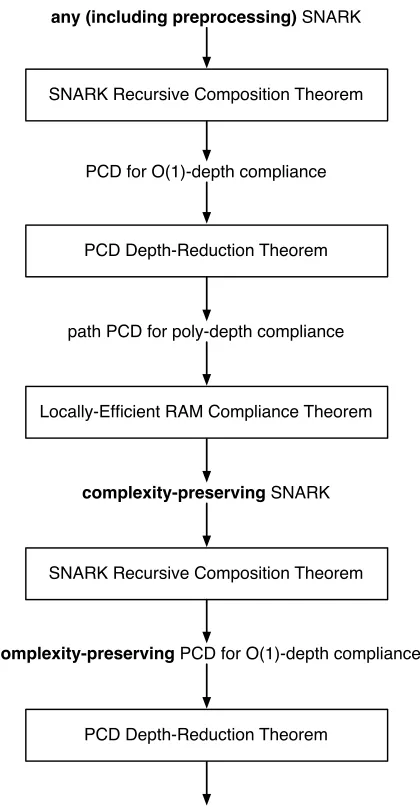
See Figure 2 for a summary of how our theorems come together and Section 9 for more details.
Instantiations. Our theorem provides a technique to improve the algorithmic properties ofanySNARK. For concreteness, let us discuss what we obtain via our theorem from known SNARK constructions.
we obtain thefirstconstructions, in the plain model, of publicly-verifiable SNARKs and PCD systems that arecomplexity-preserving(and, in particular, havenoexpensive preprocessing).
The aforementioned preprocessing SNARKs do not invoke the PCP Theorem but instead rely on simpler probabilistic-checking techniques (which can be cast aslinearPCPs [BCI+13]). While at first sight, these techniques seem to inherently require an expensive preprocessing, our transformation shows that, in fact, they can be used to obtain stronger solutions withnopreprocessing (in fact, that are complexity-preserving), still without invoking the PCP Theorem.
From PCP-based SNARKs.When plugging into our theorem any of the PCP-based SNARKs in [Mic00, BCCT12, DFH12, GLR11], we obtain complexity-preserving SNARKs based on the PCP Theorem; this, regardless of how poor is the time or space complexity of the PCP in the SNARK we start with. In particular, our theorem circumvents the seemingly-inherent suboptimal time-space tradeoffs of PCP-based SNARKs.
Technical comparison. Our main theorem says that PCD systems for a large class of distributed compu-tations can be obtained from collision-resistant hashing and any SNARK (that may have expensive prepro-cessing). Our theorem doesnotrely on the SNARK knowledge extractor being very fast; we only assume that the extractor is of polynomial size.
any (including preprocessing) SNARK
PCD for O(1)-depth compliance
path PCD for poly-depth compliance
complexity-preserving SNARK
complexity-preserving PCD for O(1)-depth compliance
complexity-preserving path PCD for poly-depth compliance SNARK Recursive Composition Theorem
PCD Depth-Reduction Theorem
Locally-Efficient RAM Compliance Theorem
PCD Depth-Reduction Theorem SNARK Recursive Composition Theorem
3
The Universal Language on Random-Access Machines
We define the universal relation[BG08] (along with related notions), which provides us with a canonical form to represent verification-of-computation problems. Because, the notion ofpreserving complexity(of SNARKs and PCD schemes) is defined relative torandom-access machines[CR72, AV77], we make them our choice of abstract machine for the universal relation.2 Doing so is also convenient because verification-of-computation problems typically arise in the form ofalgorithms(e.g., “is therewthat makes algorithmA accept(x, w)?”).
Definition 3.1. Theuniversal relation is the setRU of instance-witness pairs (y, w) = (M, x, t), w
, where|y|,|w| ≤ tandMis a random-access machine, such thatM accepts(x, w)after at mosttsteps.3 We denote byLU theuniversal languagecorresponding toRU.
For any c ∈ N, we denote byRc the subset ofRU consisting of those pairs (y, w) = (M, x, t), t
for whicht ≤ |x|c; in other words,R
cis a “generalized”NPrelation, where we do not insist on the same
machine accepting different instances, but only insist on a fixed polynomial bounding the running time in terms of the instance size. We denote byLcthe language corresponding toRc.
4
SNARKs
Asuccinct non-interactive argument (SNARG) is a triple of algorithms (G,P,V) that works as follows. The generatorG, on input the security parameterkand a time boundB, samples areference stringσand a correspondingverification state τ. The honest proverP(σ, y, w) produces a proofπ for the statement
y= (M, x, t)given a validw, provided thatt≤B; thenV(τ, y, π)deterministically verifiesπ.
The SNARG is adaptive if the prover may choose the statement after seeingσ, otherwise, it is non-adaptive. The SNARG isfully-succinctifGruns “fast”, otherwise, it is of thepreprocessingkind.
Definition 4.1. A triple of algorithms(G,P,V), whereGis probabilistic andVis deterministic, is aSNARG
for the relationRU if the following conditions are satisfied:
1. Completeness
For every large enough security parameterk∈N, every time boundB∈N, and every instance-witness pair(y, w) = (M, x, t), w∈ RU witht≤B,
Pr
V(τ, y, π) = 1
(σ, τ)← G(1
k, B)
π ← P(σ, y, w)
= 1 .
2. Soundness (depending on which notion is considered)
2
While random-access machines can be (nondeterministically) simulated by multitape Turing machines with only polyloga-rithmic overhead in running time [Sch78, GS89], the space complexity of the random-access machine isnotpreserved by this simulation. It is not known how to avoid the large space usage of this simulation. Thus, it is indeed important that we define the universal relation with respect to random-access machines and not Turing machines.
3
While the witnesswfor an instancey= (M, x, t)has size at mostt, there isno a-prioripolynomial boundingtin terms of
• non-adaptive: For every polynomial-size proverP∗, every large enough security parameterk ∈ N, every time boundB ∈N, and every instancey= (M, x, t)∈ L/ U,
Pr
V(τ, y, π) = 1
(σ, τ)← G(1
k, B)
π← P∗(σ, y)
≤negl(k) .
• adaptive: For every polynomial-size proverP∗, every large enough security parameterk ∈ N, and every time boundB ∈N,
Pr
V(τ, y, π) = 1 y /∈ LU
(σ, τ)← G(1
k, B)
(y, π)← P∗(σ)
≤negl(k) .
3. Efficiency
There exists a universal polynomialpsuch that, for every large enough security parameterk∈N, every time boundB∈N, and every instancey = (M, x, t)witht≤B,
• the generatorG(1k, B)runs in time
(
p(k+B) for a fully-succinct SNARG
p(k+ logB) for a preprocessing SNARG ;
• the proverP(σ, y, w)runs in time
(
p(k+|M|+|x|+t+ logB) for a fully-succinct SNARG
p(k+|M|+|x|+B) for a preprocessing SNARG ; • the verifierV(τ, y, π)runs in timep(k+|M|+|x|+ logB);
• an honestly generated proof has sizep(k+ logB).
Acomplexity-preserving SNARG is a SNARG where the generator, prover, and verifier complexities are essentially optimal:
Definition 4.2. A triple of algorithms(G,P,V)is acomplexity-preserving SNARGif it is a SNARG where efficiency is replaced by the following stronger requirement:
Complexity-preserving efficiency
There exists a universal polynomialpsuch that, for every large enough security parameterk∈N, every time boundB∈N, and every instancey = (M, x, t)witht≤B,
• the generatorG(1k, B)runs in timep(k+ logB);
• the proverP(σ, y, w)runs in time(|M|+|x|+t)·p(k+ logB); • the proverP(σ, y, w)runs in space(|M|+|x|+s)·p(k+ logB); • the verifierV(τ, y, π)runs in time(|M|+|x|+ logt)·p(k+ logB); • an honestly generated proof has sizep(k+ logB).
ASNARG of knowledge, or SNARK for short, is a SNARG where soundness is strengthened as follows:
Adaptive proof of knowledge4
For every polynomial-size prover P∗ there exists a polynomial-size extractor EP∗ such that for every large enough security parameterk ∈ N, every auxiliary inputz ∈ {0,1}poly(k), and every time bound
B ∈N
Pr
V(τ, y, π) = 1
(y, w)∈ R/ U
(σ, τ)← G(1k, B) (y, π)← P∗(z, σ) w← EP∗(z, σ)
≤negl(k) .
One may want to distinguish between the case where the verifier stateσis allowed to be public or needs to remain private. Specifically, apublicly-verifiable SNARK(pvSNARK) is one where security holds even ifσis public; in contrast, adesignated-verifier SNARK(dvSNARK) is one whereσneeds to remain secret.
The SNARKs given in Definition 4.3 are for the universal relationRUand are calleduniversal SNARKs.5
In this work, we neither rely on nor achieve universal SNARKs. Instead, we rely on and achieve SNARKs forNP: these are SNARKs in which, when the verifierVis given as additional input a constantc >0, proof of knowledge only holds with respect to theNPrelationRc⊂ RU (see Section 3). (Even in a SNARK for
NP, though, the polynomialpgoverning the efficiency of the SNARK is still required to beuniversal, that is, independent ofc.) Thus,everywhere in this paper, when we say “SNARK”, we mean “SNARK forNP”. (And this is indeed the definition of SNARK studied, and achieved, by previous work.)
The technical difference between a universal SNARK and a SNARK forNPwill not matter much for most of the paper, except for when proving the SNARK Recursive Composition Theorem in Section 6 (and this is why we first give the more natural definition of a universal SNARK). For completeness, we now also define a SNARK forNP.
Definition 4.4. ASNARK forNPis defined as in Definition 4.3,exceptthat proof of knowledge is replaced by the following weaker requirement:
Adaptive proof of knowledge forNP
For every polynomial-size prover P∗ there exists a polynomial-size extractor EP∗ such that for every large enough security parameter k ∈ N, every auxiliary input z ∈ {0,1}poly(k), every time bound B ∈N, and every constantc >0,
Pr
Vc(τ, y, π) = 1 (y, w)∈ R/ c
(σ, τ)← G(1k, B) (y, π)← P∗(z, σ) w← EP∗(z, σ)
≤negl(k) .
Remark 4.5 (fully-succinct SNARKs for NP). In a fully-succinct SNARK for NP, there is no need to provide a time boundBtoG, because we can setB:=klogk. We can then writeG(1k)to meanG(1k, klogk);
then, becauselogB = poly(k),Gwill run in timepoly(k),Pin timepoly(k+|M|+|x|+t), and so on.
Remark 4.6(multi-instance extraction). In this work we perform recursive extraction along tree structures. In particular, we will be interested in provers producing a vector of instances~y together with a vector of corresponding proofs ~π. In such cases, it is convenient to use an extractor that can extract a vector of witnesses w~ containing a valid witness for each proof accepted by the SNARK verifier. This notion of extraction can be shown to follow from the “single-instance” extraction notion of Definition 4.3.
4One can also formulate weaker proof of knowledge notions; in this work we focus on the above strong notion. 5