Adaptive Key Protection in Complex
Cryptosystems with Attributes
Zilong Wang∗
School of Mathematical Sciences, Peking University, Beijing 100871, P.R. China
Danfeng (Daphne) Yao† Department of Computer Science, Virginia Tech, Blacksburg VA 24060, USA
Rongquan Feng
School of Mathematical Sciences, Peking University, Beijing 100871, P.R. China
Abstract
In the attribute-based encryption (ABE) model, attributes (as op-posed to identities) are used to encrypt messages, and all the receivers with qualifying attributes can decrypt the ciphertext. However, com-promised attribute keys may affect the communications of many users who share the same access control policies. We present the notion of forward-secure attribute-based encryption (fs-ABE) and give a con-crete construction based on bilinear map and decisional bilinear Diffie-Hellman assumption. Forward security means that a compromised private key by an adversary at time t does not break the confiden-tiality of the communication that took place prior to t. We describe how to achieve both forward security and encryption with attributes, and formally prove our security against the adaptive chosen-ciphertext adversaries. Our scheme is non-trivial, and the key size only grows
∗This work was done by the first author when he was a visitor at Virginia Tech. He
was supported in part by Graduate School of Peking University (2010-02-020).
†This work has been supported in part by NSF grant CAREER CNS-0953638 and
polynomially with logN (where N is the number of time periods). We further generalize our scheme to support the individualized key-updating schedule for each attribute, which provides a finer granularity for key management. Our insights on the required properties that an ABE scheme needs to possess in order to be forward-secure compatible are useful beyond the specific fs-ABE construction given. We raise an open question at the end of the paper on the escrow problem of the master key in ABE schemes.
Keywords: Attribute-based encryption, forward security, key update
1
Introduction
The main feature of a forward-secure encryption scheme is that the compro-mise of current decryption keys does not comprocompro-mise past decryption keys; therefore the confidentiality of past communications is preserved. Forward security aims at mitigating the damages caused by stolen secret keys. This concept was first coined by G¨unther [1] and later by Diffie et al. [2]. In for-ward secure schemes, secret keys are updated at regular intervals throughout the lifetime of the system; furthermore, exposure of a secret key correspond-ing to a given interval does not enable an adversary to break the system for any prior time period. To prevent the adversary from breaking the secu-rity of the system for any subsequent time period, one needs to revoke the compromised keys. Solutions for supporting the forward security have been proposed in the context of symmetric-key encryption schemes [3], public-key encryption schemes [4], identity-based encryption [5], digital signature schemes [6, 7, 8], and recently in cloud-based content delivery [9].
In this paper, we point out that forward security is important for preserv-ing the security of attribute-based encryption (ABE) schemes [10, 11, 12]. In ABE schemes, attributes (as opposed to identities) are used for encryp-tion, and only users with qualified attributes (and corresponding private keys) can decrypt. Attribute-based encryption enables the implicit encod-ing of authorization policies in the private key of the user (e.g., key-policy attribute-based encryption [10]) or in the ciphertext (e.g., ciphertext-policy attribute-based encryption [13]). However, because the attribute-based se-crets are shared among all qualifying users, compromised keys can affect other users’ communication. Thisshared keyfeature in the key management of ABE motivates our work on designingforward-secure attribute-based en-cryption (fs-ABE). In a fs-ABE, any compromised attribute key at time t
Attribute-based encryption has practical applications in advanced access control and data management, such as electronic medical records [14, 15]. In real world, ABE system can be naturally used to construct a targeted broadcast system, which is first descibed in [10]. In this kind of system, the needs of individual users is targeted at, while a broadcast channel still offer the content with economies-of-scale. For such an application, the construc-tion based on ABE scheme is more efficent than other broadcast encrypconstruc-tion schemes. As in broadcast encryption, forward security in this situation is very important. Forward secure ABE schemes can improve the practicability of the contruction.
Our contributions are summarized as follows.
• We give the model and definition for a general forward-secure attribute-based encryption scheme that is secure against adaptive chosen-ciphertext adversaries. We define the security in a game model allowing the ad-versary to issue key-generation queries and decryption queries. The users refresh their private keys autonomously, which is scalable. We supportdynamic join where users can join the fs-ABE system at any time.
• We give a concrete instantiation of a forward-secure attribute-based encryption scheme, where secrets corresponding to all the attributes evolve and update based on the same schedule. Our construction makes use of the operations in key-policy attribute-based encryption scheme by Goyal, Pandey, Sahai, and Waters (GPSW-ABE) [10], and inherits its bilinear map usage as well as the hardness assumption of decisional bilinear Diffie Hellman (DBDH). We formally prove the security of our scheme and analyze the complexities of the operations.
We also provide insights on the general properties that an ABE scheme should posses in order to support forward security. We explain why CP-ABE scheme cannot be converted into a non-trivial forward se-cure one with the existing cryptographic tools and leave it as an open problem.
• We further improve the flexibility of our basic fs-ABE scheme by sup-porting the individualized key-updating schedule for each attribute, and provide the sketch for its security. Individualized key update im-proves the efficiency, usability, and security of the fs-ABE scheme.
encryp-tion (ABE) against compromised secret keys. Although our specific con-struction is based on key-policy ABE (KP-ABE), we summarize the prop-erties that can be used determine whether an attribute-based encryption scheme is forward-secure compatible or not. This contribution is significant beyond the specific KP-ABE scheme studied.
Organization of the paper Related work is given in the next section. We present our definitions and model of a forward-secure attribute-based encryption scheme in Section 3. We give some trivial schemes and discuss why they are not good in Section 4. We present requirements that an ABE scheme needs to satisfy in order to become foward-secure compatible in Section 5. A concrete construction based on bilinear maps is described in Section 6. Our basic fs-ABE scheme is extended into a ifs-ABE scheme in 7. Several extensions are presented to further improve the security of our scheme in Section 8. Conclusions and an open problem are given in Section 9. Our formal proof is given in Appendix B.
2
Related Work
The notion of non-interactive forward security was proposed by Ander-son [16], which was formalized by Bellare and Miner [6]. Forward-secure digital signature schemes were also proposed [6, 7, 8]. Bellare and Yee [3] provided a comprehensive description of forward security in the context of symmetric-key based cryptographic primitives. The first forward-secure public-key encryption (fs-PKE) scheme was given by Canetti et al. [4], based on the decisional bilinear Diffie-Hellman assumption [17].
The fs-PKE scheme in [4] constructs a binary tree, in which a tree node corresponds to a time period and has a secret key. Children of a node w
are labeled w0 and w1, respectively. Given the secrets corresponding to a prefix of a node representing timet, one can compute the secrets of time t. In order to make future keys computable from the current key, the secrets associated with a prefix of a future time are stored in the current key. After the key for the next time period is generated, the current decryption key is erased. The data structure was inspired by the identity hierarchy in the Gentry-Silverberg HIBE scheme [18], and is also used by our work to encode the time information in policies.
is a realistic threat over the lifetime of such a scheme, and the standard no-tion of HIBE security crucially depends on secret keys remaining secret. The forward-secure hierarchical identity-based encryption (fs-HIBE) scheme al-lows each user in the hierarchy to refresh his or her private keys periodically while keeping the public key the same.
Attribute based encryption schemes are related to the identity-based encryption (IBE) schemes [19, 20, 21, 22, 23], as both cryptosystems are novelty public-key encryption schemes with properties that can be leveraged for authorization. Solutions have been proposed to utilize IBE schemes for access control [5, 24], specifically encoding authorization policies in the public keys. Researchers recently found that ABE schemes can provide expressive and anonymous authorization mechanisms for the information sharing in the cloud [25, 26, 27, 28]. A comprehensive survey on ABE schemes can be found in [29].
3
Definitions and Models in Forward-secure
Attribute-Based Encryption
We define the syntax of forward-secure ABE (fs-ABE) scheme and security model for such schemes in this section. Most of the recent ABE schemes can be categorized as key-policy attribute-based encryption (KP-ABE) or ciphertext-policy attribute-based encryption (CP-ABE). In KP-ABE schemes (e.g., [10]), each private key is associated with an access structure that is chosen by the authority, and each ciphertext is labeled with a set of at-tributes. A private key can decrypt a ciphertext if and only if the attributes in the ciphertext satisfy the access structure in the private key. A KP-ABE scheme can be realized with a tree access structure which is composed of threshold gates as interior nodes and the attributes as leaves. Ostrovsky et al. [11] described a KP-ABE scheme where non-monotonic access structures can be specified and enforced. Bethencourt et al. [13] gave the first concrete CP-ABE scheme, where each private key is described by a set of attributes, and each ciphertext is associated with an access structure that is determined by the party encrypting the message. Our definitions and construction in this paper follows the KP-ABE paradigm. We point out the challenges as-sociated with providing non-trivial forward security for CP-ABE schemes in Section 5.
0
00
000 001 01
010 011
1
10
100 101
11
110 111
(a) The time periodh5i= 101.
z
r “1-1” “2-0” “3-1”
T
(b) The treeT101.
Figure 1: The time periodh5i= 101 in (a) and the treeT101in (b) associated
with the time period h5i = 101, where the total number of time periods is
N = 2d = 23.
the end of each time period he updates his private key for the next time period and erases the current key. During the time period i, a message is encrypted using a set of attributes and the time periodi. A user can decrypt the encrypted message using his private key for the time periodi, if and only if the access tree in his private key can be satisfied by the set of attributes in the ciphertext.
3.1 Notations
Time Period We assume for simplicity that the total number N of time periods is a power of 2; that is N = 2d. Let hii denote the d-bit represen-tation of the time periodi (where 0≤i≤2d−1). Let w=w
1w2· · ·wl be thel-bit prefix of the bit representation of some time period. In our fs-ABE scheme, time periods are associated with the leaf nodes of a binary tree. This representation of time follows that of fs-PKE [4]. Figure 1(a) shows the time periodh5i= 101, whered= 3. A simple tree T101 associated with
the time periodh5i= 101 is shown in Figure 1(b).
z
r “1-w1” “2-w2” · · · · · ·
“l-wl” (l+ 1, l+ 1)-gate
T
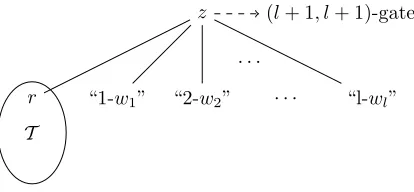
Figure 2: The treeTw, where “1-w1”, “2-w2”,· · ·, “l-wl” are components of a prefixw=w1w2· · ·wl (1 ≤l≤d) of some time period. The time period isd-bit long.
the leaf node is defined as 1. We define the function parent(x) as the parent of the nodex. Ifxis a leaf node, then we use att(x) to denote the attribute associated withx. The children of every node are numbered from 1 in some order. Such a number associated with a node x can be returned by the function index(x).
We denote the subtree of Trooted at the nodex by T |x. Thus T is the same asT |r, wherer is the root node of the treeT. If a setγ of attributes satisfies the access tree T |x, we denote it as T |x(γ) = 1. Ifx is an interior node, thenT |x is satisfied byγ if and only if at leastkx subtreesT |x′ ofT |x is satisfied, where x′ is a child of x. If x is a leaf node, then T |x(γ) = 1 if and only if att(x)∈γ.
In the construction of fs-ABE scheme, we add a trivial (1,1)-gatezabove the root noderof an access treeT to obtain the treeTε, then add attributes “1-w1”, “2-w2”,· · ·, “l-wl” in turn to the treeTεas children of the root node
z of Tε, where “1-w1”, “2-w2”, · · ·, “l-wl” are the components of a prefix
w=w1w2· · ·wl(1≤l≤d) of some time period. We denote the new tree by
Tw. Notice that the root nodezis converted from (1,1)-gate to (l+ 1, l+ 1)-gate. Let skT,w denote the secret key associated with Tw. The tree Tw is illustrated in Figure 2.
Keys We denote the private key associated with an access tree T and a time periodiby SKT,i. The private keySKT,i consists of some secret keys associated with the treeT and some prefixes of the time period i:
SKT,i= skT,hii,{skT,i0i1···ik−11}ik=0
whereskT,hiiis the secret key used to decrypt a ciphertext,{skT,i0i1···ik−11}ik=0
periodi+ 1. Notice that ifi0i1· · ·ik−10 is a prefix of the time periodithen
the secret keyskT,i0i1···ik−11 is included inSKT,i, this setting ensures that a user can compute his private key for the next time from the current private key.
3.2 fs-ABE: Syntax
A fs-ABE scheme is specified by five algorithms: Setup, Encryption, Key Generation, Update, Decryption:
SetupThis algorithm takes as input an implicit security parameter and the total number of time periodsN, and outputs the public parameters PK and the master key MK. The master key MK will be known only to the Private Key Generator (PKG).
EncryptionThe sender takes as input a message m, a set γ of attributes, the current time periodiand the public parameters PK, and outputs a pair hi, Ci as the ciphertext.
Key GenerationA user requests to join the fs-ABE system at timei. The PKG takes as input an access tree T, the master key MK and the public parameters PK, and computes an initial secret key SKT,0. If the joining
time i 6= 0, then the PKG evolves the initial secret key SKT,0 to obtain
the secret key SKT,i for time i and outputs SKT,i, else the PKG directly outputs the initial secret keySKT,0.
UpdateAt the end of time periodi, the receiver uses the secret keySKT,i to compute his secret keySKT,i+1for the next time periodi+ 1, then erases
the current secret keySKT,i.
Decryption The receiver takes as input the ciphertext hi, Ci, the secret key SKT,i and the public parameters PK, and outputs the message m if
T(γ) = 1.
The standard correctness condition must be satisfied, namely for any (PK,MK) generated by Setup, any SKT,0 output by Key Generation, any
secret keySKT,igenerated by Update for the time periodiand any message
m, we have
Decryption(hi, Ci,SKT,i,PK) =m, where hi, Ci ←Encryption(m, γ, i,PK).
3.3 fs-ABE: Security Model
adversaries who adaptively choose the ciphertext, attributes, and time pe-riod, if all polynomial time adversaries have at most a negligible advantage against the challenger in the following game.
Setup The challenger runs the Setup algorithm of fs-ABE and gives the public parameters PK to the adversary. It keeps the master key to itself. Phase 1The adversary is allowed to issue the following two types of queries:
1. Private key querySKT,j associated with an access tree T and a time periodj: the challenger runs the Key Generation algorithm to generate the private keySKT,0 corresponding to the treeT and the initial time
period 0, then recursively runs the Update algorithm to generate the private keySKT,j, and sends SKT,j to the adversary.
2. Decryption query (T,hj, Ci): the challenger runs the Key Generation algorithm to generate the private keySKT,0corresponding to the tree
T and the initial time period 0, recursively runs the Update algorithm to generate the private keySKT,j, then runs the Decryption algorithm to decrypthj, CiusingSKT,j, and sends the result to the adversary. These queries may be issued adaptively. The adversary is allowed to query for any access tree and any time period.
ChallengeOnce the adversary decides that Phase 1 is over, it submits two equal length messagesm0, m1, a set γ of attributes and a time period ion
which it wishes to be challenged. The constraint is that no private key query has been issued for the access treeT such thatT(γ) = 1 for any timej≤i.
The challenger flips a random coinb∈ {0,1}, and sets
hi, C∗i= Encryption(mb, γ, i,PK). It sendshi, C∗i as a challenge to the adversary.
Phase 2The adversary issues more queries:
1. Private key querySKT,j, where the access treeT and the time periodj are under the same restriction as in Challenge: the challenger responds as in Phase 1.
The adversary wins the game if b =b′. We define its advantage in this game to be|Pr[b=b′]−1
2|. A weaker type of security model against selective
chosen plaintext, a set of attributes and time period attack differs from the above model, in which the adversary declares the set of attributes and the time period on that it wishes to be challenged before the Setup in the game, and the adversary is not allowed to issue decryption queries in Phase 1 and Phase 2.
For security proof, we reduce the security of fs-ABE to the security of GPSW-ABE [10]. The security model for GPSW-ABE is similar to the weaker type of model for fs-ABE except that there is no time involved in the former one.
4
Some Trivial Forward-Secure Schemes
In this section, we take a quick look at three trivial forward-secure ABE constructions, and explain why these schemes are not good.
Scheme I.Consider a scheme based on any KP-ABE or CP-ABE schme (In fact, this construction can work for any other cryptosystem). A user is given a different private key per time period. This scheme is forward-secure. However, it has the following issues. First, a user cannot update the private key autonomously, and the workload of the PKG is increased. Second, the key size of the private key grows linearly with the numberN of time periods, it is not good.
Scheme II.Consider a scheme based on GPSW-ABE [10]. During a time periodi(where 0≤i≤N −1), the access tree in the private key of a user is original-tree T AND (time period i OR time period i+ 1 OR · · · OR time periodN −1). In this scheme, a user can update the private key for the next time periodi+ 1 from the current private key. This scheme is also forward-secure. However, the key size of the private key grows linearly with
N, that is the same as Scheme I.
We see this scheme is equivalent to Scheme II, and it is not good due to the key size.
All the above trivial schemes are not the fs-ABE we needed. For sim-plicity, the constructions of fs-ABE mentioned later do not include these trivial schemes. In our construction, a user can update the private key au-tonomously, and the key size of the private key only grows polynomially with logN. In addition, the secret keys composed of the private key are not all used to decrypt. Actually, only one secret key is used to do this, and the other secret keys are used to compute the private key for the next time period.
5
Generalization on Forward-Secure
Compatibil-ity
In this section, we discuss what properties should an ABE scheme have in order to support forward security, which we refer to asforward-secure com-patibility or FS-compatibility. The two requirements are the ability to dele-gate decryption keys and the extensibility of attributes, which are explained next.
Delegation of private keys. In ABE schemes, the delegation of private keys means that a user who has a private key for an access treeT (for KP-ABE schemes) or a setS of attributes (for CP-ABE schemes) can compute a new private key for a more restrictive access tree than T or a subset of
S. The ability of delegating the decryption capability to others (i.e., the delegation of private keys) in ABE schemes is a must for FS-compatibility. This requirement is because in a forward-secure scheme, a user needs to update his private key at the end of each time period; he must generate a new private key for the next time period using his current private key by himself without contacting the PKG. The delegation property is used in this process. In the construction (see Section 6) of our fs-ABE, the Update algorithm calls the Compute Next algorithm to compute the secret keys
skT,ww(l+1) from skT,w using the delegation property. Notice that the new time attribute “(l+1)-w(l+1)” is added during this process. Most of the
key-policy ABE schemes based on GPSW-ABE [10] can do this.
of attributes, which are used to describe necessary secret keys. In [13], the existing secret key associated with a set of attributes can only be used to generate a secret key for a subset of attributes – however, new attribute cannot be introduced. In constrast, for KP-ABE schemes the new time at-tribute can be added to the access tree associated with the existing secret keys – satisfying the attribute-extensibility requirement. This property al-lows one to construct the required secret keys for future time periods. How to support CP-ABE schemes with non-trivial forward security remains an interesting challenge.
6
A Forward-secure ABE Construction
In this section, we first give some mathematical preliminaries, then present the construction of a concrete forward-secure attribute-based encryption scheme.
6.1 Preliminaries
The security of our fs-ABE scheme is based on the decisional bilinear Diffie-Hellman (DBDH) assumption. We first introduce the concept of bilinear pairings.
Bilinear Pairings Let G1 and G2 be two multiplicative cyclic groups of prime order p. A bilinear pairing e : G1 ×G1 → G2 is a map with the following properties:
1. Bilinear: ∀u, v∈G1 and a, b∈Zp,e(ua, vb) =e(u, v)ab.
2. Non-degeneracy: The map does not send all pairs in G1 ×G1 to the identity inG2.
3. Computable: ∀u, v ∈G1,e(u, v) can be efficiently computed.
We callG1 a bilinear group if the group operation in G1 is efficiently com-putable.
Decisional Bilinear Diffie-Hellman (DBDH) AssumptionThe DBDH assumption is that all probabilistic polynomial time algorithms have at most a negligible advantage to distinguish the tuple (ga, gb, gc, e(g, g)abc) from the tuple (ga, gb, gc, e(g, g)z), wheregis a generator ofG1,e:G1×G1 →G2 is a bilinear pairing, and a, b, c, z are chosen fromZp randomly. The advantage of an algorithm Ais defined as
6.2 fs-ABE: Construction
LetG1 be a bilinear group of prime orderpwith a generatorg. Lete:G1× G1 → G2 denote the bilinear pairing. The size of the groups is determined by a security parameter κ. We define the Lagrange coefficient ∆i,S(x) = Q
j∈S,j6=i x−j
i−j for i ∈ Zp and a set S of elements in Zp. This construction uses all elements ofZ∗pas attributes, and it also allows us to apply a collision resistant hash functionH :{0,1}∗ →Z∗
p so that we can use arbitrary strings as attributes. The message will be encrypted under a time period i and a setγ of nelements ofZ∗p 1. The construction is shown below.
Setup(n, d) Let g1 = gy, where y is chosen randomly from Zp. Choose random g2 ∈ G1, and choose t1, t2,· · ·, tn+d+1 uniformly at random from G1. We define a function
T(X) =g2Xn+d
n+Yd+1
i=1
t∆i,Q(X)
i ,
whereQ={1,2,· · · , n+d+1}. This algorithm outputsg1, g2, t1, t2,· · ·, tn+d+1
as the public parameters PK andy as the master key MK. The master key will be known only to the Private Key Generator (PKG).
Encryption(m, γ, i,PK) Lethii=i1i2· · ·id. Choose randoms∈Zp. For a messagem∈G2, this algorithm outputs hi, Ci as the ciphertext, where
C = γ ∪ {“1-i1”,“2-i2”,· · · ,“d-id”}, C′ =me(g1, g2)s,
C′′=gs,{Ck=T(k)s}k∈γ∪{“1-i1”,“2-i2”,···,“d-id”}
.
Key Generation(T,MK,PK) The PKG computes an initial private key associated with the access treeT for the user, so that a message encrypted under a set γ of attributes and the time period 0 can be decrypted by the user if and only if the access treeT can be satisfied by the setγ of attributes. Choose a degree dx = kx −1 of polynomial qx for each node x in the tree T in a top down manner, where kx is the threshold value of the node
x. For the root noder, we completely define the polynomial qr by setting
1Strictly speaking,
γ is a set ofnelements ofZ∗
p\{“1-0”,“1-1”,· · ·,“d-0”,“d-1”}, where
{“1-0”,“1-1”,· · ·,“d-0”,“d-1”}denote all possible components of thed-bit representation of a time period. These components as attributes associated with time are also elements ofZ∗p. For clarity, we use these symbols to denote the components instead of using the numbers inZ∗
qr(0) = y and dr other points of qr randomly. For any other node x, we completely define qx by setting qx(0) = qparent(x)(index(x)) and dx other points randomly. We add a new (1,1) threshold gatez above the root node
r of the tree T, which becomes the parent of r. Define the polynomial associated withz: qz(X) ≡y such that qr(0) =qz(1) satisfied to the above constraint, where 1 is the index ofras a child ofz. We useTεto denote the new tree to whichz is added.
After all the polynomials are decided, for each leaf nodexof the treeTε, let
Dx(0) = gqx(0)
2 ·T(att(x))rx
Rx(0) = grx,
where rx is chosen randomly from Zp. Let the secret key skT,ε associated with the treeTε as
skT,ε=
{Dx(0), R(0)x }xis a leaf node ofT,∅
.
Using (skT,ε,Tε, ε), recursively apply algorithm Compute Next (defined below) to obtain the private key
SKT,0 = skT,h0i,{skT,1, skT,01,· · ·, skT,0d−11}
,
which is associated with the treeT and the time period 0. OutputSKT,0,
and erase all other information.
Notice that if the user joins the fs-ABE system at time i 6= 0, then PKG recursively runs the Update (defined later) algorithm using SKT,0
to obtain SKT,i associated with time i, and gives SKT,i to the user. For simplicity, we assume that the user joins the system at time 0.
Compute Next(skT,w,Tw, w) This algorithm takes a prefixw=w0w1· · ·wl of some time period, wherew0 =ε,0≤l≤d−1, the access treeTw and the secret key skT,w associated with Tw as input, and outputs the secret keys associated with the treesTw0and Tw1. Recall that ifw6=εthenTw denotes the tree that is obtained by adding the attributes “1-w1”, “2-w2”,· · ·, “l-wl” in turn to the tree Tε in the Key Generation algorithm as children of the root nodezof Tε, where “1-w1”, “2-w2”,· · ·, “l-wl” are the components of
Compared toTw, the treesTw0,Tw1, add one new time attribute
respec-tively. This method needs to compute the secret keys skT,w0 and skT,w1
forTw0 and Tw1. Specifically, it needs to define the polynomial for the new
time attribute. In addition, the polynomials associated with the existing attributes need to be refreshed. Then, it uses the constant terms of the polynomials associated with all the attributes in the tree to define the com-ponents of the secret key associated with the tree. Recall that in an access tree an attribute is represented by a leaf node.
Let q(xl)(X) denote the polynomial associated with the node x in the tree Tw, and let d(xl) denote the degree of qx(l)(X). Define qx(0)(X) =qx(X),
d(0)x =dx if x is inTor x=z.
1. We refresh the polynomials for all the existing nodes and define the polynomial for the new node as follows.
(a) (refresh) Refresh the polynomial forz:
qz(l+1)(X) = (− 1
l+ 2X+ 1)q
(l)
z (X) +p(zl+1)(X),
wherep(zl+1)(X) is a random polynomial of degreedz(l+1) =d(zl)+ 1 such that p(zl+1)(0) = 0. Thus, qz(l+1)(0) = q(zl)(0) = · · · =
qz(0)(0) =y, wherey is the master key.
(b) (refresh) For each node x in the tree T, refresh the polynomial forx:
q(xl+1)(X) = (− 1
l+ 2·1 + 1)q
(l)
x (X) +p(xl+1)(X),
where p(xl+1)(X) is a random polynomial of degree d(xl+1) = dx such thatp(xl+1)(0) =pparent((l+1) x)(index(x)). These polynomials are chosen in a top-down manner.
(c) (refresh) If w =ε, then go to step 1d, else for each node “k-wk” (1≤k≤l), refresh the polynomial for “k-wk”:
q(“k-l+1)w
k”(X) = (−
1
l+ 2·(k+ 1) + 1)q
(l)
“k-wk”(X) +p
(l+1) “k-wk”(X),
wherep(“k-l+1)w
k”(X) is a polynomial of degree 0 such thatp
(d) (define) For the new node “(l+1)-w(l+1)”, define the polynomial
for “(l+1)-w(l+1)”:
q(“(l+1)-l+1) w
(l+1)”(X) = 0 +p (l+1)
“(l+1)-w(l+1)”(X),
where p(“(l+1)-l+1) w
(l+1)”(X) is a polynomial of degree 0 such that
p(“(l+1)-l+1) w
(l+1)”(0) =p (l+1)
z (l+ 2).
All the above polynomials satisfy to the constraint in the Key Gener-ation algorithm.
2. Ifw6=ε, then let
skT,w=
{D(l)
x , R(xl)}xis a leaf node ofT,{D(“k-l)wk”, R
(l)
“k-wk”}1≤k≤l
.
Let the secret key associated with the treeTww(l+1) as
skT,ww(l+1) =
{D(xl+1), R(xl+1)}xis a leaf node ofT,{D“k-(l+1)wk”, R
(l+1)
“k-wk”}1≤k≤l+1
.
Next, we use the constant terms of the polynomials associated with all the leaf nodes in the treeTww(l+1) to define the components of the secret keyskT,ww(l+1). We refresh the D, R values for all the existing nodes and define theD, Rvalues for the new node as follows.
(a) (refresh) For each leaf nodex in the tree T, refresh D, Rvalues forx:
D(xl+1) = (Dx(l))−l+21 ·1+1·gp (l+1)
x (0)
2 ·T(att(x))r (l+1)
x
R(xl+1) = (R(xl))− 1
l+2·1+1·gr (l+1)
x
whererx(l+1)∈Zp is chosen randomly.
(b) (refresh) If w=ε, then go to step 2c, else for each node “k-wk” (1≤k≤l), refresh D, Rvalues for “k-wk”:
D“k-(l+1)w
k” = (D
(l) “k-wk”)
−l+21 ·(k+1)+1·gp(
l+1) “k-wk”(0)
2 ·T(att(“k-wk”))r (l+1) “k-wk”
R(“k-l+1)w
k” = (R
(l) “k-wk”)
−l+21 ·(k+1)+1·gr(“k-l+1)w
k”
wherer“k-(l+1)w k”∈
(c) (define) For the new node “(l+1)-w(l+1)”, defineD, R values for
“(l+1)-w(l+1)”:
D“(l+1)-(l+1) w
(l+1)” = g p(“(l+1)-l+1) w
(l+1)”(0)
2 ·T(att(“(l+1)-w(l+1)”)) r“(l+1)-(l+1) w
(l+1)”
R(“(l+1)-l+1) w
(l+1)” = g r(“(l+1)-l+1) w
(l+1)”
wherer“(l+1)-(l+1) w
(l+1)”∈
Zp is chosen randomly.
All the above D, Rvalues are in the same form as in the Key Gener-ation algorithm.
The algorithm outputs the secret keys skT,w0, skT,w1 associated with the
treesTw0,Tw1.
Update(SKT,i, i+ 1)(wherei < N−1) Lethii=i0i1· · ·id, wherei0 =ε.
Let SKT,i = skT,hii,{skT,i0i1···ik−11}ik=0
. Erase skT,hii. We distinguish two cases. Ifid= 0, simply output the remaining keys as the keySKT,i+1for
the next period. Otherwise, let ˜kbe the largest value such thatik˜ = 0 (such
˜
k must exist since i < N −1). Let i′ = i0i1· · ·i˜k−11. Notice that skT,i′ is included as part ofSKT,i. Using (skT,i′,Ti′, i′), recursively apply algorithm Compute Nextto generate keysskT,i′1, skT,i′01,· · · , sk
T,i′0d−˜k−11, skT,i′0d−˜k.
Erase skT,i′ and output the remaining keys asSKT,i+1.
Decryption(hi, Ci, SKT,i) This algorithm outputsmif and only ifT(γ) = 1. Lethii=i0i1· · ·id, where i0 =ε. Let
SKT,i= skT,hii,{skT,i0i1···ik−11}ik=0
,
skT,hii=
{D(xd), R(xd)}xis a leaf node ofT,{D(“k-d)wk”, R
(d)
“k-wk”}1≤k≤d
.
We first define a recursive algorithm DecryptNode(C, skT,hii, x), whereC=
γ∪ {“1-i1”,“2-i2”,· · ·,“d-id”}, C′, C′′,{Ck}k∈γ∪{“1-i1”,“2-i2”,· · ·,“d-id”}
, and
x is a node in the treeThii. • Ifx is a leaf node, then
DecryptNode(C, skT,hii, x)
=
e(Dx(d),C′′)
e(R(xd),Ck)
if k= att(x)∈γ∪ {“1-i1”,“2-i2”,· · · ,“d-id”}
• If x is an interior node, then DecryptNode(C, skT,hii, x) is defined as follows: If x is not satisfied, then DecryptNode(C, skT,hii, x) returns ⊥. Otherwise, call DecryptNode(C, skT,hii, x′) for all children x′ of x and denote the output byFx′. LetSx denote a set that consists ofkx nodesx′ such thatF
x′ 6=⊥. We define
DecryptNode(C, skT,hii, x) = Y
x′∈S
x
F∆j,Sx′(0)
x′
wherej= index(x′) and Sx′ ={index(x′) :x′∈Sx}.
The decryption algorithm calls the DecryptNode with (C, skT,hii, z), where
z is the root of the tree Thii. If the output of the DecryptNode is not ⊥, then we use it to divide into C′ and output the result. The correctness is shown in the appendix.
Proof of Security We reduce the security of fs-ABE to the security of GPSW-ABE [10]. We prove that the fs-ABE scheme is secure in the selective chosen plaintext, a set of attributes and time period model. In section 8, we will describe that how a selective chosen plaintext secure fs-ABE scheme can be transformed into one that is secure against adaptive chosen ciphertext adversaries.
The security is proven in a game model. The adversary A who can break the fs-ABE scheme can be used to construct an adversary B who attacks the GPSW-ABE scheme with a non-negligible advantage. Bis given the public parameters of the GPSW-ABE scheme by its challenger, then it simulates the fs-ABE environment for A. Although B does not have the master key of fs-ABE, B needs to answer the private key queries and the challenge ciphertext query from A. B’s responses have to be well-formed, i.e., compliant with the specifications of the fs-ABE scheme.
Theorem 1 If an adversary has advantage ǫ to attack the fs-ABE scheme in the selective chosen plaintext, a set of attributes and time period model, then a simulator can be constructed to attack the GPSW-ABE scheme in the selective chosen plaintext, a set of attributes model with the same advantage ǫ.
trees Thji and {Tj0j1···jk−11}jk=0, then constructs the secret keys associated
with these trees using the polynomials defined by PolyUnsat. B passes the set of above secret keys to A as SKT,j. For case 2, B runs PolyUnsat on the treeT, and constructs the secret key associated withT, then uses this key to obtain SK′
T,0 as in Key Generation of fs-ABE. Next, B runs Update
in fs-ABE withSK′
T,0 to genereteSKT′ ,j, and passesSKT′ ,j toA asSKT,j. The private keySKT,j in two cases both have identical distribution to that of the fs-ABE scheme. We also manage to make the simulatorB’s generation of the public parameters and the challenge ciphertext identical to that of the fs-ABE scheme. Thus, the Theorem 1 holds.
7
Individualized Forward-secure Attribute-Based
Encryption (ifs-ABE)
In fs-ABE described above, all attributes need to be updated according to the same schedule. We further extend our fs-ABE scheme to support more flexible and individualized key-update schedules, specifically each attribute may enjoy its own forward-secure key-updating precision. Our main moti-vation is to achieve more efficient operations. We refer to this new scheme as individualized fs-ABE (ifs-ABE). The ifs-ABE scheme provides the same security as fs-ABE in the fs-ABE security model. The security of the ifs-ABE scheme can be proven using a similar method as in Theorem 1. We outline our scheme next.
In an ifs-ABE scheme, each attribute has its own time precision. If the standard time period is i, then for an attribute x with the time precision
dx (dx ≤d) the local time period isi|dx, wherei|dx is the integer converted
from the dx-bit prefix i1i2· · ·idx of hii = i1i2· · ·id. In such a scheme, the
private key of a user is evolved with time. At the standard time period 0 a user is issued an initial private key associated with an access tree by the Private Key Generator (PKG). At the end of each standard time period he updates his private key for the next standard time period and erases the current key. For an attributexwith the time precisiondx, the corresponding component of the private key is not always updated when the standard time period changes. Specifically, if the next standard time period is multiple of 2d−dx then it will be updated. As an example, let the standard time
standard time period changes fromh5i= 101 to h6i = 110, the component will be updated because the local time period changes from h5i|2 = 10 to
h6i|2 = 11, i.e., from 2 to 3.
We provide the detailed description on such an ifs-ABE scheme in the following. Let G1 be a bilinear group of prime order p with a generator g. Lete:G1×G1→G2 denote the bilinear pairing. The size of the groups is determined by a security parameter κ. We define the Lagrange coefficient ∆i,S(x) =Qj∈S,j6=ixi−−jj fori∈ Zp and a set S of elements in Zp as before. This construction uses elements of Z∗p as attributes. The message will be encrypted under a standard time period iand a set γ of n elements of Z∗p. The construction is shown below.
Setup(n, d) This algorithm runs the Setup of fs-ABE with (n, nd). Let (PK,MK) denote the output of that process. Output PK as the public parameters and MK as the master key. The master key MK will be known only to the Private Key Generator (PKG).
Encryption(m, γ, i,PK) Let γ = {γ1, γ2,· · · , γn} and hii = i1i2· · ·id. For a message m∈G2, this algorithm chooses randoms∈Zp and outputs
hi, Ci as the ciphertext, where
C = γ∪ {“γ1-1-i1”,· · · ,“γ1-dγ1-idγ1”,· · ·,“γn-1-i1”,· · · ,“γn-dγn-idγn”}, C′ =me(g1, g2)s, C′′=gs,
{Ck=T(k)s}k∈γ∪{“γ1-1-i1”,···,“γ1-dγ1-idγ1”,···,“γn-1-i1”,···,“γn-dγn-idγn”}
.
Notice that “γj-1-i1”,· · ·, “γj-dγj-idγj” forj = 1 tondenote the components
ofhii|dγj =i1i2· · ·idγj corresponding to the attributeγj.
Key Generation(T,MK,PK) The PKG computes an initial private key associated with the access treeT for the user, so that a message encrypted under a setγ of attributes and the standard time period 0 can be decrypted by the user if and only if the access treeT can be satisfied by the set γ of attributes.
Choose a polynomial for each node in the treeT as in the Key Generation of fs-ABE. For each leaf node x, add a new (1,1) threshold gate z above
associated with the ancestor nodes of y. After each leaf node is processed above, we still useT to denote the new tree.
For each leaf nodex of the tree T, let
Dx(0) = gqx(0)
2 ·T(att(x))rx
Rx(0) = grx,
where rx is chosen randomly from Zp. Let (T |x)ε denote the the subtree
T |z of the tree T, where z is the (1,1) threshold gate added above x. Let the secret keyskT,x,ε associated with the tree (T |x)ε as
skT,x,ε=
{D(0)x , R(0)x },∅.
Using (skT,x,ε,(T |x)ε, ε), recursively apply algorithmCompute Next (de-fined below) to obtain the private key
SKT,0 ={SKT,x,0|dx}xis a leaf node ofT,
SKT,x,0|dx = skT,x,h0i|dx,{skT,x,1, skT,x,01,· · · , skT,x,0dx−11}
,
which is associated with the treeT and the standard time period 0. Output
SKT,0 and erase all other information.
Compute Next(skT,x,w,(T |x)w, w) This algorithm takes a prefix w =
w0w1· · ·wl of some local time period, where w0 = ε,0 ≤ l ≤ dx −1, the access tree (T |x)wand the secret keyskT,x,wassociated with (T |x)was input, and outputs the secret keys associated with the trees (T |x)w0 and (T |x)w1.
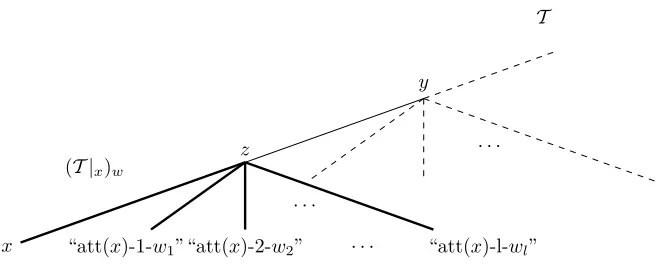
Notice that ifw6=εthen (T |x)w denote the tree that is obtained by adding the attributes “att(x)-1-w1”, “att(x)-2-w2”,· · ·, “att(x)-l-wl” in turn to the tree (T |x)ε in the Key Generation algorithm as children of the root nodez of (T |x)ε, wherexis a leaf node of the treeT, and “att(x)-1-w1”, “att(x
)-2-w2”,· · ·, “att(x)-l-wl” are the components ofw=w1w2· · ·wlcorresponding to x. The tree (T |x)w is shown in Figure 3.
Ifw6=ε, then let
skT,x,w=
{D(l)
x , R(xl)},{D (l)
“att(x)-k-wk”, R
(l)
“att(x)-k-wk”}1≤k≤l
.
Run the Compute Next of fs-ABE with (skT,x,w,(T |x)w, w) and obtain the secret keys skT |x,w0 and skT |x,w1 associated with the trees (T |x)w0 and
(T |x)w1 respectively. This algorithm outputs skT |x,w0 and skT |x,w1 as the
z
x “att(x)-1-w1”“att(x)-2-w2” · · · · · ·
“att(x)-l-wl”
y
· · · T
(T |x)w
Figure 3: In the Compute-Next operation of ifs-ABE, the tree (T |x)w, where
x is a leaf node ofT,z is a node added above x to become the parent ofx
replacing the former oney in the Key Generation algorithm, and “att(x
)-1-w1”, “att(x)-2-w2”,· · ·, “att(x)-l-wl” are the components ofw=w1w2· · ·wl corresponding tox.
Update(SKT,i, i+ 1)(wherei < N−1) Lethii=i0i1· · ·id, wherei0 =ε.
Let
SKT,i={SKT,x,i|dx}xis a leaf node ofT,
SKT,x,i|dx = (skT,x,hii|dx,{skT,x,i0i1···ik−11}ik=0)
wherehii|dx =i0i1· · ·idx,i|dx is the integer converted from the binary string
hii|dx, and k ≤ dx. For each leaf node x of T, if i ≡ 1 mod 2
d−dx and
0 < i < 2d−1 then run the Update of fs-ABE with (SK
T |x,i|dx, i|dx + 1)
and obtain the output SKT |x,i|dx+1 of that process as SKT,x,i|dx+1. This
algorithm outputs
{SKT,x,i|dx+1}xis a leaf node ofT
as the secret keySKT,i+1 associated with the treeT and the standard time
periodi+ 1.
Decryption(hi, Ci, SKT,i) This algorithm outputs the messagem if and only if the access tree T can be satisfied by the set γ of attributes in the ciphertext. Lethii=i0i1· · ·id, where i0 =ε. Let
SKT,i={SKT,x,i|dx}xis a leaf node ofT,
SKT,x,i|dx = skT,x,hii|dx,{skT,x,i0i1···ik−11}ik=0
wherehii|dx =i0i1· · ·idx,i|dx is the integer converted from the binary string
hii|dx, and k≤dx. This algorithm takes
{skT,x,hii|dx}xis a leaf node ofT
as the secret key skT,hii associated with the tree Thii that is obtained by adding the attributes “att(x)-1-i1”, “att(x)-2-i2”, · · ·, “att(x)-dx-idx” to
the tree T in the Key Generation algorithm for each leaf node x of the T. Call the function DecryptNode defined in the Decryption of fs-ABE with (C, skT,hii, r), wherer is the root of the tree Thii. If the output of the DecryptNode is not ⊥, then we use it to divide into C′ (recall that C′ is a component ofC) and obtain the messagem.
We can verify that decryption of ifs-ABE is performed correctly as in Appendix A. The process of verification is omited. The ifs-ABE scheme can be proven secure in the security model defined in section 3.3 using a similar method to that is used to proof the security of fs-ABE. We have the following theorem.
Theorem 2 If an adversary can break the ifs-ABE scheme in the selective chosen plaintext, a set of attributes and time period model, then a simu-lator can be constructed to solve the DBDH problem with a non-negligible advantage.
8
Discussion
Convert Selective CPA Secure fs-ABE to Adaptive CCA Secure One. We describe that how to convert a fs-ABE scheme that is secure against selective chosen plaintext attack (CPA) to one that is secure against adaptive chosen ciphertext attack (CCA).
A strongly unforgeable one-time signature scheme will be used. We denote the verification key and signing key of such a signature scheme by
vk and sk respectively. If a sender wants to use a set γ of attributes, the current time period iand the public parameters PK to encrypt a message, then he now uses γ ∪ {“vk”}, i and PK to encrypt it, where “vk” is an attribute corresponding to the verification key vk. Next, the sender signs the ciphertexthi, Ciusingskand takes vk,hi, Ci, σas the new ciphertext, where σ is the signature. A receiver with the private key associated with an access treeT and the current time periodifirst uses the verification key
as a child of the rootzofThii. Notice thatzis converted from (d+ 1, d+ 1)-gate to (d+ 2, d+ 2)-gate. Then he computes the secret key associated with the new tree using the same method in the Compute Next algorithm, and uses it to decrypthi, Ci. The receiver obtains the message if and only if the access treeT is satisfied by the set γ of attributes.
According to the work by Canetti et al. [30], a selective CPA secure fs-ABE scheme can be transformed into an adaptive CCA secure one by the above construction.
Private Key With Expiration Time. In the fs-ABE scheme we can add an expiration time to the private key of a user, so that during the time pe-riod time ithe user can decrypt the ciphertext if and only if,i is less than the expiration time, and the access tree T in the private key is satisfied by the setγ of attributes in the ciphertext. As an example, let the total num-ber of time periods N = 2d = 24, the current time period be h12i = 1100
and the expiration time be h13i = 1101. As in [13] we construct a subtree corresponding to the expiration timeh13i= 1101 as shown in Figure 4, and add it to the treeT as a child of the root r of T. The node r is converted from (kr, nr)-gate to (kr+ 1, nr+ 1)-gate. Notice that there is a relation-ship between the construction of the subtree and the bit representation of the expiration time. The PKG generates the initial private key for the user according to this new tree instead of the treeT. The user updates his pri-vate key by himself when the time period changes. During the current time periodh12i= 1100 the subtree is satisfied by the components “1-1”, “2-1”, “3-0”, “4-0” ofh12i= 1100, and the private key does not expire. The user can decrypt the ciphertext if and only if the access treeT is satisfied by the setγ of attributes in the ciphertext. If the time period ish14i= 1110, then the subtree is not satisfied by the components “1-1”, “2-1”, “3-1”, “4-0” of h14i = 1110, and the private key expires. The user can not decrypt the ciphertext even if the access treeT is satisfied by the setγ of attributes.
r
· · ·
(1,3)
“1-0” “2-0” (2,2)
“3-0” “4-0” T
Figure 4: A subtree corresponding to the expiration time h13i = 1101 is added to the access treeT as a child of the root r of T, where (1,3), (2,2) are threshold gates.
As in GPSW-ABE [10], the decryption time of fs-ABE and ifs-ABE can be improved by the similar method. We omit the improvement procedure and show the optimized time in Table 1. The Key Update algorithm has the same computation costO((h+ logN) logN) as the Key Generation algorithm, we show that in Table 1. The Key Update algorithm cannot be replaced by the Key Generation algorithm. A user needs to update his private key on his own, without contacting the PKG.
Delegation. Our fs-ABE scheme has the property of delegation of private keys. For a private key SKT,i associated with an access treeT and a time periodi, we can make use of the same operations in [10] to convert every secret key in SKT,i to a secret key for an access tree T′ which is more restrictive thanT. The set of these new secret keys is just the private key
SKT′,i for the access treeT′ and the time periodi.
9
Conclusions and an Open Problem
Table 1: Time Complexities and Key Sizes
Parameters fs-ABE ifs-ABE
Key generation time O((h+ logN) logN) O(mlog2N) Encryption time O(n+ logN) O(nlogN) Decryption time O(m+ logN) O(mlogN) Key update time O((h+ logN) logN) O(mlog2N)
Ciphertext length O(n+ logN) O(nlogN) Public key size O(n+ logN) O(nlogN) Secret key size O((m+ logN) logN) O(mlog2N)
Note 1: The running time complexities and key sizes of fs-ABE and ifs-ABE, whereN is the total number of time periods,nis the maximum size of the set of attributes a sender can encrypt under,mand hare respectively the number of leaf nodes and all nodes in the access treeT of a user.
Note 2: In the ifs-ABE scheme we assume that each attribute has time precision d for the worst, where d = logN. If the number of all nodes in the access treeT of a user is large, and many attributes have time precision less thand, then the Key Generation and Update algorithms of ifs-ABE are more efficient than those of fs-ABE.
Not all the existing ABE schemes may be converted into a non-trivial for-ward secure one. We generalize the properties that an ABE scheme should possess in order to support forward security. This analysis on forward-secure compatibility of ABE schemes is general and useful beyond the con-crete cryptographic construction that we presented. We pointed it out an open problem on how to support non-trivial forward secrecy in the existing ciphertext-policy ABE scheme.
A
Correctness of Decryption Algorithm
We verify that decryption of fs-ABE is performed correctly. Recall
C = γ ∪ {“1-i1”,“2-i2”,· · · ,“d-id”}, C′ =me(g1, g2)s,
C′′=gs,{Ck=T(k)s}k∈γ∪{“1-i1”,“2-i2”,···,“d-id”}
.
When decrypting, for each leaf nodex, ifk= att(x)∈γ∪{“1-i1”,“2-i2”,· · · ,“d-id”} then
DecryptNode(C, skT,hii, x) =
e(D(xd), C′′)
e(R(xd), Ck)
= e(g qx(d)(0)
2 ·T(k)r¯ (d)
x , gs)
e(g¯r(xd), T(k)s)
= e(g qx(d)(0)
2 , gs)·e(T(k)¯r (d)
x , gs)
e(gr¯(xd), T(k)s)
= e(g, g2)s·q (d)
x (0),
where ¯rx(d) can be computed from the iterative expression of Dx(d). For each interior nodex, ifx is satisfied then
DecryptNode(C, skT,hii, x) = Y
x′∈S
x
F∆j,S′x(0)
x′
= Y
x′∈Sx
(e(g, g2)s·q (d)
x′ (0))∆j,Sx′(0)
= Y
x′∈Sx
(e(g, g2) s·qparent((d)
x′)(index(x ′))
)∆j,Sx′(0)
= Y
x′∈S
x
e(g, g2)s·q (d)
x (j)·∆j,S′x(0)
= e(g, g2)s·q (d)
x (0).
We have DecryptNode(C, skT,hii, z) = e(g, g2)s·y = e(g1, g2)s if and only if
Thii γ∪{“1-i1”,“2-i2”,· · ·, “d-id”}
= 1. Thus,
C′
DecryptNode(C, skT,hii, z) =
me(g1, g2)s
e(g1, g2)s
=m
B
Proof of fs-ABE Security
Suppose there exists a polynomial-time adversary A, that can attack the fs-ABE scheme in the selective chosen plaintext, a set of attributes and time period model with advantageǫ. We construct a simulatorBthat can attack the GPSW-ABE scheme in the selective chosen plaintext, a set of attributes model with the same advantageǫ. The simulation proceeds as follows:
We first let the challenger set the groups G1 and G2 with an efficient bilinear mapeand generatorg. Then the challenger sets the parameters of GPSW-ABE, and passes g1(= gy), g2,t˜1,t˜2,· · ·,˜tn+d+1 to B. It keeps y as
the master key.
Init The simulator B runs A. A sends a set γ of attributes and a time period i on which it wishes to be challenged to B. Then B sends the set
γ∪ {“1-i1”,“2-i2”,· · ·,“d-id”} of attributes as its challenge set to the chal-lenger.
Setup B chooses a random n+ddegree polynomial f(X) and calculates a n+d degree polynomial u(X) as follows: set u(X) = −Xn+d for all
X ∈ γ∪ {“1-i1”,“2-i2”,· · · ,“d-id”} and u(X) 6= −Xn+d for other X. B sets tj = g2u(j)gf(j) for all j = 1 to n+d+ 1. Because f(X) is a random
n+ddegree polynomial, alltj will be chosen independently at random as in the fs-ABE construction. Implicitly, Bdefines T(X) =g2Xn+d+u(X)gf(X). B
passes{g1, g2, t1, t2,· · · , tn+d+1} to Aas the public parameters of fs-ABE.
Phase 1 Aissues queries for private keys SKT,j associated with a tree T and a time period j. No private key query for the access tree T such that T(γ) = 1 for any time j ≤iis allowed. Bhas to generate the private keys forA.
We first define a procedure PolyUnsat(T′|x, γ′, gλx), where T′|x is an unsatisfied access tree with the root node x, γ′ is a set of attributes such that T′|
x(γ′) = 0, and λx ∈ Zp. The procedure sets up a polynomial for each node ofT′|x.
PolyUnsat(T′|x, γ′, gλx) It first defines a polynomialqx of degreedx for the root node xsuch that qx(0) = λx by settinggqx(0) =gλx. For each x′ ofhx(≤dx) satisfied children ofx, the procedure definesqx′(0) =λx′, whereλx′ ∈ Zp is chosen randomly, and sets qx(index(x′)) =λx′. To completely define qx it then sets dx−hx points of qx randomly. For each subtreeT′|
• If T′|x′ is satisfied, it sets dx′ other points of qx′ randomly to completely defineqx′. For any other nodeyinT′|x′, it completely defines qy by setting qy(0) = qparent(y)(index(y)) and dy other points randomly.
• IfT′|
x′ is not satisfied, it recursively calls PolyUnsat(T′|x′, γ′, gqx(index(x ′))
). Notice that onlygqx(index(x′)) can be got by interpolation.
Notice that all defined polynomials satisfy to the constraint in the Key Generation algorithm of fs-ABE scheme.
For the query forSKT,j fromA,B distinguishes two cases:
• T(γ) = 1 and j > i. In the construction of fs-ABE,
SKT,j = skT,hji,{skT,j0j1···jk−11}jk=0
.
B has to generate the secret keys associated with the trees Thji and {Tj0j1···jk−11}jk=0. Since j > i, {j0j1· · ·jk−11}jk=0 are not prefixes of i. Thus,
Tj0j1···jk−11 γ∪ {“1-i1”,“2-i2”,· · ·,“d-id”}
= 0.
The simulatorBruns PolyUnsat on the treesThjiand{Tj0j1···jk−11}jk=0
with γ ∪ {“1-i1”,“2-i2”,· · · ,“d-id”}, g1
. This defines a polynomial for each node ofThji and{Tj0j1···jk−11}jk=0. The constant terms in the
polynomials associated with the roots of the above trees are all y. B first constructs the secret key skT,hji associated with the tree Thji as follows. For each leaf nodex ofThji,
– If att(x)∈γ∪ {“1-i1”,“2-i2”,· · · ,“d-id”}. B knows the polyno-mialqx completely.
Dx(d) = gqx(0)
2 T(att(x))r (d)
x =gQ
(d)
x (0)
2 T(att(x))r (d)
x
R(xd) = grx(d)
where r(xd) ∈ Zp is chosen randomly, and we denote qx(0) by
– Ifk= att(x)∈/ γ∪ {“1-i1”,“2-i2”,· · ·,“d-id”}. B knowsgqx(0).
D(xd) = g
−qx(0)f(k)
kn+d+u(k)(gk
n+d+u(k)
2 gf(k))rx
= gqx(0)
2 (g
kn+d+u(k)
2 gf(k))
−qx(0)
kn+d+u(k)(gk
n+d+u(k)
2 gf(k))rx
= gqx(0)
2 (g
kn+d+u(k) 2 gf(k))
rx− qx(0) kn+d+u(k)
= gqx(0)
2 T(k)r (d)
x
= gQ( d)
x (0)
2 T(att(x))r (d)
x
Rx(d) = g
−qx(0)
kn+d+u(k)grx =grx− qx(0)
kn+d+u(k) =gr(
d)
x
whererx ∈Zp is chosen randomly,r(xd)=rx− kn+qxd+(0)u(k), and we
denoteqx(0) byQ(xd)(0) for consistency.
B takes the set of above secret pairs as skT,hji. In a similar man-ner B can construct {skT,j0j1···jk−11}jk=0 associated with the trees
{Tj0j1···jk−11}jk=0. The distribution of each one of these secret keys
is identical to that of the fs-ABE scheme. Bpasses these keys toAas
SKT,j.
• T(γ) = 0. Bruns PolyUnsat on the treeT with (T, γ, g1). This defines
a polynomial for each node ofT. The constant term in the polynomial associated with the root of T is y. Define the secret key associated with the treeT as in above case. Buses this key to recursively apply the Compute Next algorithm of fs-ABE, and obtains SKT′ ,0. Then B runs the Update of fs-ABE with SKT′ ,0 to generate SKT′ ,j. The distribution of SK′
T,j is identical to SKT,j in the fs-ABE scheme. B passes this key toA asSKT,j.
Challenge The adversaryAsubmits two equal messagesm0andm1to the
simulator B. B submits m0 and m1 to the challenger. The challenger flips
a fair coin b ∈ {0,1}, and returns an encryption ofmb in the GPSW-ABE scheme. The ciphertext is output as:
γ∪{“1-i1”,“2-i2”,· · ·,“d-id”}, mbe(g1, g2)s, gs,{Te(k)s}k∈γ∪{“1-i1”,“2-i2”,···,“d-id”}
Bmodifies this ciphertext as follows: D
i, γ∪{“1-i1”,“2-i2”,· · ·,“d-id”}, mbe(g1, g2)s, gs,{(gs)f(k)}k∈γ∪{“1-i1”,“2-i2”,···,“d-id”}
Then Bpasses it to Aas the challenge ciphertext, which is a valid random encryption of messagemb in the fs-ABE scheme since (gs)f(k)= (gf(k))s =
T(k)s by the construction of T(X).
Phase 2 The simulator B acts exactly as it did in Phase 1.
Guess The adversary Asubmits a guess b′ of bto B. B submitsb′ to the challenger as its guess ofb.
As shown above the simulator’s generation of public parameters, private keys and the challenge ciphertext is identical to that of the actual fs-ABE scheme. The advantage of the simulator attacking GPSW-ABE scheme in selective chosen plaintext, a set of attributes game is
Pr[B’s guess ofb is correct]−1 2
= Pr[A’s guess of b is correct]−1 2 = ǫ.
For reducing the security of fs-ABE to hardness of DBDH problem, we need the following Theorem 3 from [10].
Theorem 3 If an adversary has advantage ǫ to attack the GPSW-ABE scheme in the selective chosen plaintext, a set of attributes model, then a simulator can be constructed to solve the DBDH problem with the advantage
1 2ǫ.
Combining Theorem 1 and Theorem 3, we obtain the following Theorem 4 for the fs-ABE scheme.
Theorem 4 If an adversary can break the fs-ABE scheme in the selective chosen plaintext, a set of attributes and time period model, then a simu-lator can be constructed to solve the DBDH problem with a non-negligible advantage.
References
[2] W. Diffie, P. van Oorschot, and W. Wiener. Authentication and authen-ticated key exchanges. In Designs, Codes and Cryptography, volume 2, pages 107–125, 1992.
[3] M. Bellare and B. Yee. Forward security in private-key cryptography. In CT-RSA, volume 2612 of LNCS, pages 1–18. Springer-Verlag, 2003.
[4] R. Canetti, S. Halevi, and J. Katz. A forward-secure public-key en-cryption scheme. In Advances in Cryptology — Eurocrypt ’03, volume 2656 of LNCS, pages 255–271. Springer-Verlag, 2003.
[5] Danfeng Yao, Nelly Fazio, Yevgeniy Dodis, and Anna Lysyanskaya. ID-based encryption for complex hierarchies with applications to forward security and broadcast encryption. In ACM Conference on Computer and Communications Security, pages 354–363, 2004.
[6] M. Bellare and S. K. Miner. A forward-secure digital signature scheme. InAdvances in Cryptology — Crypto ’99, volume 1666 ofLNCS, pages 431–448. Springer-Verlag, 1999.
[7] M. Abdalla, S. K. Miner, and C. Namprempre. Forward-secure thresh-old signature schemes. In Topics in Cryptography — CT-RSA ’01, volume 2020 of LNCS, pages 441–456. Springer-Verlag, 2001.
[8] Tal Malkin, Daniele Micciancio, and Sara K. Miner. Efficient generic forward-secure signatures with an unbounded number of time periods. In Advances in Cryptology — Eurocrypt ’02, volume 2332 of LNCS, pages 400–417. Springer-Verlag, 2002.
[9] Huijun Xiong, Xinwen Zhang, Wei Zhu, and Danfeng Yao. Cloudseal: End-to-end content protection in cloud-based storage and delivery ser-vices. In SecureComm, 2011.
[10] Vipul Goyal, Omkant Pandey, Amit Sahai, and Brent Waters. Attribute-based encryption for fine-grained access control of encrypted data. InACM Conference on Computer and Communications Security, pages 89–98, 2006.
[11] Rafail Ostrovsky, Amit Sahai, and Brent Waters. Attribute-based en-cryption with non-monotonic access structures. InACM Conference on Computer and Communications Security, pages 195–203, 2007.
[12] Amit Sahai and Brent Waters. Fuzzy identity-based encryption. In
[13] John Bethencourt, Amit Sahai, and Brent Waters. Ciphertext-policy attribute-based encryption. In IEEE Symposium on Security and Pri-vacy, pages 321–334, 2007.
[14] I3P. Attribute-based encryption in future applications. Website, 2009. http://www.thei3p.org/research/attribute_encrypt.html.
[15] Joseph A. Akinyele, Christoph U. Lehmann, Matthew D. Green, Matthew W. Pagano, Zachary N. J. Peterson, and Aviel D. Rubin. Self-protecting electronic medical records using attribute-based encryp-tion. Cryptology ePrint Archive, Report 2010/565, 2010. http: //eprint.iacr.org/.
[16] Ross Anderson. Two remarks on public-key cryptology, 1997. In-vited lecture,4th ACM Conference on Computer and Communications Security, 1997. Available at http://www.cl.cam.ac.uk/ftp/users/ rja14/.
[17] D. Boneh and M. K. Franklin. Identity-based encryption from the Weil pairing. InAdvances in Cryptology — Crypto ’01, volume 2139 of
LNCS, pages 213–229. Springer-Verlag, 2001.
[18] C. Gentry and A. Silverberg. Hierarchical ID-based cryptography. In
Advances in Cryptology — Asiacrypt ’02, volume 2501 ofLNCS, pages 548–566. Springer-Verlag, 2002.
[19] Adi Shamir. Identity-based cryptosystems and signature schemes. In
CRYPTO, pages 47–53, 1984.
[20] Dan Boneh and Matthew K. Franklin. Identity-based encryption from the Weil pairing. In CRYPTO, pages 213–229, 2001.
[21] Dan Boneh and Xavier Boyen. Efficient selective-ID secure identity-based encryption without random oracles. In EUROCRYPT, pages 223–238, 2004.
[22] Brent Waters. Efficient identity-based encryption without random or-acles. InEUROCRYPT, pages 114–127, 2005.
[23] Brent Waters. Dual system encryption: Realizing fully secure IBE and HIBE under simple assumptions. In CRYPTO, pages 619–636, 2009.
[25] Saman Zarandioon, Danfeng Yao, and Vinod Ganapathy. K2c: Cryp-tographic cloud storage with lazy revocation and anonymous access. In
SecureComm, 2011.
[26] Ming Li, Shucheng Yu, Ning Cao, and Wenjing Lou. Authorized pri-vate keyword search over encrypted personal health records in cloud computing. In IEEE ICDCS, 2011.
[27] Cong Wang, Qian Wang, Kui Ren, and Wenjing Lou. Privacy-preserving public auditing for data storage security in cloud computing. In INFOCOM, pages 525–533, 2010.
[28] Shucheng Yu, Cong Wang, Kui Ren, and Wenjing Lou. Achieving se-cure, scalable, and fine-grained data access control in cloud computing. In INFOCOM, pages 534–542, 2010.
[29] Jinshu Su, Dan Cao, Xiaofeng Wang, Yipin Sun, and Qiaolin Hu. Attribute-based encryption schemes. In Journal of Software, pages 1299–1315, 2011.