Urbanization and Development
Dr. Laxmi NarayanAssistant Professor of Economics, Govt. College Mahendergarh, Haryana Email: [email protected]
Abstract
The level of urbanization and economic development are positively related. An increase in concentration of population at one place yield many positive externalities increasing productivity and efficiency. The relationship between two is extensively researched in many cross country studies and cross country income differentials are examined vis-a-vis the level and growth of urbanization. The empirical evidences suggested that relationship between urbanization and development changes with changes in the stage of development. India is a comparatively less urbanized country but still around 60.0 percent of total GDP is generated in urban areas. The objective of the present paper is to analyze the relationship between growth in level of urbanization and economic performance in last three decades in India. The paper found that present level of state per capita income has positive correlation with level of urbanization. That is state with high per capita income also has higher level of urbanization and vice-versa. With regard to the relationship between growth of per capita income and growth of level of urbanization, the relationship is found insignificant during decades of 1980 and 1990 but is significant during the last decade of 2000. The paper concludes that association between urbanization and development is getting strong with time.
Keywords
- Urbanization,Development, Urbanization and Growth
Introduction
between urbanization and growth of per
capita income in India is an issue worth examination. Keeping this in view present paper attempts to analyses the relationship between urbanization and development by comparing changes in rate of urbanization with changes in economic development of the state. Paper compares the decadal growth rate of income with the decadal growth of urbanization to understand the relationship between urbanization and economic development in India.
Objectives
The main aim of the paper is to investigate the relationship between urbanization and development in India by studying the inter-state differences in both. In this endeavor, paper analyzed trends in level of urbanization across Indian states, growth in the level of urbanization and growth in per capita income.
Methodology
The paper uses data on level of urbanization from various rounds of population census published by Registrar General of India. Data pertaining to growth of state per capita income are taken from RBI Handbook of Statistics on Indian Econmy-2012-13. The paper compares present level of urbanization with level of per capita income across Indian states and using rank correlation between both. To assess the relationship between growth of level of urbanization and rate of growth per capita income, correlation coefficient for three decades in calculated.
Review of Literature
Urbanization is generally associated with specialization, industrialization and development. Urbanization is generally seems as territorial shift in response to structural changes in the economy. With
economic development the structure of output shift from low productivity to high productivity sectors as a result employment structure also changes with redistribution among sectors. As different geographical regions are suitable for a particular type of production, this result in territorial redistribution of labour force. The labour force physically gets bunched up in cities where demand for the products is created or where positive production externalities are maximized.
Urbanization can be defined "as a process
which reveals itself through temporal, spatial and sectoral changes in the demographic, social, economic, technological and environmental aspects of life in a given society. Urbanization is a progressive concentration of population in urban unit" (Kingsley Davis-1965).
These changes manifest themselves in the increasing concentration of population in human settlements, increasing participation of the people in the secondary and tertiary production activities, and in the progressive adoption of certain social traits which are not typical of traditional rural societies. A distinctive division of labour, technology based production of goods, trade of a variety of goods and service, high level of spatial and economic interaction, and relatively high density and diversity of population are basic tenets associated with urbanization (Sharma 2010). The distinction between town and country is not merely a distinction based on the nature of settlements, it is a distinction rooted in the economic structure and social relations of production and reproduction, and in the processes of social and political consciousness and its articulation.
countries experiencing high and low eco
nomic growth. This is also evident from available empirical evidences. Many empirical studies reported positive relationship between urbanization level and per capita income (Chen et al., 2014, Friedman, 2006, Henderson, 2003; Fay and Opal, 2000 and Polese, 2005).
Daniel (2007) using co-integration and causality tests investigated the relationship between urbanization and economic growth for 28 countries for the period 1950-2000 and found a long-run stable relationship between urbanization and economic growth. The Granger causality tests indicate that the urbanization Granger-causes the economic growth for developing nations, while the opposite holds for developed nations. Thus, causal relationship between the two variables is dependent upon the economic development status of a country. Glease (2000), Krugman (2000) and Quigley (2008) demonstrated positive link between productivity and agglomeration of economic activities in cities. Quigley (2008) emphasize that it is not only the internal scale economies that urbanization provide to the producers but it is external effects, spillovers, and external economies of scale that have become more important with increased industrialization, technical progress, and economic development. These external effects result into productivity gains arising from specialization; from transaction costs and complementarities in production; from education, knowledge, and mimicking; and from proximity to large numbers of other economic actors.
Chen et al. (2014) in a landmark study found that in medium to short period urbanization has little effect on economic growth and we have enough period of urbanization with no parallel growth in economic growth. Hence, it cannot be stated as a rule that higher speed of urbanization automatically lead to more rapid increase in economic growth.
Though their study found positive and high correlation between urbanization and economic growth in long term due to same evolutionary time trend followed by both processes. The study concluded that there are sufficient evidence to believe that there is no correlation between urbanization speed and economic growth rate at the global level. These findings support the findings that no linear relationship between urbanization and economic growth (Hariss, 1990; Turok and McGranahan, 2013). Abdel-Rahman et al. (2006) based on time series analyses reported that urbanization has no straightforward link to economic development. The urbanization per se does not automatically lead to increase in per capita income and the success of urbanization to induce economic growth depends on removing barriers to rural-urban migration, supporting policies, enabling markets and infrastructural investment (Turok and McGranahan, 2013). Tolley (1987) also shows that conditions in individual countries play a significant part in urbanization. The study concluded that one of the major determinants of urbanization is the degree to which countries are able to foster growth of urban productivity and countries lagging in growth of agricultural productivity are likely to face added pressure on urbanization.
survey of the literature on the presence of
agglomeration economies particularly in developed countries. Advantages associated with economies of scale motivates firm to concentrate geographically so that benefits of agglomeration economies can be fully reaped.
India: Urbanization and
Development
The urban population in India was only 25.8 million constituting 10.8 per cent of total population in 1901, which increased to 377 million comprising 31.16 per cent of total population in 2011. The contribution of urban sector has shown significant increase since independence. The contribution of urban sector to India's GDP has shown continuous increase highlighting importance of urban areas in economic growth. In 1950-51contribution of urban GDP in total GDP was only 29 per cent, which increased to 47 per cent in 1980-81 and 62-63 percent in 2009 (Government of India, 2009).
Table-1 shows that rate of urbanization has shown increasing trend over the period. The rate of urbanization grew speedily during the decade 1941-51 when the annual exponential urban growth rate was recorded as high as 3.74 per cent due to partition of the country in 1947 (Census of India 1991). The decline in the growth rate during 1951-61 was an artifact of the change in definition of urban resorted in 1961 census. As a result about 800 towns have been declassified in 1961 census (Mohan and Pant 1982). The peak in urban growth was observed during 1971-81 when the annual exponential urban growth rate was 3.79 percent per annum. After that it has slowed down and was recorded 2.77 percent per annum for the decade 2001-2011.
Table-1: Urbanization Trends in India
Census Year
No. of UA/Towns
Urban Population (millions)
Urbanization Percent
1901 1827 25.85 10.84
1911 1815 25.94 10.29
1921 1949 28.07 11.17
1931 2072 33.46 11.99
1941 2250 44.15 13.86
1951 2843 62.44 17.29
1961 2365 78.94 17.97
1971 2590 109.11 19.91
1981 3378 159.46 23.34
1991 3768 217.18 25.72
2001 5161 286.12 27.86
2011 7935 377.11 31.16
Source: Figures up to 1991 are taken from Census of India 1991, Paper 1 of 1993; Census of India 2001 and 2011, Final Population Totals, Office of the Registrar General and Census Commissioner, India, New Delhi.
Chandrasekhar and Sharma (2014) emphasized that there is compelling evidence to suggest that estimates of rate of urbanization reported by census are underestimation due to definition adopted in census. The level of urbanization is a function of the size of peripheral urban areas which are considered as rural in official data.
Table-2: Urban-Rural Population Growth
Differentials (1971-2011)
Decade Rural Urban
Urban-Rural Growth Differentials Rate (in %) 1971-1981 1.76 3.79 2.03 1981-1991 1.80 3.09 1.29 1991-2001 1.69 2.76 1.06 2001-2011 1.15 2.77 1.61
Source: Census of India, various years.
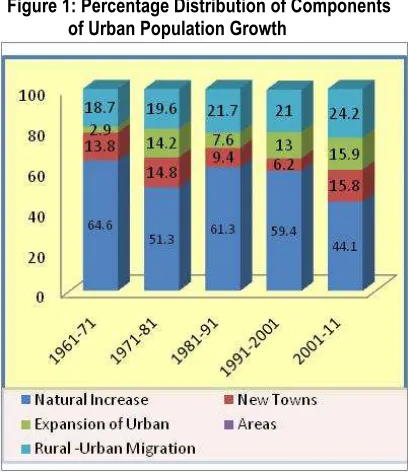
Natural increase and rural-urban migration has been main source of urbanisation in India. During 2001-2011, the push to urban population has come in from rural to urban conversion and rural- urban migration (Table-3).
Table – 3 : Components of Urban Population Growth
Components of Growth 1961-71
1971-81
1981-91
1991-2001
2001- 11
Natural Increase 64.6 51.3 61.3 59.4 44.1
New Towns 13.8 14.8 9.4 6.2 15.8
Expansion of Urban Areas
2.9 14.2 7.6 13.0 15.9
Rural -Urban Migration 18.7 19.6 21.7 21.0 24.2
Source: Ministry of Housing and Urban Poverty Alleviation, Government of India, Urbanization and Poverty in India: A Statistical Compendium, 2010, and Census 2011.
Figure 1: Percentage Distribution of Components of Urban Population Growth
Source: Plotted from data given in Table-3
relationship between urbanization speed
and economic growth rate at least during short to medium period. The urbanization of its own cannot automatically led to development as it depends on many enabling factors.
The correlation coefficient between growth of rate of urbanization and state per capita gross domestic product is very low (0.210) for the period 1981-82 to 1990-91 and is even negative for period 1991-92 to 2000-01. But for the last decade from 2001-02 to 2011-12, the correlation coefficient shows significant relation between urbanization and development. Thus, we found that relationship between both is turning statistically significant though it does not tell us direction of the relationship that is whether urbanization resulted in increase in per capita income or increased income resulted in growth of urbanization. In a recent study Daniel (2013) found that in case of India urbanization Granger causes economic growth.
Conclusions
and
Suggestions
The paper analyzed changes in rate of urbanization and rate of growth of per capita state domestic product for the last three decade using data for states in India. We found that association between urbanization and development is very weak for most of the period though we found a significant positive relationship for the last decade. Based on the results of the present study and previous recent studies, we may say that association between urbanization and development is turning significant. The future growth in state per capita income will be significantly influenced by the state ability to effectively manage urbanization in their respective states. Our study confirmed the findings of earlier studies that no straightforward relationship exists between urbanization and development.
Table - 4: Level of Urbanization and Growth of Urban Population Across States and Union Territories
2010-11 1981–91 1991–01 2001-11
States Level of Urb.
Per capita
Income (PCI) Urb. PCI Urb. PCI Urb. PCI
(1) (2) (3) (4) (5) (6) (7) (8) (9) (10)
1 Andhra Pradesh 33.5 (11) 39434 (14) 3.6 4.30 1.4 4.13 2.1 6.54
2 Arunachal Pradesh 22.7 (23) 34366 (18) 9.3 5.70 7.0 3.12 1.1 5.47
3 Assam 14.1 (27) 21793 (27) 3.3 1.93 3.1 0.51 1.0 4.18
4 Bihar 11.3 (28) 12100 (29) 2.7 2.85 2.6 1.02 0.7 6.24
5 Chattisgarh 23.2 (22) 25788 (22) NA NA 3.1 NA 1.5 7.11
6 Delhi 97.5 (01) 108876 (01) 3.8 3.16 4.1 4.36 0.5 7.34
7 Goa 62.2 (02) 104445 (02) 4.0 4.84 3.3 5.10 2.2 6.43
8 Gujarat 42.6 (07) 53789 (06) 2.9 3.93 2.8 3.95 1.3 8.92
9 Haryana 34.8 (10) 59140 (05) 3.6 4.28 4.1 2.39 1.8 7.36
10 Himachal Pradesh 10 (29) 46821 (10) 3.1 2.97 2.8 4.32 0.2 5.03
11 Jammu & Kashmir 27.2 (17) 27881 (20) 3.4 0.20 3.4 1.68 0.9 3.77 12 Jharkhand 24.1 (21) 24330 (23) NA NA 2.6 NA 0.8 6.08
13 Karnataka 38.6 (8) 40332 (13) 2.6 3.06 2.5 5.09 1.3 5.71
15 Madhya Pradesh 27.6 (16) 22091 (26) 3.7 2.42 2.7 1.75 0.3 4.25
16 Maharashtra 45.2 (06) 59735 (04) 3.3 3.73 3.0 3.77 0.6 6.17
17 Manipur 30.2 (14) 22867 (25) 3.0 2.08 1.2 2.03 2.4 3.94
18 Meghalaya 20.1 (25) 35191 (17) 3.1 2.52 3.2 2.88 0.2 6.29
19 Mizoram 51.5 (03) 36732 (16) 9.6 NA 3.3 NA 0.4 4.43
20 Nagaland 29 (15) 42511 (12) 5.6 3.94 5.3 1.78 5.0 NA
21 Orissa 16.7 (26) 23875 (24) 3.1 1.14 2.6 2.50 1.1 6.62
22 Punjab 37.5 (09) 44783 (11) 2.6 3.42 3.2 2.47 1.0 3.28
23 Rajasthan 24.9 (20) 27625 (21) 3.3 5.61 2.7 2.15 0.6 6.82
24 Sikkim 25 (19) 64693 (03) –3.2 8.02 4.8 NA 8.4 13.48
25 Tamil Nadu 48.4 (04) 51117 (07) 1.8 4.23 3.6 4.95 1.0 6.12
26 Tripura 26.2 (18) 36826 (15) 6.2 2.44 2.5 5.39 4.4 6.75
27 Uttar Pradesh 22.3 (24) 48240 (09) 3.3 2.65 2.8 1.00 0.7 5.36
28 Uttaranchal 30.6 (13) 17378 (28) NA NA 2.8 NA 1.8 6.29
29 West Bengal 31.9 (12) 32299 (19) 2.5 1.98 1.8 4.76 1.3 5.60
Correlation Coefficient ® Rank Correlation = 0.5768 r = 0.210 r = -0.156 r = 0.681
Source:Calculated from the data obtained from Various rounds of Census of India and RBI handbook of Indian Economy
Note:The value in parenthesis in column 3 and 4 are the respective rank of the state.
References:
[1]Chandrasekhar, S. and Sharma, A. (2014) Urbanization and Spatial Patterns of Internal Migration in India. Indira Gandhi Institute of
Development Research, Mumbai,
WP -2016-016.
[2]Chen M., Zhang H., Liu W. and
Zhang W.(2014). The Global
Pattern of Urbanization and
Economic Growth: Evidence from Last Three Decades. Available at
PLoS ONE 9(8):e103799.Doi:
10.371/Journal.pone.0103799.
[3]Daniel, Y.F. Lo (2013).
Urbanization and Economic
Growth - Testing for Causality.
Building and Real Estate Workshop Paper, The Hong Kong Polytechnic
University.
[4]Fay, M. and Opel, C. (2000).
Urbanization without Growth: A Not So Uncommon Phenomenon.
World Bank, Washington DC.
[5]Friedmann J. (2006). Four Theses
in the Study of China’s
urbanization. International Journal
of Urban and Regional Research.
Vol. 30: 440–451.
[6]Gleaser, E. L. (2000). The
Economics of Urban and Regional Growth. Oxford: Universty Press.
[7] Government of India (2009). India Urban Poverty
Report. Ministry of Housing and
Urban Poverty Alleviation and United Nations Development Programme, New Delhi: Oxford University Press.
[8] Government of India (2010) Urbanization and Poverty in India: A Statistical Compendium, 2010. Ministry of
Housing and Urban Poverty Alleviation, New Delhi: Oxford University Press.
(2013). Census, 2011. Office of
the Registrar General & Census Commissioner, India available
at www.censusindia.gov.in/2011-Documents
/slum_data_census_2011.xls.
[10] Government of
India(2009) Mid-term Appraisal of 11th Five Year Plan. Planning Commission, New Delhi.
[11] Government of India, Ministry of Housing and Urban Poverty Alleviation (2009)
India-Urban Poverty Report- 2009, New Delhi: Oxford University Press.
[12] Hariss, N.(1990).
Urbanization, Economic
Development and Policy in
Developing Countries. Barlett
University Development Planning Unit. Working Paper - 19.
[13] Harvey D. (2009).
Reshaping Economic Geography: The World Development Report 2009. Development and Change. Vol. 40: 1269–1277.
[14] Henderson, V.(2006). The
Urbanisation Process and
Economic Growth: The so-what Question. Journal of Economic
Growth. Vol. 8: 47-71.
[15] Krugman, P. (2000).
Increasing Return and Economic
Geography. The Journal of
Political Economy. Vol. 99(3).
[16] Lucas( 2004. Life Earnings
and Rural–Urban Migration.
Journal of Political Economy. Vol.
112 (1): S29–S59.
[17] Lucas(2007). Trade and the
Diffusion of the Industrial
Revolution. Frank D. Graham
Memorial Lecture. Princeton
University, Princeton.
[18] Lucas, R.E. (1988. On the
Mechanics of Economic
Development. Journal of Monetary
Economics. Vol. 22 (1): 3–42.
[19] Polese, N. (2005). Cites
and National Economic Growth: A Reappraisal. Routledge Taylor & Francis Group. Urban Studies. Vol. 42(8).
[20] Quigley J. M. (2008).
Urbanization, Agglomeration and
economic Development. Paper
presented at the World Bank
Seminar on Growth and
Development, Washington, D.C.
[21] Romer, P. (1986).
Increasing Returns and Long-Run
Growth. Journal of Political
Economy. 94 (5): 1002–37.
[22] Rosenthal, S., and Strange,
W.C.( 2004) Evidence on the
Nature and Sources of
Agglomeration Economies. In J.
Vernon Henderson and
Jean-François Thisse(eds.) Handbook of
Regional and Urban Economics,
Vol. 4, Amsterdam: Elsevier.
[23] Shabu, T.(2010). The
Relationship between Urbanization and Economic Development in
Developing Countries.
International Journal of Economic
Developing Research and
Investment. Vol-1(2&3).
[24] Tolley, G. S.(1987).
Urbanisation and Economic
Development. In Tolley, G.S.
and Thomas
V. (Editors). The Economics of
Urbanization and Urban Policie
s in Developing Countries.World
Bank, Washington DC. pp. 15
31.
[25] Turok, L. and McGranahan,
G. (2013) Urbanization and
Economic Growth: The Arguments and Evidence for Africa and Asia.
Environment and Urbanization.