The Optimum Controller Design for a Level
Process
Selvakumar. J
1, Dhayanithi. M
2, Ruthrapathy.S
3, Ramachandran.S
4UG Student, Dept. of Instrumentation and Control Engineering, Saranathan College of Engineering, Trichirappalli,
Tamilnadu, India1,2,3
Assistant Professor, Dept. of Instrumentation and Control Engineering, Saranathan College of Engineering,
Trichirappalli, Tamilnadu, India4
ABSTRACT The level control processes are widely used in process many industries like power plant’s drum leve control, oil industry’s distillation level control and chemical plants. The control of level is major role in such the industries. Because of the level control of the plant decides desired production level both on quality and quantity basis. It can be achieved through proper control of level process. In a process control plant, if the level control will not properly, it will leads the plant to hazard action through overflow or low level. In the article, the level control of a cylindrical tank is performed. Here the system’s liquid level is controlled by Proportional (P), Integral (I) and derivative (PID) modes with various tuning techniques like -N, Damped Oscillation Method, Tyreus Luyben Method and Cohen-Coon Method. Then the designed controllers are validated by comparing its performance criteria’s like Integral square error (ISE), Integral of absolute error (IAE), Integral of time absolute error (ITAE) and Integral of time square error (ITSE) in MATLAB environment.
KEYWORDS: Level process, PID, Tuning Method in Z-N, Damped Oscillation Method, Tyreus Luyben Method,
Cohen-Coon Method, Integral of square error (ISE), Integral of absolute error (IAE), Integral of time absolute error (ITAE) and Integral of time square error (ITSE).
I.INTRODUCTION
II.PROCESS SETUP
A.EXPERIMENT SETUP
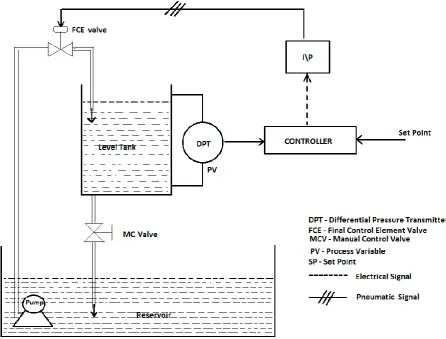
The process control loop is consisting of mainly process, sensor and a controller. A sensor is sensing the same amount of current parameter values to get the controller input after signal conditioning is done performance. The controller also gets the set point from the user and it first generates error signal which set point minus feedback variable. The controller is the control mode of (such that ON/OFF or P, PI, PD and PID) computer as the controller these given by a FCE (final control element).
Figure II.A: Piping and Instruments to Implement the Circuit Diagram
In the case of computer which has all mode control action as software. The process of level tank is observed to the reservoir water with help of pump. The level sensor is fitted on transparent process controlled by adjusting water flow to the tank by a pneumatic control valve. In necessary piping and fitting are mounted in support how designed to stand on bench top. The control of process microcontroller, output indicator, power supply for level transmitter, switches….etc.
the controller in (P, PI, PID) .Set the manual mode and adjust the output to that process value reaches of 50%. Switch the controller to auto mode and decrease the proportional band and apply the step change to set point of observe the process response.
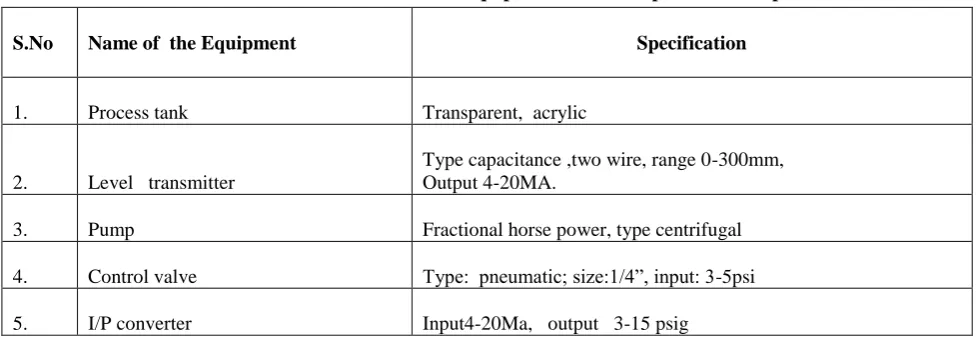
Table II.A. Technical Details of Equipment used in Experiment Setup
III. SYSTEM IDENTIFICATION
The system identification of these level process is using to input&output technique of process reaction curve method is used. The process reaction curve method is one of the closed loop system of will respond in a desirable way only, if its controller is properly tuned .The process reaction curve method is some procedure to implement the system identification.
The first step is place the controller in manual mode and wait for the process variable (pv) to come to a study state value.the another step is cause a step chage in the out of X percent ,say 6 to 12%.The process variable (PV), will after a time ,begin to chage and if it is a typical loop, the process variable will approach some new values.
The process curve traced by the change is called the reaction curve.Above the level process to excecution of output to determine the tansfer fuction is,
If transfer function,We can use with in MATLAB software to implement the find out in freqeuncy and gain. These are in values to the various tuning method is used to optimum of level process to predict the values.
IV.CONTROLLER DESIGN
PERFORMANCE OF VARIOUS TUNING METHOD
These are level process to use an three type tuning methods used,
IV.A.Ziegler-Nichols Method IV.B.Tyreus-Luyben Method IV.C.Cohen-Coon Method
S.No Name of the Equipment Specification
1. Process tank Transparent, acrylic
2. Level transmitter
Type capacitance ,two wire, range 0-300mm, Output 4-20MA.
3. Pump Fractional horse power, type centrifugal
4. Control valve Type: pneumatic; size:1/4”, input: 3-5psi
A. ZIEGLER - NICHOLS METHOD
These method is a closed loop tuning methodand in this case the controller remains in the loop as an active controller in automatic mode.In ziegler-nichols as trial and error based method on sustained oscillations of first proposed in 1942.To determine the critical gain (ku) and critical period(pu)are various ways, the proportional regulator is connected to system, the gain is gradually increased until an oscillation is obtained. In gain When this occurs the critical gain and the period oscillation is critical gain.
Table IV.A. closed loop ziegler-Nichols formulas
B. TYREUS-LUYBEN METHOD
Tyreus-luyben rules like the Ziegler-Nichols, they use ultimate gain Ku and ultimate period Pu. For only proposed in PI and PID controllers. In Ziegler-Nichols method this time consuming and forces the system to margin if in stability. This setting is based in ultimate gain and period is given table (2).
Table IV.B. Tyreus-luyben formula
C. COHEN –COON METHOD
Cohen and coon published their tuning method in 1953. This method is an open loop method, in which the control action is removed from the controller by placing it in manual mode and a transient is induced by a step change in the signal to the value. The Cohen-coon tuning rules work well on processes where the dead time is less than two time the length of the time constant. Cohen-coon provides one of few sets of tuning rules for PID controller should you ever need this. These relations were developed empirically to provide closed loop response with a ¼ decay ratio.
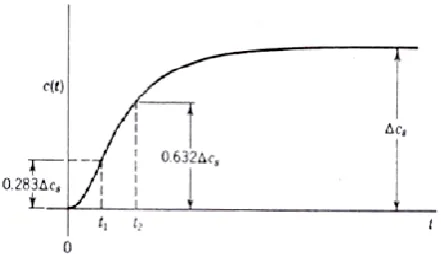
Figure IV.C: process reaction curve
Controller Kc τI τD
P 0.5Kcu - -
PI 0.45Kcu Pu/1.2 -
PID 0.6Kcu Pu/2 Pu/8
Controller Kc τI τD
PI Kcu/3.2 2.2Pu -
Where,
T = 1.5 (t2 --t1) Tm = (t2 –tm) C = plant output
t1 = time at which ∆c = 0.283 ∆cs t2 = time at which ∆c = 0.632 ∆cs
The Cohen coon method as typically used to determine the reaction curve on figure (C).The parameters which have to be determining for this method are Km, τm and td.
Table IV.C cohen coon tuning formula
V.RESULT
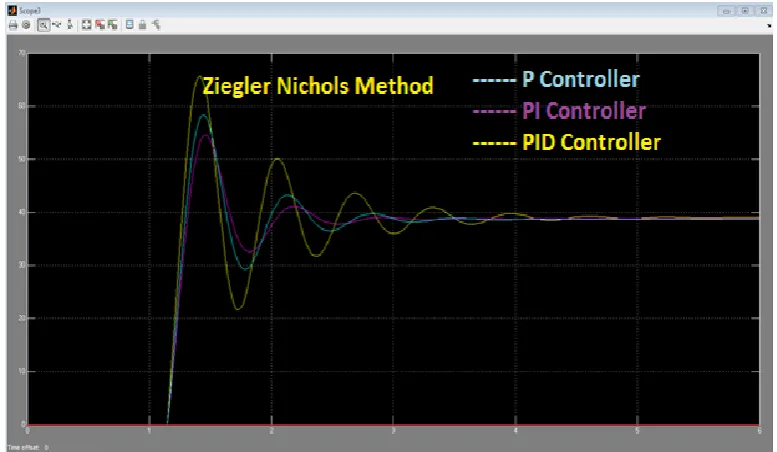
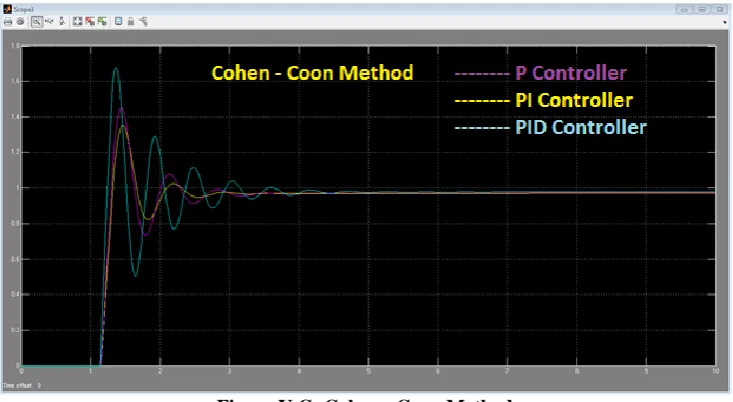
Above discribe the three types tuning methods are used to implement the various of simulation performance are,
Figure V.B: Tyreus-Luyben Method
Figure V.C: Cohen - Coon Method
VI. CONTROLLER PERFORMANCE MEASUREMENT
Table VI.A Erorr values Comparesion
Z-N
ISE ITAE IAE
501.9 81.4 29.62
COHEN-COON 479.2 73.52 27.76
VII.CONCLUSION
The controller design is most important one in process control industries. In the proposed article, the concept of controller design is carriedout on PID mode. It is performed with the help of difffernet method of controller tunning like Zigular-Nichol, Tyreus-Luyben and Cohoon Coon. In the different techniques, it is proved that the Tyreus-luyben based controller design which gives better result. It is proven by comparing its performance indexes such as ISE, ITAE and IAE. Finally, the Tyreus-Luyben method based controller design gives the better result to the proposed process. Thus, the Tyreus-Luyben method based controller design is optimum for the proposed process,
REFERENCES
[1] P.Srinivas, K.Vijaya Lakshmi & V.Naveen Kumar, “A Comparison of PID Controller Tuning Method For Three Level Process”, International Journal of Advanced Research in Electrical, Electronics and Instrumentation Engineering Vol-3, Issue-1, January 2014.
[2] P.Aravind, M.Valluvan & B.Sangeeth, “Modal Based Controller Design for Level Process”, International Journal of Computer Application (0975-887) Vol-88-No.18, February 2014.
[3] Mohammad Shahrokhi & Alireza Zomorrodi, “Comparison of PID Controller Tuning Method”, Department Of Chemical & petroleum Engineering, Apr 2014.
[4] Rajesh.T, Arun Jayakar.S & Siddharth.S.G, “Design and Implementation of IMC Based PID Controller for Conical Tank Control Process”, International Journal of Innovative Research in Electrical, Electronics, Instrumentation and Control Engineering Vol-2, Issue-9, September 2014. [5] P.Aravind, M.Valluvan & S.Ranganathan, “Modeling and Simulation of Non Linear Tank”, International Journal of Advanced Research in Electrical, Electronics and Instrumentation Engineering Vol-2, Issue-2, February 2013.
[6] Apurva Tripathi, Ram Lautan Verma & Md.Sanawer Alam, “Study and Analysis of Various Tuning Method of PID Controller for AVR System”, International Journal of Research in EEE Vol-1, July-September- 2013, pp.93-98.
[7] M.Venmathi, K.Sujatha, A.Nalini & M.Venmathi, “Fuzzy and ANN tuning of PI Controller for Level Process Station”, ACS international