FPGA Based Cordic Algorithm
Uma Kulkarni1, Preeti.G.Mandake2
Professor, Dept. of ECE, K.L.E’s Dr. M. S. Sheshgiri College of Engineering and Technology, Belgaum, Karnataka, India1
PG Student [VLSI], Dept. of ECE, K.L.E’s Dr. M. S. Sheshgiri College of Engineering and Technology, Belgaum, Karnataka, India2
ABSTRACT: DSP algorithms provide extraordinary performance in processing the real time data. Trigonometric functions play a vital role in real life applications. Especially Sine and Cosine waves are very useful in various fields of applications. Few to mention are signal processing, thermal analysis, electronic communication, medical science and many others. Algorithms play a vital role in the DSP applications. One such algorithm is the CORDIC (Co-ordinate Rotation Digital Computer) algorithm. Many real time applications require that the computation speed to be as high as possible. CORDIC is one such efficient algorithm. It was basically initiated by Volder in 1959. It is an iterative algorithm that uses shift, add/subtract and table look up operations. This paper presents implementation of CORDIC algorithm on FPGA for the generation of sine and cosine terms. The algorithm is implemented using VHDL language and simulation results are obtained from Xilinx ISE tool.
KEYWORDS: CORDIC, FPGA, VHDL, Xilinx, DSP.
I.INTRODUCTION
Sine and cosine are the essential capacities which can be gotten from any perplexing capacities utilized as a part of a wide scope of applications, for example, computerized signal handling, remote correspondence, biometrics, robotics, and so forth [1]. A few strategies exist to create equipment that performs sine and cosine counts, which are Lookup Table (LUT), Maclaurin arrangement, and CORDIC.
Table lookup technique uses pieces of memory which store estimations of the capacity to be figured for each conceivable info contentions. This strategy is generally easy to be employed since no particular estimations are required, depending just on the qualities put away on the table. Be that as it may, the quantity of table passages required will rise exponentially as the quantity of bits, which are utilized to speak to the yield contention, rise [2]. This will bring about bigger region required for equipment execution.
ISSN (Print) : 2320 – 3765 ISSN (Online): 2278 – 8875
I
nternational
J
ournal of
A
dvanced
R
esearch in
E
lectrical,
E
lectronics and
I
nstrumentation
E
ngineering
(An ISO 3297: 2007 Certified Organization)
Vol. 5, Issue 5, May 2016
presents equipment outline for figuring sine and cosine estimation of given edge utilizing CORDIC calculation with restricted equipment use.
The CORDIC calculation has turned into a broadly utilized way to deal with rudimentary capacity assessment when the silicon zone is an essential imperative. The execution of CORDIC calculation requires less perplexing equipment than the ordinary technique [3]. The CORDIC calculation has discovered its way in different applications, for example, pocket number crunchers, numerical co-processors, to elite radar signal preparing, supersonic plane air ship with a computerized partner, calculation of the (Fast Fourier Transform) FFT, and at the consequences for the numerical exactness [4]. CORDIC calculation spins around "turning" the period of an intricate number, by duplicating it by a progression of consistent qualities. Notwithstanding, the "increases" would all be able to be forces of 2, so in double number juggling they should be possible utilizing just moves and includes; no genuine "multiplier" is required in this way it more straightforward and don't require complex equipment structure as on account of multiplier. Prior strategies utilized are Table gaze upward strategy, Polynomial estimate technique and so forth for assessment of trigonometric capacities.
II.LITERATURE SURVEY
Henry Briggs portrayed a portion of the digit-by-digit strategies for the calculation of the arithmetical rudimentary capacities. These are iterative pseudo division and pseudo augmentation forms, which take after rehashed expansion duplication and rehashed subtraction division. In 1959, Volder proposed an exceptional reason advanced processing unit known as COordinate Rotation DIgital Computer (CORDIC), while building an ongoing navigational PC for use in a flying machine.
This calculation was at first created for trigonometric capacities which were communicated as far as fundamental plane pivots. The equipment acknowledgment of the calculation conditions require augmentations, increases/subtractions and getting to the table put away in memory for trigonometric coefficients. The CORDIC calculation processes 2D turn utilizing iterative conditions utilizing move and include operations.
The flexibility of CORDIC was improved by creating calculations on the same premise for change between paired to Binary Coded Decimal (BCD) number representation by Daggett in 1959. These iterative strategies were depicted utilizing decimal radix for the configuration of effective little machines by Meggitt in 1962. In this manner, Walther in 1971 has proposed a bound together calculation to register pivot in round, straight, and hyperbolic direction frameworks utilizing the same CORDIC calculation, installing coordinate frameworks as a parameter.
Amid the most recent 50 years of the CORDIC calculation a wide assortment of uses has developed. The CORDIC calculation has gotten expanded consideration after a bound together approach was proposed for its usage. From that point, CORDIC based figuring has been the decision for experimental number cruncher applications, for example, HP-2152A co-processor, HP-9100 desktop adding machine, HP-35 mini-computer are a couple of such gadgets in light of the CORDIC calculation.
III. CORDIC ALGORITHM
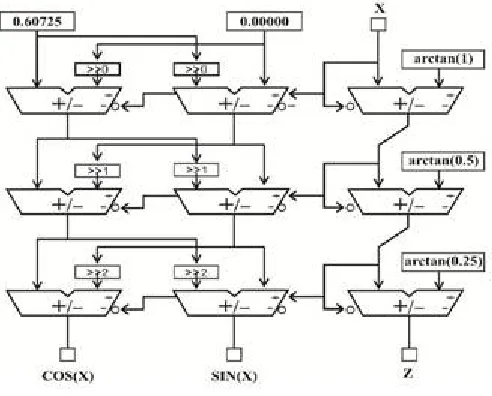
Figure.1: Graphical representation of cordic
The input angle whose sine and cosine is to be calculated is converted to radian first. Then this value is converted to binary and used in the code as input. Binary form of the output is obtained. It is then converted to decimal. The algorithm is successfully implemented on Spartan 3 FPGA board.
Utilizing a framework shape, a planar pivot for a vector of (Xi, Yi) is characterized as:
The plot for every progression is given by:
Substituting in above conditions, we get:
ISSN (Print) : 2320 – 3765 ISSN (Online): 2278 – 8875
I
nternational
J
ournal of
A
dvanced
R
esearch in
E
lectrical,
E
lectronics and
I
nstrumentation
E
ngineering
(An ISO 3297: 2007 Certified Organization)
Vol. 5, Issue 5, May 2016
In a project like style: For n=0 to infinity, If (Z(n) >= 0) then
Z(n + 1) := Z(n) – atan (1/2^n); Else
Z(n + 1) := Z(n) + atan (1/2^n); End if;
End for;
Figure.2: Flow chart for the CORDIC algorithm
The atan (1/2^i) is pre-computed and put away in a table. Interminability is supplanted with the required number of cycles, which is around 1 emphasis for each piece.
On the off chance that we include the calculation for X and Y we get the system like style for the CORDIC centre.
IV. EXPERIMENTAL RESULTS
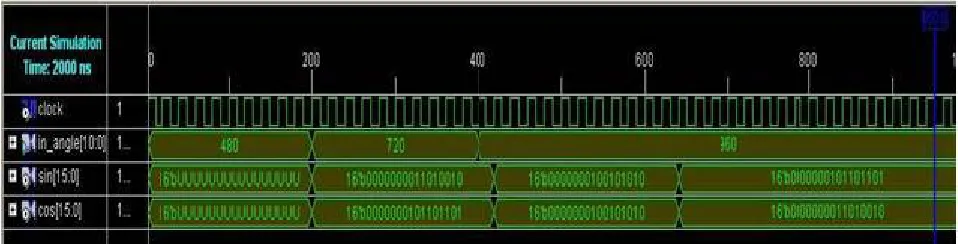
Figure.3: Test bench waveforms of cordic implementation.
Figure 4 shows sine and cosine values for a given input angle. For example 3 values of input angle z have been used as 30, 45 and 60 degrees. These angles are represented in fixed point notation as 00111100000, 01011010000 and 01111000000 respectively.
Figure.4: Sine and Cosine values for the required input angles.
As shown in figure 2, at each 200 ns, result for the value of input angle is being calculated. Results for the given input angles are as 0000000011010010, 0000000100101010 and 0000000101101101 respectively as shown for sine value. Dividing the output by 1.64676 we can get the sine value of an angle.
V.CONCLUSION
ISSN (Print) : 2320 – 3765 ISSN (Online): 2278 – 8875
I
nternational
J
ournal of
A
dvanced
R
esearch in
E
lectrical,
E
lectronics and
I
nstrumentation
E
ngineering
(An ISO 3297: 2007 Certified Organization)
Vol. 5, Issue 5, May 2016
[2] V. Kantabutra, “On hardware for computing exponential and trigono-metric functions,” Computers, IEEE Transactions on, vol. 45, no. 3, pp. 328–339, 1996.
[3] Terence K. Rodrigues and Eari E.Swartzlander ,Jr.Fellow,”Adaptive CORDIC :Using parallel Angle Recoding to Accelerate Rotations”, IEEE Transactions on Computers, Vol .59,NO.4, April 2010.
[4] Pramod K.Meher, Senior Member ,IEEE, Javier Valls, Member, IEEE, Tso- Bing Juang , Member, IEEE, K.Sridhan, Senior Member, IEEE, and Koushik Maharatna, Member , IEEE “ 50 Years of CORDIC: Algorithms, Architectures, and Applications” , IEEE transactions on circuits and systems,VOL.56.NO.9,September, 2009.
[5] Volder J. E,”The CORDIC trigonometric computing technique”, IRE Trans. Electronic Computing, Volume EC-8, pp 330 - 334, 1959. [6] Satyasen Panda, "Performance Analysis and Design of a Discrete Cosine Transform Processor using CORDIC Algorithm", M.Tech
Thesis,Dept. Electron.Comm.Eng., NIT Rourkela, Rourkela, Orissa,2010.
[7] J.-M. Muller, Elementary Functions: Algorithms and Implementation, Birkhäuser, Boston, Mass, USA, 2004.
[8] Vikas Sharma,"FPGA Implementation of EEAS CORDIC based Sine and Cosine Generator", M.Tech Thesis,Dept.Electron.Comm.Eng.,Thapar Uni., Patiala, 2009.
[9] Hu,Y.H.,and Naganathan, S., "A Novel Implementation of Chirp Z-Transformation Using a CORDIC processor, "IEEE Transactions on ASSP, Vol.38.