
An extended abstract of this work appeared in the proceedings of PKC 2015. This is the full version.
Tightly-Secure Signatures from Chameleon Hash
Functions
Olivier Blazy
1Saqib A. Kakvi
2Eike Kiltz
2Jiaxin Pan
21Universit´e de Limoges, XLim, France
2 Horst G¨ortz Institute for IT-Security, Ruhr-University Bochum, Germany
{saqib.kakvi,eike.kiltz,jiaxin.pan}@rub.de
Abstract
We give a new framework for obtaining signatures with a tight security reduction from standard hardness assumptions. Concretely, we show that any Chameleon Hash function can be transformed into a (binary) tree-based signature scheme with tight security. The transformation is in the standard model, i.e., it does not make use of any random oracle. For specific assumptions (such as RSA, Diffie-Hellman and Short Integer Solution (SIS)) we further manage to obtain a more efficient flat-tree construction. Our framework explains and generalizes most of the existing schemes as well as providing a generic means for constructing tight signature schemes based on arbitrary assumptions, which improves the standard Merkle tree transformation. Moreover, we obtain the first tightly secure signature scheme from the SIS assumption and several schemes based on Diffie-Hellman in the standard model.
Some of our signature schemes can (using known techniques) be combined with Groth-Sahai proof methodology to yield tightly secure and efficient simulation-sound NIZK proofs of knowledge and CCA-secure encryption in the multi-user/-challenge setting under classical assumptions.
1
Introduction
Digital Signatures are one of the most fundamental cryptographic primitives. They are used as a building block in numerous high-level cryptographic protocols. Their security is commonly proven in terms of a security reduction showing that any successful adversaryAattacking the scheme can be transformed into a successful adversary B breaking the underlying hard intractability assumption. Naturally, we would desire thatB’s successεBis approximately the same as A’s successεAin attacking the system and also
the running times ofAandBare approximately the same. Such a scheme is said to have a tight security reduction and does not require to compensate reduction’s security loss with increased parameters.
Signature schemes with a tight security reduction are known based on standard intractability assump-tions such as theRSA[6] or the (bilinear) Computational Diffie-Hellman (CDH) assumption [25]. However, their security can only be proven in the random oracle model [5] with all its limitations (e.g., [13, 20]).
Standard Model Signatures. We now discuss signature schemes in the standard model (i.e., without
{DLOG,RSA, . . .} {FAC,CFP}
Σ-protocols CHF 1-time two-tierTTSig binary tree-basedSig
{f-CDHI,RSA,SIS} d-times two-tierTTSig d-ary tree-basedSig
[35]
[4] §3.1 §4.1
§3.2 d= 1 §4.2 d= 2
Figure 1: Schematic overview of our constructions from the assumption level (left) over two-tier signatures (middle) to signatures (right). All implications have a tight security reduction, except the dotted line which loses a factor ofd.
the other hand, known signature schemes from “standard assumptions” (i.e., general assumptions such as the one-wayness of trapdoor permutations [43, 27, 21] or more specific assumptions such as the RSA
assumption [32, 31] , theCDHassumption [45], or the Short Integer Solution (SIS) assumption [14, 38]) have non-tight security reductions, meaning their security reduction loses a multiplicative factor of q, which is the maximal number of established signatures. Sinceqcan be as large as 240, this security loss can have a dramatic impact on the scheme’s parameters.
To the best of our knowledge, there are only a few exceptions to the above. The flatd-ary tree-based signature scheme by Cramer and Damg˚ard [18] from almost two decades ago is based on a standard as-sumption (theRSAassumption) and (even though not explicitly mentioned in [18]) the security reduction is tight. In follow-up papers [15] and [12] extend their methods to an assumption related to factoring and
CDH, respectively. Hofheinz and Jager [30] proposed a binary tree-based construction from the Linear (LIN) assumption. More recently, works on identity-based encryption [8, 16] imply tight signatures from
LIN.
1.1
Our contributions
Overview. In this work we revisit the question of construction standard-model signatures with a tight security reduction. Our main result shows that, surprisingly,tightly-securesignatures can be constructed from any Chameleon Hash function CHF. Our transformation is based on binary trees and hence a signature containsλChameleon Hashes plusλelements from the randomness space of CHF, whereλis the security parameter. As tightly secure Chameleon Hash functions exist from generic primitives such as claw-free permutations (CFP) [35], Σ protocols [4] and specific assumptions such as the RSA [32], the factoring (FAC) [35], and the discrete logarithm (DLOG) [35] assumptions, we immediately obtain a number of new signature schemes with tight security reductions. We improve the well-known Merkle tree construction [37] and its variant [41] in the sense that our signature size is the same as the original Merkle tree construction, but our security loss is independent of the number of signing queries.
In fact, our transformation can be generalized to flat-tree signatures with improved efficiency. From a general primitive calledd-time two-tier signaturesTTSig(a generalization of two-tier signatures [7] to any
d≥1), we build flatd-ary (instead of binary, 2-ary) trees via our second transformationd-Tree, such that a signature only contains O(λ/logd) many elements. Whereas Chameleon Hash functions only imply one-time two-tier signatures, for specific assumptions such asRSA,CDHandSISwe are able to construct efficient d-time two-tier signatures, hence also d-ary tree signatures. Our reduction loses a factor of d
which is still (almost) tight as d is generally assumed to be small and, in particular, is independent of the number of signing queries. See Figure 1 for a schematic overview of our transformations.
We stress that while all our schemes are only secure in a non-adaptive sense (a.k.a. weak security), they can be transformed into adaptively secure signature schemes using a Chameleon Hash or a one-time signature, without losing efficiency or tightness (such transformations have been used several one-times [35, 10, 33, 40]).
Scheme Origin Assumption |pk| Signature size Loss Structure preserving
BinTree+CHFDLOG new DLOG O(1)×G O(λ)×(G+Zp) O(1) almost BinTree+CHFFAC new FAC O(1)×ZN O(λ)×ZN O(1) −−
BinTree+CHFRSA new RSA O(1)×ZN O(λ)×ZN O(1) −−
BinTree+CHFLIN [30] LIN O(1)×G O(λ)×(G+Zp) O(1) √ d-Tree+TTSigf-CDHI new f-CDHI O(d/f)×G O(λ/log(d))×(G+Zp) O(d) almost d-Tree+TTSigRSA [18] RSA O(d)×ZN O(λ/log(d))×ZN O(d) −− d-Tree+TTSigSIS new SIS O(d)×Zp(λ×λlog(p)) O(λ/log(d))×Zλplog(p) O(d) −−
BKP14 [8] k-LIN O(λk2)×
G O(k)×G O(λ) almost
CW13 [16] k-LIN O(λk2)×
G O(k)×G O(λ) almost
Table 1: Comparison between known tightly-secure signature schemes from standard (non-q) assumptions, where λis the security parameter.
gives an overview over all known tightly secure signature schemes from standard assumptions. Some of our schemes are also structure preserving, a property with important applications, which we will discuss later.
Details. First, we transform a Chameleon Hash into a two-tier signature and then, we show how to
transform the latter into a binary tree-based signature scheme.
The concept of d-time two-tier signatures is a natural generalization of (one-time, d = 1) two-tier signatures introduced by Bellare and Shoup [7]. A two-tier signature scheme is like a standard signature scheme except that the public (secret) key is split into fixed primary part ppk (psk) and a variable secondary partspk(ssk). In terms of security we require that an adversary possessing the primary public key and having access to an oracle generating q independent secondary public keys, together with d
signatures for each of oracle queries, cannot forge a fresh signature relative to one of the established public keys. The challenge will be to construct a d-time two-tier signature scheme with a tight (i.e., independent ofq) security reduction from a standard assumption.
• Any Chameleon Hash implies a 1-time two-tier signature scheme. While it is well-known that a Chameleon Hash implies a (standard) 1-time signature [40], the novelty of our observation lies in the tight security reduction for two-tier signatures.
• We give constructions of d-time two-tier signatures for anyd≥2 with a tight security reduction from a number of standard number theoretic assumptions such as theRSA, theSIS, theCDH and the f-CDHI2 (1 ≤ f ≤ d) assumption. The important feature of our new constructions is the constant number of elements in the secondary public key while maintaining the tight reduction.
• We show that d-time two-tier signatures imply d-ary tree-based signatures with a tight security reduction. In our construction the verification/signing keys are the primary public/secret key of thed-times two-tier signature scheme. The signer implicitly maintains ad-ary authenticated tree of heightk=λ/log(d), whereλis the security parameter. Each internal node is assigned a secondary public/secret key, the secret key is used to authenticate the key of the d distinct children via a signature. To sign a message, the signer picks the next unused leaf and outputs the authenticated path to the leaf plus a signature of the message under the leaf’s secret key.
Applications. We remark that some of our tightly secure signature schemes are almost structure
preserving (cf. Table 1) in the sense that they do not satisfy the structure preserving definition in [2], but, following a similar method as Hofheinz and Jager [30], these schemes can be used to build tightly-secure simulation-sounds NIZK and tightly-tightly-secure encryption in the multi-user/multi-challenge setting. A discussion of this can be found in Appendix D. We also note that our results can be used to improve the Key Agreement of Bader et al. [3].
Open Problems. Since our signature schemes containO(λ/logd) many group elements, they cannot
be considered to be practical. More recently, Blazy, Kiltz and Pan [8] and Chen and Wee [16] proposed tightly secure identity-based encryptions from the LIN assumption independently, which imply tightly secure signature schemes with constant signature size. However, it is not clear how to extend their methods to constructing tight signatures based on theRSAassumption or any lattice assumption. Thus, obtaining a tightly secure signature scheme from the standardRSAassumption or any lattice assumption whose signatures only contain aconstant number of group elements remains an open problem.
2
Preliminaries
2.1
Notation
We denote our security parameter as λ. For all n ∈ N, we denote by 1n the n-bit string of all ones.
For any element xin a set S, we use x∈R S to indicate that we choose xuniformly random inS. All
algorithms may be randomized. For any algorithmA, we definex←$ A(a1, . . . , an) as the execution of
Awith inputsa1, . . . , an and fresh randomness and then assigning the output tox.
A list of classical security definitions and assumptions (CDH,f-CDHI, SIS,RSA) that we require for our results can be found in Appendix A.
2.2
Signatures
We first recall the definition of a digital signature scheme.
Definition 2.1 [Signature scheme] A digital signature schemeSig with message space M is defined as
a triple of probabilistic polynomial time (PPT) algorithmsSig= (Gen,Sign,Verify):
• Gentakes as an input the unary representation of our security parameter 1λ and outputs a signing keyskand verification keypk.
• Signtakes as input a signing keysk, messagemand outputs a signatureσ.
• Verify is a deterministic algorithm, which on input of a public key and a message-signature pair (m, σ) outputs 1 (accept) or 0 (reject).
Sig is perfectly correct if for anyλ∈ N, all (pk,sk)←$ Gen(1
λ), all m∈ M, and allσ ←
$ Sign(sk, m)
that Verify(pk, m, σ) = 1.
Some of the signature schemes we present are stateful. This means that the signer maintains a state that is updated after each execution of the signing algorithm. Fortunately, our stateful schemes can be transformed to be stateless by using the technique from [26].
Definition 2.2 [Security of signatures] Signature scheme Sig is (t, ε, q)-existential unforgeable under
non-adaptive chosen-message attacks (EUF-NCMA) iff
Pr[ExpEUFSig,F-NCMA,q (λ) = 1]≤ε
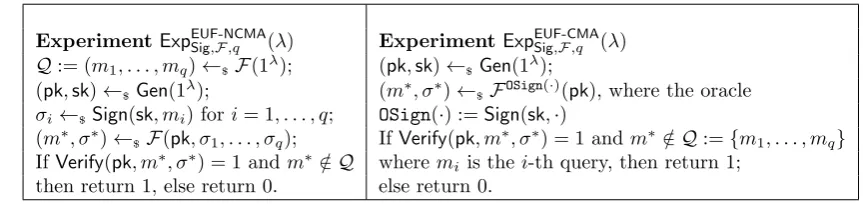
holds for any PPT adversary F with running time t, where ExpEUFSig,F-NCMA,q (λ) is defined in Table 2. The existential unforgeability under chosen-message attacks is defined in the similar way.
ExperimentExpEUFSig,F-NCMA,q (λ) ExperimentExpEUFSig,F-CMA,q (λ)
Q:= (m1, . . . , mq)←$F(1λ); (pk,sk)←$Gen(1λ);
(pk,sk)←$Gen(1
λ); (m∗, σ∗)← $FOSign
(·)(pk), where the oracle
σi←$Sign(sk, mi) fori= 1, . . . , q; OSign(·) :=Sign(sk,·) (m∗, σ∗)←
$F(pk, σ1, . . . , σq); IfVerify(pk, m∗, σ∗) = 1 and m∗∈ Q/ :={m1, . . . , mq} IfVerify(pk, m∗, σ∗) = 1 andm∗∈ Q/ wheremi is thei-th query, then return 1;
then return 1, else return 0. else return 0.
Table 2: EUF-NCMAandEUF-CMAexperiments for the signature scheme.
2.3
Two-Tier Signatures
We now present a generalization of two-tier signature schemes, due to Bellare and Shoup [7]. In a two-tier signature scheme, the key generation algorithm is split into two algorithms, the primary and secondary key generation algorithms. The primary key is static and used for all signatures. The secondary key is ephemeral and used for only one or many messages. To generate the signature, we need both a primary and secondary key. In the original definition [7], each secondary key was allowed to be used to sign exactly once. We generalize to allow each secondary key to be used to sign at most d messages. We refer to this generalization as thed-time two-tier signature, the constructions presented in [7] are 1-time two-tier signatures.
Definition 2.3 [d-time two-tier signature scheme] A two-tier signatureTTSigis defined as a quadruple
of probabilistic algorithms (PriGen,SecGen,TTSign,TTVerify):
• PriGen(1λ, d) outputs a primary signing keypskand primary verification key ppk.
• SecGen(ppk,psk) outputs a fresh secondary verification and signing key pair (spk,ssk).
• TTSign(psk,ssk, m) outputs a signatureσ. We denote the stateful variant byTTSign(psk,ssk, m;j) wherej is the state.
• TTVerify(ppk,spk, m, σ) deterministically outputs 1 (accept) or 0 (reject). We denote the stateful variant byTTVerify(ppk,spk, m, σ;j) wherej is the state.
Correctness is defined in a natural way as in Definition 2.1.
Definition 2.4 [Security of two-tier signatures] A two-tier signature TTSigis (t, q, d, ε)-existential
un-forgeable under non-adaptively chosen-message attacks (TT-EUF-NCMA) iff Pr[ExpTTSig,-FEUF,q-NCMA(λ, d) = 1]≤ε
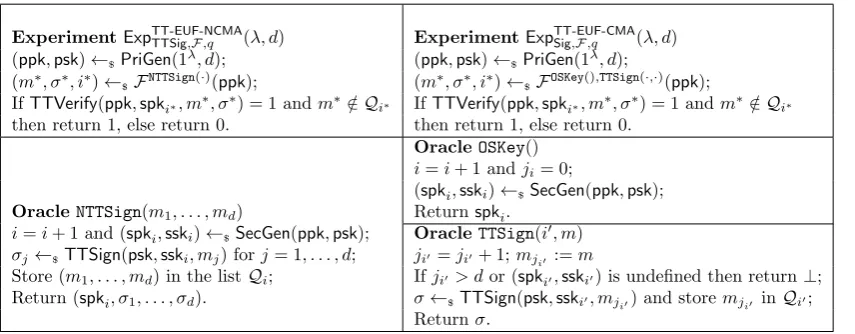
holds for any PPT adversary F with running timet, where ExpTTSig-,FEUF,q-NCMA(λ, d) is defined in Table 3. The existential unforgeability under (adaptively) chosen-message attacks (TT-EUF-CMA) is defined in the similar way.
We also define the strong unforgeability of two-tier signatures, in both the adaptive case,TT-SUF-CMA, and the non-adaptive case,TT-SUF-NCMA, analogously as to how we defined it for standard signatures.
2.4
Chameleon Hash Functions
A Chameleon Hash Function is defined asCHF= (CHGen,CHash,Coll):
• CHGen(1λ) outputs the hash key chkand the trapdoortd.
• CHash(chk, m, r) outputs the hash valueh.
ExperimentExpTTTTSig-EUF,F-,qNCMA(λ, d) ExperimentExp
TT-EUF-CMA Sig,F,q (λ, d) (ppk,psk)←$PriGen(1
λ, d); (ppk,psk)←
$PriGen(1
λ, d);
(m∗, σ∗, i∗)←$FNTTSign(·)(ppk); (m∗, σ∗, i∗)←$FOSKey(),TTSign(·,·)(ppk);
IfTTVerify(ppk,spki∗, m∗, σ∗) = 1 andm∗∈ Q/ i∗ IfTTVerify(ppk,spk
i∗, m∗, σ∗) = 1 andm∗∈ Q/ i∗ then return 1, else return 0. then return 1, else return 0.
OracleOSKey()
i=i+ 1 andji= 0;
(spki,sski)←$SecGen(ppk,psk);
OracleNTTSign(m1, . . . , md) Returnspki.
i=i+ 1 and (spki,sski)←$SecGen(ppk,psk); OracleTTSign(i0, m) σj←$TTSign(psk,sski, mj) forj= 1, . . . , d; ji0=ji0+ 1;mj
i0:=m
Store (m1, . . . , md) in the listQi; Ifji0> dor (spki0,sski0) is undefined then return⊥; Return (spki, σ1, . . . , σd). σ←$TTSign(psk,sski0, mj
i0) and storemji0 inQi0; Returnσ.
Table 3: TT-EUF-NCMAandTT-EUF-CMAexperiments for the two-tier signature scheme.
The standard security notion for Chameleon Hashes is collision resistance (coll). Formally,CHFis (t, ε)-coll
if for the adversaryArunning in time at mostt we have: Pr
(chk,td)←$CHGen(1λ); ((m1, r1),(m2, r2))←$A(chk)
∧CHash(chk, m1, r1) =CHash(chk, m2, r2)∧(m1, r1)6= (m2, r2)
≤ε.
However, any user in possession of the trapdoor td is able to find a collision using Coll. Additionally, Chameleon Hash functions have the uniformity property, which means the hash value leaks nothing about the message input. Formally, for all pair of messages m1 and m2 and the randomly chosen
r, the probability distributions of the random variables CHash(chk, m1, r) and CHash(chk, m2, r) are computationally indistinguishable.
3
Constructions of Two-Tier Signatures
In this section we show different constructions of d-time two-tier signatures ford= 1 (Section 3.1) and
d≥2 (Section 3.2).
3.1
Construction from any Chameleon Hash function
We construct a non-adaptively strongly secure one-time two-tier signature TTSigCHF= (PriGen,SecGen, TTSign,TTVerify) from any Chameleon Hash CHF= (CHGen,CHash,Coll) with message space M and randomness spaceR.
• PriGen(1λ): Generate a Chameleon Hash key and the corresponding trapdoor (chk,td)←
$CHGen(1 λ). Defineppk=chkandpsk=td.
• SecGen(ppk,psk): Pick random ˆσ∈RRand computeh=CHash(ppk,m,ˆ σˆ), for an arbitrary public ˆ
m∈ M(possibly ˆm= 0). Definespk=handssk= ˆσ.
• TTSign(psk,ssk, m): The signer uses the trapdoor of the chameleon hash to compute a collision as
σ=Coll(psk,m,ˆ σ, mˆ ), which meansCHash(ppk, m, σ) =spk. The signature on misσ∈ R.
• TTVerify(ppk,spk, m, σ): Check ifCHash(ppk, m, σ) =spk.
Correctness of the scheme follows by correctness of the Chameleon Hash function.
Theorem 3.1 If CHF is a (t, ε)-coll Chameleon Hash function, then for any q ∈ N, TTSigCHF is a
Proof:LetFbe apptadversary that (t0, q,1, ε0)-breaks theTT-SUF-NCMAsecurity ofTTSigCHF. Then we construct an adversary B that (t, ε)-breaks the collision resistance of CHF. Formally, B is given the challenge Chameleon Hash keychkand asked to come up with two distinct inputs (m, r)6= (m0, r0) such that CHash(chk, m, r) =CHash(chk, m0, r0).
Simulation. B simulates PriGen(1λ) as follows: it sets ppk=chkand returns ppkto F. Now B does
not have the Chameleon Hash trapdoor and pskis empty.
Upon receiving the ith message mi from F, B simulates NTTSign(mi) as follows: it picks a random
σi ∈R R and computeshi =CHash(ppk, mi, σi). Define the secondary public key spki =hi and return spki and the signatureσi.
The simulation is identical to the real execution. Firstly, chk is from the Chameleon Hash challenge and, thus, the simulation of PriGen is identical to the definition. Secondly, in the original definition
spki =CHash(ppk,0, ri), whilespki =CHash(ppk, mi, σi) in the simulation. These two distributions are identical based on the uniformity property ofCHF. Thirdly, it is easy to see the simulated signatures are well-formed.
Extracting the collision. Once F outputs a forgery (m∗, σ∗, i∗), B aborts if spki∗ is undefined. Otherwise, B checks if CHash(ppk, mi∗, σi∗) = spki∗ = CHash(ppk, m∗, σ∗). If that is the case, then
B returns the collision ((m∗, σ∗),(mi∗, σi∗)). By the strong unforgeability of TTSigCHF, (m∗, σ∗) 6= (mi∗, σi∗). Thus, ifF outputs a successful forgery thenBfinds a collision for the Chameleon Hash with probability ε=ε0.
3.2
Direct Constructions of
d
-time Two-Tier Signatures
The construction from Section 3.1 can be extended to yield a d-time two-tier signature scheme for any
d≥1 but the size of the secondary public-key is linear indwhich is not useful for constructing efficient flat-tree signatures. In this section, we present statefuld-time two-tier signature schemes withconstant size secondary key, from the f-CDHI, and SIS assumptions. Two more constructions from RSA and factoring are given in .
3.2.1 Construction fromf-CDHI
The construction from this section has an additional parameter 1≤f ≤dwhich offers a trade-off between the size of ppk(O(d/f) group elements) and the underlying hardness assumption f-CDHI relative to a pairing group generator algorithm PGroupGen. (See Appendix A for a formal definition of f-CDHI.) We now present the stateful d-time two-tier signature scheme TTSigf-CDHI = (PriGen,SecGen,TTSign, TTVerify) from f-CDHIwith message space Zp. For simplicity we assume there exists an integer c such that c·f =d.
• PriGen(1λ, d): generates a pairing group PG = (G, g, p,GT, e) ←$ PGroupGen(1
λ), picks random scalarsx0, . . . , xc ∈RZpand computeshi=g
xi fori= 0. . . , cand definespsk= (x
0, . . . , xc),ppk= (PG,(h0, . . . , hc)).
• SecGen(psk,ppk): picks a randomu∈RG, and definesspk=u, the secondary signing key is empty.
• TTSign(psk,ssk, mj;j): to sign thej= (α·f+β)-th messagemj(j∈J1, dK, α∈J0, cK, β∈J0, f−1K),
computeσj= (gmju)1/(xα+β).
• TTVerify(ppk,spk, mj, σj;j): parsesj=α·f+β and checks ife(σ, hα·gβ) =e(gmj ·u, g). It is easy to verify correctness.
Theorem 3.2 If thef-CDHIassumption is(t, ε)-hard, then for anyq∈N,TTSigd,f-CDHI is a(t0, q, d, ε0
)-TT-EUF-NCMA signature scheme whereε0 =dεand t0=t−O(dq).
We stress thatf is a fixed small parameter of the scheme. In particular, as 1-CDHIis equivalent to
CDH,TTSig1-CDHI is secure under the standardCDHassumption, which is equivalent to the scheme from [12].
Proof:LetFbe an adversary that (t0, q, d, ε0)-breaks theTT-EUF-NCMAsecurity ofTTSigf-CDHI. Then
pairing group description PGˆ = (G,GT,ˆg, p, e) and a f-CDHI-challenge (ˆg,gˆx, . . . ,ˆgx f
). Its goal is to compute ˆgx1.
• To simulatePriGen, B picks a randomj0 ∈R J1, dK, which defines uniquely α0, β0 as the quotient and modulo in the euclidean division ofj0 by f. B computesg = ˆgQb6=β0(x+b−β
0)
(b ∈J0, f−1K) from f-CDHI-challenge and chooses c random scalars (x0, . . . , xα0−1, xα0+1, . . . , xc) ∈
R Z c p, where
c=d/f as defined in the scheme, and for allα∈J0, cKcomputes:
hα=
gx−β0 if α=α0 (Implicitely, x
α0 :=x−β0)
gxα otherwise
The primary public-key isppk= (PG= (G, g, p,GT, e, g),(h0, . . . , hc)).
• When receiving thei-thNTTSignquery (i∈J1, qK) onm~i= (mi,1, . . . , mi,d):
1. SecGen: Bpicks a random scalar ri ∈RZp and definesspki=ui= ˆg ri
f
Q
b=1
(x+b−β0)
h−mi,j0 α0 . 2. TTSign: Bthen computes the signature vector~σi= (σi,1, . . . , σi,d) onm~i via
σi,j= (ui·hmαi,j) 1 xα+β =
gri if j=j0
ˆ
g
ri Q b6=β
(x+b−β0) ˆ
g
(mi,j−mi,j0)(x−β 0) Q
b6=β,β0
(x+b−β0)
if α=α0∧β 6=β0 u1/(xα+β)
i h
mi,j/(xα+β)
α otherwise
where j =α·f +β and α∈ J0, cK and β ∈ J0, f−1K. Since xα (forα6= α0) is chosen by B, the last equation can be computed. It is easy to see the simulated distribution is identical to the real scheme, since ˆg fromf-CDHIchallenge is a random generator ofG.
Eventually, the adversaryF outputs a forgeryσ∗on a messagem∗ for some previously establishedspki∗ (i∗∈
J1, qK). With probability 1/dthe forgery is for thej
0-th index. As σ∗ is valid we have
σ∗= (ui∗hm ∗
α0 )1/(xα0+β 0)
= ˆg
ri∗ Q b6=β0
(x+b−β0) (ˆg
(x−β0)·(m∗−m i,j0)·Q
b6=β0
(x+b−β0) )1/x As we knowm∗, mi,j0, ri, andm∗6=mi,j0 this allows to compute the helper value
(σ∗/gri∗)1/(m∗−mi,j0)= (ˆg
(x−β0) Q
b6=β0
(x+b−β0) )1/x.
The helper value can be written as ˆgpoly(x)x , where poly(x) admits{β0−b:b∈
J1, fK∧b6=β
0} ∪ {β0}as
roots. Using partial fraction decomposition, it can be rewritten as ˆgpoly0(x)gˆβ 0Q
b6=β0(β0 −b)
x where poly0 is
a polynomial of degreef−1. Due to its degree, ˆgpoly0(x)can be efficiently computed from the challenge, so Bcan recoverg1x to solve thef-CDHIchallenge with probabilityε=ε0/d.
3.2.2 Construction fromSIS
Useful facts about lattice are recalled in Appendix A. Our scheme is defined as follows:
Letk=dlogpe=O(logλ), ¯m=O(λk) andm= ¯m+λkbe the dimension of the signature. LetD=
DZm¯×λk,ω(√logλ)be the Gaussian distribution overZm¯×λk with parameterω(
√
logλ) and lets=O(√λk) be a Gaussian parameter. Then the signature schemeTTSigSIS = (PriGen,SecGen,TTSign,TTVerify) with message space {0,1}` is defined as follows:
• PriGen(1λ, d): pick a random matrixA0∈RZ λ×`
p . Fori= 1, . . . , d, sample (Ai,Ri)←$GenTrap D
(1λ,1m, p). Defineppk= (A0,A1, . . . ,Ad) andpsk= (R1, . . . ,Rd).
• TTSign(psk,ssk,mj;j): to sign the j-th message mj ∈ {0,1}`, compute the syndrome yj =u−
A0mj. Then sampleσσσj∈Zm fromDΛ⊥
yj(Aj),s·ω( √
logλ),σσσj ←$SampleD(Rj,Aj,yj, s).
• TTVerify(ppk,spk,mj, σσσj;j): accept ifkσσσjk ≤s·ω(
√
logλ)·√mandAjσσσj =u−A0mj; otherwise, reject.
Correctness of the scheme follows as explained in Lemmas A.2 and A.1.
Theorem 3.3 If SISp,β is(t, ε)-hard for β =
p
`+s2·ω(logλ)·m), then for any q∈
N, TTSigSIS is a
(t0, q, d, ε0)-TT-SUF-NCMAsignature scheme where ε0=dε+negl(λ)andt0=t−O(d·q).
Proof:LetF be apptadversary that (t0, q, d, ε0)-breaks theTT-SUF-NCMAsecurity ofTTSigSIS. Then
we construct an adversary B that (t, ε)-breaks the SISp,β problem. B is given a SISp,β instance A = [A0|A00]∈RZ
λ×m0
p wherem0=`+mandA0∈R Z λ×`
p andA00∈R Z λ×m p .
Simulation. B simulates PriGen(1λ, d): it guesses a randomi∗∈R {1, . . . , d} and defines A0=A 0 and Ai∗=A00. Fori6=i∗, BgeneratesAi andRi as in the real scheme. ThenBsends ppk= (A0, . . . ,Ad) to F.
Upon receiving the d messages (m1, . . . ,md) from F, B simulates the corresponding signatures and the secondary verification key: it samples a σσσi∗ from the Gaussian D
Zm,s·ω(√logλ) and computes u = [A0|Ai∗]·
mi∗
σ σσi∗
and definesspk=u. BusesRi to computeσσσias in the real scheme for i6=i∗. ThenB respondsF with the signatures{σσσ1, . . . , σσσd}and the secondary verification keyspk.
The simulation is statistically close to the real execution. According to Lemma A.1 the simulated Ai∗ isnegl(λ)-far from the real distribution. It is easy to see the signaturesσσσi fori6=i∗ are identical to the scheme definition. It remains to show the simulated joint distribution{spk, σσσi∗}is statistically close to the real distribution. Firstly, in the real scheme, spkis uniformly random overZλp. In the simulation,spk=
u=A0mi∗+Ai∗σσσi∗, whereσσσi∗ ∈D
Zm,s·ω(√logλ) and s·ω(
√
logλ) =O(√λk)ω(√logλ)> ω(√logm). By Lemma A.3, for all but a 2p−λ fraction of all A
i∗ ∈Zλp×m, Ai∗σσσi∗ is statistically close to uniform overZλ
p, which impliesspkis statistically close to the real distribution. Secondly, in the real scheme,σσσi∗ is sampled from the Gaussian DΛ⊥
yi∗(Ai∗),s·ω( √
logλ) where yi∗ =u−A0mi∗. In the simulation, σσσi∗ is sampled from DZm,s·ω(√logλ) and it is easy to see σσσi∗ ∈ Λ⊥y
i∗(Ai∗), since Ai∗σσσi∗ = u−A0mi∗ =yi∗. Thus, the simulatedσσσi∗ is identical to the real scheme.
Extracting SISp,β solution. Once F outputs a forgery (m∗, σσσ∗), B aborts if (m∗, σσσ∗) is not valid under Ai∗. Otherwise, since (m∗, σσσ∗) is valid signature, we have
[A0|Ai∗]·
m∗
σ σσ∗
=u= [A0|Ai∗]·
mi∗
σ σ σi∗
.
Define z =
m∗ σ σσ∗ −
mi∗
σ σσi∗
. By the strong unforgeability of TTSigSIS, (m∗, σσσ∗) 6= (mi∗, σσσi∗) and thus
z6=0. We claim zis the solution to the SISp,β problem instance A, since
A·z=A·(
m∗ σ σ σ∗ −
mi∗
σ σσi∗
) = [A0|Ai∗]·(
m∗ σ σσ∗ −
mi∗
σ σσi∗
) =0.
and kzk2 ≤ `+s2ω(√logλ)2m = β2 by the triangle inequality. The successful probability of B is
ε= εd0 −negl(λ) and its running time ist=t0+O(d·q).
4
Generic Constructions of Non-Adaptive Signatures
scheme and the second construction is from ad-time two-tier signature scheme. Both constructions have tight security. The basic idea behind our constructions is as follows.
Basic Idea. In our constructions, the signer implicitly holds a tree. Each node has an out-degreedand
the depth of the tree is h. Every node, including the leaves,v ∈ {1, . . . , d}≤h has a label L
v which is a secondary public key ofTTSig. All nodes can be computed “on the fly.” Each leaf is used to sign a single message. We have dh= 2λ(or, equivalently, hlogd=λ), where the scheme can sign up to 2λmessages. When signing messagem, the signer takes the leftmost unused leaf vh ∈ {1, . . . , d}h in the tree and generates the label Lvh ←$SecGen(ppk,psk). Define Lvh+1 =m. Then the path from the rootv0 to vh
is computed. For each undefined node vi on the path, the signer assigns label Lvi ←$ SecGen(ppk,psk).
After that, every node on the path is signed using the label (i.e., the secondary secret key) of its parent. In this step, we have different signing methods depending on whetherd= 1 ord≥2.
• d = 1: The signer holds a binary Merkle tree. When signing the nodes on the path, the signer takes the node vi in the top-down manner and signs both children of vi under Lvi, σi+1 ←$ Sign(psk,sskvi,Childl||Childr) wheresskvi is the secondary secret key associated with node vi, and Childl and Childr are the left and right children of node vi respectively. This construction can be viewed as a generalization of the tree-based signature by Hofheinz and Jager [30].
• d≥2: The signer holds a flat-tree with out-degree d. When signing the nodes on the path, the signer takes the nodeviin the top-down manner. Assume the jth childChildj ofvi is on the path. Then the signer usessskvi to signChildj,σi+1←$Sign(psk,sskvi,Childj).
The signer outputs the path and the two-tier signatures on the path as the signature of m. Details are given in the definitions of the schemes.
Note that both of our schemes are stateful. One can use the technique of Goldreich [26] to make them stateless. Precisely, the randomness used to generate secondary secret keysskvi for each nodevi will be
derived by a pseudo-random function. Another pseudo-random function will be used to determine the leaf used to sign a given message. As this technique is quite standard for Merkle-tree-based signatures, we skip the details here and refer the reader to Section 3.2.3 of [34].
Moreover, it is well-known that a non-adaptively secure signature can be tightly transferred to be an adaptively secure signature by using a Chameleon Hash [35]. This is explicitly proven in the full version of [33].
4.1
Construction from any One-Time Two-Tier Signature
Let TTSig = (PriGen,SecGen,TTSign,TTVerify) be a one-time two-tier signature scheme with message space{0,1}∗. The stateful signature schemeBinTree[TTSig] = (Gen,Sign,Verify) is based on a binary tree
of height h=λand is defined as follows. Figure 2 shows the nodes involved in signing thei-th message
m.
• Gen(1λ): Generate a primary key (ppk,psk) ←
$ PriGen(1λ,1). The label of the root node is
also generated (spk,ssk) ←$ SecGen(ppk,psk) and L = spk. Define the verification key pk = (ppk,spk) and the signing key sk= (psk,ssk).
• Sign(sk, m): To sign a message m, the signer proceeds in two steps:
– Node generation step: The signer takes the leftmost unused leaf vh ∈ {0,1}h and searches the binary path (v0, v1, v2, . . . , vh) from the root v0 = tovh, i.e., vi is the i-th prefix ofvh. For each nodevi on the path (including the leafvh), if vi’s label Lvi is not defined, then the
signer generates (spkvi,sskvi)←$SecGen(ppk,psk) and assignsLvi=spkvi. For the sibling ¯vi
ofvi, the corresponding secondary public key and secret key are generated in the same way, (spkv¯i,ssk¯vi)←$SecGen(ppk,psk) andLv¯i =spkv¯i.
– Path authentication step: Define Mh =m. For each node vi (i =h−1, . . . ,0) on the path, define the message associated withvi byMi=Lvi||0||Lvi||1, whereLvi||0 andLvi||1 are labels
..
. ... ... ...
mi
..
. ... ... ...
..
. ... ...
.. .
mi
.. . ...
..
. ... ...
· · ·
· · ·
· · ·
· · · ·
· · ·
Figure 2: Nodes in black are used in thei-th Signature withBinTree[TTSig], left andd-Tree[TTSig], right.
The signer returnsσ= (vh, M0, . . . , Mh−1, σ0, . . . , σh) as the signature ofm.
• Verify(pk, m, σ): A signatureσ= (vh, M0, . . . , Mh−1, σ0, . . . , σh) on the messagemis verified in the natural way. Define Mh =m. Note that eachMi−1 (i = 1, . . . , h) contains the secondary public keys of vi−1’s children,Lvi−1||0 andLvi−1||1. Hence, we check ifTTVerify(ppk, Lvi, Mi, σi) = 1. If
that is true fori= 0, . . . , h, then it outputs 1, otherwise 0.
The following theorem shows the non-adaptively security ofBinTree[TTSig] is tightly reduced to the security of the one-time two-tier signatureTTSig.
Theorem 4.1 If TTSig is (t, q,1, ε)-TT-EUF-NCMA secure, then Sig = BinTree[TTSig] is (t0, ε0, q0
)-EUF-NCMA secure, wheret0=t−O(hq0), ε0=ε, andq0= h+1q .
Proof:LetF0be a
pptadversary that breaks theEUF-NCMA-security ofSigwith success probabilityε0
and time complexityt0and makesq0times non-adaptive message queries. Then we construct an adversary
F to (t, q,1, ε)-breaks the TT-EUF-NCMA security ofTTSig with the parameters given above. First,F
is given a challengeTTSigprimary public keyppk.
Simulation. Recall that F0 is an adversary for non-adaptive security, which meansF0 will output q0
messagesm1, . . . , mq0 before seeing the verification key. In the following we explain howFgenerates the signatures on eachmi and the verification key ofSigwithout knowing the real signing key ofTTSig.
F generates the binary tree in a bottom-up fashion by using the oracleNTTSign(note that the number of leaves are the same as the number of the signing queries q0 and, thus, all the leaves are defined after signingq0 messages). For each i-th query toNTTSign(1≤i≤q0),F does the following:
• For a leaf v(i)h , F definesMh(i) =mi and queries (spkv(i) h
, σh(i))←$ NTTSign(M (i)
h ). Define Lv(i)h = spkv(i)
h
.
• For an internal nodevj (for each 0≤j ≤h−1), F defines M (i)
j = Lvj−1||0||Lvj−1||1. F queries
(spkvj, σ(i)j )←$NTTSign(M (i)
j ). DefineLvj =spkvj.
• The signatureσi onmi is (v (i) h , M
(i) 0 , . . . , M
(i) h−1, σ
(i) 0 , . . . , σ
(i) h ).
Finally,F returns the verification keypk= (ppk,spk) and the signatures (σ1, . . . , σq0) toF0.
Note that the simulation is identical to the real execution. Firstly, ppk is from the TTSig challenger, which is distributed identically to the real distribution. Secondly, due to the correctness ofNTTSign, the binary tree generated by F is identical to the real one and the same for the corresponding signatures on the path. Thus, the simulated verification key and signatures forq0-messages are identical. Moreover,F
Extracting the forgery for TTSig. Let the set Good contain all the labels Lvj assigned by F.
Recall that a forgery (m∗, σ∗) consists of σ∗ = (v∗h, M0∗, . . . , Mh∗−1, σ∗0, . . . σh∗) and Mj∗ contains the labels of both children of node v∗j. Then, after F0 outputs a forgery (m∗, σ∗) for Sig, F can search
the largest index δ ∈ {0, . . . , h} such that Lv∗
δ is in set Good. Lv ∗
δ was previously defined by running
(spkv∗
δ, σδ)←NTTSign(M
0) for some M0. If (m∗, σ∗) is a validEUF-NCMA forgery,F can find (M∗
δ, σδ∗) such that TTVerify(ppk,spkv∗
δ, M ∗
δ, σδ∗) = 1 where Mδ∗ 6= M0. Thus, F can break the TT-EUF-NCMA security of TTSig with probability ε = ε0. A similar argument can be applied to prove the strong
EUF-NCMAsecurity ofSigwhenTTSigis stronglyTT-EUF-NCMAsecure.
4.2
Construction from any
d
-Time Two-Tier Signature
LetTTSig= (PriGen,SecGen,TTSign,TTVerify) be ad-time two-tier signature with message space{0,1}∗.
The stateful signature schemed-Tree[TTSig] = (Gen,Sign,Verify) is defined as follows, once again you can refer to Figure 2 to see the nodes involved:
• Gen(1λ): It generates a d-time primary key, (ppk,psk) ←
$ PriGen(1
λ, d). The label of the root
v0=is also generated (spk,ssk)←$SecGen(ppk,psk) andL:=spk. Define the verification key pk:= (ppk,spk) and the signing key sk:= (psk,ssk).
• Sign(sk, m): To sign a message m, the signer proceeds in two steps:
– Nodes generation step: The signer takes the leftmost unused leafvh∈ {1, . . . , d}hand searches the path (v0, . . . , vh) from the root v0 = to vh. Define Lvh := m and for each internal
nodevion the path, ifvi’s labelLvi is not defined, then the signer generates (spkvi,sskvi)←$ SecGen(ppk,psk) and assignsLvi :=spkvi.
– Path authentication step: EachLvi (i= 1, . . . , h) on the path is signed underLvi−1 =spkvi−1, σi ←$ TTSign(psk,sskvi−1, Lvi;j) wherevi =vi−1||j and 1≤j ≤d. Thed-time TTSign is a
stateful algorithm andj is the state.
The signer returnsσ= (vh, Lv1, . . . , Lvh−1, σ1, . . . , σh) as the signature ofm.
• Verify(pk, m, σ): Parseσ= (vh, Lv1, . . . , Lvh, σ1, . . . , σh). The verifier defines Lvh :=mand checks
ifTTVerify(ppk, Lvi−1, Lvi, σi;j) = 1 for alli= 1, . . . , h, wherevi+1=vi||j (1≤j ≤d). If that is
true, then it outputs 1, otherwise 0. Here thed-timeTTVerifyis a stateful algorithm andj is the state.
The following theorem tightly reduces the non-adaptively security ofd-Tree[TTSig] to the one of the
d-time two-tier signatureTTSig.
Theorem 4.2 IfTTSigis(t, q, d, ε)-TT-EUF-NCMAsecure, thenSig=d-Tree[TTSig]is(t0, ε0, q0)-EUF-NCMA
secure, where t0 =t−O(hq0), ε0 =ε, andq0= qh.
Proof:The security proof is a generalization of the proof of the Cramer-Damg˚ard scheme [18], and it is
rather similar to the proof of Theorem 4.1. Therefore we only sketch it. The major difference betweenSig
andBinTree[TTSig] is that each internal nodevinSiguses ad-time signature to sign itsd-many children one by one, while inBinTree[TTSig] each internal nodev can only sign its both children one-time. Assume F0 (t0, ε0, q0)-breaks EUF-NCMA-security of Sig. Then we construct F break TT-EUF-NCMA
security ofTTSig:
Simulation. Similar to the proof of Theorem 4.1, given q0 messages,F can simulate all the tree nodes
and the signature on the path by asking the d-time signing oracleNTTSignin a bottom-up fashion. By the correctness ofNTTSign, it is easy to see the simulation is identical to theSig definition. Moreover,F
makes one NTTSignquery per node and makes hence a total ofq=q0·hqueries.
Acknowledgements
We thank Mihir Bellare for his valuable comments. Part of this work was done while Olivier Blazy was employed at Ruhr-University Bochum. All authors were (partially) funded by a Sofja Kovalevskaja Award of the Alexander von Humboldt Foundation, the German Federal Ministry for Education and Research, and ERC Project ERCC (FP7/615074). Jiaxin Pan was also partially funded by the German Israeli Foundation.
References
[1] M. Abe, B. David, M. Kohlweiss, R. Nishimaki, and M. Ohkubo. Tagged one-time signatures: Tight security and optimal tag size. In K. Kurosawa and G. Hanaoka, editors, Public Key Cryptography, volume 7778 of Lecture Notes in Computer Science, pages 312–331. Springer, 2013. (Cited on page 22.)
[2] M. Abe, G. Fuchsbauer, J. Groth, K. Haralambiev, and M. Ohkubo. Structure-preserving signatures and commitments to group elements. In T. Rabin, editor, CRYPTO 2010, volume 6223 of LNCS, pages 209–236. Springer, Aug. 2010. (Cited on page 3, 20.)
[3] C. Bader, D. Hofheinz, T. Jager, E. Kiltz, and Y. Li. Tightly-secure authenticated key exchange. Cryptology ePrint Archive, Report 2014/797, 2014. (Cited on page 3.)
[4] M. Bellare and T. Ristov. A characterization of chameleon hash functions and new, efficient designs. Journal of Cryptology, 27(4):799–823, Oct. 2014. (Cited on page 2.)
[5] M. Bellare and P. Rogaway. Random oracles are practical: A paradigm for designing efficient protocols. In V. Ashby, editor, ACM CCS 93, pages 62–73. ACM Press, Nov. 1993. (Cited on page 1.)
[6] M. Bellare and P. Rogaway. The exact security of digital signatures: How to sign with RSA and Rabin. In U. M. Maurer, editor,EUROCRYPT’96, volume 1070 ofLNCS, pages 399–416. Springer, May 1996. (Cited on page 1.)
[7] M. Bellare and S. Shoup. Two-tier signatures, strongly unforgeable signatures, and Fiat-Shamir without random oracles. In T. Okamoto and X. Wang, editors,PKC 2007, volume 4450 of LNCS, pages 201–216. Springer, Apr. 2007. (Cited on page 2, 3, 5.)
[8] O. Blazy, E. Kiltz, and J. Pan. (hierarchical) identity-based encryption from affine message authen-tication. In J. A. Garay and R. Gennaro, editors, CRYPTO 2014, Part I, volume 8616 of LNCS, pages 408–425. Springer, Aug. 2014. (Cited on page 2, 3, 4.)
[9] D. Boneh and X. Boyen. Short signatures without random oracles. In C. Cachin and J. Camenisch, editors, EUROCRYPT 2004, volume 3027 of LNCS, pages 56–73. Springer, May 2004. (Cited on page 1.)
[10] D. Boneh and X. Boyen. Short signatures without random oracles and the SDH assumption in bilinear groups. Journal of Cryptology, 21(2):149–177, Apr. 2008. (Cited on page 2.)
[11] D. Boneh, X. Boyen, and H. Shacham. Short group signatures. In M. Franklin, editor, CRYPTO 2004, volume 3152 ofLNCS, pages 41–55. Springer, Aug. 2004. (Cited on page 22.)
[12] D. Boneh, I. Mironov, and V. Shoup. A secure signature scheme from bilinear maps. In M. Joye, editor,CT-RSA 2003, volume 2612 ofLNCS, pages 98–110. Springer, Apr. 2003. (Cited on page 2, 7.)
[14] D. Cash, D. Hofheinz, E. Kiltz, and C. Peikert. Bonsai trees, or how to delegate a lattice basis. In H. Gilbert, editor,EUROCRYPT 2010, volume 6110 ofLNCS, pages 523–552. Springer, May 2010. (Cited on page 2.)
[15] D. Catalano and R. Gennaro. Cramer-Damg˚ard signatures revisited: Efficient flat-tree signatures based on factoring. In S. Vaudenay, editor, PKC 2005, volume 3386 of LNCS, pages 313–327. Springer, Jan. 2005. (Cited on page 2, 18, 19, 20.)
[16] J. Chen and H. Wee. Fully, (almost) tightly secure IBE and dual system groups. In R. Canetti and J. A. Garay, editors,CRYPTO 2013, Part II, volume 8043 ofLNCS, pages 435–460. Springer, Aug. 2013. (Cited on page 2, 3, 4.)
[17] B. Chevallier-Mames and M. Joye. A practical and tightly secure signature scheme without hash function. In M. Abe, editor, CT-RSA 2007, volume 4377 of LNCS, pages 339–356. Springer, Feb. 2007. (Cited on page 1.)
[18] R. Cramer and I. Damg˚ard. New generation of secure and practical RSA-based signatures. In N. Koblitz, editor,CRYPTO’96, volume 1109 ofLNCS, pages 173–185. Springer, Aug. 1996. (Cited on page 2, 3, 12, 18.)
[19] R. Cramer and V. Shoup. Signature schemes based on the strong RSA assumption. InACM CCS 99, pages 46–51. ACM Press, Nov. 1999. (Cited on page 1.)
[20] Y. Dodis, R. Oliveira, and K. Pietrzak. On the generic insecurity of the full domain hash. In V. Shoup, editor,CRYPTO 2005, volume 3621 ofLNCS, pages 449–466. Springer, Aug. 2005. (Cited on page 1.) [21] C. Dwork and M. Naor. An efficient existentially unforgeable signature scheme and its applications. In Y. Desmedt, editor, CRYPTO’94, volume 839 of LNCS, pages 234–246. Springer, Aug. 1994. (Cited on page 2.)
[22] A. Escala, G. Herold, E. Kiltz, C. R`afols, and J. Villar. An algebraic framework for Diffie-Hellman assumptions. In R. Canetti and J. A. Garay, editors,CRYPTO 2013, Part II, volume 8043 ofLNCS, pages 129–147. Springer, Aug. 2013. (Cited on page 17.)
[23] A. Escala, G. Herold, E. Kiltz, C. Rafols, and J. Villar. An Algebraic Framework for Diffie-Hellman Assumptions. In R. Canetti and J. A. Garay, editors,CRYPTO 2013, volume 8043 ofLNCS, pages 449–475. Springer, Aug. 2013. (Cited on page 2.)
[24] C. Gentry, C. Peikert, and V. Vaikuntanathan. Trapdoors for hard lattices and new cryptographic constructions. In R. E. Ladner and C. Dwork, editors,40th ACM STOC, pages 197–206. ACM Press, May 2008. (Cited on page 17.)
[25] E.-J. Goh, S. Jarecki, J. Katz, and N. Wang. Efficient signature schemes with tight reductions to the Diffie-Hellman problems. Journal of Cryptology, 20(4):493–514, Oct. 2007. (Cited on page 1.) [26] O. Goldreich. Two remarks concerning the Goldwasser-Micali-Rivest signature scheme. In A. M.
Odlyzko, editor,CRYPTO’86, volume 263 ofLNCS, pages 104–110. Springer, Aug. 1986. (Cited on page 4, 10.)
[27] S. Goldwasser, S. Micali, and R. L. Rivest. A digital signature scheme secure against adaptive chosen-message attacks. SIAM Journal on Computing, 17(2):281–308, Apr. 1988. (Cited on page 2.) [28] J. Groth. Simulation-sound NIZK proofs for a practical language and constant size group signatures. In X. Lai and K. Chen, editors,ASIACRYPT 2006, volume 4284 ofLNCS, pages 444–459. Springer, Dec. 2006. (Cited on page 20.)
[30] D. Hofheinz and T. Jager. Tightly secure signatures and public-key encryption. In R. Safavi-Naini and R. Canetti, editors,CRYPTO 2012, volume 7417 ofLNCS, pages 590–607. Springer, Aug. 2012. (Cited on page 2, 3, 10, 17, 20, 21, 22.)
[31] D. Hofheinz, T. Jager, and E. Kiltz. Short signatures from weaker assumptions. In D. H. Lee and X. Wang, editors, ASIACRYPT 2011, volume 7073 ofLNCS, pages 647–666. Springer, Dec. 2011. (Cited on page 2.)
[32] S. Hohenberger and B. Waters. Realizing hash-and-sign signatures under standard assumptions. In A. Joux, editor, EUROCRYPT 2009, volume 5479 of LNCS, pages 333–350. Springer, Apr. 2009. (Cited on page 2.)
[33] S. Hohenberger and B. Waters. Short and stateless signatures from the RSA assumption. In S. Halevi, editor,CRYPTO 2009, volume 5677 ofLNCS, pages 654–670. Springer, Aug. 2009. (Cited on page 2, 10.)
[34] J. Katz. Digital Signatures. Springer, 2010. (Cited on page 10.)
[35] H. Krawczyk and T. Rabin. Chameleon signatures. InNDSS 2000. The Internet Society, Feb. 2000. (Cited on page 2, 10.)
[36] Y. Lindell. A simpler construction of cca2-secure public-key encryption under general assumptions. In E. Biham, editor,EUROCRYPT 2003, volume 2656 ofLNCS, pages 241–254. Springer, May 2003. (Cited on page 20.)
[37] R. C. Merkle. A certified digital signature. In G. Brassard, editor, CRYPTO’89, volume 435 of LNCS, pages 218–238. Springer, Aug. 1989. (Cited on page 2.)
[38] D. Micciancio and C. Peikert. Trapdoors for lattices: Simpler, tighter, faster, smaller. In D. Pointcheval and T. Johansson, editors,EUROCRYPT 2012, volume 7237 of LNCS, pages 700– 718. Springer, Apr. 2012. (Cited on page 2, 17.)
[39] D. Micciancio and O. Regev. Worst-case to average-case reductions based on Gaussian measures. In 45th FOCS, pages 372–381. IEEE Computer Society Press, Oct. 2004. (Cited on page 17.)
[40] P. Mohassel. One-time signatures and chameleon hash functions. In A. Biryukov, G. Gong, and D. R. Stinson, editors,SAC 2010, volume 6544 ofLNCS, pages 302–319. Springer, Aug. 2010. (Cited on page 2, 3.)
[41] M. Naor and M. Yung. Universal one-way hash functions and their cryptographic applications. In 21st ACM STOC, pages 33–43. ACM Press, May 1989. (Cited on page 2.)
[42] M. Naor and M. Yung. Public-key cryptosystems provably secure against chosen ciphertext attacks. In22nd ACM STOC, pages 427–437. ACM Press, May 1990. (Cited on page 22.)
[43] J. Rompel. One-way functions are necessary and sufficient for secure signatures. In 22nd ACM STOC, pages 387–394. ACM Press, May 1990. (Cited on page 2.)
[44] S. Sch¨age. Tight proofs for signature schemes without random oracles. In K. G. Paterson, editor, EUROCRYPT 2011, volume 6632 ofLNCS, pages 189–206. Springer, May 2011. (Cited on page 1.)
A
Hardness Assumptions
We now define the hardness assumptions that we have used in our results.
Group generator algorithms. We define an algorithm GroupGen, that on input of 1λ gives us
G= (G, g, p), such thatG=hgiis a multiplicative group of orderpand logp=λ.
Let PGroupGen be an algorithm that on input 1λ outputs a description of a bilinear group PG = (G,GT, g, p, e) such that G=hgiandGT are two cyclic groups of prime-orderpand e:G×G→GT is a bilinear pairing satisfying the following properties:
1. GT =he(g, g)i(in particulare(g, g)6= 1). 2. ∀a, b∈Zp,e(ga, gb) =e(g, g)ab.
We now discuss the computational assumptions that we use in this setting. All the assumptions below are defined relative to eitherGroupGenorPGroupGen. For compactness, we use theSetupalgorithm, which can be in either setting.
Linear Assumption. The linear assumption, denoted byLIN, states that given three random generators
g, h, k ofGand a tuple (gu, hv, kc) whereu, v ∈
R Zp and c=u+v or random inZp, it is hard for the
adversaryAto guessc=u+vorcis random. LINis said to be (t, ε)-hard if for all adversariesArunning in time at most t, we have
Pr [A(g, h, k,(gu, hv, kc))$→ ‘c=u+v’ or not]≤ε.
Computational Diffie-Hellman Assumption. The Computational Diffie-Hellman Assumption, de-noted byCDH, states that givenG= (G, g, p) and elementsga, gb, it is hard to computegab. CDHis said
to be (t, ε)-hard if for all adversariesArunning in time at mostt, we have PrG ←$Setup(1
λ), a, b∈ R Zp:g
ab←
$A(G, g a, gb)
≤ε.
f-Computational Diffie-Hellman Inversion Assumption. Thef-Computational Diffie-Hellman Inversion Assumption, denoted byf-CDHI, states that givenG= (G, g, p) and elementsgx, gx
2
, gx3, . . . gxf, it is hard to compute (g1x). f-CDHI is said to be (t, ε)-hard if for all adversariesA running in time at
mostt, we have
PrhG ←$Setup(1 λ), x∈
R Zp:g 1 x ←
$A(G, g x, gx2
, gx3, . . . gxf)i≤ε.
We note that 1-CDHIis tightly equivalent to CDH.
RSA Assumption. The RSA Assumptions, denoted byRSA, states that given (N, e, xe), whereN is a
randomλ-bit RSA modulus generated by an algorithmRSAGen(1λ) andx∈ RZ
∗
N, it is hard to compute
x. RSAis said to be (t, ε)-hard, if for all adversariesArunning in time at mostt, we have: Pr
(N, e)←$RSAGen(1 λ), x∈
R Z ∗
N :x=A(N, e, x e)
≤ε.
Lattices and SIS Assumption. for integersλ, mand for a primep, letA∈Zλp×m. Them-dimensional integer lattice Λ⊥(A) is defined as
Λ⊥(A) :={z∈Zm:Az=0modp}.
For anyu∈Zλ
p, define the coset
Λ⊥u(A) :={z∈Zm:Az=umodp}.
if all adversaries with running time t have a success probability of at most ε. It has been shown if
p≥β√λ·ω(√logλ) then solving SISp,β is at least as hard as approximating the Shortest Independent Vectors Problem within approximation factor ˜O(β√λ) in worst case [39, 24].
Let DZm,s be the Gaussian distribution over Zm with center0 and parameter s and, similarly, let DΛ⊥(A),s be the Gaussian distribution over Λ⊥(A) with center0and parameters.
The following lemmas are useful for the definition and the security proof of our scheme.
Lemma A.1 (Theorem 5.1 of [38]) There is an efficient randomized algorithm GenTrapD(1λ,1m, p)
that, given any integersλ≥1,p≥2, and sufficiently largem=O(λlogp), outputs a parity-check matrix
A∈Zλp×mand a trapdoorRsuch that the distribution ofAisnegl(λ)-far from uniform andRis sampled from the Gaussian D.
Moreover, for anyy∈Zλp and large enoughs=O(
√
λlogp), there is an efficient randomized algorithm
SampleD(R,A,y, s)that samples from a distribution withnegl(λ)statistical distance ofDΛ⊥
y(A),s·ω(
√
logλ).
Lemma A.2 (Lemma 4.4 of [39]) Let x ← DΛ⊥(A),s where A ∈ Zλp×m. Then the probability that
kxk> s√mis negligible in λ.
Lemma A.3 (Corollary 5.4 of [24]) Let λ be a positive integer and p be a prime, and let integer
m ≥ 2λlogp. Then for all but a 2p−λ fraction of all A ∈
Zλp×m and for any s ≥ ω(
√
logm), the distribution of the syndrome y = Ax modp is statically close to uniform over Zλp, where x is from
DZm,s.
B
LIN
-Based Chameleon Hash Function
We now present the Chameleon Hash function due to Hofheinz and Jager [30]. As noted by the authors, the scheme presented in [30, Sect 3.1] is almost like a Chameleon Hash function, but does not fit the syntactical definition. If we directly use their construction, we see that their algorithmT is the Chameleon Hash algorithm and their signing algorithm is the collision finding algorithm. The hashing algorithm uses 3 random values from Zp as the randomness, where as the collision algorithm returns 2 group elements. It is exactly this syntactical mismatch that precludes this scheme from being a Chameleon Hash function. It must be noted that despite this, one is still able to compute the hash given these two group elements. We present a slight modification to the scheme, which makes it a chameleon hash. For convenience, we adopt the following notation whereby given a vector of group elements~a= (a1, . . . , an) and a group elementb,E(~a, b) denotes the vector resulting from component-wise pairing. That is to say
E(~a, b) = (e(a1, b), . . . , e(an, b)). We define “•” as the component-wise vector multiplication. We now detail the scheme.
• CHGen(1λ): Generate a pairing group (
G, g, p,GT, e)←$ Pairing(1λ) and pick two additional
gen-eratorsh, kofG. Picku, v∈RZp and set U = (g
u, hv, ku+v). Returnchk=U andtd= (u, v).
• CHash(chk, m, s, t): Let G= (g,1, k) andH = (1, h, k). ReturnE(U, m)•E(G, s)•E(H, t).
• Coll(td, m, s, t,me): Computese=smu
e
m−u,
e
t=tmv
e
m−v. Return (
e
s,et).
As stated in the introduction, this can be trivially generalized to any matrix assumption [22], which gives us tightly secure signatures under any matrix assumption.
C
Other Two-Tier Constructions
C.1
Construction from
RSA
Cramer and Damg˚ard presented a tightly secure signature scheme based on the RSA assumption [18]. The signature scheme they present is implicitly based on ad-time 2-tier signature scheme. We detail the schemeTTSigRSA= (PriGen,SecGen,TTSign,TTVerify) below. For a primeeand an integerN, we define the functionF(e) to be the smallest power ofesuch thatF(e)> N, i.e.,F(e) = min{ea;ea > N, a∈
N}.
• PriGen(1λ, d): picks random primesp, qand setN =pq. Pick a random h∈ R Z
∗
N. Pickdrandom primesej, such that gcd(ej, ϕ(N)) = 1, j∈J1, dK. Returnppk= (N, h, e1, . . . , ed) andpsk= (p, q).
• SecGen(psk,ppk, d): picksu∈RZ∗
N, and returnsspk=u, ssk={}is empty.
• TTSign(psk,ssk, mj;j): to sign thej-th messagemj (j∈J1, dK), computeσ= (uh
mj)1/F(ej).
• TTVerify(ppk,spk, mj, σj;j): checks ifσ F(ej) j =uh
mj.
It is easy to verify correctness.
Theorem C.1 If RSA is (t, ε)-hard, then for any q ∈ N, TTSigRSA is a (t0, q, d, ε0)-TT-EUF-NCMA
signature scheme where
ε0 =dεandt0=t−O(dq).
Proof:LetFbe an adversary that (t0, q, d, ε0)-breaks theTT-EUF-NCMAsecurity ofTTSigRSA. Then we
construct an adversaryB that (t, ε)-breaks theRSAAssumption. AdversaryBinputs anRSAchallenge (N, e, y). Its goal is to computexsuch thatxe=y.
• To simulatePriGen,Bpicks a randomj0 ∈RJ1, dK, and setsej0 =e. B then picksej, for j6=j0, as a random prime such that gcd(e, ϕ(N)) = 1. The primary public keyppkis then (N, e1, . . . , ed, h=
yQj6=j0F(ej))
• When receiving thei-thNTTSignqueryi∈J1, qKonm~i= (mi,1, . . . , mi,d): 1. SecGen: Bpicks a random scalar ai∈RZN and definesspki=ui=a
Q
j∈J1,dK
F(ej)
i h−
mj0. 2. TTSign: Bthen computes the signature vector~σi= (σi,1, . . . , σi,d) onm~i via
σi,j=
aQk6=j0F(ek) if j =j0
aQk6=jF(ek)y(Qk=j6 0,jF(ek))(mk−mj0) otherwise.
Eventually, the adversaryFoutputs a forgeryσ∗on a messagem∗valid under some previously established
spki(i∈J1, qK). With probability 1/dthe forgery is for thej0-th index. Asσ∗is valid we haveσ∗F(ej0)= uihm
∗ = a
Q
j6=j0F(ej)
i y
(Q
j6=j0F(ej))(m∗−mj0). We now define Z = σ∗ej0a−
Q
j6=j0F(ej)
i = y
Q
j6=j0F(ej). As
we have F(ej0) coprime to Q
j6=j0F(ej), and |m∗−mj0| < F(ej0), B can use Shamir’s trick to recover
y1/F(ej0), from which we can easily recover y1/ej0 =y1/e and solve the RSA challenge with probability ε=ε0/d.
C.2
Construction from Factoring
The following construction is based on the flat-tree signature scheme due to Catalano and Genaro [15]. Its security is based on the following assumption related to factoring.
d-Factoring Assumption. Defined-FacGenbe the algorithm on input 1λanddoutputs a Blum moduli:
• d-FacGen(1λ, d): randomly chooses dsmall odd primes ρ
1, . . . , ρd and sets ˆp=Q
bd/2c
i=1 ρi and ˆq =
Qd
i=bd/2c+1ρi. Randomly chooses two distinct large primesp
d-FACis (t, ε)-hard iff the following holds for any PPT adversaryAwith running time at mostt: Pr[(N,(ρ1, . . . , ρd))←$d-FacGen(1
λ, d) : (P, Q)←
$A(N, ρ1, . . . , ρd) andN =P Q]≤ε.
The d-time two-tier signature TTSigd-FAC = (PriGen,SecGen,TTSign,TTVerify) with message space
{0,1}`<λ/2 is defined as follows:
• PriGen(1λ, d): calls (N,(ρ1, . . . , ρd))←$d-FacGen(1
λ, d). Computee
i=ρ`iiwhere`iis the minimum integer such that ρ`i
i > 2`. Select h uniformly random from the E-residues modulo N where
E=Qd
i=1ρi. Defineppk= (N, e1, . . . , ed, h) andpsk= (ρ1, . . . , ρd, p0, q0).
• SecGen(ppk,psk): picksuuniformly random from the E-residues modulo N. Define spk=u and
ssk={}is empty.
• TTSign(ppk,psk,spk,ssk, mj;j): to sign thej-th messagemj(j∈J1, dK), computeσj = (u·h
mj)1/ej
modN.
• TTVerify(ppk,spk, mj, σj;j): check ifσ ej
j =uhmj modN. Correctness is easy to be analysed.
Theorem C.2 If d-FAC is(t, ε)-hard, then for any q∈ N, TTSigd-FAC is a (t0, q, d, ε0)-TT-EUF-NCMA
signature scheme where
ε0≤ 3d
2 εandt
0=t−O(dq).
Proof: Let F be a PPT adversary that (t0, q, d, ε0)-breaks the TT-EUF-NCMA security of TTSigd-FAC.
Then we construct an adversary B that (t, ε)-breaks d-FAC. B queries d-FacGen(1λ, d) to get d-FAC
instance (N,(ρ1, . . . , ρd)).
• To simulatePriGen, Bpicks a random j0 ∈R J1, dK and computese1, . . . , ed as in the real scheme.
Then it chooses a randomα∈R Z∗
N, computesG=ρj0·Q
j6=j0ej andh=αG modN. B returns the primary public-keyppk= (N, e1, . . . , ed, h).
• When receiving thei-thNTTSignquery (i∈J1, qK) onm~i= (mi,1, . . . , mi,d):
1. SecGen: B picks a randomβi ∈R Z ∗
N and computesspki =β
G·ρ(`j0 −1) j0
i h−
mi,j0 modN, where
ρ`j0 j0 =ej0.
2. TTSign: Bcomputes the signatures (σi,1, . . . , σi,d) onm~i via
σi,j= (spki·h
mi,j)1/ej =
βG/ρj0
i if j=j0
(βG·ρ (`j0 −1) j0
i ·h
(mi,j−mi,j0))1/ej otherwise.
Note that, by the definition ofG, (βG·ρ (`j0 −1) j0
i )1/ej andh1/ej are computable ifj6=j0.
We prove the simulated distribution is identical to the real distribution. As shown by [15], E -residues are equal toG-residues. Thus, his identical to the real scheme. In the simulation, spki
can be written as (βej0/ρj0
i ·α−mi,j0)G modN andβ ej0/ρj0
i ·α−mi,j0 is uniformly random overZ∗N, which implies spki is distributed identically to the real scheme. Condition on the simulated joint distribution{h,spki}, the signatures distribution is same as the original distribution.
Extracting the solution. According to the TT-EUF-NCMA definition, once the adversary F
outputs a forgery (m∗, σ∗, i∗) (i∗∈J1, qK),Baborts if (σ∗)ej0 6=spk i∗·hm
∗
modN. Otherwise, we have the equations:
(σ∗)ej0 =spk i∗·hm
∗
(σi∗,j0)ej0 =spk
i∗·hmi∗,j0 modN where the last equation is from the signing queries.
By dividing them,Yej0 =h∆m = (α∆m)G modN, whereY =σ∗/σ
i∗,j0 and ∆m=m∗−mi∗,j0. Since ∆m6= 0 andG6 |ϕ(N),Y 6= 1. Hence, ∆m=ρw
j0γ withγ≥1 and gcd(γ, ρj0) = 1. Moreover
w < `j0, because of ρwj0·γ= ∆m≤2`< ρ `j0
j0 . We haveZ=Y
ρ(`j0 −w−1)
j0 is anρ
j0 root ofhγ, since
Yρ `j0 j0 = (α
γG
ρj0)ρw+1j0 modN.
Obviously,α γG
ρj0 is another ρ
j0 root of hγ. From the simulation, the information about theα γG ρj0 is never leaked out. Then, with probability 1−1/ρj0, Z 6= α
γG
ρj0, which implies we solve d-FAC by Lemma 2 of [15]. As the smallest value forρj0 is 3,Bcan solved-FACwith probability at least 2
3dε
0.
D
Applications
In this appendix we show some applications in terms of our structure-preserving signature scheme
Sigd,f-CDHI=d-Tree[TTSigf-CDHI] and we get a more efficient tightly-secure CCA encryption in the
multi-user and multi-challenge setting.
A Structure-Preserving signature over a bilinear group [2] considers signatures fully compatible with the Groth-Sahai methodology. Such signatures assume that messages, signatures and verification keys are in the same space (G), or at least can be lifted into it; and that verification can be expressed as simple pairing product equations
When someone wants to commit to a signature, the naive approach consists in computing the signa-ture, and then committing individually to each component of the signature. However, in many signature schemes, like ours, parts of the signature do not require the knowledge of the secret key and therefore do not require to be committed.3 In the following, we relax the definition of structure preserving signatures and consider signatures where the verification equation is a pairing product equation in the elements that have to be committed. (To be more specific, we will allow hash values to appear in the verification equation as long as it is a hash of an uncommitted/public value.)
In a symmetric bilinear groupPG= (p,G, g,GT, e), a Pairing-Product Equation is an equation of the form: Qn
i=1e(Xi, Ai)·Q n i=1
Qn
j=ie(Xi, Xj)γi,j =tT,where Ai are public group elements inG, γi,j are public scalars in Zp, tT is a public element in the target group GT, andXi are variables in G. In [29],
the authors have shown how to build Non-Interactive Zero-Knowledge Proofs of Knowledge of solutions of such equations and have proven that their construction can be improved in the linear case (~γ=~0).
D.1
Tight Simulation-Sound NIZK in Pairing Groups
In this subsection, we revisit a technique introduced in [36, 28] to obtain simulation-sound NIZK (also used in [30]) and instantiate it with our new signature scheme Sigd,f-CDHI.
A Simulation-Sound Non-Interactive Zero-Knowledge (SSNIZK) Proofs of Knowledge, is a standard NIZK where the soundness holds even if the simulator is given simulated proofs.
We build SSNIZK Proofs of Knowledge to prove that variables X verify a set of Pairing-Product EquationsS, for which we combine our non-adaptive signature scheme, a one-time two-tier signature (to make it adaptively secure) and Groth-Sahai Proofs of Knowledge [29].
The verification of the validity of our signature can be viewed as several linear Pairing-Product Equations. This will allow us to greatly improve the efficiency of the SSNIZK Proof of Knowledge.
3A good illustration consists in considering a Waters signature: σ

![Figure 2: Nodes in black are used in the i-th Signature with BinTree[TTSig], left and d-Tree[TTSig], right.](https://thumb-us.123doks.com/thumbv2/123dok_us/7902267.1311858/11.595.122.477.93.240/figure-nodes-black-signature-bintree-ttsig-tree-ttsig.webp)
