Simple, Efficient and Strongly KI-Secure
Hierarchical Key Assignment Schemes
Eduarda S. V. Freire?, Kenneth G. Paterson??, and Bertram Poettering??
Information Security Group, Royal Holloway, University of London, U.K.
Abstract Hierarchical Key Assignment Schemes can be used to enforce access control policies by cryptographic means. In this paper, we present a new, enhanced security model for such schemes. We also give simple, efficient, and strongly-secure constructions for Hier-archical Key Assignment Schemes for arbitrary hierarchies using pseudorandom functions and forward-secure pseudorandom generators. We compare instantiations of our construc-tions with state-of-the-art Hierarchical Key Assignment Schemes, demonstrating that our new schemes possess an attractive trade-off between storage requirements and efficiency of key derivation.
Keywords: key assignment scheme, general poset, pseudorandom function, pseudoran-dom generator, forward security.
1 Introduction
Access control: There are numerous examples where it is desirable to provide differenti-ated access to data according to anaccess control policy. As an illustration, consider a hospital where doctors are assigned access permission to a set of files containing some personal information in a patient’s medical record, depending on their seniority, while nurses, being at a lower level in the hierarchy, have more restricted access to that infor-mation. As another example, consider a building management scenario where sensors are installed to capture temperature, humidity, light, motion, sound, or other data. These data have different levels of sensitivity, and access to information of different types might be restricted to different personnel, depending on their roles in the organization. Nor-mal employees would only be able, for example, to access temperature, humidity and light of the floor where they work, while managers of that floor would be able to have access to information related to presence in rooms on that floor, like motion and sound data. The manager of the building would, however, have access to all information for the different floors of the building. As a third example, broadcasters wish to control access to broadcast services in such a way that only paying customers can access the programmes included in the package to which they have subscribed, and nothing else. Other application domains include management of databases containing sensitive infor-mation, military and government communication, and protection of industrial secrets. Indeed the field of access control is a healthy sub-discipline of Information Security in its own right.
Cryptographic enforcement: The use of cryptographic techniques to enforce access con-trol policies for hierarchical structures was first proposed in 1983, by Akl and Taylor [1], who put forward the concept of a (hierarchical) key assignment scheme (KAS). Such a scheme is a method to assign some private information and encryption keys to each
?
This author supported by CAPES Foundation/Brazil on grant 0560/09-0 and Royal Holloway, Uni-versity of London.
??
class in a hierarchy in such a way that the private information assigned to a class, along with some public information, can be used to derive symmetric encryption keys assigned to all classes lower down in the hierarchy. Formally, the hierarchy is modelled as a par-tially ordered set (poset), each data item is labelled by a class u in the hierarchy, and is encrypted using the encryption keyku corresponding to that class. Now a user, given
access to the private information Su, can derive the relevant encryption key kv for any descendant classv, and hence gain access to the data of classv. Since the original paper by Akl and Taylor, a large number of different schemes have been proposed, offering different trade-offs in terms of the amount of public and private storage required and the complexity of key derivation – see for example [2–17]. Many additional issues are addressed in these works: time-dependent constraints, dynamic addition and removal of classes, and revocation, for example. A recent survey of this area by Cramptonet al.[18] provides a detailed classification and analyses of many of the schemes proposed in the last decades.
Many of the early schemes lacked any formal security analysis, but this shortcoming has been gradually addressed beginning with the work of Atallahet al.[8], who proposed two different security notions: security against key recovery attacks (KR-security) and security with respect to key indistinguishability (KI-security). Informally, KR-security captures the notion that an adversary should not be able to compute a key to which it should not have access; whereas in the notion of KI-security, the adversary should not even be able to distinguish between the real key and a random string of the same length. The stronger KI-security notion is important in enabling secure composability for hierarchical key assignment schemes, that is, in achieving the property that any secure key assignment scheme can be safely used alongside any suitably secure encryption scheme.
Our contributions: We first argue that the KI-security notion introduced in [8] needs to be strengthened in order to capture the widest possible range of realistic attacks. In particular, the current model does not allow an adversary to gain access to encryption keys kv for classes above the target class u, even though these encryption keys might leak through usage and their compromise need not directly lead to a compromise of the private informationSu or encryption keyku for the target class. We then define a model that provides this additional compromise capability to the adversary, and show that our new model is strictly stronger than the existing KI-security notion. Section 2 contains the details.
of security or efficiency of key derivation for different subgroups in a hierarchy, by using different schemes in each chain.
This construction enables us to focus on constructing efficient KAS for chain posets in our strengthened model. Our first construction in Section 4 is based only on pseu-dorandom functions (PRFs), which can be efficiently implemented using, for example, HMAC [19] built using only a cryptographic hash function. Our second construction, in Section 5, is based on any forward-secure pseudorandom generator (FS-PRG). This construction is a generalization and a strengthening of the construction for chains given in [16], which implicitly makes use of the known forward-security of the BBS PRG [20] in order to achieve KI-security. Note that the BBS generator was not originally pre-sented as a stateful generator and its forward-security property was first used in the Blum-Goldwasser cryptosystem [21] and later by Bellare and Yee [22]. An FS-PRG can be obtained cheaply and generically from any PRG using the constructions of Bellare and Yee [22]; moreover a PRG can be easily obtained from a PRF. Thus our second scheme can be instantiated in a variety of ways.
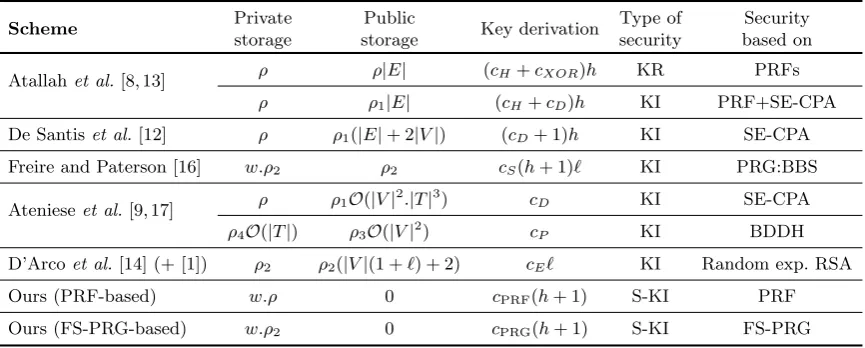
We also provide a comparison of instantations of our new constructions with a variety of proven-secure KAS from the literature. Details can be found in Section 6.
2 Hierarchical Key Assignment Schemes
2.1 Basic Definitions
A partially ordered set (poset) is a pair (V,≤) where V is a finite set of pairwise dis-joint classes, called security classes, and ‘≤’ is a partial order on V, i.e. is a reflexive, antisymmetric, and transitive binary relation. A security class can represent a person, a department, or a user group in an organisation. Relation ≤ is defined in accordance with authority for each class in V: for any two classesu, v∈V we writev≤uoru≥v
to indicate that users in class u can access the data of users in class v. We say that u covers v, denoted vlu or umv, if v < u and there does not exist c ∈ V such that
v < c < u. (V,≤) is atotally ordered set (or chain) if for all u, v ∈V, either v < uor
u > v or u =v. We say that A⊆V is an antichain inV if for all u, v∈ A, u6=v, we havevuandvu. Any poset (V,≤) can be represented by a specific directed acyclic graph G = (V, E), called access graph, where the vertices coincide with the security classes and there is an edge from class u to class v if and only ifu > v. Apartition of set V is a collection of sets {V1, . . . , Vs} such that (i) Vi ⊆V ∀i, (ii) V1∪. . .∪Vs=V,
and (iii) i6=j⇒Vi∩Vj =∅.
The problem that we address consists of assigning keys (e.g., to be used in a symmet-ric encryption scheme) to each class in a poset in such a way that it should be possible to efficiently derive the keys for any descendant class in the poset. The cryptographic primitive that solves this challenge is called a hierarchical key assignment scheme [1], and is defined as follows.
Definition 1 (Key Assignment Scheme). Let Γ denote a set of access graphs, i.e. of graphs that correspond to posets. A hierarchical key assignment scheme (KAS) for Γ is a pair of algorithms (Gen,Derive) satisfying the following conditions:
1. Gen(1ρ, G) is a probabilistic polynomial-time algorithm that takes as input a security parameter 1ρ and a graphG= (V, E)∈Γ and outputs
(b) public information pub.
We denote by (S, k,pub) the output of Gen(1ρ, G), where S = (Su)u∈V and k =
(ku)u∈V are the vectors of private information and keys, respectively.
2. Derive(G, u, v, Su,pub) is a deterministic polynomial-time algorithm that takes as input a graph G, classes u, v ∈ V such that v ≤ u, private information Su, and public information pub, and outputs a key k∈ {0,1}p(ρ) assigned to class v.
For correctness we require that for all ρ ∈ N, all G ∈ Γ, all (S, k,pub) output by
Gen(1ρ, G), and all u, v∈V, v≤u,we have Derive(G, u, v, Su,pub) =kv.
Remark 1. Observe that key assignment schemes are essentially symmetric in nature, i.e. a separation of entities holding secret keys and entities holding public keys is not assumed. As a consequence,Gen’s outputpub does not have to be public in the classical sense, but could also be folded into private information Su, for all u ∈ V. We point
out that we leftpub in Definition 1 to keep it consistent with prior work. However, the schemes that we propose in this paper will not make use ofpub, i.e. will assign an empty value to it.
2.2 Security of Key Assignment Schemes
Various informal security models for key assignment schemes have been developed and proposed in the past. Formal security modelling began with [8]. However, as we will argue, all these models – both formal and informal – are inadequate for practical appli-cation in the most challenging of security environments. In the following, we first describe our new, strengthened models, and then discuss the differences to the established ones. We consider variants of the key indistinguishability (KI) security goal proposed by Atallah et al. in [8]. We consider models with both static and dynamic adversaries. It will shortly become clear, however, that these two models are polynomially equivalent. We begin with an informal statement of our security models, and then give a formal model in terms of a security experiment involving an adversary.
Static adversaries Astat, upon given an access graph G = (V, E), first choose a
security classu∈V to attack. UsingGenalgorithm on graphG, the experiment generates (S, k,pub). The adversary is then provided with private information Sv assigned to all classes v ∈V that should not enable the computation of key ku, along with the set of all keyskv associated to classesv∈V such thatv > u, and the public information pub.
Precisely, the adversary getspub and the two sets CorruptG,S,u and KeysG,u, where we define
CorruptG,S,u={Sv ∈S|uv} and KeysG,u={kv |v > u} .
Notice that, given CorruptG,S,u, the adversary can compute for himself all keys kv for
v ∈ CorruptG,S,u. As a challenge, the adversary additionally gets either key ku or a random string of the same length, and it has to distinguish these two cases. We refer to Definition 2 below for the formal specification of this experiment. Observe that, from the obtained information, the adversary can gain access tokv for any v∈V \ {u}.
In contrast to static adversaries, dynamic (also called adaptive) adversaries Adyn may request keyskv and secret informationSv in an adaptive manner before eventually committing to a security class u ∈V they want to attack. After receiving a challenge based on keyku, they continue to request keys and secret information until terminating
the keykufrom random, under the restriction thatu6≤vfor all classesvin the corrupted
set and that keyku has not been requested.
It is not difficult to see that the static and dynamic models are actually polynomially equivalent. Indeed, in the corresponding reduction, the static adversary simply guesses which class will be the subject of the dynamic adversary’s query, and aborts if the guess turns out to be incorrect; this reduction succeeds with probability 1/|V|. A similar proof was used in [9] (and implicitly in [8]). So schemes proven secure against static adversaries are automatically also secure against dynamic adversaries (albeit with a less tight overall security reduction). In the remainder of the paper, we focus on the static case.
We next give our definition for security in the sense ofstrong key indistinguishability with respect to static adversaries (S-KI-ST-security), formalising the above discussion.
Definition 2 (S-KI-ST). Let Γ be a set of access graphs and let (Gen,Derive) be a hierarchical key assignment scheme for Γ. Consider the following experiment (where we assume that adversary A keeps state between invocations):
Experiment ExpSA−,GKI−ST(1ρ) :
u← A(1ρ, G)
(S, k,pub)←Gen(1ρ, G)
β ←− {r 0,1}
If β = 1 then T ←ku elseT ←− {r 0,1}p(ρ)
d← A(pub,CorruptG,S,u,KeysG,u, T)
return d
For any G∈Γ, the advantage of A in the above experiment is defined as
AdvSA−,GKI−ST(ρ) = 2 Pr
h
ExpSA−,GKI−ST(1ρ) =βi−1/2 .
Note that if we writeExpSA−,GKI−ST,γ(1ρ),γ ∈ {0,1}, for the modification ofExpSA−,GKI−ST(1ρ)
where bit β is fixed to β =γ, we have that
AdvSA−,GKI−ST(ρ) =
Pr[Exp
S−KI−ST,1
A,G (1
ρ) = 1]−Pr[ExpS−KI−ST,0
A,G (1
ρ) = 1] .
The key assignment scheme is said to be secure in the sense of strong key indis-tinguishability with respect to static adversaries (S-KI-ST-secure) if AdvSA−,GKI−ST(ρ) is negligible for every efficient adversary A and any graphG∈Γ.
It will be evident that one can also define an S-KR-ST-security notion, in which the adversary is required to recover the key ku rather than distinguish it from a random key. Clearly S-KI-ST-security implies S-KR-ST security.
We now explain why our model is stronger than the one introduced by Atallah et al.[8] that it is based on. While our S-KI-ST adversary receives both the setCorruptG,S,u⊆
S of secret information and the setKeysG,u⊆ {0,1}p(ρ) of computed (symmetric) keys,
in the model from [8] the adversary receives only the former set when performing its attack. In the dynamic setting, our strong adversary has access to keys kv for which
note that the previous security model from [8] provides no such guarantees, whereas our model provides the strongest possible guarantee, in thatall keyskv withv > u are
given to the adversary. Indeed, as the next example makes clear, it is quite feasible that leakage of a key kv for which v > ucan damage the security of the key ku.
A separating example: Consider a graph (V, E) having linear structure, i.e.
V = {v0, . . . , vn−1} with vi+1lvi for all i. Let H be a one-way function, which we model as a random oracle. We select Sv0 at random from the domain of H and set
kvi =Svi and Svi+1 = H(Svi) for alli. It is clear how the Gen and Derivealgorithms should be defined, and that the resulting scheme is correct. It is also easy to see that the scheme is KR-ST-secure in the random oracle model, in the sense of [8]. However, it is also clear that with knowledge of key kv0 = Sv0, all keys kv in the hierarchy can be efficiently determined (including challenge key ku) and hence the scheme is insecure in the S-KR-ST model. We note that this separation is for key recovery (KR) security notions.
3 Security Analysis of the Chain Partition Construction
We begin by reviewing the Chain Partition Construction for key assignment schemes from [15]. Given a partially ordered set (V,≤), represented by the directed acyclic graph
P = (V, E), Dilworth’s Theorem [23] asserts that every partially ordered set (V,≤) can be partitioned into w chains, where w is thewidth of V, that is, the cardinality of the largest antichain inV. The partition need not be unique. We select a particular partition of V into chains {C0, . . . , Cw−1}. The length of Ci is denoted by li, for 0≤i≤w−1.
We letlmax denote maxi{li}. The maximum class of Ci is regarded as the first class in Ci and the minimum class as the last class. Since {C0, . . . , Cw−1} is a partition of V,
each u∈V belongs to precisely one chain.
LetC =u0m. . .mum be any chain inV. Then any chain of the formujm. . .mum, 0< j≤mis said to be asuffix ofC. Now, for anyu∈V, the set↓u:={v∈V :v≤u} has non-empty intersection with one or more chainsC0, . . . , Cw−1. It is proved in [15] that
the intersection of↓uand the chainCi is a suffix ofCi or the empty set. Following, [15], this will enable us to define the private information that should be given to a user with label u.
Since {C0, . . . , Cw−1} is a partition ofV into chains,{↓u∩C0,. . .,↓u∩Cw−1} is a
disjoint collection of chain suffixes. Additionally, the private information for each class inV should be chosen so that the private information for the j-th class of a chain can be used to compute keys for all lower classes in that chain. Hence, we can see that a user with labelu should be given the private information for the maximal classes in the non-empty suffixes↓u∩C0, . . . ,↓u∩Cw−1. Givenu∈V, let ˆu0, . . . ,uˆw−1 denote these
maximal classes, with the convention that ˆui=⊥if↓u∩Ci =∅. Letuij denote thej-th class in the chain Ci, where 0≤j≤li−1.
The Chain Partition Construction: Let (V,≤) be a poset,P = (V, E) the corresponding directed acyclic graph, and ρ a security parameter. Select a chain partition of V into
w chains C0, . . . , Cw−1, so that Ci contains classes ui0, ui1, . . . , uili−1, with u
i
j+1 < uij,
0 ≤ j < li −1. Let lmax denote maxi{li}. Additionally, let X = (GenX,DeriveX) be
a KAS scheme for the set consisting of a single chain of length exactly lmax. Then the chain partition scheme KASCP(X, P) = (GenCP,DeriveCP) (relative to the particular
Algorithm GenCP(1ρ, P):
1. For 0 ≤ i ≤ w−1, run GenX on inputs 1ρ and a chain of length lmax to obtain
(Ti, ki,pubi). Discard the last lmax −li elements of Ti and ki to obtain the se-cret information and keys for a chain of length li. Note that this chain has the
same Derive algorithm as the starting chain. For ease of notation, we continue to denote the reduced sets by Ti and ki, and we write Ti = {Tui
0, . . . , Tuili−1} and
ki = {kui
0, . . . , kuili−1}. We stress here that we could run different algorithms GenX to produce the different chains of lengthsli, but for ease of notation we will assume
they are all the same.
2. For eachu∈V, define the private informationSu to be{Tuˆi : ˆui6=⊥,0≤i≤w−1} and the encryption keyku to be ku =kui
j, whereu=u
i j.
3. Let S and k be the sets of private information and keys, respectively, in the above construction, and let pubCP= (pub0, . . . ,pubw−1).
4. Output (S, k,pubCP).
Algorithm DeriveCP(P, uij, u g h, Sui
j,pubCP):
1. For uij ≥ugh, find ˆug, the maximal class in ↓uij∩Cg. This class is in chain Cg. We denote it byugr, where 0≤r < lg. Note that, by construction,ugr ≤uij andTugr ∈Suij. 2. Set kug
h ←DeriveX(Cg, u
g
r, ugh, Tugr,pubg). 3. Output kug
h.
Theorem 1 (S-KI-ST Security of the Chain Partition Construction). Let P = (V, E) be a directed acyclic graph and let lmax be the maximum length of the chains in a chain partition ofV. LetXbe an S-KI-ST-secure scheme for the set of graphs consisting of the single chain of length lmax. Then the scheme KASCP(X, P) = (GenCP,DeriveCP) for
graph P obtained from the above chain partition construction is also S-KI-ST-secure. More precisely, for every S-KI-ST adversary ACP that breaks the scheme KASCP(X, P)
with advantage AdvSA−CP,PKI−ST(ρ), there exists an S-KI-ST adversary AX that breaks X
with the same advantage. Moreover, the two adversaries run in roughly the same time.
Proof. Assume ACP attacks a class uij of graph P. If ACP is able to distinguish between
the real keykui
j associated with class u
i
j, and a random string having the same length,
we show that we can construct an S-KI-ST adversary AX against the scheme X that,
usingACP as a black box, is able to distinguish between real or random keys. Algorithm AX plays the S-KI-ST security game described in Definition 2, receiving as initial input
a security parameter 1ρ and a chain on lmax classes. Adversary AX simulates the
envi-ronment of ACP in such a way that ACP’s view is indistinguishable from its view when playing the S-KI-ST security game.
Algorithm AX:
1. Receive from the S-KI-ST experiment a chain C onlmax classesv0, . . . , vlmax−1.
2. Let P = (V, E) ∈ Γ and run ACP with input (1ρ, P) to get A
CP’s choice of target
class u.
3. Generate a chain partition of P containing chains C0, . . . , Cw−1. In this partition,
the set of secret information, the set of keys and the public information for a chain of length exactlylt. By abuse of notation, we continue to use (St, kt,pubt) to denote
this data.
4. Output vj in chain C as AX’s choice of target class. AX now receives as input the
public information, pub, output by GenX, along with secret information Svt for all classes vt< vj inC, and all secret keys kvt inC such thatvt> vj. AX also receives as input a value T which is either the real key kvj or a random key of the same length. In what follows, AX will identify the firstli classes inC with the chainCi in
the chain partition construction.
5. Set pubCP = (pub0, . . . ,pubi−1,pub,pubi+1, . . . ,pubw−1). Use the secret information
Svt for classes vt < vj in C together with the secret information in the sets S
t for
0≤t≤w−1, t6=ito build the setCorruptP,S,u. Use keyskvt inC such thatvt> vj and the keys from the sets kt to build the set Keys
P,u.
6. Run ACP with inputs (pubCP,CorruptP,S,u,KeysP,u, T). It is easy to see that AX
has the information required to properly construct the setsCorruptP,S,u,KeysP,u in such a way that ACP’s input here is valid in ACP’s experiment against the scheme
KASCP(X, P), and such thatT is the real key (resp. the random key) inACP’s
experi-ment if and only ifT is the real key (resp. the random key) in AX’s experiment.
7. When ACP outputs a bit, output the same bit.
Now as AX’s simulation is perfect, we see that the advantage of AX in winning its S-KI-ST indistinguishability game for the chain C of length lmax is the same as the
advantage of ACP in playing the S-KI-ST indistinguishability game againstKASCP(X, P).
The theorem now follows. ut
Note that, in the above theorem,Xneed only be an S-KI-ST-secure scheme for chains of length exactly lmax. Because of the truncation trick, this is equivalent toXbeing an
S-KI-ST-secure scheme for the set of graphs consisting of chains of lengths up tolmax.
4 A Scheme based on PRFs
In this section we construct an S-KI-ST-secure key assignment scheme for totally-ordered hierachical access structures of arbitrary depth, based on pseudorandom functions. By combining our construction with the result from Section 3, a general key assignment scheme for arbitrary posets is obtained.
We admit that also Atallah et al. [8] give an efficient PRF-based construction for arbitrary posets. However, their construction achieves only a security notion called ‘key recovery’ (where an adversary attacking a classu has to compute the challenge key ku,
instead of distinguishing it from a random key), which is weaker than our S-KI-ST secu-rity notion. Moreover, our scheme is much simpler, and requires no public information to be stored.
We start by recalling the definition of a PRF, the central building block of our construction:
Definition 3 (Pseudorandom Function, PRF). Let K,D,R be finite sets1 andF : K × D → R be an efficient function. For all κ ∈ K and x ∈ D we also write Fκ(x) = F(κ, x) and call Fκ : D → R an instance of F. We call K the set of keys, while D
1
andRare the domainand range ofF, respectively. Function F is pseudorandomif the input/output behaviour of a random instance Fκ is computationally indistinguishable from that of a random function D → R.
More formally, let Rand= RD = {g|g : D → R} denote the set of all functions D → R. Let AF be an algorithm that has oracle access to a function D → R, and returns a bit. In our security model, this function is either drawn at random from Rand, or is Fκ for a random κ
r
←− K, and AF has to distinguish these cases. Consider the following two experiments:
Experiment ExpPRFA −1 F,F (1
ρ) : Experiment ExpPRF−0
AF,F (1
ρ) :
κ←− Kr g←−r Rand
d← AFκ
F (1ρ) d← A
g F(1ρ)
returnd return d
The advantage of AF is defined as AdvPRFAF,F(ρ) =
Pr
h
ExpPRFA −1 F,F (1
ρ) = 1i−PrhExpPRF−0
AF,F (1
ρ) = 1i .
We say that F is pseudorandom (or: is a PRF) if AdvPRFAF,F(ρ) is negligible for every efficient adversary AF.
In our following construction, we will use special PRFs where K = R = {0,1}ρ
for security parameter ρ, and D is any set. We remark that some constructions in [8] also require PRFs with similar restrictions on keyspace and range. For concreteness, we propose to deploy the (hash-based) HMAC primitive [19] as a PRF (see also analysis in [24]). In addition, it might be possible to find suitable constructions based on number-theoretic assumptions, e.g. derived from the PRF obtained by converting the BBS [20] PRG into a PRF via the Goldreich-Goldwasser-Micali (GGM) construction [25].
4.1 A PRF-based Key Assignment Scheme for Totally Ordered Hierarchies
We briefly recall the setting of key assignment for chains. LetΓ be the family of graphs corresponding to totally ordered hierarchies, and letG= (V, E)∈Γ be a graph, where
V = {u0, . . . , un−1} for some n, and ui+1 lui for all i. To each security class ui ∈ V, private information Si and key ki are assigned, where Si can be used to compute
subordinated keys. Note that here we abuse notation, for better exposition (we can do this because we are in the linear setting), writing Si forSui andki for kui.
Let ρ be a security parameter and let F :{0,1}ρ× D → {0,1}ρ be a PRF. Let c
0
and c1 be two different elements in D. TheGenand Derivealgorithms work as follows.
Algorithm Gen(1ρ, G): 1. Pick random S0
r
←− {0,1}ρand set k
0 ←FS0(c1).
2. For each class ui ∈V, i >0,setSi ←FSi−1(c0) and ki ←FSi(c1). 3. Set S←(S0, . . . , Sn−1),k←(k0, . . . , kn−1), andpub← ∅.
4. Output (S, k,pub).
Algorithm Derive(G, ui, uj, Si,pub): (note that we may assume j≥i)
Sh←FSh−1(c0). 3. Return kj =FSj(c1).
Observe that computing key kj from secret information Si requires exactly j−i+ 1 evaluations of the underlying PRF.
Theorem 2 (S-KI-ST Security of the PRF-based Scheme for Totally Ordered Hierarchies). The above PRF-based scheme is key indistinguishable, in the sense of Definition 2, for any totally ordered graph G, assuming security of pseudorandom func-tion F.
Proof. Fix any totally ordered graph G = (V, E) ∈ Γ. Proving the theorem amounts to showing that the only way to break the key indistinguishability of our PRF-based scheme, in the sense of Definition 2, is by breaking the pseudorandom function F. To this aim, we need to show how to turn an S-KI-ST adversary A attacking our KAS scheme into an adversary AF attacking F. AssumeA attacks a classui ∈V. We define
a sequence of computationally indistinguishable games Game 0, Game 1,. . ., Gamei+1. Game 0 is the actual adversarial game (as defined in Definition 2), and in the last game, Game i+ 1, the probability that A is successful in outputting the correct bitβ is only 1/2. Let Succι be the event thatAis successful in Gameι, i.e. thatd=β in the
exper-iment.
Game 0. Let Game 0 be the original attack game as described in Definition 2.
Game ι (1 ≤ ι ≤ i+ 1). This game is identical to Game ι−1, except that here the assignment of private information and keys is modified in such a way that keykι−1 and
private informationSι are substituted with values randomly selected from{0,1}ρ. This
modification amounts to substituting the occurrences of FSι−1 in Game ι−1 with a truly random function, which is warranted by the security of the PRF, as we will see in Lemma 1. Hence,
|Pr[Succι]−Pr[Succι−1]| ≤PRF(ρ) ,
wherePRF is a bound on the advantageAdvPRFAF,F(ρ) for any polynomial-time adversary AF.
Now, we see that in Gamei+ 1 the adversary’s view is independent of bitβ: in both cases it gets as challenge a random value in {0,1}ρ. Thus,
Pr[Succi+1] = 1/2 .
Therefore, we have
AdvSA−,GKI−ST(ρ) = 2|Pr[Succ0]−1/2| ≤2(i+ 1)PRF(ρ) .
As, by assumption,PRF(ρ) can be chosen to be negligible, and this completes the proof.
u t
Lemma 1. |Pr[Succι]−Pr[Succι−1]| ≤PRF(ρ).
and Game ι. We describe below how to construct an algorithm AF that, using A as a black-box, is able to distinguish between pseudorandom and truly random functions.
Algorithm AF plays the PRF game described in Definition 3 and is thus given
ac-cess to a functiong(·) that is either an instance of a pseudorandom function, keyed with a key κ, or a truly random function. In order to use algorithm A, AF simulates the
environment of A in such a way that interpolates between Game ι−1 and Game ι. This means that ifAF is interacting with a pseudorandom function, then the simulation proceeds as in Gameι−1. Otherwise, ifAF is interacting with a random function, then the simulation proceeds as in Gameι. More formally, algorithm AF works as follows.
Algorithm AF:
1. Run A with input (1ρ, G) to get A’s choice of target classui.
2. Set up the access hierarchy for graph G by running Gen(1ρ, G) with the following modifications:
(a) Private information Sι and key kι−1 are computed via oracle g as follows:
Sι ←g(c0), kι−1 ←g(c1).
(b) For allι0< ι, set Sι0 ←− {r 0,1}ρ.
(c) For allι0< ι−1, set kι0 ←− {r 0,1}ρ.
So far, this is almost equivalent to the actions of Game ι−1 when AF’s oracle computes g according to a pseudorandom function, and equivalent to Gameι when it computes gcompletely at random. The only difference is that, in casegis a PRF, the private information Sι−1 is not the same asg’s internal key (unknown toAF).
This is completely indistinguishable from A’s view sinceAis not allowed to ask for private information Si0,i0 < i+ 1, and thus asι≤i+ 1, Ais not allowed to ask for
Sι0,ι0< ι.
3. Pick a random bitβ ∈ {0,1}. If β = 1,AF setsA’s challenge, denoted here byT, to
be the real key ki. Ifβ = 0,AF setsT to be a random key of the same length of ki.
4. Run A with inputs (pub,CorruptG,S,ui,KeysG,ui, T), where CorruptG,S,ui = {Si+1, . . . , Sn−1} and KeysG,ui = {k0, . . . , ki−1}, to obtain a bit d. (Note that ac-cording to AF’s setup of the access hierarchy, it can compute all this information.)
Here d isA’s guess as to whether it was given the real key associated with class ui
or a random string having the same length.
5. If d = β, output 1, guessing for a pseudorandom function; otherwise, output 0, guessing for a truly random function.
Now we have
PRF(ρ)≥AdvPRFAF,F(ρ) =
Pr[Exp
PRF−1
AF,F (1
ρ) = 1]−Pr[ExpPRF−0
AF,F (1
ρ) = 1]
=|Pr[AF outputs 1|g is a PRF]−Pr[AF outputs 1 |gis random]|
=|Pr[Aguesses β correctly |g is a PRF]−Pr[Aguesses β correctly |g is random]| =|Pr[Succι−1]−Pr[Succι]|.
5 A Scheme based on Forward-Secure PRGs
FS-PRGs, introduced by Bellare and Yee in [22], are stateful/iterated pseudorandom generators (PRGs) that deterministically derive sequences of fixed-length bit strings from an initial (random) seed. More precisely, in each iteration they output a string of bits, update their internal state, and securely erase the old state. Like in regular PRGs, the output sequences are required to be indistinguishable from sequences of random strings. The pivotal property of FS-PRGs isforward security, i.e. the adversary has the ability to eventually corrupt generator’s internal state, but indistinguishability of output strings is guaranteed to still hold up to that point. Different constructions of FS-PRGs are proposed in [22], including highly efficient ones based on symmetric building blocks like blockciphers or HMAC [19], and also a construction based on a number-theoretic assumption (specifically, on the Blum-Blum-Shub PRG [20]).
In this section, building on generic FS-PRGs, we construct a key assignment scheme which achieves S-KI-ST security for totally-ordered access graphs and, in combination with the results from Section 3, for arbitrary posets. It is worth pointing out that we actually widely generalize the construction from [16], which implicitly exploits the property of forward security of the BBS pseudorandom generator. As our construction generically builds on FS-PRGs, it is amenable to the efficiency gain obtained by replacing the BBS-based FS-PRG by, for instance, an HMAC-based one.
Before describing our scheme, let us first recall the definition and security notion of forward-secure pseudorandom number generators (FS-PRGs). Observe that we slightly weaken the model from [22] (considering static adversaries instead of adaptive ones), what renders our construction of a key assignment scheme more general. Clearly the FS-PRG constructions proposed and proved secure in [22] naturally remain secure in our adapted model.
Definition 4 (Forward-Secure PRG). Let GFS = (GFS.setup, GFS.key, GFS.next)
be a set of efficient algorithms such that GFS.setup is a probabilistic algorithm that, on
input a security parameter 1ρ, outputs a set of system parameters ‘params’; GFS.key
is a probabilistic key generation algorithm that takes ‘params’ as input and outputs an initial state St0∈ {0,1}ρ (the initial seed);GFS.next:{0,1}ρ→ {0,1}ρ× {0,1}p(ρ) is a
deterministic algorithm that turns state Sti−1∈ {0,1}ρ (the ‘seed’ at iteration i) into a
pair (Sti, Outi), where Sti∈ {0,1}ρ is the updated state, and Outi is a p(ρ)-bit string. Let D be an adversary against GFS. D is fed with a number of output blocks, Out1,
Out2, . . . , Outi, each of length p(ρ), and is given the then current state of the generator,
Sti.D’s job is to decide whether these blocks are the real output of the generator, or just a sequence of random bits. To formalize this, we consider the following experiments.
The advantage of D is defined as
AdvFSD,GFS−PRG(ρ) = Pr
h
ExpFSD,GFS−PRG−1(1ρ) = 1 i
−Pr h
ExpFSD,GFS−PRG−0(1ρ) = 1 i
.
We say that GFS is a forward-secure pseudorandom number generator (FS-PRG) if
Experiment ExpFSD,GFS−PRG−1(1ρ) : Experiment ExpFSD,GFS−PRG−0(1ρ) :
i← D i← D
params ←−r GFS.setup(1ρ) params
r
←−GFS.setup(1ρ)
St0
r
←−GFS.key(params) St0
r
←−GFS.key(params)
i0 ←0 i0 ←0
Repeat Repeat
i0←i0+ 1 i0 ←i0+ 1
(Sti0, Outi0)←GFS.next(Sti0−1) (Sti0, Outi0)←GFS.next(Sti0−1)
Outi0 ←− {r 0,1}p(ρ)
Until i0 =i Untili0 =i
Out←Out1, Out2, . . . , Outi Out←Out1, Out2, . . . , Outi
d← D(Sti, Out) d← D(Sti, Out)
return d returnd
5.1 The FS-PRG-based Scheme for a Single Chain
Key assignment schemes for totally-ordered access graphs are readily constructed from FS-PRGs: In our construction, we identify the FS-PRG’s state Sti with the private
information Si stored for class ui, while key ki is set to the FS-PRG’s outputOuti+1.
More precisely, let Γ be the family of graphs corresponding to totally ordered hi-erarchies, let G = (V, E) ∈ Γ be a graph, where V = {u0, . . . , un−1} for some n, and
ui+1lui for all i. As in Section 4.1, we writeSi for private information Sui, andki for key kui. Let ρ be a security parameter, and let GFS = (GFS.setup, GFS.key, GFS.next) be an FS-PRG. Then Genand Derivealgorithms work as follows.
Algorithm Gen(1ρ, G):
1. Run params ←GFS.setup(1ρ) andS0 ←GFS.key(params);
2. For all 0≤i < n:
Compute (Si+1, ki)←GFS.next(Si);
3. Set S←(S0, . . . , Sn−1),k←(k0, . . . , kn−1), andpub← ∅;
4. Output (S, k,pub).
Algorithm Derive(G, ui, uj, Si,pub): (note that we may assume j≥i) 1. For h=itoj:
(Sh+1, kh)←GFS.next(Sh);
2. Return kj.
Theorem 3 (S-KI-ST Security of the FS-PRG-based Scheme for Totally Or-dered Hierarchies). The above FS-PRG-based scheme is key indistinguishable, in the sense of Definition 2, for any totally ordered graph G, assuming security of the FS-PRG, GFS.
Proof. Fix any totally ordered graph G = (V, E) ∈ Γ. This proof amounts to showing that for every S-KI-ST adversaryAthat breaks our FS-PRG-based scheme with advan-tage AdvSA−,GKI−ST(ρ), there exists a PPT algorithm D that breaks the security of the FS-PRG, GFS, with advantage AdvFSD,GFS−PRG(ρ) ≥ Adv
S−KI−ST
A,G (ρ)/2. Assuming we have
real key ki and a random string of the same length, we can construct an algorithm D
that, using A as a black box, is able to tell apart output blocks generated by GFS, up
to some iterationt, from a sequence of purely random blocks.
Algorithm D has to distinguish the two experiments described in Definition 4. For this, it initially outputs an iteration number, sayt, and then is given access to a sequence oftoutput blocksOut1, . . . , Outt, that are either random or the firsttoutput blocks of
GFS. Dis also given the current state, Stt, of the FS-PRG. Given all that information,
D simulates the environment of A in a way that A’s view is indistinguishable from its view when playing the S-KI-ST game described in Definition 2. We need to prove that
AdvSA−,GKI−ST(ρ) =
Pr[Exp
S−KI−ST,1
A,G (1
ρ) = 1]−Pr[ExpS−KI−ST,0
A,G (1
ρ) = 1]
≤2FS−PRG(ρ) , whereFS−PRGis an upper bound on the advantageAdvFSD,GFS−PRG(ρ) for any
polynomial-time distinguisher D. We define a sequence of games and then analyse it.
Game 0. Define Game 0 to be identical to ExpSA−,GKI−ST,0(1ρ). In particular, challenge key T is chosen to be random in{0,1}p(ρ).
Game 1. This game is like Game 0, except that all elements in KeysG,u are replaced by random strings. Challenge keyT remains as before, i.e. random.
Game 2. This game is identical to ExpSA−,GKI−ST,1(1ρ). In particular, challenge keyT is the real key, as computed viaDerivealgorithm.
In the analysis, let Succι be the event that A outputs 1 in Game ι. First we
show that |Pr[Succ0]−Pr[Succ1]| ≤ FS−PRG(ρ). Consider the following distinguisher
D against the FS-PRG GFS: It runs A with input (1ρ, G) to get ui, the class that
A is aiming to attack. D chooses an integer t = i and sends it to its own chal-lenger, receiving Sti and Out = Out1, . . . , Outi, where the latter is either the honest
output generated by GFS.next, or a collection of random strings in {0,1}p(ρ). D sets
KeysG,ui = Out1, . . . , Outi and uses Sti to compute the private information collected
inCorruptG,S,ui.DsetsCorruptG,S,ui ={Sti+1, . . . , Stn−1}andpub ← ∅. Finally,D
exe-cutes A on input (pub,KeysG,ui,
CorruptG,S,ui, T), where like in Games 1 and 2,T is chosen to be random in{0,1}p(ρ).
Whenever D receives a bit d from A, D forwards the same bit to its own challenger. We see that ifOut is the sequence of outputs generated by GFS.next, then A’s view is
exactly as in Game 0. On the other hand, if the values are random strings, then A’s view is the one from Game 1. Now we have
FS−PRG(ρ)≥AdvFSD,GFS−PRG(ρ)
= Pr
h
ExpFSD,GFS−PRG−1(1ρ) = 1i−PrhExpFSD,GFS−PRG−0(1ρ) = 1i
=|Pr[Succ0]−Pr[Succ1]|.
Next we bound |Pr[Succ1]−Pr[Succ2]|. The reduction is similar to the one above,
the difference is that this time the FS-PRG distinguisher D specifies t=i+ 1 instead of t=i, and assigns kj ←Outj+1 for all 0≤j ≤i. This means that not only the keys
in KeysG,ui are taken from Out, but also the ‘challenge key’ ki. Notice that here, D
CorruptG,S,ui = {Sti+1, . . . , Stn−1}. Similarly to above, this establishes |Pr[Succ1]−
Pr[Succ2]| ≤FS−PRG(ρ).
All in all, this proves that
AdvSA−,GKI−ST(ρ) =
Pr[Exp
S−KI−ST,1
A,G (1
ρ) = 1]−Pr[ExpS−KI−ST,0
A,G (1
ρ) = 1]
=|Pr[Succ2]−Pr[Succ0]|
≤2FS−PRG(ρ),
as required. ut
6 Comparison with Previous Schemes
In this section, we compare instantiations of our constructions with other provably secure schemes from the literature. Note that all these previous schemes have proofs only in weaker models than our strong models. (However, in some cases, these schemes can also be proven secure in our strong models.)
In [8, 13], Atallah et al.proposed a first construction based on pseudorandom func-tions, which they prove to be KR-secure; and a second construction which they prove to be KI-secure, but which requires the additional use of a symmetric encryption scheme secure under chosen plaintext attack (SE-CPA). In both constructions the private in-formation of a class consists of a single symmetric key associated with that class. In the first construction, the amount of public information grows with the number of edges in the directed acyclic graph (each edge has an associated PRF output). In the second con-struction, the amount of public information grows with the number of classes (each class has an associated ciphertext). In both constructions, key derivation uses only symmetric operations and its cost grows linearly with the number of levels between the classes.
De Santiset al.[12] proposed a construction which is based on symmetric encryption schemes only, achieves KI security and is simpler than the KI-secure scheme proposed in [8]. The construction uses only a chosen plaintext secure symmetric encryption scheme and the required private key storage is small at one key per class. The amount of public storage needed grows linearly with the number of classes and the number of edges in the graph. Key derivation requires roughlyhsymmetric decryptions, wherehis the number of levels between the classes.
Atenieseet al.[9,17] proposed two different constructions for time-bound key assign-ment schemes, which achieve KI security. Their first construction is based on symmetric encryption schemes and the second makes use of bilinear maps. The security of the latter construction is based on the Bilinear Decisional Diffie-Hellman (BDDH) assump-tion. The advantage of these constructions is that they provide very efficient procedures for key derivation, requiring only one decryption or one pairing evaluation, no matter the number of levels between the classes. However, the public information for a scheme obtained from the first construction can be very large since it depends not only on the number of classes, but also on the number of time periods. The downside of the second construction is that the private information could be as large as the number of time periods (and the public information is already very large). These constructions are not directly comparable to normal (i.e. non-time-bound) schemes, but we include them in the table to get an idea of their efficiency compared to normal schemes.
Scheme Private Public Key derivation Type of Security
storage storage security based on
Atallahet al.[8, 13] ρ ρ|E| (cH+cXOR)h KR PRFs
ρ ρ1|E| (cH+cD)h KI PRF+SE-CPA
De Santiset al.[12] ρ ρ1(|E|+ 2|V|) (cD+ 1)h KI SE-CPA
Freire and Paterson [16] w.ρ2 ρ2 cS(h+ 1)` KI PRG:BBS
Atenieseet al.[9, 17] ρ ρ1O(|V|
2.|T|3) cD KI SE-CPA
ρ4O(|T|) ρ3O(|V|2) cP KI BDDH
D’Arcoet al.[14] (+ [1]) ρ2 ρ2(|V|(1 +`) + 2) cE` KI Random exp. RSA
Ours (PRF-based) w.ρ 0 cPRF(h+ 1) S-KI PRF
Ours (FS-PRG-based) w.ρ2 0 cPRG(h+ 1) S-KI FS-PRG
Table 1.Comparison with Previous Schemes
hard-core bit (GL bit) [26]. They instantiated their construction with an Akl-Taylor scheme, which they proved to be KR-secure under the RSA assumption, therefore achiev-ing KI-security under the same assumption. Their construction can also be instantiated, for example, with the KR-secure scheme from Atallah et al. [8], yielding a KI-secure scheme based on PRFs. However, their construction involves a significant “blow up” when going from KR-security to KI-security, since it requires the use of a KR-secure scheme for a poset having ` classes for each class in the poset for the final KI-secure scheme, where ` is the length of the keys ku. Typically, we would desire ` = 128 bits
in applications. Their construction also consumes a large amount of public storage, re-quiring roughly`times as many public values as in the starting KR-secure scheme. Key derivation also involves an increase by a factor of `relative to the starting scheme.
Freire and Paterson [16] proposed a construction which exploits the chain partition approach proposed in [15] and which achieves KI security. In their scheme, the maximum amount of private information associated with a class is related to the width w of the poset representing the hierarchy. The public storage is much smaller than in previous schemes: when instantiated using the BBS generator, the public storage is just one RSA modulus. Key derivation requires multiple squaring operations modulo an RSA modulus, the number of such operations growing as`hwhere`is the bit-size of the scheme’s keys and h is the number of levels between the classes.
Our constructions provide stronger security guarantees (i.e., key indistinguishability in ourstrengthened model) than all the above schemes and indeed all other hierarchical key assignment schemes in the literature. As with [16], our constructions provide schemes having a trade-off between storage of private information and efficiency of key derivation, depending on how the poset is partitioned into chains. The overall efficiency of key derivation is bounded by the length of the longest chain in the partition, and the amount of private information depends on w, the poset width (which is equal to the number of chains in the partition). Moreover, due to the cryptographic components used in our constructions (PRFs and FS-PRGs), key derivation is relatively efficient, growing linearly inh, the number of levels between classes. In addition, our constructions require
nopublic storage.
computation that is needed to traverse h levels down in the hierarchy. We also include the type of security that the scheme achieves, key recovery (KR), key indistinguishability (KI) or our strengthened version, S-KI, and the basic components of the scheme. In the table,ρis a security parameter that corresponds to the size of the keys for a PRF or for a symmetric encryption scheme E;ρ1 represents the size of ciphertexts for a semantically
secure symmetric encryption scheme; ρ2 is a security parameter for a pseudorandom
number generator; ρ3 represents the size of pairing-friendly group elements (which is
typically a little larger than twice the security parameter, e.g. 171 bits at the 80-bit security level);ρ4 is the size of the orderqof a pairing-friendly group (which can usually
be taken as twice the security parameter); cH denotes the computation required to
compute the output of a hash function;cD is the computation needed for a symmetric
key decryption; cP is the computation needed for one pairing evaluation;cS is the cost of squaring modulo an integerN of size ρ2;cE is the cost of exponentiation modulo an
integerN of sizeρ2;cPRF is the computation needed to compute the output of a PRF;
cPRG is the computation needed to compute the output of an FS-PRG;`is the bit-size
of the scheme’s keys; andw is the width of a poset. Finally,|T|represents the number of distinct time periods in the time-bound schemes of [9, 17].
References
1. Akl, S.G., Taylor, P.D.: Cryptographic solution to a problem of access control in a hierarchy. ACM Transactions on Computer Systems1(3) (1983) 239–248
2. MacKinnon, S.J., Taylor, P.D., Meijer, H., Akl, S.G.: An optimal algorithm for assigning cryp-tographic keys to control access in a hierarchy. IEEE Transactions on Computers 34(9) (1985) 797–802
3. Harn, L., Lin, H.Y.: A cryptographic key generation scheme for multilevel data security. Computers & Security9(6) (1990) 539–546
4. Chen, T.S., Chung, Y.F.: Hierarchical access control based on Chinese Remainder Theorem and symmetric algorithm. Computers & Security21(6) (2002) 565–570
5. Shen, V., Chen, T.S.: A novel key management scheme based on discrete logarithms and polynomial interpolations. Computers & Security21(2) (2002) 164–171
6. Wu, T.C., Chang, C.C.: Cryptographic key assignment scheme for hierarchical access control. Int. Journal of Computer Systems Science and Engineering16(1) (2001) 25–28
7. Yeh, J.H., Chow, R., Newman, R.: A key assignment for enforcing access control policy exceptions. In: Int. Symposium on Internet Technology. (1998) 54–59
8. Atallah, M.J., Blanton, M., Fazio, N., Frikken, K.B.: Dynamic and efficient key management for access hierarchies. In: ACM Conference on Computer and Communications Security. (2006) 190–202 9. Ateniese, G., De Santis, A., Ferrara, A.L., Masucci, B.: Provably-secure time-bound hierarchical key assignment schemes. In: ACM Conference on Computer and Communications Security. (2006) 288–297
10. Tzeng, W.G.: A secure system for data access based on anonymous authentication and time-dependent hierarchical keys. In: ACM Symposium on Information, Computer and Communications Security. (2006) 223–230
11. Wang, S.Y., Laih, C.S.: An efficient solution for a time-bound hierarchical key assignment scheme. IEEE Transactions on Dependable and Secure Computing3(1) (2006) 91–100
12. De Santis, A., Ferrara, A.L., Masucci, B.: Efficient provably-secure hierarchical key assignment schemes. In: MFCS. (2007) 371–382
13. Atallah, M.J., Blanton, M., Fazio, N., Frikken, K.B.: Dynamic and efficient key management for access hierarchies. ACM Trans. Inf. Syst. Secur.12(3) (2009)
14. D’Arco, P., De Santis, A., Ferrara, A.L., Masucci, B.: Variations on a theme by Akl and Taylor: Security and tradeoffs. Theoretical Computer Science411(1) (2010) 213–227
15. Crampton, J., Daud, R., Martin, K.M.: Constructing key assignment schemes from chain partitions. In: Working Conference on Data and Applications Security (DBSec 2010). (2010) 130–145
17. Ateniese, G., De Santis, A., Ferrara, A.L., Masucci, B.: Provably-secure time-bound hierarchical key assignment schemes. J. Cryptology25(2) (2012) 243–270
18. Crampton, J., Martin, K.M., Wild, P.R.: On key assignment for hierarchical access control. In: Computer Security Foundations Workshop. (2006) 98–111
19. Bellare, M., Canetti, R., Krawczyk, H.: Keying hash functions for message authentication. In: CRYPTO. (1996) 1–15
20. Blum, L., Blum, M., Shub, M.: A simple unpredictable pseudo-random number generator. SIAM Journal on Computing15(2) (1986) 364–383
21. Blum, M., Goldwasser, S.: An efficient probabilistic public-key encryption scheme which hides all partial information. In: CRYPTO. (1984) 289–302
22. Bellare, M., Yee, B.S.: Forward-security in private-key cryptography. In: CT-RSA. (2003) 1–18 23. Dilworth, R.P.: A decomposition theorem for partially ordered sets. Annals of Mathematics51(1)
(1950) 161–166
24. Dodis, Y., Gennaro, R., Hastad, J., Krawczyk, H., Rabin, T.: Randomness extraction and key derivation using the CBC, Cascade and HMAC modes. In: CRYPTO. Volume 3152. (2004) 115–133 25. Goldreich, O., Goldwasser, S., Micali, S.: How to construct random functions. J. ACM33(4) (1986)
792–807