EXTRACTION STUDY OF CADMIUM(II) AND COPPER(II)
USING ALIQUAT 336
Submitted by L I J U A N W A N G B.Sc.
This thesis is submitted in total fulfillment of the requirements for the Degree of Master of Science
School of Life Sciences and Technology
Victoria University of Technology Victoria
Australia
p
TABLE OF CONTENTS
ACKNOWLEDGEMENTS vii
DECLARATION viii
SUMMARY ix
CHAPTER ONE INTRODUCTION
1.1 GENERAL INTRODUCTION 1
1.2 S O L V E N T E X T R A C T I O N O F Cd(H) A N D Cu(II) F R O M
H Y D R O C H L O R I C ACID SOLUTIONS B Y ALIQUAT 336 2
1.2.1 The Basic Principle of Solvent Extraction 2
1.2.2 The Metal Extraction Systems 2 1.2.2.1 Compound formation extraction systems 2
1.2.2.2 Ion-association extraction systems 4 1.2.2.3 Solvation extraction systems 4 1.2.3 High Molecular Weight Amines and Quaternary A m m o n i u m
Salts 5 1.2.4 Extraction Study of Cd(II) and Cu(II) by Aliquat 336 7
1.3 E X T R A C T I O N O F Cd(II) A N D Cu(H) F R O M H Y D R O C H L O R I C A C I D S O L U T I O N S B Y A L I Q U A T 336/PVC
MEMBRANES 8
1.3.1 The Basic Principles of Membrane Extraction 9
1.3.2 Aliquat 336/PVC Membranes 10 1.3.3 Extraction of Cd(II) and Cu(II) From Both Sides of Aliquat
336/PVC Membranes 10 1.3.4 Extraction of Cd(II) and Cu(II) From The Feed Phase
Through The Aliqaut 336/PVC Membrane Into The
1.4 SURFACE CHARACTERIZATION OF ALIQUAT 336/PVC
MEMBRANES 12
1.5 AIMS OF THIS STUDY 13
CHAPTER TWO SOLVENT EXTRACTION OF Cd(II) AND Cu(II)
FROM HYDROCHLORIC ACID SOLUTIONS
BY ALIQUAT 336 IN SHELLSOL AB
2.1 INTRODUCTION 14
2.1.1 Equilibrium Studies of The Extraction of Cd(II) and Cu(II)
Using Aliquat 336 15
2.1.2 T h e Extraction Mechanism 17
2.1.3 T h e Methods for Identification of T h e Extracted Complex
and Evaluation of The Extraction Equilibrium Constant 18
2.1.4 T h e Distribution Ratio and The Efficiency of Extraction 19
2.1.5 T h e Effect of Diluents on T h e Extraction of Metal Ions by
Aliquat 336 20
2.2 E X P E R I M E N T A L 21
2.2.1 Materials 21
2.2.1.1 Reagents 21 2.2.1.2 Preparation of Cadmium(II) chloride solutions 22
2.2.1.3 Preparation of Copper (II) chloride solutions 22
2.2.1.4 Preparation of Aliquat 336 solutions 22 2.2.1.5 Preparation of Cadmium (II) and CopperfID working
standards 22
2.2.2 Solvent Extraction Procedure 23
2.2.2.1 Batch extraction 23 2.2.2.2 Two-phase titration technique 23
2.3 R E S U L T S A N D DISCUSSION 25
2.3.1 Effect of Organic-Aqueous Phase Contact Time on The
Extraction of Cd(II) and Cu(II) 25
2.3.2 Effect of Hydrochloric Acid Concentrations on The
Extraction of Cd(H) and Cu(II) 26
2.3.3 Equilibrium Studies of The Extraction of Cd(II) and Cu(II)
From Hydrochloric Acid Solutions by Aliquat 336 in
ShellsolAB 27
2.3.3.1 The equilibrium data for the extraction of Cd(II)
and Cu(II) 28 2.3.3.2 Average composition of the extracted complex 32
2.3.3.3 The extraction reaction and their equilibrium constants . 35
2.3.4 The Effect of Diluents on The Extraction of Cd(II) and
Cu(II) Using Aliquat 336 39
2.4 C O N C L U S I O N 40
CHAPTER THREE EXTRACTION OF Cd(II) AND Cu(II) IN
HYDROCHLORIC ACID SOLUTIONS
USING ALIQUAT 336/PVC MEMBRANE
3.1 INDRODUCTION 42
3.1.1 Flux and Driving Forces in Membrane Separation
Processes 43
3.1.2 Membranes and Membrane Extraction 44
3.1.3 Metal Ions Extraction Using P V C Based Membranes 46
3.1.4 Transport Mechanism in Aliquat 336/PVC Membrane
Extraction System 46
3.2 E X P E R I M E N T A L 47
3.2.1 Materials 47
3.2.1.3 Preparation of CadmiumfID solutions 48 3.2.1.4 Preparation of CopperflD solutions 48
3.2.1.5 Preparation of membranes 48 3.2.1.6 The compositions of membranes 49
3.2.2 Measurement of M e m b r a n e Thickness 49
3.2.3 M e m b r a n e Extraction Procedure 49
3.2.3.1 Extraction of Cdfin and CufID from both phases of
the system to the membrane 50 3.2.3.2 Extraction of CdfTD and CuflP from the feed phase
through the membrane into the receiver phase (in a
continuous manner) 50
3.2.4 Metal Analysis 50
3.3 R E S U L T S A N D D I S C U S S I O N 51
3.3.1 The Extraction of Cd(II) and Cu(II) form Hydrochloric
Acid Solutions Using Aliquat 336/PVC M e m b r a n e s 51
3.3.1.1 The effect of the membrane composition on the
extraction of CdfTO and Cufll) 51 3.3.1.2 The effect of the membrane thickness on the extraction .. 53
3.3.1.3 The effect of the different sides of the membrane on the
extraction 53 3.3.1.4 The extraction behavior and the mechanism for the
Aliquat 336/PVC membrane extraction 57
3.3.2 Investigation of The Extraction of Cd(II) and C u ( H ) F r o m
T h e Feed Phase Through Aliquat 336/PVC M e m b r a n e Into
The Receiver Phase in a Continuous M a n n e r 62
3.3.3 Stability of Aliquat 336/PVC M e m b r a n e s 65
CHAPTER FOUR PRELIMINARY STUDY OF SURFACE
PROPERTIES OF ALIQUAT 336/PVC
MEMBRANES
4.1 INTRODUCTION 68
4.2 B A C K G R O U N D O F A F M A N D XPS 69
4.2.1 The Principle of A F M 69
4.2.1.1 Operation principles 69 4.2.1.2 Contact non-contact imaging and lateral force mapping... 71
4.2.2 T h e Principle of X P S 74
4.2.2.1 General principle 74 4.2.2.2 X P S instrumentation 75
4.3. E X P E R I M E N T A L 77 4.3.1 Materials 77 4.3.2 Atomic Force Microscopy (AFM) 77
4.3.3 X-Ray Photoelectron Spectroscopy (XPS) 78
4.4 RESULTS A N D DISCUSSION 78 4.4.1 General Surface Characteristics of the Aliquat 336/PVC
Membranes Studied by A F M Technique 78 4.4.2 XPS Study of Aliquat 336/PVC Membranes 85
4.4.2.1 XPS band assignments 85 4.4.2.2 Quantitative XPS study of the membrane surfaces 88
4.4.3 Micro-structures of The Membrane Surfaces Studied
Using A F M 90 4.4.4 Membrane Stability 93
4.5 C O N C L U S I O N 96
ACKOWLEDGEMENTS
I wish to extend m y sincere gratitude to the following:
Dr. Rohani Paimin and Prof. Robert W. Cattrall, my supervisors, for all their guidance and support, consistent encouragement and expert advice over the course of this work.
Dr. S. Kolev for his great help in doing the mathematical modeling for this thesis.
Assoc. Prof. John Casey, the former head of the Department of Chemistry and Biology, for his support to m y work.
Assoc. Prof. Maurice Trewhella, the coordinator of postgraduate study, for his great help and assistance during m y study in the Department.
Mr. Ian Sullivan, Mr. Vince Murone, Mrs Min Nguyen, Miss Stella Halkiadakis, Mrs Jillian Vince and Miss Effi Soulis for their assistance in the acquisition of m a n y chemicals and equipment used during m y study.
DECLARATION
Except where reference is m a d e in the text of the thesis, this thesis contains n o material published elsewhere or extracted in whole or in part from the thesis presented by m e for another degree or diploma.
No other person's work has been used without due acknowledgment in the main text of the thesis.
This thesis has not been submitted for the award of any other degree or diploma in any other tertiary institution.
SUMMARY
T h e research work described in this dissertation focuses on the investigation of the extraction of Cd(II) and Cu(II) from hydrochloric acid solutions using Aliquat 336 in Shellsol A B solvent and Aliquat 3 3 6 / P V C membranes.
In the solvent extraction study, factors that affect the extraction rate, such as the extractant concentration in the organic phase, the chloride ion concentration in the aqueous phase and extraction time were investigated. T w o phase titration method w a s used to investigate the distribution of the metal complexes, stoichiometry of the extracted complexes and the equilibrium constants of extraction reactions.
In the m e m b r a n e extraction study, extraction rates and capacities of the m e m b r a n e were studied as functions of major variables such as the concentration of Aliquat 336 in the m e m b r a n e and the thickness of the membrane. Mathematical modeling w a s used to calculate the extraction kinetic rate constants and the diffusion coefficients of the metal complexes in the m e m b r a n e . T h e possibility of using the Aliquat 336/PVC m e m b r a n e to concentrate Cd(II) from a feed solution into a receiver solution w a s explored for the first time in this work.
T h e surface of the Aliquat 3 3 6 / P V C m e m b r a n e w a s analyzed for the first time using X-ray Photoelectron Spectroscopy ( X P S ) and Atomic Force Microscopy ( A F M ) to reveal the surface chemical composition and topographic structure of the m e m b r a n e and to study the stability of the m e m b r a n e at a microscopic level.
It w a s found in this w o r k that in the solvent extraction study using Shellsol A B as the solvent, Aliquat 336 extracted Cd(II) more efficiently than Cu(II). The extracted Cd(II) and Cu(II) complexes had a metal-to-extractant ratio of 1:1.
CHAPTER ONE
INTRODUCTION
1.1 GENERAL INTRODUCTION
Separation and purification of chemicals from a mixture are fundamental technologies in chemistry and chemical engineering. O n e of the traditional methods for chemical separation and purification is solvent extraction. T h e basic concept of solvent extraction is to remove one or m o r e chemical components from a mixture by the use of a solvent with which the liquid is immiscible or nearly so [1]. Solvent extraction technique has grown over the last century to be one of the most powerful separation and purification techniques and it has been widely used in m a n y fields such as hydrometallurgy [2-4], nuclear industry [5-8], petrochemical industry [9, 10], biotechnology [11-13], environmental science and technology [14-17] and industrial wastes treatment [18-20]. There has also been a tremendous research effort directed to the understanding of the fundamental mechanism of solvent extraction systems [21-24] and developing n e w and more effective extractants [25-27]. Those studies have greatly enriched our knowledge of the science of solvent extraction.
Solvent extraction technique, however, is not without its associated problems. Problems such as solvent loss, difficulties in solvent disposal and in s o m e cases, poor separation of the analytes, are well recognized. A s our society becomes more environmentally conscious, there is a real demand for the development of n e w and more environmentally friendly separation technologies. O n e of these is the m e m b r a n e separation technology because it minimizes the use of organic solvents.
In the present work, the extraction behaviours of cadmium(II) and copper(II) by high molecular weight quaternary a m m o n i u m salts such as tricaprylmethylammonium chloride (Aliquat 336) have been investigated using both conventional solvent extraction and m e m b r a n e extraction techniques.
1.2 SOLVENT EXTRACTION OF Cd(II) AND Cu(H) FROM
H Y D R O C H L O R I C A C I D S O L U T I O N S B Y A L I Q U A T 336
1.2.1 The Basic Principle of Solvent Extraction
W h e n a metal-containing aqueous phase and an extractant-containing organic phase are in contact and mixed by shaking, the metal will be distributed between the two phases. T h e distribution m a y be controlled by a chemical or a physical process or both, depending o n the system. Chemical distribution processes involve chemical reactions between the metal species present in the aqueous phase and one or more components in the organic phase. Normally, a metal ion exists in an aqueous phase as a hydrated ion, with little or no tendency to be transferred to an organic phase in the absence of the extractant. Thus, the metal ion needs to be modified in order to be extracted. Various ways of modifying metal ions to form an extractable species are [38]:
(a) C o m p o u n d formation — complexing the metal ion with ion(s) of the opposite charge to form a neutral species which, at the same time, replaces s o m e or all of the water of hydration of the metal ion.
(b) Ion-association — formation of metal ion-association complexes which can form neutral species with an extractant.
(c) Solvation — replacing the water of hydration around the metal ion with solvent molecules.
T h e overall process is then one of converting a hydrophilic metal species into a hydrophobic species. T h e nature of the extractable metal species is therefore of fundamental importance in metal extraction systems.
1.2.2 The Metal Extraction Systems
1.2.2.1 C o m p o u n d formation extraction systems
In the chelating extraction systems, the metal ion reacts with an organic chelating extractant to form a neutral chelate complex. T h e simplest equation that can be written to illustrate the extraction of a metal ion by a chelating extractant in these systems is,
Mn+aq + nHAorg — MAn,org + nH +
aq (1.1)
Where aq and org are aqueous and organic phase respectively, Mn+ is a metal ion and H A is a chelating extractant.
Equation (1.1) indicates that the extraction of a metal ion in these systems strongly depends on the equilibrium [H+] (hydrogen ion concentration) of the aqueous phase. Thus, as the [H ] is increased, metal extraction will decrease since the equilibrium is towards the left. Conversely, as the [H+] is decreased, metal extraction will increase. T h e extraction is also dependent o n the stability of the extractable metal complex formed, the distribution of the extractable metal complex between the two phases and the solubility of the extractant in the aqueous phase.
Another type of extractant, which is included in these systems is the acidic extractant. These extractants, unlike chelating extractants, interact with metal ions mainly through electrostatic forces and have great tendency to polymerize through hydrogen bonds in the organic phase. T h e extraction process of the metals with this extractant is m o r e complicated than with the chelating extractant. Acidic extractants usually form dimers or polymers in non-polar organic solvents as a result of hydrogen bonding. In the case where dimerization or polymerization of the extractant occurs, the equilibrium or mass action equation must be modified. A s an example of the extraction of a metal ion Mn + with a dialkylphosphoric acid into nonpolar organic solvents, the reaction is represented as;
Mn+aq +n(HA)2>org — M(HA2)n,org + nH +
aq (1.2)
where (HA)2 represents the dimeric form of the extractant.
the two phases and the solubility of the extractant in the aqueous phase, but also the polymerization of the extractant in the organic phase [38].
1.2.2.2 Ion-association extraction systems
These systems include the extraction of metals with basic extractants such as high molecular weight primary ( R N H2) , secondary ( R ^ N H ) , and tertiary amines
(RiR.2R.3N), or quaternary a m m o n i u m salts ( R1R2R3R4N +
X " ) . These extractants are used for solvent extraction of anionic species. T h e interaction of these extractants with the anionic species is due mainly to the electrostatic forces. T h e general extraction reaction for the extraction of metal anionic species in these systems can be expressed as;
M'aq + B +
org — (B +
M")org (1.3)
where M" is an anionic metal complex species in the aqueous phase, B+ is an amine or a quaternary a m m o n i u m salt extractant in the organic phase and (B M " ) is the
metal-extractant complex formed in the organic phase.
T h e solvent extraction work described in this thesis involves an ion-association extraction system because the extractant used is a high molecular weight quaternary a m m o n i u m salt and the extractable species are anionic metal complexes.
1.2.2.3 Solvation extraction systems
These systems are based on the power of oxygen-containing organic extractants to solvate inorganic molecules or complexes. B y such solvation, the solubility of the inorganic species in the organic phase is greatly increased.
hydrogen bonding. These extractants can, by virtue of solvation, extract both acids and metal complexes.
1.2.3 High Molecular Weight Amines and Quaternary Ammonium Salts
There are three types of amines, namely, primary R N H2, secondary R j R ^ N H , and
tertiary R ! R 2 R 3 N amines, in addition to quaternary a m m o n i u m salts R i R2R3R 4 N +
X " (some or all of the Rl 5 R2, R3 and R4 m a y be the same). All these organic derivatives of
a m m o n i a can be used for solvent extraction of metal ions and other anions. These amines in the aqueous phase are weak bases. They can accept one further proton and form amine salts. However, w h e n the four hydrogen atoms of a m m o n i u m ion are substituted with hydrocarbons, the quaternary a m m o n i u m ion is formed which cannot accept a further proton. These quaternary a m m o n i u m salts are strong electrolytes and can extract anions and anionic metal complexes from acidic, neutral and basic solutions, whereas, amines can only be used in acidic or neutral conditions.
The extraction behaviour of m a n y amines and a m m o n i u m salts has been extensively studied [39-43], and various types of amines and quaternary a m m o n i u m salts have been used for the extraction of metal complexes. R a o and Sastri [44] reviewed the extraction of metals using high molecular weight amines and quaternary a m m o n i u m compounds, and concluded that the extraction efficiency of the amines generally increases with increased basicity of the amines. Seeley and Crouse [45] investigated the extraction coefficients for 63 metals and found a similar correlation between the extraction efficiency and the basicity of amines. Quaternary a m m o n i u m salts were found to be better extractants than amines [44,45].
The structural effect of the quaternary a m m o n i u m salts on their extraction efficiency was also investigated. It was reported that, under the same conditions, symmetrical quaternary a m m o n i u m cations are more efficient extractants than the unsymmetrical cations and the carbon chain length also contributes to the extraction efficiency of alkylammonium salts [46-48].
hydrolyze. Therefore, by using the quaternary a m m o n i u m salts as extractants, the extraction can be carried out under acidic, neutral or basic conditions [38]. Aliquat 336 (tricaprylylmethyl a m m o n i u m chloride) is one such compound and the interest in its use for the extraction of metal complexes is reflected by the continuous research into its applications over the last three decades. Aliquat 336 has been used in a wide range of metal extraction studies [27, 49, 50], in various analytical methods [51], chromatographic studies [52] and ion-selective electrode work [53, 54].
Aliquat 336 is represented by the formula R3M e N +
C l " where R3 represents
alkyl-groups which contain a mixture of C8 and C1 0 straight chains with C8 predominating
[55] and M e is the methyl group (-CH3). It is available commercially in the chloride
form. T h e average molar mass of Aliquat 336 reported by the manufacturer is 404.17 [55]. Lee et al. have developed a chromatographic method for quantitative analysis of various components of Aliquat 336 [56]. In their approach, they used an internal standard and a pure component of quaternary a m m o n i u m chloride. Their approach eliminates any assumptions concerning the thermal decomposition products formed from quaternary a m m o n i u m chlorides and therefore offered a more reliable estimate of the quaternary components present in Aliquat 336. Paimin [57] used this method to analyze the composition of Aliquat 336 and compared the results with those published by Lee et al. Both Lee et al. and Paimin have found that Aliquat 336 contains four major components of quaternary a m m o n i u m salts (with C8 and C1 0 side chains), with
the methyldioctyldecylammonium chloride being the most abundant component [56, 57]. Small amounts of n-octanol, n-decanol and water were also found to be present in the Aliquat 336. It is, therefore, expected that since Aliquat 336 is mixture of m a n y components, there m a y be a slight variation in its composition in different synthetic batches.
chromatography [58]. T h e results reported by the above-mentioned authors were very close to that reported by the manufacture.
1.2.4 Extraction Study of Cd(H) and Cu(II) by Aliquat 336
T h e extraction of Cd(II) and Cu(II) from various solutions using a n u m b e r of extractants have been extensively studied [15, 27, 59-66]. These studies covered m a n y aspects of the solvent extraction of these metals including the effect of extractant concentration on the extraction efficiency, selectivity, reversibility, extraction thermodynamics and mathematical modellings of the extraction mechanism. Other w o r k focused on the selection of the extractants and diluents for the extraction of certain metal ions, since extractants and diluents are major factors affecting extraction efficiency [67]. S o m e information is available in the extraction of Cd(II) and Cu(II) by high molecular weight Aliquat 336. Hayati et al. [60] investigated the extraction equilibrium for the extraction of Cd(II) and Cu(II) from hydrochloric acid solutions by Aliquat 336 in chloroform. Their results showed that Aliquat 336 has a higher extraction efficiency to Cd(II) than Cu(II). Another investigation on the extraction of Cd(II) and Cu(II) using Aliquat 336 w a s carried out by Sato et al. [66]. They systematically studied the extraction efficiency of Cd(II) and Cu(II) using Aliquat 336 in benzene under different conditions and found that the order of the extraction efficiency is Cd(II) » Cu(II).
1.3 EXTRACTION OF Cd(II) AND Cu(II) F R O M HYDROCHLORIC ACID
SOLUTIONS BY ALIQUAT 336/PVC MEMBRANES
A n alternative and m o r e recent separation technique is the m e m b r a n e extraction. It is a promising method for separating and concentrating metals which can extract valuable and/or toxic substances d o w n to residual concentrations. This method m a y be particularly valuable in the analysis of materials from environment, for purifying effluents, and for developing waste-free technology.
S o m e work has been reported on the study of membrane extraction of c a d m i u m and copper. These studies include the m e m b r a n e extraction of cadmium with dithizone in multiple emulsion [67], the extraction of cadmium from dilute aqueous solution using hollow-fibre m e m b r a n e [68], the extraction of cadmium from aqueous solution using a liquid m e m b r a n e [69], the extraction of copper using liquid surfactant m e m b r a n e [70], m e m b r a n e extraction of copper with macrocyclic compounds [71] and copper removal and recovery by contained liquid m e m b r a n e permeator [72]. Recently, the use of polyvinylchloride ( P V C ) [73-76], polyurethane foam [77] and filter paper [78, 79], instead of an organic solvent as the extracting medium, has been investigated for the extraction of metal ions. Extraction processes aided by ion-exchange membranes and supported liquid membranes have also been studied [36, 80-82].
Quite recently Argiropoulos et al. [83] used Aliquat 3 3 6 / P V C m e m b r a n e to investigate the extraction of Au(III) from hydrochloric acid solutions. Their results showed that membranes containing 2 0 % to 4 0 % of Aliquat 336 exhibited quite high extraction rate to Au(III). T h e Aliquat 336/PVC membranes have also shown a reasonable selectivity to Au(III) against Cu(II) [83], although the extraction efficiency of the membranes to Au(III) w a s slightly affected w h e n Cu(II) w a s present in the aqueous phase. Their results also showed that the Aliquat 3 3 6 / P V C m e m b r a n e had considerable stability and that the loss of reagent to the aqueous phase w a s reasonably low in strong acid solutions.
1.3.1 Basic Principles of T h e M e m b r a n e Extraction
A m e m b r a n e m a y be defined as a permselective barrier between two phases. It can be homogeneous or heterogeneous in chemical composition. It m a y be solid or liquid and it m a y be either electrically neutral, or carry positive or negative charge(s), or both. T h e thickness of a m e m b r a n e m a y vary between less than 100 u m to more than a centimetre. M a s s transport through a m e m b r a n e can be driven by diffusion of individual molecules or by convection induced by gradients in electrical potential, concentration, pressure or temperature.
In the present m e m b r a n e extraction system, the membrane used (Aliquat 3 3 6 / P V C membrane) is a homogeneous membrane. The solution containing metal species is transported through this m e m b r a n e under the driving force of the chemical potential of the metal complex. Since the pressure and temperature were held constant during extraction experiments, the chemical potential of a metal complex is determined by the concentration of the metal ion and the concentration of the ligand. This will be further discussed in Chapter 3. T h e extraction of various components in a solution is directly related to their transport rate within the membrane phase, which is determined by their diffusivity and concentration in the membrane matrix.
The m e m b r a n e extraction process m a y be described by the following simplified expression:
pMaq + qBmem =^ (BqMp)mem (1.4)
where, M is the metal species, such as Cd(II) and Cu(II), in the aqueous phase, Bmem is
the free extractant held in the m e m b r a n e and BqMp is complex moiety in the membrane.
instead of the flux. T h e relationship between the diffusion coefficient and the flux is given by Fick's law (or the law of diffusion):
J^-DjdCj/dx (1.5)
Here, Jj is the flux of species i, Dj is the diffusion coefficient and dc/dx is the gradient of concentration.
1.3.2 Aliquat 336/PVC Membranes
The m e m b r a n e used for the present study is P V C m e m b r a n e and the extractant held within the m e m b r a n e is Aliquat 336. This type of membrane has been widely used in ion-selective electrodes [85]. It has been found that Aliquat 336 acts as a plasticizer for P V C and produces a membrane which has high stability [85]. However, this type of m e m b r a n e differs from other supported liquid membranes in that no diluent is required in the m e m b r a n e and the reagent is trapped within the polymer structure in liquid channels rather than occupying pores. This type of membrane m a y therefore be called, more accurately, as the "entangled" membrane. P V C membranes of this type with appropriate complexing agents s h o w considerable promise in the removal of Au(III) from hydrochloric acid solutions [83].
A similar type of P V C m e m b r a n e w a s used by Neplenbroek et al. [86] to study the stability and transport rate of the supported liquid membrane. In this m e m b r a n e a homogeneous gel network containing P V C and an extractant w a s applied in the pores of the support. In doing so both the mechanical stability and the long term permeability increase substantially. Bromberg et al. [87] later studied the transport rate of metals through such gelled supported liquid membranes and found high flux through these membranes.
1.3.3 Extraction of Cd(II) and Cu(H) From Both Sides of Aliquat 336/PVC
M e m b r a n e s
feed and the m e m b r a n e is similar to that occurring at the interface of aqueous and organic phases in solvent extraction [88]. T h e latter has been proposed to be a very fast ion-exchange reactions between the m o n o - and/or divalent anionic complexes to form extractable ion-pair which then diffused into the bulk organic phase and is replaced at the interface by fresh Aliquat 336 [57].
In this work, the experimental data of the membrane extraction of Cd(II) and Cu(II) were tested using the diffusion-kinetic model [88]. In this model, the extraction rate of metal ions w a s assumed to be governed by both the rate of the chemical reactions occurring at the interface and by diffusion of the extracted complex species within the m e m b r a n e [88]. It w a s also suggested that diffusion w a s the dominant transport mechanism of the extracted complex within the membrane.
In the present study, the conditions in which the extraction rate and the diffusion coefficient of the extracting complex could be increased have been investigated. The investigation included studying the extraction rates using membranes containing different composition of Aliquat 336 and P V C .
1.3.4 Extraction of Cd(II) and Cu(II) From The Feed Phase Through the Aliquat 3 3 6 / P V C M e m b r a n e Into T h e Receiver Phase
T h e ultimate goal in any m e m b r a n e extraction study is to transfer and concentrate the c o m p o u n d of interest from the 'feed' phase to the 'receiver' phase. It must be noted that, although the back-extraction of an extracted compound from a m e m b r a n e that is saturated with this c o m p o u n d into a receiver solution is possible, a continuous operation which combines both the extraction (from the 'feed') and the back-extraction (into the 'receiver') has so far not been successfully performed for this system [83].
m e m b r a n e in the extraction of Cd(II) and Cu(II) from both sides of the Aliquat 3 3 6 / P V C m e m b r a n e w a s used for the study of the continuous extraction system.
1.4 SURFACE CHARACTERIZATION OF ALIQUAT 336 /PVC MEMBRANES
O n e of the major differences between the m e m b r a n e and solvent extraction is that in the former, the metal is transported through the interface of the aqueous phase and a polymer matrix, which has certain characteristics of solid polymeric materials. The chemical and physical properties of the m e m b r a n e m a y affect its extraction behaviour. In order for the extracted complexes to be concentrated in the Aliquat 3 3 6 / P V C membrane, the extracted complex must first undergo an ion-exchange with Aliquat 336 at the liquid-membrane interface. Therefore, characterization of the m e m b r a n e surface is very important in its o w n right.
1.5 A I M S O F T H I S S T U D Y
The general aim of this research is to study the extraction behaviour of Cd(II) and Cu(II) from hydrochloric acid solutions using Aliquat 336 in solvent and membrane extraction systems.
The specific aims of this project are:
(a) to determine the nature of the extracted complex,
(b) to determine extraction equilibrium constants in solvent extraction,
(c) to determine extraction rates of Cd(II) and Cu(II) in membrane extraction, (d) to elucidate the mechanism of the membrane extraction,
(e) to determine the conditions for the continuous operation of the extraction of Cd(II) and Cu(II) by the membrane,
(f) to investigate the microscopic structure of the membrane and the chemical composition of the membrane surfaces, and
CHAPTER T W O
SOLVENT EXTRACTION OF Cd(II) AND Cu(II)
FROM HYDROCHLORIC ACID SOLUTIONS
BY ALIQUAT 336 IN SHELLSOL AB
2.1 INTRODUCTION
High molecular weight quaternary a m m o n i u m salts have been used widely in solvent extraction studies [21, 23, 27, 51, 60, 61, 66, 106-112]. These studies included the extraction of Au(III) [51, 66 ], Co(II) [66, 107-109], Zn(II) [23, 60, 61, 66, 110,
111], Cd(II) [27, 60, 61, 66, 111] and Cu(II) [60, 66, 111] using high molecular weight quaternary a m m o n i u m salts in various diluents. M o s t of these studies have focused on the equilibrium distribution of the metal ions between the aqueous and organic phases and the control parameters that affect such distribution [21, 51, 60, 61, 66, 108, 109, 111, 112]. S o m e authors also investigated the effects of diluents on the extraction of metal ions using high molecular weight quaternary a m m o n i u m salts [108,110, 113].
2.1.1 Equilibrium Studies of T h e Extraction of Cd(II) and Cu(II) Using Aliquat
336
A n equilibrium extraction study is essential in solvent extraction work and one of the purpose of this study is to determine the exact nature of the metal complexes which are being extracted into the organic phase. Accordingly, identification of these complexes is important in postulating the reaction mechanism occurring in an extraction system.
In amine extraction system, metal extraction is carried out from acidic media, so that the amine in the organic phase is first converted to its salt [114]. This limitation on the aqueous condition, however, does not apply to quaternary a m m o n i u m salts, which can be employed in neutral, slightly alkaline or acidic solutions.
In the case of the extraction of metal ions by amine salts, the extraction reaction can be described by the following simplified equations [114]:
(RNH3 +
X")org + M"aq ^ (RNH3 +
M-)org +X"aq (2.1)
(R2NH2 +
X" )org + M"aq *=* (R2NH2 +
M" )org + X'aq (2.2)
(R3NH +
X" )org + M"aq ^ (R3NH +
M" )org + X'aq (2.3)
Where subscripts org and aq represent the organic and aqueous phases respectively, and R N H2, R2N H and R3N , primary, secondary and tertiary amines respectively. M"a q
represents the metal anionic species in the aqueous phase.
T h e overall reaction is described as anion-exchange, which implies that an anionic species is transported across the aqueous-organic interface into the organic phase. Equations (2.1) to (2.3) suggest that in the case of metal ion extraction, it is essential that the metal ion is in an appropriately complexed anionic form in the aqueous phase in order for its transfer to the organic phase to occur.
( R4N +
X " )o r g + M"a q ^ * ( R4N +
M " )o r g + X"aq (2.4)
An alternative mechanism has also been proposed by Coleman et al. [115] in the study of the extraction of uranium(VI) from sulfate solutions. H e suggested that extraction of uranium(VI) occurs via adduct formation (i.e. direct complexation). This mechanism does not require the anionic form of the metal species to be present in the aqueous phase and it implies that a neutral metal containing species is transferred across the interface. This mechanism can be represented as,
U02 2+
aq + S04 2
"aq *— U02S04aq (2.5)
followed by,
{(R3NH)2S04}org + U02S04aq -^-r {(R3NH)2U02(S04)2}org (2.6)
Coleman [116] later suggested that it is possible for the two mechanisms to operate simultaneously in the extraction of uranium(VI). O n e mechanism is described as in equation (2.6) and the other, via anion-exchange, m a y be written as:
U02 2+
aq + 2S04 2
"aq ^ {U02(S04)2 2
"}aq (2.7)
{(R3NH)2S04}org + {U02(S04)2 2
"}acl ^
{ ( R3N H )2U 02( S 04)2}o r g + S04 2
-a q (2.8)
It is n o w generally accepted that anion-exchange and adduct-formation mechanisms can occur in the extraction processes. The mechanism which predominates depends mainly on the composition of the aqueous phase and possibly on the type of extractants [118].
D a u d and Cattrall [60] studied the extraction of Cd(II) and Cu(II) using Aliquat 336 in chloroform. They have identified that for both Cd(II) and Cu(II) (under the specified H C 1 concentrations), the singly and doubly charged metal complexes were extracted into the organic phase. They concluded that the mechanism involved in the extraction of Cd(II) and Cu(II) using Aliquat 336 in chloroform w a s the ion-exchange process.
2.1.2 The Extraction Mechanism
The extraction mechanism in an extraction system can be classified into two major categories [108], depending on the locality of the extraction processes. These are the homogeneous and the heterogeneous mechanisms. The homogeneous mechanism involves the distribution of the reagent between the organic and the aqueous phases, complexation (the term that is used to describe adduct-formation, ion-exchange and chelation) within the aqueous phase followed by the distribution of the complex formed into the organic phase. Heterogeneous mechanism, on the other hand, consists of the processes which occur at the interface. These processes include diffusion of the reagent to the interface, complexation at the interface and finally diffusion of the complex formed away from the interface.
For the extraction of anionic metal complexes by high molecular weight quaternary a m m o n i u m salts, the complexation reactions at the aqueous-organic interface seem to provide the most plausible mechanism, since the quaternary a m m o n i u m salts are surface active reagents [119, 120]. In the extraction of iron (III) from chloride solutions by the high molecular weight quaternary a m m o n i u m chloride, P ^ N CI", the reaction mechanism can be represented as [108],
(FeCl3 )aq + CFaq ^ (FeCLf )aq (2.9)
(FeCL/ )aq + (R4N +
Cf), -=^ (R4N +
( R4N +
F e C l4" ) , ^ ( R4N +
F e C l4" )o r g (2.11)
where i represents the interface.
Extraction via ion-exchange of an anionic metal complex from the aqueous phase has been described in several studies [21, 23, 27, 51, 60, 61, 66, 106-113, 121]. However, it should not be overlooked that an adduct-formation reaction (extraction of a neutral species), such as described by M c D o w e l l and Coleman [118], m a y still be possible in m a n y cases. The adduct-formation reaction, for the extraction of iron(III) above, can be described as,
( FeCl3 )aq + (R4N +
Cf )org ^ (R4N +
FeCl4-)org (2.12)
It is obvious that many factors, such as the nature of the extractant, the metal complexes present in the aqueous phase, the nature of the extracted metal species and the composition of the extracted complex can affect the mechanism for the extraction of metals. Thus, in this chapter, the nature of the Cd(II) or Cu(II) species which w a s extracted into organic phase by Aliquat 336 was investigated and the extraction mechanism for the extraction of Cd(II) or Cu(II) with Aliquat 336 w a s also evaluated.
2.1.3 Methods for Identification of The Extracted Complex and Evaluation of The
Extraction Equilibrium Constant
Several approaches have been employed for identification of the extracted complex. These approaches include various spectroscopic methods (e.g., infra-red, ultra-violet and visible spectroscopy) and other physical and chemical techniques [122]. Despite the straightforward approach of spectroscopic methods, the traditional distribution experiments have been found to be by far the most useful method for studying the extracted complexes as well as the mechanistic processes involved in the extraction [108]. T h e experimental data obtained from distribution experiments, in most cases, is analyzed using the loading ratio, the slope analysis and the elemental analysis methods.
procedures of this method are given in references [108] and [123]. This method has been found to be highly suitable for the treatment of the data obtained from the two-phase titration experiments [15, 51, 108-110, 124], which w a s developed independently by Dyrssen [125] and Hogfeldt [126]. T h e experimental details will be presented in section 2.2.2.2.
Recently, Argiropoulos et al. used a modified but simpler method for calculating the extraction equilibrium constants [51]. However, in this method, knowledge of the stoichiometry of the extracted complex is required. This method is outlined in Section 2.3.3.3.
In the present study, the integration method [108, 123, 127] and the method proposed by Argiropoulos et al. [51] were used in the calculation of the stoichiometric coefficients and the extraction equilibrium constants of the extraction of Cd(II) and Cu(II) using Aliquat 336.
2.1.4 The Distribution Ratio and The Efficiency of Extraction
T h e distribution of a metal ion species between the organic and aqueous phases is governed by the N e m s t partition or distribution law which states that at equilibrium, a given solute will distribute itself between two essentially immiscible liquids in a specific ratio [128]. Thus, distribution ratio (D) of a metal ion species ( M ) between the organic phase (org) and the aqueous phase (aq) is given by the equation,
[MJaq
100 x D
% E = (2.14)
VaqD + (—1)
Vorgwhere V
a qand V
o r gare the volumes of the aqueous and organic phases, respectively. In
the case where V
a qand V
o r gare equal, equation (2.14) can be rewritten as,
100 xD
% E = (2.15)
D + l
2.1.5 T h e Effect of Diluents on T h e Extraction of Metal Ions by Aliquat 336
The effect of diluents on the extraction of metal ions by high molecular weight
amines and quaternary a m m o n i u m compounds has been investigated by several authors
[129-132]. Sato et al. [133] studied the effect of diluents on the extraction efficiency of
Aliquat 336 for zirconium (IV) chloride. They found that the extraction efficiency of
Aliquat 336 chloride for zirconium w a s strongly influenced by the diluent used but no
simple relationship holds between the extraction efficiency and physical parameters of
the organic solvents. Horwitz et al. [131] investigated the effect of s o m e selected
diluents on the distribution coefficient of americium (III) using Alamine 336 nitrate and
Aliquat 336 nitrate. They found that the most suitable solvent w a s diisopropylbenzene
for Alamine 336 nitrate and xylene for Aliquat 336 nitrate. According to D i a m o n d
[130], the solvent employed in the extraction w a s not 'inert' but interacted with the
extractant through its functional groups. It is therefore evident that solvents play an
important role in the extraction of metals using high molecular weight a m m o n i u m
compounds. Various attempts to explain the influence of diluents on the extraction
efficiency has been based on purely qualitative considerations. M a n y authors have
assumed that the influence of diluents on the extraction efficiency is attributed to a
variety of interaction between the extractant and the diluent [129, 130]. They have
assumed that two types of solvation m a y occur:
(b) A chemical solvation which is directly related to short range specific (Lewis acid-base) interactions between the extractant and the solvent.
Diamond [130] proposed that the extraction efficiency of an extractant for the metal complex is reduced if the extractant is more strongly solvated relative to the metal complex. However, Shmidt et al. [134] suggested that the extraction efficiency is dependent upon the type of functional groups (either basic or acidic) presented in the extractant that is involved in the solvation, or extractant-diluent interaction. Thus, in both types of solvation, if the extractant is mainly basic and the diluent is acidic, the solvation of the coordination site would reduce the extraction. If the diluent is basic and the extractant is mainly acidic, the solvation would not reduce the extractant but would enhance it.
One conflicting view was observed, however, when aromatic diluents were used for trilaurylamine hydrochloride extraction system. Shmidt et al. [134] proposed that benzene interacts as an acidic solvent with the anion of the salt, whereas Diamond et al.
[130] proposed that it interacts as a basic solvent with the hydrogen of the ammonium cation.
In the investigation of the influence of diluents on the extraction of Zn(II) [111], it has been found that different Zn(II) species are preferentially extracted into different diluents. The preferential extraction of certain metal species can be explained in terms of various interactions involved in the aqueous and the organic phases.
In this work, study was conducted on the extraction of Cd(II) using Aliquat 336 in different diluents. The effect of diluents on the extraction efficiency and the nature of metal species being extracted are discussed.
2.2 EXPERIMENTAL
2.2.1 Materials
2.2.1.1 Reagents
Aliquat 336 (tricaprylylmethylammonium chloride with the formula of R3MeN +
Cl") was obtained from Fluka. The compound is a viscous and straw colored liquid. It was used as received.
Hydrochloric acid (HC1), cadmium chloride (CdCl2«H20) and cupric chloride
Shellsol A B w a s obtained from Shell Chemical (Australia) Pty. Ltd. It is a clear and colourless liquid and contains approximate 9 9 % aromatics [135]. Analytical reagent grade chloroform (CHC13) was obtained from B D H . T h e solvents were used without
any further purification.
Cd(II) and Cu(II) standard solutions for Atomic Absorption Spectroscopy measurements were obtained from B D H . T h e concentration of both standards w a s 1000 mg/L.
Milli-Q water w a s used for all dilutions.
2.2.1.2 Preparation of cadmium(II) chloride solutions
A series of Cd(II) chloride solutions were prepared in a concentration range of 0.0006M to 0.02M with 2 M hydrochloric acid solution. All the aqueous solutions were presaturated with the organic solvents (Shellsol A B or Chloroform) prior to the solvent extraction.
2.2.1.3 Preparation of copper(H) chloride solutions
A series of Cu(II) chloride solutions were prepared in a concentration range of 0.003M to 0.25M with 3 M hydrochloric acid solution. All the aqueous solutions were presaturated with the organic diluents (Shellsol AB/chloroform) prior to the solvent extraction.
2.2.1.4 Preparation of Aliquat 336 solutions
Aliquat 336 concentrations prepared were 0.04M, 0.06M, 0.08M and 0.12M in Shellsol A B and 0.04M and 0.08M in Chloroform. Shellsol A B and Chloroform were presaturated with 2 M H C 1 or 3 M H C 1 solutions prior to solvent extraction.
2.2.1.5 Preparation of cadmiumQD and copperfID working standards
2.2.2 Solvent extraction procedure
2.2.2.1 Batch extraction
Batch extraction technique w a s used to determine the equilibrium time of the extraction and to study the effect of concentration of chloride ion (CI") on the extraction. Experiments were carried out by mixing equal volumes of the Cd(II) or Cu(II) solution and the organic phases containing Aliquat 336 in Shellsol A B or chloroform in an indented round bottomed flask and then vigorously shaking in a themostated water bath (25°C) for a preset period of time. Immediately after the two phases were separated, an aliquot of the aqueous phase w a s taken out of the system for metal analysis using Atomic Absorption Spectroscopy ( A A S ) .
2.2.2.2 Two-phase titration technique
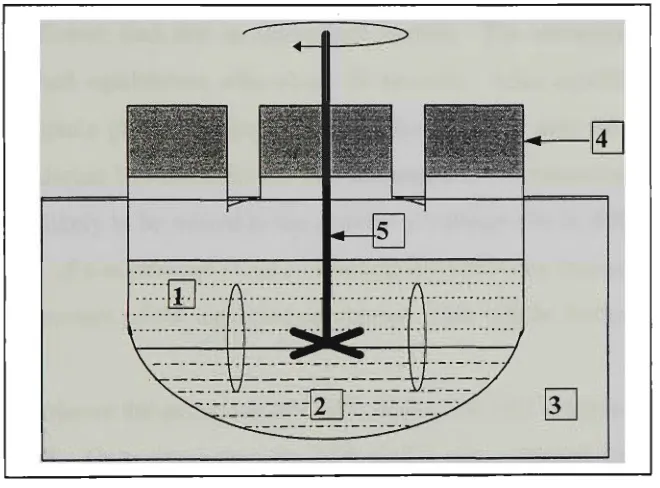
T h e extraction equilibrium studies were carried out using the two-phase titration technique. T h e main advantage of this technique compared to the batch-wise extraction method, is that it allows collection of a large number of data points in a short period of time. 100ml of an Aliquat 336/Shellsol A B solution w a s added to an indented round bottomed flask secured in a thermostated water bath (25°C) ( Figure 2.1). A n accurate 100ml of the lowest concentration metal solution w a s then added into the s a m e flask and the phases were rapidly stirred for the pre-determined equilibration time. After equilibration, 10ml of the aqueous phase w a s removed for metal analysis. 10ml of the same fresh metal solution w a s then added and the process repeated. This w a s then repeated once before proceeding to the next higher metal concentration. A t each step the concentration of metal in the organic phase w a s obtained by difference.
2.2.2.3 Metal analysis
Table 2.1. Instrumental parameters used in this investigation
Parameters
L a m p current ( m A ) Wavelength (nm) Slit width (nm) Flame composition
for the analysis of metals bv A A S
Cd(II) 3.0 228.8
0.5 a
Cu(II) 3.0 324.7
0.5 a
a = Air-acetylene, oxidizing
Figure 2.1. Schematic diagram of the two-phase titration apparatus. (1) Organic phase, (2) Aqueous phase, (3) Thermostated water bath, (4) Three-neck round bottomed flask with indentations to facilitate mixing and (5) Stirrer
2.3 R E S U L T S A N D DISCUSSION
2.3.1 Effect of Organic-Aqueous Phase Contact Time on The Extraction of Cd(II)
and Cu(II)
Using batch extraction method, the extraction of Cd(II) and Cu(II) from HC1 solutions by Aliquat 336 was studied as a function of extraction time. Shellsol A B was used as the diluent for the organic phase. Since extraction of Cd(II) and Cu(II) by Aliquat 336 using chloroform as the diluent has been reported previously [60], in the present work, only the extraction of Cd(II) by Aliquat 336 in chloroform was re-investigated for the purpose of comparison. Figure 2.2 shows the time dependence of these extraction systems expressed in terms of % E .
It is clear from Figure 2.2 that the extraction of Cd(II) by Aliquat 336 in Shellsol A B system is more efficient than that in chloroform system. The extraction of Cd(II) in both systems reached equilibrium after about 30 seconds. After equilibrium, 99.98% Cd(II) is in the organic phase of Aliquat 336/Shellsol A B , but only 86.89% is in the organic phase of Aliquat 336/chloroform. The difference in the extraction efficiency of the two diluents is likely to be related to the activity of Aliquat 336 in different diluents, which is as a result of a number of factors including the molecular interactions between the diluent and extractant of the extracted complexes. This will be further discussed in Section 2.3.4.
efficiency between Cd(II) and Cu(II) by Aliquat 336 indicates that these metals can be separated from aqueous chloride solutions.
In the two-phase titration study of Cd(II) and Cu(II), 5 and 10 minutes of phase-mixing were used to allow the equilibrium to be established, respectively. These
equilibrium times were considered sufficient, since the extraction of Cd(II) and Cu(II) by Aliquat 336 reaches equilibrium after 30 seconds of phase-mixing, and prolonged phase-mixing w a s found to have no further effect on the extraction equilibrium.
100 -,
80
60
% E 40
20
-AA A
*f •
j
L.
A A A •
• • •
• • • •
— A 1
— •
™
of" "
0
250 500 750T i m e (second)
1000
Figure 2.2 Effect of organic-aqueous phase contact time on the extraction of Cd(II) and Cu(II) from 3 M hydrochloric acid solutions by Aliquat 336. (A Cd(II)/Shellsol A B , • Cd(II)/Chloroform, • Cu(II)/Shellsol A B . The initial aqueous phase Cd(II) and Cu(II) concentration were 200 m g / L and
140mg/L, respectively. The Aliquat 336 concentration in the organic phase w a s 0.04M.)
2.3.2 Effect of Hydrochloric Acid Concentrations on The Extraction of Cd(II)
and Cu(II)
100 -, 80 60
-% E
40
20
- / '
;
o,;.
r--0 1
2.
i • — i
3 4
[HC1]
(M)
5
A
— — •
6 7
Figure 2.3. Effect of H C 1 concentrations on the extraction of Cd(II) and Cu(II) from hydrochloric acid solution by Aliquat 336 in Shellsol A B (A Cd(II) and • Cu(II). T h e initial aqueous phase Cd(II) and Cu(II) concentration were 200 m g / L and 140 mg/L, respectively. T h e initial Aliquat 336 concentration of the organic phase w a s 0.04M.)
Figure 2.3 shows the extraction efficiency of Cd(II) and Cu(II) as a function of hydrochloric acid concentrations. For Cd(II) an extraction percentage > 9 9 . 9 8 % w a s reached for all H C 1 concentrations > 0.5M. However, for Cu(II), the extraction percentage w a s found increased as the H C 1 concentration was increased up to 4 M and reached a plateau (* 4 2 % extraction) for H C 1 concentration > 4 M .
Extraction of Cd(II) and Cu(II) from an aqueous phase containing no H C 1 and 0.1M H C 1 concentrations w a s also studied, but stable emulsions formed in both phases which m a d e the phase separation and the metal concentration analysis impossible. The result indicates that H C 1 is needed for the phases to separate and to avoid the formation of emulsion.
F r o m the above results and results of previous studies [60], H C 1 concentrations chosen to be used in the extraction systems were 2 M for Cd(II) and 3 M for Cu(II).
2.3.3 Equilibrium Studies of The Extraction of Cd(H) and Cu(II) From
Hydrochloric Acid Solutions by Aliquat 336 in Shellsol A B
have been reported in the past using Aliquat 336 as the extractant [60, 61] to extract
Cd(II) and Cu(II) by means of two-phase titration technique. In this section, two-phase
titration technique was employed to study the extraction of Cd(II) and Cu(II) from H C 1
solutions using Aliquat 336 dissolved in Shellsol A B . The stoichiometry of the
extracted complex and the equilibrium constant of the extraction reaction were
evaluated.
2.3.3.1 The equilibrium data for the extraction of Cd(II) and CuflD
The experimental data for the extraction of Cd(II) and Cu(II) from hydrochloric acid
solutions using organic phase of Aliquat 336 in Shellsol A B are presented in the form of
plots of Z versus the logarithm of the concentration of the neutral metal species M C 1
2in
the aqueous phase at equilibrium (Figures 2.4 and 2.5). Z is defined as the ratio of the
total metal concentration in the organic phase to the total Aliquat 336 concentration in
the organic phase [60]. The concentration of the neutral metal species, in each case, was
calculated from the total metal concentration using the values for the formation
constants of the various metal complexes [140] and is shown below.
The distribution of the various metal species in solution was determined by
considering the metal complex equilibria described below [140]. The generalized metal
complex formation equilibria between a metal ( M ) and an anionic ligand (X) in aqueous
solution, neglecting the coordinated water and charges for convenience, are,
ki r M X l
M + X .^===* M X ki = -
L(2.16)
[M][X]
M X + X ^ M X
2lo = - E ^ L (2.17)
[MX][X]
In general,
kn [MXn]
MX,, + X * 2 * Mx
nkn = —
l
where k
l5k
2, .... k
nare the stepwise formation constants. The overall formation constant
p
n, which is the product of the stepwise formation constants, m a y be expressed as
follow,
M + nX
J^ Mx
np
n= -^- (2.19)
[M][Xf
The total concentration of metal ion in the aqueous phase, [M]
T, assuming that there are
no hydrolysis or side reactions, is,
[M]
T= [M] + [MX] + [MX
2] + .... + [Mx
n] (2.20)
Substitution of the appropriate stepwise formation constants into equation (2.20) gives,
[M]
T= [M] + P,[M][X] + (3
2[M][X]
2+ ... + P
n[M][X]
n(2.21)
[ M ] T
= 1 + P,[X] + P
2[Xf + ... + p
n[X]
n( 2.22)
If the total metal ion concentration is small in comparison to the total concentration
of the anionic ligand, the free anion concentration m a y be assumed to be that of the total
concentration, as the amount of anion complexed with metal ions is negligible. Thus, if
the concentration of free anion and the stepwise formation constants are known, and if
the total concentration of metal ion in the aqueous phase can be experimentally
determined, the free metal ion concentration [M] in the aqueous phase can be calculated
from equation (2.22). Hence the concentrations of the other species present in the
aquesous phase can be calculated by incorporating the appropriate stepwise formation
constants to the equation:
[MX] PiPC]
[M]x " 1 + Pi[X] + p2[X]
2+...+(3n[X]
n[MXz]
p
2[X]
2[ M ] T 1 + PifX] + p2[X] 2
+...+pn[X]
r (2.24)
Therefore the concentration of the neutral metal species, C d C l2 and CuCl2, can be
calculated as below,
[CdClJ
[Cd(ii)]
Tp
2[cr]
2
-n4
1 + pi[cr] + p
2[crr + Pstcrr + P 4 c n
(2.25)
[CuClJ
[Cuai)]Tp
2[cr]^
-n4i + pi[cr] + p
2[crr +p3[crr + P 4 c r ]
(2.26)
0.20 0.15 0.10 0.05
0,00 • • . . — - *
• • * • *
1
-7.50 -7.00 -6.50
log[CdCI2]
-6.00
Figure 2.4 Equilibrium data for the extraction of Cd(II) from 2 M hydrochloric acid solution using Aliquat 336 in Shellsol A B solvent (A 0.04M Aliquat 336; • 0.06M Aliquat 336; • 0.08M Aliquat 336. The aqueous phase Cd(II) concentration range was 0.0006 to 0.02M)
Figure 2.4 and 2.5 represent the equilibrium data (Z vs log[CdCl2] or log[CuCl2])
work, they investigated the extraction of Cu(II) from relatively low H C 1 concentrations. T h e data points obtained for this system lie close to a c o m m o n curve, thus, they concluded that there w a s only one metal complex being extracted into the organic phase [60]. They further concluded that the extracted metal complex w a s the singly charged anionic species, CuCl3", as this species was the dominant species within the H C 1
concentration range studied [60].
0.30 0.25 0.20 0.15
o.io
10.05 0.00
-/
•^^•^r
-4.50 -4.00 -3.50 -3.00
log[CuCl2]
-2.50 -2.00
Figure 2.5. Equilibrium data for the extraction of Cu(II) from 3 M hydrochloric acid solution using Aliquat 336 in Shellsol A B (A 0.04M Aliquat 336; • 0.08M Aliquat 336; • 0.12M Aliquat 336. The aqueous phase Cu(II) concentration range was 0.003-0.25M)
In the present study, the extracted metal complex is also most likely to be the singly charged anionic species, CdCl3" or CuCl3". Further discussion o n the average
composition of the extracted complex will be given in the following section.
T h e extraction of Cd(II) using Aliquat 336 in chloroform reported previously by D a u d and Cattrall showed, however, that more than one species were extracted into the organic phase and these species were identified as CdCl3" and C d C l4 " [60]. This w a s
shown by the plots of Z against log[CdCl2] at different Aliquat 336 concentrations
obtained for this system which did not fall on the same curve. T o re-enforce this point, the extraction of Cd(II) using Aliquat 336 in chloroform w a s re-investigated at two different Aliquat 336 concentrations (Figure 2.8). The results clearly s h o w that the points on the Z against log[CdCl2] plots did not fall on the same curve. It is therefore
re-confirmed experimentally that if the Z against log[MCl2] plots at different Aliquat 336
concentrations fall on a c o m m o n curve, there m a y only be one species being extracted into the organic phase.
2.3.3.2 Average composition of the extracted complex
T o validate the above assumption that only one metal species is being extraction into the organic phase for the extraction of Cd(II) and Cu(II), the stoichiometry of the species formed in the organic phase is evaluated. This is done by using the integration method of Sillen [123] as described below.
A general expression can be written to describe the equilibrium reaction for Cd(II) and Cu(II) extraction system [60]. This expression makes no assumptions concerning the stoichiometry of the extracted complex, and for the sake of simplicity involves the reaction of Aliquat 336 with the species M C 12 (CdCl2 or CuCl2) from the aqueous
phase.
qR3MeN +
Cl"org +pMCl2aq *=^ (R3MeN +
Cl")q(MCl2)p org (2.27)
For the extraction of Cd(II) or Cu(II) from hydrochloric acid solutions by Aliquat 336 in Shellsol A B system, it is expected that the extraction involves the monovalent and divalent anionic complexes CdCl3" and CdCl4
2
" or CuCl3" and CuCl4 2
monovalent and divalent anionic species were found to be the extracted metal species for the extraction of Cd(II) or Cu(II) in chloroform system [60].
T h e stoichiometry of the species formed in the organic phase of the present system can be evaluated using the integration method proposed Sillen [123] which w a s later described in detail by Hogfelt and Fredlund [141]. In this method the average p and q, which are the average numbers of M C 12 and R3M e N
+
C l " moieties per complex molecules respectively, are evaluated from the Z versus log[MCl2]aq experimental data
plot, assuming that the law of mass action is valid [141].
According to previous studies [108, 123, 141], the average p and q can be evaluated from the following equations [108]:
q = P
4
Z
[(-JDdZ-JZdln[MCl2])/2.303
(2.28)
D d Z + 1 0[ H D d Z
- JZ d^ [ M C l2] ) / 2 . 3 0 3 ] _i
(2.29)
W h e n employing the above approach, the following treatments are required to obtained the values of p and q.
F r o m the data given in the plot of Z against log [MCl2]aq, a plot of log[MCl2]aq
against log[Aliquat 336]Total, for constant Z, can be obtained. The latter plot is then used
to evaluate the D value by the taking partial derivative of Log[MCl2]a q (or ln[MCl2]aq)
against log[Aliquat 336]Total (or ln[Aliquat 336]Total):
8 ln[MCh] d /«[Aliquat 336]
= - D (2.30)
JZ
where D is obtained from the slope of the plot.
various concentrations of Aliquat 336 all lie close to the same curve. Thus, the -D value (equation (2.30)) is zero as the slope of the plot log[MCl2]aq against log[Aliquat 336]T is
zero. Therefore, the value of the integral, J D d Z , in equations (2.28) and (2.29) equals to zero. These equations then become
q = 1 - 10
[-JZdln[MCh]/2.303]'
(2.31)
p =
- Z
(-JZdln[MCk]/2.303) (2.32)
Substituting equation (2.32) into equation (2.31), q can then be calculated as:
q = ' (-{ZdIntMCb.y2.303) =r X
1 - 1 0 (-JZdln[MCb]/2.303)
(2.33)
- Z
1 - 1 0 (-|Zdln[MCh]/2.303) x
1 - 1 0 (-JZdln[MCl2]/2.303)
=* =1 (2.34)
From the general expression of the equilibrium reaction (equation (2.27)) it is clear that if q equals to 1, then p must equal to 1. Thus, it can be concluded that Cd(II) or Cu(II) complexes extracted into Aliquat 336/Shellsol A B system has the formulation of R3M e N
+
C d C l3" or R3M e N +
C u C l3\ In other words, the metal ion/extractant ratio in the
extracted complexes is 1:1. O n the other hand, the metal ion/extractant ratios of the complexes extracted into the Aliquat 336/chloroform system must include both 1:1 and 1:2, since the points on the Z against log[MX2] plots for the extraction of Cd(II) or
For the extraction of Cd(II) and Cu(II) from hydrochloric acid solutions in the Aliquat 336/Shellsol A B system, the extraction reactions can be written as,
(R3MeN +
Cl")org+ CdCl3"aq ^A (R3MeN +
CdCl3" )org + Cl"aq (2.35)
(R3MeN +
Cl" )org + CuCl3"aq ^ (R3MeN +
CuCl3" )org + Cl"aq (2.36)
Here, org and aq represent the organic and the aqueous phases respectively. kn is the
extraction equilibrium constant for the monovalent metal ion/Aliquat 336 complex. Equations (2.35) and equation (2.36) are written with the assumption that anion-exchange reactions are occurring. These equations also suggest that reactions can occur either in the bulk phases or at the aqueous-organic interface. For quaternary a m m o n i u m salts, which are highly surface active, it is reasonable to assume that the anion-exchange reactions are occurring at the interface. This assumption is supported by the interfacial tension studies previously reported [117].
T h e extraction equilibrium constants for the extraction of species M C 13" (CdCl3" or
CuCl3") from the aqueous phase can be written as,
[RMeN+MCb>g[Cr]aq
kn = (2.37) [R3MeN + C r ]org[MCl3" ]aq
study that the activity coefficients of Aliquat 336 in the concentration range of 0.04-0.12M are constant.
A s previously discussed, the equilibrium study results are plotted in the form of Z versus the concentration of species M C 12 at equilibrium phase. For the convenience of
the following discussion, equation (2.37) is rewritten in the following form.
[RMeNCfJorg [Cl']aq
(2.38)
[PoMeNMCbJorg kii[MCb-]aq
The total concentration of Aliquat 336 in the organic phase, [R3MeNCl]T org, is,
[R3MeNCl]T;0rg = [R3MeNCl]org + [R3MeNMCl3]org (2.39)
Substituting equation (2.39) into equation (2.38) leads to:
[RsMeNClfrorg - [RsMeNMCbjorg [Cl"]aq
[RsMeNMCbJorg kn[MCb"]aq
(2.40)
Since Z is defined as the ratio of the total metal concentration in the organic phase to the total Aliquat 336 concentration in the organic phase, then equation (2.40) can be written as,
1 [CHaq
_ _ i = — L — J J — (2 4 n
Z kn[MCl3-]aq v ' ;
Take logarithms for equation (2.41) leads to:
log(l/Z - 1) = -log[MCl3"]aq - log kn + log[Cl"]aq (2.42)
This equation describes a linear relationship between log(l/Z-l) and log[MCl3"]aq
Cu(II). Equilibrium concentrations of the species [MC13"] were again calculated from the
appropriate formation constants.
G o o d linearity is seen in both Figures 2.7 and 2.8 with a slope of-1.42 and an R2 of 0.98 for Cd(II) and -1.35 and 0.99 for Cu(II). In an ideal case, the plot of the equation (2.42) should result in a slope of -1. In cases of Cd(II) and Cu(II) presented here, the slopes are smaller than -1. Similar situation w a s also encountered in the study by Argiropoulos et al. [51]. T h e linearity of both plots offers further support to the proposed formation of a single complex in the organic phase with a 1:1 metal ion/Aliquat 336 complex stoichiometry. T h e extraction equilibrium constants for these metals can be calculated from equation (2.42) and from the intercepts of Figure 2.7 and Figure 2.8. T h e values of logkn for the extraction of Cd(II) and Cu(II) are 7.81 and
3.39 respectively (Table 2.2).
Figure 2.7 Relationship between log(l/Z-l) and log[CdCl3"]
Table 2.2 T h e extraction equilibrium constants for Cd(II) and Cu(II)
Metals Shellsol A B chloroformLOUJ
logkn l o g kH log k12
^ 00
^ 1.50
i — i
S i-oo
*-uv bfi £ 0.50 0.00 --4.00* ¥ f ^ y = -l-35x - 2.93
^ V ^ R
2= 0.99
^ $ S A
^^^^_ *^^. \ ^
-3.50 -3.00 -2.50 -2.00
log[CuCl3]
Figure 2.8 Relationship between log(l/Z-l) and log[CuCl3"]aq
The high value for the extraction constant of Cd(II) demonstrates a much stronger affinity of the Aliquat 336 cation to the anionic c a d m i u m species compares to the anionic copper species. This suggests that the Aliquat 336/Shellsol A B system is more suitable for the recovery of c a d m i u m from chloride solutions.
In previous studies involving extraction with Aliquat 336, the mechanism for the Aliquat 336 extraction proposed w a s the interfacial mechanism [107]. In their study, considerable evidence w a s obtained for a reaction mechanism which consisted of fast ion-exchange at the interface followed by a rate determining step which involved the replacement of the metal containing complex at the interface by reagent in the bulk phase. A similar mechanism is also proposed in the present system.
In the extraction of Cd(II) and Cu(II) using Aliquat 336, Table 2.2 clearly shows a significant different between the extraction equilibrium constant for the [ R3M e N
+
C d C l3"
] complex to that for the [ R3M e N +
C u C l3" ] complex. This different suggests that Cd(II)
can be easily separated from Cu(II) using Aliquat 336 from chloride solutions.
Table 2.3 Predominant chloro complexes in aqueous hydrochloric acid solutions of various concentration at r o o m temperature [144]
Central ion Cu(II)
1MHC1
CuCl(H20)3"
CdCl (H 0)"
8MHC1
CuCl2(H20)2, CuCl3"
CdCl 2"
13MHC1
CuCl4z"

![Figure 2.8 Relationship between log(l/Z-l) and log[CuCl3"]aq](https://thumb-us.123doks.com/thumbv2/123dok_us/7912211.1313741/48.553.22.492.723.799/figure-relationship-between-log-z-and-log-cucl.webp)