Estimation of Accumulation of Zinc content in mushroom and
Soil by Atomic Absorption Spectroscopy
Dr Monika Chauhan, PhD
1 1Associate Professor, Chemical Engineering, Adama Science and Technology University,
Adama, Ethiopia
Abstract
The current study was undertaken to determine Level of Zinc in four wildly growing edible mushroom varieties Button mushroom (Agaricus bisporus), Oyster mushroom (Pleurotus sajor-caju), Milky mushroom (Calocybe indica) and Shiitake (Lentinus edodes) and its soil collected in near the industrial drainage and heavy traffic neighboring area of Delhi-NCR, India. It was determined by Flame Atomic Absorption Spectrometry. The concentration was determined on dry weight basis. The range of elemental concentration was mg/kg. In general, levels of Zinc were higher than PFA and WHO permissible limits in case of industrial area, roadside area. Whereas level of the metal at remote residential area and cultivated area was within permissible limits. Two Way ANOVA was used to found significant variation in trace metal concentrations at different
locations and in different varieties
.
Keywords:
Zinc, Heavy Metal, Mushroom, Atomic Absorption Spectroscopy.1. Introduction
Various environmental and toxicological studies have lead to interest in the determination of toxic elements in food. Though mushroom does not constitute significant portion of human diet, still the consumption of both wildly grown and cultivated mushrooms have been sought after in recent times. There are several reasons why mushroom poisoning can occur among people, and the high heavy metal concentrations in some edible
fungi is a known source as chronic poisoning (Tuzen et al.,
1998). Many species of mushrooms possess the ability to
effectively take up and accumulate heavy metals (Kojo and
Lodenius 1989; Kalacˇ et al. 1991; Falandysz et al. 1993, 1995; Lodenius 1994; Melgar et al. 1998; Garcia et al. 1998; Alonso et al. 2000; Kalacˇ and Svoboda 2000).
The accumulation of trace metals in agricultural soils disposal, waste incineration, urban effluent, traffic is of increasing concern due to the food safety issues potential health risks as well as its detrimental effects on soil ecosystems. Heavy metals are considered to be one of the main sources of pollution in the environment, since they have a significant effect on its ecological quality. Human activity leads to increasing levels of heavy metal contamination in the environment. Heavy metals owing to atmospheric and industrial pollution accumulate in the
soil and influence the ecosystem nearby (Al-Radady et al.,
1994). The determination of heavy metal in soils is very
important in monitoring environmental pollution (Zhou et al.,
1997).
In the present paper the accumulation of zinc was studied in four wildly grown mushroom at four different locations in an around Delhi- NCR region for two consecutive years.
.
2 MATERIALS AND METHODS
2.1 Sample Collection
Samples of soils and four different species of wildly growing
edible mushrooms: Button mushroom (Agaricus bisporus) (V1),
Oyster mushroom (Pleurotus sajor-caju) (V2), Milky mushroom
(Calocybe indica) (V3) and Shiitake (Lentinus edodes) (V4) were collected from North Delhi Border and Sonipat region, India during monsoon. The area studied was divided into area of industrial activity (L1), road side area (L2) with heavy vehicular traffic on NH-1 national highway and state highway criss crossing NH1 and connecting Sonipat and UP. Residential area (L3), Commercial samples ( L4 ) was studied from APMC Market Azadpur, Delhi. Cultivated samples (L5) were collected from HAIC, Murthal, Sonipat, Haryana.
2.2 Analytical method of soil and Mushroom
Flame Atomic Absorption Spectrophotometer (Perkin-Elmer, ANALYST 100) equipped with flame and graphite furnace was used to determine level of Zinc content.
3. RESULTS AND DISCUSSION
3.1 CONCENTRATION OF ZINC IN THE MUSHROOM SAMPLES
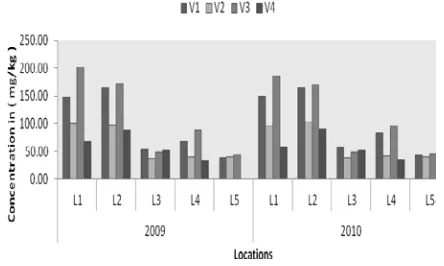
A perusal of Table No. 1 and 2 and Figure 1 shows that
mushroom varieties had significant variation (P<0.01) in zinc
concentration. Zinc Concentration was found to be maximum in
Milky (Calocybe indica) followed by Button mushroom
(Agaricus bisporus). Thereafter was Oyster (Pleurotus sajor-caju) and the minimum value was in Shiitake (Lentinula edodes).
The maximum zinc accumulation was in roadside samples
followed by industrial drainage samples . Sporocarps collected
from HAIC (cultivated samples) have minimum zinc
accumulation ranged from 31.0 to 54.0 mg/kg dry matter.
Fig 1. Zinc Concentrations (as mg/kg) of different Mushroom Species at various locations
In the study if was observed that location had significant
variation in zinc concentration in mushroom at different
locations (p<0.01). All the samples of roadside area and Industrial drainage above the safe limits WHO limits (60 mg/kg dw) and most stringent PFA/FSSAI maximum allowed
concentration i.e. 50.0 mg/ kg of dry matter. In case of
Commercial sample, remote residential area sample and cultivated samples only some sample were above the safe limits of WHO and PFA. The FAO/WHO has set a limit for heavy metal intakes based on body weight. For an average adult (60 kg body weight), the provisional tolerable daily intake for zinc is 60 mg/kg dw (FAO/WHO 1999).
Table 1
Mean Zinc Concentration (mg/kg dw) in different varieties of mushroom in the year 2009
Sampling sites
Agaricus bisporus
Pleurotus sajor-caju
Calocybe indica
Lentinula edodes Mean
L1 148.44 100.98 201.58 67.61
129.6 5
L2 165.50 97.64 172.10 87.31
130.6 4
L3 54.75 37.39 48.95 52.60 48.43
L4 67.62 40.25 88.21 33.35 57.35
L5 39.01 40.51 44.23 - 41.25
Mean 95.07 63.35 111.01 60.22
Location Variety
Location x Variety
S.E.(m) 4.34 3.88 8.67
LSD (0.05 P) 12.18 10.89 24.35
Mushrooms are known as zinc accumulators and the sporophore:
substrate ratio for Zn ranges from 1 to 10 mg/kg (Isıloglu et al.,
2001). Zinc concentrations of mushroom samples in the literature
have been reported to be in the ranges: 30-150 mg/kg (Kalac &
Svoboda, 2000), 29.3–158 mg/kg) (Isıloglu et al., 2001), 33.5–
89.5 mg/kg (Tüzen, 2003), 40.3–64.4 mg/kg (Mendil et al.,
2004), 45.2–173.8 mg/kg (Soylak et al., 2005), 30.1-137.4 (Ita, Essien and Ebong, 2006), 43.5–205 mg/kg (Sesli et al., 2008)
and 42.9-94.3mg/kg (Fangkun Zhu et al., 2011) respectively.
Hence, zinc content in mushrooms of the present study is in agreement with the previous studies.
Table 2
Mean Zinc Concentration (mg/kg dw) in different varieties of mushroom in the year 2010
Sampling sites
Agaricus bisporus
Pleurotus sajor-caju
Calocybe indica
Lentinula edodes Mean
L1 149.93 95.70 186.64 58.74
122.7 5
L2 164.79 103.19 171.47 91.02
132.6 2
L3 56.63 39.08 48.82 52.66 49.30
L4 83.59 41.67 96.92 34.94 64.28
L5 42.97 39.79 45.22 - 42.66
Mean 99.58 63.89 109.82 59.34
Location Variety
Location x Variety
S.E.(m) 3.98 3.56 7.95
LSD (0.05 P) 11.17 9.99 22.33
3.2 CONCENTRATION OF ZINC IN THE SOIL OF MUSHROOM SAMPLES
Soil of mushroom varieties had significant variation (P<0.01) in
zinc concentration as shown in Figure 2 and Table No. 3 and 4.
Among the soil of different varieties of mushrooms, in the first
year the maximum zinc concentration was found in soil of Milky
(Calocybe indica) followed by Button mushroom (Agaricus bisporus) . This was followed by Oyster (Pleurotus sajor-caju)
and the minimum value was in Shiitake (Lentinula edodes) i.e.
50.13 mg/kg dw. Whereas in the second year, minimum zinc
concentration was found in sample of Oyster (Pleurotus
sajor-caju).
Fig 2. Zinc Concentrations (as mg/kg dw) in Soil at different locations
Locations had significant variation in zinc concentration in the
soil at different locations (p<0.01). There is significant variation
in trace metal concentration with location. (Jain et al 2013,
Chauhan 2014 and Chauhan et al 2015). Highest zinc
samples) i.e. 31.25 mg/kg dw in the first year and 30.20 mg/kg
dw in the second year. All the samples of soil were within the
safe limits of WHO (7500 mg/kg dw).
Table 3
Mean Zinc Concentration (mg/kg dw) in Soil in the year 2009
Sampling sites
Agaricus bisporus
Pleurotus sajor-caju
Calocybe indica
Lentinula edodes
Mea n L1 112.35 71.66 139.87 43.93 91.95 L2 123.42 77.20 128.49 68.13 99.31 L3 41.22 28.45 35.50 38.32 35.87 L5 31.47 29.14 33.15 - 31.25 Mean 77.11 51.61 84.25 50.13
Location Variety
Location x Variety S.E.(m) 2.09 1.87 4.19 LSD (0.05 P) 5.88 5.26 11.75
Table 4
Mean Zinc Concentration (mg/kg dw) in Soil in the year 2010
Sampling sites
Agaricus bisporus
Pleurotu s sajor-caju
Calocybe indica
Lentinula edodes Mean
L1 111.21 75.62 151.10 50.63 97.14 L2 123.87 73.05 128.95 65.29 97.79 L3 39.82 27.19 35.60 38.24 35.21 L5 28.56 29.63 32.41 - 30.20 Mean 75.86 51.37 87.02 51.39
Location Variety
Location x Variety S.E.(m) 2.29 2.05 4.59 LSD(0.05 P) 6.44 5.76 12.88
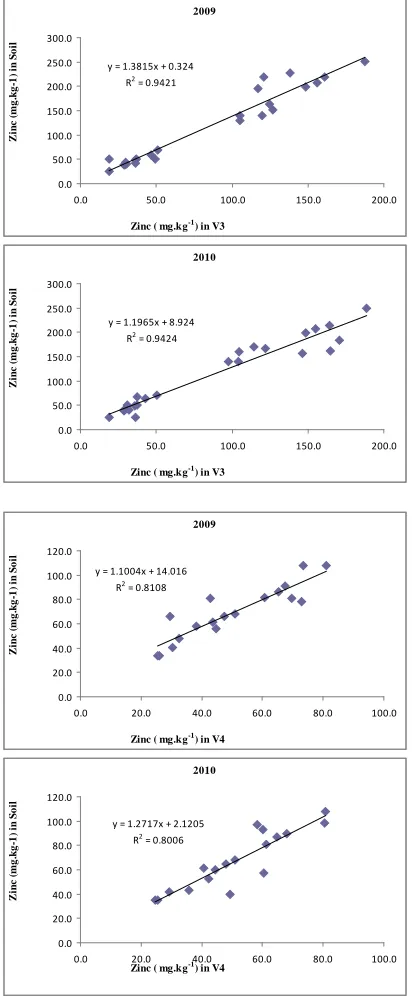
3.3 Relationship between Zinc Concentration in various mushroom varieties and their underlying soil.
The zinc shows a higher mobility in the analyzed species of mushrooms because of the highest concentration of this element in the cap of fruiting body for the analyzed wild growing edible species of mushrooms. All tested fungi revealed ability for zinc accumulation being higher concentration of zinc in mushroom
than in soil. Rudawska and Leski, 2005 also reported similar
findings. During our investigation, we did not found much difference in zinc accumulation in relation to sites and different varieties of mushrooms due to similar BCF values. Zinc is an essential element and fungi have high requirements for Zn conveying this element to their metabolism by means of
well-operating mechanisms of absorption and translocation (Carlyle
and Watkinson, 1994). However, Carmen Cristinia, 2010 did not find the significant influence of soil characteristics on zinc accumulation in the fruiting body of mushrooms. He also found negative correlation between soil and mushroom zinc levels i.e. for an increase of zinc content in the soil with 20-25 mg/kg, the zinc concentration in the fruiting body decreased with 10-15 mg/kg. But he also reported higher level of concentration for this metal in the in cap comparing with the stalk of mushroom.
2009
y = 1.317x + 0.3682 R2 = 0.9434
0.0 50.0 100.0 150.0 200.0 250.0
0.0 50.0 100.0 150.0 200.0
Zinc ( mg.kg-1) in V1
Z
inc
(
m
g
.kg
-1
) i
n So
il
2010
y = 1.2538x + 8.4613 R2 = 0.9429
0.0 50.0 100.0 150.0 200.0 250.0
0.0 50.0 100.0 150.0 200.0
Zinc ( mg.kg-1) in V1
Z
inc
(
m
g
.kg
-1
) i
n So
il
2009
y = 1.2797x + 3.0803 R2 = 0.9349
0.0 20.0 40.0 60.0 80.0 100.0 120.0 140.0
0.0 20.0 40.0 60.0 80.0 100.0
Zinc ( mg.kg-1) in V2
Z
inc
(
m
g
.kg
-1
) i
n So
il
2010
y = 1.2676x + 4.3219 R2 = 0.9349
0.0 20.0 40.0 60.0 80.0 100.0 120.0 140.0
0.0 20.0 40.0 60.0 80.0 100.0
Zinc ( mg.kg-1) in V2
Z
inc
(
m
g
.kg
-1
) i
n So
2009
y = 1.3815x + 0.324 R2 = 0.9421
0.0 50.0 100.0 150.0 200.0 250.0 300.0
0.0 50.0 100.0 150.0 200.0
Zinc ( mg.kg-1) in V3
Z
inc
(
m
g
.kg
-1
) i
n So
il
2010
y = 1.1965x + 8.924 R2 = 0.9424
0.0 50.0 100.0 150.0 200.0 250.0 300.0
0.0 50.0 100.0 150.0 200.0
Zinc ( mg.kg-1) in V3
Z
inc
(
m
g
.kg
-1
) i
n So
il
2009
y = 1.1004x + 14.016 R2 = 0.8108
0.0 20.0 40.0 60.0 80.0 100.0 120.0
0.0 20.0 40.0 60.0 80.0 100.0
Zinc ( mg.kg-1) in V4
Z
inc
(
m
g
.kg
-1
) i
n So
il
2010
y = 1.2717x + 2.1205 R2 = 0.8006
0.0 20.0 40.0 60.0 80.0 100.0 120.0
0.0 20.0 40.0 60.0 80.0 100.0
Zinc ( mg.kg-1) in V4
Z
inc
(
m
g
.kg
-1
) i
n So
il
Fig 3: Relationship between Zinc Concentration in various mushroom varieties and their underlying soil.
4. CONCLUSION
Among all the four varieties of mushrooms the mean zinc
concentration was in the descending order as Calocybe indica,
Agaricus bisporus, Pleurotus sajor-caju and Lentinula edodes.
Mean zinc concentration in soil samples were found to be maximum in roadside followed by industrial drainage and the
least was in cultivated soil samples. In the present study, the detected levels of zinc in the samples from industrial drainage and roadside area were found to be 34.0-251.6.
The order of the levels of heavy metals in the mushroom samples
were generally in agreement with previously reported but higher than maximum permissible standards of WHO, PFA, Czech and
EU. Observed concentrations of Zn in the vegetables were
compared with Prevention of Food adulteration (PFA) act 50
mg/kg, standards of food contamination. Even the loosely
available commercial mushroom samples during monsoon have shown higher metal contents. This may be due their collection might be done from wildly growing places. Roadside soils have been shown to have considerable contamination due to both depositions on vehicle – derived metal and to relocation of
metals deposited on the road surface (Ball et al., 1991). Because
of the severe adverse environmental and/or ecological and health effects of these heavy metals, there have been many studies on
heavy metal contamination in soils along major roads (Turer,
2005). The fruit bodies of mushrooms accumulate remarkably high concentrations of trace metal content, especially in the vicinity of highways. Our results agree with the data of other
authors (Laaksovirta & Alakuijaka, 1978). Mushrooms can be
used as bioindicators for soil pollution (Lodenius et al., 1981;
Quinche, 1987).
References
[1] Alonso J, Salgado MJ, Garcı´a MA, Melgar MJ (2000)
Accumulation of mercury in edible macrofungi: influence of some factors. Arch Environ Contam Toxicol 38:158–162
[2] Al-Radady A.S., B.E. Davies, M.J. French, (1994) Science of
Total Environment. 145:143–156.
[3] Ball, D. J., Hamilton, R. S. and Harrison, R. M. (1991).
Studies in Environmental Science Highway Pollution, U.K, 44:1-47
[4] Carlile, M. J.and Watkinson, S. C. (1994). The fungi.
Academic Press. London.
[5] Carmen Cristina and Gabriela Busuioc (2010). The
Mycoremediation of Metals Polluted Soils Using Wild Growing Species of Mushrooms. Latest Trends on Engineering Education, 36-39
[6] Chauhan,M , Chauhan,D., Gupta, V.K. and Kumar, A.
(2015). STUDY ON ACCUMULATION OF NICKEL CONTENT IN MUSHROOM IN DELHI-NCR REGION OF INDIA BY ATOMIC ABSORPTION SPECTROSCOPY International Journal of Scientific Engineering and Applied Science (IJSEAS),1(3),143-149.
[7] Chauhan, M (2014). “Bioaccumulation of Lead Content in
Mushroom and Soil in Delhi-NCR Region of India”, International Journal of Advanced Research in Chemical Science (IJARCS), 1 (3), 1-6.
[8] Chauhan,M (2014), “Assessment of Heavy Metals in Soil
and Mushroom and its Determination by Atomic Absorption Spectrometry”, World Journal of Publisher, 2(2)
[9] Dilek Turer, (2005). Effect of non–vehicular sources on
heavy metals concentration of roadside soils. Water, air and Soil pollution, 166:251-264
[10]Falandysz, J, Danisiewicz D, Galecka, K (1995) Mercury in
[11]Falandysz, J, Niesto´j M, Danisiewicz, D, Pempkowiak J, Bona H (1993) Cadmium and lead content of wild mushrooms Agaricus campestris L. collected from different locations in northern Poland. Bromat Chem Toksykol 26:275–280
[12]Fangkun Zhu, Li Qu, Wenxiu Fan, Meiying Qiao, Hailing
Hao and XuejingWang. (2011). Assessment of heavy metals in some wild edible mushrooms collected from Yunnan Province, China. Environmental Monitoring Assessment, 179(1-4):191-199
[13]FAO/WHO Standards. (1976). List of maximum levels
recommended for contaminants by the Joint FAO/WHO Codex Alimentarius Commission. Second Series. CACIFAL, Rome, 3: 1–8.
[14]FAO/WHO (1999). Expert Committee on Food Additives,
Summary and Conclusions. Fifty-third Meeting, Rome
[15]Garcia, M.A., Alonso J, Ferna´ndez, M.I., Melgar, M.J.
(1998) Lead content in edible wild mushrooms in northwest Spain as indicator of environmental contamination. Arch Environ Contam Toxicol 34:330–335
[16]Isıloglu, M., Yılmaz, F., & Merdivan, M. (2001).
Concentrations of trace elements in wild edible mushrooms. Food Chemistry, 73:169–175.
[17]Ita, B. N., Essien, J. P. and Ebong, G.A. (2006) Heavy Metal
Levels in Fruiting Bodies of Edible and Non-edible Mushrooms from the Niger Delta Region of Nigeria. Journal of Agriculture and Social Sciences, 2(2):84-87
[18]Jain M, Gupta V K and Kumar A, (2013).
“Bioaccumulation of Cadmium Content in Mushroom and Soil in Delhi-NCR Region of India”, Chemical Science Transactions, 2, 1288.
[19]Kalac, P. and Svoboda, L. (2000) A review of trace element
concentrations in edible mushrooms. Food Chem 69:273– 281
[20]Kalac, P., Burda J, Staskova, I. (1991) Concentrations of
lead, cadmium, mercury and copper in mushrooms in the vicinity of lead smelter. Sci Total Environ 105:109–119
[21]Kojo M.R., Lodenius, M. (1989) Cadmium and mercury in
macrofungi. Mechanisms of transport and accumulation. Angew Botanik 63: 279–292
[22]Laaksovirta, K., and Alakuijala, P. (1978). Lead, cadmium
and zinc content on fungi in the parks of Helsinki. Ann Bot. Fenn., 15:253–257.
[23]Lodenius, M., Kuusi, T., Laaksovirta, K., Liukkonen-Lilja,
H. and Piepponen, S. (1981a). Lead, cadmium and mercury contents of fungi in Mikkeli, SE Finland. Annales Botanici Fennici, 8:183-186.
[24]Lodenius, M. (1994) Mercury in macrofungi: natural or
anthropogenic? Ed. S. Varnavas. Proc. Environmental Contamination, 6th Int. conf, Delphi (Greece). Edinburgh
[25]Melgar, M.J., Alonso, J., Perez Lopez M, Garcia MA (1998)
Influence of some factors in toxicity and accumulation of cadmium from edible wild macrofungi in NW Spain. J Environ Sci Health B33:439– 455
[26]Mendil, D., Uluozlu, O. D., Hasdemir, E., and Caglar, A.
(2004). Determination of trace elements on some wild edible mushroom samples from Kastamonu Turkey. Food Chemistry, 88, 281–285.
[27]Quinche JP (1987) Les teneurs en huit e´le´ments traces de
Lepista nuda. Mycol Helv 2:173–181
[28]Rudawska, M. & Leski, T. (2005) Trace elements in fruiting
bodies of ectomycorrhizal fungi growing in Scots pine (Pinus sylvestris L.) stands in Poland. Science of the Total Environment, 339(1-3): 103-115
[29]Sesli, E., Tüzen, M., & Soylak, M. (2008). Evaluation of
trace metal contents of some wild edible mushrooms from Black sea region, Turkey. Journal of Hazardous Materials, 160: 462–467.
[30]Soylak, M., Saracoglu, S., Tüzen, M., & Mendil, D. (2005).
Determination of trace metals in mushroom samples from Kayseri, Turkey. Food Chemistry, 92: 649–652.
[31]Tuzen M, Ozdemir M, Demirbas A (1998). Heavy metal
bioaccumulation by cultivated Agaricus bisporus from artificially enriched substrates. Z Lebensm Unters Forsch A 206:417–419
[32]Tüzen, M., Turkekul, I., Hasdemir, E., Mendil, D., & Sari, H.
(2003). Atomic absorption spectrometric determination of trace metal contents of mushroom samples from Tokat, Turkey. Analytical Letters, 36:1401–1410.
[33]Zhou, C.Y. M.K. Wong, L.L. Koh, Y.C. Wee, (1997).