A Fast Phase-Based Enumeration Algorithm for SVP Challenge
through
y
-Sparse Representations of Short Lattice Vectors
? ??Dan Ding1, Guizhen Zhu2, Yang Yu1, Zhongxiang Zheng1
1
Department of Computer Science and Technology, Tsinghua University, Beijing 100084, China P. R.
2
Data Communication Science and Technology Research Institute, Beijing 100191, China P. R.
Abstract. In this paper, we propose a new phase-based enumeration algorithm based on two interesting and useful observations fory-sparse representations of short lattice vectors in lattices from SVP challenge benchmarks[24]. Experimental results show that the phase-based algorithm greatly outperforms other famous enumeration algorithms in running time and achieves higher dimensions, like the Kannan-Helfrich enumeration algorithm. Therefore, the phase-based algorithm is a practically excellent solver for the shortest vector problem (SVP).
Keywords:Lattice-Based Cryptography; Shortest Vector Problem(SVP);y-Sparse Representation; Phase-based Enumeration Algorithm.
1
Introduction
Lattice is a set of regularly arranged points in a Euclidean space, and it is widely used in both cryptanalysis and cryptography in recent years. As a promising candidate for the post-quantum cryptography, the lattice-based cryptography [19] attracts much attention from the cryptology community. The seminal paper in 1982 by A. K. Lenstra, H. W. Lenstra and L. Lav´asz [15] proposes the famousLLLalgorithm for finding a short lattice basis. In the past 30 years after LLL algorithm, a variety of one-way functions are proposed based on the worst-case hardness of variants of lattice problems [1][17][18], and some new public-key cryptography [3][8][23] are put forward based on the hardness of lattice problems.
Therefore, the lattice problems are of prime importance to cryptography because the security of the lattice-based cryptography is based on the hardness of them. The two famous lattice problems are, the shortest vector problem (SVP), which is to, given a lattice basis, find the shortest nonzero vector in the lattice, and the closest vector problem (CVP), which is to, given a lattice basis and a target vector, find the lattice vector closest to the target vector.
The CVP has long been proved to be NP-hard by P. van Emde Baos in 1981 through classical Cook/Karp reduction[27], and the proof is refined by D. Miccancio et al[16], while, at the same time, the hardness of other lattice problem SVP remains an open problem until SVP is proved to be NP-hard under a randomized reduction by M. Ajtai in 1998[2]. Therefore, both CVP and SVP are hard enough to afford the security of lattice-based cryptography.
Since the hardness of both lattice problems, the algorithms to solve the two of them attracts interests of more and more researchers in cryptology community recently. In the last 30 years, a variety of algorithms have been proposed for both lattice problems, or, more specifically, for SVP. The SVP algorithms are of the following two categories: the theoretically sound algorithms, and the practically sound ones. The sieve algorithm for SVP [4] [22] [28] is proved to find the shortest vector within 2O(n) time complexity with an exponential space complexity, which defies implementation, or, is not practical, especially for lattices of high dimensions. The algorithm based on Voronoi-cell computation [20] is a deterministic SVP algorithm, which is proved to be of 22n+o(n) time complexity, and not practical with an exponential
?
Supported by 973 Program (Grant No. 2013CB834205) and the National Natural Science Foundation of China (Grant No. 61133013).
??
space complexity. The blockwise Korkin-Zolotarev algorithm, or, BKZ algorithm [5][25], falls into the second category, and theBKZalgorithm is a basis reduction algorithm and is to find lattice basis with excellent properties (which will be discussed in Section 2), which is also, practically, good at finding short vectors. The SVP algorithm is amenable for implementing with polynomial space, but it is still unknown whether theBKZalgorithm will terminate within finite steps, though the basis is good enough after finite iterations[9][10] (not theoretically sound). A genetic algorithm for SVP is proposed [6] based on the y-sparse representation of short lattice vectors, with polynomial space complexity and excellent experimental results, but it is still an open problem to estimate its time complexity.
The enumeration algorithm is sound both practically (of polynomial space complexity) and theoret-ically (with delicate theoretical analysis). The most famous Kannan-Helfrich enumeration algorithm is proposed by R. Kannan [13] and B. Helfrich[12], which is theoretically analyzed as of 2O(nlogn) time complexity[14][11]. Some further improved enumeration algorithms[7] are proposed afterwards obtaining good experimental results.
The contributions of this paper are twofold. First, we propose some interesting observations for the
y-sparse representations of the short lattice vectors: dividing the vector ycorresponding to the shortest vector in a lattice evenly into phases, the second half of theytakes on an ascending order in their`1-norm of each phases, and sparse as whole; second, based on the observations, we propose a new phase-based enumeration algorithm, and the results show that the algorithm dramatically reduces the running time compared to other famous enumeration algorithms, like the Kannan-Helfrich algorithm, without missing the shortest vector.
The rest of the paper is organized as follows: Section 2 presents some necessary preliminaries on lattices andy-sparse representations of short lattice vectors; Section 3 introduces the concept of ”phase” to the y-sparse representations of short lattice vectors, and proposes some interesting observations for the short vectors of SVP challenge benchmarks; based on phases, we put forward a fast phase-based enumeration algorithm in Section 4; experimental results are reported in Section 5, and the conclusion is drawn in the following Section 6 and future work in Section 7.
2
Preliminaries
Let n be an integer, and let Rn be the n-dimensional Euclidean space. The Euclidean norm, `2-norm, of a vector v is defined as kvk = pPni=1vi2, and the `1-norm of v as kvk1 =
Pn
i=1|vi|, in which
v = (v1, . . . , vn) ∈ Rn. The linear space spanned by a set of vectors is denoted by span(·) and its orthogonal complement span(·)⊥, andBT is the transpose of a matrix B. We denote b·c as the closest
integer less than or equal to a real number, and d·ethe upper closest integer. The closed sphere inRn is
denoted as Bn(O, r) withO as its origin andr its radius. Finally, we denote the inf(·) as the infimum
of the sequence, min(·,·) as the smaller of the two parameters, and dim(·) the dimension of the spanned space.
2.1 Lattices
Alattice Lis an additive subgroup of the Euclidean spaceRn. The lattice can be defined as set of all the integral combinations of n linearly independent vectorsb1, . . . ,bn. If all the vectors are of dimensional
n, the lattice is called full-rank. All the lattices considered in this paper are full-rank if not specified otherwise.
The basisBof a latticeLis the matrixB= [b1, . . . ,bn]∈Rn×n with thenvectorsb1,b2, . . . ,bnas
its columns. Then the lattice can be represented as
L(B) ={Bx|x∈Zn}={v∈
Rn |v=
n
X
i=1
Theithsuccessive minimum λ
i(L) (fori= 1, . . . , n) of a latticeLis defined as the smallest radium of a
sphere within which there areilinearly independent lattice points, i.e.,
λi(L) = inf{r∈Rn|dim{span(L ∩ Bn(O, r))}=i}.
Then, the first successive minimaλ1(L) is the Euclidean norm, or length, of the shortest nonzero vector in the latticeL. For a basisB= [b1, . . . ,bn] of a latticeL(B)∈Rn×n, itsGram-Schmidt Orthogonalization
B∗= [b∗1, . . . ,b∗n] is defined as,
b∗i =bi− i−1
X
j=1
µijb∗j,
where
µij =
hbi,b∗ji
hb∗
j,b∗ji
, for 1≤j≤i≤n.
and the factor matrix µ={µij}1≤i,j≤n in whichµij = 0 fori < j.
We defineπi:Rn7→span(b1, . . . ,bi−1)⊥ as the projection on the orthogonal complement of the span of the firsti−1 bases ofB, for alli∈ {1,2, . . . , n}.πi(bj) is expressed as
πi(bj) =b∗j + j−1
X
k=i
µjkb∗k, if i < j.
And, we defineL(ik)as the lattice of rankk generated by the basis [πi(bi), . . . , πi(bi+k−1)] in which
i+k≤n+ 1. Clearly, it is true thatLi(n−i+1)=πi(L), which implies the lattice of rankn−i+ 1 generated
by basis [πi(bi), . . . , πi(bn)].
Thereby, we define a basisB= [b1, . . . ,bn] as aβ-blockwise Korkin-Zolotarev basis, orBKZ-reduced
basis, if the following conditions hold:
1. Its|µij| ≤1/2, for 1≤j < i≤n;
2. andπi(bi) is the shortest vector of the latticeL
(min(β,n−i+1))
i under the Euclidean norm, or length,
for 1≤i≤n.
You can refer to [16] for details of lattices.
2.2 y-Sparse Representations of Short Lattice Vectors
As defined above, a lattice vector v ∈ L(B) can be represented as v = Bx, in which x is an integer vector. Thenxcan corresponds to a specific lattice vectorvunder a basisB. They-sparse representation is to regards the latticev from another point of view, which is endowed with some excellent properties.
Given a lattice basisB= [b1, . . . ,bn] and its Gram-Schmidt orthogonalizationB∗= [b∗1, . . . ,b∗n] with
its factor matrixµ={µij}1≤i,j≤n ∈Rn×n such thatB=B∗µT, for any vectorv∈ L(B), orv=Bx, in whichx= [x1, . . . , xn]∈Zn, we define another vectort= [t1, . . . , tn]∈Rn as, for 1≤i≤n,
ti=
(
0 fori=n,
Pn
j=i+1µjixj fori < n.
and another vectory= (y1, y2, . . . , yn)∈Zn as, for 1≤i≤n,
yi=bxi+tie.
Thereby, the definition establishes a one-to-one correspondence between a lattice vector v and itsy as below:
y←−−−−→y=x+bte x←−v=−−→Bx v,
We call such a representation as sparse because most of the elements inycorresponding to short lattice vectors under a BKZ-reduced basis are zero’s. For example, the shortest vector of the 40-dimensional lattice (generated byseed= 0) in SVP challengev is (-398 -305 -268 125 96 214 284 -108 37 -2 402 228 -243 -33 -76 -265 -3 558 323 552 -419 -408 217 2 440 375 -153 108 79 80 -299 -81 385 -80 -53 -294 -170 380 164 172), (andkvk= 1702), and its correspondingyunder its 5-BKZreduced basis is (0 0 0 0 0 0 0 0 0 0 0 0 0 0 0 0 0 0 0 0 0 0 1 0 0 0 0 0 0 0 0 0 0 0 -1 -1 0 0 0 1). We can see that only 4 nonzero elements in yand they are all distributed in the second half with absolute value of 1.
Actually, mosty-sparse representations of the short vectors in the lattice under aBKZ-reduced basis shares this excellent property. Therefore, for an integer vector y = (y1, y2, . . . , yn) corresponding to a
short vector in a lattice under aBKZ-reduced basis, we have the following two heuristics as follows:
1. The first half integer elementsy1, . . . , ybn/2c in yare all zero’s;
2. The absolute valueybn/2c+1, . . . , yn of the second half integers inyis bounded by
q λ
1 kb∗ ik
instead of
λ1 kb∗ ik
as stated in the theorem in [6], forbn/2c+ 1≤i≤n;
For a more rigorous treatment ofy-sparse representation, refer to [6].
3
y
-Phase: Some Interesting Observations
In this section, we discuss the phase of the y-sparse representation of short lattice vectors and some interesting and useful observations.
As discussed in Section II, theythat is correspondent to a short vectorvis sparse, i.e., only a fraction of the elements ofyis nonzero, and, more precisely, the absolute value of the nonzero elements are small, say 1, 2, or 3, and most nonzero elements fall into the second half of vectory. Like they corresponding to the shortest vector of the random lattice of dimension 40 of SVP challenge, under a BKZ-reduced basis, as shown in Fig. 1, only 4 elements are nonzero (of absolute value 1), and they are all distributed in the second half (of index 21-40) ofy.
Fig. 1.They-Phases of the 40-Dimensional Random Lattice of SVP Challenge
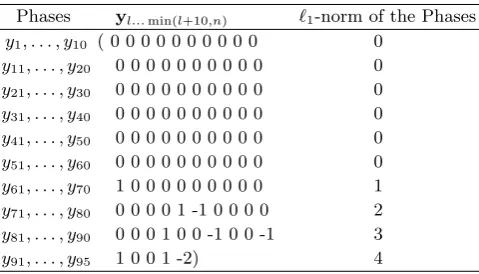
If we consider they corresponding more deeply, we can see that nonzero elements are not distributed evenly in the last half elements: the last ten elements includes 3 nonzero elements while only 1 nonzero element falls between index 21 and 30 (the first half of the last 20 elements in y). Therefore, we can divide the 40 elements of y evenly into 4 phases, each of which contains 10 elements. As in Fig. 1, the first two phases are all 0’s, and the third phase has 1 nonzero element while the last phase obtains 3. We can notate the first phase as y1,...,10, andy11,...,20, y21,...,30, and y31,...,40 as the following 3 phases, or
Phases yl...min(l+10,n) `1-norm of the Phases
y1, . . . , y10 ( 0 0 0 0 0 0 0 0 0 0 0
y11, . . . , y20 0 0 0 0 0 0 0 0 0 0 0
y21, . . . , y30 0 0 0 0 0 0 0 0 0 0 0
y31, . . . , y40 0 0 0 0 0 0 0 0 0 0 0
y41, . . . , y50 0 0 0 0 0 0 0 0 0 0 0
y51, . . . , y60 0 0 0 0 0 0 0 0 0 0 0
y61, . . . , y70 1 0 0 0 0 0 0 0 0 0 1
y71, . . . , y80 0 0 0 0 1 -1 0 0 0 0 2
y81, . . . , y90 0 0 0 1 0 0 -1 0 0 -1 3
y91, . . . , y95 1 0 0 1 -2) 4
Table 1.y-Phases of the Random Lattice of Dimension 95 (kvk= 2584)
most of y corresponding to the short vectors in random lattices of SVP challenges obtains the same property as we observe above, Therefore, we concludes the two useful observations as follows:
Phases yl...min(l+10,n) `1-norm of the Phases
y1, . . . , y10 ( 0 0 0 0 0 0 0 0 0 0 0
y11, . . . , y20 0 0 0 0 0 0 0 0 0 0 0
y21, . . . , y30 0 0 0 0 0 0 0 0 0 0 0
y31, . . . , y40 0 0 0 0 0 0 0 0 0 0 0
y41, . . . , y50 0 0 0 0 0 0 0 0 0 0 0
y51, . . . , y60 0 0 0 0 0 0 0 0 0 0 0
y61, . . . , y70 0 0 0 0 0 0 0 0 0 0 0
y71, . . . , y80 0 0 0 1 0 0 0 0 0 0 1
y81, . . . , y90 0 0 0 0 0 0 0 1 0 0 1
y91, . . . , y100 0 0 0 0 0 1 0 0 0 0 1
y101, . . . , y110 0 -1 0 0 1 0 0 1 0 0 3
y111, . . . , y120 0 0 1 -1 0 0 2 1 0 0 5
y121, . . . , y130 0 0 0 2 -1 0 -1 0 -1 1 6
y131, . . . , y134 3 2 -1 -1) 7
Table 2.y-Phases of the Random Lattice of Dimension 134 (kvk= 2976)
Observation 1 Under aBKZ-reduced basis, only a fraction of they-representation of the short vectors are nonzero elements (only 1
10 ∼ 1
6). And as stated in [6], the nonzero elements almost all fall into the second half of its y-representation with small absolute value of the nonzero elements. In other words, the
`1-norm of the wholey is approximately between 10n and n6.
Observation 2 Divided into phases of length 10, the y-representation of the short vectors of random lattices in SVP challenge, under a BKZ-reduced basis, is of an ascending order under `1-norm.
The two observations are useful in designing fast enumeration algorithm for SVP challenge as in the next section.
4
A Phase-Based Enumeration Algorithm for SVP challenge
4.1 Overview
Table 3.The Phase-Based Enumeration Algorithm for SVP
Input:Aβ-BKZreduced basisB= [b1, . . . ,bn] of a latticeL. Output:The Shortest Nonzero Vectorv0in the latticeL(B) 1. ComputeB’s Gram-Schmidt OrthogonalizationsB∗= [b∗1, . . . ,b∗n] and its factor matrixµ={µij}1≤i,j≤n;
2. Estimate the first minimaλ1by Gaussian Heuristic; 3. Initializeα= (α1, . . . , αn) asαi←0, for 1≤i <bn2c,
andαi←
r
λ1
kb∗ ik
, forbn
2c ≤i≤n;
4. Lety←(0,0, . . . ,0), andv0←b1; 5. Letm← dn
2/10e;d← {d1, d2, . . . , dm};//max`1-norms of phases 6.PhaseEnumeration(0,bn
2c, min(b n
2c+ 10,n),y,v
0
); 7.Return v0;
The low`1-norm of y-representation of short vectors as in Observation 1 shows us that we need not waste time enumerating all the feasible lattice vectors, and that all we need to do is to enumerate all the
ysuch that the`1-norm of the last half ofyis 10n to n6, i.e.,
ybn2c,...,n
1∈[
n
10,
n
6]. Moreover, Observation 2 reveals that the nonzero elements are distributed unevenly among the phases in the last half ofy, and, more precisely, the `1-norm of the phases in the second half takes on an ascending order. Then, we can enumerate phase by phase theywith ascending`1-norms for phases in the second half, which highlights the main idea of our phase-based enumeration algorithm.
Our phase-based enumeration predefines an integer sequenced= (d1, . . . , dm) (m is the number of
phases) of the maximum `1-norm for each phases (the sum of all the`1-norm are only 10n to n6), and it is clear that the sequence is in an ascending order. Then, the algorithm enumeratesy recursively phase-after-phase with theithphase of`
1-norm less thandi. Finally, the algorithm returns the shortest lattice
vector. Clearly, the enumeration procedure based on phase searches much less lattice vectors than the common enumeration algorithm which runs over all the lattice vectors, and the two observations in the last section ensure that the shortest vector will not be omitted in such phase-based method.
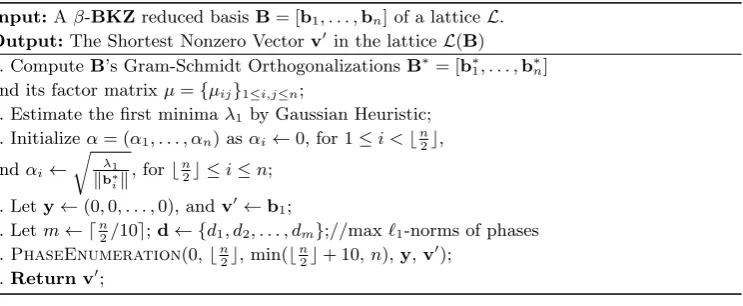
Table 3 shows the pseudo-codes of the main procedure of our phase-based enumeration algorithm. As in the table, given a lattice basisB= [b1, . . . ,bn] (which is BKZ-reduced), the procedure first computes
the Gram-Schmidt orthogonalzation B∗ and its µ. Estimating the first minima λ1 of the lattice, the procedure calculates the bounds α= (α1, . . . , αn) ofyas 0 for the first half of the elements and
q λ
1 kb∗ ik for the second half, based on theorem and heuristics in [6]. Then, the procedure initialize the integer vector y as all-zero and the shortest vectorv0 as the first vectorb1 of the basis B. Note that we only take the phases in the second half into consideration, and, so, the number of phases mis set asdn
2/10e. After predefining the integer sequence d = (d1, . . . , dm) in an ascending order withP
m
i=1(di)≤ n6, we
starts to enumerates all they such that the`1-norm of theithphase is less thandi using the subroutine
PhaseEnumeration(), which will be described in the following subsection.
4.2 PhaseEnumeration() and PhaseEnumerationBottom()
In this subsection, we discuss two subroutines PhaseEnumeration() and
PhaseEnumerationBot-tom(), which constitute the main body of our phase-base enumeration algorithm.
Table 4.PhaseEnumeration()
Input:the phasep, low indexl, high indexh, an integer vector y= (y1, . . . , yn) and a lattice vectorv0;
Output:The shortest nonzero vectorv0= (v10, . . . , v0n). 1.If h≥nthenPhaseEnumerationBottom(l,y,v0,l); //Enter the bottom procedure
2.else fori∈ {l, . . . , h}do
(a)if i=hthenPhaseEnumeration(p+ 1,h, min(h+ 10, n), y,v0); //Enter the next phase
(b)else forj∈ {−αi, . . . , αi}do (i)if kyh−10,...,i−1k1+|j| ≤dpthen
(1) Letyi←j;
(2)if kyh−10,...,ik1=dpthen//enter the next phase
PhaseEnumeration(p+ 1,h, min(h+ 10, n),y,v0);
(3)else//continue with the current phase
PhaseEnumeration(p,i+ 1,h,y,v0); (4) Letyi←0;
3.Return v0.
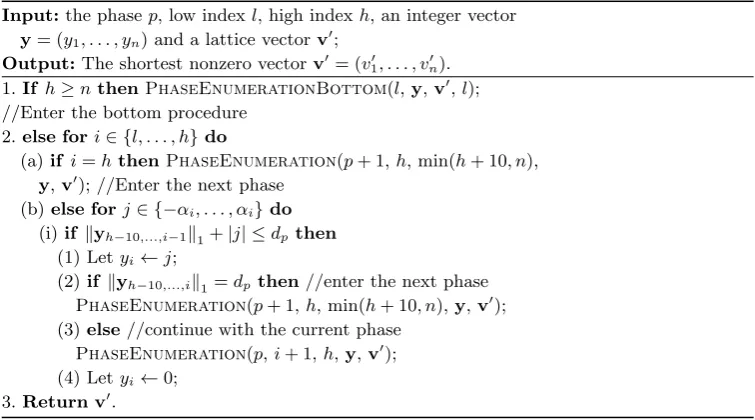
dp− kyh−10,...,l−1k1, and, then, it invokes itself or the bottom procedurePhaseEnumerationBottom() to search the next phase.
Entering the procedurePhaseEnumeration(), it invokes the bottom subroutine
PhaseEnumera-tionBottom() if the high indexhis larger than the lattice rankn. If not, the procedure has not arrived at the last phase, and (at Line 2) it searches all the index between l and h. If the variablei grabs the high index h, the procedure has enters the phase that follows, and, then, it calls itself with parameters ofp+ 1,h,h+ 10. Ifigrabs an index less than h, the procedure chooses aj as the nonzero value foryi
within bounds [−αi, αi]. If the newly chosen has not made the `1-norm of the current phase larger than
dp, yi is set as j, and the procedure either enters another phase if the `1-norm of the current phase is equal to dp, or, otherwise, continues with current phase by invoking itself with the low index l replaced
byi+ 1 (searches between indexi+ 1 andh). Thereby, the procedure searches all theythat satisfies the requirements of the predefined maximum`1-normd.
Table 5.PhaseEnumerationBottom()
Input:the low indexl, an integer vectory= (y1, . . . , yn), a lattice vectorv0, and the low indexl0 of the last phase;
Output:The shortest nonzero vectorv0= (v10, . . . , v
0
n). 1.fori∈ {l, . . . , n}do
(a)forj∈ {−αi, . . . , αi}do (i)if kyl0,...,ik
1+|j| ≤dmthen (1) Letyi←j;
(2) Computev∼yusingB∗andµ;
(3)if kvk<kv0kthen v0←v; (4)if kyl0,...,ik
1< dmthen
PhaseEnumerationBottom(i+ 1,y,v0,l0); (5) Letyi←0.
2.Return v0.
Table 5 shows the bottom procedure of our phase-based enumeration algorithm. Given the low index
chooses all the value between−αi andαi foryi. If the newly-generated nonzero element does not make
the`1-norm of the current phase go beyonddm, theyiis set asjand we go on with updating the shortest
vector v0 if better solution comes to light. After that, if the `1-norm of the current phase is still less than dm, or, in other words, the current phase can still contain more nonzero elements, the procedure
continues with the phase by invoking itself with a new low index i+ 1.
The two subroutines recursively searches all they= (y1, . . . , yn) which satisfies that the `1-norm of each phases is less than a predefined maximum `1-norm sequenced= (d1, . . . , dn), thereby finding the
shortest vector in the lattice by searching relatively few lattice vectors.
5
Experimental Results
In this section, we compare the running times of our phase-based enumeration algorithm with the seminal Kannan-Helfrich Enumeration algorithm [14] and`1-norm based enumeration algorithm, and all the three algorithms are implemented using C++ with Victor Shoup’s Number Theory Library (NTL) version 6.0.0 [26]. Experiments are performed on a workstation with 16 Intel Xeon 2.4Ghz CPUs and 16G RAM under a Red Hat Linux Server release 5.4. All the experiments are run on the SVP challenge benchmarks [24] of dimension 20-95, and all the random bases are generated using their random lattice generator with random seed= 0. All the bases are preprocessed by a BKZ subroutine with their block sizeβ < n4 (n
is their rank of the lattices). The Kannan-Helfrich enumeration algorithm is, actually, to search all the feasible lattice vectors in the hypersphere ofPn
i=1y 2
i kb∗ik
2
≤λ1, which has been deeply researched into in the recent years [12][11][21], and the`1-norm based enumeration algorithm is to searchywith the last half of`1-norm less than 10n ∼n6 (based on Observation 1), or, in other words, the 1-phase enumeration algorithm. Our phase-based enumeration algorithm runs with the predefined maximum`1-norm for the second half phasesdas (1,2, . . . , m).
Table 6.Running Time Comparison of Enumeration Algorithms under Dimension-40 Random Lattices
Running Time Enumeration Algorithms
3017.3270s the Kannan-Helfrich Enumeration Algorithm
12.0048s the`1-Norm Based Enumeration Algorithm
1.47209s the Phase-Based Enumeration Algorithm
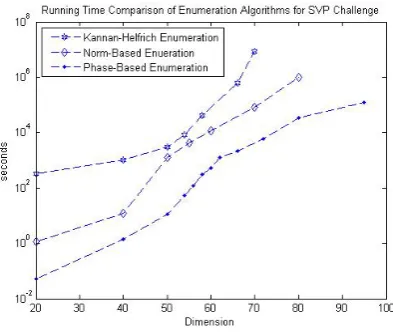
The three algorithms are run under the random lattice basis of dimension 40 (with a preprocessing of 5-BKZ reduction), the running time of the three are compared in Table 5. As shown in the table, the Kannan-Helfrich enumeration algorithm find the shortest vector (of Euclidean norm 1702) with over 3000 seconds, and the `1-norm based enumeration algorithm uses approximately 12 seconds, and our phase-enumeration algorithm only 1.4 seconds, which is over 3000 faster than Kannan-Helfrich algorithm and 10 times faster than`1-norm based algorithm.
Fig. 2.Running Time Comparison of the Enumeration Algorithms for SVP Challenge
maximum`1-norm for phases, and we believe that an improvement can be achieved by choosing a better
d.
The experimental results implies that the phase-based enumeration algorithm gains a great advantage over the other two enumeration algorithm in running time, and it never misses any optimum solution though searching only a fraction of the feasible lattice vectors.
6
Conclusion
In this paper, we propose a novel phase-based enumeration algorithm for shortest vector problems based on the two interesting and useful observations for the short lattice vectors. The experimental results show that the phase-based enumeration greatly outperforms the other famous enumeration algorithms in time complexity under the most random lattice bases in SVP challenge benchmarks[24]. In conclusion, it is practically an excellent algorithm for SVP challenge.
7
Future Work
In the future, we will attempt to give a theoretical and quantitative analysis of time complexity of our phase-based enumeration algorithm compared to Kannan-Helfrich algorithm, and, at the same time, we will run our phase-based enumeration algorithm under the lattices of much higher dimensions, like of dimension 136, with more delicately-chosen predefined maximum phase-wise `1-norms.
References
1. Ajtai, M. Generating hard instances of lattice problems (extended abstract). InSTOC (1996), pp. 99–108. 2. Ajtai, M. The shortest vector problem in`2 is np-hard for randomized reductions. Proceeding of the30th
Symposium on the Theory of Computing (STOC 1998), 284-406 (1998).
3. Ajtai, M., and Dwork, C. A public-key cryptosystem with worst-case/average-case equivalence. InSTOC (1997), pp. 284–293.
4. Ajtai, M., Kumar, R., and Sivaumar, D. A sieve algorithm for the shortest lattice vector problem. Proceedings of the33th annual ACM symposium on Theory of computing (STOC’01) 33, 601-610 (2001). 5. Chen, Y., and Nyuyen, P. Q. Bkz2.0: Better lattice security estimates. Advances in Cryptology C
ASI-ACRYPT 2011, Lecture Notes in Computer Science 7073, 1-20 (2011).
6. Ding, D., Zhu, G., and Wang, X.A genetic algorithm for searching shortest lattice vector of svp challenge.
7. Gamma, N., Nguyen, P. Q., and Regev, O. Lattice enumeration using extreme pruning. Advances in Cryptology C EUROCRYPT 2010, Lecture Notes in Computer Science 6110, 257-278 (2010).
8. Goldreich, O., Goldwasser, S., and Halevi, S. Public-key cryptosystems from lattice reduction
prob-lems. InCRYPTO(1997), pp. 112–131.
9. Hanrot, G., Pujol, X., and Stehl´e, D. Analyzing blockwise lattice algorithms using dynamical systems. Advances in Cryptology-CRYPTO 6841, 447-464 (2011).
10. Hanrot, G., and Stehl´e, D. Analyzing blockwise lattice algorithms using dynamical systems. Advances in Cryptology-CRYPTO 4622, 170-186 (2007).
11. Hanrot, G., and Stehl´e, D. Improved analysis of kannans shortest lattice vector algorithm. Advances in Cryptology - CRYPTO 2007, Lecture Notes in Computer Sciences 4622, 170-186 (2007).
12. Helfrich, B. Algorithms to construct minkowski reduced and hermit reduced bases. Theoretical Computer Sciences 41, 125-139 (1985).
13. Kannan, R. Improved algorithms for integer programming and related lattice problems. Proc. of the15th Symposium on the Theory of Computing (STOC1983) 15, 99-108 (1983).
14. Kannan, R. Minkowski’s convex body theorem and integer programming. Mathemaatics of Operations Research 12, 415-440 (1987).
15. Lenstra, A. K., Lenstra, H. W., and Lav´asz, L. Factoring polynomials with rational coefficients. Math-ematische Annalen 261, 513-534 (1982).
16. Micciancio, D., and Goldwasser, S.Complexity of Lattice Problems: A Cryptographic Perspective. Kluwer Academic Publishers, 2002.
17. Micciancio, D., and Regev, O. Worst-case to average-case reductions based on Gaussian measure. In Proceedings of the 45rd annual symposium on foundations of computer science - FOCS 2004 (Rome, Italy, Oct. 2004), IEEE, pp. 371–381. Journal verion in SIAM Journal on Computing.
18. Micciancio, D., and Regev, O. Worst-case to average-case reductions based on Gaussian measure. SIAM Journal on Computing 37, 1 (2007), 267–302. Preliminary version in FOCS 2004.
19. Micciancio, D., and Regev, O.Lattice-based cryptography.Proceeding of the Post-Quantum Cryptography (PQC’09), 147-191 (2009).
20. Micciancio, D., and Voulgaris, P. A deterministic single exponential time algorithm for most lattice
problems based on voronoi cell computations. Proceedings of the42th annual ACM symposium on Theory of
computing (STOC’10) 42, 351-358 (2010).
21. Micciancio, D., and Walter, M.Fast lattice point enumeration with minimal overhead. Cryptology ePrint
Archive, Report 2014/569, 2014. http://eprint.iacr.org/.
22. Nguyen, P. Q., and Vidick, T. Sieve algorithms for the shortest vector problem are practical. Journal of Mathematical Cryptography 2, 2(181C207) (2008).
23. Regev, O. New lattice-based cryptographic constructions. J. ACM 51, 6 (2004), 899–942.
24. Schneider, M., and Gamma, N. Svp challenge, 2010. http://www.latticechallenge.org/ svp-challenge/.
25. Schnorr, C. P. A hierarchy of polynomial lattice basis reduction algorithms.Theoretical Computer Sciences 53, 201-224 (1987).
26. Shoup, V. Number theory c++ library (ntl) vesion 6.0.0, 2010. http://www.shoup.net/ntl/.
27. van Emde Boas, P. Another np-complete partition problem and the complexity of computing short vectors in a lattice. Technical Report, Mathematisch Instituut, Universiteit van Amsterdam 81-04 (1981).
28. Wang, X., Liu, M., Tian, C., and Bi, J. Improved nguyen-vidick heuristic sieve algorithm for shortest
vector problem. InProceedings of the 6th ACM Symposium on Information, Computer and Communications