Molecular dynamics study on the Li diffusion
mechanism and delithiation process of Li
2MnO
3Yang Huanga*,, Long Liub, Min Gaoa*
a. China Spallation Neutron Source (CSNS), Institute of High Energy Physics (IHEP), China Academy of Science (CAS), Dongguan, 523803, China
b. Shandong Analysis and Test Center, Qilu University of Technology (Shandong Academy of Sciences), Jinan 250014, China
* Yang Huang, E-mail: [email protected] * Min Gao, E-mail: [email protected]
Abstract
Li2MnO3 is critical component in the well-studied Li-excess cathode materials
xLi2MnO3·(1- x)LiMO2 for achieving high lithium storage capacity. In this article, the
diffusion of Li ions in Li2MnO3 is studied using molecular dynamics (MD) simulation
with well-behaved empirical force fields obtained by fitting against the crystal structure from experiment and phonons calculated using Density Function Theory (DFT). We have found two possible tetrahedral hopping channels, 0-TM and 1-TM(Mn4+) channel,
which are differentiated by the face sharing octahedral cations. Simulation results show that the 0-TM channel is active for Li hopping, while 1-TM(Mn4+) channel is inactive.
During the delithiation process, the Li ions in the transition metal (TM) layer are firstly removed, then those in the Li layer. However, the Li ions will be trapped in the tetrahedral 0-TM channels as long as the four face sharing octahedral sites are cleared. Up to x=1.0 for Li2-xMnO3, almost all the Li ions are located at the tetrahedral sites,
forming a regular array along a axis. The de-intercalation of tetrahedral Li ions requires a high voltage (>5.2 V vs. Li/Li+), limiting the practical capacities measured in lab. The diffusion of Mn ions into the Li layer is observed in a deeper delithiated structure (x=1.2 for Li2-xMnO3), indicating an initial phase transformation to a spinel-like structure.
However, the Mn ions are mainly trapped in the tetrahedral sites in the Li layer, instead of the octahedral sites in spinel-like structure. A few of Mn ions diffusing into the octahedral sites in Li layers have no face sharing tetrahedral Li ions, revealing a further Li de-intercalation is imperative for the complete phase transformation. Our model is not stable for x≥1.4 in Li2-xMnO3. Other charge compensation mechanism should be
considered in this high delithiation stage, eg. oxygen release.
Keywords: Li2MnO3; Molecular dynamics; diffusion; delithiation
Introduction
Lithium-ion batteries are considered to be one of the best candidates for hybrid electric vehicle and plug-in hybrid electric vehicle applications, because of their high energy density, high power density, long service life and environmental friendliness. Cathode materials play an important role on determining the performance and safety of lithium-ion batteries. At present, layered transition metal oxides (LiCoO2) [1], spinels
(LiMn2O4) [2], and olivines (LiFePO4) [3] are the mainly used cathode materials in the
commercial lithium-ion batteries. The surface reactivity and instability of delithiated LixCoO2 limit the practical capacity of LiCoO2 electrodes to approximately 140 mAh
g-1, which corresponds to about 50% of its theoretical value (273 mAh g-1) [4]. On the
other hand, though the 4 V spinel LiMn2O4 and 3.4 V olivine LiFePO4 have drawn lots
of attention due to their excellent cyclic performance, environmentally friendly nature, and low cost. They both have relative low energy densities due to the low capacity for the former and the low operating voltage for the later [5]. Therefore, great efforts have been devoted to explore alternative cathodes in order to improve the energy density of large-scale rechargeable lithium-ion batteries (LIB).
In the past decades, a type of layered Li-excess cathode materials with composite structure in which a layered Li2MnO3 component is structurally integrated with a
layered LiMO2 component was proposed [6-9]. Nearly 1 mol of lithium can be
extracted from this kind of Li-rich Mn-based layered material, corresponding to capacities of 250–300 mAhg–1, much higher than those in the commercial application.
The layered Li2MnO3 is a critical component in the Li-excess materials and its specific
capacity could reach an ideal 459 mAhg-1. Characteristic potential profiles with a flat
and wide plateau at ∼4.5V in the first charging are observed in the first charge/discharge cycle of Li2MnO3, which is believed to be responsible for the high-voltage (4.4–5 V)
of Li-excess materials [10]. Hence, further studies on one of the end members of the composites, Li2MnO3, could shed valuable insights on the electrochemical behaviour,
chemical composition, structural stability and cycling deficiency of the layered Li-excess materials.
In past few years, much work has been done to study the properties of Li2MnO3, both
in laboratory and theoretical calculations. In Li2MnO3, it is generally believed that Mn
can not be oxidised beyond +4 in an octahedral oxygen environment. Theoretically, Li2MnO3 is electrochemically inactive. However, experimental results show that the
material is in fact electrochemically active, and the charge/discharge capacities depend strongly on synthesis conditions. So the experimental researchers pay much attention on explaining the source of electrochemical activities of Li2MnO3. Many proposals
have been proposed, such as the irreversible loss of oxygen from the surface [11,12,13,14], partially oxidised oxygen anions[10,15,16], surface reaction through electrode/electrolyte reduction and/or hydrogen exchange[17,18,19]. Clearly, the origin of electrochemical activity is still in debate and more work should be done to get a better understanding. For the theoretical studies on Li2MnO3, only several DFT works
compensation mechanism, the structure evolution, the operating voltage and the kinetics of Li diffusion.
It is well known that during the charging/ discharging process of LIB, Li ions will move circularly between the cathodes and anodes. So the transporting mechanism of Li ions is very important for the final performance of LIB. Using molecular dynamics, one can track the Li ion movement in the materials theoretically. It helps to a get better perceiving about the details of Li transporting in materials. However, classical molecular simulations suffer from the limitations in available classical interatomic force fields (or, interatomic potentials). Due to the complex combination of chemical species as well as inter molecular interactions, parametrization of interatomic force fields is challenging, thereby limiting applications of classical MD in exploring the large scale structural properties of materials. In this work, we developed a force field for Li2MnO3 based on a standard model from the work of Alfonso Pedone et al [20], by
fitting against the crystal structure and the phonon spectrum. Then we simulated the stoichiometric and delithiated Li2MnO3 by MD with our force field parameters. The
macro diffusion directions and the micro hopping paths of Li ions, the delithiation mechanism, and the possible phase transformation path are discussed based on the MD simulation. Some of the results accord with those predicted by DFT calculations or measured by experiments, proving the rationality of our force field. In addition, a new delithiation mechanism involving the tetrahedral Li and a new phase transformation way involving the tetrahedral Mn is proposed. We believe that our way of improving the initially rough force field is universal and can be applied to other LIB materials in which the ion transport properties are the research emphasis.
2. Methodology
2.1. Li2MnO3 Structure
The crystal structure of Li2MnO3 is illustrated in Figure 1. The space group of this
material is C2/m. It resembles other layered materials LiMO2 (M=Co, Ni, Mn). The Li
layer, O layer and transition metal (TM) layer are stacked layer by layer consecutively with ABC form (O3-type). Furthermore, excess of Li ions enter Mn layer and replace some of them. So the chemical formula can be rearranged as Li(Li1/3Mn2/3)O2. As a
result, the symmetry of LiMO2 is broken and the Li sites can be divided into Li2b (in
the TM layer), Li2c and Li4h (in the Li layer). Figure 1 also shows the arrangement of
ions in the TM layer and in the Li layer. Each 2b site is coordinated by six Mn sites in the TM layer, each 2c site is coordinated by six 4h sites in the Li layer and each 4h site is coordinated by three 4h sites and three 2c sites.
2.2. Potential Model
In this article, the Morse function is used to model the interaction between ions. There are three terms contributed to the potential as shown in Equation (1):
U(𝑟) =𝑧𝑖𝑧𝑗𝑒
2
𝑟 + 𝐷𝑖𝑗[{1 − 𝑒
−𝑎𝑖𝑗∙(𝑟−𝑟𝑖𝑗)} 2
− 1] +𝐶𝑖𝑗
𝑟12 (1)
in which the first term is the long-range coulomb potential, zi and zj are ionic charges,
The last term C/r12 represents the repulsive interaction.
The Morse function is usually used in modelling bonded interactions in covalent systems (e.g., the hydroxide ion in ionic systems) in which the Coulomb term is subtracted. The physical meaning of the different quantities is well defined: Dij is the
bond dissociation energy, aij is a function of the slope of the potential energy well, and
rij is the equilibrium bond distance.
The repulsive term, C/r12, is necessary to represent the interaction at high temperature
and high pressure. In our work, the repulsive interaction is not considered since we are just interesting in the properties at the normal pressures and temperatures below1000K.
2.3. Interatomic Potential Derivation
The empirical fitting method implemented in the GULP package [21] was used to derive the interatomic potential parameters. In our strategy, the parameters are derived to reproduce the experimental crystal structures (lattice parameters and atomic positions) and phonon frequencies.
The conventional fitting procedure consists of the following steps:
(1) Fit the interatomic potential parameters to the experimental crystal structure [22]. The initial guess for the potential parameters is from the work of Alfonso Pedone et al. [20]. Their model is established for binary oxides which covers the most of transition metal (TM) /lithium–oxygen interactions. So it is convenient to transplant them to the Li-TM-O system of cathode materials. For the Li2MnO3, we optimized
the initial potential parameters (the ionic charges are kept constant, only Dij, aij and
rij are fitted) and relaxed the structure with them. The relaxed structure is compared
with the experimentally measured ones. Typically we expect a good potential model to have an accuracy for the crystal structure of up to 2%
(2) Calculate the phonon frequencies of Li2MnO3 with the optimized potential
parameters. Check if all the phonons have the real and positive frequencies. Since Li2MnO3 exist in nature as a stable phase, any imaginary frequency calculated by
our potential parameters suggest a further optimization is needed for a better representation of the shape of the energy surface.
(3) As a more rigorous calibration, we compared the phonon frequencies calculated with our potential parameters and by DFT calculation accomplished in the PHONOPY package [23]. The potential parameters should be further optimized to give a better fitting of DFT results, especially in the low frequency range.
The final potential parameters are listed in table 1. Table 2 lists the relaxed unit-cell structure and the experimental structure. The maximum error is -1.93%, proving the reliability of our model to describe the energy surface at the local minimum of Li2MnO3.
Figure 2 shows the phonon frequencies calculated with our potential model and with DFT calculation. No imaginary frequencies are observed and a relatively high match between the phonon frequencies (especially in the low frequency range) calculated with the two method is obtained. It proves that our potential model is suitable for the simulation of thermal vibrations which control the Li transport in the system.
2.4 Molecular dynamics simulation details
Coulombic interactions were calculated by the Verlet algorithm [25] and Ewald method [26] respectively. The time step was 1 fs. Nose–Hoover thermostat was used to regulate the system’s temperature at specific temperatures [27, 28].
A set of configurations with different percentage of Li ions (LixMnO3 1< x<2) are
created from a 10×6×9 supercell of the Li2MnO3 unit cell, which contains 4320 Li ions,
2160 Mn ions and 6480 O ions. Li ions are removed randomly to create vacancies. The charge of the removed Li is compensated by increasing the valence state of O anions to keep the system neural. This strategy is verified by the DFT calculation [10,15,16] and it can keep the structural stability of LixMnO3 in a large Li removal range.
Table 1: The potential parameters of Morse function for Li2MnO3 system.
Interaction Dij (ev) aij(Å-2) Rij(Å)
Li+0.6– O-1.2 0.001114 3.429506 2.621360
Mn+2.4–O-1.2 0.029658 2.607543 2.452075
O-1.2– O-1.2 0.042395 2.379316 3.148701
Table 2:The optimized unit-cell structure and the experimental structure.
Experimental value
Optimized
value Difference
Error (%)
Volume(Å3) 199.7725 195.9116 -3.8609 -1.93
a (Å) 4.9370 4.9252 -0.0118 -0.24
b (Å) 8.5320 8.5206 -0.0114 -0.13
c (Å) 5.0300 4.9467 -0.0833 -1.66
β (degree) 109.4600 109.3096 -0.1504 -0.14
Li4h(y) 0.6606 0.6477 0.0129 1.95
Mn4g(y) 0.1671 0.1676 0.0005 0.32
O4i(x) 0.2189 0.2176 0.0013 0.60
O4i(z) 0.2273 0.2232 0.0041 1.81
O8j(x) 0.2540 0.2516 0.0024 0.96
O8j(y) 0.3212 0.3221 0.0009 0.29
O8j(z) 0.2233 0.2213 0.0020 0.89
Figure 2. The phonon spectrum calculated along the wave vectors [0, 0, 0] to[0, 0, 0.5] with our potential mode (in green color) and with DFT method (in purple color). An enlargement picture of the three acoustic branches which shows a high accordance is also displaced.
3. Results
3.1 The macro diffusion of Li
It is well known that the LIB is charged/discharged through Li ions intercalation/de-intercalation in the positive and negative anodes. So the diffusion of Li is crucial for the operational performance of LIB, especially the rate of charge/discharge.
Firstly, we investigated the macro diffusion of Li in stoichiometric Li2MnO3 by
calculating the Mean Square Displacement (MSD) of Li ions along the directions of a, b and c axes. Figure 3 shows the results simulated at 1000K in NPT ensemble. It is obvious that Li can diffuse along all the three axes. This result is constituent with those obtained by DFT calculation [15].
We have further studied the individual diffusions of Li ions at 2b, 2c and 4h sites more closely. The sub-plots (2), (3), (4) of figure 3 show the MSD along the three axes of Li2b, Li2c and Li4h respectively. Li2b mainly diffuse along c axis. This is expected
considering the local chemical environments of 2b sites in the TM layer. Each Li2b is
coordinated by six Mn-O octahedrons in the ab plane. So if a Li2b ion would migrate to
the nearest Li2b vacancy site, it should cross the Mn coordinated layer. The long
migrating path hinders the diffusion of Li2b in the TM layer. Also, the slow increase of
Li2b MSD along a and b axes indicate they may enter the Li layer along c axis and
diffuse along a and b axes there.
Checking the diffusion of the Li2c and Li4h in the Li layer, some different characters
are observed. The increase of MSD along c axis indicates that both Li2c and Li4h can
diffuse along c axis. So the diffusion into Li layers of Li2b can be compensated by the
diffusion into TM layers of Li2c and Li4h, resulting the overall three-dimensional
diffusion of Li ions in the system. A further analysis of MSD shows that the diffusion rate of Li4h along a and b axes is uniform, while Li2c diffuse along a axis more
environment within the Li inter-slab, the farther TM layer can influence the movement of Li2c and Li4h. This point will be investigated further by analyzing the micro hopping
mechanism in the next section.
Figure 3. The MSD of Li ions in stoichiometric Li2MnO3 simulated at 1000K. (1) The MSD of Li along a, b and c axes as a whole. (2) The MSD of Li2b along a, b and c axes.
(3) The MSD of Li2c along a, b and c axes. (4) The MSD of Li4h along a, b and c axes. 3.2The micro hopping path of Li
Once vacancies are created by the thermal vibration or external perturbation, the Li ions nearby tend to fill them by hopping. The nudged elastic band (NEB) method can be used to calculate the activation barriers for an ion to migrate between two sites and determine the optimum hopping path with the lowest activation barrier [29]. The NEB calculations of some cathode materials show that the hopping of Li ions may be indirect. They may pass by some metastable sites in the system and then get into the vacancies. For example, Li ions in LiCoO2 hop to the vacancies nearby via O-tetrahedron sites,
resulting a curving hopping paths [30]. Also, the calculations of LiFePO4 show that Li
ions move to the nearby vacancies along a zigzag path in the channels [31]. While performing an NEB calculation requires knowledge of the ion migration pathway, MD can be applied to structures that are more complex without prior assumptions about the diffusion path [32].
In this work, we studied the hopping paths of Li ions in stoichiometry Li2MnO3 by
was simulated for two hundred thousand time steps (1 fs every step) and sampled every 100 time step to count the displacements of Li2b, Li2c and Li4h.
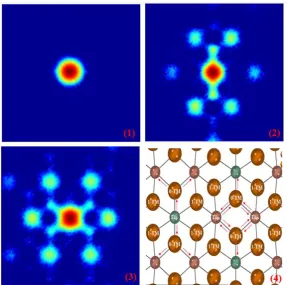
Figure 4 shows the DFD pictures of Li2b, Li2c and Li4h in the ab plane (To be noted,
this figure just counts the Li atoms moving in the original ab plane. So if one Li ion diffuses out of the original ab plane along c axis, it will be ruled out in the subsequent counts). The subplot (1) clearly indicates that Li2b don’t diffuse within the TM layer as
no displacement frequencies domains exist in the outer range. This accords with the speculation from the macro diffusion of Li2b in the last section. The subplots (2) and (3)
show the DFD pictures of Li2c and Li4h in the ab plane. As discussed above, the
Li2MnO3 has the layered structure, consisting of layers of TM cations separated from
Li layers by oxygen. In this structure, Li is coordinated octahedrally by oxygens but diffuses from site to site by hopping through intermediate tetrahedral sites. For the layered cathode materials, each tetrahedral site are coordinated by three Li ion in the Li layer and one TM ion in the TM layer. So the tetrahedral sites can all be remarked as 1-TM channels. The energy required for a Li ion to cross the activated state is proved to depend on the TM ion coordinating the tetrahedral site. The DFT calculations show that low-valent TM ions are beneficial to the Li diffusion, while the high-valent TM ions bring strong electrostatic repulsion on the activated Li ion and hinders the diffusion [33]. For the Li2MnO3, the 2b sites in the TM layers are occupied by Li ions, making a
more complicated hopping paths for the Li ions in the Li layers. As indicated in the figure 4, the six tetrahedral sites around Li2c can be divided into four 1-TM(Mn4+) and
two 0-TM channels along a axis, while the six tetrahedral sites around Li4h can be
divided into four 1-TM(Mn4+) and two 0-TM channels at the right/left hand side. The
DFD pictures clearly show that the Li4h and Li2c ions can only hopping through the
0-TM channels. The 1-0-TM(Mn4+) channels are closed for them. This accords with the
calculations of DFT. The high valence state of Mn (tetravalence) brings a strong electrostatic repulsion on the activated Li ion and hinders the diffusion throung 1-TM(Mn4+) channels, while the 0-TM channels are always open for the diffusion. 3.3 The delithiation mechanism
Once Li ions are removed from the material, the periodicity of the structure is destroyed, changing the local chemical environments of the remaining Li ions. So the distribution and diffusion of Li ions may change in the delithiation process. This consideration is quite noticeable for Li2MnO3, since Li ions are both located at the sites
in TM layer (2b) and Li layer (2c, 4h).
Several DFT works studied the delithiation process of Li2MnO3 by calculating the
ground states of LixMnO3(x>1). However, quit different results are reached. Yukinori
Koyamaa et al. suggested the removal of lithium from the Li layers at the beginning of charging, then from the TM layer [16]. Ruijuan Xiao et al. pointed out that the lithium extraction from both Li (4h site) and TM (2b site) layers starts at an even earlier stage, because the 4h and 2b vacancies simultaneously exist in the ground-state configuration of Li1.5MnO3 by their calculation[15]. However, the calculation of Eunseok Lee et al.
site are extracted[10].
Figure 4. The displacement frequency distribution (DFD) pictures of Li ions in stiochiometry Li2MnO3, the range is -5 Å to 5 Å along a and b axes. (1) The DFD picture of Li2b. (2) The DFD picture of Li2c. (3) The DFD picture of Li4h. (4): A topo view of an O-Li-O inter-slab. Dark green for Li2c, dark pink for Li4h, brown for O. The tetrahedral sites of 0-TM and 1-TM (Mn4+) channels and the hopping path are remarked for a better comparison with the DFD pictures.
In this article, the delithiation process of Li2MnO3 is investigated by MD simulation,
which can probe the distribution of Li ions in the delithiated structures under the thermal equilibrium. The Li ions are removed randomly from the initial stoichiometry Li2MnO3 configuration. Then the delithiated systems were simulated at 300K for 200
ps in NPT ensemble to get into the equilibrium states. We check a series of delithiated systems. The figure 5 show the MSD of Li in Li1.0MnO3 along a, b and c axes. It can
be inferred the three-dimensional diffusion of Li ions in stiochiometry Li2MnO3 evolves
into the one-dimensional diffusion mainly along a axis in Li1.0MnO3. Figure 6 shows
the final simulated structure of Li1.0MnO3. No Li ions remain in TM layer. In the Li
layer, the Li ions are arranged in two sub rows on top of each other which locate at the primal rows of Li2b viewed from a axis. A close observation reveals that Li ions are in
the center of O tetrahedrons, while the 2b and 4h site are at the center of O octahedrons. This new tetrahedral site can be set as 4i in Wyckoff notation. A different delithiation mechanism is inferred from our simulation. During the delithiation process, the Li ions will be driven into the tetrahedral 4i site by the thermodynamics, which is not predicted by DFT calculation of Li2MnO3. However, we can get some inspirations from the DFT
structure in which Li and TM ions are separated into different layers. However, the lithium and TM ions (Ni) are not as strictly segregated. The experiments proved significant exchange of Li and Ni, about 8–10% Li ion residing in the TM layer and a similar amount of Ni in the Li layer. This situation resembles that of Li2MnO3, in both
situation some Li ions are located in the TM layers. The replacement of TM ions by Li in the TM layer creates tetrahedral sites in the Li layer that are only surrounded by Li ions (0-TM channels). When the four face sharing octahedral sites are cleared in the delithiation process, the tetrahedral sites become stable sites and are filled by the remaining Li ions. For each Li site in the TM layer (2b), there are two potential tetrahedral Li sites (4i), one above and one below. So when half of Li ions are removed, all the Li ions in Li1.0MnO3 will fulfill the tetrahedron 4i site. Then the diffusion
direction of Li ions is mainly along a axis.
Figure 7 shows the ratios of Li in all the four sites (2b, 2c, 4h, tetrahedral 4i site) during the delithiation process. In the initial stage of delithiation (x<0.2), Li ions are mainly removed from the 2b site in the TM layer. At this very early stage, some Li ions have filled the 4i tetrahedral site. Then the Li ions are mainly remove from the 2c and 4h sites in the Li layer (0.2<x<0.8), followed by a further fulfilling of the tetrahedral sites by Li ions. At the last stage (x>0.8), the octahedral sites in the TM layer and Li layer are cleared simultaneously, resulting a rapid increase of Li ion in tetrahedron site. Finally, almost of the Li ions are located in the 4i tetrahedron site in Li1.0MnO3. Since
the tetrahedral sites are energetically very stable, a high voltage (>5.2 V vs. Li/Li+) is
required to remove the Li ions in the 4i site [35]. This means that almost half of the Li ions must be de-intercalated at the high voltage range. However, in the practical use, to keep the stabilization of liquid electrolyte, the cathodes are often cycled below 5V. All the experimentally measured capacities of Li2MnO3 samples at ambient temperature
are below half of its theoretical capacity (~458 mAh/g) [9, 12, 18, 19, 36, 37, 38], which proves our calculation. To further improve the capacity, defects in the bulk materials are introduced intentionally when synthesized [37, 38] or cycled at a higher temperature to increase the activity of Li ions [12, 17].
Figure 6. (1) The local picture of Li1.0MnO3 (viewed from a axis).
Figure 7. The proportion of Li ions at tetrahedron 4i site and octahedron 2b, 2c and 4h sites under the thermal dynamics equilibrium in MD simulation during the delithiation process 3.4 The phase transformation
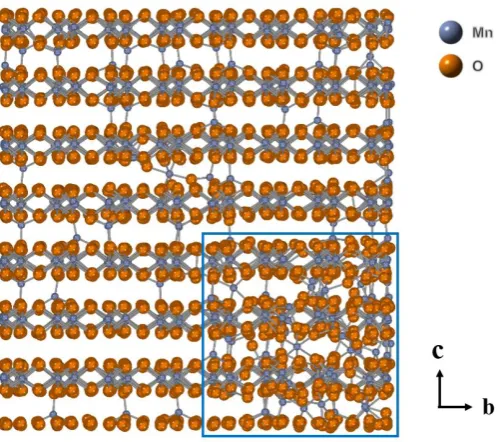
Upon the further delithiation (x=1.2 for Li2-xMnO3), we observe that some Mn ions
migrate into the Li layer (figure 8). This indicates the possible phase transition into a spinel-like structure as discussed in many experimental and theoretical studies [10, 12, 36, 38]. In the spinel LiMn2O4, the Li ions are located at the tetrahedrons. This is also
the situation for Li1.0MnO3 proved by last section. The major difference between the
site, migrates into the nearest tetrahedral vacancy site in the Li-layer and then 2) moves, through a face, into the nearest octahedral site in the Li layer. However, our results indicate that this process may be interrupted by step 1). The Mn ions hopping into the tetrahedrons scarcely further hop into the octahedron sites in the Li0.8MnO3 structure.
This may be because the Li ions at the 4i tetrahedron site brings strong electrostatic repulsion on the face sharing octahedron sites, preventing its occupation by Mn4+. Our
further check on the final structure also sustains the hypothesis. All the unoccupied octahedron sites are face sharing with Li tetrahedrons, indicating that they are ‘inactive’ sites for Mn ions, while several Mn octahedrons in the Li layers shares no face with the Li tetrahedrons. Our simulation shows that the phase transition may require a very deep de-intercalation of Li ions to accommodate the complete migration of octahedron Mn4+
in the TM layer to the octahedron vacancies in the Li layer. However, a further delithiated structure (Li0.6MnO3) is unstable under the thermodynamics simulation of
MD. Other process must be considered at this deep delithiation stage. To be an instinctive consideration, oxygen release should be the main factor for stabling the dynamics equilibrium at this rather high delithiation stage, as the ratios 1:3 of Mn to O in Li2MnO3 should be forced into 1:2 in the spinel-like structure. In fact, the oxygen
release has been observed in the many electrochemical tests of Li2MnO3 [11-13].
Though the oxygen deficiency is often considered to be formed on the surfaces during the cycling, we believe that this phenomenon may spread to the bulk at the high delithiation stage.
Figure 8. The final configuration of Li0.8MnO3. For a clear view of Mn arrangement, the Li ions are hidden. The local region inside the blue box is the main distribution zone where octahedron Mn ions are located. The robust oxygen framework deforms in this area, indicating the possible
release of oxygen in a deep delithiation level.
4. Conclusion
delithiation process using the molecular dynamics simulation method. In order to do this work, we optimized an initial force field model established for binary oxides. The new model for Li2MnO3 has been validated with calculations of crystal structure and
phonon dispersion curves.
Based on the new model force fields, a set of systematic MD simulations on the stiochiometry and delithiated Li2MnO3 have been presented. The simulations on
stoichiometry Li2MnO3 show that the diffusion of Li ions is three dimensional. The Li
sites in the TM layer open the diffusion channel along c aixs, which is often prohibitive in layered cathode materials. By analyzing the specific movement of Li2b ions in the
TM layer and Li2c, Li4h ions in the Li layer, it is found that the hopping of Li2bwithin
the TM layer is forbidden. The O(octahedron)-T(tetrahedron)-O(octahedron) hopping path is observed for Li2c and Li4h ions in the Li layer. But the tetrahedral hopping
channels are divided into 0-TM and 1-TM(Mn4+) subclasses. Only the 0-TM channels
are active for Li ions, the 1-TM(Mn4+) channels are impassable as a result of the strong
electrostatic repulsion.
In addition to the diffusion mechanism of Li ions, the delithiation process has been also simulated. We found a new delithiation mechanism, not predicted by the previous DFT works. In the delithiation process, Li ions remained in the system will tend to be tracked at new tetrahedron site 4i. In the initial stage of delithiation (x<0.2), Li ions are mainly removed from the 2b site in the TM layer. Then the Li ions are mainly removed from the 2c and 4h sites in the Li layer (0.2<x<0.8). At the last stage(x>0.8), the octahedral sites in the TM layer and Li layer are cleared simultaneously. The fulfilling of 4i site is throughout this process, as long as a ‘clean’ tetrahedron site is formed with no face sharing octahedron cations. Up to Li1.0MnO3, all the Li ions will be located at
4i sites and so an ordered distribution of Li ions is recovered. The Mn migration into Li layer is found in a Li0.8MnO3, indicating a phase transformation to a spinel-like
structure. However, this transition is not complete, as most of Mn ions are trapped in the tetrahedral sites instead of the octahedral sites. The deeply delithiatiated structure (Li0.6MnO3) is not stable during the thermodynamics process. Other charge
compensation mechanism should be considered in the high delithation stage, like oxygen release et al.
Acknowledgments: This work was supported by the China Postdoctoral Science
Foundation (2018M641475), the National Natural Science Funds of China (Grant No.
11605106)
References
[1] K. Mizushima, P.C. Jones, P.J. Wiseman, J.B. Goodenough. LixCoO2 (0<x≤1): a new cathode material for batteries of high energy density. Mat. Res. Bull., 1980, 15, 783-789.
[4] Ping He, Haoran Wang, Lu Qia, Tetsuya Osaka. Synthetic optimization of spherical LiCoO2 and precursor via uniform-phase precipitation. Journal of Power Sources. 2006, 158, 529–534.
[5] M. Stanley Whittingham. Lithium batteries and cathode materials. Chem. Rev. 2004, 104, 4271-4301.
[6]Jeom-Soo Kim, Christopher S. Johnson, John T. Vaughey, Michael M. Thackeray. Electrochemical and structural Properties of xLi2M‘O3·(1−x)LiMn0.5Ni0.5O2 electrodes for lithium batteries (M‘ = Ti, Mn, Zr; 0 ≤ x⩽ 0.3). Chem. Mater. 2004, 16, 1996-2006.
[7] M.M. Thackeray, S.-H. Kang, C.S. Johnson, J.T. Vaughey, S.A. Hackney. Comments on the structural complexity of lithium-rich Li1+xM1-xO2 electrodes (M = Mn, Ni, Co) for lithium batteries. Electrochemistry Communications, 2006, 8, 1531–1538.
[8] Michael M. Thackeray, Sun-Ho Kang, Christopher S. Johnson, John T. Vaughey, Roy Benedek, S. A. Hackney. Li2MnO3-stabilized LiMO2 (M = Mn, Ni, Co) electrodes for lithium-ion batteries.
J. Mater. Chem., 2007, 17, 3112–3125.
[9] C.S. Johnson, N. Li, J.T. Vaughey, S.A. Hackney, M.M. Thackeray. Lithium–manganese oxide electrodes with layered–spinel composite structures xLi2MnO3·(1-x)Li1+yMn2-yO4(0<x<1, 0≤y≤0.33) for lithium batteries. Electrochemistry Communications, 2005, 7, 528–536.
[10] Eunseok Lee, Kristin A. Persson. Structural and chemical evolution of the layered li-excess
lixMnO3 as a function of li content from first-principles calculations. Adv. Energy Mater. 2014, 4, 1400498.
[11] A. Robert Armstrong, Michael Holzapfel, Petr Novak, Christopher S. Johnson, Sun-Ho Kang,
Michael M. Thackeray, Peter G. Bruce. Demonstrating oxygen loss and associated structural reorganization in the lithium battery cathode Li[Ni0.2Li0.2Mn0.6]O2. J. AM. CHEM. SOC., 2006, 128, 8694-8698.
[12] S. Francis Amalraj, Boris Markovsky, Daniel Sharon, Michael Talianker, Ella Zinigrad, Rachel Persky, Ortal Haik, Judith Grinblat, Jordan Lampert, Martin Schulz-Dobrick, Arnd Garsuchc,
Luba Burlaka, Doron Aurbach. Study of the electrochemical behavior of the “inactive” Li2MnO3. Electrochimica Acta, 2012, 78, 32– 39.
[13] Denis Y.W. Yu, Katsunori Yanagid. Structural Analysis of Li2MnO3 and related Li-Mn-O materials. Journal of the Electrochemical Society, 2011, 158(9), A1015-A1022.
[14] Yasuharu Okamoto. Ambivalent effect of oxygen vacancies on Li2MnO3: a first-principles study. Journal of the Electrochemical Society, 2012, 159(2), A152-A157.
[15] Ruijuan Xiao, Hong Li, Liquan Chen. Density functional investigation on Li2MnO3. Chem. Mater. 2012, 24, 4242−4251.
[16] Yukinori Koyama, Isao Tanaka, Miki Nagao, Ryoji Kanno. First-principles study on lithium removal from Li2MnO3. Journal of Power Sources, 2009, 189, 798–801.
[17] Alastair D. Robertson, Peter G. Bruce. The origin of electrochemical activity in Li2MnO3. CHEM. COMMUN. , 2002, 2790–2791.
[18] Alastair D. Robertson, Peter G. Bruce. Mechanism of electrochemical activity in Li2MnO3. Chem. Mater. 2003, 15, 1984-1992.
[19] Younkee Paik, Clare P. Grey, Christopher S. Johnson, Jeom-Soo Kim, Michael M. Thackeray. Lithium and deuterium NMR studies of acid-leached layered lithium manganese oxides. Chem. Mater. 2002, 14, 5109-5115.
silica-based glasses. J. Phys. Chem. B., 2006, 110, 11780-11795.
[21] Gale, Julian, Rohl, Andrew. The general utility lattice program (GULP). Molecular Simulation. 2003, 29(5), 291-341.
[22] Pierre Strobel, Bernadette Lambert-Andron. Crystallographic and Magnetic Structure of Li2MnO3. Journal of solid state chemistry, 1988, 75, 90-98.
[23] Atsushi Togo, Isao Tanaka. First principles phonon calculations in materials science. Scripta Materialia, 2015, 108, 1–5.
[24] Ilian T. Todorov, William Smith, Kostya Trachenko, Martin T. Dove. DL_POLY_3: new dimensions in molecular dynamics simulations via massive parallelism. J. Mater. Chem., 2006, 16, 1911–1918.
[25] L. Verlet, Computer "Experiments" on Classical Fluids. I. Thermodynamical Properties of Lennard-Jones Molecules. Phys. Rev., 1967, 159, 98-103.
[26] P. P. Ewald. Die Berechnung optischer und elektrostatischer Gitterpotentiale. Ann. Phys., 64, 1921, 253-287.
[27] S. Nose, A unified formulation of the constant temperature molecular dynamics methods, J. Chem. Phys., 1984, 81, 511–519.
[28] W. G. Hoover, Canonical dynamics: Equilibrium phase-space distributions. Phys. Rev. A, 1985, 31(3), 1695-1697.
[29] Yan Wang, William Davidson Richards, Shyue Ping Ong, Lincoln J. Miara, Jae Chul Kim, Yifei Mo, Gerbrand Ceder. Design principles for solid-state lithium superionic conductors. NATURE MATERIALS, 2015, 14, 2016-1031.
[30] A. Van der Ven, G. Ceder. First-principles theory of ionic diffusion with nondilute carriers. PHYSICAL REVIEW B, 2001, 64, 184307.
[31] M. Saiful Islam, Daniel J. Driscoll, Craig A. J. Fisher, Peter R. Slater. Atomic-scale investigation of defects, dopants, and lithium transport in the lifepo4 olivine-type battery material. Chem. Mater. 2005, 17, 5085-5092.
[32] Gerbrand Ceder , Shyue Ping Ong , Yan Wang. Predictive modeling and design rules for solid electrolytes. Frontiers of Solid-State Batteries, 2018, 43(10), 746-751.
[33] Kisuk Kang, Ying Shirley Meng, Julien Bre´ger, Clare P. Grey, Gerbrand Ceder. Electrodes with high power and high capacity for rechargeable lithium batteries. Scienec, 2006, 311, 977-980. [34] A. Van der Ven, G. Ceder. Ordering in Lix(Ni0.5Mn0.5)O2 and its relation to charge capacity and electrochemical behavior in rechargeable lithium batteries. Electrochemistry Communi- cations, 2004, 6, 1045–1050.
[35] Julien Breger, Ying. Meng, Yoyo Hinuma, Sundeep Kumar, Kisuk Kang, Yang Shao-Horn, Gerbrand Ceder, Clare P. Grey. Effect of High Voltage on the Structure and Electrochemistry of LiNi0.5Mn0.5O2: A Joint Experimental and Theoretical Study. Chem. Mater.2006, 18, 20, 4768-4781. [36] Sang-Ho Park, Yuichi Sato, Jae-KooK Kim, Yun-Sung Lee. Powder property and electrochemical characterization of Li2MnO3 material. Materials Chemistry and Physics, 2007, 102, 225–230.
[37] Rui Wang, Xiaoqing He, Lunhua He, Fangwei Wang, Ruijuan Xiao, Lin Gu, Hong Li, Liquan Chen. Atomicstructure of Li2MnO3 after partial delithiation and re-lithiation. Adv. Energy Mater. 2013, 3, 1358–1367.
![Figure 2. The phonon spectrum calculated along the wave vectors [0, 0, 0] to [0, 0, 0.5] with our potential mode (in green color) and with DFT method (in purple color)](https://thumb-us.123doks.com/thumbv2/123dok_us/7998821.1328460/6.595.98.491.74.270/figure-phonon-spectrum-calculated-vectors-potential-method-purple.webp)