Part-of-Speech Tagging with a Symbolic Full Parser:
Using the TIGER Treebank to Evaluate
Fips
Yves Scherrer
Language Technology Laboratory (LATL)
University of Geneva
1211 Geneva 4, Switzerland
[email protected]
Abstract
In this paper, we introduce the German ver-sion of the multilingual Fipsparsing system. We focus on the evaluation of its part-of-speech tagging component with the help of the TIGER treebank. We explain howFipscan be adapted to the tagset used by TIGER and re-port first results of this study: currently, 87% of words are tagged correctly. We also discuss some common errors and explore a possible extension of this study to parsing.
1
Introduction
Fipsis a parsing framework based on the main as-sumptions of Chomsky’s generative linguistics. It has been designed as a multilingual framework, making it easy to add new languages. Currently, it is available for six languages (English, French, Ger-man, Italian, Spanish and Greek). While the French version (providing the best coverage) has taken part in evaluation campaigns (Adda et al., 1998; Gold-man et al., 2005), the other language modules have only been subject to internal qualitative evaluation. However, the availability of gold standard treebanks allows for quantitative evaluation of rule-based pars-ing systems. In particular, we propose to use the TIGER treebank for the evaluation of the German version ofFips.
This paper reports on research in progress. As a preliminary step towards a quantitative assessment of parser performance, we focus on the task of Part-of-Speech (POS) tag comparison here. This task is intended to yield a first appreciation of the quality of the GermanFipscomponent without having to deal with the full parser output and its possible incom-patibilities due to underlying theoretical differences.
Tag comparison operates on a word-by-word basis and provides binary measures of accuracy (tag iden-tity or difference).
We extend our work to the tasks of lemma identi-fication and morphological analysis: Fipsas well as the TIGER treebank provide this information.
Fips has been developed independently of the TIGER treebank. Therefore, a large part of this pa-per deals with problems arising from mismatches between the design decisions made forFipsand the annotation guidelines of TIGER. In our view, a de-tailed discussion of these mismatches is essential for a fair assessment of the performances of Fips, but may also be interesting for future research involving evaluation.
This paper is organized as follows. In Section 2, we present the Fips framework. In Section 3, we recall the main characteristics of the TIGER tree-bank, explain the adaptations we applied to theFips
tagger and give some information about the evalu-ation setup. We go on to report the results for the three main tasks: Part-of-Speech tagging (Section 4), lemma identification (Section 5), and morpho-logical analysis (Section 6). Section 7 compares our work to statistical POS tagging and to parser eval-uation. We conclude by giving an overview of the benefits of quantitative evaluation.
2
The
Fips
framework
CP
TP
VP
Part
an DP
NP
N
Obergrenze D
eine AdvP
PP
DP
NP
N
Kuren P
bei AdvP
PP
DP
D
Zuzahlungen P
für C
deutete DP
NP
N
Minister D
Der
Figure 1: Example output of the GermanFipsparser.
Syntax model (Culicover and Jackendoff, 2005), as well as from Lexical Functional Grammar (Bresnan, 2001). Each syntactic constituent is represented as a simplified X-bar structure without intermediate lev-els, in the form[XPLXR].Xdenotes a lexical cate-gory,LandRstand for (possibly empty) lists of left and right subconstituents, respectively.
The originality ofFipslies in its two-layer archi-tecture. Fundamental properties and structures that are common to all languages are defined in an ab-stract, language-independent layer. On a theoreti-cal level, this layer can be associated to the con-cept of “universal grammar”. On top of this layer, a particular, language-dependent layer extends the abstract structures and adds language-specific gram-mar rules. TheFipslexicon contains detailed mor-phosyntactic and semantic information such as se-lectional properties, subcategorization information and syntactico-semantic features. The parser is thus based on a strong lexicalist framework. In order to guide ambiguity resolution, numeric penalty values can be assigned to rules and lexemes.
The German component ofFipscontains around 100 language-specific grammar rules. The lexicon contains 39 000 lexemes and 410 000 word forms. The word forms are generated by a rule-based mor-phological generator. The lexicon also contains 500 multi-word expressions and 1500 high-frequency compound nouns. Unknown compound nouns are chunked at runtime.
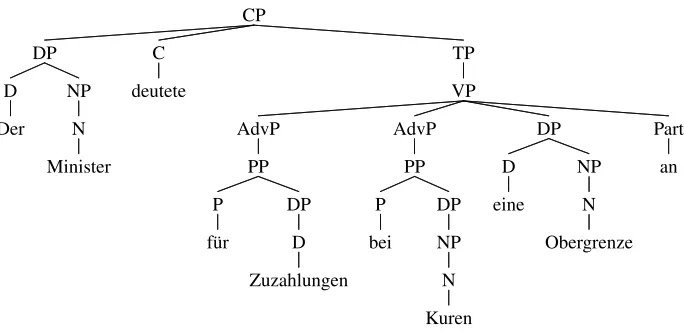
Fipsoperates in two modes: parser (see Figure 1)
and tagger (see Figure 2) output.1 The tagger out-put allows us to benefit from the rich information of theFipslexicon, being at the same time more robust than the parser.
3
Experimental setup
3.1 The TIGER treebank
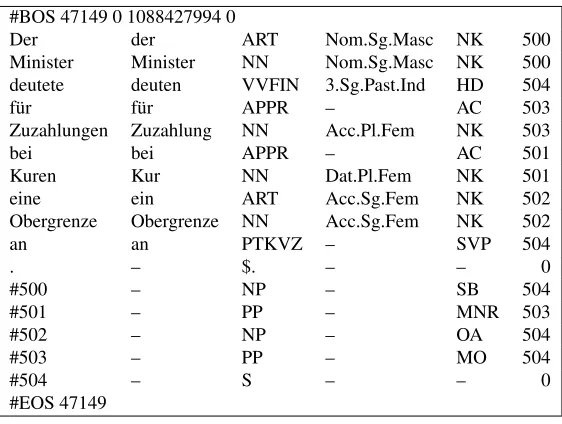
The TIGER treebank contains about 50 000 sen-tences of newspaper text, covering all domains (Brants et al., 2002). The annotation has been per-formed with the help of interactive tools. This methodology allows the human annotator to easily accept or reject proposals made by the computer. Part-of-speech tags are proposed by a statistical tag-ger trained on a manually annotated corpus. It uses the Stuttgart-Tübingen-Tagset (STTS) (Thielen et al., 1999). The parse trees were constructed inter-actively with the help of a statistical parser. Figure 3 shows an example of the TIGER export file.
3.2 Adaptations
In order to compare theFipsoutput with the TIGER tags, some adaptations had to be made. First of all, the tagset had to be changed to match the STTS tagset. While this procedure was straightforward for most of the categories, it showed that the Ger-man tagging module ofFipshad never been subject
1The parser output is shown here for illustration – we do not
use it in the present study.
der ART SIN-MAS-NOM 311000336 0 der SUBJ
minister NN SIN-MAS-NOM 311019783 3 Minister
deutete VVFIN IND-KON-PRA-3-SIN 311021998 12 andeuten
für APPR 311050006 20 für
Zuzahlungen NE INN-ING-NOM-ACC-DAT 0 24 Zuzahlungen
bei APPR 311050009 36 bei
kuren NN PLU-FEM-NOM-ACC-DAT-GEN 311004912 40 Kur
eine ART SIN-FEM-NOM-ACC 311000346 46 ein OBJ
ober¬ NN SIN-MAS-NOM-ACC-DAT 311019956 51 Ober COMP-CHUNK
grenze NN SIN-FEM-NOM-ACC 311001176 55 Grenze COMP-HEAD
an PTKVZ 311050018 62 an
. $. 0 65 .
Figure 2: Example output of the GermanFipstagger. The columns show: the word as found in the text; the POS tag in the STTS tagset; morphological information in a proprietary tagset; the lexeme number of the internal database (0 stands for unknown words); the character position at which the word begins; the lemma. The rightmost column contains additional information like grammatical function and compound noun syntax.
Note that the compound nounObergrenzewas automatically chunked and that the wordZuzahlungenwas not found in the lexicon; the particleanis attached to the lemma of the main verbdeutete.
to a rigorous evaluation. For example, there were no particular tags for pronominal prepositions (e.g., darüber, deswegen), for prepositions with articles (e.g.,beim, ins), and for the infinitival particlezu.
Small adaptions concerned the replacement ofß byss(Fipsuses the Swiss Standard German orthog-raphy, lacking the letterß) and the different lemma-tization of the particle verbs: in TIGER and in con-trast to Fips, the particles are not attached to the lemma (see the verbandeutenin Figures 2 and 3).
Finally, the Fips tagger contains a compound noun chunker which is automatically used for un-known words and which outputs one line for each chunk. These lines had to be reassembled to fit with the unchunked TIGER output (cf. the compound nounObergrenzein Figures 2 and 3).
3.3 Evaluation
From the TIGER export file, we extracted the orig-inal sentences and submitted them to theFips tag-ger. Then, we compared its results with the informa-tion given in TIGER. Overall, 792 885 words were compared. This number does not correspond to the 888 578 tokens of the TIGER corpus, because the concept of word is much more flexible inFipsthan in TIGER. For example, the token62jährigeris split into two words 62 and jähriger. By contrast, vor allemis regarded as a single lexical item (adverb) by
Fips, but as two words by TIGER. Moreover, for a
TIGER Tag FipsTag Number Percentage
NN NE 12592 1.59
KON ADV 8000 1.01
ADJD ADV 6737 0.85
ADV PTKA 4976 0.63
NE NN 4782 0.60
VAFIN VVFIN 3529 0.45
ART PRELS 2935 0.37
VVFIN VVIMP 1937 0.24
VVINF VVFIN 1859 0.23
VVPP VVFIN 1624 0.20
Correct tags 692 386 87.32
Tested words 792 885 100.00
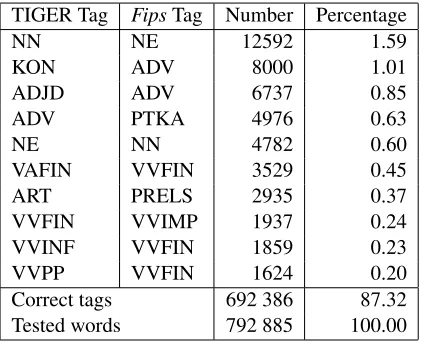
Table 1: Results of the part-of-speech tag comparison. The table shows the number of tags correctly predicted by Fips(second last line), as well as the ten most fre-quent erroneous predictions. The first column shows the correct tag as given by TIGER, the second column shows the erroneous tag assigned byFips.
currently unknown reason, some words do not show up in the output of theFipstagger.
4
Part-of-speech tagging results
the ten most frequent tagging errors. In the follow-ing sections, we discuss some of these errors.
4.1 Proper and common nouns
The most common error is related to the distinction between proper (NE) and common nouns (NN). This error affects 2.19% of words (see first and fifth line in Table 1) and accounts for 17.29% of all tagging errors. Currently, the distinction between proper and common nouns is implemented inFipsas follows.
A noun is regarded as common noun if:
• it is present in the lexicon and not explic-itly marked as proper noun: Chemie, Hirsch, Konkurrenz, or
• it is a compound noun that can be analyzed into chunks which are present in the lexicon: Bun-des+bank, Finanz+markt, Sitz+platz.
A noun is regarded as proper noun if:
• it is explicitly marked as such in the lexicon: Gregor, Berlin, Europa.
• it is not present in the lexicon and cannot be fully analyzed as compound noun: Talk, Gaullismus, Kibbuzarbeiter.
Tagging errors occur in two ways. Words that are annotated as common nouns by TIGER are anno-tated as proper nouns byFips (see first line in Ta-ble 1). This happens for all common nouns that are not present in the lexicon (e.g., Primadonna, Port-folio, Niedersachse, Gaullismus). There are also compound nouns with a proper noun complement: Vichy-Zeiten, Spreearm. While TIGER considers these words as common nouns because the head is a common noun,Fipsstill analyzes them as proper nouns. For other words likeMarseillaise, the TIGER annotation as common noun may be questioned.
In the other way, some TIGER proper nouns have been tagged byFipsas common nouns (cf. fifth line in Table 1). One common category of erroneous tag-ging is the case of homonymous proper and common nouns. For example,Kohl andTeufel are common nouns, but also the names of German politicians and therefore proper nouns. These misinterpretations are due to the fact thatFipsdoes not contain any spe-cific Named Entity Recognition module. WhileFips
successfully relies on letter case to identify proper nouns in other languages, this approach obviously does not work in German.
Some proper nouns exhibit a more subtle phe-nomenon: words like Mannheim, Wendland or Kantstrasse are analyzed by Fips as common compound nouns (Mann+Heim, wenden+Land, Kante+Strasse). Again, a Named Entity Recogni-tion system would prevent such unfortunate analy-ses. Furthermore, we do not find it compelling to an-alyzeBuddha, BundesbankandBundeskriminalamt as proper nouns.
To sum up, the source of noun mistagging is three-fold. First, the Fips lexicon contains some gaps. Second, the lack of a Named Entity Recognition module inFipscauses an overgeneration of homo-graph common nouns where a proper noun would be appropriate. Third, the distinction between proper and common nouns is not clear-cut, and some diver-gences can be considered as normal.
4.2 Conjunctions and adverbs
Conjunctions are frequently mistagged as adverbs. Above all, this error affects the words und, aber, denn, which can have an adverbial (ADV) or a con-junction (KON) reading. In (1), the first occurrence ofund is erroneously tagged as adverb. However, if we parse the first part of the sentence only (2),Fips
obtains the correct conjunction reading. This sug-gests that the conjunction reading is available also for (1), but that the ranking mechanism is flawed and prefers the adverb reading.
(1) Automaten sind dort nur in Geschäften und Restaurants erlaubt und nicht wie in der Bundesrepublik auch im Freien.
(2) Automaten sind dort nur in Geschäften und Restaurants erlaubt.
#BOS 47149 0 1088427994 0
Der der ART Nom.Sg.Masc NK 500
Minister Minister NN Nom.Sg.Masc NK 500
deutete deuten VVFIN 3.Sg.Past.Ind HD 504
für für APPR – AC 503
Zuzahlungen Zuzahlung NN Acc.Pl.Fem NK 503
bei bei APPR – AC 501
Kuren Kur NN Dat.Pl.Fem NK 501
eine ein ART Acc.Sg.Fem NK 502
Obergrenze Obergrenze NN Acc.Sg.Fem NK 502
an an PTKVZ – SVP 504
. – $. – – 0
#500 – NP – SB 504
#501 – PP – MNR 503
#502 – NP – OA 504
#503 – PP – MO 504
#504 – S – – 0
#EOS 47149
Figure 3: An example sentence of the TIGER corpus. The#BOSand#EOSlines mark the beginning and the end of a sentence. The columns show: the word (or word component) as found in the text; the lemma; the POS tag in the STTS tagset; the morphological features. The fifth and sixth column, as well as the lines beginning with#50x, contain information for the construction of the parse tree and are not relevant for our study.
4.3 Adjectives and adverbs
In contrast to English or French, there is no for-mal difference in German between adjectives used as predicates (e.g.,Er ist schnell) or as adverbs (e.g., Er fährt schnell). This formal identity may have mo-tivated the developers of the STTS tagset to use the same tag (ADJD) in both cases. In contrast, the Ger-manFipstagger is based on earlier work on French and English, where distinct tags for adverbials and predicatives are needed. Therefore, it also uses dif-ferent tags for German.
We tried to come up with a simple solution to this problem by assigning the ADJD tag to all adverbs whose base forms are homograph with an adjective. However, in this case, we also assigned the ADJD tag to words likeganz, natürlich, wirklich, which are tagged as proper adverbs (ADV) in TIGER. In short, we had the choice of either overgenerating ADV tags (keeping theFips output as-is) or over-generating ADJD tags (with the homograph modi-fication). Preliminary tests showed similar amounts of overgeneration in both cases. We have thus cho-sen to stick to the originalFipsanalyses.
4.4 Particles followed by adjectives
STTS introduces a special tag (PTKA) for parti-cles “followed by adjectives or adverbs”, for exam-pleam [schönsten], zu [schnell]. InFips, the class of comparative adverbs also contains auch, so and mehr. Of course, these words are not always fol-lowed by adjectives, and should thus not always be given the PTKA tag. While different readings are indeed available in theFipslexicon, the results sug-gest thatFipsovergeneralizes the comparative read-ing and assigns the PTKA tag even in cases where a normal ADV tag would be adequate. (3) shows a sentence whereFipserroneously assigned the PTKA tag toauch.
(3) Der Verkehrssenator, wie er künftig auch heißen möge, . . .
4.5 Pronouns
The seventh line refers to the homography of the def-inite determiner and the relative pronoun (PRELS) whenever Fips cannot find an agreement between the determiner and the head of the noun phrase.
In (4), the Fipslexicon only contains the neuter lexemeSchild (which serves as a head of the com-pound noun Atomschild), but not the rarer mas-culine homograph lexeme. This lexical gap pre-vents the masculine determinerden to be attached toAtomschild as a determiner, and Fipsresorts to the relative pronoun analysis instead.
4.6 Verb problems
Verb tagging seems to be a serious problem toFips: four of the ten most frequent tagging errors involve verbs.
The first type of error is related to the distinction between auxiliary and full verbs. The three auxiliary verbs haben, sein, werden can also have full verb readings, depending on the context. We recently ob-served thatFipspreferred the auxiliary reading even in cases where a full verb reading is required, and subsequently modified the constraints on the lexeme selection. It now turns out that these constraints are too strong and lead to a massive overgeneration of the full verb reading.
Then, Fips tends to overgenerate imperatives: third person singular forms are erroneously analyzed as imperative plurals (e.g.,kommt, schreit). Again, this is due to agreement constraints: the third person singular requires an overt subject, while an imper-ative does not. If Fips fails to find a subject that agrees with the verb (for example because of an un-detected long distance dependency), it will resort to an imperative reading. In the future development of
Fips, further restrictions should be imposed on the use of imperative forms as these are extremely rare in newspaper text.
The last two lines in Table 1 reveal that finite verb forms are preferred to infinite forms: infinitives are mistagged as finite plural forms, and past partici-ples withoutge-prefix are mistagged as third person singular forms (for regular verbs) or as past plural form (for irregular verbs with-enparticiple). These phenomena depend on long distance relations and should typically benefit from a full parsing approach like the one used byFips. Two factors may explain why this is not the case. First, many sentences in which such errors occur could not be parsed com-pletely byFips; long distance relations are not fully detected in these cases. Second, the implementation of passive and modal sentences is incomplete and
TIGER Base Form FipsBase Form
dieser diese
anderer ander
welche welcher
Beamte Beamter
Angestellte Angestellter
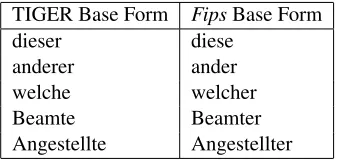
Figure 4: For some pronouns and nouns, TIGER andFips
use different base forms.
lacks some essential constraints on verb form selec-tion.
5
Lemmatizer results
On the whole TIGER corpus (792 885 words), 94.32% of the words (747 855) were correctly lemmatized. Most errors were due to diverg-ing base form choices. This especially holds for pronouns and nominalized adjectives (cf. Fig-ure 4), but also for pronouns. In TIGER, femi-nine and neuter pronouns always refer to the mas-culine lemma, whereas Fips separates the gen-ders more strictly: der (Dat.Sg.Fem) refers to the lemma der (Nom.Sg.Masc) in TIGER, but to die (Nom.Sg.Fem) inFips. Moreover, participles used as adjectives keep the infinitive as base form inFips, but not in TIGER.
Some lemma errors are due to wrong POS tag-ging. For instance, we found thatFipsovergenerates imperatives. For example, einig is not analyzed as adjective, but as the imperative singular (with elision of finale) ofsich einigen; the adjectivenötigeis an-alyzed as the imperative singular ofnötigen. How-ever, such awkward analyses should be easy to iron out.
Globally, we find that very few errors are directly due to the lemmatizer; most of them are either due to different base forms or to POS tagging errors.
6
Morphology results
mor-Type Number Percentage
Number mismatch 15617 2.26
Case mismatch 12420 1.79
Gender mismatch 8461 1.22
Degree mismatch 514 0.07
Person mismatch 108 0.02
Correct analysis
or no morphology 665 110 96.06
Tested words 692 386 100.00
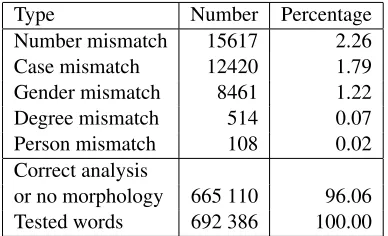
Table 2: Results of the morphological analysis. The table presents the numbers of words that have been correctly analyzed byFips, and the types of errors that occurred. A word can present several mismatch types.
phology evaluation. Parts of speech without inflec-tion were considered as correctly analyzed. We split the errors into five categories, according to the in-flection feature thatFipsfailed to predict correctly. The different mismatch types do not sum up to 100% because a word can show several mismatches (e.g., a noun can show case and number mismatch), and be-cause not all types of mismatch apply to all parts of speech (for instance, degree mismatch only applies to adjectives).
It is not easy to find recurrent patterns in the er-rors. However, we found that most errors occurred in noun phrases. Most inflected adjective and ar-ticle forms admit several morphological analyses, but the ambiguities can usually be reduced by the syntactic context. If the ambiguities are reduced in an incorrect way, this means that the syntactic con-text has been analyzed badly. In other words, such morphology errors often reflect bad parses. There-fore, it might be useful to address these errors be-fore evaluating the parsing performance ofFips. An-other rather odd fact is that nouns with identical sin-gular and plural forms (for example,Minister, Un-ternehmen) prefer to be analyzed as plurals byFips. Here again, these cases hint at bad parses.
Degree mismatches result from a bug in Fips: comparative forms in predicative positions as in (5) are assigned the positive tag instead of the compara-tive one.
(5) . . . um nochtieferin den Kosmos blicken zu können.
7
Related work
It may be interesting to compareFipsto a statistical part-of-speech tagger for German. The TnT tagger (Brants, 2000) is based on Hidden Markov Models, and has been trained and tested on the NEGRA cor-pus (Skut et al., 1997); NEGRA is the predecessor of TIGER and uses the same tagset. Brants (2000) re-ports an overall accuracy of 96.7%. However, TnT is not directly comparable toFipsfor several reasons.
First, we showed thatFipsoriginally used a differ-ent tagset, based on differdiffer-ent linguistic assumptions than STTS. Those conceptional differences make up a large part of the errors, as has been shown for the distinction between the ADJD and ADV tags. By contrast, TnT has been trained directly over the STTS tagset and should thus not present such errors. Second, the recurrence of certain error patterns withFipsillustrates the classical problem of manual rule ranking and weighting in rule-based systems.
Third,Fipshas been conceived as a parser in the first place, and its tagger functionality should rather be viewed as a by-product. Hence, its algorithms are not optimized for POS tagging. While there may be simpler approaches to obtain high tagging accuracy, the method chosen forFipsseems theoretically more plausible to us.
As we pointed out at the beginning, this tagger evaluation has been started as a first step towards the evaluation of theFipsparser. While POS tagging has the advantage of operating word-by-word and of be-ing rather theory-independent, these two properties do not hold for parsing.
8
Conclusion
As we remarked above, this article reports on work in progress. Until now, we have been able to show that the general approach of evaluatingFipswith the help of the TIGER treebank is valid. With very little adaptation work (see Section 3.2), we managed to obtain 87.32% of POS-tagging accuracy. This is a very promising beginning, and the discussion of the errors has shown that there are many “low hanging fruits” to improve the performance.
In any way, we find that the quantitative evalu-ation of NLP systems can be quite rewarding: de-veloping rule-based systems is a complex task, of-ten guided by vague intuitions about parsing qual-ity. Quantitative evaluation allows us to measure the progress of the development and guarantees us that improvements on one parameter do not yield un-wanted side effects on another.
Finally, the quantitative evaluation of the POS tagging performances yields important feedback on the forces and weaknesses ofFips. The result of the evaluation can be viewed as a sort of priority list for the developer. By working on the most common er-rors in a target-oriented way, (s)he is guaranteed to invest his/her time in a maximally effective manner. Such guiding principles are very valuable for the fur-ther development of any rule-based parsing system, independently of the precise accuracy figures of the evaluation. Even if the adaptation of two different tagsets and tagging philosophies is not straightfor-ward, we plan to extend our evaluation to other lan-guages of theFips project for which suitable gold standard corpora exist.
Acknowledgements
We thank Eric Wehrli and for his precious support for this work and for his valuable comments on pre-vious versions of this paper.
References
G. Adda, J. Mariani, J. Lecomte, P. Paroubek, and M. Ra-jman. 1998. The GRACE French part-of-speech tag-ging evaluation task. InProceedings of the First In-ternational Conference on Language Resources and Evaluation (LREC), Granada.
E. Black, S. Abney, S. Flickenger, C. Gdaniec, C. Gr-ishman, P. Harrison, D. Hindle, R. Ingria, F. Jelinek,
J. Klavans, M. Liberman, M. Marcus, S. Roukos, B. Santorini, and T. Strzalkowski. 1991. Procedure for quantitatively comparing the syntactic coverage of English grammars. InHLT ’91: Proceedings of the Workshop on Speech and Natural Language, pages 306–311, Pacific Grove, California.
S. Brants, S. Dipper, S. Hansen, W. Lezius, and G. Smith. 2002. The TIGER Treebank. InProceedings of the Workshop on Treebanks and Linguistic Theories, So-zopol.
T. Brants. 2000. TnT – a statistical part-of-speech tagger. InProceedings of the Sixth Applied Natural Language Processing (ANLP-2000), Seattle.
J. Bresnan. 2001.Lexical Functional Syntax. Blackwell, Oxford.
J. Carroll, A. Frank, D. Lin, D. Prescher, and H. Uszko-reit. 2002. Beyond PARSEVAL – towards improved evaluation measures for parsing systems. In Proceed-ings of the LREC 2002 Workshop, Las Palmas, Gran Canaria.
N. Chomsky. 1995. The Minimalist Program. MIT Press, Cambridge, Mass.
P. W. Culicover and R. Jackendoff. 2005. Simpler Syn-tax. Oxford University Press, Oxford.
J.-P. Goldman, C. Laenzlinger, G. Soare, and E. Wehrli. 2005. L’analyseur syntaxique multilingue Fips dans la campagne EASy. InProceedings of TALN XII, vol-ume 2, pages 35–49, Dourdan.
I. Rehbein and J. van Genabith. 2007. Treebank annotation schemes and parser evaluation for Ger-man. In Proceedings of the 2007 Joint Conference on Empirical Methods in Natural Language Process-ing and Computational Natural Language LearnProcess-ing (EMNLP/CoNLL 2007), pages 630–639, Prague. W. Skut, B. Krenn, T. Brants, and H. Uszkoreit. 1997.
An annotation scheme for free word order languages. InProceedings of the Fifth Conference on Applied Nat-ural Language Processing ANLP-97, Washington, DC. C. Thielen, A. Schiller, S. Teufel, and C. Stöckert. 1999. Guidelines für das Tagging deutscher Textkorpora mit STTS. Technical report, University of Stuttgart and University of Tübingen.