Volume 6, No. 1, Jan-Feb 2015
International Journal of Advanced Research in Computer Science RESEARCH PAPER
Available Online at www.ijarcs.info
ISSN No. 0976-5697
Energy Efficient Protocols For Wireless Sensor Network: EA-LEACH
Rekha Baghel
Assistant Professor ,Department of Information Technology Galgotias college of engineering & Technology
Greater noida, India [email protected]
Vikas verma
Assistant professor, school of Computer & System Sciences ,Jaipur National University
Jaipur, India [email protected]
___________________________________________________________________________________
Abstract: Wireless Sensor Network (WSN) are networks that consists of sensors which are distributed in ad hoc manner . WSN are more constraint by sensors limited power, energy and computational capability,. Energy optimization is one of the major issues of WSNs to extend the lifetime of these networks. A number of clustering based protocols like LEACH and SEP are already developed and used to increase stability of the network. We have proposed a technique EA-LEACH (Energy Aware LEACH) in which the randomized selection of clusters is tried to be centralized. So, unlike LEACH, cluster heads are chosen based on their available energies which result in better distribution of cluster heads within the region. Simulations on MATLAB show that EA-leach depicts better results than the existing protocols like LEACH and SEP.
Keywords: Wireless Sensor Networks, Stability, LEACH protocol, SEP protocol, EA-LEACH protocol
___________________________________________________________________________________________________________________
I.INTRODUCTION
Wireless sensor network (WSN) is a network that consists of a large number of low-cost, low-power, and multifunctional wireless sensor nodes, with sensing, wireless communications and computation capabilities. The data sensed by these nodes are then passed to the Base Station (BS) for evaluation. The nodes have some battery life and the energy of the nodes keep on dissipating whenever they transmit or receive the information. There are various routing protocols which help in minimization of energy dissipation in wireless networks. . Since the nodes sense data and if they are present too near to each other then redundant data is transferred to the base station. Hence, the protocols try to minimize the energy by avoiding transmission of the redundant information. To avoid such types of redundancies, clustering protocols were proposed and LEACH [1] is one of the famous clustering protocols. In clustering protocols, the nodes present in the network are grouped into clusters and a cluster head is being assigned to each cluster. The main purpose of the cluster head is to aggregate the information send by its cluster nodes, and then transmit this aggregated information to the base station. Such types of clustering protocols can also be referred to as the hierarchical protocols. So, clustering helps in increasing the overall lifetime of the network. In our protocol EA-LEACH, we have tried to make an improvement over the existing LEACH [1] protocol by centralizing the network in such a way that the network stability is improved. Our simulation results on MATLAB show that EA-LEACH gives far more better results than the existing protocols like LEACH[1] and SEP[2]. We have performed simulations on MATLAB and compared the results on the basis of stability period and energy utilization of the system.
The paper is organized as follows: Section 2 reviews the related work. Section 3 explains the proposed protocol in detail. Experimental evaluations of the proposed protocol and results have been discussed in section 4. Section 5 presents the conclusion and the future work.
II. RELATEDWORK
A lot of research has been done for better utilization of the energy of the wireless system. The main motive of all the existing protocols is to minimize the energy dissipation during routing. A detailed survey of energy efficient clustering protocols for wireless sensor networks is presented in [3] .To propose a new protocol, we first analyze several efficient protocols of wireless sensor network.
A.Low Energy Adaptive Clustering Hierarchy
(LEACH)
Low Energy Adaptive Clustering Hierarchy (LEACH) is the first energy efficient routing protocol for hierarchical clustering. It reduces the energy significantly [4]. The LEACH protocol forms clusters in the sensor networks and randomly selects the Cluster-heads for each cluster. The non head nodes sense the data and transmit to the cluster-heads. The cluster-heads aggregate the received data and then forward the data to the sink. This aggregation process reduces the transmission of duplicate data.
© 2015-19, IJARCS All Rights Reserved 217 P is the percentage of cluster heads, r is the rth round, G is
the set of nodes which are not cluster heads in the last 1/P rounds.
Whenever, a cluster head is chosen, the CH broadcasts its advertisement to in the entire region and the nodes which are receiving better signal strength will associate themselves to be with this Cluster Head. In such a way, the clusters are formed and organized. Cluster heads (CH) perform a lot more work and dissipate energy more quickly than the non-CH nodes. So, instead of assigning the role of the non-CH to the same node always, the role of the CHs is equally distributed among all the nodes present in the network. Hence, CHs keep on rotating with each round. A node which had become the CH in the current round will not get an opportunity to become the CH again before a set interval of time.
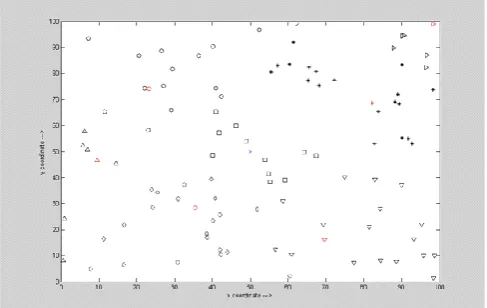
Figure 1 below shows how clusters are formed in 100*100 region in one round. The same cluster can be identified with nodes having same symbol. The cluster heads are shown in red. Base Station(or sink) is situated at (50,50) and is shown by X.
B. Enhanced Low-energy Adaptive Clustering
Hierarchy (E- LEACH)
[image:2.595.49.272.66.118.2]Enhanced Low-energy Adaptive Clustering Hierarchy (E- LEACH) proposes a cluster head selection protocol for sensor networks that have non-uniform starting energy level among the sensors.
Figure 1. Distribution of nodes and formation of clusters
It also determines that the required number of cluster heads has to scale as the square root of the total number of sensor nodes to minimize the total energy consumption. LEACH-Centralized (LEACH-C) uses a centralized clustering protocol and same steady-state protocol. During the set-up phase of LEACH-C, each node sends information about current location and energy level to base station (BS) [6]. The BS will determine clusters, CH and non-CHs of each cluster. The BS utilizes its global information of the network to produce better clusters that require less energy for data
transmission. The number of CHs in each round of LEACH-C equals a predetermined optimal value.
C. Multi-Hop LEACH(M-LEACH)
M-LEACH modifies LEACH allowing sensor nodes to use multi-hop communication within the cluster in order to increase the energy efficiency of the protocol [7]. This work extends the existing solutions by allowing multi-hop inter-cluster communication in sparse WSNs in which the direct communication between CHs or the sink is not possible due to the distance between them. Thus, the main innovation of the solution proposed here is that the multi-hop approach is followed inside the cluster and outside the cluster. CHs can also perform data fusion to the data receive, allowing a reduction in the total transmitted and forwarded data in the network. Among the hierarchical routing protocols, LEACH is the most popular cluster-based routing protocol. A node becomes a CH for the current rotation round if the number is less than the following threshold:
Where p is the percentage of nodes that can become CHs, r is the current round and G is the set of nodes that have not served as cluster head in the past 1/p rounds [8].
However, instead of better stability period and efficient utilization of energy, LEACH has some drawbacks. One of the drawbacks is that the LEACH is single hop routing protocol. Each node transmits data to one node only. Each normal node transmits information to either CH or BS directly. Moreover, if network size is increased, the dynamic clustering may become overhead because of energy dissipations due to advertisements of CHs at every round. In LEACH, the number of clusters formed is random. Sometimes, very small number of clusters and sometimes very large number of clusters is obtained
D. Stable Election Protocol(SEP)
SEP [2] was an improvement over LEACH in such a way that it took into account the heterogeneity of the networks. In SEP, two types of nodes are assumed - normal nodes and advanced nodes.
Advanced nodes are considered to have more energies than the normal nodes. So, SEP improves the protocol by assigning high probability to the advanced nodes to become the cluster heads. SEP is a two –tier clustering protocol.
E. LEACH-C protocol
[image:2.595.36.280.463.617.2]© 2015-19, IJARCS All Rights Reserved 218 F. LEACH-F protocol
LEACH-F is fixed cluster LEACH. In LEACH-F, once the optimal clusters are identified, the clusters formed are fixed and not changed with rounds. However, the role of CHs is distributed in each round within the same cluster. No set-up overhead is required in each round in LEACH-F. The centralized cluster protocol is same as LEACH-C but unlike LEACH-C, this protocol runs only once before the commencement of first round. However, the disadvantage is that the protocol is static. The protocol does not allow change in the network size because if the network size is varied, the fixed clusters would be required to change. Moreover, adding new nodes in the existing network also requires change in the fixed clusters.
G. PEGASIS
PEGASIS [5], which is an extension of LEACH, does not allow formation of multiple clusters. It only allows sensor nodes to transmit and receive nodes to their neighbor nodes only. Hence, the information is passed to the base station by the formation of the chain. Only one node that is near to the BS is selected to pass the data to the BS. The chain is selected based upon the annealing protocol. It is the near chain optimal cluster. There are also further developments in PEGASIS like Hierarchical PEGASIS and Energy Balancing PEGASIS
III. ENERGYAWARELEACH
PROTOCOL(EA-LEACH)
This protocol adopted a variable length cluster allocation protocol.. In addition to this, we have also changed the criteria of selection of cluster heads at each round. In EA-LEACH, BS selects the optimum number of CHs. Unlike LEACH, The CHs selected are not random but are chosen depending upon the available energies of the nodes. In other words, out of the total number of nodes, those nodes which have maximum energies available have a higher priority to become the CHs. So, the CHs are chosen as evenly as possible which can only be achieved if at each round BS is aware of the available energy of each and every node. Moreover, in EA-LEACH, whenever the CHs are chosen by the BS, it is also verified that no two CHs lie too close to each other. The CHs have to be separated by a certain favorable distance d. EA-LEACH is divided into three phases:
A. Pre-setup phase
This phase takes place at the start of the system before the commencement of the first round. In this phase, all the nodes send their respective energies, positions and ID directly to the base station. We are assuming that each node is capable of calculating its own position using modern GPS systems. After receiving the information from each node, BS broadcasts positions and IDs of all the nodes in the entire system. Each node now has the information about other nodes of the system.
B .Set-up phase
The setup phase takes place at the beginning of each round. At the start of the each round, BS has the knowledge of available energies of all the nodes. So, BS sorts the available energies of the nodes present in the system and then choose „k‟ number of nodes to become the cluster heads. The nodes
chosen are the nodes with maximum available energies. k can be chosen in such a way that the minimum energy is dissipated(in that case, k=kopt). The value of k may vary depending upon the network size and degree of heterogeneity of the nodes. It can also be noted here that an increase in the value of k results in better data quality and a decrease in value of k results in better energy optimization with the expense of some data quality. Hence, our protocol is flexible enough to maintain a tradeoff between the data quality and energy optimization depending upon the type of application in which the protocol is used. The BS advertises the cluster head IDs in whole network and the nodes whose own ID matches with the ID sent by the BS, that node elects itself to be the cluster head. Now, each node has the information about the CHs selected and the distance with these CHs. Now, each node selects its CH by choosing that CH which is at the minimum distance from it. Hence, there is no need of the advertisement of CH ids by the CHs. In addition of above criteria of selection of CHs, BS does not allow CHs to lie too close to each other. BS assures that two CHs must be separated by a favorable distance d to eliminate further redundancy of the information. It is found from the experiments that the optimal value of d depends upon the network size and the total number of nodes. A large value of d also results in reduction of the number of clusters formed.
calculation of d –
Consider a square region of dimension M and suppose k number of clusters is to be formed in the region. Then –
From the above equation, r comes out to be –
As an example, if we consider M=100 and k=kopt=2, then d comes out to be 39. It means that if the cluster separation, d =39, then an average two clusters are formed in the region, which results in minimum energy dissipation.
C. Steady State Phase
In this phase, actual dissipation of energy takes place. The data is transmitted, received and aggregated by various nodes. The data sensed by the nodes is transferred to the CHs or to the BS, whichever is close. The duration of this phase is more as compared to the steady state phase to minimize overhead.
When the sensor node transmit k-bit data by its transmitter, the energy dissipation is –
ET
Here Eelec is the energy dissipated to run the electronics circuits, k is the packet size,
Efs and Emp are the characteristics of the transmitter amplifier and d is the distance between the two communicating ends.
When the sensor node receives k-bit data packet, the energy dissipation is –
© 2015-19, IJARCS All Rights Reserved 219 In addition to above energy dissipations, CH also dissipates
energy in data aggregation. The data aggregation energy EDA has the value of 5nJ/bit/signal.
The energy dissipation due to CH is given by –
E(CH) = ET(k, dto BS) + ER(k) + EDA , Here k is the packet size.
The energy dissipation due to non-CH node is given by –
E(non-CH) = ET(k, dto CH) + ER(k)
In EA-LEACH, we are considering that BS has the knowledge of the available energy of each and every node. However, transmission of the energy by a node directly to the BS is not feasible. So, whenever a node transmits data to the CH, it also transmits its available energy to the CH. Now, CH transmits the aggregated data of its cluster nodes and ID and available energy of all the nodes (without aggregation) to the BS. In our experiments, we have also appended additional bits representing available energy of the nodes.
BS is considered to have infinitesimal energy and never runs out of energy. So, no energy is dissipated when BS transmits or receives data.
IV.PERFORMANCEANALYSIS
We have carried out simulations on MATLAB and
compared our results with the existing protocols like LEACH and SEP with the same settings. Our results depict that EA-LEACH has more stability period and higher energy utilization than the existing protocols.For network settings we have used a 100*100 region with the deployment of 100 nodes. The fraction of advanced nodes are taken to be 0.2, hence number of advanced nodes is 20.
The performance is compared on the basis of following parameters –
(i) Stability Period is the period (or round) up to which all nodes are alive. This period lies from first round up to the round of first dead node.
(ii) Amount of data received at the BS. (iii) Energy dissipation of the system.
[image:4.595.316.559.93.271.2]The following parameter values are used for simulation –
Table 1: Simulation parameters
Description Value
Eelec 50 nJ/bit
Efs 10 pJ/bit/m2
Emp 0.0013 pJ/bit/m4
EDA 5 nJ/bit/packet
E0 0.5 J
No. of bits 4000 bits (LEACH,SEP) 4100 bits (EA-LEACH)
kopt 2
N 100
A 1
M 0.2
D 30
Network size 100*100 Base Station Location (50,50)
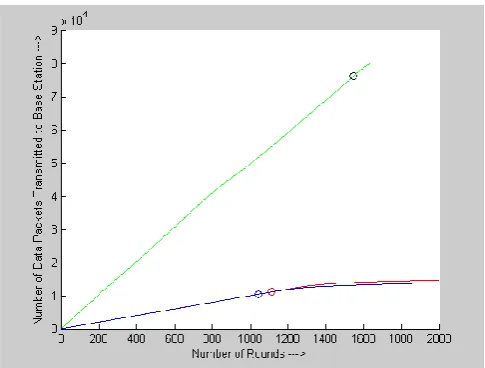
In this figure Blue, green and Red line indicates the LEACH, EA-LEACH and SEP protocols respectively.
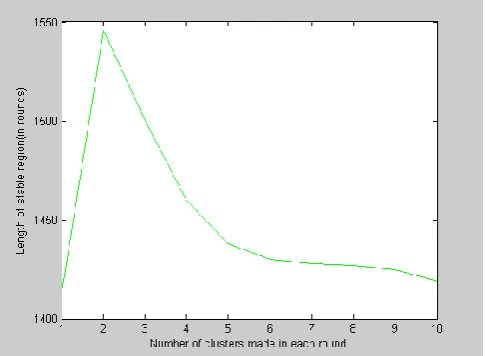
[image:4.595.316.558.353.531.2]Figure 3. Change in stable region as the number of clusters varies
Figure 3 shows the number of clusters formed by the BS vs length of stable region. From the figure, it is clear that the system is more stable when kopt=2 for the parameters taken in our experiment
.
Figure 4. Dissipation of total energy of the system with the number of rounds
Figure 4 shows the comparison on the basis of the total energy remaining in the system with the number of rounds. From the figure, it is clear that after a given number of rounds, EA-LEACH has more energy of the system as compared to LEACH and SEP.
Figure 5 shows the information received at the base station with time. It can be concluded from the graph that after a given number of rounds, in EA-LEACH, BS receives a large number of packets as compared to LEACH and SEP. This large improvement is mainly due to the fact that in this protocol nodes closer to each other can send their data directly.
From our simulations, following results are obtained: (i) The stability period shows a major improvement over the existing protocols.
[image:4.595.48.281.594.761.2]© 2015-19, IJARCS All Rights Reserved 220 (iii) The information received at the BS is increased
[image:5.595.36.279.100.284.2]considerably with time.
Figure 5. Packets received at the base station with time
V. CONCLUSION AND FUTURE WORK
EA-LEACH is a hierarchical cluster based technique in which random selection of cluster heads is ruled out. The concept of threshold T(n) is not present in this protocol. Instead, the CHs are chosen by BS based upon the available energies of the nodes in the network. The protocol ensures best possible way in which the CHs can be chosen in a given network. There is an extra overhead in EA-LEACH to aware the BS about the available energies of the nodes at each round, however, even after considering this extra overhead; EA-LEACH is able to give best results as proved in our simulations.
In this paper, we have carried out our experiments in a fixed network size with the same level of heterogeneity. In future work, we will try to change the level of the heterogeneity and the number of clusters formed in the network and then examines the change in stability period.
VI. REFERENCES
[1]. W.R. Heinzelman, A. Chandrakasan, and H. Balakrishnan, Energy- efficient Communication Protocol for Wireless Microsensor Networks., in IEEE Computer Society
Proceedings of the Thirty Third Hawaii International Conference on System Sciences (HICSS '00), Washington, DC, USA, Jan. 2000, vol. 8, pp. 8020.
[2]. G. Smaragdakis, I. Matta, A. Bestavros, SEP: A Stable Election Protocol for clustered heterogeneous wireless sensor networks, in: Second International Workshop on Sensor and Actor Network Protocols and Applications (SANPA 2004), 2004.
[3]. Dali Wei, Shaun Kaplan and Anthony Chan, “Energy efficient Clustering protocols for wireless sensor networks”, in Proceedings of the ICC 2008 Workshop.
[4]. W. Heinzelman, A. Chandrakasan and H. Balakrishnan, "Energy efficient communication protocol for wireless
microsensor networks," in the Proceedings of HICSS '00, Jan 2000.
[5]. S. Lindsey and C.S. Raghavendra, “PEGASIS: Power efficient gathering in sensor information systems,” in Proceedings of IEEE Aerospace Conference, vol 3, pp. 3-1125–3-1130, Mar 2002
[6]. Christopher Ho, Katia Obraczka, Gene Tsudik, and Kumar Viswanath, “Flooding for reliable multicast in multi-hop ad hoc networks”, In Proceedings of the 3rd International Workshop on Discrete Protocols and Methods for Mobile Computing and Communications (DIAL-M‟99), 1999, pp. 64–71.
[7]. K.K.Sing,M.P.Singh and D.K.Singh,”A survey of Energy-Efficient Hierarchical Cluster-based Routing in Wireless Sensor Networks”,International Journal of Advanced Networking and Application(IJANA),Sept.-Oct. 2010,vol.02,issue 02,pp.570-580.
[8]. Vinh Tran Quang and Takumi Miyoshi,”Adaptive routing Protocol with energy efficient and event clustering for wireless sensor network,” IETCE Trans.Commun.,Vol E91-B,No.9,Sep 2008.
[9]. Shio Kumar Singh Shio Kumar Singh, M.P.Singh, and D.K.Singh, .A Survey of Energy-Efficient Hierarchical Cluster Based Routing in Wireless Sensor Networks., in International Journal of Advanced Networking and Applications Volume: 02, Issue: 02, Pages: 570-580 (2010) [10]. S.Lindsey and C.S.Raghvendra.”PEGASIS:Power Efficient
Gathering in Sensor Information System,Proceeding IEEE Aerospace Conference vol.3,Big Sky,MT,Mar.2002,pp.1125-1130.