Improving the Efficiency of a Wide-Coverage CCG Parser
Bojan Djordjevic and James R. Curran School of Information Technologies
University of Sydney NSW 2006, Australia
{bojan,james}@it.usyd.edu.au
Stephen Clark Computing Laboratory
Oxford University Wolfson Building, Parks Road
Oxford, OX1 3QD, UK
Abstract
The C&C CCG parser is a highly efficient linguistically motivated parser. The effi-ciency is achieved using a tightly-integrated supertagger, which assignsCCGlexical cat-egories to words in a sentence. The integra-tion allows the parser to request more cat-egories if it cannot find a spanning anal-ysis. We present several enhancements to theCKYchart parsing algorithm used by the parser. The first proposal is chart repair, which allows the chart to be efficiently up-dated by adding lexical categories individu-ally, and we evaluate several strategies for adding these categories. The second pro-posal is to addconstraintsto the chart which require certain spans to be constituents. Fi-nally, we proposepartialbeam search to fur-ther reduce the search space. Overall, the parsing speed is improved by over 35% with negligible loss of accuracy or coverage.
1 Introduction
A recent theme in parsing research has been the application of statistical methods to linguistically motivated grammars, for example LFG (Kaplan et al., 2004; Cahill et al., 2004), HPSG (Toutanova et al., 2002; Malouf and van Noord, 2004), TAG
(Sarkar and Joshi, 2003) and CCG (Hockenmaier and Steedman, 2002; Clark and Curran, 2004b). The attraction of linguistically motivated parsers is the potential to produce rich output, in particular the predicate-argument structure representing the under-lying meaning of a sentence. The disadvantage of
such parsers is that they are typically not very effi-cient, parsing a few sentences per second on com-modity hardware (Kaplan et al., 2004). The C&C CCG parser (Clark and Curran, 2004b) is an order of magnitude faster, but is still limited to around 25 sentences per second.
The key to efficient CCG parsing is a finite-state supertagger which performs much of the parsing work (Bangalore and Joshi, 1999). CCG is a lex-icalised grammar formalism, in which elementary syntactic structures — in CCG’s case lexical cate-goriesexpressing subcategorisation information — are assigned to the words in a sentence. CCG su-pertagging can be performed accurately and effi-ciently by a Maximum Entropy tagger (Clark and Curran, 2004a). Since the lexical categories contain so much grammatical information, assigning them with low average ambiguity leaves the parser, which combines them together, with much less work to do at parse time. Hence Bangalore and Joshi (1999), in the context ofLTAGparsing, refer to supertagging as almost parsing.
Clark and Curran (2004a) presents a novel method of integrating the supertagger and parser: initially only a small number of categories, on av-erage, is assigned to each word, and the parser at-tempts to find a spanning analysis using the CKY
chart-parsing algorithm. If one cannot be found, the parser requests more categories from the supertagger and builds the chart again from scratch. This process repeats until the parser is able to build a chart con-taining a spanning analysis.1
1
Tsuruoka and Tsujii (2004) investigate a similar idea in the context of theCKYalgorithm for aPCFG.
The supertagging accuracy is high enough that the parser fails to find a spanning analysis using the initial category assignment in approximately 4% of Wall Street Journal sentences (?). However, parsing this 4%, which largely consists of the longer sen-tences, is disproportionately expensive.
This paper describes several modifications to the
C&Cparser which improve parsing efficiency with-out reducing accuracy or coverage by reducing the impact of the longer sentences. The first involves chart repair, where the CKYchart is repaired when extra lexical categories are added (according to the scheme described above), instead of being rebuilt from scratch. This allows an even tighter integra-tion of the supertagger, in that the parser is able to request individualcategories. We explore methods for choosing which individual categories to add, re-sulting in an 11% speed improvement.
The next modification involves parsing with con-straints, so that certain spans are required to be con-stituents. This reduces the search space consider-ably by eliminating a large number of constituents which cross the boundaries of these spans. The best set of constraints results in a 10% speed improve-ment over the original parser. These constraints are general enough that they could be applied to any constituency-based parser. Finally, we experiment with several beam strategies to reduce the search space, finding that apartial beamwhich operates on part of the chart is most effective, giving a further 6.1% efficiency improvement.
The chart repair and constraints interact in an in-teresting, and unexpected, manner when combined, giving a 35.7% speed improvement overall without any loss in accuracy or coverage. This speed im-provement is particularly impressive because it in-volves techniques which only apply to 4% of Wall Street Journal sentences.
2 The CCG Parser
Clark and Curran (2004b) describes theCCGparser.
The grammar used by the parser is extracted from CCGbank, a CCG version of the Penn Treebank (Hockenmaier, 2003). The grammar consists of 425 lexical categories plus a small number of combi-natory rules which combine the categories (Steed-man, 2000). A Maximum Entropy supertagger first
assigns lexical categories to the words in a sen-tence, which are then combined by the parser using the combinatory rules. A log-linear model scores the alternative parses. We use the normal-form model, which assigns probabilities to single deriva-tions based on the normal-form derivaderiva-tions in CCG-bank. The features in the model are defined over local parts of the derivation and include word-word dependencies. A packed chart representation allows efficient decoding, with the Viterbi algorithm find-ing the most probable derivation.
The supertagger uses a log-linear model to de-fine a distribution over the lexical category set for each word and the previous two categories (Ratna-parkhi, 1996) and the forward backward algorithm efficiently sums over all histories to give a distribu-tion for each word. These distribudistribu-tions are then used to assign a set of lexical categories to each word (?). The number of categories in each set is determined by a parameterβ: all categories are assigned whose forward-backward probabilities are withinβ of the highest probability category (?). If the parser can-not then find a spanning analysis, the value ofβ is reduced — so that more lexical categories are as-signed — and the parser tries again. This process re-peats until an analysis spanning the whole sentence is found.
In our previous work, when the parser was unable to find a spanning analysis, the chart was destroyed and then rebuilt from scratch with more lexical cate-gories assigned to each word. However, this rebuild-ing process is wasteful because the new chart is al-ways a superset of the old one and could be created by just updating the previous chart. We describe the chart repairprocess in Section 3 which allows addi-tional categories to be assigned to an existing chart and the CKY algorithm run over just those parts of
the chart which require modification.
2.1 Chart Parsing
The parser uses the CKY chart parsing algorithm (Kasami, 1965; Younger, 1967) described in Steed-man (2000). TheCKYalgorithm applies naturally to
all the sub-constituents which could be used to cre-ate a particular new constituent are already present in the chart.
The charts arepackedby grouping together equiv-alent chart entries, which allows a large number of derivations to be represented efficiently. Entries are equivalent when they interact in the same manner with both the generation of subsequent parse struc-ture and the statistical parse selection. In practice, this means that equivalent entries have the same span; form the same structures, i.e. the remain-ing derivation plus dependencies, in any subsequent parsing; and generate the same features in any sub-sequent parsing.
The Viterbi algorithm is used to find the most probable derivation from a packed chart. For each equivalence class of individual entries, we record the entry at the root of the subderivation which has the highest score for the class. The equivalence classes are defined so that any other individual entry can-not be part of the highest scoring derivation for the sentence. The highest-scoring subderivations can be calculated recursively using the highest-scoring equivalence classes that were combined to create the individual entry.
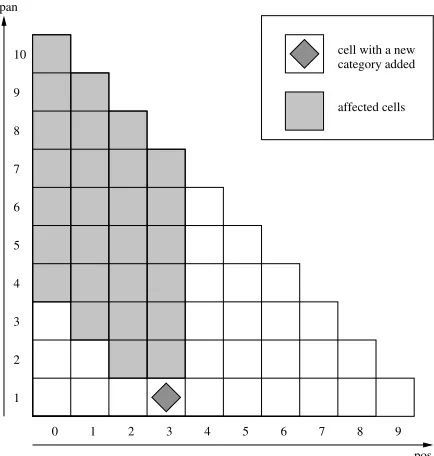
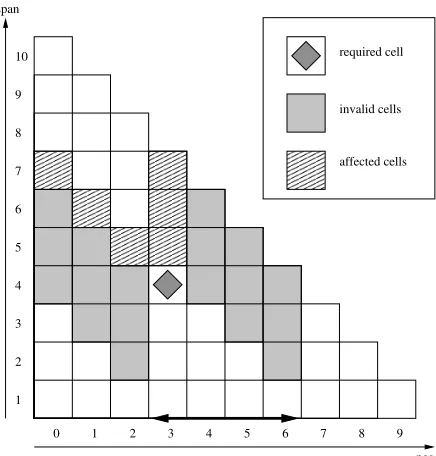
Given a sentence of n words, we define pos ∈ {0, . . . , n−1}to be the starting position of an en-try in the chart (represented by aCCGcategory) and span ∈ {1, . . . , n} its length. Letcell(pos, span) be the set of categories which span the sentence from postopos+span. These will be combinations of categories incell(pos, k)andcell(pos+k, span−k) for allk∈ {1, . . . , span−1}. The chart is a two di-mensional array indexed byposandspan. The valid (pos, span) pairs correspond topos+span ≤ n, that is, to spans that do not extend beyond the end of the sentence. The squares represent valid cells in Figure 1. The span from position 3 with length 4, i.e.cell(3,4), is marked with a diamond in Figure 2.
3 Chart Repair
The parser interacts with the supertagger by decreas-ing the value of the β parameter when a spanning analysis cannot be found for a sentence. This has the effect of adding more lexical categories to the chart. Instead of rebuilding the chart from scratch when new categories are added, it can be repaired
affected cells cell with a new category added 10
5
0 1 2 3 4 5 6 7 8 9
1 span
pos 2
[image:3.612.318.535.54.282.2]3 4 6 7 8 9
Figure 1: Cells affected by chart repair.
by modifying cells that are affected by the new cat-egories. Considering the case where a single lexical category is added to theith word in annword sen-tence, the new category can only affect the cells that satisfypos≤iandpos+span > i. These cells are shown in Figure 1 for the word at position 3.
The number of affected cells is(n−pos)(pos+1), and so the average over the sentence is approxi-mately n1Rn−1
0 (n−p)(p+ 1) dp ≈ n
2
6 cells. The
total number of cells in the chart isn(n+1)2 . The chart can therefore be repaired bottom up, inCKY order, by updating a third of the cells on average.
Additional lexical categories for a word are in-serted into the corresponding cell in the bottom row, with the additional categories being marked as new. For each cellCin the second row, each pair of cells AandBis considered whose spans combine to cre-ate the span ofC. In the originalCKY, all categories fromAare combined with all categories fromB. In chart repair, categories are only combined if at least one of them is new, because otherwise the result is already inC. The categories added toCare marked, and the process is repeated for all affected cells in
CKYorder.
affected cells invalid cells required cell
6 7 8 9
1 span
pos 2
3 4 6 7 8 9 10
5
[image:4.612.76.294.53.281.2]0 1 2 3 4 5
Figure 2: Cells affected by adding a constraint.
timeuntil a spanning derivation is found. In the orig-inal approach extra categories were added in bulk by changing the β level, which significantly increased the average ambiguity. Chart repair allows the min-imum amount of ambiguity to be added for a span-ning derivation to be found.
TheC&Cparser has a predefined limit on the num-ber of categories in the chart. If this is exceeded before a spanning analysis is found then the parser fails on the sentence. Our new strategy allows a chart containing a spanning analysis to be built with the minimum number of categories possible. This means that some sentences can now be parsed that would have previously exceeded the limit, slightly increasing coverage.
3.1 Category selection
The order in which lexical categories are added to the chart will impact on parsing speed and accu-racy, and so we evaluate several alternatives. The first ordering (β VALUE) is by decreasingβ value,
where theβvalue is the ratio between the probabil-ity of the most likely category and the probabilprobabil-ity of the given category for that word.2 The second
or-dering (PROB) is by decreasing category probability
2
We are overloading the use ofβfor convenience. Here,β
refers to the variable ratio dependent on the particular category, whereas theβvalue used in supertagging is acutoffapplied to the variable ratio.
as assigned by the supertagger using the forward-backward algorithm.
We also investigated ordering categories using in-formation from the chart. Examining the sentences which required chart repair showed that, when a word is missing the correct category, the cells af-fected (as defined in Section 3) by the cell are often empty. The CHARTordering uses this observation to select the next lexical category to assign. It selects the word corresponding to the cell with the high-est number of empty affected cells, and then adds the highest probability category not in the chart for that word. Finally, we included a RANDOMordering baseline for comparison purposes.
4 Constraints
The set of possible derivations can be constrained if we know in advance that a particular span is re-quiredto be the yield of a single constituent in the correct parse. A constraint on span p reduces the search space becausepmust be the yield of a single cell. This means that cells with yields that cross the boundary ofpcannot be part of a correct derivation, and do not need to be considered (the grey cells in Figure 2). In addition, if a cell yieldspas aprefixor suffix(the hashed cells in Figure 2) then it also has constraints on how it can be created.
Figure 2 shows an example constraint requiring words 3–6 to be a constituent, which corresponds to p = cell(3,4). Considercell(3,7): it yields words 3–9 and so containspas the prefix. Normally it can be created by combining cell(3,1)with cell(4,6), orcell(3,2)withcell(5,5), and so on up tocell(3,6) withcell(9,1). However the first three combinations are not allowed because the second child crosses the boundary ofp. This gives a lower limit for the span of the left child. Similarly, ifp is the suffix of the span of a cell then there is a lower limit on the span of the right child.
As the example demonstrates, a single constraint can eliminate many combinations, reducing the search space significantly, and thus improving pars-ing efficiency.
4.1 Creating Constraints
ex-plored constraints derived from shallow parsing and from the raw sentence. Our results demonstrate that simple constraints can reduce parsing time signifi-cantly without loss of coverage or accuracy.
Chunk tags were used to create constraints. We experimented with both gold standard chunks from the Penn Treebank and also chunker output from the
C&Cchunk tagger. The tagger is very similar to the Maximum Entropy POStagger described in Curran
and Clark (2003). Only NP chunks were used be-cause the accuracy of the tagger for other chunks is lower. The Penn Treebank chunks required modi-fication because CCGbank analyses some construc-tions differently. We also created longerNPs by con-catenating adjacent baseNPs, for example in the case
of possessives.
A number of punctuation constraintswere used and had a significant impact especially for longer sentences. There are a number of punctuation rules in CCGbank which absorb a punctuation mark by combining it with a category and returning a cate-gory of the same type. These rules are very produc-tive, combining with many constituent types. How-ever, in CCGbank the sentence final punctuation is always attached at the root. A constraint on the first n−1words was added to force the parser to only attach the sentence final punctuation once the rest of the sentence has been parsed.
Constraints are placed around parenthesised and quoted phrases that usually form constituents be-fore attaching elsewhere. Constraints are also placed around phrases bound by colons, semicolons, or hy-phens. These constraints are especially effective for long sentences with many clauses separated by semicolons, reducing the sentence to a number of smaller units which significantly improves parsing efficiency.
In some instances, adding constraints can be harmful to parsing efficiency and/or accuracy. Lack of precision in the constraints can come from noisy output from NLP components, e.g. the chunker, or from rules which are not always applicable, e.g. punctuation constraints. We find that the punctua-tion constraints are particularly effective while the gold standard chunks are required to gain any ben-efit for theNP constraints. Adding constraints also
has the potential to increase coverage because the re-duced search space means that longer sentences can
be parsed without exceeding the pre-defined limits on chart size.
5 Selective Beam Search
Beam search involves greedy elimination of low probability partial derivations before they can form complete derivations. It is used in many parsers to reduce the search space, for example Collins (2003). We use avariable width beamwhere all categories c in a particular cell C that satisfy score(c) < max{score(x)|x ∈ C} −B, for some beam cut-offB, are removed. The category scores score(c) are log probabilities.
In theC&Cparser, the entire packed chart is con-structed first and then the spanning derivations are marked. Only the partial derivations that form part of spanning derivations are scored to select the best parse, which is a small fraction of the categories in the chart. Because the categories are scored with a complex statistical model with a large number of features, the time spent calculating scores is signif-icant. We found that applying a beam to every cell during the construction of the chart was more expen-sive than not using the beam at all. When the beam was made harsh enough to be worthwhile, it reduced accuracy and coverage significantly.
We propose selective beam search where the beam is only applied to spans of particular lengths. The shorter spans are most important to cull because there are many more of them and removing them has the largest impact in terms of reducing the search space. However, the supertagger already acts like a beam at the lexical category level and the parser model has fewer features at this level, so the beam may be more accurate for longer spans. We there-fore expect the beam to be most effective for spans of intermediate length.
6 Experiments
sentences in section 00.
The failure rate (opposite of coverage) is broken down into sentences with length ≤ 40 and > 40 because longer sentences are more difficult to parse and theC&Cparser already has very high coverage on shorter sentences. There are 1784 1-40 word sen-tences and 129 41+ word sensen-tences. The average length and standard deviation in the 41+ set are 50.8 and 31.5 respectively.
All experiments used gold standard POS tags. Original and REPAIR do not use constraints. The
NP(GOLD) experiments use Penn Treebank gold
standard NP chunks to determine an upper bound on the utility of chunk constraints. The times re-ported forNP(C&C) using theC&Cchunker include the time to load the chunker model and run the chun-ker (around 1.3 seconds). PUNCT adds all of the punctuation constraints.
Finally the best system was compared against the original parser on section 23, which has 2257 sen-tences of length 1-40 and 153 of length 41+. The maximum length is only 65, which explains the high coverage for the 41+ section.
6.1 Chart Repair Results
The results in Table 1 show that chart repair gives an immediate 11.1% improvement in speed and a small 0.21% improvement in accuracy. 96.1% of sentences do not require chart repair because they are successfully parsed using the initial set of lexi-cal categories supplied by the supertagger. Hence, 11% is a significant improvement for less than 4% of the sentences.
We believe the accuracy was improved (on top of the efficiency) because of the way the repair process adds new categories. Adding categories individually allows the parser to be influenced by the probabil-ities which the supertagger assigns, which are not directly modelled in the parser. If we were to add this information from the supertagger into the parser statistical model directly we would expect almost no accuracy difference between the original method and chart repair.
Table 2 shows the impact of different category ordering approaches for chart repair (with PUNCT
constraints). The most effective approach is to use the information from the chart about the proportion of empty cells, which adds half as many categories
METHOD secs % F-SCORE CATS
RANDOM 70.2 -16.2 86.57 23.1
β VALUE 60.4 — 86.66 15.7
PROB 60.1 0.5 86.65 14.3
[image:6.612.321.534.54.134.2]CHART 57.2 5.3 86.61 7.0
Table 2: Category ordering for chart repair.
on average as theβ value and probability based ap-proaches. All of our approaches significantly out-perform randomly selecting extra categories. The
CHARTcategory ordering is used for the remaining experiments.
6.2 Constraints Results
The results in Table 1 show that, without chart re-pair, using gold standard noun phrases does not im-prove efficiency, while using noun phrases identi-fied by theC&Cchunker decreases speed by 10.8%. They both also slightly reduce parsing accuracy. The number of times the parsing process had to be restarted with the constraints removed, was more costly than the reduction of the search space. This is unsurprising because the chunk data was not ob-tained from CCGbank and the chunker is not ac-curate enough for the constraints to improve pars-ing efficiency. The most frequent inconsistencies between CCGbank and chunks extracted from the Penn Treebank were fixed in a preprocessing step as explained in Section 4.1, but the less frequent con-structions are still problematic.
The best results for parsing with constraints (with-out repair) were with both punctuation and gold standard noun phrase constraints, with 20.5% im-provement in speed and 0.42% in coverage, but an F-score penalty of 0.3%. This demonstrates the pos-sible efficiency gain with a perfect chunker – the corresponding results with theC&Cchunker are still worse than without constraints. The best results without a decrease in accuracy use only punctuation constraints, with 10.4% increase in speed and 0.37% in coverage. The punctuation constraints also have the advantage of being simple to implement.
METHOD secs % F-SCORE COVER n≤40 n >40
Original 88.3 — 86.54 98.85 0.392 11.63
REPAIR 78.5 11.1 86.75 99.01 0.336 10.08
NP(GOLD) 88.4 -0.1 86.27 99.06 0.224 10.85
NP(C&C) 97.8 -10.8 86.31 99.16 0.224 9.30
PUNCT 79.1 10.4 86.56 99.22 0.168 9.30
NP(GOLD) +PUNCT 69.8 20.5 86.24 99.27 0.168 8.53
NP(C&C) +PUNCT 97.0 -9.9 86.31 99.16 0.168 10.08
NP(GOLD) +REPAIR 65.0 26.4 86.04 99.37 0.224 6.20
NP(C&C) +REPAIR 77.5 12.2 86.35 99.37 0.224 6.20
PUNCT+REPAIR 57.2 35.2 86.61 99.48 0.168 5.43
NP(GOLD) +PUNCT+REPAIR 48.2 45.4 86.14 99.48 0.168 5.43
[image:7.612.106.504.53.236.2]NP(C&C) +PUNCT+REPAIR 63.2 28.4 86.43 99.53 0.163 3.88
Table 1: Parsing performance on section 00 with constraints and chart repair
METHOD secs % F-SCORE COVER n≤40 n >40
Original 88.3 — 86.54 98.85 0.392 11.63
PUNCT 79.1 10.4 86.56 99.22 0.168 9.30
REPAIR 78.5 11.1 86.75 99.01 0.336 10.08
PUNCT +REPAIR 57.2 35.2 86.61 99.48 0.168 5.43
PUNCT +REPAIR+BEAM 52.4 40.7 86.56 99.48 0.168 5.43
Table 3: Best performance on Section 00
accuracy were with only punctuation constraints and chart repair, with improvements of 35.2% speed and 0.63% coverage. Coverage on both short and long sentences is improved – the best results show a 43% and 67% decrease in failure rate for sentence lengths in the ranges 1-40 and 41+ respectively.
6.3 Partial Beam Results
We found that using the selective beam on 1–2 word spans had negligible impact on speed and accuracy. Using the beam on 3–4 word spans had the most im-pact without accuracy penalty, improving efficiency by another ∼5%. Experiments with the selective beam on longer spans continued to improve effi-ciency, but with a much greater penalty in F-score, e.g. a further∼5% at a cost of 0.5% F-score for 3–6 word spans. However, we are interested in efficiency improvements with negligible cost to accuracy.
6.4 Overall Results
Table 3 summarises the results for section 00. The chart repair and punctuation constraints individually increase parsing efficiency by around 10%.
How-ever, the most interesting result is that in combina-tion they increase efficiency by over 35%. This is because the cost of rebuilding the chart when the constraints are incorrect has been significantly re-duced by chart repair. Finally, the use of the selec-tive beam gives modest improvement of 5.5%. The overall efficiency gain on section 00 is 40.7% with an additional 0.5% coverage, halving both the num-ber of short and long sentences that fail to be parsed. Table 4 shows the performance of the punctuation constraints, chart repair and selective beam system on section 23. The results are consistent with sec-tion 00, showing a 30.9% improvement in speed and 0.29% in coverage, with accuracy staying at roughly the same level. The results show a consistent 35-40% reduction in parsing time and a 40-65% reduc-tion in parse failure rate.
7 Conclusion
We have introduced several modifications to CKY
[image:7.612.117.496.274.359.2]METHOD secs % F-SCORE COVER n≤40 n >40
Original 91.3 — 86.92 99.29 0.621 1.961
PUNCT +REPAIR+BEAM 58.7 35.7 86.82 99.58 0.399 0.654
Table 4: Best performance on Section 23
Chart repair improves efficiency by reusing the chart from the previous parse attempts. This allows us to further tighten the parser-supertagger integra-tion by adding one lexical category at a time until a spanning derivation is found. We have also explored several approaches to selecting which category to add next. We intend to further explore strategies for determining which category to add next when a parse fails. This includes combining chart and prob-ability based orderings. Chart repair alone gives an 11.1% efficiency improvement.
Constraints improve efficiency by avoiding the construction of sub-derivations that will not be used. They have a significant impact on parsing speed and coverage without reducing the accuracy, provided the constraints are identified with sufficient preci-sion. Punctuation constraints give a 10.4% improve-ment, butNPconstraints require higher precisionNP
chunking than is currently available for CCGbank. Constraints and chart repair both manipulate the chart for more efficient parsing. Adding categories one at a time using chart repair is almost a form of agenda-based parsing. We intend to explore other methods for pruning the space and agenda-based parsing, in particular A* parsing (Klein and Man-ning, 2003), which will allow only the most proba-ble parts of the chart to be built, improving efficiency while still ensuring the optimal derivation is found.
When all of our modifications are used parsing speed increases by 35-40% and the failure rate de-creases by 40-65%, both for sentences of length 1-40 and 41+, with a negligible accuracy penalty. The re-sult is an even faster state-of-the-art wide-coverage
CCGparser.
Acknowledgements
We would like to thank the anonymous reviewers for their feedback. James Curran was funded under ARC Discovery grants DP0453131 and DP0665973.
References
Srinivas Bangalore and Aravind Joshi. 1999. Supertag-ging: An approach to almost parsing. Computational Linguistics, 25(2):237–265.
A. Cahill, M. Burke, R. O’Donovan, J. van Genabith, and A. Way. 2004. Long-distance dependency resolu-tion in automatically acquired wide-coverage PCFG-based LFG approximations. In Proceedings of the 42nd Meeting of the ACL, pages 320–327, Barcelona, Spain.
Stephen Clark and James R. Curran. 2004a. The impor-tance of supertagging for wide-coverage CCG pars-ing. InProceedings of COLING-04, pages 282–288, Geneva, Switzerland.
Stephen Clark and James R. Curran. 2004b. Parsing the WSJ using CCG and log-linear models. In Proceed-ings of ACL-04, pages 104–111, Barcelona, Spain.
Michael Collins. 2003. Head-driven statistical models for natural language parsing. Computational Linguis-tics, 29(4):589–637.
James R. Curran and Stephen Clark. 2003. Investigating GIS and smoothing for maximum entropy taggers. In
Proceedings of the 10th Meeting of the EACL, pages 91–98, Budapest, Hungary.
James R. Curran, Stephen Clark, and David Vadas. 2006. Multi-tagging for lexicalized-grammar parsing. In Proceedings of COLING/ACL-06, pages 697–704, Sydney, Austrailia.
Julia Hockenmaier and Mark Steedman. 2002. Gener-ative models for statistical parsing with Combinatory Categorial Grammar. InProceedings of the 40th Meet-ing of the ACL, pages 335–342, Philadelphia, PA.
Julia Hockenmaier. 2003. Data and Models for Statis-tical Parsing with Combinatory Categorial Grammar. Ph.D. thesis, University of Edinburgh.
J. Kasami. 1965. An efficient recognition and syntax analysis algorithm for context-free languages. Techni-cal Report AFCRL-65-758, Air Force Cambridge Re-search Laboratory, Bedford, MA.
Dan Klein and Christopher D. Manning. 2003. A* pars-ing: Fast exact Viterbi parse selection. In Proceed-ings of Human Language Technology and the North American Chapter of the Association for Computa-tional Linguistics Conference, pages 119–126, Ed-mond, Canada.
Robert Malouf and Gertjan van Noord. 2004. Wide coverage parsing with stochastic attribute value gram-mars. In Proceedings of the IJCNLP-04 Workshop: Beyond shallow analyses - Formalisms and statistical modeling for deep analyses, Hainan Island, China.
Adwait Ratnaparkhi. 1996. A maximum entropy part-of-speech tagger. InProceedings of the EMNLP Con-ference, pages 133–142, Philadelphia, PA.
Anoop Sarkar and Aravind Joshi. 2003. Tree-adjoining grammars and its application to statistical parsing. In Rens Bod, Remko Scha, and Khalil Sima’an, editors,
Data-oriented parsing. CSLI.
Mark Steedman. 2000. The Syntactic Process. The MIT Press, Cambridge, MA.
Kristina Toutanova, Christopher Manning, Stuart Shieber, Dan Flickinger, and Stephan Oepen. 2002. Parse disambiguation for a rich HPSG grammar. In
Proceedings of the First Workshop on Treebanks and Linguistic Theories, pages 253–263, Sozopol, Bulgaria.
Yoshimasa Tsuruoka and Jun’ichi Tsujii. 2004. Iterative cky parsing for probabilistic context-free grammars. In Proceedings of the IJCNLP conference, pages 52– 60, Hainan Island, China.
D. Younger. 1967. Recognition and parsing of context-free languages in time n3. Information and Control,