DOI:
AN
Abstr Whil resou dupli dedup dedup Keyw In th being amou impo effic mana optim stora comp whic copy popu seco and spac level size data hash gene exist alrea is co cons an ov : http://dx.doi.N ANALY
Depar Govt. Arts Cract: When the
le handling hug urces. Data ded icate data effici plication techn plicationtechn
words: Dedupli
he current digi g produced fr unt of data h ortant tasks i cient optimiz agement issu mization techn age of duplica
Data de pression" or ch eliminates y of each file o ular storage
ndary in addi cloud like lar e. Deduplicat l [25]. Block or variable-si the hash alg h value nam
erated hash v ting hash val ady in an inde onsidered as sidered a new
[image:1.595.318.552.541.647.2]verview of Da
Figure 1 .org/10.26483/ Inter
YSIS AND
Hem Research rtment of Com College (Autovolume of digi ge amount of duplication is o
iently, which r niques and eval niques.
ication, Chunki
I. INTROD
ital world eno rom different has become o in mass stora zation techniq ues. Deduplica nique that mi ate data.
e-duplication "single-instan
duplicate da or block. Data optimization ition to widel
ge storage are tion can eithe
level approac ize blocks [23 gorithm, which mely MD5/SH alue is then, lues. If the h ex, the data bl
duplicate. O one and it ha ata Deduplicat
: Overview of
/ijarcs.v9i2.531 V rnational Jo A
D COMPA
T
ma S Scholar, mputer Applica onomous), Salital data increas data, duplicacy one of the esse emoves redund luation process ing, Convergen DUCTION ormous amoun devices, back one of the mo age systems.
que can mi ation is one nimizes the tr
often call nce storage" ata by storing a Deduplicatio n technique
y adapted in eas in order to er be file-leve
ch breaks the 3]. To proces h is used to HA1/SHA256
compared w hash value o lock need not Otherwise, the as to be stored
tion.
f Data Dedupl 18
Volume 9, N
ournal of Ad
REV Available O
ARISON
TO EFFIC
ations, lem-7 Indiases, it requires m y is unavoidab entially used te dant data; minim s used to meas
nt Encryption, P
nt of digital da kup of this hu ost difficult a Thus, using inimize stora such a stora ransmission a
led "intellige is a techniq g only a sing on has become necessary f primary stora o reduce stora el [24] or bloc e file into fixe ss each block generate uniq 6/SHA512. T with an index
f data block be stored and e data block d. Figure1 sho
lication
No. 2, March
dvanced Re
VIEW ARTIC
Online at ww
OF DAT
CIENT S
more storage sp ble. Backup of echniques in st mizes bandwid sure their perfo
Proof-of-Owner ata uge and an age age and ent que gle e a for age age ck- ed-of que The of is d it is ws II du pr A) H ch H A bi in SH W an B O B d 0 m w r h-April 2018
esearch in Co
CLE
ww.ijarcs.inf
TA DEDU
TORAGE
Department o
pace and efficie f duplicate data torage environm dth and optimiz
ormance. Also ship. I. PROCEDU Follow uplication to rocess. ) Hash-Based
ash based al hunks of data. ash Algorith lgorithm (MD it) designed fo nto chunks an
HA-1 has ver While compare nd less secure.
B) The Basic
Figur
One of the m Basic Sliding duplication rat 0 mod p algor main factors window (W), remainder (R) Previous Ch
Beginning of File
8 omputer Sc fo
UPLICAT
E
Dr.Kang Assistan of Computer A (Autonomouent technique to a increases the ment that empl zes storage utili compares and
URES USED I
wing are some improve the
d Algorithms
gorithms can . Most commo hm (SHA-1) D5) [27]. Both for cryptograp nd generate un
ry less chance ed with
SHA-. But MD5 is
c Sliding Wind
re 2: Basic Slid
most important g Window tio than previ rithms. The BS
to segment t , ii) integer ), where R < Set hunk S ience ISSN No
ION APP
gaiammal A nt Professor, Applications, G us), Salem-7 Ino effectively han storage time loys various te ization. This pa
correlates sec
IN DEDUPLI
e of the mecha performance
n be used to only used algo ) [26] and h SHA-1(160-phic purpose w
nique hash ke es of incident 1, the MD5 al faster than SH
dow algorithm
ding Window A
t chunking al (BSW) [28] ious technique
SW algorithm the data strea divisor (D), D. A proble
Rabin Fingerprinting
t P as breakpoint Yes
Sliding Window W
P
o. 0976‐5697
PROACH
Govt. Arts Co ndia
ndle these huge and consumes echniques to m
aper reviews va curity related to
ICATION
anisms used i e of deduplic
uniquely ide orithms are S d Message-D
bit) and MD5 which divides ey for each ch
t of data coll lgorithm is w HA-1.
m(BSW)
Algorithm
lgorithm nam gives best es like k-gram m mainly uses
am. i) fixed , and iii) in em arises in g (W) mod D = R?
Shift one byte No
End o
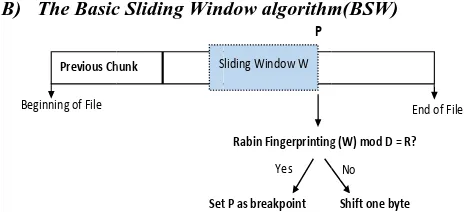
algorithm is that it may create too small chunk or too large chunk because of it has very poor control over the chunk size. Figure 2 shows Basic Sliding Window Algorithm.
A fixed-size window (W) moves one byte at a time from the beginning of the file to end of the file.
(1) At every location P, it applies Rabin Fingerprinting algorithm to calculate a hash value (h) for the current window content.
(2) If h mod D = R, then that location is the break point for chunk boundary. Sliding window W starts at the break point position P and repeat the task. (3) If h mod D ≠ R, the sliding window W keeps
shifting one byte and continue the process.
C) Two Threshold Two Divisor Algorithm (TTTD)
TTTD[28] algorithm uses everything was similar to the BSW algorithm but it utilize four parameters, the maximum threshold, the minimum threshold, the main divisor, and the secondary or backup divisor. By using minimum threshold and maximum threshold parameters, this approach give a solution of the problem happened in BSW algorithm In TTTD, the main divisor works similar to BSW algorithm and additionally it use secondary divisor to find breakpoint for chunks in case the main divisor fails to find any breakpoint. TTTD performs much better than all the existing algorithms, and enhance the performance of applications that use content based chunking.
D) Content or Application Aware-Based Chunking
Content Aware chunking method understands the format of the files, can give good deduplication ratio than the fixed-size and variable-size chunking methods. Hence, content aware chunking method compares the incoming file with its index table, which contains existing file information to identify similarities and relationship. Moreover, this method is known about the file format, so that it selects a similar format file as a reference file from an index table in order to make a comparison. Finally, it computes difference (delta) between the incoming file and its reference file, then stores this delta value rather than to store the whole incoming file.
.
E) Convergent Encryption
A technique recommended to perform deduplication on encrypted data is known as Convergent Encryption [20]. This technique uses an encryption key which is derived from the data content itself to perform encryption on the data and hence, it will generate same identical cipher text for two identical copies of the files. Moreover, this scheme ensures the privacy of user and at the
same time it will perform deduplication, unfortunately it is vulnerable to dictionary attacks.
F) Proof-of-ownership
Specifically client-side deduplication allows an adversary who knows a little information about the file can convince the server, as a result the server permits adversary to access the entire file. To overcome such kind of problem, an approach proposed is known as Proof-of-Ownership (PoWs) [5,21], which allows a client to make confirmation to the server that he is the owner of the entire file not just part of the file.
III. RELATED WORK
Xia W et al [1] surveyed the background and various methodologies used in data deduplication, which saves more storage space in storage systems. This approach eliminates redundant data at the file or chunk level and identifies duplicate data using fingerprint value. In this comprehensive study, they explained about the differences between data deduplication and traditional data compression. They have classified the data deduplication into six general categories, and created taxonomy for each category, which gives the development of the technology over the years in addition to pros and cons of the state-of-the-art approaches to all stages of data deduplication. It provides an in-depth study of the new and emerging areas for deduplication, such as delta compression, restore, garbage collection, security, reliability, etc. Further they have discussed about publicly available open-source projects, datasets, and traces for the data deduplication research community. Finally, they have summarized open problems and research challenges in front of data deduplication research.
Z. Yan et al. [2] proposed a deduplication scheme to store encrypted form of data in the cloud . This paper motive is to protect the privacy of data holders. However, encrypted data establish new trouble for cloud data deduplication, which becomes critical for big data storage and processing in cloud. It also suffers from security weakness. Hence, common deduplication schemes may not be used for encrypted data. To overcome this problem they proposed a method based on data ownership challenge and Proxy Re-Encryption (PRE) to deal with deduplicate encrypted data which is stored in cloud. They applied Elliptic Curve Cryptography (ECC) to authenticate data ownership with the support of an authorized party. This method can support data sharing with deduplication and achieved excellent performance even when the data holders are offline. Author evaluated the performance of the scheme and the test results showed that encrypted data can be safely accessed only by the authorized data owner who owns the symmetric keys required for data decryption.
privacy of users data outsourced, it is stored in an encrypted form. In this paper, they proposed a scheme based on proxy re-encryption which is used to reduce computation complexity and cost. . This scheme can flexibly support data updation and deduplication. It does not interrupt with the privacy of data owners. The efficiency of PRE and the effectiveness of encryption / decryption is tested by experimentation. As the scheme cannot be tested straightforwardly in the cloud, MYSQL database is utilized to store data files and related information. Output of the scheme upon extensive performance analysis and experimentation demonstrates it as an efficient security model.
Puzio et.al in [4] designed a system, based on
Convergent Encryption Technique. The design guarantees both block level deduplication and confidentiality of data. An additional encryption layer is introduced in this system to protect the confidentiality of the data and to avoid well known attacks against convergent encryption. This system recommended an efficient key management task performed by metadata manager (MM).MM contains a small database and a linked list in order to maintain file ownerships, file composition and avoid duplicate data storage. MM utilized file table – to maintain file Meta data, pointer table – to handle storage and signature table – to keep signature Meta data. Finally, it is concluded that the solution avoids curious cloud providers from inferring the user’s stored data.
Halevi, Shai, et al. [5] introduced the new concept known as proofs-of ownership (PoWs). Deduplication technique stores only a single copy of reoccurring data. Hash value is computed for each and every data needed to be stored in cloud. If a data is identified as duplicate using hash value, it is not stored, instead a pointer is generated for that duplicate data thus saves storage and cost.This paper mainly focused on client-side deduplication and it is applied at the file level. In client side approach, hash values of data are computed by client and forwarded for duplicate check. In this process, attacks to hack the hash value are identified. By knowing hash value, hacker may convince storage service to access the entire file of other users. To secure data and to overcome such attacks, a concept known as proofs-of ownership (PoWs) is introduced. PoW is a protocol worked between two parties a prover and verifier. First the verifier generates a (shorter) verification code ”v” , a prover needs to calculate verification code “v” and send it to verifier in order to prove his authenticity that he is the owner of the file.
In [6] Bellare et.al designed a system name it as
DupLESS, which supports deduplicated storage and also resists brute-force attacks. oblivious PRF protocol is used by key-server to provide key to the client for encryption. Secrete key is safe with key server while public key for encryption is shared among the client is established using OPRF protocol. The proof is evident that the DupLESS model enhanced the performance and reduced the storage space of encrypted data.
Ng, Wee Keong et.al in [7] introduced a new
concept known as private data deduplication protocol for cloud storages. By using this protocol, a client provides proof of ownership to the server by disclosing just the summary string of the data without informing any additional information. They proved that the suggested private data deduplication protocol is provably secure in the framework which is simulation based.
Venish. A et.alin [8] discussed different chunking
algorithms and compared its performance. Data has broken into small pieces called “chunks” and each chunk is recognized by hash value. These hash values are used to identify presence of duplicate data. According to this paper, file level chunking technique is efficient for smaller size files, but it is not suitable for larger size files. This paper addressed the boundary shifting problem occurring in fixed size chunking method and this problem can be overcome by using variable size chunking method. A variety of variable chunking methods are also discussed in this paper. Finally, they pointed out that content aware chunking method gives good results for multimedia files like videos, audio, images and decrease the space utilization.
In [9] Wen Xia et al. presented a new scheme
named as SiLo, a similarity-locality based deduplication system in order to attain high deduplication throughput and reduce RAM overhead than existing approaches. By using similarity algorithm, SiLo combine small correlated files and splits larger files to reduce RAM utilization while the locality algorithm used to remove most of the duplicate data to achieve higher throughput. Under various workload conditions, an experimental result proves that SiLo scheme is very effective.
In [10] Kiran Srinivasan et.al proposed an inline
deduplication system name it as iDedup. The design, implementation and evaluation of iDedup illustrated in this paper. In inline deduplication algorithm they derived two key insights: i) spatial locality – to perform deduplication only sequences of disk blocks, thus it reduce fragmentation; and ii) temporal locality – allows maintaining dedup-metadata in an in-memory cache in order to avoid additional IOs. Ultimately, this system reduces resource overheads (CPU and Memory) and thus iDedup appropriate for latency sensitive workloads.
Xia, Wen, et.al [11] presented a new scheme
of deduplication is improved by Delta compression scheme widening the logical space for the restoration of cache.
In [12] M. Lillibridge, et al presented a technique known as
Sparse indexing that applied sampling and locality concepts for large-scale backup storage. Chunk-based deduplication scheme needs a full chunk index to find duplicate, unfortunately, it is difficult to keep full index in RAM and thus it creates chunk-lookup disk bottleneck problem. In this approach, the above said issue has been solved by using locality principle. Segment creation, the key factor of stream deduplication, is used in this technique. sampling and sparse indexing is also used in addition to identify similar segments. Previously stored small numbers of similar segments have been chosen and deduplicate each segment against this chosen few segments whereby it avoids keeping full chunk index in RAM. This approach needs only few searches for each segment so that chunk-lookup disk bottleneck problem was avoided and simultaneously it improved the deduplication process tremendously.
D. Bhagwat et al [13] introduced a new technique
called Extreme Binning for Scalable and parallel deduplication, which is Suitable for non-traditional backup workloads. Instead of locality principle, Extreme Binning utilized file similarity principle. This approach divides the chunk index into two tiers. First tier is placed in RAM and the second tier is stored in disk. Extreme Binning system avoids chunk lookup access for each chunk in a file and it performs only one disk access for entire file. Thus, it reduced the disk bottle neck problem and gives reasonable throughput.
Fanglu Guo et al in [14] mainly focused on system design
instead of enhancing the duplicate detection algorithms. The proposed single-node deduplication system use progressive sampled indexing in memory which offers high scalability and efficient memory usage. Resource management and reclamation problem can be solved by using mark-and-sweep mechanism, which reduced disk accesses and accomplished near-optimal scalability. Furthermore, they have proposed an asynchronous interface to the server back-end, in order to forward data into server at high-enough rates. Finally, their prototype implementation oversees dedupe challenges as well as used to attain high backup, restore throughput, and gives efficient deduplication.
Kaiser J et al in [15] described a new
deduplication system for parallel processing of numerous backup streams. This approach used sorted order index for fingerprints instead of locality, so that every streams have right to access the same index region simultaneously. The implementation results proved that this approach guarantees
a disk-friendly access pattern by consuming much lesser memory than Data Domain deduplication file system and Sparse Indexing.
In [16] Xia, Wen et al put forward Ddelta, a
deduplication inspired fast delta compression method to speed up the delta encoding and decoding processes. This paper employed Gear-based chunking algorithm to quickly carry out chunking process and Spooky based fingerprinting in order to speed up duplicate identification. Moreover, greedy byte-wise scanning approach is utilized to discover more redundancy. Experimental outcome showed that Ddelta accomplishes amazing encoding and decoding when compared to traditional delta-compression approaches like Xdelta and Zdelta.
Wang J et al [17] suggested I -sieve, a high
performance inline deduplication system, which aims to build a small scale storage system. This system exploited a lightweight indexing table and a two-level cache structure using SSD in order to enhance deduplication performance. They executed I-sieve prototype and simulated common I/O features using IOmeter tool. They evaluated it with three different models, the traditional iSCSI (RAW for short) model, cache module (DC), and bloom filter modules (DCB).When compared with cache module(DC), bloom filter module (DCB) gives better performance, which speedup block retrieval. Finally, the evaluation results illustrated that I-sieve has brilliant deduplication ratio and foreground performance.
In [18]Liu J et al. developed the first single-server
scheme which supports client-side encryption in order to protect user’s privacy. This cross-user deduplication scheme employed a PAKE (password authenticated key exchange) protocol that allows two clients confidentially compare their secrets and exchange their encryption key. If two parties upload the same file, the duplicate was identified by server and it stored only one copy. Furthermore, this strategy prevents online brute-force attacks and it does not need any additional independent servers. Finally, implementation result showed the effectiveness and the efficiency of their strategy.
Xu J et al. in [19] Presented a secure client-side
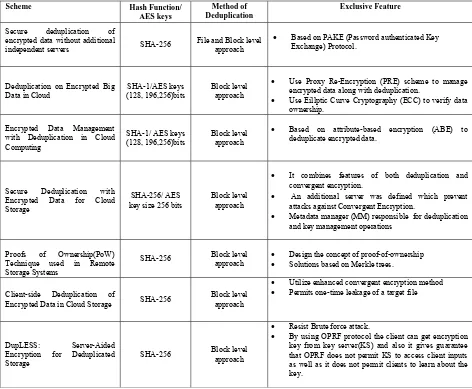
Table 1 shows the comparison of different secure related data deduplication techniques.
Table 1 Comparison of secure related data deduplication techniques
Scheme Hash Function/
AES keys
Method of Deduplication
Exclusive Feature
Secure deduplication of encrypted data without additional
independent servers SHA-256 File and Block level approach
Based on PAKE (Password authenticated Key
Exchange) Protocol.
Deduplication on Encrypted Big Data in Cloud
SHA-1/AES keys (128, 196,256)bits
Block level approach
Use Proxy Re-Encryption (PRE) scheme to manage
encrypted data along with deduplication.
Use Eillptic Curve Cryptography (ECC) to verify data
ownership.
Encrypted Data Management with Deduplication in Cloud Computing
SHA-1/ AES keys (128, 196,256)bits
Block level approach
Based on attribute-based encryption (ABE) to
deduplicate encrypted data.
Secure Deduplication with Encrypted Data for Cloud Storage
SHA-256/ AES key size 256 bits
Block level approach
It combines features of both deduplication and
convergent encryption.
An additional server was defined which prevent
attacks against Convergent Encryption.
Metadata manager (MM) responsible for deduplication
and key management operations
Proofs of Ownership(PoW) Technique used in Remote Storage Systems
SHA-256 Block level approach Design the concept of proof-of-ownership
Solutions based on Merkle trees.
Client-side Deduplication of
Encrypted Data in Cloud Storage SHA-256
Block level approach
Utilize enhanced convergent encryption method
Permits one-time leakage of a target file
DupLESS: Server-Aided Encryption for Deduplicated Storage
SHA-256 Block level approach
Resist Brute force attack.
By using OPRF protocol the client can get encryption
key from key server(KS) and also it gives guarantee that OPRF does not permit KS to access client inputs as well as it does not permit clients to learn about the key.
V. CONCLUSION
This paper has surveyed various deduplication schemes and has compared deduplication techniques and presents their relationship. Among various methods, some approaches handle encrypted data and mostly works are on the basis of convergent encryption method. It is observed from this survey, the file level approach is relatively easy to understand but not efficient for large size files while variable-size approach has high redundancy detection ability than fixed size approach. Further, this survey explores how the content aware chunking method gives better deduplication ratio than the fixed-size and variable-size chunking methods. Finally, this paper discusses some efficient indexing techniques such as sparse indexing, similarity and locality based approaches etc. Such indexing techniques support duplicate identification and also save memory space.
VI. REFERENCES
[1] Xia W, Jiang H, Feng D, Douglis F, Shilane P, Hua Y, Fu M, Zhang Y, Zhou Y. A comprehensive study of the past, present, and future of data deduplication. Proceedings of the IEEE. 2016 Sep;104(9):1681-710. [2] Z. Yan, W. Ding, X. Yu, H. Zhu and R. H. Deng,
"Deduplication on Encrypted Big Data in Cloud,"
in IEEE Transactions on Big Data, vol. 2, no. 2, pp.
138-150, June 1 2016.
[3] Z. Yan, M. Wang, Y. Li and A. V. Vasilakos, "Encrypted Data Management with Deduplication in Cloud Computing," in IEEE Cloud Computing, vol. 3, no. 2, pp. 28-35,Mar.-Apr.2016.
[4] Puzio, Pasquale, Refik Molva, Melek Önen, and Sergio Loureiro."ClouDedup:Secure Deduplication with Encrypted Data for Cloud Storage." .In Cloud Computing Technology and Science(CloudCom),2013 IEEE 5th International Conference on (Volume:1) p.363 – 370. [5] Shai Halevi , Danny Harnik , Benny Pinkas , Alexandra
[6] Bellare, Mihir, Sriram Keelveedhi, and Thomas Ristenpart. "Dupless: Server-aided encryption for deduplicated storage." Proceedings of the 22nd USENIX conference on security. USENIX Association, 2013. [7] Ng, Wee Keong, Yonggang Wen, and Huafei Zhu.
"Private data deduplication protocols in cloud storage." Proceedings of the 27th Annual ACM Symposium on Applied Computing. ACM, 2012.
[8] Venish, A., and K. Siva Sankar. "Study of Chunking Algorithm in Data Deduplication." Proceedings of the International Conference on Soft Computing Systems. Springer, New Delhi, 2016.
[9] Wen Xia , Hong Jiang , Dan Feng , Yu Hua, SiLo: a similarity-locality based near-exact deduplication scheme with low RAM overhead and high throughput, Proceedings of the 2011 USENIX conference on USENIX annual technical conference, p.26-28, June 15-17, 2011.
[10] Srinivasan, Kiran, Timothy Bisson, Garth R. Goodson, and Kaladhar Voruganti. "iDedup: latency-aware, inline data deduplication for primary storage." In FAST, vol. 12, pp. 1-14. 2012.
[11] Xia W, Jiang H, Feng D, Tian L. DARE: A deduplication-aware resemblance detection and elimination scheme for data reduction with low overheads. IEEE Transactions on Computers. 2016 Jun 1;65(6):1692-705.-1705.
[12] M. Lillibridge, K. Eshghi, D. Bhagwat et al., “Sparse indexing: Large scale, inline deduplication using sampling and locality.” in Proceedings of the 7th USENIX Conference on File and Storage Technologies (FAST’09), vol. 9. San Jose, CA: USENIX Association, February 2009, pp. 111–123.
[13] D. Bhagwat, K. Eshghi, D. D. Long et al., “Extreme binning: Scalable, parallel deduplication for chunk-based
file backup,” in Proceedings of IEEE International Symposium on Modeling, Analysis & Simulation of Computer and Telecommunication Systems (MASCOTS’09). London, UK: IEEE Computer Society Press, September 2009, pp. 1–9.
[14] Fanglu Guo and Petros Efstathopoulos. 2011. Building a high-performance deduplication system. In Proceedings of the USENIX Annual Technical Conference (ATC). USENIX, Berkeley, CA, 1–14.
[15] Kaiser J, Süß T, Nagel L, Brinkmann A. Sorted deduplication: How to process thousands of backup streams. InMass Storage Systems and Technologies (MSST), 2016 32nd Symposium on 2016 May 2 (pp. 1-14). IEEE.
[16] Xia, Wen, Hong Jiang, Dan Feng, Lei Tian, Min Fu, and Yukun Zhou. "Ddelta: A deduplication-inspired fast delta
compression approach." Performance Evaluation 79 (2014): 258-272.
[17] Wang J, Zhao Z, Xu Z, Zhang H, Li L, Guo Y. I-sieve: An inline high performance deduplication system used in cloud storage. Tsinghua Science and Technology. 2015 Feb;20(1):17-27.
[18] Liu, Jian, N. Asokan, and Benny Pinkas. "Secure deduplication of encrypted data without additional independent servers." In Proceedings of the 22nd ACM SIGSAC Conference on Computer and Communications Security, pp. 874-885. ACM, 2015.
[19] Xu, J., Chang, E.C., Zhou, J.: Weak leakage-resilient client-side deduplication of encrypted data in cloud storage. In: 8th ACM SIGSAC Symposium, pp. 195– 206.
[20] J. Douceur, A. Adya, W. Bolosky, D. Simon, and M. Theimer. “Reclaiming space from duplicate files in a serverless distributed file system. In Distributed Computing Systems”, 2002. Proceedings. 22nd International Conference on, pages 617{624. IEEE, 2002.
[21] Di Pietro R, Sorniotti A. Boosting efficiency and security in proof of ownership for deduplication. InProceedings of the 7th ACM Symposium on Information, Computer and Communications Security 2012 May 2 (pp. 81-82). ACM.
[22] Mogul J, Douglis F, Feldmann A, Krishnamurthy B (1997) Potential benefits of delta encoding and data compression for HTTP. In: Proceedings of ACM SIGCOMM’97 conference, pp 181– 194, Sept 1997. [23] Rabin M.O., “Fingerprinting by random polynomials.
Center for Research in Computing Technology”, Aiken Computation Laboratory, Univ., 1981.
[24] CoxL. P., MurrayC. D., and NobleB. D., “Pastiche: Making backup cheap and easy”, ACM SIGOPS Operating Systems Review, vol. 36, no. SI pp. 285–298, 2002.
[25] Wilcox-O’HearnZ. and WarnerB., “Tahoe: the least- authority file system”, Proceedings of the 4th ACM International workshop on Storage Security and Survivability.pp.21–26, 2008.
[26] National Institute of Standards and Technology, FIPSPUB 180-1: Secure hash Standards, Technical Report, 1995.
[27] R. Rivest, The md5 message-digest algorithm, http://www.ietf.org/rfc/rfc1321.txt, 1992.