IJEDR1502169
International Journal of Engineering Development and Research (www.ijedr.org)962
A Hybrid Routing Protocol in Localization of
Wireless Sensor Networks
Hardik Sarvaiya1, Prof. Sanjay M. Shah2 ME Scholar1, Associate Professor2 Computer Science and Engineering1,2,
Government Engineering College, Sector-28, Gandhinagar, India1,2
________________________________________________________________________________________________________
Abstract - Wireless sensor networks are ad hoc wireless networks composed of number of small nodes with sensing capabilities and physical characteristics .WSNs have attracted a lot of attention by scientific community. Small and inexpensive nodes with low energy consumption and limited resources are adopted in many applications like environment monitoring, target tracking and medical health monitoring. Main system parameter of application is node localization. In generally, localization schemes are classified into two broad categories: range-based and range-free. Existing range-free schemes usually give poor results in routing packets of information in terms of Packet Delivery Ratio, End-to-End Delay, Packet loss. Several localization algorithms have been proposed which can be used for better routing packets, low localization error, reducing power consumptions, for security and irregular locations of many nodes. Each algorithm has its own typical features and none is absolutely the best. We propose a hybrid routing protocol in localization, which is integration of two different routing protocols. The aim of hybrid scheme will be to achieve better Packet Delivery Ratio, End-to-End Delay and low Packet loss.
Index Terms – hybrid routing protocol, Wireless sensor networks, protocols in localization
________________________________________________________________________________________________________
I.INTRODUCTION
There is a most simple equation about wireless sensor networks:
Sensors + processors + Radio transmission = Number of potential applications
A wireless sensor network is used to monitor environmental conditions such as sound, pressure temperature and much more parameters of sensing in distributed autonomous area. and to cooperatively pass various data through the network to a main location. Nowadays networks are bi-directional, sending data and receiving data also enabling control of sensor activity. This area of wireless sensor networks is motivated by military applications such as surveillance of battlefield. today many networks are used in various areas like industry level applications and consumer applications such as industrial process control and monitoring, machine health monitoring, and much more.
The sensor networks is built of nodes , from a limited number to several hundreds or even thousands, where each and every node are connected. Each node has normally several parts: a radio with internal antenna and transceiver modules, connection to an external antenna, a microcontroller, an electronic circuit which interface with both sensors and energy sources commonly a battery or an embedded form of energy harvesting. The cost of sensor nodes is likewise variable, inn between few to hundreds of dollars, cost depends on complexity of sensor nodes. cost and size of sensor nodes result in corresponding resources such as memory, communication bandwidth, energy, computational speed. The topology of the sensor networks can differ from a simple star topology network to an advanced multi-hop wireless mesh topology network. Wireless sensor networks are an active research area with numerous workshops and conferences
Figure-1 wireless sensor network architecture
IJEDR1502169
International Journal of Engineering Development and Research (www.ijedr.org)963
information the data received in the sin node cannot be identified where it comes from and becomes meaningless to the application. Nodes without location information are known as blind or ordinary nodes and with location information are known as beacon or anchor nodes. Localization is not only needed for tagging of an object it is also needed for fiding optimum coverage of an area and fiding optimal routes in geographic routing. Location information can be used to design efficient networking and management protocols. Localization problem is closely dependent on how nodes are deployed in environment.II.ROUTING PROTOCOL IN LOCALIZATION[7]
Routing in sensor networks is very important and challenging task due to numerous characteristics that differentiate them from wireless sensor networks and communication. There is not possible to figure out the most global scheme for deploying of many sensor nodes. Therefore, conventional IP-based protocols can’t be applied to sensor networks. Second, in conflicting to the classic communication networks almost all applications of sensor networks needs the flow of sensed data from multiple sources to a particular sink. Third, produced data traffic has significant redundancy in it since multiple sensors may generate same data within the vicinity of a phenomenon. Such redundancy needs to be broken by the routing protocols to improve bandwidth utilization and energy. Fourth, sensor nodes are tightly constrained in terms of on board energy, processing capacity transmission power and storage and thus require careful resource management. Due to this types of differences we proposed many new algorithms for the routing data in networks. These routing mechanisms have measured the characteristics of sensor nodes along with the architecture requirements and application. Almost all of the routing protocols can be classified as hierarchical, location based and data centric although there are few distinct ones based on network flow or QoS awareness. Data-centric protocols are query-based and depend on the naming of data, which benefits in removing much redundancy of transmissions. Hierarchical protocols aim at save energy by clustering the nodes and reducing the data. Location based protocols utilize the location information to relay the data to the desired recourse rather than the whole network. The location based protocol includes routing approaches that are based on general network-localization schemes that gives results on based routing different types of measurements parameters.
III.EVALUATING MEASUREMENTS OF ROUTING PROTOCOLS[9]
Packet delivery ratio: the ratio of the number of delivered data packets to the destination. Gives results of how many packets are delivered to destination
Number of packets receive / Number of packets send
The high value of packet delivery ratio means the better performance of the algorithm.
End to end delay : the average time of the received packets at destination. It also comprises the delay caused by queue in data packet transmission and route discovery process. Only the packets that successfully delivered to destinations that are calculated.
∑ ( receive time – send time ) / ∑ Number of connections
The less the value of end to end delay means the performance of the algorithm is better.
Packet loss : during the simulation of routing, total number of dropped packets known as packet loss. Packet loss = Number of packet sent – Number of packet received .
The less the value of the packet loss means the better performance of the algorithm.
IV.PROPOSED METHODOLOGY
A. Problem Definition
Existing methods of range-free schemes mostly give poor results in routing packets in terms of Packet Delivery Ratio, End-to-End Delay, Packet loss. Some of factors that influence Performance of WSN Network include: packet loss during routing, packet delivery Error Ratio, Power consumptions ,Security etc.
B. Problem solution
IJEDR1502169
International Journal of Engineering Development and Research (www.ijedr.org)964
C. Proposed WorkFigure-2 proposed work
The proposed work is achieved by above steps. First is number of nodes will be initialized and they will start broadcasting signals. By using neighbour discovery protocol (NDP) we can define the neighbour of each nodes and it will have all details of neighbour nodes. After that we use hybrid algorithm that gives the output.tr trace file. Trace file have all details of sending and received packets. This output will give to awk file that is generally data extractor file using in scripting language. That awk files gives results about packet delivery ratio, packet loss, and end to end delay. And last use xgraph tool to display graph of results.
D. Implementation work flow
Figure-3 implementation work flow
Shown in above figure that all implementation work was done in that flow. We using NS2 simulator for the networking simulations. First of all we implement the environment for the existing routing methods to localize the 42 sensor nodes in wireless networks.
With help of the xgraph tool in the NS2 analysis the existing methods and gives results about packet loss, end to end delay and packet delivery ratio in terms of routing packets through created environment networks. Then after proposed hybrid zrp method was implement and analysis their results via xgraph tools. At last we compare the all results of routing protocols in parameters of packet loss, end to end delay and packet delivery ratio
IJEDR1502169
International Journal of Engineering Development and Research (www.ijedr.org)965
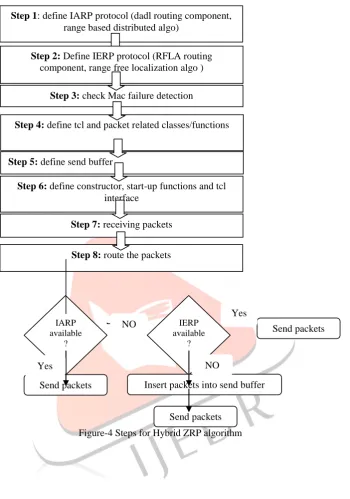
Figure-4 Steps for Hybrid ZRP algorithmF. Simulation Results
Parameters Value
Number Of Nodes 42
Simulation Area 1400*300
MAC type Mac/802_11
Routing Protocol ZRP,RFLA,DADL
time of simulation end 10,20,30,40 sec Table 1 parameters taken for simulation
Step 1: define IARP protocol (dadl routing component, range based distributed algo)
Step 2: Define IERP protocol (RFLA routing component, range free localization algo )
Step 3: check Mac failure detection
Step 4: define tcl and packet related classes/functions
Step 5: define send buffer
Step 6: define constructor, start-up functions and tcl interface
Step 7: receiving packets
Step 8: route the packets
IARP available
?
IERP available
?
Send packets
Send packets
Insert packets into send buffer
Send packets NO
NO Yes
IJEDR1502169
International Journal of Engineering Development and Research (www.ijedr.org)967
Figure-6 comparison of end to end delayIJEDR1502169
International Journal of Engineering Development and Research (www.ijedr.org)968
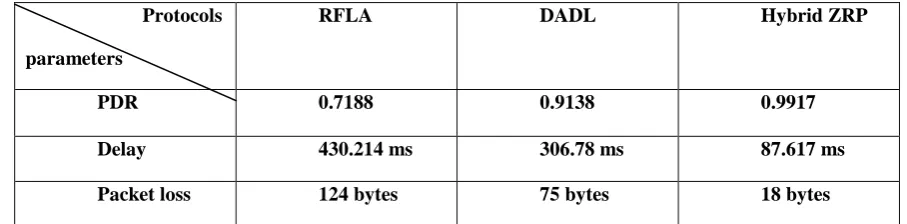
G. Performance matricesProtocols
parameters
RFLA DADL Hybrid ZRP
PDR 0.7188 0.9138 0.9917
Delay 430.214 ms 306.78 ms 87.617 ms
Packet loss 124 bytes 75 bytes 18 bytes
Table 2 comparision parameters of methods at 20 simulation end time
V.CONCLUSION
Localization in wireless sensor network is a hot area of research that has been addressed through many proposed schemes. WSNs are a current area of research, there are already various routing schemes in localization. Each with an emphasis on specific scenario and/or application existing range-free schemes usually give poor results in terms of routing packets. Each and every algorithm has their own classical features and no one is completely the best algorithm. Hybrid routing protocol in localization provides better accuracy than single one. We implement a hybrid routing scheme, which is integration of two different routing protocols. The performance comparison of proposed scheme with integrating schemes is done via simulation results. As per shown in graphs and by comparing all graphs in terms of Packet Delivery Ratio, End-to-End Delay, Packet loss we can conclude that hybrid scheme is gives us better results than existing ones.
REFERENCES
[1] Jeffrey HS Tay, Vijay R Chandrasekhar, and Winston KG Seah,”Range-free Localization Using Dynamic Hop Size Computation in Wireless Sensor Networks”, 2006 IEEE.
[2] Yen-Hsu Chen, Wei-Ho Chung, Shih-Yi Yuan, Hongke Zhang, and Sy-Yen Kuo,” Order-Based Localization Scheme for Ad Hoc Sensor Networks”,2011 IEEE.
[3] Yan-Ling Chu, Jau-Rong Tzeng, Yung-Pin Cheng and Min-Te Sun,” Density-Adaptive Range-Free Localization in Large-Scale Sensor Networks”,2012 IEEE.
[4] ZHAO Hu, LI Zhi,” Dynamic-Anchor Distributed Localization in Wireless Sensor Networks”,2008 IEEE.
[5] U. Nazir, M. A. Arshad, N. Shahid, S. H. Raza,” Classification of Localization Algorithms for Wireless Sensor Network: A Survey”,2012 IEEE.
[6] I.F. Akyildiz, W. Su , Y. Sankarasubramaniam, E. Cayirci,” Wireless sensor networks: a survey”, 2002 Published by Elsevier Science B.V
[7] Kemal Akkaya and Mohamed Younis,”A Survey on Routing Protocols for Wireless Sensor Networks”, University of Maryland, Baltimore County,Baltimore, MD 21250
[8] https://en.wikipedia.org