IJEDR1403073
International Journal of Engineering Development and Research (www.ijedr.org)3264
A Study and Application of Lean Construction
Techniques Using Last Planner Concept in
Residential Building
1
Mr. J. Rajprasad,
2Shuaibu Saminu,
3Harish Babu S.
1
Assistant Professor, 2,3PG Students Department of Civil Engineering.
Faculty of Engineering and Technology SRM University, Tamil Nadu, Channai India.
________________________________________________________________________________________________________
Abstract - This study intends to provide a better understanding of the Last Planner System (LPS) which is a Lean Construction concept by analyzing the various schedule systems involved in the concept. The Last Planner System (LPS) is a production control system for managing projects. It supplements or replaces a typical management system based on activities and a defined schedule produced by a project manager. The LPS produces predictable workflow and rapid learning. This produces maximum value to the owner by eliminating waste caused by unpredictable workflow. Its use has enabled contractors to reduce the delivery time of a project and at the same time allowed specialty contractors to improve utilization of their resources. This paper focuses on implementing Last Planner System in residential construction by comparing the present scheduling techniques used in the industry. The data is collected through questionnaire survey. A total of 25 respondents are interviewed and the results are analyzed using the software Statistical Package for Social Sciences (SPSS). The results indicated that the respondents are not familiar with the LPS concept. The residential contractors are presently following the Master Schedule method to track their projects. Previous usages of LPS in construction projects proved that the system helps to improve the schedule performance and to avert the possible mistakes. It was concluded that with effective training in the concepts of LPS, the builders can overcome schedule delay and can improve the standards of the projects.
Key words - Value, Value Stream, Supply flow, Pull, Perfection, Last planner
________________________________________________________________________________________________________
I. INTRODUCTION
Surveys indicate that up to 30% of construction costs are due to inefficiencies, mistakes, delays, and poor communications. The construction industry faces many similar obstacles in both the developed and developing nations. In both nations the concept of construction performance does not emphasize on productivity and quality initiatives. The work of many researchers has revealed an industry tendency to measure performance in terms of the following: completion on time, completion within budget, and meeting construction codes. Very little attention has been directed to owner satisfaction as a performance measure.
Last Planner Concept In Constrctruction
Lean thinking in construction is a philosophy based on the concepts of lean production. The first consideration of the ideas of lean production for use within construction is formulated through transformation-flow-value generation model of production, known as the TFV theory of production, which could lead to improved performance when applied to construction. The proposed study review construction production as a combination of conversion and flow processes to remove waste, when traditional thinking of construction was only focusing on conversion activities and ignoring flow and value considerations (Glenn Balard and Gregory A. Howel 2002). There are eight types of waste which are commonly agreed on by researchers: Transportation, Inventory, Motion, Waiting, Over-Production, Consequently, many researchers emphasised the importance of the use of appropriate performance measurement systems, which can give early warnings and identify problems before they occur, to support the successful implementation of lean construction (Lantelme and Formoso, 2000).
Lean construction maximizes value and reduces waste. It accomplishes these objectives through the use of Supply Chain Management (SCM) and Just-In-Time (JIT) techniques as well as the open sharing of information between all the parties involved in the production process. Lean concept, developed by TaichiiOhno in the 1950s, is based on lean manufacturing. The lean philosophy includes minimizing waste in all forms and continuous improvement of processes and systems.
II. METHODOLOGY
In this paper, an intensive study of previous work in the area of lean construction and last planner concept which helps to know the basic knowledge for this research and also for developing implementation strategy. Basically high cost projects, medium cost projects and low cost projects have been selected and focused.
Last Planner Concept In Construction
© 2014 IJEDR | Volume 2, Issue 3 | ISSN: 2321-9939
IJEDR1403073
International Journal of Engineering Development and Research (www.ijedr.org)3265
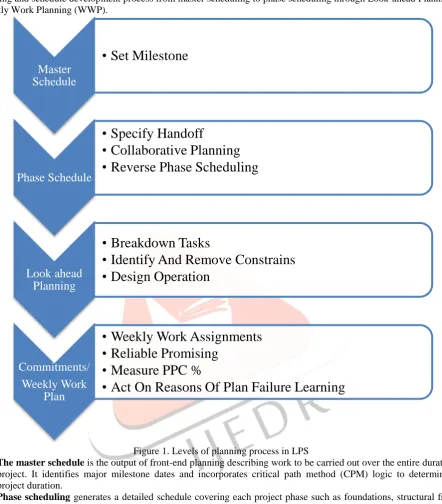
operations. The system originally addressed variations in workflow at the weekly work plan level but soon expanded to cover the full planning and schedule development process from master scheduling to phase scheduling through Look-ahead Planning (LAP) and Weekly Work Planning (WWP).Figure 1. Levels of planning process in LPS
1. The master schedule is the output of front-end planning describing work to be carried out over the entire duration of the project. It identifies major milestone dates and incorporates critical path method (CPM) logic to determine overall project duration.
2. Phase scheduling generates a detailed schedule covering each project phase such as foundations, structural frame, and finishing.
3. Look-ahead planning signifies the first step of production planning with a time frame usually spanning between two to six weeks.
4. Commitment planning represents the most detailed plan in the system showing the interdependence between the works of various specialist organizations. It directly drives the production process.
Last Planner Planning In Detailed Process
Decisions regarding what work to do in what sequence over what durations using what resources and methods are made at every level of the organization, and occur throughout the life of the project. Ultimately, some planner produces assignments that direct physical production. This “last planner” is last in the chain because the output of the planning process is not a directive for a lower level planning process, but results in produced is different and which is shown below:
Master
Schedule
• Set Milestone
Phase Schedule
• Specify Handoff
• Collaborative Planning
• Reverse Phase Scheduling
Look ahead
Planning
• Breakdown Tasks
• Identify And Remove Constrains
• Design Operation
Commitments/
Weekly Work
Plan
• Weekly Work Assignments
• Reliable Promising
• Measure PPC %
IJEDR1403073
International Journal of Engineering Development and Research (www.ijedr.org)3266
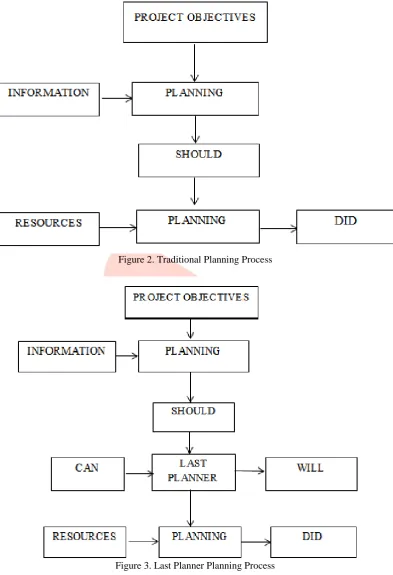
Figure 2. Traditional Planning ProcessFigure 3. Last Planner Planning Process
The figure above shows how the last planner method of planning which includes should-can-will-do analyses process and at the end resources planning is done.
Stabilizing the work environment begins by learning to make and keep commitments. Last planners can be expected to make commitments (WILL) to do what SHOULD be done, only to the extent that it CAN be done. Expressing this as a rule, we might say: Select assignments from workable backlog; i.e. from activities you know can be done.
Milestone Schedule Method
The milestone schedule should divide the project into logical phases. The duration should be established in manner so that those responsible for the project are confident that the work can be completed as planned. This may require the development of a more detailed CPM, conversations with those responsible for work on the critical path or other investing.
© 2014 IJEDR | Volume 2, Issue 3 | ISSN: 2321-9939
IJEDR1403073
International Journal of Engineering Development and Research (www.ijedr.org)3267
All the team members responsible for the work to deliver a milestone will participate in developing the Phase Pull Schedule (PPS). PPS should be developed in a face to face conversation that establishes context, define the milestone deliverable, develops an execution strategy, identifies tasks and organizes them in a pull plan working from the end of the phase back. All tasks on the PPS must produce a deliverable defined in terms accepted by their customer.
Look-ahead Plan Method
Activities in the PPS established tasks in the Week Look-ahead Plan (WLAP) each week. The link between task in the LAP and PPS activities should be recorded and maintained.
Sub-tasks can be created and linked to tasks in the LAP. Typically, the hand-off of work between trades is established in PPS level tasks. Sub-tasks are usually managed within each craft.
Tasks and sub-tasks produce deliverables.
Assignments on the WLAP should be sized for daily completion. Larger assignments may be made if this not practical, that is work will span several days and interim completion is difficult to establish.
Inspection task should be included in WLAP when inspections are required before the next crew begins.
Last Planner System
Figure 4. look ahead planning method Identifying Constraints
Constraints are those directives, resources and prerequisite work not shown on the PPS that are required to start and complete tasks.
The link between constraints and tasks will be maintained.
Tasks (and sub-tasks) on entering LAP are screened for constraints by the responsible individual and at least again when assigned to Last Planners (LP).
Responsible individual will remove those constraints normally within their authority and make requests to other for those beyond their authority.
Requests that require a promise from someone outside organization will be made through established channels and recorded on the project constraint log.
Preparing Weekly Work Plan
All the tasks in the Weekly Work Plan (WWP) should be in the WLAP and linked to PPS.
Only tasks in a condition to start and finish on time should be included in WWP. In rare cases, work that is not in a ready condition may be included even though the LP is not confident it can be Made Ready or completed. In this case, the next LP must be notified that the work may not be delivered.
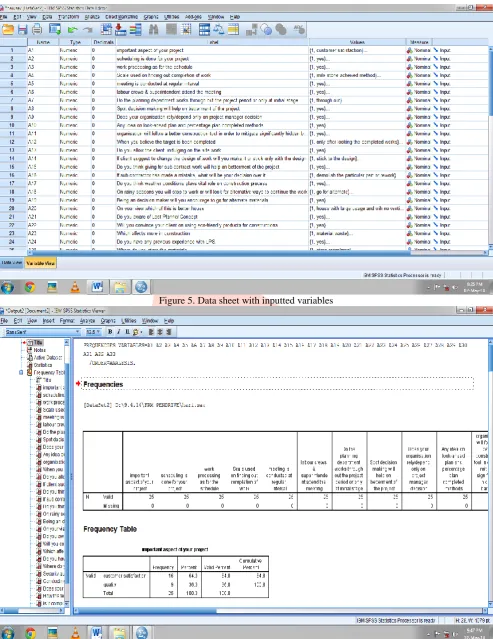
III. ANNALYSISCARRIEDOUTUSINGSPSSSOFTWARE
IJEDR1403072
International Journal of Engineering Development and Research (www.ijedr.org)3268
Figure 5. Data sheet with inputted variablesFigure 6. Frequency Table with Cumulative Value
© 2014 IJEDR | Volume 2, Issue 3 | ISSN: 2321-9939
IJEDR1403072
International Journal of Engineering Development and Research (www.ijedr.org)3269
IV. RESULTSANDANAYLSISThe survey is conducted on various ranges of companies; each company differs from the technique they implement regarding planning, execution and working style. From our 25 respondents half of the companies are working with project value of more than 10 crores and some with less than 5 crores and few with less than 2 crores. The questions we asked are answerable by al l range of companies.
Therefore, the results were obtained using SPSS software, initially for the survey work 25 companies were approached which are in and around Chennai and totally of 33 questions were asked mainly regarding the method of construction they follow, back ground of their organisation, main obstacles they face on execution part and various other factors like weather condition, knowledge regarding LPS and other important factors. From the result or answer we obtained from the companies a data sheet is made using SPSS software. The input provided are based on the respondent weightage for each question the value gets raised accordingly. The result is obtained using cumulative percent formula. From 33 questioner survey, 10 important questions are taken for the analysis.
V. RECOMENDATIONS
Last Planner System in Residential Construction
The Last Planner System (LPS) is a production control system for managing projects. It was developed by Ballard (2000) and Howell (1999) as a production planning and control system to assist in smoothing variations in construction work flow, developing planning foresight, and reducing uncertainty in construction operations. The system originally addressed variations in workflow at the weekly work plan level but soon expanded to cover the full planning and schedule development process from master scheduling to phase scheduling through Look-Ahead Planning (LAP) and Weekly Work Planning (WWP).
As a lean tool, LPS advocates:
1. Planning in greater detail as time gets closer to executing the work, 2. Developing the work plan with those who are going to perform the work,
3. Identifying and removing work constraints ahead of time as a team to make work ready and increase reliability of work plans,
4. Making reliable promises and driving work execution based on coordination and active negotiation with trade partners and project participants, and
5. Learning from planning failures by finding the root causes and taking preventive action
VI. CONCLUSION
The theoretically informed analysis of the LPS shows that its implementation has a particular impact on the technical-organizational learning environment, influencing it in a direction that can be seen as advantageous in that it promotes conditions which are associated with job satisfaction. Thus, it can also be expected to create a positive spin-off effect with regard to the socio-cultural environment, through the creation of a series of new meeting arenas of great importance for reflection and experiential learning. Based on learning theory, the main challenge associated with implementing the LPS is to ensure that the work identity of employees alters in a way that matches the desired work practice. Resistances to change can be traced to the psycho-dynamic dimension, where our emotions are found. Thus, seeking to implement the LPS and other major changes in general, is a futile exercise unless key personnel in the project management are positive to such a move. Based on the input from learning theory, a considerably more efficient approach is to draw on additional resources from the company in question, or to hire in external consultants, or to invite researcher’s to work on projects in collaboration with the ordinary project staff during an alteration phase, based on an action research perspective. Such an approach also has the potential of overcoming the inherent limitations of experiential learning. When the LPS are practiced as intended, it produces an experiential learning cycle. This requires an active approach to evaluation plans by those involved in the project in order to uncover underlying reasons for failure to complete tasks as planned and it also depends on this knowledge being shared on the same arena.
REFERENCE
[1] Bo Terjekalsaas(November 27,2011),The Last Planner System Style Of Planning: Its Basis In Learning Theory, Journal Of Engineering, Project And Production Management 2012,
[2] Carlos T. Formoso And Camile B. Moura(2000),Evaluation Of The Impact Of The Last Planner System On The Performance Of Construction Projects, International Conference On Engineering And Project, Production Management.
[3] Eric Johansen And Geoff Porter(August 2002), An Experience Of Introducing Last Planner Into A Uk Construction Project, Paper Presented At The 11th Annual Conference Of The International Group For Lean Construction, Gramado, Brazil, [4] Glenn Balard And Gregory A. Howell(2002),An Update On Last Planner, Paper Presented At The Founding Conference Of
The Iglc (Ballard, 2002)
[5] Luis F. Alarcón, Sven Diethelm And Rodrigo Calderon(13, July 2005), Assessing The Impacts Of Implementing Lean Construction,Proceedings Iglc-13, July 2005, Sydney, Australia
[6] Marion M. Russell, Greg Howell Simon M. Hsiang, And Min Liu, Causes Of Time Buffer In Construction Project Task Durations,20th Annual Conference Of The International Group For Lean Construction.
[7] Olli Seppannen, Glenn A Ballard, Sakaripersonen(2010),The Combination Of Last Planner System And Location Based Management System, Based Management System,
IJEDR1403072
International Journal of Engineering Development and Research (www.ijedr.org)3270
[9] SaadSarhan And Andrew Fox(2013),Performance Measurement In The Uk Construction Industry And Its Role In SupportingThe Application Of Lean Construction Concept,Australasian Journal Of Construction