The free recall search process introduces errors in short term memory but apparently
not in long term memory
Eugen Tarnow, Ph.D. 18-11 Radburn Road Fair Lawn, NJ 07410 [email protected] (e-mail)
Abstract:
Introduction
Methods
This article does not itself involve any new experiments but rather makes use of existing experiments and statistically synthesizes their data. Below are summaries of the experimental processes undertaken to arrive at the four existing datasets used in this paper.
The Murdock (1962) data can be downloaded from the Computational Memory Lab at the University of Pennsylvania (http://memory.psych.upenn.edu/DataArchive). In this experiment, 103 undergraduate subjects were read 80 lists of words devised from a random selection of the approximately 4,000 of the most common English words at the time. The subjects were read the lists 20 at a time in groups of five over four sessions, each spaced by a period of 2-7 days. There were six types of word quantity/presentation rate combinations that subjects could have heard: 10 words per list at a presentation rate of .5 words per second, 20 words per list at a presentation rate of one word per second, 15 words per list at a presentation rate of .5 words per second, 30 words per list at a presentation rate of one word per second, 20 words per list at a presentation rate of .5 words per second, and 40 words per list at a presentation rate of one word per second. A metronome was used during the sessions to ensure the accuracy of the presentation rates. After each list was read, subjects were given 1.5 minutes to recall as many words as they could. A verbal “Ready” signal was used to terminate each recall period and indicate 5-10 seconds until the beginning of the next list-reading.
Murdock and Okada (1970) investigated inter-response times in single-trial free recall. Each of 72 subjects was tested with 20 20-item word lists presented visually at a presentation rate of either 1 or 2 words per second. Spoken recall was tape-recorded and timed afterwards. The data can also be downloaded from the
Computational Memory Lab at University of Pennsylvania (http://memory.psych.upenn.edu/DataArchive).
minutes for the recall phase. Before any list was read, the experimenter would say “list” followed by the
corresponding number of the list such as “list one” for the first or “list two” for the second. After the list was read, the experimenter would say “recall” to indicate the beginning of the recall phase.
Results
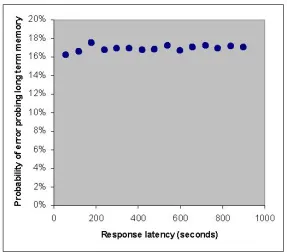
Fig. 1. Probability that a response is erroneous versus response latency. Data from Murdock & Okada (1970).
The time to read a word was not recorded in the data and set to 1 second. Changing this time parameter to 0.5
seconds did not change the results.
Fig. 2. Probability that a response is erroneous versus response latency when probing long term memory (two
The short term memory search process thus might introduces random excitations which also activates erroneous items. The subject judges an item as a “presented” item perhaps when the activation level of an erroneous item is as high as the activation level of a presented item (indeed, the probability of closely related items to be erroneously detected is at least the same as the probability of the least remembered list item in Roediger & McDermott, 1995 and McDermott, 1996). In other words, as long as the activation level of an erroneous item is the same as the activation level of presented items, subjects might not be able to tell the difference between erroneous and presented items and recalls an error.
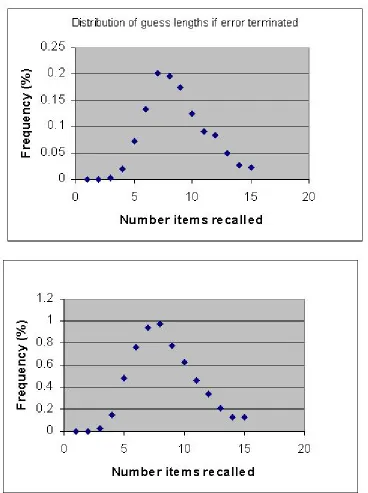
Fig. 3. The distribution of error terminated series (upper panel) and non-error terminated series (lower panel)
Experimental series
t
t distribution
10-2
0.57
57%
15-2
0.000005
100.00%
20-2
0.05
96%
20-1
0.62
54%
30-1
0.87
38%
40-1
0.09
93%
All together
0.00082
99.94%
Table 1. Values of t and the corresponding chance that two identical distributions would have given that t value.
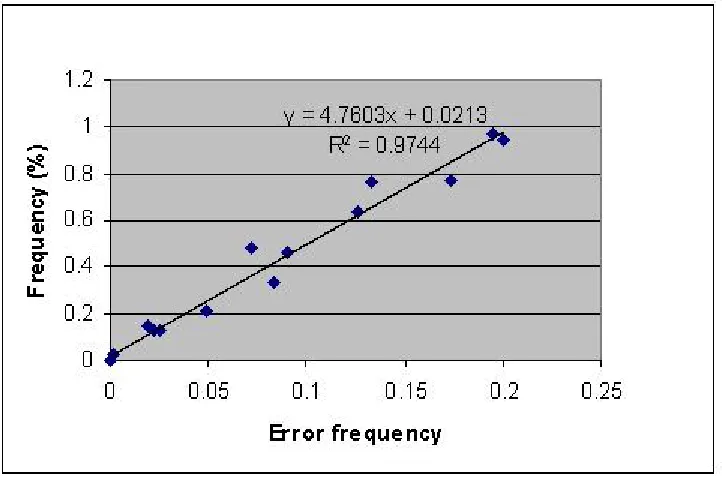
Fig. 4. Frequencies of recall of error terminated and non-error terminated sets plotted against each other for
same item total numbers which also shows that the two distributions are equal. Average over all Murdock
(1962) data.
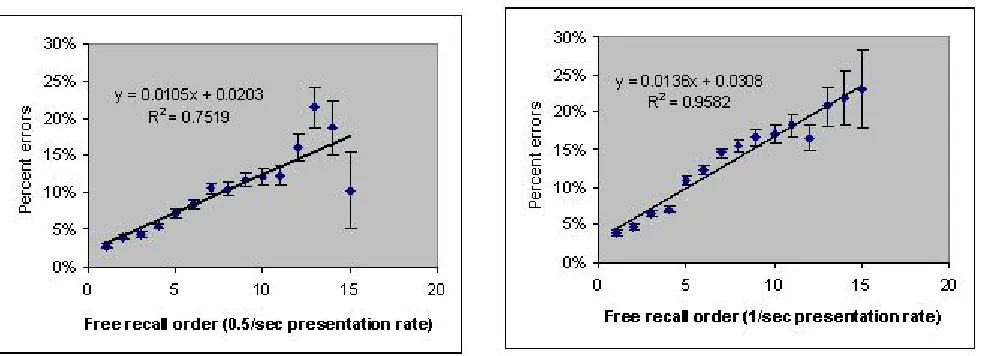
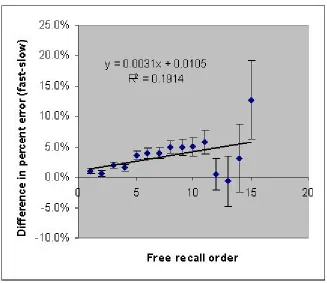
presentation rate and the right panel the data for the faster presentation rate. The probability of a recall error increases close to linearly with the recall position. There is also an offset – even the first item recalled has an error (which also sets a limit on the transcription error of at most 2.5%). In Fig. 6 is shown the differences in the number of errors as a function of recall position with the lower presentation rate errors subtracted from the higher presentation rate errors. The higher presentation rate increases the probability of error, both the offset and the slope.
Fig. 5. Recall errors as a function of the recall position for the data in Murdock (1962). The left panel shows the
average over the data with 0.5/second presentation rate and the right panel shows the average over the data
with 1/second presentation rate. Note that the error rate increases linearly with the free recall order. The error
Fig. 6. Difference in number of recall errors for the two presentation rates in Murdock (1962) (low presentation
rate subtracted from the high presentation rate). The error bars in each direction are the standard deviation of a
Poisson distribution.
Fig. 7. Probability of particular intrusion error in Roediger & McDermott (1995), left panel, and McDermott
(1996), right panel. In both cases the errors form not a linear function but an exponential function (the y-axis is
logarithmic so an exponential function will display as a straight line). It is not clear why the two graphs are
Discussion
Many interesting findings came out of our analysis of the data of Murdock (1962), Murdock & Okada (1970), Roediger & McDermott (1995), and McDermott (1996):
First, short term memory errors in free recall are introduced by the search. That search of short term memory should introduce errors makes sense. We know that the search appears to be random (Murdock & Okada, 1970) and a search mechanism of random excitation (or amplification like in Posner, 1994, ) to see which short term memories are most quickly reactivated is plausible.
Second, the search mechanisms of short term memory and long term memory must be different: the short term memory search introduces errors (error rate proportional to the search time for time scales up to 60 seconds with a proportionality constant of 1% per second) while the search of long term memory does not (on the time scale of 15 minutes). This also makes sense. While activation can make erroneous items look the same as presented items, long term memories take longer to create. The search process would have at least have to be on the order of the time scale of protein synthesis (Kandell, 2001) to create erroneous items that look equivalent to the presented items.
Third, if the search occurs by random excitations that reactivate previous list items or increase the activation level of related items, the subjects have no way to tell the difference between erroneous and presented items. That subjects were unaware of making the errors was suggested by the error-terminated output item distributions being the same as those terminated by presented items and was earlier observed by others for closely related items (for a review, see, for example, Gallo (2010)). The only way an insightful subject can decrease the error rate is to limit the search time which would unfortunately also limit the number of correct items reported.
References
Bartlett FC (1932). Remembering: A study in experimental and social psychology. Cambridge, England: University Press.
Deese J (1959) On the prediction of occurrence of particular verbal intrusions in immediate recall. Journal of Experimental Psychology 58(1) 17-22
Gallo DA, Roberts MJ, Seamon JG (1997) Remembering words not presented in lists: Can we avoid creating false memories? Psychonomic Bulletin and Review 4(2) 271-276
Gallo DA (2010) False memories and fantastic beliefs: 15 years of the DRM illusion, Memory & Cognition, 38, 833-848.
Kandel, E.R. (2001). The Molecular Biology of Memory Storage: A Dialogue Between Genes and Synapses. Science, pp. 1030-1038.
McDermott, K. B. (1996). The persistence of false memories in list recall. Journal of Memory & Language, 35, 212-230.
Murdock B B (1962). The serial position effect of free recall. Journal of Experimental Psychology 64(5) 482-488.
Murdock, B B and Okada R (1970). Interresponse times in single- trial free recall. Journal of Verbal Learning and Verbal Behavior, 86, 263-267.
Posner MI (1994) Attention: The mechanisms of consciousness, PNAS 91, 7398-7403
Roediger, H. L., III, & McDermott, K. B. (1995). Creating false memories: Remembering words not presented in lists. Journal of Experimental Psychology: Learning, Memory, & Cognition, 21, 803-814.
Tarnow E (2010). The initial free recall is different from subsequent recalls: offset and constant search time suggest context identification and/or clustering of items. Submitted for publication.
Wixted JT, Rohrer D (1993). Proactive Interference and the Dynamics of Free Recall. Journal of Experimental Psychology: Learning Memory and Cognition 19(5) 1024-1039