International Journal of Women’s Health
Safety and effectiveness of termination services
performed by doctors versus midlevel providers:
a systematic review and analysis
Thoai D Ngo1,2 Min Hae Park1 Caroline Free2
1Research, Monitoring and Evaluation
Team, Health System Department, Marie Stopes International, UK;
2Faculty of Epidemiology and
Population Health, London School of Hygiene and Tropical Medicine, London, UK
Correspondence: Thoai D Ngo Research, Monitoring, and Evaluation Team-Health System Department, Marie Stopes International, 1 Conway Street, London W1T 6ED, UK
Tel +44 20 7034 2352
Email [email protected]
Objective: Training midlevel providers (MLPs) to conduct surgical abortions and manage
medical abortions has been proposed as a way to increase women’s access to safe abortion. This paper reviews the evidence that compares the effectiveness and safety of abortion procedures administered by MLPs versus doctors.
Methods: A systematic search was conducted of published trials and comparison studies
assessing the effectiveness and/or safety of abortion provided by MLPs compared to doctors. The Cochrane Central Register of Controlled Trials, EMBASE, MEDLINE, and Popline were searched. The primary outcomes of interest were: (1) incomplete or failed abortion; and (2) measures of safety (adverse events and complications) of abortion procedures administered by MLPs and doctors. Odds ratios (ORs) and their 95% confidence intervals (CIs) were calculated for each study. Data were synthesized in a narrative fashion.
Findings: Five studies were included in this review (n = 8539 women), comprising two
ran-domized controlled trials (RCTs) (n = 3821) and three prospective cohort studies (n = 4718).
In total, 4198 women underwent a procedure administered by an MLP, and 4341 women underwent a physician-administered procedure. Studies took place in the US, Nepal, South Africa, Vietnam, and India. Four studies used surgical abortion with maximum gestational
ages ranging from 10 to 16+ weeks, while a medical abortion study had gestational ages up
to 9 weeks. In RCTs, the effect estimates for incomplete or failed abortion for procedures
performed by MLPs compared with doctors were OR = 2.00 (95% CI 0.85–4.68) for surgical
abortion, and OR = 0.69 (95% CI 0.34–1.37) for medical abortion. Complications were rare
among both provider types (1.2%–3.1%; OR = 1.80, 95% CI 0.83–3.90 for surgical abortions),
and no deaths were reported.
Conclusion: There were no statistical differences in incomplete abortion and complications for
first trimester surgical and medical abortion up to 9 weeks performed by MLPs compared with physicians. Further studies are required to establish more precise effect estimates.
Keywords: abortion, misoprostol, manual vacuum aspiration, medical abortion
Introduction
Unsafe abortion remains a major public health concern in developing countries. Despite
the existence of safe and effective surgical1 and medical2 methods to induce abortion,
an estimated 22 million abortions are performed unsafely each year, resulting in the
deaths of 47,000 women and disabilities for an additional 5 million women.3 Most
of these deaths and disabilities could be prevented through the provision of safe and legal induced abortion by qualified providers.
To ensure that women living in developing countries can readily access safe ter-mination services, the World Health Organization (WHO) recommends that abortion
Dove
press
R E v I E W
open access to scientific and medical research
Open Access Full Text Article
International Journal of Women's Health downloaded from https://www.dovepress.com/ by 118.70.13.36 on 23-Aug-2020
For personal use only.
Number of times this article has been viewed
This article was published in the following Dove Press journal: International Journal of Women’s Health
can be provided at the lowest level of the health care system.4
However, in many developing countries, even in settings where abortion is legal, access to abortion remains limited due to a shortage of trained physicians (gynecologists and obstetricians). Irrespective of legal conditions, in settings where access to safe abortion care is lacking, women often obtain termination services from unqualified or unskilled
providers.5 Therefore, training midlevel providers (MLPs –
midwives, nurses, and other nonphysician providers) to con-duct first-trimester aspiration abortions and manage medical abortions has been proposed as a way to increase women’s
access to safe termination services.6
Authorizing and training MLPs to provide abortion could reduce the number of unsafe procedures and allevi-ate burden on the health care system. A review of medical abortion service delivery suggests that the provision and management of medical abortion by MLPs is cost-effective in resource-limited settings due to the salary costs and scarcity
of obstetrician-gynecologists.6 However, only a few countries
across the world adopt this practice. In developed settings
(France, Sweden, the UK, and the USA),7 nurses and
mid-wives are not permitted to manage and administer abortion procedures independently. Only a handful of countries in the developing world permit midwives to perform surgical
abor-tion (Cambodia,8 South Africa, and Vietnam) or paramedics
to carry out “menstrual regulation” procedures (Bangladesh). In these countries, national policies limit access to medical abortion by restricting its prescription and provision to
certi-fied physicians.9
Restrictions on midlevel provision are mainly due to concerns about the standard of care and safety of abortions provided by MLPs. The evidence on the effectiveness and safety of abortion procedures performed by midlevel providers compared with doctors was reviewed. A similar study was published during the finalization of this present
review,10 but this present paper discusses the implications
of the evidence with specific reference to settings with a shortage of physicians and high incidence of unsafe abor-tion procedures.
Methods
Published studies assessing the effectiveness and/or safety of abortion provided by MLPs compared with procedures provided by doctors were reviewed. Trials, comparison studies, and observational studies were eligible for inclusion. For the purposes of this review, MLPs are defined as any trained health professionals who are not physicians. No ethics approval was required for this systematic review.
Selection criteria
Inclusion criteria include the following:
• Trial (randomized or not) or comparison study in any
setting exploring effectiveness or safety of abortion procedures (surgical or medical) provided by MLPs and physicians
• Report of at least one of the outcome measures described
below
• Any language
• No limits on gestational age.
Exclusion criteria include the following:
• No comparison group
• Focus on support role of providers in abortion provision,
eg, pre-abortion counseling, post-abortion care
• Focus on provider attitudes or experiences of abortion
with no measure of effectiveness or safety
• Policy statement or technical report.
Participants
Participants of interest were women in any setting who were seeking a termination of pregnancy.
Outcomes
The primary outcomes of interest were: (1) measures of effectiveness or efficacy of abortion procedures provided by midlevel providers compared with doctors (for the purposes of analysis, incomplete or failed abortion were the main outcomes); and (2) measures of safety of abor-tion procedures administered by midlevel providers versus doctors, namely adverse events and complications (excess bleeding, cervical injury, uterine perforation, adverse drug reaction, retained products of conception, hematometra, pelvic infection, excessive post-abortion bleeding, and abortion-related death.
Search strategy
Ovid MEDLINE (1948 to February week 2, 2012), EMBASE (1980 to week 6, 2012), Popline, and the Cochrane Central Register of Controlled Trials were searched electronically for studies assessing the effectiveness and safety of midlevel provision of abortion, using the following terms: (1) mid-level provider.mp; (2) nurse.mp; (3) midwife.mp; (4) nurse practitioner.mp; (5) physician assistant.mp; (6) or/1–5; (7) abortion, legal/or abortion, incomplete/or abortion, therapeutic/or abortion, induced/or abortion.mp; and (8) 6 and 7. Relevant publications were also hand-searched for further studies. Search results were restricted to studies published after 1980. No limits were placed on language.
Dovepress
Ngo et al
International Journal of Women's Health downloaded from https://www.dovepress.com/ by 118.70.13.36 on 23-Aug-2020
Study quality
Studies were assessed for quality based on a scale adapted from the Newcastle–Ottawa Scale. They were awarded points based on the following domains: (1) selection bias (for obser-vational studies, one point if the study inclusion criteria were applied before allocation to study arms; for trials, one point if participants were randomly allocated to groups and allocation was concealed); (2) confounding (one point if the study dem-onstrated comparability of gestational age at baseline in study arms or controlled for gestational age in analysis; one point if the study controlled for any other potential confounder); (3) assessment of outcomes (one point if outcomes assessed by a trained health professional or information extracted from clinic records; for trials, one point if blinding of study participants occurred); and (4) adequacy of follow-up (one point if all subjects were accounted for at follow-up; one point
if the number of subjects lost to follow-up was #20% or a
description of those lost to follow-up indicated no difference from those that were followed up). Studies that met criteria in all four domains were classed as high quality.
Data abstraction
Two independent reviewers (TDN and MHP) screened the data for initial assessment of eligibility. Inter-rater agreement was assessed using a kappa coefficient. Disagreements were resolved through discussion. Data were double-extracted by the reviewers using a pre-designed form; the study design, study population, study inclusion criteria, interventions, primary out-comes, and methods of assessing outcomes were recorded.
Data synthesis
The principal measure of effect was the odds of incomplete or failed abortion administered by MLPs, relative to the odds of incomplete or failed abortion administered by a physician, and the 95% confidence interval (CI) of this odds ratio (OR). The OR for overall complications was also examined, which had been categorized in some of the included studies as either immediate (complications occurring during the procedure or up to discharge from the clinic) or delayed (occurring any time between discharge and follow-up). Due to the small number of retrieved studies and diversity of study designs and abortion methods, outcome measures were synthesized in a narrative fashion.
Results
Description of included studies
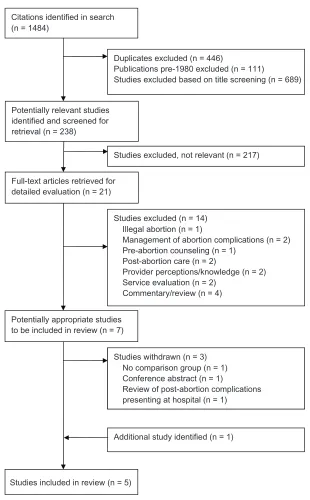
Five studies were included in this review (Figure 1), com-prising three prospective cohort studies and two randomized
controlled trials (RCTs). A total of 8539 women were included across the five studies; of these, 4198 underwent a procedure administered by a midlevel provider (3680 had surgical abortion; 518 had medical abortion) and 4341 women underwent a physician-administered procedure (3827 had surgical abortion; 514 had medical abortion). All studies took place in either a hospital or specialist health clinic, such as a women’s health center or sexual and reproductive health clinic. Studies are described in detail in Table 1.
One RCT of manual vacuum aspiration (MVA) proce-dures administered by MLPs and physician took place in
South Africa (n = 1153) and Vietnam (n = 1636) in 2003.11
The other RCT was carried out in Nepal in 2009 (n = 1032)
and compared outcomes of medical abortion procedures
administered by MLPs and physicians.12 The three
prospec-tive cohort studies (n = 3821) assessed surgical abortion
procedures conducted in the US between 198113 and 1997,14
and India in 2009.15
Study participants
All studies included women aged from ,20 to .40 years.
In the four studies of surgical abortion,11,13–15 maximum
gestational ages ranged from 10 to 16+ weeks. In the RCT
of medical abortion,12 women with gestational ages of up to
9 weeks were included. Gestational age was estimated using pelvic examination, or a combination of pelvic examination, ultrasound, and last menstrual period (Table 1).
Interventions
The RCT conducted in South Africa and Vietnam compared outcomes of MVA procedures for pregnancies up to 12 weeks gestation delivered by MLPs with government-accredited training in abortion, and those administered by physicians. All participants were offered lidocaine and additional oral analgesia; in one of the study locations (South Africa), misoprostol 400 mg was administered 2–3 hours before the
procedure.11 The other RCT used a medical abortion
regi-men of 200 mg mifepristone orally followed by 800 µg of
misoprostol vaginally 1–2 days later, delivered by MLPs (staff nurses and auxiliary midwives) trained in MVA, or doctors (obstetricians, gynecologists, general practitioners, and other
doctors) across five district hospitals in Nepal.12 In both RCTs,
women were followed up 10–14 days after the procedure. The three prospective cohort studies used surgical
abor-tion methods.13,14 One study conducted in the US used early
uterine evacuation or suction curettage,13 delivered by either a
physician assistant or physician; women arriving at the clinic
Dovepress Midlevel providers versus doctors for termination services
International Journal of Women's Health downloaded from https://www.dovepress.com/ by 118.70.13.36 on 23-Aug-2020
were seen by the next available provider and were followed up within four weeks of the procedure. In the other US
study,14 physicians with at least 5 years experience in abortion
procedures performed standard vacuum curettage procedures for pregnancies up to 12 weeks gestation, while physician assistants with the same level of experience provided MVA or standard vacuum curettage procedures for pregnancies up to 14 weeks gestation. Follow-up was within 14 days of
the procedure. The study conducted in India15 used MVA
delivered by nurses or physicians with no previous experi-ence of providing any type of abortion, who underwent MVA training as part of the study. All abortion procedures were conducted in the presence of a qualified supervisor. Women were followed up after 7 days.
Study quality
The two RCTs met all four quality criteria described
pre-viously,11,12 and were considered to be high quality. In the
Citations identified in search (n = 1484)
Duplicates excluded (n = 446)
Publications pre-1980 excluded (n = 111)
Studies excluded based on title screening (n = 689)
Potentially relevant studies identified and screened for retrieval (n = 238)
Full-text articles retrieved for detailed evaluation (n = 21)
Potentially appropriate studies to be included in review (n = 7)
Studies included in review (n = 5)
Studies excluded, not relevant (n = 217)
Studies excluded (n = 14) Illegal abortion (n = 1)
Management of abortion complications (n = 2) Pre-abortion counseling (n = 1)
Post-abortion care (n = 2)
Provider perceptions/knowledge (n = 2) Service evaluation (n = 2)
Commentary/review (n = 4)
Studies withdrawn (n=3) No comparison group (n=1) Conference abstract (n=1)
Review of post-abortion complications presenting at hospital (n=1)
Additional study identified (n = 1) Studies withdrawn (n = 3)
No comparison group (n = 1) Conference abstract (n = 1)
Review of post-abortion complications presenting at hospital (n = 1)
Figure 1 Summary of study selection process.
Dovepress
Ngo et al
International Journal of Women's Health downloaded from https://www.dovepress.com/ by 118.70.13.36 on 23-Aug-2020
medical abortion trial, loss to follow-up was 4%, while in the MVA trial, these figures were 0.1% in South Africa and 5.7% in Vietnam. These rates were similar in both study arms (MLPs versus physicians).
Two of the three prospective cohort studies met all quality criteria for non-RCTs, both of which reported loss
to follow-up at 4%.13,15 One US study did not meet quality
criteria for minimizing selection bias, as eligibility criteria
and interventions were different for study arms.14 Women
in the MLP group underwent vacuum curettage or MVA through to 14 weeks gestation, while those in the physician group underwent vacuum curettage up to 12 weeks gestation. This study used self-reported outcomes, and had loss to follow-up of 30%.
Incomplete or failed abortion
In the two RCTs, data on incomplete or failed abortion were available for 1918 women who had procedures administered by MLPs (Table 2). The proportion of incomplete or failed abortion among this group was 1.1%
for surgical abortion in South Africa and Vietnam,11 and
2.7% for medical abortion procedures in Nepal.12 Among
1903 women who had abortion procedures provided by physicians in these trials, the proportion of incomplete or failed abortion was 0.6% for surgical procedures in South
Africa and Vietnam11 (OR of incomplete or failed
abor-tion provided by MLPs = 2.00; 95% CI 0.85–4.69) and
3.9% for medical procedures in Nepal (OR = 0.69; 95%
CI 0.34–1.37).12
In one US cohort study of surgical abortion, there were increased odds of incomplete or failed abortion among women who had a procedure provided by MLPs compared with those who had a procedure administered by a physician
(OR = 4.03; 95% CI 1.07–15.28).14 In the study conducted
in India, the proportion of incomplete abortion was 1.2% for procedures administered by MLPs, and 0.9% for those
administered by physicians (OR = 1.25; 95% CI 0.33–4.69).
Data on incomplete or failed abortion were not available for the other cohort study.
Complications
Complications of abortion were generally reported as immediate or delayed. Immediate complications included excess bleeding, cervical injury, uterine perforation, and adverse drug reaction on the day of the procedure up to discharge. Delayed complications included retained products of conception, hematometra, pelvic infection, excessive
post-abortion bleeding, and abortion-related death up to the date of follow-up.
The RCT of surgical abortion showed that the overall complication rate for MLP-delivered procedures was 1.3%
(n = 18), while the rate for physician administered procedures
was 0.7% (n = 10). All of the complications in the MLP
group were delayed complications (two pelvic infections; 16 retained products). In the physician group, there was one immediate complication (adverse drug reaction), and the rest were delayed complications (eight retained products; one pelvic infection). This study found no difference in odds of
overall complications by provider type (OR = 1.80; 95% CI
0.83–3.90).
In the three cohort studies, the overall complication rate for MLP-administered surgical procedures ranged from 1.4% to 2.7%, while the rate was 0.9%–3.1% for physician-administered procedures. The majority of complications in the MLP group (39 out of 47 cases, 83.0%) and in the physician-administered group (44 out of 55 cases, 80.0%) were delayed complications. These delayed complications included continued pregnancy, ectopic pregnancy, infection, hemorrhage, and retained products. None of the three studies found a difference in the odds of overall complications by provider type.
Discussion
Based on data from trials, there was no strong evidence for differences in odds of incomplete or failed abortion for first trimester medical or surgical abortions performed by MLPs versus physicians. Incomplete or failed abortions were rare (less than 4%) for MLPs and physicians. One cohort study, which had a high risk of selection bias, reported increased odds of incomplete or failed abortion for procedures admin-istered by MLPs compared with those adminadmin-istered by physicians. Complications were rare for medical and surgical procedures, administered by either MLPs or physicians.
Strengths and limitations
The inclusion of non-randomized studies in this review increased the likelihood of biases. Of particular concern is selection bias due to unconcealed allocation or different eligibility criteria in study arms, which could lead to systematic differences between participant characteristics in the intervention groups. This is prob-lematic where these participant characteristics may be associated with abortion outcomes, leading to differences between the two groups which cannot be attributed solely to the intervention. There were too few trials of each type of abortion to pool the effect
Dovepress Midlevel providers versus doctors for termination services
International Journal of Women's Health downloaded from https://www.dovepress.com/ by 118.70.13.36 on 23-Aug-2020
Tab
le 1
Characteristics of included studies
Study name
Study design
Study setting and period of data collection
Intervention
Providers
Outcome(s)
N
Characteristics of women
Gestational age
RCTs Warriner et al
11
Multicentre randomized controlled equivalence trial MSI clinics providing FP and abortion services. Four clinics in South Africa and four in
v
ietnam.
September 2003–June 2004 in South Africa,
M ay –D ec em be r 20 03 in v ietnam M v A:
All participants offered para
ce rv ic al b lo ck w ith li do ca in e an d ad di tio na l or al a na lg es ia . M iso pr os to l 4 00 m g ad m in ist er ed s ub lin gu al ly or o ra lly in S ou th A fr ic a 2– 3
hours before abortion
(n ot u se d in v ietnam) .
Follow-up 10–14 days later
Midlevel providers with government-accredited training in abortion, or doctors
Im m ed ia te c om pl ic at io ns : e xc es s bleeding . 5 00 m L, c er vi ca l in ju ry , u te rin e pe rf or at io n,
adverse drug reaction Del
ay ed c om pl ic at io ns : re ta in ed p ro du ct s of c on ce pt io n ne ce ss ita tin g re -e va cu at io n, he m at om et ra , p os t-ab or tio n
pelvic infection, excessive post- abortion bleeding (
. 50 0 m L) , abortion-related death
South Africa: 1160 vietnam: 1734 Age 18 to .40 years
Up to 12 weeks (LMP, pelvic examination, and ultrasound)
Warriner et al
12
Multicentre randomized controlled equivalence trial Five rural/peri-urban district hospitals in Nepal April 2009–March 2010 Medical abortion: Day 1: 200 mg mifepristone orally Day 3: 800
µ
g misoprostol
vaginally and monitored for 3 hours Follow-up 10–14 days later Providers trained in Mv
A: staff
nurses, auxiliary midwives, obstetricians/ gynecologists, general practitioners, doctors Complete abortion without Mv
A
within 30 days of treatment Serious adverse events (hemorrhage necessitating transfusion, conditions necessitating hospitalization)
1104
Mean age: 28.0
±
5.9 years
Mean: 6.9
±
1.0
weeks (range 5–9) (LMP and bim
an ua l p el vi c ex am in at io n; ul tr as ou nd u se d in 2.3% women)
Prospective cohort studies Freedman et al
13
Prospective cohort
v
ermont Women’s Health Center, USA January 1981–December 1982 Early uterine evacuation or suction curettage up to 8 weeks LMP. Follow-up visit within 4 weeks, at clinic or by personal physician Physician assistant or physician. Women seen by next available provider Complications (immediate or delayed): excessive bleeding, uterine perforation, cervical laceration, incomplete abortion/retained products, infection, post- abortion syndrome, vagal reaction
2458
Age: 29% , 20 years, 42% 20–24 years Up to 12 weeks (pelvic estimate)
Goldman et al
14
Prospective cohort
1.
Feminist Health Center of Portsmouth, New Hampshire, USA
2.
v
ermont Women’s Health Center, USA
July 1996–October 1997
1. S ta nd ar d va cu um cu re tt ag e pe rf or m ed b y
physicians through to 12 weeks gestation.
2.
M
v
A or standard
vacuum curettage performed by physician assistants through to 14 weeks gestation. Follow-up within 2 weeks of discharge Physician assistant or physician with
$
5 years
experience in abortion procedures Complications (immediate or dela
ye
d)
:
incomplete abortion, failed abortion, ectopic/ extr
au te rin e pr eg na nc y, pe rf or at io n, ce rv ic al la ce ra tio n, in fe ct io n, he m or rh ag e, others 1363
Age: 23.7% , 20 years, 23.3% 20–24 years, 21.4% 25–29 years
1.
Up to 13–15
weeks 2. Up to 16
+
weeks (LMP, pelvic examination and ultrasound)
Dovepress
Ngo et al
International Journal of Women's Health downloaded from https://www.dovepress.com/ by 118.70.13.36 on 23-Aug-2020
Jejeebhoy et al
15
Prospective cohort Five clinics of non-government orga
ni
za
tio
n
Ja
na
ni
in
B
ih
ar
a
nd
Jh
ar
kh
an
d
states, India One provider type (nurse or physician) assigned to each facility at any given time July 2009–January 2010
M
v
A:
Day 1 – intramuscular prostaglandin analog injection administered 1–2 hours before procedure; M
v
A
performed with double-valve syringe; provider could call upon supervisor for assistance; antibiotics and pain relief prescribed Follow-up 7 days later
N
ur
se
o
r
ph
ys
ic
ia
n
w
ith
n
o
pr
ev
io
us
e
xp
er
ie
nc
e
of
providing abor
tio
n
or
p
el
vi
c
examination All providers underwent standard M
v
A training
Complete abortion by day 7 Complications: incomplete abortion or ongoing pregnancy, blood transfusion or hospitalization, injury to cervix, uterus or bowel, signs of infection Unscheduled contacts Acc
ur
ac
y
of
a
ss
es
sm
en
t
of
gestational age;
failure to assess complete abortion Women’s satisfaction with experience and provider
897
Mean age: 27–28 years Mean: 8.6 weeks (range 5–11
+
; inclusion
criterion: gestational age
#
10 weeks) (pelvic examination)
Abbreviations:
LMP, last menstrual period; MSI, Marie Stopes International; M
v
A, manual vacuum aspiration; RCT, randomized controlled trial.
estimates. Although only two high quality RCTs were identified in this review, they included 3821 women. The demographic data of the participants from the medical abortion trial were similar to the socio-demographic characteristics of women typically seeking abortions in Nepal. The surgical trial conducted in South Africa and Vietnam took place in Marie Stopes International (MSI) clinics, which serve a population that is slightly more educated
and well-off than clients in the public sector;11 therefore, the
women in this trial may not be representative of women living in rural areas in these countries.
In the Nepali medical abortion trial, the training that the providers received was part of the first training curriculum in the country. MLPs had more years of professional experiences than doctors; however, multivariate analysis showed that years of experience did not have an effect on safety and effectiveness. In the surgical abortion trial, MLPs in South Africa and Vietnam were private providers working at MSI clinics, who had routinely undertaken first-trimester abortions; therefore, no additional training was required. These individuals may not be representa-tive of the skills and training level required of providers working in public facilities, who might require formal training programs. However, South African providers simultaneously worked at MSI and public facilities, while Vietnamese providers had previ-ous experience working in public health facilities.
The findings from this review are only applicable to pregnancies up to 9 weeks for medical abortion, and up to 12 weeks for surgical procedure. Data cannot be general-ized to settings where misoprostol-only regimen is used in higher doses to induce abortion. This review focuses on clinical measures of effectiveness and safety as the outcomes. Assessment of the feasibility, acceptability, and barriers of midlevel provision were beyond the scope of this review.
Implications
Due to the shortage of physicians, MLPs are often the only health professionals available in many settings. Given the potential to expand women’s access to safe abor-tion in underserved areas, midlevel provision has been
widely advocated.16–18 Training MLPs to provide first
trimes-ter medical abortion and surgical abortion up to 12 weeks could facilitate widened access to safe termination, with the potential of reducing the number of unsafe abortions and related deaths and disabilities.
Taking the greatest difference in complication rates between physicians and MLPs (1.4%; 95% CI 0.4–2.7 in
South Africa11), employing MLPs instead of physicians in
this setting would mean one additional complication for
every 37 procedures.18 However, in the context of settings
Dovepress Midlevel providers versus doctors for termination services
International Journal of Women's Health downloaded from https://www.dovepress.com/ by 118.70.13.36 on 23-Aug-2020
Tab
le 2
Percentage and OR of incomplete abortion and complications in included studies, by provider type
Number of women Incomplete or failed abortion
a, % (n) Incomplete or fa ile d ab or ti on ,
OR (95% CI)
b
Overall complications % (n)
O ve ra ll co m pl ic at io ns ,
OR (95% CI)
c
Immediate complications, % (n)
Immediate co m pl ic at io ns ,
OR (95% CI)
Delayed complications % (n)
D el ay ed co m pl ic at io ns ,
OR (95% CI)
MLP Physician MLP Physician MLP Physician MLP Physician MLP Physician
RCTs Warriner et al
11 (surgical abortion) 1400 1389 1.1 (16) 0.6 (8) 2.00 (0.85–4.68) 1.3 (18) 0.7 (10) 1.80 (0.83–3.90) 0 0.1 (1) 0.33 (0.01–8.12) 1.3 (18) 0.6 (9) 2.00 (0.89–4.46)
Warriner et al
12 (medical abortion) 518 514 2.7 (14) 3.9 (20) 0.69 (0.34–1.37) n/a n/a n/a n/a n/a n/a n/a n/a n/a Total 1918 1903
Cohort studies Freedman et al
13 1285 1173 n/a n/a n/a 2.7 (35) 3.1 (36) 0.88 (0.55–1.42) 0.5 (6) 0.8 (9) 0.61 (0.22–1.71) 2.3 (29) 2.4 (27) 0.98 (0.58–1.67)
Goldman et al
14 546 817 1.5 (8) 0.4 (3) 4.03 (1.07–15.28) 2.2 (12) 2.3 (19) 1.28 (0.66–2.47) 0.5 (2) 0.1 (1) 4.51 (0.47–43.45) 1.8 (10) 2.2 (17) 1.11 (0.55–2.22)
Jejeebhoy et al
15 449 448 1.2 (5) 0.9 (4) 1.25 (0.33–4.69) 1.4 (6) 0.9 (4) 1.50 (0.42–5.36) n/a n/a n/a n/a n/a n/a Total 2280 2438 Notes: aIncomplete abortion (retained produ cts) and failed abortion (continuing pregnanc y); bOR of incomplete or failed abortion for MLP group compared with physician group; cOR of overall complications for MLP group compared with
physician group; n/a indicates that information on this outcome was not available. Abbreviations:
CI, confidence interval; MLP, midlevel provider; OR, odds ratio; RCT, randomized controlled trial.
with a shortage of physicians and high incidences of unsafe abortion procedures, the potential health gains associated with midlevel provision of abortion are substantial. The
cur-rent WHO unsafe abortion statistics3 estimate that 22 million
unsafe abortions take place every year, resulting in 5 million
complications (a 23% complication rate) and 47,000 deaths.3
Even based on the conservative assumption that the complica-tion rate with trained providers (MLP or physician) is as high as 4.5%, if all unsafe abortions were carried out by trained and accredited providers, there would be an 80% reduction
in complications and far fewer deaths.18
Adequate training and infrastructure are likely to be central to the delivery of effective and safe abortion. The MLPs in the studies included in this review were trained nurses, physician assistants, and midwives, who had experience in abortion pro-cedures or were supervised by a qualified provider. National reproductive health programs need to evaluate how training will be structured and rolled out. Additionally, operational research studies are needed to assess the feasibility and accept-ability of rolling out midlevel provision. Evaluations should also consider the structure of the wider health care system and availability of personnel, to identify which MLPs are best placed to provide abortion procedures, and also consider how the process from pre- to post-abortion care is managed.
A review was published during the finalization of this
paper which reported similar results to this study.10 This
pres-ent study has expanded on this published review by examin-ing the findexamin-ings in the context of settexamin-ings where there is a shortage of providers and high incidence of unsafe abortions; these are the settings in which implementation of midlevel provision of abortion is likely to be a priority. Future studies should also evaluate the feasibility of introducing midlevel provision in these settings.
Conclusion
Based on a small number of studies, there is no strong evi-dence for differences in effectiveness or safety of abortion procedures performed by MLPs compared with physicians. In settings with a shortage of trained providers, coupled with high incidence of unsafe abortion, midlevel provision of terminations could potentially reduce complications and death related to unsafe abortion. Further studies are required to establish more precise effect estimates.
Acknowledgments
The authors acknowledge support from the STEP UP (Strengthening Evidence for Programming on Unintended Pregnancy) Research Programme Consortium. STEP UP
Dovepress
Ngo et al
International Journal of Women's Health downloaded from https://www.dovepress.com/ by 118.70.13.36 on 23-Aug-2020
International Journal of Women’s Health
Publish your work in this journal
Submit your manuscript here: http://www.dovepress.com/international-journal-of-womens-health-journal
The International Journal of Women’s Health is an international, peer-reviewed open-access journal publishing original research, reports, editorials, reviews and commentaries on all aspects of women’s healthcare including gynecology, obstetrics, and breast cancer. The manuscript management system is completely online and includes
a very quick and fair peer-review system, which is all easy to use. Visit http://www.dovepress.com/testimonials.php to read real quotes from published authors.
is funded by UKaid from the Department for International Development.
Disclosure
The authors report no conflicts of interest in this work.
References
1. Kulier R, Fekih A, Hofmeyr GJ, Campana A. Surgical methods for
first trimester termination of pregnancy. Cochrane Database Syst Rev.
2001;4:CD002900.
2. Kulier R, Kapp N, Gulmezoglu AM, Hofmeyr GJ, Cheng L, Campana A.
Medical methods for first trimester abortion. Cochrane Database Syst
Rev. 2011;11:CD002855.
3. Sedgh G, Singh S, Shah IH, Ahman E, Henshaw SK, Bankole A. Induced
abortion: incidence and trends worldwide from 1995 to 2008. Lancet.
2012;379(9816):625–632.
4. World Health Organization. Safe abortion: technical and policy guidance for health system. Geneva: World Health Organization; 2003. 5. World Health Organization. Safe Abortion: Technical and Policy Guidance
for Health Systems, 2nd ed. Geneva: World Health Organization; 2012. 6. Berer M. Provision of abortion by mid-level providers: international
policy, practice and perspectives. Bull World Health Organ. 2009;
87(1):58–63.
7. Jones RK, Henshaw SK. Mifepristone for early medical abortion:
experi-ences in France, Great Britain and Sweden. Perspect Sex Reprod Health.
2002;34(3):154–161.
8. Long C, Neang R. Abortion in Cambodia: country report. Phnom Pehn: Ipas/IHCAR; 2001. http://www.tingsene.se/expacc/CambCR.PDF.
9. Yarnall J, Swica Y, Winikoff B. Non-physician clinicians can safely provide first trimester medical abortion. Reprod Health Matters. 2009;17(33):61–69.
10. Renner RM, Brahmi D, Kapp N. Who can provide effective and safe
termination of pregnancy care? A systematic review*. BJOG. Epub
August 20, 2012.
11. Warriner IK, Meirik O, Hoffman M, et al. Rates of complication in first-trimester manual vacuum aspiration abortion done by doctors and mid-level providers in South Africa and Vietnam: a randomised
controlled equivalence trial. Lancet. 2006;368(9551):1965–1972.
12. Warriner IK, Wang D, Huong NT, et al. Can midlevel health-care providers administer early medical abortion as safely and effectively as doctors? A randomised controlled equivalence trial in Nepal. Lancet. 2011;377(9772):1155–1161.
13. Freedman MA, Jillson DA, Coffin RR, Novick LF. Comparison of
complication rates in first trimester abortions performed by physician
assistants and physicians. Am J Public Health. 1986;76(5):550–554.
14. Goldman MB, Occhiuto JS, Peterson LE, Zapka JG, Palmer RH. Physician assistants as providers of surgically induced abortion services.
Am J Public Health. 2004;94(8):1352–1357.
15. Jejeebhoy SJ, Kalyanwala S, Zavier AJ, et al. Can nurses perform manual vacuum aspiration (MVA) as safely and effectively as physicians?
Evidence from India. Contraception. 2011;84(6):615–621.
16. Ipas and IHCAR. Deciding women’s lives are worth saving: expanding the role of midlevel providers in safe abortion care. Chapel Hill: Ipas; 2002. 17. Samora JB, Leslie N. The role of advanced practice clinicians in the
availability of abortion services in the United States. J Obstet Gynecol Neonatal Nurs. 2007;36(7):471–476.
18. Chong YS, Mattar CN. Mid-level providers: a safe solution for unsafe
abortion. Lancet. 2006;368(9551):1939–1940.
Dovepress
Dove
press
Midlevel providers versus doctors for termination services
International Journal of Women's Health downloaded from https://www.dovepress.com/ by 118.70.13.36 on 23-Aug-2020