111
Exploring dimension, perceived individual tension and capacity building measure of
women empowerment in India
K. Gayathri Reddya
Varsha, P. S. b
L. N. Sudheendra Rao c
Amit Kumar d
a Associate Professor & Regional Director; Visvesvaraya Technological University (VTU) Regional Office, Bengaluru, Karnataka, India
b PhD Scholar; Visvesvaraya Technological University (VTU) Bengaluru, Karnataka, India
c Professor & Director-MBA, Institute of Management Studies, Rani Chanamma University, Ilkal, Bagalkot, Karnataka, India d PhD Scholar; Newcastle Business School, The University of Newcastle, Callaghan, NSW, 2299, Australia
[email protected](Corresponding author)
Corresponding author
A R T I C L E H I S T O R Y :
Received: 08-Apr-2019 Accepted: 21-Jun-2019 Online available: 10-Jul-2019
Keywords:
Women empowerment, Dimensions,
Perceived tension,
Capacity building measures, Factor analysis,
India
A B S T R A C T
The objective of current study is to identify different dimensions of women empowerment, problems and challenges such as perceived tension of individual self -help group member in the process of women empowerment, and suggestions to improve women empowerment in the context of India. The 351 responses were collected via stratified random sampling from members of self -help groups, and an exploratory principal component analysis is undertaken to identify the number of components that underlie the women empowerment. Further, a confirmatory factor analysis is used to confirm the factors in the study. The findings indicate five broad dimensions (i.e. economic, political, social, legal, psychological), four different types of perceived individual tensions (i.e., economic, social, legal, technology-oriented learning), and four significant categories of capacity building measures (i.e. training on governance, technology-driven livelihood support, promoting networking, social justice & harmony) of women empowerment.
Contribution/ Originality
This empirical study provides greater clarity needed for understanding the conceptual domains of women empowerment in terms of the broad dimensions, inherent perceived tension, and capacity building measures, in an emerging economy context, i.e. India. The findings have important managerial and policy implications in both micro and macro perspectives and suggest the directions for future research.
DOI: 10.18488/journal.1007/2019.9.5/1007.5.111.131 ISSN (P): 2306-983X, ISSN (E): 2224-4425
How to cite: K. Gayathri Reddy, Varsha, P. S., L. N. Sudheendra Rao and Amit Kumar (2019). Exploring dimension, perceived individual tension and capacity building measure of women empowerment in India. Asian Journal of Empirical Research, 9(5), 111-131.
© 2019 Asian Economic and Social Society. All rights reserved
Asian Journal of Empirical Research
Volume 9, Issue 5 (2019): 111-131
112
1. INTRODUCTION
Women empowerment (WE) is a multifaceted procedure (O’Hara and Florian, 2018; Johnson, 2005;
Kabeer, 1999) in societal development and women position in the globe (Sinha et al., 2012). To
achieve these, gender equality is the primary concept in the Millennium Development Goals (MDGs) and sustainable growth (Ahenkan and Boon, 2011). Self -help groups (SHG) model initiated to uplift the rural women agreed by various governments across the globe. This SHG scheme includes providing finance, having regular gatherings, promote training, education, and minimizes to poverty
(Bali and Wallentin, 2012).
Literature helps us in understanding the various dimensions of WE, such as economic, political, social, legal, and psychological empowerment. Women empowers mean they should have the capability to make choices and self-decisions on their earnings (Bourey et al., 2015). The education which has an impact on economic development and creating job opportunities (Kabeer, 2017), tends to increase female workforce involvement (Samarakoon and Parinduri, 2015), enhanced women confidence and independence results to access their money also, increased purchasing power (Kabeer, 2017). Past literature emphasizes the social status of women has their liberty to make decisions in their households in Ethiopia (Tarozzi et al., 2015). The SHGs in Rajasthan, India proved that women have importance, accessed supremacy and visibility in the family (Desai and Joshi, 2013), women networking (Kabeer, 2011), mutual support among the members (Kumari, 2011) and social respect (Sahu and Singh, 2012) through participation in SHGs. Prior studies have also provided specific information on the political matters that members started interacting with the government officials and politician for community and village development, nominated as a counselor (Kumari, 2011). Then women are emotionally intense, capable of speaking in front of others like family members, government officials, politicians attained maturity level (Kabeer, 2011; Kumari, 2011) and found the solution for domestic violence’s
(Sahu and Singh, 2012). In a similar vein, a report from San Francisco Asia Foundation mentioned
that the usage of legal aspects raises to regulate and minimize the population of birth rates (Golub, 2007), increase the wellness of women (Golub, 2007), improved the better life in the rural and urban areas across the globe (Cotula, 2007).
The recommendations for the betterment of women are the governance has to monitor women regarding monetary resources, their behavior and attitude in public and family and awareness on resolving disputes in their households (Kabeer, 2011). Also, provide information on technology usage achieving digital India and legal aspects. Prior studies have also provided specific information on the other capacity building measures which help in improving WE.
Most of the researchers mentioned that the high levels of empowerment lead to a better life, and overall wellbeing of the families. However, few researchers are critically examined that there are worries and challenges in their life. The worries or stress could be husband alcoholism, domestic violence, marital relationships (Rocca et al., 2008), health issues (Kostick et al., 2010), and intimate partner violence
(Dalal, 2011).
The literature on women empowerment helps us in recognizing some of the critical knowledge gaps. First, many scholars in the field have identified that SHGs help in achieving the goal of WE and in reducing poverty across nations (Nair and Tankha, 2015; Chowdhury, 2012). However, none of the studies have conceptualized all dimensions of WE in the managerial principles. More specifically, very few studies have discussed how SHG results in the rise of legal and psychological enablement, in addition to the economic, political and social empowerment (Eyben et al., 2008, Varsha et al.,
113
member. Therefore, there are no studies or empirical evidence regarding what challenges and problems women have faced after availing benefits from the SHGs (Brody et al., 2015). Finally, although several studies have proposed solutions to improve WE (i.e., capacity building measures), they failed to conceptualize this construct as well. Further, it indicates that research studies are limited to the governance aspects (such as training, marketing, digitalization, and legal) in order to improve SHG schemes effectively and empowering women at the macro level. A rigorous attempt has been made in this research to fill the gaps in the literature by developing a new scale (psychometrically valid) and advances our knowledge of WE.
Concluding the above, the objective of this study is to explore and conceptualize (1) various dimensions of WE, (2) different types of perceived tension of individual SHG member, and (3) different categories of capacity building measures in the process of WE.
Our primary contribution is three-fold. First, the current research is envisaged to develop a new scale (26-item scale) that access various dimensions of WE. Moreover, this study is also designed to be the first to consider all the five dimensions (economic, political, social, legal, and psychological) of WE into the analysis. The additional benefit of the research is that a scale comprising 10 items of capacity building (CB) measures have been established. Hence, scholars can use this scale in the research study of compound problems of WE. Finally, although investigators have theorized and accessed individual tension in many different ways, our results contribute to an understanding of this novel construction by developing a scale in the context of WE.
2. RELEVANT PRIOR LITERATURE
Our discussions on WE include mainly three aspects: dimensions of WE, capacity building (CB) measures, and perceived individual tension (T). This section discusses these aspects as below; 2.1. Dimensions of WE
WE and gender equality to take a salient part in today's world (Kabeer, 2011). Studies suggest mainly five dimensions of WE, such as economic, social, political, legal, and psychological empowerment. The term WE refer to economic empowerment that means increases in their standard of living, social empowerment indicates the equal position in the society, legal empowerment is the rights and justice for rural women, and political empowerment creates an opportunity for the women to participate in local elections. Both the government and people support this liberation to remove poverty, gender inequality, self-decision and encourage them to take part in social, political, and economic level in both rural and urban areas (Kabeer, 1999).
Economic empowerment the women able to access, own, and control their resources. It is evaluated by income generating activities by women, female proprietorship of properties and land, cash outflow structure (spending), women involvement at the workplace, the domestic labor force of men and women and controlling power on financial decisions through SHGs (Brody et al., 2015). Economic empowerment encouraged women to understand fiscal skills and independent decision making
(Kabeer, 2011). Many of the members never involved in a financial process like buying and selling
goods, managing their household's finances before joining SHGs. Hence, literature mentioned that women are given access to money transactions, marketing their products (Kabeer, 2011; Kumari, 2011) and save their money for daughter education (Sahu and Singh, 2012). Also, women understand the financial experience and managing money (Kumari, 2011), emerged as women entrepreneurs
(Hopkins et al., 1994) and social entrepreneurs (Haugh and Talwar, 2016) to reduce poverty and
overall wellbeing. Therefore, economic empowerment improves women social status in society and the globe.
114
households, access to adult education, and vocational training. Social empowerment helps women to achieve networking, solidarity, and community respect for development context by SHGs. Networking enhances women communication, able to talk confidently at home and outside, comfortable to have a conversation with the local regime, politicians and legal experts to help the villages like building toilets, vocational education, keeping the village clean, enhance their skills on organic farming and seek justice to their community (Kabeer, 2011). Next solidarity brings the women together to support the group or community and due to their boldness and courage capable to solve the domestic violence in the family (Kabeer, 2011). Solidarity leads to respect in society. Women raised their voices for community development, involved in decision making on societal activities helps to gain respect from others (Sahu and Singh, 2012).
Women are capable of making decisions and participating in the electoral process at the village level by joining SHGs. Political empowerment includes awareness of elections, voting system, legal rights, has their land legally, gender equality and capable of accomplishing a leadership position in the government (Hughes et al., 2015). Grasping political system is very important in political empowerment (Kumari, 2011). The political originalities mentioned in Grameen and BRAC among the groups, daily meeting, orientation made them for innovative thoughts which result in the high rate of data and information of politics accessed by the rural women and they confidently participate in the elections and judgmental decision making (Kabeer, 2017).
The term psychological empowerment elucidates the individual women can be able to make their own choices. Psychological empowerment includes efficacy or agency, feeling of reliant, self-confidence and self-esteem (Kabeer, 2011). Psychological empowerment includes agentic voice, participation in household negotiations and domestic disputes (Kumari, 2011). Women are capable of speaking in the SHG group meetings, participation in community projects, interacting with government officials and political leaders to abolish superstitious beliefs, justice for domestic violence
(Kabeer, 2011) refereed as agentic voices. Gaining respect in the family, both in-laws and husband
also sought permission to join SHG groups; convincing abilities leads to household negotiation
(Harley et al., 2018; Kabeer, 2011; Kumari 2011). Domestic disputes resolved due to join SHGs and
started earnings, gained respect from family (Kumari, 2011).
Legal empowerment is an ideal and functional tool to eradicate poverty (Banik, 2009). It is a subpart of empowerment, and explains, as the utilization of legal services helps the poor people for development activities (Golub, 2007). The old regulation has been revised with the help of state government organization called the top-down regulation approach. However, this approach will have a limited effect in rural areas in emerging nations. Hence the legal empowerment is a model to showcase the bottom-up or community driven. Then these model helps to underprivileged women to know their rules regulations and increase the status, livelihood, and their families (Golub, 2007). Overall, the economic, political, and social dimensions of WE are well documented in the literature. However, evidence on legal and psychological dimensions is scarce.
2.2. Perceived individual tension
115
The social tension exists on the high level of empowerment. The study suggested that in South India, active participation of women in SHGs, exposure of training and adult education enhanced marketing skills, and job opportunities increased the domestic violence in their families (Rocca et al., 2008). They never listen, spouse; less patience results in the social tension (Tuladhar et al., 2013). Women participation in SHGs in regular meetings, involved in societal activities, adult education, training on social awareness, quality time has not been appropriately given to family and children causes the social stress in the households (Kabeer, 2005).
In another study in Bangladesh, women in rural areas have high mobilization, financially independent, decision making on their own without concerning partners and the situation will be more violent due to high empowerment (Kabeer, 2011). These rise conflict on properties and women earnings cause’s worry in the family can be termed as economic tension (Kabeer, 2011). Some studies found that there is an increase in women financial contributions to the family without keeping any accountability, fulfill the basic needs of families and gender equality results stress, decreased the emotions of the overall wellbeing of women leads to economic tension (De Hoop et al., 2014; Ahmed, 2005).
SHG groups comprise different castes. Then the group comprises of mixed castes lead to the stress and conflict among the members. There is a drawback on the SHGs with the same community and do not even know the norms. The members need to wait to get monetary assistance or will not get funds sometimes leads to further strain (Mathrani and Pariodi, 2006). In a similar vein, few studies found that women availed the loans, do not even know how utilize the money sometimes they were beaten by the husband to take this amount (Goetz and Gupta, 1996). Women are assaulted, abused, and annoyance cannot be able to share their sorrow with others for suggestions due to lack of legal knowledge to create tension. The literature also indicates that low management skills in the groups, limited knowledge about digital use, and gender disparity in education could lead to knowledge and leaning tension in individual.
2.3. Capacity building measures
Capacity building is a multifaceted concept and defined as several features in the business and management literature (Leeman et al., 2015). The researchers recommend that across various disciplines, the capacity building includes planned, coordinated and mission-driven efforts intended to reinforce the activities, management, and governance of agencies to enhance their performance and its effect (Brownson et al., 2018). Nevertheless, this study is more focused on the capacity building of women in villages. Additionally, it also supports non-government organizations (NGOs) to improve the capacity building at the individual and community levels.
The capacity building is the capability of individuals, groups, institutions, and organizations to identify and solve development problems on time (Lusthaus et al., 1999). Capacity building is the pioneer of human capital development, and it is continued when the person applies that capacity like knowledge, information, and experience in his or her life felt as individually empowered. Studies have documented multiple resources like financial earnings, people management, and social relations needed for capability growth and development of empowered individuals (Fonti and Maoret, 2016; Coleman, 1988). However, very limited works have suggested the empowerment as the result of several aspects connected to capacity building measures such as training on governance (Reddy and Manak, 2005), technology-driven livelihood support (Aminuzzaman et al., 2003), promoting networking
(Vossenberg, 2013; Turner, 2002), and social justice and harmony (Reddy and Manak, 2005) of
individuals. Individual capacity building has been known as the main factor to the financial growth and women empowerment (Kabeer, 2012). Further, the concept of WE has to changeable based on the perspectives and time duration (Kabeer, 1999).
116
for long-term vision (Kabir et al., 2018). SHGs are an informal and formal organization with weak governance, and the competence of members in the governance is weak due to limited knowledge of political and legal norms. Hence, required strong governance to help poor women in rural areas. Training on governance in politics helped the women enter politics at the local level and involved in discussion with regime officials. Member trained and understood the governance, and women were able to convenience government people and politicians for village development work (Reddy and
Manak, 2005). Member also trained to maintain records, find the solution to disputes, and manage
finances (Sinha et al., 2012). The study revealed that training is provided to the member by external people like outsourcing to the corporates, results in the high social and economic growth (Kabeer, 2017). NGOs in India voluntarily come forward to train SHG members’ results to increase in savings, solidarity, and awareness on legal aspects (Tankha, 2012). In a similar vein, few other studies affirmed that group involvement and cohesion bring the great responsibility in the group like regular meetings with attendance, social networking improved the knowledge of group members (Kabeer, 2017;
Anderson and Baland, 2002). Past studies also revealed that training helps the members to enhance
their skills on entrepreneurship lead improvement in productivity and increases self-confidence (Bali
and Wallentin, 2012). Moreover, NGOs provides orientation to the members helped to buy properties
(Bali and Wallentin, 2012). The training is given to female farmers results in the leadership quality
and cost-benefit analysis during crisis management (Fischer and Qaim, 2012).
Technology-driven livelihood support helps the SHG members to create more economic opportunities and minimizes poverty in the emerging nations. The new technology motivated for urbanization connects humans and brings decision makers for new tools for development. These are the paradigm shift of the emerging techno knowledge-based economy in our country (Adolph, 2003). Technology innovation and adoption incorporated into farming (Gugerty et al., 2019) posited that members provided training and experience new learnings and knowledge increase growth and reduced production expenses. Fischer and Qaim (2012) affirmed in their study due to technology intervention acceptance of rates increased in the variety of banana crops between 72-73 percent of the group members.
In SHGs, effective networking is an essential factor for empowerment. Networking is a common platform that brings women fraternity together for common goals to achieve economic development
(Reddy and Manak, 2005). Women formed a group formally or informally as SHGs and saved the
money for a small business (Reddy and Manak, 2005). Further, several elements have been identified for encouraging SHGs such as effective networking, communication, knowledge & information-based discussion, periodic meeting that encourages the policies formulation for SHGs, organization or national level (Reddy and Manak, 2005). The introduction of policies to save and secure the environment for women, specifically women welfare (Fatima, 2017). With the help of social networking in the SHGs, members can take the right decisions in families, well managed with the finances and independent decision making on financial matters (Brody et al., 2015). Hence networking builds the trust, harmony, and respect from the family and other members. Flat level networks include both formal and informal causes social capital regarding trust, assurance, mutual trade (social business) among the members.
117
tribe (ST), minorities, backward caste, and another caste. In India, we have several castes and religion. So SHGs framed with mix caste model group bring the harmony between the members and communities (Reddy and Manak, 2005). The mixed caste model will inspire many groups to follow this and enhances the woman's position in society and leads to women empowerment. Thus, the author argues that social justice and social harmony eradicated the stigma of casteism and untouchability through SHGs.
3. RESEARCH METHOD
3.1. Survey instrument
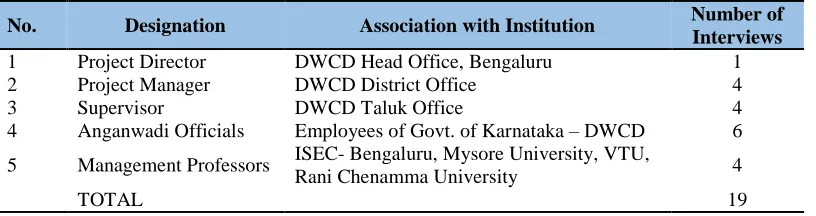
The questionnaire was used in the survey. Since the primary objective of this study is to develop a new scale (psychometrically valid) and which could advance our knowledge of WE, the research leads to a quantitative study. The questionnaire was used in the survey. The items proposed evaluating the various dimensions of WE, problem and challenges (i.e. perceived tension which individual SHG member faces in the process of WE), and solutions to improve WE (i.e. capacity building measures of WE). The questionnaire was designed by using opinions from the domain experts of the field (19 interviews were conducted, as depicted in Table 1), and further refined based on previous research. We pilot tested the face validity of these scales with 10 members who were benefitted from the SHG scheme.
Table 1: Number of interviews
No. Designation Association with Institution Number of Interviews
1 Project Director DWCD Head Office, Bengaluru 1
2 Project Manager DWCD District Office 4
3 Supervisor DWCD Taluk Office 4
4 Anganwadi Officials Employees of Govt. of Karnataka – DWCD 6 5 Management Professors ISEC- Bengaluru, Mysore University, VTU,
Rani Chenamma University 4
TOTAL 19
3.2. Data collection
Initially, 362 completed responses were collected from the members of self-help groups. However, eleven responses were incomplete and eliminated. Finally, 351 responses were found original, legitimate and reliable, considered for further analysis.
3.3. Analysis
This study aims to explore the different types of WE, problems and challenges (i.e. perceived tension) an individual faces in the process of WE, and suggestions to improve WE (i.e. capacity building measures) in the context of SHG program in India. Later, a four-stage data analysis process incorporated in the study. In the first stage, various opinions on women empowerment (i.e. on various dimensions, problems and challenges, and suggestive measures to empower women) were collected from the domain experts, government officials and professionals who are directly or indirectly associated with running SHG program in the state of Karnataka, India. This information helped in preparing a survey questionnaire items related to various dimensions of WE, problems/challenges associated within a process of WE, and suggestions to improve WE. In the next stage, a survey questionnaire was distributed among SHG members and 351 responses were collected during the period between Dec 2017 and Aug 2018. These responses to scale items are examined.
118
helped the researcher in assessing the different scales established for the research. Further, researcher identified the structure of the key constructs results in the chances for data aggregation. The following segment provides information about the use of PCA in the study. PCA aids the researcher to examine the dimensionality of the constructs, and to evaluate the convergent and discriminant validity of the construction measures (Churchill and Iacobucci, 2006). In this research, convergent validity is specified by high loadings on the factor of the construct to which the variable belonged whereas discriminant validity. Again it showed by low correlations with constructs to which a variable should not belong (Churchill, 1979). Cronbach’s alpha was also used to assess the reliability of the scale measures (Malhotra et al., 2004). Cronbach’s alpha is used to measure mean and check questionnaire reliability (Cavana et al., 2001).
In the final stage, a confirmatory factor analysis (CFA) was used to study the factors in the research. AMOS Version 18 (Analysis of Moment Structures; Arbuckle, 1997) was selected for further process, the latent construct of WE was analyzed using factors known in PCA and established in CFA procedure as recommended by Byrne (2006).
4. FINDINGS
4.1. Descriptive analysis
The preliminary analysis of demographic questions revealed that the average age of respondent (i.e. SHG member) is around 34 years. Mostly the SHG members are married with two children. The average income of an individual is around USD 100 per month. Mostly, their spouses are working. On average, respondent has seven or more years of SHG membership. All respondents have availed loan mostly for agriculture and education of their child. Mostly, respondent has gone through secondary education. Moreover, all respondents have undergone through a formal training program under the SHG schemes.
4.2. Principal components analysis (PCA)
PCA is used to know the relationship of factors (or dimensions) constitutes WE. Ideally, factor analysis is applied to data that are distributed in a multivariate normal fashion. However, principal component (or least squares), which is by far the most commonly used approach for exploratory factor analysis, does not require the assumption of multivariate normality (Floyd and Widaman, 1995). To evaluate these a Cronbach’s Alpha test was undertaken to examine the reliability of the questionnaire (Nunnally
and Bernstein, 1994). Nevertheless, various tests were examined for the validity based on factor
analysis. Bartlett’s test of sphericity and the Kaiser-Meyer-Olkin (KMO) used to evaluate sampling competence and examined factorability of the matrix (Bhattacharyya and Cummings, 2014). The Bartlett’s test confirmed the correlations were significant at the 0.001 level and the Kaiser– Meyer– Olkin (KMO) measure of sampling adequacy (MSA) value lies in the adequate range (above 0.50) with a value of 0.801, shows that the variables meet the essential requirements for factor analysis. 4.3. Principal components analysis (PCA) on women empowerment
119
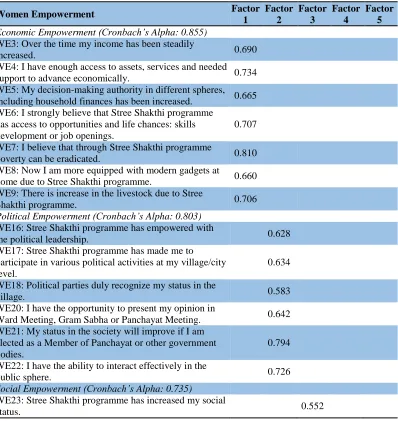
WE23, WE24, WE25, WE29 and WE30) loaded in the range of 0.55 to 0.68. The Cronbach’s Alpha value for this factor is 0.735. The fourth factor consists of five items (WE31, WE32, WE33, WE35 and WE36) that represent strengthening the capacity of all members to exercise their rights, either as individuals or as members of a community. All five items are loaded in the range of 0.71 to 0.83, and hence the fourth factor is named as ‘Legal Empowerment’. The Cronbach’s Alpha value for this factor is 0.865. Finally, four items are loaded on the fifth factor (items WE39, WE40, WE41 and WE42) in the range of 0.60 to 0.84. The items in the fifth factor are named as ‘psychological empowerment’. The Cronbach’s Alpha value for this factor is 0.806.
In summary, the items under factors economic, political, social, legal and psychological empowerment load highly on their particular factors representing good discriminant validity (Diamantopoulos, 2005). The reliability scores for all the five factors were in the range of 0.73 to 0.86, indicating acceptable reliability (Nunnally and Bernstein, 1994). Interestingly, the outcomes show the most important variable of women empowerment is ‘I have clearly understood the concept of gender equality’ (i.e. WE32) with 0.829 factor loading.
Table 2: Factor loadings of women empowerment of Indian respondents
Women Empowerment Factor
1
Factor 2
Factor 3
Factor 4
Factor 5 Economic Empowerment (Cronbach’s Alpha: 0.855)
WE3: Over the time my income has been steadily
increased. 0.690
WE4: I have enough access to assets, services and needed
support to advance economically. 0.734
WE5: My decision-making authority in different spheres, including household finances has been increased. 0.665 WE6: I strongly believe that Stree Shakthi programme
has access to opportunities and life chances: skills development or job openings.
0.707 WE7: I believe that through Stree Shakthi programme
poverty can be eradicated. 0.810
WE8: Now I am more equipped with modern gadgets at
home due to Stree Shakthi programme. 0.660 WE9: There is increase in the livestock due to Stree
Shakthi programme. 0.706
Political Empowerment (Cronbach’s Alpha: 0.803) WE16: Stree Shakthi programme has empowered with
me political leadership. 0.628
WE17: Stree Shakthi programme has made me to participate in various political activities at my village/city level.
0.634 WE18: Political parties duly recognize my status in the
village. 0.583
WE20: I have the opportunity to present my opinion in
Ward Meeting, Gram Sabha or Panchayat Meeting. 0.642 WE21: My status in the society will improve if I am
elected as a Member of Panchayat or other government bodies.
0.794 WE22: I have the ability to interact effectively in the
public sphere. 0.726
Social Empowerment (Cronbach’s Alpha: 0.735)
WE23: Stree Shakthi programme has increased my social
120
WE24: Stree Shakthi programme has made me popular in
my community. 0.682
WE25: My community people respect me after becoming
member of the Stree Shakthi programme. 0.615
WE29: Stree Shakthi programme increased community participation in planning and implementation of development programmes.
0.547 WE30: Stree Shakthi programme has strengthened bond
between members for cooperation and community development.
0.616 Legal Empowerment (Cronbach’s Alpha: 0.865)
WE31: My knowledge on women rights has been increased after I became member of the Stree Shakthi programme.
0.807 WE32: I have clearly understood the concept of gender
equality. 0.829
WE33: I can advise other women on ‘Balanced
workloads for women’. 0.710
WE35: Being a member, it helps tackle the causes of
poverty, not only its symptoms. 0.757
WE36: Stree Shakthi programme helps to overcome the legal and governance-related constraints that undermine poverty reduction efforts.
0.813 Psychological Empowerment (Cronbach’s Alpha: 0.806)
WE39: I am became more optimist due to Stree Shakthi
programme. 0.734
WE40: I feel that I’m a person of worth, at least on an
equal plane with others. 0.815
WE41: After becoming a member of Stree Shakthi
programme I take a positive attitude toward myself. 0.802
WE42: After becoming member of Stree Shakthi
programme I became more assertive. 0.578
4.4. Principal components analysis (PCA) on perceived individual tension
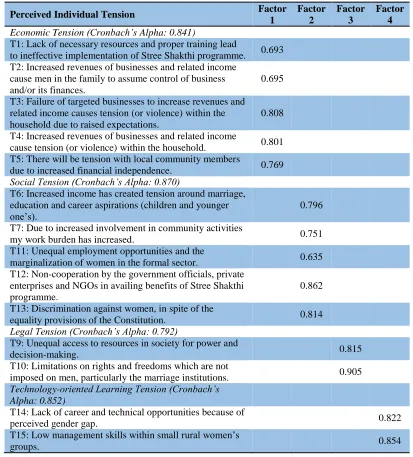
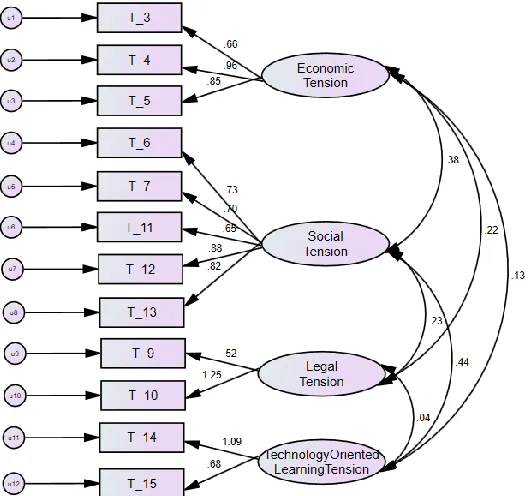
The PCA on the perceived individual tension of Indian data discovered a five-factor structure that described 73.43% of the total variance. Table 3 provides outcomes for perceived tension individual faces in the process of women empowerment. The first factor consisted of five items (T1, T2, T3, T4 and T5) that loaded in the range of 0.696 to 0.80. This factor is labelled as ‘economic tension’ based on the substantive commonalities between the items. The Cronbach’s Alpha value for this factor is 0.841. Five items are loaded on the second factor (items T6, T7, T11, T12 and T13) in the range of 0.63 to 0.86. The items in the second factor are labelled as ‘social tension’. The Cronbach’s Alpha value for this factor is 0.870. The third factor is labeled as ‘legal tension’ based on their substantive item commonality. The two items in this factor (items T9 and T10) loaded in the range of 0.81 to 0.90. The Cronbach’s Alpha value for this factor is 0.792. Finally, two items are loaded on the fourth factor (items T14 and T15) in the range of 0.82 to 0.85. The items in the fourth factor are labelled as ‘technology-oriented learning tension’. The Cronbach’s Alpha value for this factor is 0.852.
121
Table 3: Factor loadings of the perceived individual tension
Perceived Individual Tension Factor
1
Factor 2
Factor 3
Factor 4 Economic Tension (Cronbach’s Alpha: 0.841)
T1: Lack of necessary resources and proper training lead
to ineffective implementation of Stree Shakthi programme. 0.693 T2: Increased revenues of businesses and related income
cause men in the family to assume control of business and/or its finances.
0.695 T3: Failure of targeted businesses to increase revenues and
related income causes tension (or violence) within the household due to raised expectations.
0.808 T4: Increased revenues of businesses and related income
cause tension (or violence) within the household. 0.801 T5: There will be tension with local community members
due to increased financial independence. 0.769 Social Tension (Cronbach’s Alpha: 0.870)
T6: Increased income has created tension around marriage, education and career aspirations (children and younger one’s).
0.796 T7: Due to increased involvement in community activities
my work burden has increased. 0.751
T11: Unequal employment opportunities and the
marginalization of women in the formal sector. 0.635 T12: Non-cooperation by the government officials, private
enterprises and NGOs in availing benefits of Stree Shakthi programme.
0.862 T13: Discrimination against women, in spite of the
equality provisions of the Constitution. 0.814
Legal Tension (Cronbach’s Alpha: 0.792)
T9: Unequal access to resources in society for power and
decision-making. 0.815
T10: Limitations on rights and freedoms which are not
imposed on men, particularly the marriage institutions. 0.905 Technology-oriented Learning Tension (Cronbach’s
Alpha: 0.852)
T14: Lack of career and technical opportunities because of
perceived gender gap. 0.822
T15: Low management skills within small rural women’s
groups. 0.854
4.5. Principal components analysis (PCA) on capacity building measures
122
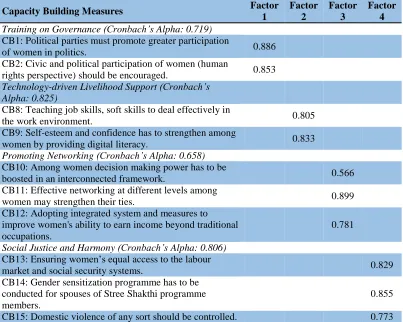
in the range of 0.77 to 0.85. The fourth factor includes items are labelled as ‘social justice and harmony’. The Cronbach’s Alpha value for this factor is 0.806.
In summary, items under all four factors load highly on their respective factors signifying good discriminant validity. The reliability scores signified all the four factors were in the range of 0.65 to 0.82, representing acceptable reliability. Interestingly, the outcome shows that the most important variable of capacity building measure individual tension is ‘Effective networking at different levels among women may strengthen their ties’ (i.e. CB11) with 0.899 factor loading.
Table 4: Factor loadings of the capacity building measures
Capacity Building Measures Factor
1
Factor 2
Factor 3
Factor 4 Training on Governance (Cronbach’s Alpha: 0.719)
CB1: Political parties must promote greater participation
of women in politics. 0.886
CB2: Civic and political participation of women (human
rights perspective) should be encouraged. 0.853 Technology-driven Livelihood Support (Cronbach’s
Alpha: 0.825)
CB8: Teaching job skills, soft skills to deal effectively in
the work environment. 0.805
CB9: Self-esteem and confidence has to strengthen among
women by providing digital literacy. 0.833
Promoting Networking (Cronbach’s Alpha: 0.658) CB10: Among women decision making power has to be
boosted in an interconnected framework. 0.566
CB11: Effective networking at different levels among
women may strengthen their ties. 0.899
CB12: Adopting integrated system and measures to improve women's ability to earn income beyond traditional occupations.
0.781 Social Justice and Harmony (Cronbach’s Alpha: 0.806)
CB13: Ensuring women’s equal access to the labour
market and social security systems. 0.829
CB14: Gender sensitization programme has to be conducted for spouses of Stree Shakthi programme members.
0.855 CB15: Domestic violence of any sort should be controlled. 0.773
4.6. Confirmatory factor analysis (CFA)
CFA procedure was accepted to confirm the factors that underlie the dimensions, perceived tension and capacity building measures for WE. As suggested by Bollen and Long (1993), multiple fit indices were considered for judging how well the planned models of women empowerment fit the data. The study observed a non-significant chi-square (χ²), the goodness of fit index to denote good fit (Marsh
123
4.7. Confirmatory factor analysis (CFA) on women empowerment
The result of the first reiteration of data discovered an unacceptable model fit χ²(367) = 1619.4, σ = 0.00. Multiple fit indices and Modification indices (MIs) information provided to identify the model fit can be improved. Further, items were removed after considering their substantive meaningfulness to the construct (Byrne, 2009). This process gives the information of exclusion of one item (i.e. WE23) from the model. After deleting items, the model was again re-run for the second iteration. The final five-factor model of women empowerment providing a moderate fit to the data as showed by (χ²(289) = 1318.6, σ = 0.05) and supportive fit indices (RMSEA = 0.078, NFI = 0.713, TLI = 0.705, CFI = 0.757). The five factors of women empowerment (economic, political, social, legal and psychological mentioned in Figure 1 below) presented significant factor coefficients ranging from a low of 0.41 (item WE25) to a high of 0.84 (item WE21).
Figure 1: The confirmed five-factor model of women empowerment
4.8. Confirmatory factor analysis (CFA) on perceived individual tension
124
of perceived individual tension (economic, social, legal, and technology-oriented learning) mentioned in Figure 2 below.
Figure 2: The confirmed five-factor model of perceived individual tension
4.9. Confirmatory factor analysis (CFA) on capacity building measures
The outcome of the first iteration of data revealed an acceptable model fit. Multiple fit indices and Modification indices (MIs) were used to recognize the model fit may enhance. However, without deleting any further item, the final four-factor model of capacity building measures provided an adequate fit to the data as specified by (χ²(29) = 334.8, σ = 0.00) and supporting fit indices (RMSEA = 0.091, NFI = 0.774, TLI = 0.694, CFI = 0.786). The four factors of capacity building measures (training on governance, technology-oriented livelihood support, promoting networking, social justice and harmony) provided in Figure 3 below.
125
5. DISCUSSION AND IMPLICATION
This study attempts to conceptualize various constructs of WE. The findings help us in understanding the five dimensions of WE, four different categories of capacity building measures, and four different types of perceived individual tension in the process of WE. Women empowerment studies are more important in emerging countries. Therefore, the findings and their implications are important for policy, practice, theory, and subsequent research.
The first important implication of our study derives from our unique findings on the five dimensions of WE. SHG members are steadily increased in income, access to needed support, access to new opportunities, and improve decision-making in diverse spheres lead to economic empowerment. Whereas, SHG member's involvement in election activities at the village or urban level, leadership quality, nomination as member of the village council, ability to convenience politicians and government officials for development work, leads to the political empowerment. Further, members are well-known, respectful, and their involvement in social work and community development activities lead the social empowerment. SHG member’s improved knowledge on women rights, gender equality, and work-life balance and solution provided for poverty reduction lead to legal empowerment. Finally, more involvement in SHGs group meeting, participation in social work has a significant impact on member life, like becoming a positive nature and self-confident result in the psychological empowerment.
The second important implication of our study derives from our unique findings on the perceived individual tension in the process of WE. We found the evidence on four different types of perceived individual tension: economic, social, legal, and technology-oriented learning. Economic tension of SHG members consists of an increase in revenues, making assets, failure in business, financial independence, implementation challenges of projects, and purchasing decision power in their families. Economic tension is related to the increased involvement in community activities; no fairness in employment opportunities and the poor women in the formal sector; and non-cooperation with the government officials, private enterprises and NGOs in availing benefits. Lack of access to power, limited decision making, and various restriction to women rights after marriages, lead to the legal tension. Finally, members have low management skills in the groups, limited knowledge in digital use, gender disparity in education causes of tension called technology-oriented learning tension.
The final important implication of our study derives from our unique findings on capacity building measures in WE. The findings indicate four different categories of capacity building measures in WE. These are training on governance, technology-oriented livelihood support, promoting networking, and social justice and harmony. Training on governance mostly includes training on legal literacy program, and encouraging members to participate in political activities. The technology-driven livelihood support is about providing technology-based education, soft skills program, and digital literacy orientation to the SHG members. Women decision making power while considering their peer groups views, intense socialization from top to bottom-up approach, maintained solidarity helps to build and promote strong networking. Finally, equality in gender in the workplace and society reduces the domestic violence results in the social justice and helps in achieving social harmony.
126
6. CONCLUSION
The main focus of this study is to conceptualize the different dimensions of WE, various types of perceived individual tension of the SHG member during the process of WE, and various categories of capacity building measures in the Indian perspective. As the seminal work, we collected survey data of 351 respondents (SHG members) using a stratified random sampling technique. The exploratory principal component analysis (PCA) is incorporated to identify the number of components that underlie the WE. Further, a confirmatory factor analysis (CFA) is used to confirm the factors in the study. We made some observations about the new dimensions of WE, capacity building measures and perceived, individual tension through quantitative work.
These aspects are essential for our understanding and could be considered as the crux of the field. The unique findings are: five dimensions of WE (economic, social, political, psychological and legal), four types of perceived individual tension (economic, social, legal and technology-oriented learning), and four categories of capacity building measures (training on governance, technology-driven livelihood support, promote networking, social justice and harmony).
Considering the critical consciousness of WE in the emerging nations like India, these interventions have great potential for empowerment, hence, reducing poverty, bringing gender equality, and overall wellbeing of a member of SHGs. These conceptualizations help in measuring and evaluating various schemes and their effects on the individual dimension (level) of WE. Further, a set of four categories of capacity building measures, and four types of perceived individual tension help in formulating policies and governance from a macro perspective.
6.1. Contribution
The study provides a conceptualization of various aspects on WE. Our primary contribution is three-fold. First, the current research is considered to develop a new scale (26-item scale) that assesses various dimensions of WE. Moreover, this study is also designed to be the first to consider all the five dimensions (economic, political, social, legal and psychological) of WE into the analysis. Another advantage of this study is that a scale includes 10 items for the capacity building (CB) measures have been formed, then researchers can use this scale if they are working with complex issues of WE and looking at solutions on it. Finally, although researchers have conceptualized and evaluated individual tension in many different ways, our results contribute to an understanding of this novel construction by developing a scale in the context of WE.
6.2. Limitation and future research direction
In spite of its various contributions, this paper does exhibit certain limitations. We highlight several limitations of this paper, some of which also provide directions for future research. The first limitation is restricted by its attention to the rural areas in the state of Karnataka, India. Therefore, it is necessary to inspect whether the validity of the scale holds for other rural backgrounds, and other settings/emerging/developed economies (Kumar and Dutta, 2017; Chauhan et al., 2015). The second limitation of this study is the use of stratified random sampling. The sample was not drawn at systematically and is prone to community bias as the initial respondents affect the final sample
(Atkinson and Flint, 2004). An additional large-sample of data may attempt to refine and validate
relationships among several variables and formulate new ones (Kumar et al., 2017a; Kumar and
Kumar, 2018). Lastly, the current study has not considered all enablers that are critical for WE, and
acknowledges that the field is subject to significant underlying and dynamic trends. Hence, a replication of the same study in the future could generate new insights about the growth of the field
(Snehvrat et al., 2018).
This study has a plethora of opportunities to explore further. We outline many but five such directions. First, we suggest scholars of the field relate our conceptualization of various constructs to the theories, frameworks, and perspectives related to WE (Chauhan and Kumar, 2013; Kumar et al., 2017b; Prasad
127
critical to WE. The future researcher can include more enablers and validate the various relationships. For example, further research could be on social innovation and how it influences WE through SHGs in emerging nations. Third, future research should be a call for SHGs to study the different schemes in a particular state, and relate it to the capacity building measures in order to empower women in all the five dimensions.
Funding: This study received no specific financial support.
Competing Interests: The authors declared that they have no conflict of interests.
Contributors/Acknowledgement: All authors participated equally in designing and estimation of current research.
Views and opinions expressed in this study are the views and opinions of the authors, Asian Journal of Empirical Research shall not be responsible or answerable for any loss, damage or liability etc. caused in relation to/arising out of the use of the content.
References
Adolph, B. (2003). The role of self-help groups in rural nonfarm employment Rural non- farm economy: Access factors. Discussion Paper. Natural Resource Institute. University of Greenwich, Medway, United Kingdom.
Ahenkan, A., & Boon, E. (2011). Non-timber forest products farming and empowerment of rural women in Ghana. Environment, development and sustainability, 13(5), 863-878. doi.org/10.1007/s10668-011-9295-7
Ahmed, S. M. (2005). Intimate partner violence against women: experiences from a woman-focused development program in Matlab, Bangladesh. Journal of Health, Population and Nutrition, 23(1), 95-101.
Aminuzzaman, S., Baldersheim, H., & Jamil, I. (2003). Talking back! Empowerment and mobile phones in rural Bangladesh: a study of the village phone scheme of Grameen Bank. Contemporary South Asia, 12(3), 327-348. doi.org/10.1080/0958493032000175879
Anderson, S., & Baland, J. M. (2002). The economics of roscas and intrahousehold resource allocation. The Quarterly Journal of Economics, 117(3), 963-995. doi.org/10.1162/003355302760193931
Arbuckle, J. L. (1997). Amos user's guide version 3.6. SmallWaters Corporation: Chicago retrieved from https://ci.nii.ac.jp/naid/10010343361/.
Atkinson, R., & Flint, J. (2004). Order born of chaos? The capacity for informal social control in disempowered and’disorganised’neighbourhoods. Policy & Politics, 32(3), 333-350. doi.org/10.1332/0305573041223690
Baden, S. (2000). Gender, governance and the feminization of poverty, women and political participation: 21st century challenges. United Nations Development Programme: New York, NY.
Bali, S. R., & Wallentin, F. Y. (2012). Factors empowering women in Indian self-help group programs. International Review of Applied Economics, 26(4), 425-444. doi.org/10.1080/02692171.2011.595398
Banik, D. (2009). Legal empowerment as a conceptual and operational tool in poverty eradication. Hague Journal on the Rule of Law, 1(1), 117-131. doi.org/10.1017/s1876404509001171 Bhattacharya, J., Banerjee, S., & Bose, M. (2013). On assessment of women empowerment at
individual level: an analytical exposition. In Development and Sustainability Springer: India, pp. 385-400.
Bhattacharyya, A., & Cummings, L. (2014). Attitudes towards environmental responsibility within Australia and India: a comparative study. Journal of Environmental Planning and Management, 57(5), 769-791. doi.org/10.1080/09640568.2013.768972
Bollen, K. A., & Long, J. S. (1993). Testing structural equation models. Sage: Newbury Park, CA. Bourey, C., Williams, W., Bernstein, E. E., & Stephenson, R. (2015). Systematic review of structural
128
Brody, C. M., De Hoop, T., Vojtkova, M., Warnock, R., Dunbar, M., Murthy, P., & Dworkin, S. (2015). Economic self-help group programs for improving women’s empowerment: A systematic review. Campbell Systematic Reviews, 1, 19-35.
Brown, M., & Cudeck, R. (1993). EQS structural equations program manual. Multivariate Software Inc: Los Angeles.
Brownson, R. C., Fielding, J. E., & Green, L. W. (2018). Building capacity for evidence-based public health: reconciling the pulls of practice and the push of research. Annual Review of Public Health, 39, 27-53.
Byrne, B. (2006). Structural equation modeling with eqs: basic concepts. Applications, and Programming (Multivariate Applications) (Multivariate Applications Series), 2nd, London: Lawrence Erlbaum.
Byrne, B. (2009). Structural equation modeling with AMOS: Basic concepts. applications and programming. Routledge: New York.
Cavana, R. Y., Delahaye, B. L., & Sekaran, U. (2001). Applied business research: Qualitative and quantitative methods. John Wiley & Sons Inc, retrieved from http://eprints.qut.edu.au/10523/. Chauhan, R., & Kumar, A. (2013). Cloud computing for improved healthcare: Techniques, potential
and challenges. In 2013 E-Health and Bioengineering Conference (EHB) IEEE, pp. 1-4. Chauhan, R., Kumar, A., & Singh, H. (2015). Lessons from startup for energising online patient care.
International Journal of Technology Marketing, 10(2), 195-208.
Chowdhury, P. R. (2012). Microfinance: the shg-linkage program. In the oxford handbook of the Indian economy, New Delhi: Oxford University Press Mar 13, pp. 149.
Churchill, G. A. (1979). A paradigm for developing better measures of marketing constructs. Journal of Marketing Research, 16(1), 64-73.
Churchill, G. A., & Iacobucci, D. (2006). Marketing research: methodological foundations. New York: Dryden Press.
Coakes, S., Steed, L., & Ong, C. (2010). SPSS: Analysis without anguish: version 20 for Windows: 2nd ed. Australia: John Wiley & Sons Australia, Ltd.
Coleman, J. S. (1988). Social capital in the creation of human capital. American Journal of Sociology 94, 95-120.
Cotula, L. (2007). Legal empowerment for local resource control: Securing local resource rights within foreign investment projects in Africa. IIED, London retrieved from http://dlc.dlib.indiana.edu/dlc/bitstream/handle/10535/5396/08_IIED_legal_empowerment.p df.
Dalal, K. (2011). Does economic empowerment protect women from intimate partner violence?. Journal of Injury and Violence Research, 3(1), 35-44.
De Hoop, T., van Kempen, L., Linssen, R., & van Eerdewijk, A. (2014). Women's autonomy and subjective well-being: how gender norms shape the impact of self-help groups in Odisha, India. Feminist Economics, 20(3), 103-135.
Desai, R. M., & Joshi, S. (2013). Collective action and community development: Evidence from self-help groups in rural India. The World Bank Economic Review, 28(3), 492-524.
Diamantopoulos, A. (2005). The C-OAR-SE procedure for scale development in marketing: a comment. International Journal of Research in Marketing, 22(1), 1-9.
Eyben, R., Kabeer, N., & Cornwall, A. (2008). Conceptualising empowerment and the implications for pro poor growth. DAC Poverty Network by the Institute of Development Studies: Brighton.
Fatima, S. (2017). The impact of employee psychological empowerment on job satisfaction and organizational commitment “moderating role of self-leadership” doctoral dissertation. COMSATS University Islamabad, Lahore Campus.
Fischer, E., & Qaim, M. (2012). Linking smallholders to markets: determinants and impacts of farmer collective action in Kenya. World Development, 40(6), 1255-1268.
Floyd, F. J., & Widaman, K. F. (1995). Factor analysis in the development and refinement of clinical assessment instruments. Psychological Assessment, 7(3), 286-299.
129
Goetz, A. M., & Gupta, R. S. (1996). Who takes the credit? Gender, power, and control over loan use in rural credit programs in Bangladesh. World development, 24(1), 45-63.
Golub, S. (2007). The Rule of Law and the UN Peacebuilding Commission: a social development approach. Cambridge Review of International Affairs, 20(1), 47-67.
Gugerty, M. K., Biscaye, P., & Leigh, A. C. (2019). Delivering development? Evidence on self‐help groups as development intermediaries in South Asia and Africa. Development Policy Review 37(1), 129-151.
Harley, D., Grome, S., Kim, S. H., McLendon, T., Hunn, V., Canfield, J., & Wells, A. (2018). Perceptions of success and self-sustainability among women participating in an entrepreneurial skills development and empowerment program through photovoice. Journal of Ethnic & Cultural Diversity in Social Work, pp. 1-19.
https://doi.org/10.1080/15313204.2017.1344900.
Haugh, H. M., & Talwar, A. (2016). Linking social entrepreneurship and social change: The mediating role of empowerment. Journal of Business Ethics, 133(4), pp. 643-658.
Hopkins, J., Levin, C., & Haddad, L. (1994). Women's income and household expenditure patterns: Gender or flow? Evidence from Niger. American Journal of Agricultural Economics,76(5), 1219-1225.
Hughes, M. M., Krook, M. L., & Paxton, P. (2015). Transnational women's activism and the global diffusion of gender quotas. International Studies Quarterly, 59(2), 357-372.
Johnson, S. (2005). Gender relations, empowerment and microcredit: moving on from a lost decade, The European Journal of Development Research, 17(2), 224-248.
Kabeer, N. (1999). Resources, agency, achievements: Reflections on the measurement of women's empowerment. Development and Change, 30(3), 435-464.
Kabeer, N. (2005). Gender equality and women's empowerment: A critical analysis of the third millennium development goal 1. Gender & Development, 13(1), 13-24.
Kabeer, N. (2011). Between affiliation and autonomy: navigating pathways of women's empowerment and gender justice in rural Bangladesh. Development and Change, 42(2), 499-528.
Kabeer, N. (2012). Women’s economic empowerment and inclusive growth: labour markets and enterprise development. International Development Research Centre, 44(10), 1-70.
Kabeer, N. (2017). Economic pathways to women’s empowerment and active citizenship: what does the evidence from Bangladesh tell us?. The Journal of Development Studies, 53(5), 649-663. Kabir, S. M. S., Aziz, M. A., & Shathi, A. S. J. (2018). Women Empowerment and Governance in
Bangladesh. ANTYAJAA: Indian Journal of Women and Social Change, 3, 1-12.
Kantor, P. (2003). Women's empowerment through home–based work: Evidence from India. Development and Change, 34(3), 425-445.
Kostick, K. M., Schensul, S. L., Jadhav, K., Singh, R., Bavadekar, A., & Saggurti, N. (2010). Treatment seeking, vaginal discharge and psychosocial distress among women in urban Mumbai. Culture, Medicine, and Psychiatry, 34(3), 529-547.
Kumar, A., & Dutta, S. K. (2017). Tacit knowledge transfer in coopetition: An empirical investigation of the role of business group (BG) affiliation. Journal of Strategy and Management, 10(4), 453-468.
Kumar, A., Kumar, R., Dutta, S. K., Kumar, R., & Mukherjee, A. (2017). Reconceptualising co-opetition using text mining: inductive derivation of a consensual definition of the field (1996-2015). International Journal of Business Environment, 9(2), 114-137.
Kumar, A., Kumar, R., Haque, M. R., Chowdhury, S. P., & Islam, S. (2017). Entrepreneurial Networks and Knowledge Transfer: The Moderating Role of Incubator/Accelerator Affiliation. Asian Economic and Financial Review, 7(11), 1093-1107.
Kumar, R., & Kumar, A. (2018). Conceptualizing corporate entrepreneurship capability and its linkages towards firm performance. In Global Entrepreneurship and New Venture Creation in the Sharing Economy IGI Global pp. 12-36.
Kumari, K. B. V. (2011). Microcredit as a poverty alleviation strategy, women's empowerment and gender relations. Doctoral dissertation, Rutgers University-Graduate School: New Brunswick. Leeman, J., Calancie, L., Hartman, M. A., Escoffery, C. T., Herrmann, A. K., Tague, L. E., &
130
community-based interventions and are they effective?: a systematic review. Implementation Science, 10(1), 80-95.
Lusthaus, C., Adrien, M. H., & Perstinger, M. (1999). Capacity development: definitions, issues and implications for planning, monitoring and evaluation. Universalia Occasional Paper, 35(35), 1-21.
Malhotra, N., Hall, J., Shaw, M., & Oppenheim, P. (2006). Marketing research: An applied orientation. Pearson Education: Australia. http://dro.deakin.edu.au/view/DU:30010407. Marsh, H. W., Balla, J. R., & McDonald, R. P. (1988). Goodness-of-fit indexes in confirmatory factor
analysis: The effect of sample size. Psychological Bulletin, 103(3), 391-410.
Mathrani, V., & Periodi, V. (2006). The Sangha Mane: the translation of an internal need into a physical space. Indian Journal of Gender Studies, 13(3), 317-349.
Mohapatra, S., & Sahoo, B. K. (2016). Determinants of participation in self-help-groups (SHG) and its impact on women empowerment. Indian Growth and Development Review, 9(1), 53-78. Nair, T. S., & Tankha, A. (2015). Inclusive finance India report 2014. New Delhi: Oxford University
Press.
Nunnally, J. C., & Bernstein, I. H. (1994). The theory of measurement error.Psychometric Theory, 3, 209-247.
O'Hara, C., & Clement, F. (2018). Power as agency: A critical reflection on the measurement of women’s empowerment in the development sector. World Development, 106, 111-123. Patel, V., Kirkwood, B. R., Pednekar, S., Weiss, H., & Mabey, D. (2006). Risk factors for common
mental disorders in women: Population-based longitudinal study. The British Journal of Psychiatry, 189(6), 547-555.
Prasad, V., & Kumar, A. (2014). Need for organizational values and ethics in strategic decision making: a perspective of Indian pharmaceutical industry. Research Journal of Science & IT Management, 3(11), 31-37.
Puri, R., & Kumar, A. (2015). Innoz technologies: The powerhouse of innovation. Emerald Emerging Markets Case Studies, 5(1), 1-13.
Ramasubban, R., & Rishyaringa, B. (2001). Weakness (‘ashaktapana’) and reproductive health among women in a slum population in Mumbai. In Cultural Perspectives on Reproductive Health, Edited by: Obermeyer, C. M.13–37. Oxford: Oxford University Press.
Reddy, C. S., & Manak, S. (2005). Self-help groups: A keystone of microfinance in India-women empowerment and social security. Andhra Pradesh Mahila Abhivruddhi Society (APMAS) India: Hyderabad.
Rocca, C. H., Rathod, S., Falle, T., Pande, R. P., & Krishnan, S. (2008). Challenging assumptions about women's empowerment: social and economic resources and domestic violence among young married women in urban South India. International Journal of Epidemiology, 38(2), 577-585.
Sahu, L., & Singh, S. K. (2012). A qualitative study on role of self help group in women empowerment in rural Pondicherry, India. National Journal of Community Medicine, 3(3), 473-479. Samarakoon, S., & Parinduri, R. A. (2015). Does education empower women? Evidence from
Indonesia. World Development, 66, 428-442.
Sinha, B., Jha, S., & Negi, N. S. (2012). Migration and empowerment: the experience of women in households in India where migration of a husband has occurred. Journal of Gender Studies, 21(1), 61-76.
Snehvrat, S., Kumar, A., Kumar, R., & Dutta, S. (2018). The state of ambidexterity research: a data mining approach. International Journal of Organizational Analysis, 26(2), 343-367.
Tankha, A. (2012). Banking on self-help groups: Twenty years on. Sage Publications: India.
Tarozzi, A., Desai, J., & Johnson, K. (2015). The impacts of microcredit: Evidence from Ethiopia. American Economic Journal: Applied Economics, 7(1), 54-89.
131
Turner, C. S. V. (2002). Women of color in academe: Living with multiple marginality. The Journal of Higher Education, 73(1), 74-93.
Varsha, P. S., Reddy, G., Sudheendra, R. L. N., & Kumar, A. (2019). Impact of self-help groups, capacity building measures and perceived tension on women empowerment-an empirical study. Asian Journal of Empirical Research, 9(3), 65-87.