IJEDR1602334 International Journal of Engineering Development and Research (www.ijedr.org) 1899
Bearing Currents and Shaft Voltage Reduction in
Dual-Inverter-Fed Open-End Winding Induction
Motor With CMV PWM Methods Employing PID
T.Rakesh1, K.Suresh 2
1
PG Scholar (PS), Nalanda Institute of Engineering and Technology, Sattenapalli, Guntur Dt, A.P 2
Associate Professor (EEE), Nalanda Institute of Engineering and Technology, Sattenapalli, Guntur Dt, A.P
Abstract- Exploiting the rich switching redundancies of the dual
inverter, new hybrid pulse width-modulation (PWM) switching
methods are proposed in this paper using the degree of freedom
of operating the individual inverters independently, in addition to
exercising the degree of freedom of controlling the switching
action of the individual legs independently. Two voltage entities,
namely, common-mode voltage (CMV) and differential mode
voltage are identified in the dual inverter, and all hybrid PWMs
are envisaged aimed at reducing and also eliminating the CMV in
it. The effects of such attempts on motor shaft voltage and also the
motor bearing currents are presented in detail. Furthermore,
bearing current profiles of an open-end winding induction motor
are also presented with both conventional and hybrid PWMs
proposed in this paper. Electric discharge machining discharge
currents are completely eliminated with the use of all hybrid
PWM methods proposed in this paper. In addition, implications
of completely eliminating the CMV are also presented in this
paper. All hybrid PWMs proposed in this paper are first
simulated using MATLAB and implemented the system with PID
controller to enhance the performance.
I.INTRODUCTION
Inverter-driven ac motors have become common in variable speed applications due to increased energy conservation. The use of high-frequency PWM methods and also multilevel inverters make the output voltage of the inverters more sinusoidal but also generate high common-mode voltage (CMV). From the studies on PWM-inverter-fed drives in the last few decades, it is found that high-frequency CMV of the inverters causes voltage drop across the bearings and this may cause bearing currents leading to premature bearing failures. Owing to increased cost of maintenance and downtime, attention on protecting the motor bearings has increased . Among the known solutions such as the
use of brushes, insulated bearings, and electrostatic shielding, the use of appropriate filters is reported in. Also, new PWM methods are proposed for the two-level inverters that only reduce the CMV generated by them since complete elimination is not possible. To investigate the impact of CMV generated by PWM inverters on bearing currents, a simplified measurement setup is proposed in that enables the measurement of motor shaft voltage and motor bearing current in an induction motor driven from a two-level inverter. Multilevel inverters can also offer excellent solutions in reducing the CMV and the related problems.
Reducing the motor shaft voltage and bearing currents using multilevel inverters is reported in and Of many multilevel inverter topologies, the dual-inverter topology employing open-end winding induction motor drive has slowly gaining popularity ever since it was introduced as it inherits many advantages compared to its counterparts. In, a dual inverter fed from two isolated dc sources and also a single dc source is presented. However, arresting circulating zero sequence currents in the motor phase windings is addressed using zero sequence chokes in single-dc-source-driven dual inverter. Later, many PWM methods are reported for the dual inverter for achieving improved performance.
IJEDR1602334 International Journal of Engineering Development and Research (www.ijedr.org) 1900 in the dual inverter can be forced to zero in the average sense in
every sampling time interval by suitably placing the effective-time periods of the individual inverters. Recently, it has been shown that the effective-time periods of the individual inverters can be independently controlled to control the ripple content in the load current.
From the knowledge of motor shaft voltage which is found to be replica of the CMV output of the inverter, the equivalent voltage in the dual inverter that is responsible for motor shaft voltage is clearly identified, and analytical expression for the same is first presented in. In, four new hybrid PWMs are proposed that successfully reduce the motor shaft voltage by following the reduced CMV principles reported for the two level inverter in. Exploiting the rich switching redundancy of the dual two level inverter, new hybrid PWM methods are proposed in this paper for the dual inverter, which are aimed at reducing and also eliminating the CMV output.
Bearing current profiles composed of capacitive bearing currents (dv/dt) and the electric discharge machining (EDM) discharge currents are presented for the open-end winding induction motor drive fed from dual inverter with conventional and also hybrid PWM methods proposed in this paper. The effects of reducing and eliminating CMV in the dual inverter on motor shaft voltage and bearing currents are also presented in this paper. The proposed hybrid PWMs succeed in reducing the motor shaft voltage to such an extent that they manage to completely keep the EDM discharge currents away in the open-end winding induction motor that are known to be dominant in low-power-rating motors [2]. The envisaged propositions are first simulated using MATLAB and are validated experimentally.
II.DUAL TWO-LEVEL INVERTER FOR THREE-LEVEL INVERSION
The power circuit configuration of a dual two-level inverter feeding open-end stator windings of a 3-φ induction motor load is shown in Fig. 1. This topology can synthesize a three level voltage space vector similar to any other equivalent three level inverter topology. Each inverter in Fig. 1 is capable of attaining eight switching states. The dual two-level inverter is thus capable of attaining 82, i.e., 64, switching states. From Fig. 1, the three-phase voltages of the open-end winding induction motor can be given as
The voltage space vector thus generated can be written as
IJEDR1602334 International Journal of Engineering Development and Research (www.ijedr.org) 1901 Fig. 2. (a) Space vectors generated by dual inverter. (b) Principle
of decoupled PWMs for the dual inverter.
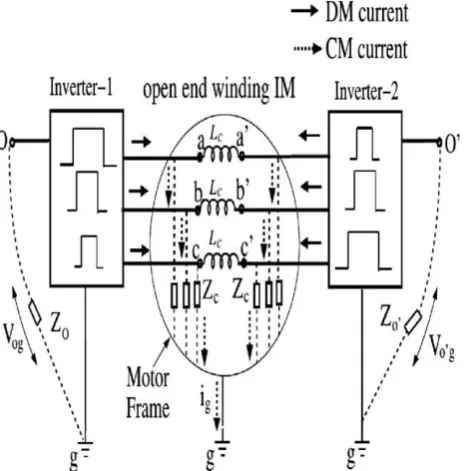
Fig. 3. Common- and differential-mode currents in dual-inverter-fed open-end winding induction motor.
Isolated dc sources are used for the dual inverter to arrest the flow of circulating current in the motor phase windings.
However, the high-frequency PWM inverters excite the machine parasitic capacitances, resulting in the CMV appearing across the motor phase windings. Based on the paths provided by the parasitic capacitances, common- and differential-mode current components can flow in the PWM inverter drive. Common- and differential-mode current paths in dual inverter- fed open-end winding induction motor drive are now shown in Fig. 3. Common-mode current flows through the motor frame and returns to the inverters and/or input ac mains (not shown in Fig. 3 in the interest of brevity), whereas differential-mode current flows between inverter legs and the motor phase windings. In Fig. 3, Lc is the leakage inductance of motor phase windings, Zc is the parasitic impedance between stator phase windings to motor frame (grounded), and Zo and Z_ o are the parasitic impedances between inverter ground (heat sink) and O and O_ of inverter-1 and inverter-2, respectively. Since the open-end stator windings are energized by two voltage sources, as shown in Fig. 3, zero sequence current can circulate in the phase winding that is decided by the difference between the two source voltages. This can be defined in terms of CMV of the individual inverters (vCMV1 and vCMV2) as
It can be seen that the common-mode leakage ground current (ig) flows from the inverters to the motor frame (grounded) through the stray impedances formed by Zc and Zo, and Zc and Z_ o. Hence, CMV in the dual inverter can be written in terms of
the CMV of the individual as
IJEDR1602334 International Journal of Engineering Development and Research (www.ijedr.org) 1902 Several PWMs have been reported in the literature on
minimizing and eliminating the latter components, leaving scope for investigations on the former part. As explained in the previous section that there exists a high degree of freedom in the selection of switching combinations in the dual inverter, various hybrid PWMs are proposed in this paper that not only reduce the magnitude of CMV in the dual inverter but also reduce its frequency of occurrence. Synthesized by the individual two-level inverters and the principle is depicted in Fig. 2(b). In addition to exercising the options of independently controlling the individual inverters, additional degree of freedom of independent switching of inverter legs is explored in the present paper.
Fig.4 matlab circuit for proposed system with PI controller
Fig.5 CMVs in the dual inverter when controlled with PI controller
Fig.6 bearing current and motor shaft voltage profile with PI controller
IJEDR1602334 International Journal of Engineering Development and Research (www.ijedr.org) 1903 Fig.8 CMVs in the dual inverter when controlled with PID
controller
Fig.9 bearing current and motor shaft voltage profile with PID controller
CONCLUSION
Three-level inversion has been achieved with hybrid PWM switching methods proposed in this paper by exploring the degree of freedom of adopting independent PWM methods for the individual inverters in addition to operating them independently. Motor shaft voltage in the dual-inverter scheme is found to be a replica of CMV of the dual inverter while DMV is identified to be entirely different from CMV. Analytical expressions are presented for both, supported by theoretical and experimental results. New hybrid PWM switching methods have been envisaged in this paper, aimed at reducing the CMV output
from the dual inverter with the intention of reducing motor shaft voltage, and have been found successful. In addition, investigations on completely eliminating the CMV have also been presented in this paper using selected hybrid PWM method, and inherent difficulties have clearly been presented with detailed analysis. Furthermore, bearing current profiles have also been presented with both conventional PWMs and hybrid PWMs proposed in this paper. EDM discharge currents that are reported to be the main sources of bearing damages in small-medium-power motors are completely eliminated with the use of the hybrid PWM methods proposed in this paper, demonstrating their effectiveness.
REFERENCES
[1] J. M. Erdman, R. J. Kerkman, D. W. Schlelgel, and G. L. Skibinski, “Effect of PWM inverters on AC motor bearing currents and shaft voltages,” IEEE Trans. Ind. Appl., vol. 32, no. 2, pp. 250–259, Mar./Apr. 1996.
[2] A. Muetze, “Bearing currents in inverter fed AC motors,” Ph.D. dissertation, Technische Universitaet Darmstadt, Darmstadt, Germany, 2004.
[3] D. Dahl, D. Sosnowski, D. Schlegel, R. J. Kerkman, and M. Pennings, “Gear up your bearings,” IEEE Ind. Appl. Mag., vol. 14, no. 4, pp. 45–53, Jul./Aug. 2008.
[4] A. Willwerth and M. Roman, “Electrical bearing damage A lurking problem in inverter-driven traction motors,” in Proc. IEEE ITEC, Jun. 16–19, 2013, pp. 1–4.
[5] A. Datta, M. Dubey, and S. Jain, “Effect of static power supply in alternator used for short circuit testing observation of shaft voltage,” IEEE Trans. Power Electron., vol. 29, no. 11, pp. 6074–6080, Nov. 2014.
[6] A. Muetze, J. Tamminen, and J. Ahola, “Influence of motor operating parameters on discharge bearing current activity,” IEEE Trans. Ind. Appl., vol. 47, no. 4, pp. 1767–1777, Jul./Aug.
2011.
[7] N. Zhu, J. Kang, D. Xu, B. Wu, and Y. Xiao, “An integrated AC choke design for common-mode current suppression in neutral-connected power converter systems,” IEEE Trans. Power Electron., vol. 27, no. 3, pp. 1228– 1236, Mar. 2012.
IJEDR1602334 International Journal of Engineering Development and Research (www.ijedr.org) 1904 inverter drives,” IEEE Trans. Ind. Electron., vol. 47, no. 6, pp.
2570–2577, Nov./Dec. 2011.
[9] H. Akagi and T. Shimizu, “Attenuation of conducted EMI emissions from an inverter-driven motor,” IEEE Trans. Power Electron., vol. 23, no. 1, pp. 282, 290, Jan. 2008.
[10] N. O. Cetin and A. M. Hava, “Compatibility issues between the filter and PWM unit in three-phase AC motor drives utilizing the pure sine filter configuration,” IEEE Trans. Ind. Electron., vol. 47, no. 6, pp. 2559–2569, Nov./Dec. 2011.
First Author: T.Rakesh is pursuing his M.Tech from Nalanda Institute of engineering, Sattenapalli, Guntur dt. Affiliated to JNTUK, Kakinada, A.P, India. His Research Interests is Power Systems, Power Electronics.