Processing and Utilization of Sorghum and Maize in Botswana: Current Status and Opportunities
G. P. Nthoiwa and T. Gombalume Botswana College of Agriculture, Sebele, Botswana
K. K. Mokwena Nthoiwa
Rochester Institute of Technology, Rochester, New York, United States Abstract
The study reviews the current sorghum and maize production, processing and utilization in Botswana. Most of the grains produced in Botswana are used for home consumption, while processing of commercial and export commodities are limited both in terms of quantity and extent of processing. The major processing activity by both small scale and large scale firms is grain milling into maize and sorghum flours. There is limited value-added commercial processing. This creates an opportunity for development and marketing of traditional and new value-added products. Opportunities for expanding and diversifying industrial or semi-industrial processing of maize and sorghum beyond grain milling are suggested.
Keywords: Maize, Sorghum, milling, value-added processing, food security
Introduction
Cereals have a long history of use by humans as staple foods and important sources of nutrients in both developed and developing countries. Cereals and cereal products are an important source of energy, carbohydrate, protein and fiber, as well as containing a range of micronutrients such as vitamin E, some of the B vitamins, magnesium and zinc (McKevith, 2004). Cereal grains form a major portion of the diet of the people of Botswana, and are widely grown throughout the country. Many different processing activities are utilized to turn coarse cereal grains into products ready for human consumption. Food processing contributes to food security by reducing postharvest food Corresponding author’s:
Name: K. K. Mokwena Nthoiwa Email address:[email protected]
losses and contributing to diversity of the diet. Food processing absorbs the surplus agricultural products that may otherwise be lost by using them as raw materials that are converted into intermediate or finished consumer products. The Food and Agriculture Organization of the United Nations (FAO) estimated world food losses at 33% or 1.3 billion tons per year (FAO, 2011). The FAO report stated that food losses in the developing world tend to be related to financial, managerial and technical limitations of food distribution between the farmer and the consumer. Proper processing and packaging of foods can minimize this waste by offering foods with extended shelf life that provides more time for sale, thus saving food that is normally lost. Food processing also ensures higher value addition to agricultural production, generates employment, improves farmer income and creates markets for domestic consumption and export of foods. It has
Asian Journal of Agriculture and Rural Development
been estimated that high-income countries add over US$200 per ton of value by processing agricultural products while developing countries add less than US$50 (UNIDO, 2013). Furthermore, while 98% of agricultural production in high-income countries undergoes industrial processing, in developing countries, barely 30% is processed. A dynamic food processing sector provides strong linkages and synergies between agricultural production and the consumers and hence plays significant role in the overall economic setup of a country.
While it is widely recognized that processing provides a strong backward linkage to agricultural production, the potential of the cereal processing industry in Botswana is not fully utilized to achieve this purpose. In general, a relatively small amount of agricultural products in Botswana are industrially processed. The main objective of this study is to review literature on the production and utilization of maize and sorghum in Botswana. The study make use of existing secondary data from the Ministry of Agriculture, Statistics Botswana, Ministry of Trade and Industry and other relevant government and non-government agencies (both local and international). The secondary data were complemented by extensive survey of literature relating to maize and sorghum utilization in Botswana. Cereal production trends in Botswana Cereal production in Botswana is based on rain-fed farming. However, the low and erratic rainfall coupled with relatively poor soils, makes crop production in general a high risk system with low productivity. Arable crop production is carried out by both commercial farmers and subsistence
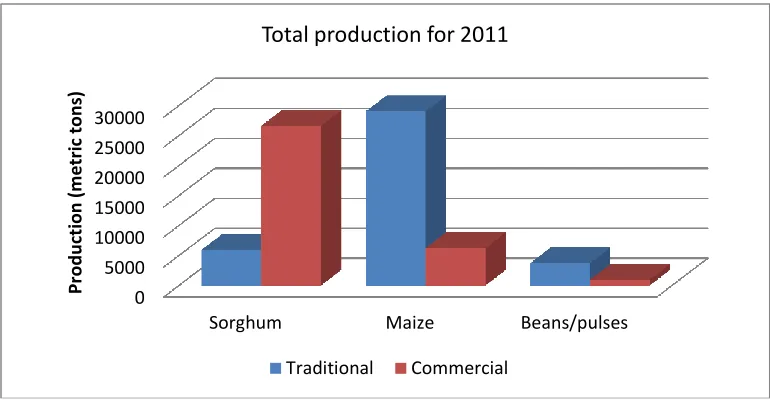
smallholder farmers. The arable sector is dominated by small traditional farms with an average farm size of 5 hectares. Farm size estimates for the year 2011 showed that about 63,000 arable farms were 5 hectares or less and only 112 farms were larger than 150 hectares (Statistics Botswana, 2013). Sorghum and maize are two of the major crops grown in terms of area planted. Sorghum is traditionally the most important crop and the one best suited to Botswana’s agro-climatic conditions. However, the share of maize production has grown over years in response to increasing demand, despite it being a more risky crop (Stockbridge, 2006).
Figure 1: Total production of major crops in Botswana during 2011 Source: Statistics Botswana, 2013
The land area available for crop cultivation, as well as the actual area planted and the actual area harvested after planting, vary considerably from year to year, as shown in Figure 2. From the figure, the average land area available for crop production was about 250,000 ha during the period between 2001 and 2011 (Statistics Botswana, 2013).
However, only 178,000 ha, or about 70%, of this available land area were actually planted with crops during this period. Of the area planted, only about 60% was actually harvested. This data shows that much of the land is being underutilized, or not used at all.
Figure 2: Land area, area planted and harvested during 2001-2011. Data for 2005 is missing. Source: Statistics Botswana 2013
0 5000 10000 15000 20000 25000 30000
Sorghum Maize Beans/pulses
Pr
o
d
u
ction
(m
e
tr
ic
to
n
s)
Total production for 2011
Traditional Commercial
2001 2002 2003 2004 2006 2007 2008 2009 2010 2011
Available Land Area 299 287 195 209 191 182 279 327 259 273
Area Planted 94 201 80 142 173 108 227 256 239 262
Area Harvested 50 79 17 99 133 27 126 181 159 174
0 50 100 150 200 250 300 350
A
re
a (
'000
h
a)
Lack of rainfall and poor soils have been cited as the main constraints for farm productivity in Botswana, but a broad comparison between commercial and subsistence farming indicates that climatic conditions cannot take the full blame for low land productivity within the traditional subsistence farming community. While climatic factors have been cited as constraints for improved yields in many countries, other factors have also been identified, such as preference of one crop over the other. For example, in Bangladesh, slowing yield growth of wheat was reported over the years, which was attributed to comparative advantage of cultivation of Boro rice over wheat (Poudel and Chen, 2012). Similar trends were also reported for maize cultivation in Pakistan, where land area previously used for sorghum production was being converted to cultivating other crops which yield higher profits in the market (Habib et al., 2013). In Botswana however, there are no alternative crops preferred over maize and sorghum to explain the trend. The traditional farming system is characterized by farmers who keep livestock in addition to crop cultivation. In some years, it is possible that these farmers may decide to concentrate more on livestock rearing at the expense of crop cultivation. Additionally poor agronomic practices and economic constraints might explain the underutilization of land. Increasing crop yields per unit of land can be achieved through use of new improved technologies, high yielding cereal varieties and improved production practices such as proper land preparation techniques and correct fertilizer use. Use of drought tolerant varieties can produce desirable effects in crops such as maize. The results of a study by Kiani (2013) indicated that there is a lot of genetic variation in maize varieties with regard to drought tolerance. This is particularly important to consider in a semi-arid country such as Botswana. The right type and accurate fertilizer application rates have been shown to satisfy crop requirements and produce higher crop yields. Ejuneke (2013)
showed that organic manure from poultry and cow dung and an inorganic NPK fertilizer applied to three varieties of maize crop produced higher grain/cob.
provided they improve their farming practices.
Cereal milling technologies in Botswana Processing of sorghum and maize in Botswana is done by both traditional and commercial sectors. Whether at the traditional or industrial levels, milling is the main activity associated with cereal processing in Botswana. Hand pounding with mortar and pestle has been the primary processing technique used for milling maize and sorghum by traditional households. Traditional hand pounding is extremely labor-intensive, and the laborious task has traditionally been performed by women and children. Eastman (1980) established from several informal surveys that women can devote 2-5 hours a day to processing sorghum and millet grain for family daily grain needs. A study cited by Mmapatsi and Maleke (1996) revealed that using a mechanical dehuller instead of hand pounding saves 41% of women’s time and 50% of children’s time to engage in other productive activities. Hand pounding is still a major food preparation activity in some rural areas of Botswana, despite the widespread availability of mechanical milling.
Commercial sorghum milling in Botswana utilizes a technology consisting of a decorticator (commonly referred to as a dehuller) and hammer mills. The type of decorticator most common in Botswana is based on a prototype put out by Prairie Research Laboratory (PRL) in Canada (Bassey and Schmidt, 1989; Mmapatsi and Maleke, 1996). This decorticator has the advantage of being relatively inexpensive to install, operate and maintain. Bassey and Schmidt (1989) described the development of this type of decorticator and its use in Africa. A description of the machine used in Botswana, which was developed and introduced by Rural Industries Innovation Center (RIIC), was given by Mmapatsi and Maleke (1996).
The decorticator is an abrasive disc type that removes mainly the outer pericarp layers of sorghum during a dry milling operation. Evenly spaced abrasive wheels (carborundum stones) rotate clockwise against the grain inside a horizontal barrel, enabling a progressive abrasion and decortication of the outer layers of grains along the length of a barrel. A suction aspiration fan and ducting system removes the husks and bran, while the decorticated grain is discharged after sufficient decortication. This can be done as either a batch or a continuous process where several decorticators are used in series (Mmapatsi and Maleke, 1996). The development of sorghum milling technology through RIIC and the continued support of the industry by government has produced business opportunities that created jobs, generated income to business owners and improved livelihoods of many. Rohrbach et al. (2000) stated that initially machine processing of sorghum was viewed primarily as a means to encourage growth of sorghum production and consumption in rural areas. However, over the years sorghum milling has grown into a commercial enterprise. The rapid growth of the milling industry was attributed to financial support from the government through programs such as the former Financial Assistance Policy (FAP) which provided grants for land, buildings, machinery, labor and packaging.
Grain milling products
hand pounding comprise a mixture of different size granules of the endosperm, but may also contain particles from the germ and pericarp fractions of the grain. The moisture content of flour is a very important quality factor for shelf life purposes. Due to the semi-wet milling process, the flour produced from the traditional milling process is moist; hence it has a shelf life of about three days (Kebakile, 2008).
All grain milling techniques, manual or mechanical, result in some loss of nutrients in the grain. However, the nutrient content of manually produced flour is generally higher than that of highly refined industrially produced flours. Eastman (1980) revealed that more nutrients were lost from grains processed with the PRL/ RIIC dehuller compared to grains processed manually because the traditional wet process removes very little of the grain germ, which happens to contain many of the high quality nutrients. It was reported that mechanical processing removes more of the germ and resulted in flour that has, on average, 25% less fat, 10% less crude fiber, 15% less ash, and slightly less protein than does manually processed sorghum flour (Eastman, 1980). Pedersen and Eggum (1983a, 1983b) studied the influence of milling on the nutritive value of flour from maize and sorghum. Pedersen and Eggum (1983a) reported that milling of maize reduced the fat content and minerals to approximately 28% of corresponding levels in whole maize. The composition of amino acids in maize flour was also significantly affected by milling.
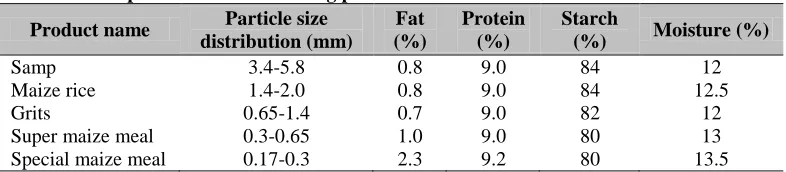
The effect of degerming was most pronounced in the reduction of lysine and tryptophan, which were reduced to 63% and 69%, respectively, of corresponding levels in whole maize. Starch and protein are less affected by processing as these are concentrated in the endosperm of the grain (Goldberg, 2003, Inglett, 1970). A reduction in the fat and ash content of sorghum flours was reported, despite higher contents of these components being retained as compared to hand dissected endosperm (Pedersen and Eggum, 1983b). The authors speculated that a considerable proportion of the germ is retained during milling even at an extraction rate of 64%. It was also found that the content of lysine was significantly decreased by milling, while the content of leucine, which is naturally present in excessive amounts in sorghum, was further increased. The lysine content of whole sorghum meal (i.e., 100% extraction rate) was 2.02% which reduced to 1.3% at 64% extraction rate (Pedersen and Eggum, 1983b). On the other hand, leucine content was 13.9% at 100% extraction rate and increased to 15.7% at 64% extraction rate. The maize meal categories available in the retail market in Botswana are generally identified as ‘Super’, ‘Special’, ‘Sifted’ or ‘Unsifted’, based on the composition and particle size index as shown in Table 1. Also shown in Table 1 are the compositions of other maize milling products such as samp, maize rice and grits. Some of the maize meal grades are fortified to improve the nutrient reductions during milling.
Table 1: Composition of maize milling products Product name Particle size
distribution (mm)
Fat (%)
Protein (%)
Starch
(%) Moisture (%)
Samp 3.4-5.8 0.8 9.0 84 12
Maize rice 1.4-2.0 0.8 9.0 84 12.5
Grits 0.65-1.4 0.7 9.0 82 12
Super maize meal 0.3-0.65 1.0 9.0 80 13
Special maize meal 0.17-0.3 2.3 9.2 80 13.5
The major cereal milling companies in Botswana include Bolux Milling, Foods Botswana and Bokomo Botswana. These are all large scale companies manufacturing maize- and sorghum-based milling products under different brand names found in the local market. Bokomo Milling manufactures and markets a fortified maize meal (under brand name ‘White Star’) locally through wholesalers and retailers. Bokomo also produces an unfortified maize meal product, special maize meal, which is of lower quality in terms of nutrients. Bolux milling company also produces fortified and unfortified maize meal under ‘A1’ brand. According to Seleka et al. (2008) the fortification used by these companies is based on South African standards as Botswana does not have laws to regulate cereal fortification. Another company, Foods Botswana, is a major producer of sorghum meal under the brand name ‘Sechaba’, sorghum beer powder or malt under the brand name ‘Tholo’, and samp under the brand name ‘Sarona’ (Sefalana Holding Company Limited, 2011). Foods Botswana also produces fortified pre-cooked maize meal product used for supplementary feeding of older children and adults (‘Tsabotlhe’) and a soya-sorghum weaning food (‘Tsabana’). According to Seleka et al. (2008) Tsabotlhe was the only fortified sorghum meal produced on a commercial basis in Botswana. The soya-sorghum weaning food brand ‘Tsabana’ is a product specifically made for Botswana government to be used as a weaning food for supplementary feeding of children aged between 6 to 36 months (Ohiokpehai et al., 1998). Tsabana is made out of a combination of red sorghum and soya beans. It is pre-cooked using extrusion cooking and fortified with vitamins and minerals. In addition to maize- and sorghum-based products, these companies manufacture and/or distribute other cereal products, especially wheat-based products (wheat flour, pasta products, and biscuits). Bokomo also distributes other food products manufactured by its sister companies in
South Africa or elsewhere, such as breakfast cereal products, dried fruits and vegetables, poultry products, etc.
Value-added products
Apart from use in local staple porridge dishes, sorghum and maize flours can be further processed in a variety of ways and combined with many other ingredients to produce a vast range of value-added products. These value-added products use a variety of food preservation methods such as fermentation, pasteurization, etc., and products may be non-alcoholic or alcoholic. Botswana Breweries Limited is a major company engaged in production of alcoholic and non-alcoholic beverages based on sorghum and maize. The company produces a non-alcoholic maize meal based beverage known as Mageu under the brand ‘Keone Mooka’. Mageu is prepared by cooking maize meal in boiling water to obtain a final product containing about 8-10% solids. Upon cooling a small amount wheat meal (0.1-0.2%) and sugar (1-2%) are added to initiate lactic acid fermentation (Holzapfel and Taljaard, 2004). Preservatives such as sodium benzoate, potassium sorbate, or calcium propionate are often added. The product may be pasteurized in order to obtain a reasonable shelf life for retail distribution. The final product usually has acidity of about 0.4-0.5% lactic acid (Holzapfel and Taljaard, 2004). Mageu is packaged in 500 mL and 1 Liter cartons and various flavors are available in the retail market, such as ‘plain’, ‘banana’, ‘cream’ and others.
lactic acid fermentation (Haggblade and Holzapfel, 2004). Chibuku is packaged in 1-liter cartons and is actively fermenting when sold, with alcohol strength increasing from 0.5% on the first day to about 4% in five days before expiry. Recently Botswana Breweries Limited also started producing ‘Phafana’ brand of premium opaque beer. According to the company, this brand is targeted to non-consumers of Chibuku who prefer to drink in the formal channel. Role of cereals in the economy
As of 2012, the contribution of agriculture to GDP of Botswana was very minimal at 2.7% compared to 5.8% contributed by manufacturing and 20% by mining (Statistics Botswana, 2013). The contribution of agriculture comes from the beef industry, which is the only sub-sector of agriculture that has constantly remained a significant contributor to the national GDP over the years. Meat and meat products contributed 2.7% of the BWP1 951.6 million worth of total exports in January 2009, (CSO, 2009). While Botswana is a net exporter of beef, it has always been a net importer of the staple commodities of sorghum and maize.
Data from FAO on cereal demand/supply balances estimates as of early June 2013 indicate that Botswana would need 230,000 tons of coarse grain cereals for food use during 2013/14 period (FAO, 2013). During 2012, only 30,000 tons of grains were produced in Botswana, hence 215,000 tons will be imported to cover both food and non-food uses, which is over 90% of national grain requirements. Despite the lack of measurable contribution to GDP, the cereal sub-sector contributes to employment through both crop production and grain milling and processing. There is a wide geographical distribution of grain mills, mostly sorghum mills, throughout Botswana, and a corresponding widespread
1
BWP means Botswana Pula, which is the currency of Botswana (BWP1 is currently approximately US$8.50)
availability of locally produced sorghum meal brands in the local retail market. A survey conducted by Seleka et al. (2008) showed that commercial sorghum milling in Botswana is characterized by existence of numerous small firms, whereas maize milling is dominated by a few large firms. The authors identified three categories of millers: those who mill and package flour for sale through formal retail markets; those who do only service milling (also known as ‘contract’ milling) where customers bring their grain to a mill and have it ground for either a small fee or a proportion of the flour, and; those who do both service milling and produce packaged product for the retail market.
Opportunities for expanding industrial utilization of sorghum and maize
Despite agriculture’s declining share of the GDP, it remains vitally important to the economy and achievement of food security. Processing of cereals produces foods that are considered staples in Botswana and worldwide; hence the industry is poised to remain relevant in the years to come. Furthermore, agro-based industries, includ-ing cereal processing, have great significance to the rural population as they can be instrumental in fostering strong linkages between the agricultural and industrial sectors and in enhancing the employment potential.
support, capacity building, and market information to producers, applied research and overall investment in the supply chain. Some of the opportunities in improving grain production and supply, and promotion of small scale food processing businesses are discussed below.
Use of contract farming to improve grain supplies
A major limiting factor for value-added processing of sorghum and maize in Botswana is the limited and inconsistent supply of good quality grain. The low productivity and associated low incomes make it difficult to attract the next generation of farmers. Increasing productivity of smallholder farmers is essential, but has been a challenge so far. Apart from increasing the land area available for agricultural production, productivity can also be improved by increasing yields from the land already in use. The use of contract farming can provide an opportunity to promote production and ensure grain of specific quality depending on the end-use industry.
Contract farming has been discussed by various authors as having the potential to incorporate low-income growers into the modern sector (Glover, 1984; Goldsmith, 1985; Williams and Karen, 1985). In contract farming, agro-processing firms can provide, via contracts, the credit, inputs, information, and services smallholders need to cultivate and market traditional and lucrative nontraditional crops while the firm has greater control over the production process and final product quality. Contracting has been used in countries like Zambia, Zimbabwe and South Africa, especially in the opaque beer industry, where farmers are issued with seeds at the beginning of the planting season to ensure varieties with good malting qualities (Rohrbach and Kiriwaggulu, 2007). However, contract farming has not been widely used in Botswana. Recently, Botswana Breweries Limited initiated a sort
of contract farming project called Project Thusanang to promote sourcing of bitter sorghum for use in production of Chibuku beer from local small scale subsistence farmers (Sechaba Breweries Holdings Limited, 2012). This program benefits farmers by enhancing land productivity and promoting use of scientific farming methods. As noted earlier, crop production in Botswana is characterized by numerous small scale farms and low production and yields, which might make it difficult to administer and manage contract farming projects. To resolve this problem, Project Thusanang has implemented a Hub and Spoke model where a lead farmer oversees, assists and encourages farmers in a cluster to help drive the objectives of the project (Sechaba Breweries Holdings Limited, 2012). Promotion of similar projects for other end-use specific industries can go a long way in encouraging more productive use of available farm lands.
Processing and packaging of traditional and new value-added products
meal with water, which is then allowed to spontaneously ferment in a warm place for two to three days. After fermentation the gruel is cooked in boiling water and consumed as thin or thick porridge with sugar, meat or vegetables. Traditional opaque beers are brewed with tastes that differ from the industrially produced Chibuku beer. Brewing procedures vary from place to place or even from brewer to brewer within the same locality. Fermentation is known to improve bioavailability of nutrients of cereal products containing antinutritional factors such as phytates, polyphenols and tannins (Steinkruss, 1995). Hence, proper fermentation of maize and sorghum-based products can change a diet which generally has low nutrient availability to one of high nutrient availability. Research is needed to isolate the microflora responsible for natural fermentation of these traditional products. One notable study was carried out by Sekwati-Monang (2011) to characterize the microorganisms responsible for fermen-tation of ting. For both ting and sorghum beer, the development and commercial-ization of a bulk starter medium for fermentation processes is prerequisite for improving these indigenous fermentation technologies and commercially produce products which closely resemble the traditional ones.
In addition to the traditional products, small scale processors can be supported in developing new and exotic cereal-based, high value products. For example, there is a growing demand for gluten free foods and beverages for people with celiac disease who cannot consume wheat based products. Celiac disease is characterized by damage of the mucosa of the small intestine caused by gluten in wheat and other grains (Fasano and Catassi, 2001). Sorghum has been recommended as a safe food for celiac patients (Kasarda, 2001) and can be used an alternative breads and other naked goods such as cakes, cookies (biscuits) and snacks. Apart from targeting celiac patients,
development of sorghum-based baked products might replace some of the wheat-based products, thereby reducing wheat imports and associated costs.
Support of SMEs through Business Incubation
agricultural production districts where producers and processors can have easy access. Research and academic institutions such as the National Food Technology Research Center, Botswana College of Agriculture, University of Botswana and Department of Agricultural Research, can be engaged in providing the technical support and business assistance to start-up companies.
Conclusions
Cereal grain production is very limited in Botswana, partly due to the agro-ecological conditions, but also due to human related problems that can be resolved. Increased production of good quality grains is a prerequisite for successful development of commercial cereal processing. Currently, primary milling is the main cereal processing activity carried out in the country, with very limited value-added processing. Commercial processing of locally grown grains such as sorghum and maize into value-added food and beverage products can be an important driver for economic development. However, this requires policy, financial and technical support from the government, industry and academic institutions. Efforts from the government should promote food processing as one of the ways to achieve food security at both the household and national levels. Strong links should be developed between grain producers, research and development institutions and the food manufacturing industry.
References
Bassey, M. W. and O. G. Schmidt (1989). Abrasive-disk dehullers in Africa: from research to dissemination. International Development Research Center. Ottawa, Ontario, Canada. CSO (2009). Botswana External Trade
Monthly Digest. Issue No. 12 of 2008/09. January 2009. Central Statistics Office.
Eastman, P. (1980). End to pounding: a new mechanical flour milling system in use in Africa. International Development Research Center. Ottawa, Ontario.
Ejuneke, E. C. (2013). Effects of variety and fertilizers on number of grains/cob of maize in Asaba area of Delta State. Asian Journal of Agriculture and Rural Development, 3(4): 215-225. Erasmus, C. (2003). Maize kernel
translucency measurement by image analysis and its relationship to vitreousness and dry milling performance. PhD. Thesis. University of Pretoria. South Africa.
FAO (2011). Global food losses and food waste: extent, causes and prevention. A Study conducted for the International Congress Save Food! Interpack 2011, Dusseldorf, Germany.
FAO (2013). Cereal supply/demand balances for Sub-Saharan Africa as of early June 2013. FAO/GIEWS. Fasano, A. and C. Catassi (2001). Current
approaches to diagnosis and treatment of celiac disease: an evolving spectrum. Gastroenterology, 120: 636-651.
Glover, D. (1984). Contract farming and smallholder outgrowerschemes in less developed countries. World Development, 12 (11/12): 1143-1157. Goldberg, G. (2003). Plants: Diet and Health. The Report of the British Nutrition Foundation Task Force. Blackwell, Oxford.
Goldsmith, A. (1985). The private sector and rural development: can agribusiness help the small farmer? World Development, 13(10/11): 1125-1138.
Haggblade, S and W. H. Holzapfel (2004). Industrialization of Africa’s indigenous beer brewing. in K. H. Steinkraus, ed. Industrialization of Indigenous Fermented Foods. 2nd ed. Marcel Dekker, Inc. New York. 363-407.
Holzapfel, W. H. and J. L. Taljaard (2004). Industrialization of Mageu fermentation in South Africa. in K. H. Steinkraus, ed. Industrialization of Indigenous Fermented Foods. 2nd ed. Marcel Dekker, Inc. New York. 363-407.
Inglett, G. E. (1970). Kernel structure, composition and quality. In G. E. Inglett, ed. Corn: Culture, processing, products. AVI Publishing Co., Connecticut, USA. pp. 138-150. Kasarda, D. D. (2001). Grains in relation to
celiac disease. Cereal Foods World, 46: 209-210.
Kebakile, M. M. (2008). Sorghum dry-milling processes and their influence on meal and porridge quality. Ph. D. Thesis. University of Pretoria. South Africa.
Kiani, M. (2013). Screening drought tolerance criteria in maize. Asian Journal of Agriculture and Rural Development, 3(5): 290-295.
McKevith, B. (2004). Nutritional aspects of cereals British Nutrition Foundation. Nutrition Bulletin, 29: 111-142. Mmapatsi, MD, and J. M. Maleke (1996).
Development of and institutional support systems for sorghum milling technology. in K. Leuschner, and C. S. Manthe, eds. Drought Tolerant Crops for Southern Africa. Proceedings of the SADC/ICRISAT Regional Sorghum and Pearl Millet Workshop. 25-29 July 1994, Gaborone, Botswana. 7-18.
Ohiokpehai O., J. Jagow, J. Jagwer and S. Maruapula. (1998). Tsabana– Towards locally produced weaning foods in Botswana. In: K. Gabotswang, G. Holmboe-Ottesen and M. Mugabe, Eds. From Food
Security to Nutrition Security in Botswana. Published by Lentswe La Lesedi, Gaborone for National Institute of Development Research and Documentation (NIR), University of Botswana and Department of General Practice and Community Medicine (IASAM), University of Oslo.
Pedersen, B. and B. O. Eggum. (1983a). The influence of milling on the nutritive value of flour from cereal grains. 5. Maize. Qualitas Plantarum Plant Foods for Human Nutrition. 33: 299-311.
Pedersen, B. and B. O. Eggum. (1983b). The influence of milling on the nutritive value of flour from cereal grains. 6. Sorghum. Qualitas Plantarum Plant Foods for Human Nutrition. 33: 313-326.
Poudel, M. P. and S. Chen. (2012). Trends and variability of rice, maize, and wheat yields in South Asian countries: a challenge for food security. Asian Journal of Agriculture and Rural Development, 2(4): 584-597.
Rohrbach, D. D. and J. A. B. Kiriwaggulu. (2007). Commercialization Prospects for sorghum and millet in Tanzania. SAT eJournal, 3(1): 1-24.
Rohrbach, D. D., K. Mupanda and T. Seleka (2000). Commercialization of sorghum milling in Botswana: trends and prospects. Working Paper No 6. Socioeconomics and Policy Program, International Crops Research Institute for the Semi-Arid Tropics.
Scaramuzzi, E. (2002). Incubators in developing countries: status and development perspectives. The World Bank.
Sechaba Breweries Holdings Limited (2012). Sustainable Development Report. Downloaded on September 8, 2013 from
Sefalana Holding Company Limited. (2011). Annual report. Downloaded on September 8, 2013, from
http://www.investinginafrica.net/wp- content/uploads/2012/09/Sefalana-2011-Annual-Report.pdf.
Sekwati-Monang, B. (2011).
Microbiological and chemical characterization of ting, sorghum based free fermented cereal product from Botswana. Ph. D. Thesis. University of Alberta. Canada. Seleka, T. B., P. M. Makepe, P. Kebakile, L.
Batsetswe, D. Mmopelwa, K. Mbaiwa and J. Jackson. (2008). The feasibility of mandatory fortification of cereals in Botswana. Botswana Institute of Development Policy Analysis.
Statistics Botswana (2013). The 2011 Annual Agricultural Survey Preliminary Results. Issue No. 13 of 2013. Statistics Botswana.
Steinkrauss, K. (1995). Handbook of Indigenous Fermented Foods. 2nd ed. Marcel Dekker, Inc. New York. Stockbridge, M. (2006). Agricultural trade
policy in developing countries during take-off. Oxfam GB Research Report. UNDP. (2012). Poverty and social impact analysis of the Integrated Support Program for Arable Agriculture Development (ISPAAD). The report on the consultancy for the United Nations Development Program. Republic of Botswana.
UNIDO (2013). Agribusiness development: transforming rural life to create wealth. United Nations Industrial Development Organization.